During the Second World War, there is no doubt that Germany led the world in military designs and innovations. However, in the years after the war, a near legendary status has surrounded Germany’s tanks, with names such as the Panther, Tiger I and King Tiger (and, of course, the redoubtable Maus) all coming to mind as nearly indestructable fighting machines. But was this actually the case? Were Panzers as amazing as we have been led to believe, and how have they gained such a formidable reputation?
Before we begin…
In this piece, I will compare the qualities of German tanks in theory (that is to say, theoretically), with that of their contemporaries, by looking at the 'Big Three': maximum armour of the tank, gun calibre and maximum speed. Then, I will talk about why they gained such a fierce reputation.
In addition, I have divided the comparisons into the four stages of the war where German tanks changed and encountered newer Allied machines. Even though the war began in 1939 with the invasion of Poland, I have not mentioned this year, as not only did the Polish army not have many tanks at that time, but hardly any of either the German or Polish machines used then are featured in War Thunder, and so would be irrevelant to the piece.
1940 (Blitzkrieg in Western Europe)
In theory
During the Blitzkrieg, four tank types made up the bulk of the Panzerwaffe’s strength:
| Tank | Max armour | Gun calibre | Max speed |
| Panzer III E, B and F variants (medium tank) | 35 mm | 37 mm | 71 km/h |
| Panzer II C and F variants (light tank) | 20 mm | 20 mm | 44 km/h |
| Panzer 35t and 38t (light tank) | 25 mm | 37 mm | 33 km/h |
| Panzer IV C, E and F1 variants | 30 mm | 75 mm | 42 km/h |
Note: These tanks served different roles in a unit, and some were thus more common than others. For example, a typical company would consist of three Panzer IIIs led by one Panzer IV as a 'command' tank. However, in 10 armoured divisions consisting of 2,687 tanks, only 627 were Panzer IIIs and IVs, the remaining machines being the lightly armed and armoured Panzer 38t/35t and Panzer II for recon roles. Thus, it would be inaccurate to assume that the Allies were constantly facing Germany’s best tanks in battle, when actually, tanks with a 20mm cannon were more commonly found.
One noticeable feature of German tank regiments was the lack of specifically light or heavy tanks used; this is because Heinz Guderian (the commander that led the Panzer Divisions through France) favoured medium tanks which were more versatile and reliable. In addition, he listed his priorities of tank design as: mobility, firepower, armour protection and communication, in that order; this is very clear in early German Panzers. However, with the Allies it seems that they almost had the opposite priorities, with armour and armament being the main concern, and mobility and communication almost being completely ignored.
During the defence of France and the Low Countries, Britain and France had 6 main tanks in service:
| Tank | Max armour | Gun calibre | Max speed |
| Char B1 bis (heavy tank) | 60 mm | 47 mm in the turret and 75mm in the hull | 28 km/h |
| H.39 (medium tank) | 45 mm | 37 mm | 36 km/h |
| S.35 (medium tank) | 45 mm | 47 mm | 40 km/h |
| Matilda I *not in War Thunder* (infantry tank) | 60 mm | 1x Vickers .303 machine gun or 1x .50 Vickers machine gun | 13 km/h |
| Matilda II (infantry tank) | 75 mm | 40 mm (2-pounder) | 24 km/h |
| A13 (light tank) | 14 mm | 40 mm (2-pounder) | 48 km/h |
Now, let us compare the heavy tanks (to pick a type at random) from these three nations: the B1 bis, Matilda II and Panzer IV C, examining their overall combat efficency:
- In terms of thickest armour, the Matilda II champions with armour that’s more than 2x thicker than the Panzer IV’s, and 20% thicker than that of the B1 bis, affording much better protection to the crew and supporting infantry.
- For the larger gun, both the B1 and Pz. IV share the same calibre (75 mm), which could penetrate 62 mm and 52 mm of armour respectively, with the latter not even being able to penetrate a Matilda II frontally. However, the Matilda is equipped with a 40 mm 2-pounder, which, whilst being of a smaller calibre, can still penetrate 72 mm of armour.
- For speed, the German tank is finally superior, with a top speed of 42 km/h, which is noticeably faster than the 24 km/h of the Matilda II and the 28 km/h of the B1 bis; incidentally, it is this quality of extremely slow speed that gives the British and French Ground Trees at low tiers such a bad name in the game.
It thus becomes apparent that Allied vehicles were both more armed and armoured that their German counterparts, making them more effective for tank-on-tank engagements, exploiting breakthroughs and infantry support roles; this led to Guderian to name the B1 bis as the best tank of 1940.
At the Battle of Stonne on the 16th May 1940, a Char B1 named 'Eure' under Capitaine Pierre Billotte single-handedly took out 11 Pz. IIIs and 2 Pz. IVs, whilst taking 140 hits from the enemy, none of which penetrated the thick armour of the tank. It is incidents like these that paint a picture of the material superiority of French tanks over those of the Panzer Corps.
But the Allied tanks were not perfect. The Char B1 bis, and most other French designs, only had a one-man turret, unlike the German three-man designs. This meant that the man in the turret had three jobs, to load the gun, to aim and fire it, and to command the tank itself. This could mean that he could be overloaded with tasks, and be better at some roles than others, thereby compromising the overall effectiveness of the tank in question.
In practice: coordination, exploiting enemy weaknesses, speed, audacious leadership
Through these figures, it is clear that German tanks were (and are, in-game) inferior to the French and British models of 1940. How is it possible, then, that France was defeated in a matter of weeks by a predominantly tank-based force, even though it had superior numbers? Afterall, it was this achievement that gave the Panzer such a fearsome reputation during the Blitzkrieg.
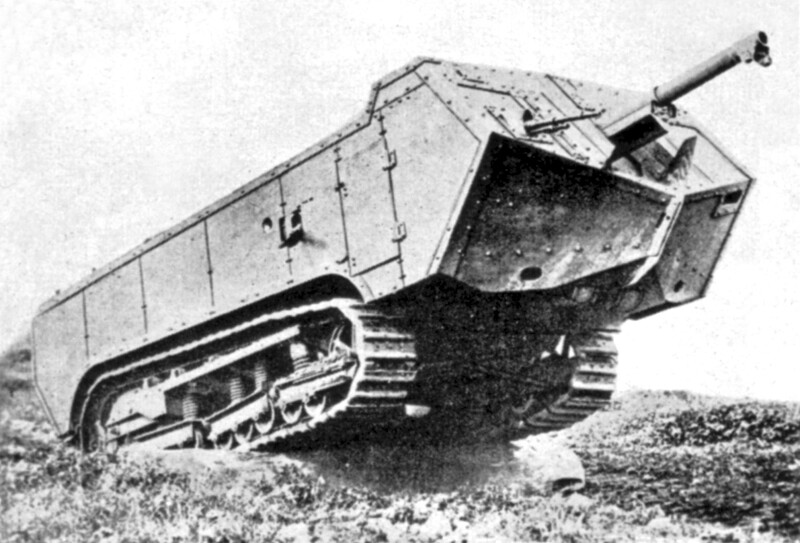
After the Treaty of Versailles in 1919, the German army’s (Reichswehr) strength was significantly reduced by placing great restrictions on its size, and the weapons that were allowed. Among other things, tanks were completely banned, effectively making the Reichswehr useless in a world where armies were quickly becoming mechanised. However the Allies, after a hard-fought victory in the First World War, fully believed that they had found the key to victory, and did not need to further develop tank ideology. But what was this 'key to victory'?
The idea was that tanks could work on their own, with only infantry for support, to cut down wire, soak up enemy fire and destroy stationary enemy emplacements, like bunkers. This is reflected in the organisation of French units of 1940, with tanks being used in isolated 'pockets' ahead of the rest of the army, designed to slow down the enemy’s advance, by absorbing their shots with their thick armour, and harassing enemy troops using their superior guns. From this, it is apparent how little speed and mobility mattered to the Allied designers, as there was no need for this asset on the First World War battlefield, which instead favoured thick armour and heavy guns.
However, whilst the Germans weren’t allowed to operate tanks, they still studied their use extensively. This gave them an edge over the Allies as, because their officers had hardly any experience with these vehicles in the last war, they had to learn not from experience, but from observing and studying the Allied tactics. In turn, this allowed German strategists to formulate their own ideas and opinions, making the eventual use of tanks in 1939 fresh and original. Thinkers such as Erwin Rommel (who later became known as 'The Desert Fox' in North Africa) and Heinz Guderian invented a new kind of warfare, Blitzkrieg, which prioritized speed and communication, thereby making the First World War mindset of slow, costly battles of attrition outdated (you can read more in-depth about this in my previous article here). In addition, these tactics had already been tried and tested by Germany in places such as Spain during the Civil War, with great success (it was a victory for fascist forces).
The degree of mechanisation of the Wehrmacht in 1940 is reflected through the number of armoured divisions as a percentage of the whole army: only 6.77% of the French army was made up of armoured divisions, and 5.26% made up Britain’s forces. However, 7.4% of the Wehrmacht was made of armoured divisions. Thus, by 1940, the Wehrmacht was ready to fight a new, modern kind of war. The Allies, however, were still equipped to fight the war of 20 years ago.
Just after the Great War, the French had built the 'Maginot Line', a string of fortresses stretching from the Swiss border to the Belgian, deeming it 'impossible to penetrate'; this eliminated the need for tanks, which were mainly an offensive tool, whereas this 'fortress' was a defensive one. But this structure avoided the Ardennes (which would become famous four years later, in the Battle of the Bulge), as it was believed by Allied commanders to be nearly impossible to cross with conventional tanks, due to the thick foliage which would severely impede the advance of slow, lumbering tanks like the Char B1 bis.
Thus, on the 10th May 1940, the first of many Panzer Divisions rolled across the French border, straight through the Ardennes forest. Within just over a month, the French army, once one of the most powerful armies in the world, and led by some of the foremost military thinkers of the time, would be humbled in a humiliating defeat.
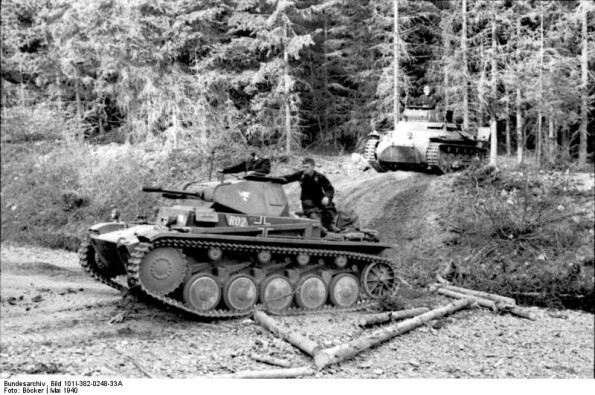
The German advance was extremely rapid. On the 13th they had broken through the French positions at Sedan, by concentrating huge numbers of men and machines on a single area, a tactic known as 'Schwerpunkt' (literally 'Pressure Point'); by the 21st they were at Arras, and finally on the 26th May, 16 days after the invasion, the remaining British and French forces were trying to escape from France altogether at Dunkirk.
For the whole of the advance, the Panzers were at the front of the pursuit, ahead of even the infantry. Seeing as they were so inferior to the tanks of their enemies, how did they manage to advance so rapidly, clearing any opposition in a matter of days? Surely, with thick armour and big guns, the Allies could have kept the Panzers held up for ages, trying to knock them out? Well, there were four main reasons that prevented this from becoming a reality:
1. Speed
Due to the extreme speed of German tanks compared to those of the Allies, they were able to cover large distances in a relatively short time; for example, the 2nd Panzer Division advanced 90km in one day on the 20th, whilst harassing the enemy’s retreat to the coast. However, such a thing would have been impossible in the minds of the British, whose tanks were only designed to keep-up with the advancing infantry (and so were named 'Infantry tanks', rather than 'Heavy tanks'). This speed allowed German commanders to achieve complete surprise and confusion amongst the enemy: due to a lack of effective communication on the French side (even the main HQ didn’t possess a telephone), a commander could go to sleep one night near Paris, and then only recieve the news that the enemy had advanced 90 km, the next day at lunch!
2. Coordination
As discussed, all branches of the Wehrmacht (the Heer, Luftwaffe, and, to a lesser extent, the Kriegsmarine) were able to coordinate amongst themselves attacks to an extremely high degree. Nowhere else is this a better example than the Invasion of Holland on the 10th May 1940. Here, the defending soldiers were some of the first victims of three-dimensional warfare, where soldiers were under attack from in front, behind, and above. As dawn broke, German units crossed the frontier in the north and south of the country, moving towards Amsterdam. At the same time, huge drops of paratroops and glider landings took place over vital defensive areas, such as Rotterdam and Fort Eben Emael in Belgium, thereby compromising the rear of the Dutch and Belgian defences. In addition, regular air-attacks by the feared 'Stukas' were being carried out on heavy positions, such as bunkers and entrenchments, pummeling them and the morale of the soldiers inside. Thus, by the time the Panzers rolled across the border, they advanced almost unopposed, as all heavy fortifications had effectively ceased to exist; this meant that the Panzers were never truly tested for combat efficiency for most of the Dutch and Belgian campaign, as the workload was shared evenly between the different branches of service. The whole of Holland was overrun in four days.
3. Lack of Coordination
However, it wasn’t just German assets that made the Panzers of 1940 so successful: it was also the Allied shortcomings, or rather their lack of assets. The main example of this was an absence of fast and precise coordination between foreign units. Already such a task was difficult, as not only was language a significant barrier between two foreign allies, but also communication was extremely limited and outdated, with messenger pigeons and flags the most common way to relay orders, despite the fact that such methods were easily open to misinterpretation in the heat of battle. The most significant example of this is at the Battle of Arras on the 21st May. In order to relieve pressure on the British force inside the city of Arras, surrounded by German troops, the combined British and French forces decided to perform an attack to the right of the city, pushing down to the south. However, right from the start, this attack was a failure. Due to a misunderstanding of the time for the attack, some French S.35s started to advance. Whilst doing so, they crossed over into the line of sight of a battery of British anti-tank guns; in the early morning light, the gunners of the battery must have mistaken the French tanks as German ones, as they started to open fire, causing a skirmish to break out between the two Allies. Eventually, one gun was destroyed, several of the crew killed, and many of the tanks damaged before the battery commander realised that the 'enemy' was in fact speaking French. After this, the advance was resumed, but by the end of that day, due to extreme pressure from machine gun, artillery and even Stuka attacks, the Allies had to withdraw, losing 500 men and 60 tanks.
4. Leadership
As we have seen, a lot of the success of the Panzers was down to their assets, and the enemy’s lack of them. However, the men that led them during 1940 also played a large part in the victories of the Panzer Corps: if some people had had their way, these tanks might have never been victorious in France. Towards the end of the campaign, after the aforementioned Battle of Arras, the Allies were in full retreat, with Guderian’s Panzers hot on their heels. Haring along country roads, the Panzers would go so far so quickly that they were in danger of getting separated from their supply chains, effectively isolating them from the rest of the army. Due to this, Hitler himself ordered Guderian to halt his Panzer columns, and await the infantry and supply lines to catch up. However, unusually, this order was ignored by Guderian, who believed that by slowing his advance, he would be putting less pressure on the retreating enemy; this in-turn would allow them to re-group and re-organise, and possibly even receive fresh reinforcements, allowing for a renewed defense against the German onslaught.
In the end, ignoring this order turned out to be the key to victory for the Panzer columns, as they managed to pursue the weakened Allies to the Channel within the next few days, before the enemy could even think of a counter-attack to cut the stretched German supply lines. It was moments of pure boldness like this by Guderian that gave the Panzer of 1940 its legendary status in the history books. In fact, Sir Basil Liddell Hart (a British strategist who set down the basis for Blitzkrieg ideals), having interviewed Generalleutnant Leo Freiherr Geyr von Schweppenburg who was one of Guderians subordinates, gave this description of the Panzer commander, based off of Geyr’s remarks in his book, The Other Side of the Hill:
“Sixty per cent of what the German Panzer forces became was due to him. Ambitious, brave, a heart for his soldiers who liked and trusted him […] If you suggest revolutionary ideas, he will say in 95% of cases: 'Yes', at once.”
So, whilst German tanks were certainly inferior to Allied designs in theory, in battle their defects were masked by German tactical skill and superiority. Thus in 1940, the Panzer gained a reputation not because of its own assets, but rather by how those assets were exploited by some of the most tactically brilliant minds of the Second World War.
1941 (Blitzkrieg in Russia)
In theory
During the subsequent invasion of the USSR in 1941 (known as Operation Barbarossa), the main German tanks that were used stayed the same, but new Soviet designs were encountered. During the invasion, the main tank models in service in the Red Army were:
| Tank | Max armour | Gun calibre | Max speed |
| T-34 (1940) and (1941) variants (medium tank) | 45 mm (mostly slanted) | 76 mm | 49 km/hm |
| KV-1 (L-11) (heavy tank) | 75 mm | 76 mm | 36 km/h |
| T-26 (light tank) | 15 mm | 45 mm | 30 km/h |
| BT-7 (light tank) | 20 mm (mostly slanted) | 45 mm | 62 km/h |
Note: as with the German tanks, it would be unrealistic to assume that the monstrous KV-1 and T-34 made up the bulk of the USSR’s strength at that time.
Through this table, it becomes apparent that the Soviet tanks facing the invasion force were superior in almost every way to the German Panzer. The KV-1's armour was impervious to anything the Germans had mounted on their Panzers at the time, whilst their light tanks' armour was on par with their Axis counterparts. Whilst it might seem that the armour of the T-34 could be easily penetrated by a Panzer IV C (52 mm of pen), the famous slanted armour of the tank makes it nearly impenetrable due to basic geometry. This lesson would be learned well by German technicians, who used it later in their Panther series. However, the T-34's armour was heat-treated to a high degree. If done incorrectly (which it very often was, by minimum-wage factory workers in Siberia), this treatment could transform the armour into a brittle shell, which was extremely susceptible to cracking under the impact of High-Explosive and HEAT rounds.
In contrast, the T-34 and KV-1, with a 76 mm gun, could easily penetrate Germany’s most heavily armoured frontline tanks — at 500m of range, no less!
In addition, they were generally the same speed (or faster in relation to their weight) as the German tanks. For example, the KV-1 weighs 46 t, whereas the Panzer IV C is 19.2 t. Even though the Pz. IV is less than half the weight of the KV-1, it can only go 6 km/h faster.
However, the Soviet designs were not without flaws themselves. Generally speaking, visibility was extremely poor in the T-34, with only two slits on the sides and a periscope for the turret’s crew. This made it extremely difficult not only to have an idea of what was going on outside, but also to effectively communicate with friendly forces, especially as many tanks were without a radio. Also, many of the tanks were relatively new designs (such as the T-34); this meant that many were still suffering from mechanical problems due to complexity or from early design faults.
In conclusion, during the Blitzkrieg period, German tanks were on the whole inferior to those of their enemies. Being entirely outclassed in 1940, their short-comings were further highlighted the next year with the invasion of the Soviet Union. However, in many ways the German designs of this period were very advanced, featuring accurate radio sets and good crew visibility; all of which are noticeably absent in the Allied designs.
In practice (exploiting enemy confusion, inexperience and shortcomings)
The situation faced by the Panzers of 1941 in the USSR was very similair to that of the year before: their designs were under-gunned, under-armoured and, unlike in 1940, almost completely out-paced. In addition, the Wehrmacht was dwarfed in size by the Red Army, with 5.5 million soldiers on the Soviet side, ready to face 3.8 million combat-ready Wehrmacht troops. Considering this, it seems crazy that by December that year, German forces were already at the gates of Moscow; however, as with the French the year before, not all was as it seemed with the Soviet military might.
Whilst the use of the previously mentioned Blitzkrieg tactics did play a large part in the early successes of the campaign, this was not necessarily due to the out-dated views that the Soviet generals might have held. This in fact was to the contrary: in the 1930s, the Red Army had been extremely innovative with military tactics, with public demonstrations of manoevres such as mass military paratroop drops taking place for the world to see near Kiev (incidentally, they even did this before the Wehrmacht started to investigate paratroop warfare, even though they were the ones who would eventually use it best, at Eben Emael in Belgium, and Crete in 1941).
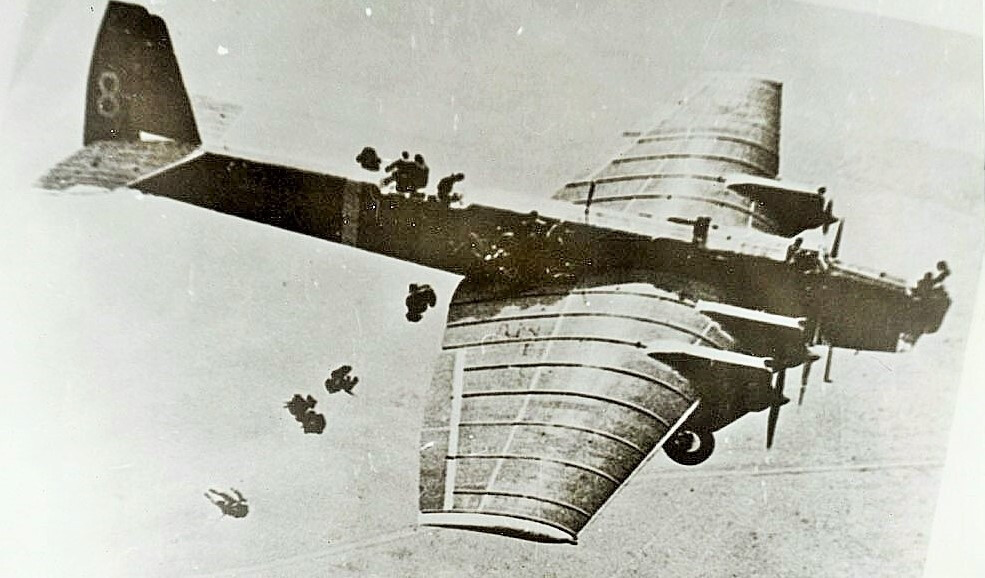
Instead, it was a number of other factors that caused the Red Army so much suffering during the invasion.
1. Element of surprise
Ever since the Nazi Party had come to power in Germany in the early 30s, relations with Soviet Russia had been strained, mainly due to the aggressive anti-communist stance taken by Hitler’s party. However, in 1939, the Molotov-Ribbentrop pact was signed, ensuring security and peace between the two political giants of the east. After a joint invasion of Poland, however, relations between the two nations started to go south again, resulting in the German invasion of the USSR in 1941, in order to secure the Caucasian oil fields for the Reich’s future conquests. In the Kremlin, however, Stalin was unwilling to believe that an invasion (resulting in an all-out war) would really happen, despite regular reports from the embassy in Berlin suggesting that this would be the case. In fact, commanders who were warning their men of the danger of Nazi Germany were even put to death for 'fear mongering'.
Thus, when the Panzers did roll over the border, the Red Army was in chaos, with new units being rushed to the front lines whilst the ones on the border were being destroyed in surprise attacks by the Luftwaffe. This happened to all branches of the Red Army, with the Air Force losing over 1,200 aircraft within the first day of the invasion, almost all of which were grounded when they were put out of action. This disorganisation affected the Tank Corps greatly as well. Because tanks were not used as border-guard units, they had to be hastily transported to the front-lines and formed into their units, making it nearly impossible to form a coherent defence for at least a few weeks. So, when the Panzers that were spear-heading the invasion force started to advance into Soviet Russia, the 'terrifying' KV-1s and T-34s were terribly organised, allowing the precisely drilled Panzer Divisions to swiftly deal with them.
2. Exploiting the severe inexperience of the enemy’s crews
By the time of the invasion, the Panzer crews were extremely experienced, with most of them having served in Poland, the Low Countries, France and the Balkans just a few months before. In addition, some of the infamous SS Panzer Divisions were amongst the invasion force; these troops and crews had been especially trained as the elite troops of the Wehrmacht, able to carry out tactics and orders with the highest precision. In contrast, the USSR’s tank crews were extremely inexperienced. This was because most of the tanks that were fit for action were kept in storage in Siberia, just in case they might be damaged during training, which would be costly to repair. This meant that when the crews eventually were allowed to use their actual tanks in combat, they were not comfortable at all in them, compared with the German crews, many of whom had been in the same tank for two years.
So, it was as if the German player, who is at Level 70, had spent all of their 'Crew Training' points on their Panzer IIIs, whereas the USSR player at Level 4 had just unlocked the T-34, and had no idea how to use it best against the inferior (but at the same time superior) Panzer III player.
3. Exploiting the inexperience of the Soviet commanders
In the mid-30s, after an assasination of a high-ranking Soviet official in 1934, Stalin became paranoid about his position of power as dictator of the Soviet Union. This led him to initiating hundreds of trials and subsequent executions of men in positions of power in the USSR; this would later be called the 'Great Purge'. Among the victims of these investigations were military commanders, strategists and even men as low-ranking as Captains and Lieutenants, executed for things such as 'collaborating', or 'treason'. In fact, these unjust executions became so bad that by the end of them, 7.7% (or roughly 100,100 men) of the Red Army were dismissed or killed before the war itself had even begun. Many of these men were some of the Soviet Union’s best military thinkers, leaving a serious gap in the Red Army command structure. In order to make up for this, young officers that had just graduated from military colleges were drafted into High Command, along with men that were able to flatter Stalin but not command an Armoured Division. As these new commanders were so young, they were extremely inexperienced in the art of war. In contrast, German commanders such as Erwin Rommel had served in the army since the First World War, and just the year before Barbarossa, had led their men to victory in Western Europe.
When the two armies (the Wehrmacht and Red Army) met in 1941, not only were the men operating the Panzers more experienced, but those who were commanding them were, too.
4. Exploiting shortages of equipment
Whilst the Red Army was not short of manpower for 1941, the equipment that those men would fight with was a different matter, especially in the Tank Divisions. For example, the 1st Tank Division had less than 10% of their required KV-1 strength on the eve of Barbarossa, and only 35% of their T-34s. This severe deficiency in equipment led the Red Army High Command to believe that their units had a greater strength than they really had, making the task of organising an effective defence very difficult. This meant that even though the Panzers were outclassed in 1941 by their Soviet adversaries, they greatly outnumbered them, which will always inevitably mean victory; this too will be seen later in the war.
1941-1942 (Victory and defeat in Africa; Stalemate in Russia)
In theory (North Africa)
By 1942, the Wehrmacht was fighting a war on two fronts: the USSR to the east, and Britain to the south, in North Africa. This put incredible demands on the armaments industry, over-straining an already strained economy. On top of this, priority had been given by the OKW to aircraft designing and manufacturing over improving tank designs. So, it was believed that the best way to combat the superior Allied designs was to simply convert their exsiting tanks, the Panzer III and IV, into vehicles with heavier armament and, sometimes, extra armour. In addition, out-dated tanks, mainly the Panzers I, 38, and 35, were phased out (the Panzer II was retained for recon duties until 1944). Thus, whilst the main German tanks in use in 1942 hadn’t changed much since 1940, their modifications had:
| Tank | Max armour | Gun calibre | Max speed |
| Panzer III J and L variants (medium tank) | 53 mm | 50 mm | 53 km/h |
| Panzer IV F2 and G variants (medium tank) | 50 mm | 75 mm | 43 km/h |
| Panzer II C and F variants (light tank) | 20 mm | 20 mm | 44 km/h |
For the British in the Western Desert, many of the veteran designs of the 1940 campaign remained in service, however newer tanks were also introduced into the armoured regiments:
| Tank | Max armour | Gun calibre | Max speed |
| Matilda II (heavy tank) | 75 mm | 40 mm (2-pounder) | 24 km/h |
| Crusader II and III (light tank) | 52 mm | 40 mm (2-pounder) | 42 km/h |
| Valentine I (heavy tank) | 65 mm | 40 mm (2-pounder) | 24 km/h |
| Churchill III (heavy tank) | 89 mm | 57 mm (6-pounder) | 28 km/h |
| A13 Mk.I (light tank, mainly for reconnaissance) | 14 mm | 40 mm (2-pounder) | 48 km/h |
| Grant I (medium tank), Lend-Lease vehicle from the U.S. | 76 mm | 75 mm in the hull, 37mm in the turret | 39 km/h |
| Stuart I (light tank), another Lend-Lease design | 44 mm | 37 mm | 50 km/h |
Even now, two years later, the armour of the Panzers were struggling to compete with those of the British. For example, the armour of the Churchill III (a new design in the Western Desert), is almost double that of the Panzer IV, whilst that of the Panzer III struggles to compete with the Crusader II’s 52 mm of frontal armour.
However, one big improvement is noticeable in the German designs: better armament. Whilst the Panzer IV F2 and G were still equipped with a 75 mm gun, this was the newer Kwk40 L43 model, with 137 mm of penetration, which could easily deal with even the new Churchill from the front.
In practice
With the introduction of the up-gunned Pz.III and IV variants, the playing field was certainly levelled. However, as in 1940, what gave the Panzers of the Western Desert a reputation was not their armour, armament or even speed: it was how they were used.
Mechanised warfare in the desert was a rather novel concept by 1941; such a terrain was completely different to the woods, hedgerows, and fields of Fance, or the complex, winding trench systems of Flanders. Nevertheless, British commanders tended to treat the wide desert plains as if they were just that: tight spaces, perfect for slow infantry support. Early on in the campaign, it was not uncommon to see the slow, heavy 'Infantry tanks' like the Valentine I and Matilda II, crawl into a village, try to capture it with a frontal assault, fail, and then try again. Whilst this may work in the dense bocage of Northern France where the enemy’s line of sight might be blocked by trees and hedges, in the desert this tactic failed miserably, with the German defences being able to see them coming from miles away, as their silhouettes stood out on the bare, arid horizon.
Another difficulty of desert warfare was that tank tracks were originally designed by the Allied engineers of 1915 to cope with the boggy and churned-up mud of First World War battlefields, and as a result this was where they performed best. The basic structure of a length of track was lots of smaller segments, connected by pins running through them, designed to be lubricated by the wet mud of battlefields. However in the desert, water is extremely scarce, let alone mud; this meant that tracks could start to grind against grains of sand, causing friction and slowing down a tank’s progress. In addition, the abrasive qualities of the sand could wear down the connecting pins, forcing the track links to break which would disable the tank for a while until it was fixed. However, whilst this problem did plague the Panzers just as much as it did the British, the Germans had dedicated tank transporter lorries and recovery vehicles (such as the Sd.Kfz.6) to help the Panzer crews deal with this nuisance, whereas British Regiments were less mechanised and didn’t. This meant that progress was constantly hindered, with tanks breaking down often and taking ages to be repaired again.
In February 1941, the German forces that would later be known as the Afrika Korps landed in Tripoli, commanded by Erwin Rommel of Blitzkrieg fame, a.k.a the 'Desert Fox'. Despite being completely new to this terrain, Rommel quickly realised that conventional Blitzkrieg tactics used the year before wouldn’t work as well in this theatre of war due to the wide open spaces that could effectively be utilised to his advantage in other ways. Therefore, he started to command his Panzers using tactics similar to those used in naval engagements, with his units making wide, sweeping manoevres, passing by the enemy’s flank.
In this style of warfare, the commander had to look at the battle in a much bigger picture than in Europe, as swathes of barren land could be present between his forces and those of the enemy. Such battle conditions created a style of warfare unique to the Western Desert: a kind of tug-of-war, with armies capturing, retreating and then counter-attacking a vital point for weeks. For example, the relatively small town of El Agheila in Libya was captured at least three times within two years. Nonetheless, this was certainly a war of rapid movement, but on a far larger and more repetitive scale than that of the Blitzkrieg. This tactic worked very well for the fast Panzer Divisions, and by October 1942, less than two years after they had arrived, the Afrika Korps had reached El Alamein, just 260 km short of Cairo, the heart of Britain’s Middle-Eastern empire. Here, in a large tank battle, Rommel was defeated. This was because of three reasons:
- A new commander, Bernard Montgomery, took command of the Commonwealth forces a few months before; he was far more skilled in desert warfare than his predecessors. Finally the British had a commander that could compete with Rommel on the battlefield.
- The Lend-Lease program with the U.S.A (who were finally in the war, albeit a few years late), was in full swing, with hundreds of new aircraft (such as the P-40 and the Hudson V) and tanks (the M3 Lee and Stuart I) in service with the 'Desert Rats' (the nickname given to the 8th Army, or the British force in the Western Desert). These tanks were much better than both the older British and German designs, with better guns, armour, and better speed in proportion to their armour thickness. The Panzer of 1940 was now being out-classed on all fronts. In addition to this, around 1,000 Allied tanks were present at El Alamein, whereas the Afrika Korps had less than half of that number.
- The Panzers were almost 1,800 km away from their supply bases in Tripoli; this put severe strains on the supply lines, which were constantly under attack by the 'Tank-Busting' Hurricane Mk.IVs, all whilst trying to traverse blinding sandstorms and primitive roads. This supply problem would prove to be Rommel’s 'Achilles' Heel' during the Desert Campaign and, at El Alamein, the Panzers suffered severely from this, being constantly short of petrol, ammunition and even water. However, the British tanks not only had superior designs and numbers, but also plenty of supplies, just 3 hours away in Cairo.
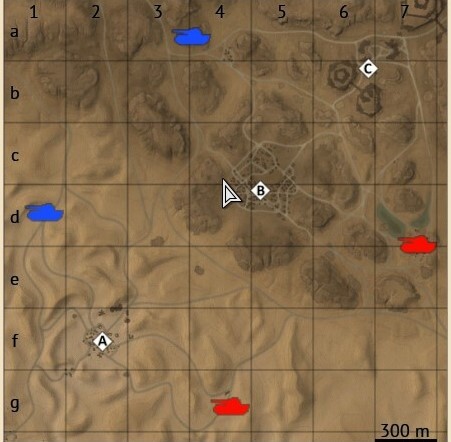

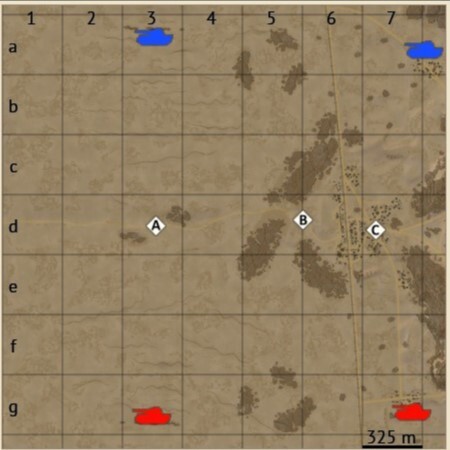
In theory (Eastern Front)
On the Eastern Front at this time, much like the Germans, Soviet tank design hadn’t changed much, with the T-34 and KV-1 still being the workhorse of the army, and the earlier designs of the BT-5 and T-26 being phased out as well, making the T-34 the dominant design.
However, instead of falling behind in tank developement, the T-34s of 1941 (and the newer 1942 variant), still were able to compete with the new German designs, both in terms of armour and firepower. Such was the case with slanted armour that despite a gun’s penetration, if the armour was slanted, it was nevertheless extremely challenging to successfully penetrate, especially in the case of the Panzer III’s 50 mm gun.
In practice
By December 1941, the Wehrmacht had reached the outskirts of Moscow, and the Red Army was in full retreat. However, the Soviets still had one thing on their side: the weather. 'General Frost' (or 'Генерал Мороз' in Russian) was the name for the uniquely fierce Russian winter; the German tanks, not designed for the cold which could reach −28.8 °C, would slowly start to freeze over: first the rain water collecting in crevices, then the engine oil, and even the hinges of tank hatches. These conditions put the Panzers at a great disadvantage, as the crews were completely unprepared, leading to many tanks being put out of action solely due to ice. Some Soviet designs such as the T-34 however, were vastly simplified, featuring things such as the Christie suspension system, which was a simple suspension design consisting of large wheels within a length of track; the system on the Pz. III and IV however was a lot more complicated, and thus more prone to freezing over and breaking down.
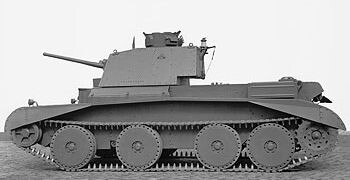
Seeing the troubles that the Germans were having with the cold, Stalin decided to counter-attack, whilst the enemy was at his weakest. Around Moscow, the Red Army’s best troops were deployed: the Siberian Armour Regiments. These were hardened soldiers who had grown up in the harsh Siberian country-side, and who were used to such conditions. In addition, they were more experienced than the average Soviet soldier, as many of them had seen service in the Winter War of 1939-1940 in Finland, and so had experience in fighting in extreme weather. As a result, this counter-offensive was extremely successful; the Panzers weren’t able to use Blitzkrieg as they were on the defensive and were nearly frozen solid, so were nearly useless against the attacks. Here one thing becomes apparent:
Blitzkrieg was only useful in an attack; in defense, however, the superior armour and armament of the Soviets highlighted the deficencies of the Panzers, deficiencies which had previously been masked by the tactical superiority of German commanders.
After the winter, however, the Germans were able to retake the initiative, and even out the front-lines again. Throughout that year, German attacks and Soviet counter-attacks took place over and over again, much similar to the Western Desert campaign.
But despite the fact that hundreds of Regiments were constantly being sucked out of Europe to carry on the campaign, the Panzer Regiments just couldn’t keep up with the amount of men and machines that the Soviets were throwing at them in the large (if ill-coordinated) mass attacks that took place in the summer. The German armament industry was tiny and fragile compared to that of the Soviets, with the amount of tanks produced not being able to effectively compensate for the number of those lost; this was because the factories where they were made was being bombed around the clock, by the USAAF in the day and the RAF at night.
This is reflected in the composition of a German Panzer Division in 1942: there were 4 motorized infantry battalions, 3 motorized artillery battalions, and only 2 tank battalions. Although this was a strong formation, it lacked tracked vehicles and tanks. In 1940, however, a division consisted of 4 motorized infantry battalions, 4 tank and 2 of motorized artillery. The significant increase in artillery and reduction of tanks by 1942 shows the gradual decline of Germany’s tank strength: quantity, not quality, was becoming the deciding factor for victory in Europe.
In addition, vehicles without turrets (such as the Jagdpanther, Jagdpanzer 38(t) 'Hetzer' and Jagdpanzer IV, among others) were becoming increasingly mass-produced: this was because it was cheaper and more material-efficient, as extra components such as ball-bearings and turret rings could be missed out completely.
By this time, the efficiency of the weakly-armoured, under-gunned German designs was really starting to be questioned by OKW.
1943 (the Battle of Kursk and the Anglo-American Invasion of Italy)
In theory (Eastern Front)
After the stalemate on the Eastern Front in 1942, it was clear to Hitler that his current tank designs were falling greatly behind those of the Allies. With a lack of heavy tanks, it was difficult to exploit breakthroughs in an attack, and the current Panzer III and IV series of medium tanks simply couldn’t compete with the T-34. It was under these circumstances that he initiated the developement of the Tiger and Panther series.
With the Panzer III almost entirely phased out, the Panzer IV was now a second-rate tank to the new German designs:
| Tank | Max armour | Gun calibre | Max speed |
| Panzer VI 'Tiger' H variant (heavy tank) | 100 mm | 88 mm | 45 km/h |
| Panzer V 'Panther' D variant (medium tank) | 80 mm | 75 mm | 55 km/h |
| Panzer IV J and H (medium tank) | 80 mm | 75 mm | 39 km/h |
Note: Whereas from 1940–1942 the basic structure of an armoured unit was three Panzer IIIs to a single Panzer IV, by now there was one Panther to every three Panzer IVs, or even three Panthers to every Tiger, which would have been a fearsome force to behold!
Meanwhile, on the Soviet side, a few new designs were seen as well, such as the beginning of the infamous IS series of tanks:
| Tank | Max armour | Gun calibre | Max speed |
| IS-1 (heavy tank, introduced in October, so not technically at the Battle of Kursk) | 120 mm | 85 mm | 37 km/h |
| T-70 (light tank) | 50 mm | 45 mm | 45 km/h |
| T-34 (1942) variant (medium tank) | 45 mm | 76 mm | 49 km/h |
| KV-1S (heavy tank) | 82 mm | 76 mm | 45 km/h |
In the summer of 1943, near the town of Kursk in Southern Russia, German forces gathered strength to break through the Soviet line in order to prevent an offensive. They named the operation Citadel. By now, Germany’s new generation of tanks had been delivered to the front-lines, ready to be blooded in one of the biggest tank battles in history.
During this battle, both sides employed some of their best designs of the war and, as a result, it was extremely hard-fought on either side. However, during the battle it became clear that the German machines had superior firepower, mobility and armour. Taking notes from the Soviet designs of 1941, German technicians employed many features used by the Soviets in their tanks, the most notable example, in the Panther series, being the slanted armour; in fact, this feature (among others) made the Panther one of the most successful tanks of the war, and the forerunner of the modern MBT. Both nations' medium tanks — the T-34 and Panther Ausf. D — had similar speeds, with the Panther going 6 km/h faster. However, with regards to firepower and armour, the Panther was undoubtedly superior with almost double the armour thickness at an angle, and a much more powerful 75 mm KwK42 gun. Because of the all-round superiority of the Panther, it is rightly considered one of the best medium tanks of the war.
In practice
On 5 July, 146 Tiger Is, 702 Pz. IVs, 668 Pz. IIIs, and 200 Panthers set out in two narrow corridors in an enveloping flank manoeuvre around Kursk. Advancing in a Panzerkiel formation (literally 'Tank Wedge', which consisted of Tiger tanks at the front and flanks of an echelon formation, with Panzer III and IVs in the middle), the Panzers soon encountered heavy Soviet opposition on both flanks in the form of minefields and defensive positions, which had been prepared in the weeks prior to the battle. However, despite the deep fortifications, German tank losses were extremely light, as the Tigers' thick armour deflected most of the shells. Up and down the front-line, the sudden superiority of the German tanks caught the Soviet defenders entirely off-guard; hardly any gun that the Red Army had could take them out frontally, apart from the SU-122 self-propelled gun and the 57 mm anti-tank gun. For example, on the left flank, during an attack on a weak-point in the Soviet defences, a battalion of Tigers was intercepted by 90 T-34s, who immediately started to open fire. At the end of this skirmish, 42 T-34s were put out of action, whilst only two Tigers were knocked out.
However, the German tanks at Kursk were not invincible; the Panthers at the battle were some of the first production models (the 'D' variant), and were rushed into service as soon as possible, but as a result suffered engine fires and transmission problems. Because of this, most of the tanks present on the 5 July got stuck in the marshy ground that was a result of a rainstorm, missing out on a lot of the fighting. This was worsened by the fact that the 'D' variant’s rubber tyres would often pop off. This came about because of their extreme weight, which would also make them difficult to use on soft ground, greatly impeding the progress of a unit.
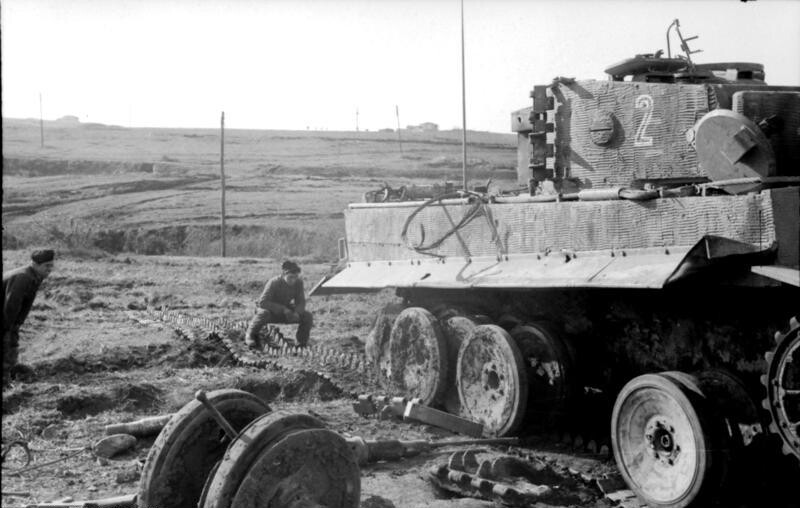
The Tiger tanks also suffered their own problems. Because it was even heavier than the Panther (57.3 t, as opposed to the Panther’s 45.3 t), the transmission was constantly suffering mechanical breakdowns, and the torsion bars would frequently be crippled, not being able to support such weight. In addition, engine fires were extremely common as the huge engine needed for powering such a heavy tank was prone to overheating, along with the fact that fuel leaks were common as well. One other problem was that the heater would pump carbon monoxide into the turret occasionally, which could lead to the crew blacking out, or becoming dizzy and confused; in the heat of combat, this certainly wasn’t ideal.
In addition, there were problems that plagued both tanks equally at Kursk:
- After the costly engagements of the last few years such as El Alamein and Kharkov (February 1943), the Panzer Korps were suffering from a major lack of crews to operate their newest designs. Much like the Red Army in 1941, young, badly-trained crew members were rushed to the front-lines. Because the Panthers and Tigers were so different from previous models, most of these crews found it difficult to operate these behemoths. This led to heavy losses later in the war, as the Panzers weren’t used to their greatest potential because experienced crews were increasingly becoming few and far between. This is similar to the circumstances in War Thunder: the new player will immediately start grinding the German tech tree with the sole aim of unlocking the famous Tiger Tank; however, upon unlocking it, because they’re only about Level 10, they instanly get crushed by the more experienced USSR player at Level 100.
- During the design of the next generation of Panzers, the old suspension system that was used on the Panzer II, III and IV was dispensed with, with the engineers opting for a system of interlocking wheels instead (known in German as 'Schachtellaufwerk'). However, whilst this system did afford superior weight distribution compared to the older design, it was not without problems: because of this complex design, if one of the interior wheels was damaged, it would require the removal of two of the outer wheels first, just in order to access the damaged one, which would have been a headache for crews on the move. In addition to this, the interlocking set-up created plenty of recesses which were perfect for mud to collect and compact in the autumn, and for ice to freeze in the cold Russian winters. This was a great problem for these tanks. Originally designed as breakthrough vehicles, which would only have to advance a few metres to smash the enemy line, on the Eastern Front (where there were swathes of muddy roads and fields between the front-lines and the supply depots), these vehicles were being expected to travel hundreds of miles across the steppes, and then fight a battle. During this journey, many of the fearsome Tigers and Panthers were lost solely due to mechanical breakdown, not to Soviet shells. This put them at a great disadvantage compared to the extremely hardy and reliable T-34.
- The stock of spare parts for German tanks (which had never been abundant) fell to a critical level during Kursk, where tanks were constantly needing repairs. This was mainly because the German tank industry was focusing most of its efforts on increasing tank production, and were placing less emphasis on the army’s need for spare parts. This meant that when spare parts (such as the pins for tracklinks) were needed, as they so often were, it could take weeks to obtain them. The Soviets however didn’t have such a problem, as their factories were so large and near to the front-lines, that vehicles could quickly and easily be maintained.

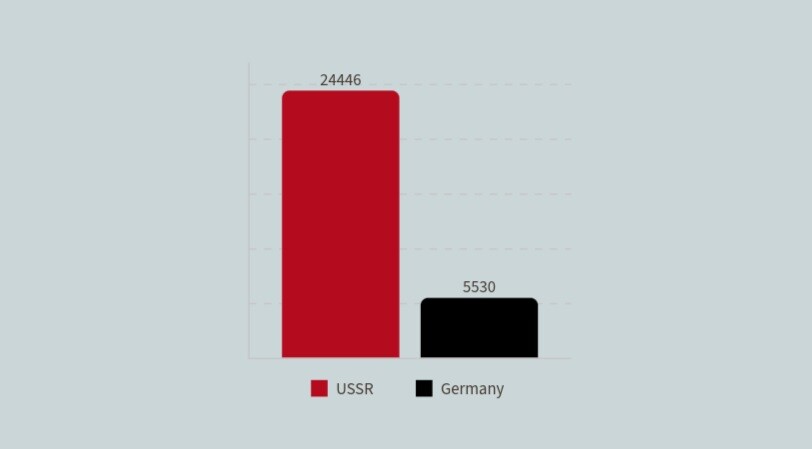
Despite the amount of Soviet losses compared to German losses — 6,000 Soviet tanks and 760 German — the Panzer Korps failed to achieve any significant gains in the month that the battle took place, and so is generally considered a Soviet victory.
The lack of progress made on the German side was mainly because the Red Army had prepared a complex defensive system in depth: this included heavy tank destroyers such as the SU-152 dug into hull-down positions, barbed wire, mines, and anti-tank ditches. However, despite the German strategic failure, the superiority of the newest Panzers established itself in the minds of the Soviet commanders.
The Panther and Tiger designs ushered in a new period of German tactical thinking, signalling the end of Blitzkrieg-like strategies. Before, speed and close inter-unit coordination was used to give the Panzers an advantage. Now, the heavy and medium tank was the backbone of the Panzer Korps, relying on heavy armour and powerful guns to smash through the enemy lines; the Tigers and Panthers were now only required to lumber forward, perhaps take out a few emplacements or eliminate a troublesome tank, and then allow the supporting infantry to flood through the gap in the front-lines and do the rest.
In theory (Italy)
By early 1943, Rommel’s Afrika Korps had effectively ceased to exist, crushed by the sheer material might of the Anglo-American armies. This allowed the Allies to invade Sicily and, after that, Italy to finally gain full control of the Mediterrenean Sea, and force Benito Mussolini out of the war.
Here, brand-new American designs made their debut, along with some British veterans of the Desert Campaign.
| Tank | Max armour | Gun calibre | Max speed |
| M4 Sherman (medium tank) | 76 mm | 75 mm | 39 km/h |
| M5A1 Stuart (light tank) | 50 mm | 37 mm | 58 km/h |
| Churchill III (heavy tank) | 89 mm | 57 mm (6-pounder) | 28 km/h |
On this front, it is obvious that the newer German designs were superior, with all-round better armour (only the Churchill could compete with the Panther or Tiger), armament (the Sherman’s 75 mm was notoriously weak, with a measly 78 mm of pen at 500 m), and speed (the Panther is only 3 km/h slower than the Stuart, despite the 29.1 t weight difference).
However, despite the overwhelming superiority of German designs, they were improved still further in the following years.
In practice
Towards the end of the North African campaign in Tunisia in spring 1943, new German tanks such as the Tiger were gradually being introduced to front-line units, and thus were encountered on a limited scale by the Allies. However, upon landing in Axis-held Sicily in July 1943, it became clear that the Shermans and Churchills in service were completely outclassed by the Panthers, Tigers and, to a lesser extent, the Panzer IVs.
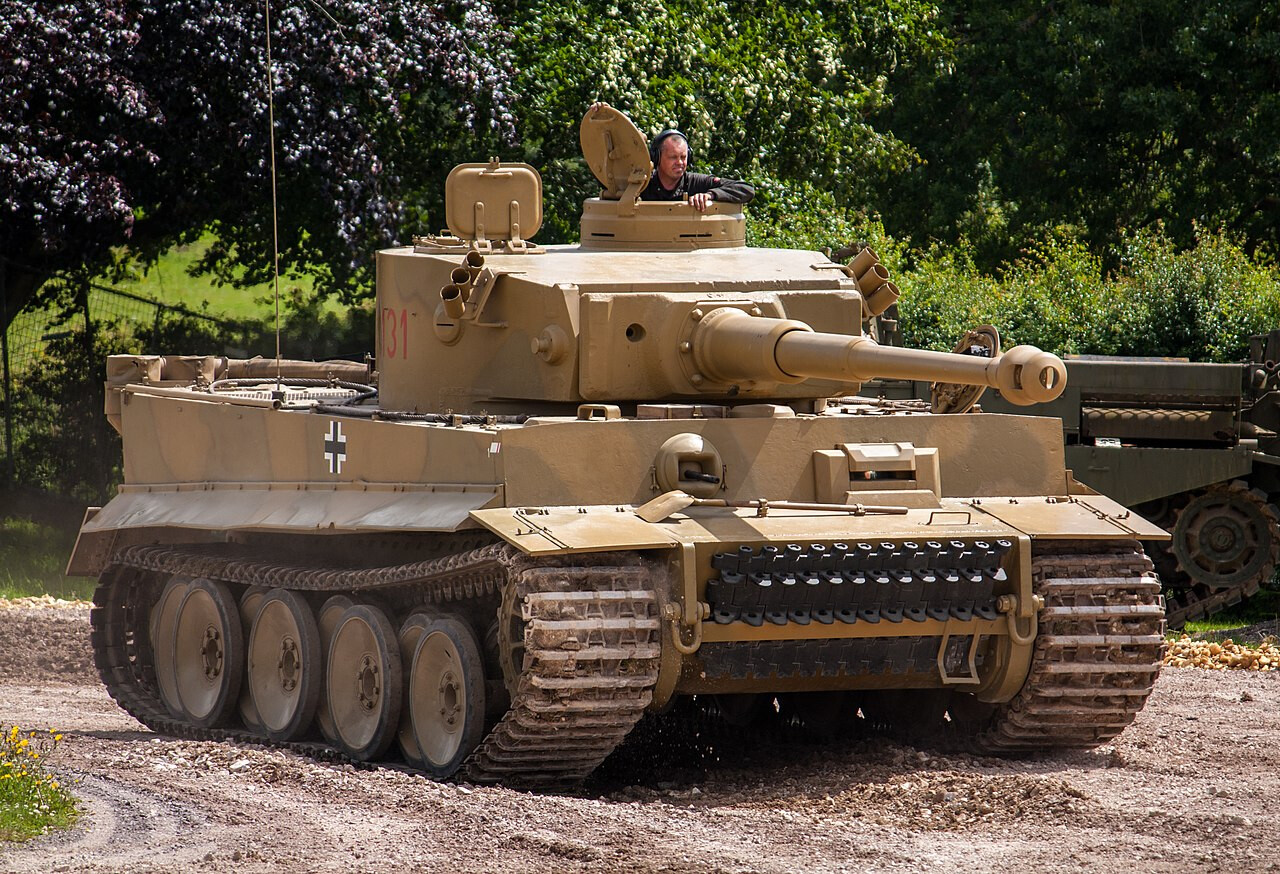
Even though the Tigers and Panthers had an advantage in terms of armour and firepower compared to their enemies in Sicily, the problems faced by them in this theatre were very similair to those faced on the Eastern Front:
- A lack of spare parts
- Complete numerical inferiority: in Sicily, there were about 13 German tanks to every 30 Allied tanks.
- Mechanical issues: 60% of Tigers suffered breakdowns on the road to the front-lines in Italy.
Despite these set-backs, the Panthers and Tigers still gained a fierce reputation amongst Allied troops.
1944-1945 (The Invasion of Mainland Europe ending with the Red Army at the Gates of Berlin)
By the end of 1943, the Allies had kicked fascist Italy out of the war, the Red Army had almost pushed the Wehrmacht back to where they were on the eve of Barbarossa, and the constant Allied strategic and terror bombings were taking their toll on German industry and morale.
In theory (Eastern front)
After the liberation of Kiev in November, the opening of bridgeheads on the Dniepr river in September, and a Soviet push to the Carpathians in December, the Wehrmacht was constantly fighting on the back foot by late 1943. This was mainly due to the publication of the Red Army’s 'Fedorenko Order' in summer 1942. Whilst it was published quite early on during the Eastern Front campaign, it took a while for the doctrine of this order to establish itself in the minds of commanders. Essentially, this paper required commanders of armoured elements to destroy enemy units, 'in co-operation with the air force and with other ground units', and 'when reinforced by artillery, tactical air force, infantry, and engineers, an armoured corps may attempt a breakthrough'. These tactics are much more akin to the German Blitzkrieg, favouring inter-unit coordination over the mass charges used earlier in the campaign. Such a strategy was very effectively used throughout 1944 and into 1945, notably during the liberation of Poland. Such gains were rapidly diminishing the German presence in the East, even if the German economy was on a 'Total War' footing, trying to compensate for the immense military losses that were taking place.
Despite the strains put on the German economy, Hitler kept pushing for bigger, heavier and better armed tanks, believing that it was this that would halt the Soviet onslaught, as almost happened in 1940 with the French tanks. In addition, the Tiger I and Panther series remained in service, along with the older Panzer IVs.
Thus, during the last two years of the war, the main tanks used in the Panzer-Armeen were:
| Tank | Max armour | Gun calibre | Max speed |
| Panzer VI Ausf. B (H) 'Königstiger' (heavy tank) | 185 mm | 88 mm | 38 km/h |
| Panzer V 'Panther', A and G variants (medium tank) | 100 mm | 75 mm | 46 km/h |
| Panzer VI 'Tiger' E variant (heavy tank) | 100 mm | 88 mm | 45 km/h |
| Panzer IV, J and H variants (medium tank) | 80 mm | 75 mm | 39 km/h |
Meanwhile, in the Red Army, designs that were intended to compete with the Panthers and Tigers encountered at Kursk were starting to appear on the front-lines, along with the veteran, if heavily upgraded, T-34:
When comparing the relative statistics of firepower, mobility and armour, it becomes clear that both the Soviets and Germans had similair tank philosophies by this stage of the war: both clearly do not prioritise speed and mobility (even though the Soviet tanks are quite a bit faster), but rather big guns and thick armour. Thus, these tanks were similar in performance, being designed as breakthrough vehicles rather than nimble offensive tanks.

However, in certain aspects, one nation’s designs succeed whereas the other’s don’t. For example, the Red Army’s main medium tank, the T-34-85, is both notoriously well-protected (thanks to its slanted, but still thick, armour) and well-armed, boasting an 85 mm gun that puts the Panther’s 75 mm to shame. However, unlike the Panther, it is extremely fast for its tank class, at 55 km/h compared to the Panther’s measly 46 km/h. This made it very well suited to the fast offensive operations that were needed as the race to Berlin was picking up speed. However, by the time it was designed, the Panther was not really needed for large attacks as the Wehrmacht was almost constantly on the defensive. Perhaps both tanks were perfectly designed for their time and, if the tactical situation of 1943 had been different, the features of both would have been changed significantly?
In practice
On the Eastern Front, the role of the Panzer by 1944 was almost completely different than that of 1940. Now used solely as a defensive weapon, it could be argued that the main virtues of a tank (the ability to provide mobile support to infantry, by eliminating obstacles) were non-existant. Most of the time, a Panzer would be expected to hold a strong-point from the enemy without much support in the way of combined arms, or maybe lead a small attack on a village in the same manner. In addition, the Luftwaffe no longer ruled the skies (they hardly ruled their own airfields!), which left the slow Tigers and Panthers extremely vulnerable to attack from the air, which was an art that was being rapidly perfected by the VVS (Soviet Air Forces), using the IL-2 Sturmovik. Thus, due to the tactical situation, these 'wonder weapons' of the German army were severely handicapped in operational capability.
In addition, the old problems that had been plaguing the Panzers since 1942 were ever-present: lack of spare parts, experienced crews and shortage of personnel and vehicles.
Another problem faced by Panzer commanders was morale. After 1942, it had seemed to German troops as though the whole campaign in the East was characterised by a series of defeats and, in truth, this was mostly true. The Red Army, in contrast, had constantly been on the offensive by the end of Kursk, liberating city after city.
On top of all of this, Soviet commanders were becoming more and more experienced, after three long years of fighting. However, in the Wehrmacht, many experienced commanders had already been killed.
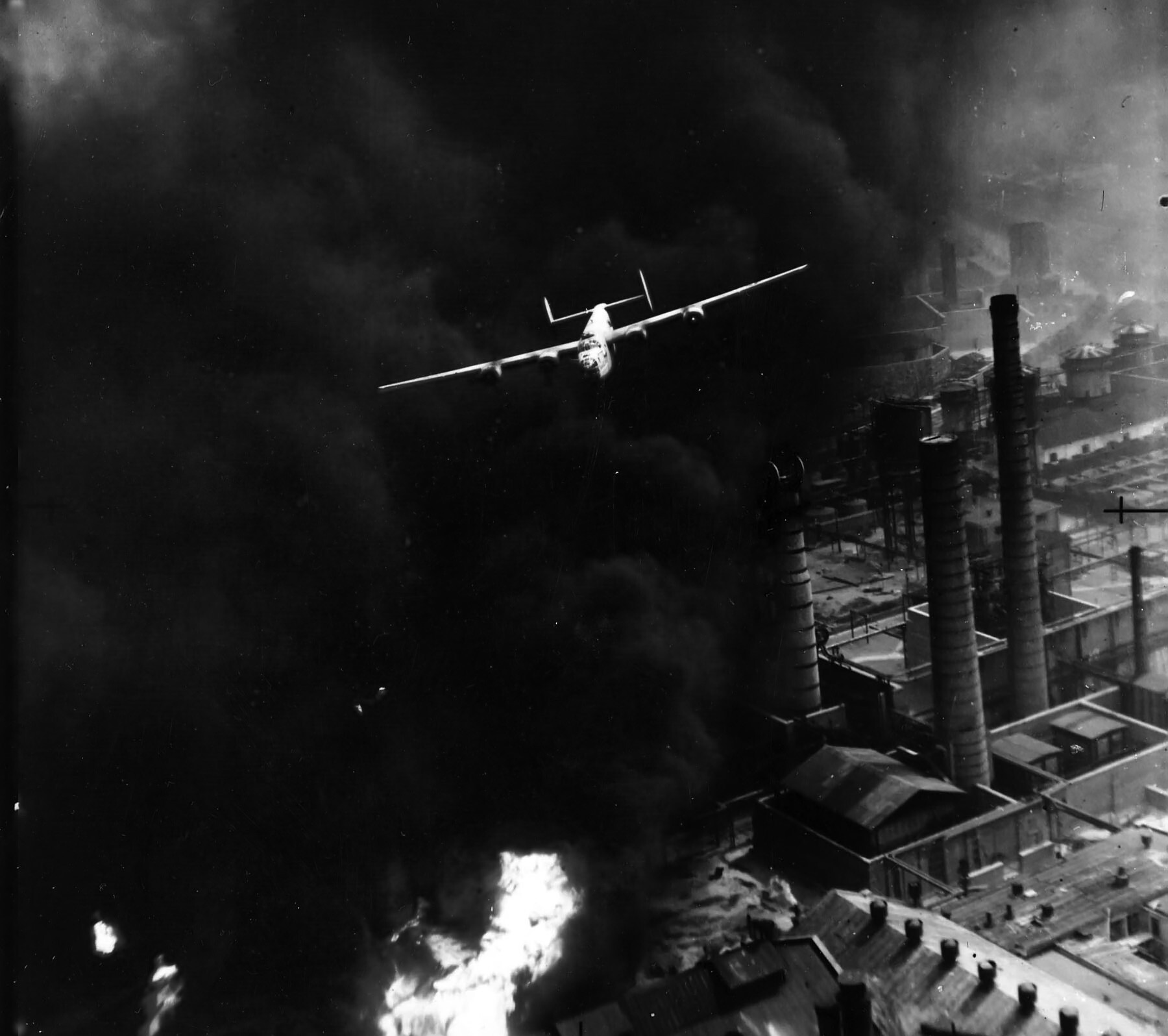
A major difficulty for the Panzer Korps was a lack of oil. After the Afrika Korps' failure to capture Egypt and thereby the Middle Eastern oilfields, the Wehrmacht had to look elsewhere for abundant and naturally-occuring oil, which was difficult to find in Europe. One place was in the Caucasus in the Soviet Union, whose vast oilfields had been supplying the Red Army for decades. However, after the disastarous Battle of Stalingrad in late 1942, German hopes of conquest in the southern Soviet Union were crushed. Thus, by 1944, the Wehrmacht had to turn to their last hope, the Ploiești oilfields in their ally Romania. In fact, from only nine Romanian oilfields was made about 8,595,000 tons of oil a year. These fields were so precious to the Reich's war effort that the USAAF (United States of America Air Force) conducted a large raid on them in 1943. However, this was ultimately a failure as the German defences knew they were coming. But when, in August 1944, Romania’s puppet-dictator was overthrown and the nation joined the Allies, Germany lost this source as well. Therefore, from late 1944 to the end of the war, German tanks were forever handicapped by a limited range of operations due to the scarcity of engine oil.
So, in summary, the German Panzers on the Eastern Front by 1944 were poorly led, under-equipped, under-trained, under-fuelled and low in morale. In the West, however, things were going even worse.
In theory (Western Front)
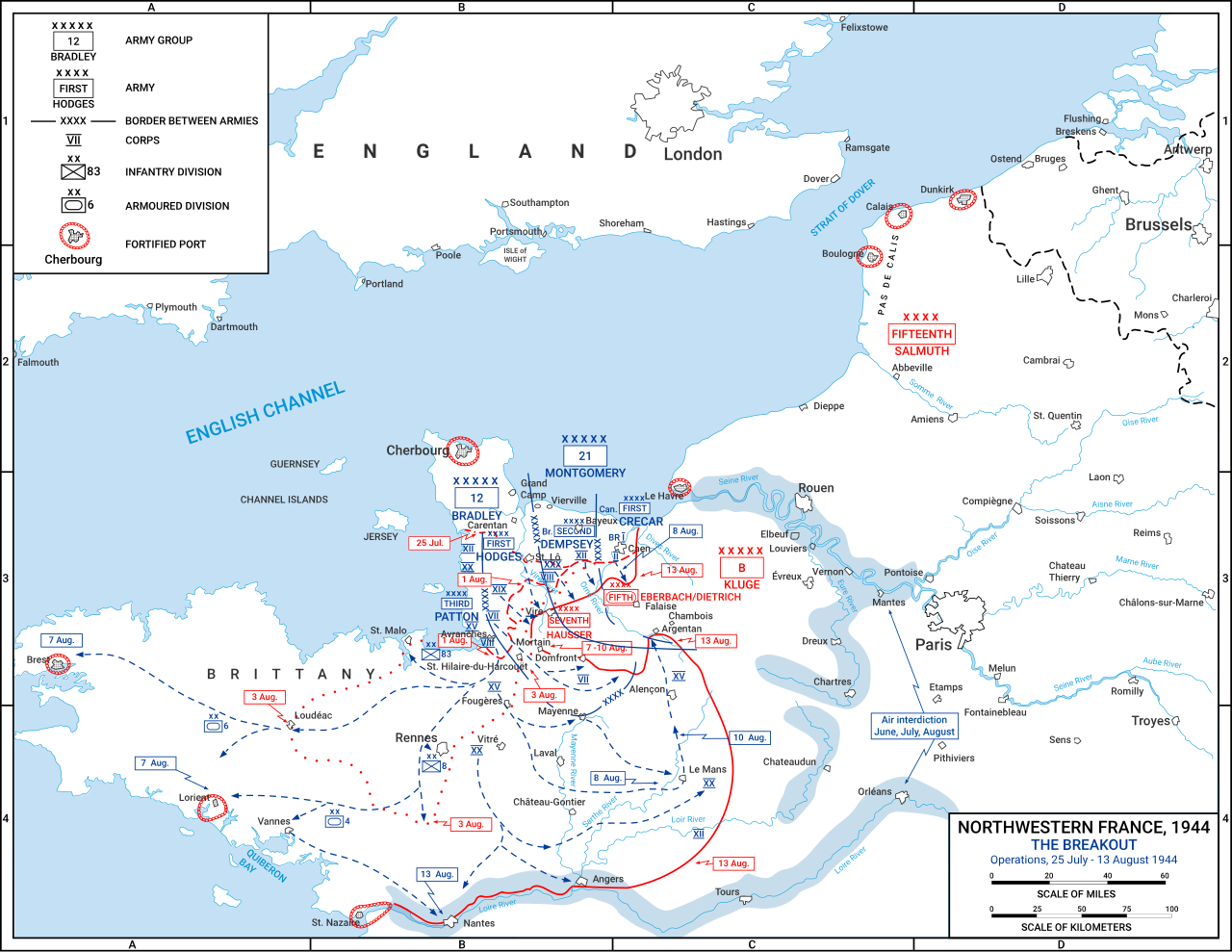
After the success of Operation Husky (the Anglo-American invasion of Sicily) in August 1943, and the invasion of the Italian mainland in September, America became anxious to open another front against Germany, through France. The British, however, prefered to defeat Germany through the 'soft under-belly' of Europe, the Italian front. Eventually though, it was agreed that a third front had to opened, and planning for 'Operation Overlord' (the invasion of Europe through France) went ahead, and eventually, June 6th 1944 was set as the date for the operation. After the landings in Normandy, Allied progress was rapid: in just over two months, Paris had been liberated; by September, Holland, and by April the following year, Hamburg, just 300km away from Berlin. In Italy, however, Allied progress was quite the opposite: almost a year after the landings, Rome had just been captured by the Allies, and even by the end of the war, the Allies were still slogging against the Gustav line in the north of the country.
In terms of vehicles used by both sides, most of the tanks used by the Germans on the Eastern Front appeared in the Southern and Western Fronts, although the King Tiger was never used in Italy during the war.
On the Allied side, the Sherman and Churchill remained the workhorses during the European campaign, but other designs cropped up as well:
U.S.A
| Tank | Max armour | Gun calibre | Max speed |
| M4 Sherman (medium tank) | 76 mm | 75 mm | 39 km/h |
| M4A2 (76) W Sherman (medium tank) | 63 mm | 76 mm | 47 km/h |
| M4A3E2 Sherman 'Jumbo' (heavy tank) | 177 mm | 76 mm | 35 km/h |
| M24 'Chaffee' (light tank) | 25 mm | 75 mm | 56 km/h |
| M4A3 (105) (heavy tank) | 76 mm | 105 mm (Howitzer) | 42 km/h |
Great Britain
| Tank | Max armour | Gun calibre | Max speed |
| Sherman Firefly (medium tank) | 76 mm | 76 mm (17-pounder) | 47 km/h |
| Cromwell V (medium tank) | 64 mm | 75 mm (6-pounder gun, designed to fire US ammunition) | 64 km/h |
| Churchill VII (heavy tank) | 152 mm | 75 mm | 20 km/h |
| Comet I (medium tank) | 102 mm | 77 mm | 52 km/h |
Note: In these tables, I include tanks that were invented by the nation whose table it is in. However, this does not mean that only that nation used those tanks. For example, under the Lend-Lease program, Britain extensively operated American-made Shermans, Stuarts and other vehicles. In addition, I have ommited some vehicles from this list (such as the M22, Calliope and AVRE Petard), as whilst they were used during 1944-45, they were not particularly numerous in deployment, and therefore would be an unfair comparison to the German tanks of this period.
Allied and German tank doctrine was very different in this period, as these tables show. Like the Red Army, German tank design favoured heavier 'breakthrough' tanks, which tended to be over-engineered and complicated. In contrast, the machines of the Western Allies tended to be highly simplified, and were mostly medium or light tanks. In fact, it could be argued that it was this attribute of simplicity that gave the Anglo-American vehicles such an edge over their enemies (this will be discussed later).
From these tables, it becomes clear that whilst the Wehrmacht did produce some superior tanks in terms of firepower and armour overall, certain Allied vehicles are clearly able to compete with these designs; at least on paper, that is.
For example, let us compare the Tiger tank and its rough American equivalent, the notorious 'Jumbo':
First, the 'Jumbo' has far thicker armour, with 7.7 cm more protecting the cheeks of the turret. In game, this American tank is a nightmare to fight, where it regularly deflects shots from even Germany’s feared 8.8 cm gun.
Both have powerful guns, and so it is debateable which was better in action. However, I believe that it is quite safe to say that the Tiger’s 88 mm would generally have come out superior in a firefight.
In terms of mobility, neither are extremely fast, but the 'Jumbo' is slower by about 10 km/h, which is surprising, given the relative sizes of both tanks.
As we have seen, the Tigers and Panthers of 1944 could be (and were) evenly matched by some Allied machines, namely the 'Jumbo', Churchill, Firefly and M4A2 (76) W. It must be noted, however, that these last two favoured heavier armament over armour, with both of them retaining the Sherman’s famously un-armoured hull, where the ammunition was stored in easily flammable areas. This could put them at a disadvantage in a firefight against, say, a Panther, as whilst they may be able to penetrate its armour, the Panther would have no trouble, even with its smaller calibre gun.
However, it should be noted that, as with most great tanks, these Allied designs were not the most common tanks that were in service at the time, as they were more expensive to produce.
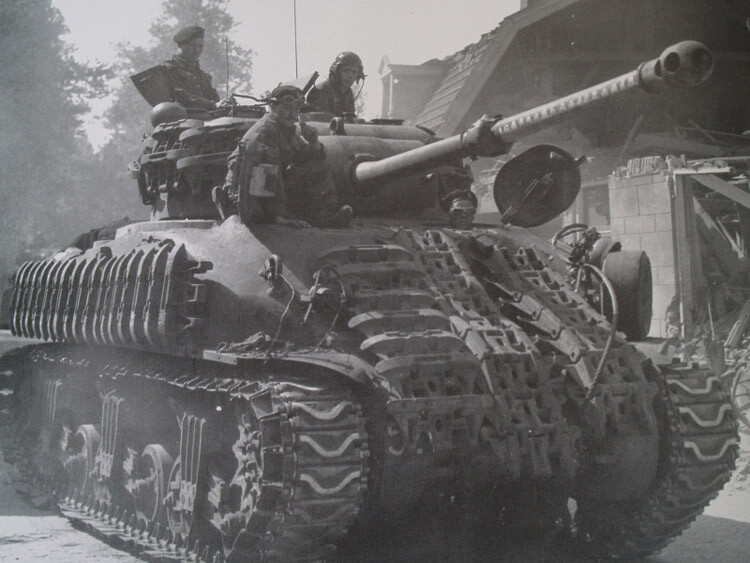
For example, there was generally one Firefly to every three regular Shermans in a troop, with it being used as a command tank. Interestingly, it was for this reason that many Fireflies painted the ends of their 17-pounders with half-grey, half-green camouflage, as can be seen on the Firefly in the 'Echoes of Overlord' pack: this would camouflage the gun to look shorter than it was, making it look like a regular M4 with a 75 mm gun; this was done because German gunners would often pick out the leading Firefly as the first target during an ambush, as it was the greatest threat compared to the other three Shermans.
In the US Army, the M4 was the workhorse for the Normandy and later European campaigns, whilst the Cromwell V and Lend-Lease M4 were the main tanks in service with the British Army at this time as well. Both these tanks are clearly inferior to the Tigers and Panthers of the Wehrmacht (even though the Tiger rarely appeared in the Normandy campaign), which is how this myth of the 'rubbish Anglo-American designs in Normandy' came about. Whilst it is true that the majority of Shermans were destroyed by superior German technology in 1944, the reason for the Panzers' failings during this period is far more nuanced.
In practice
By now, the main difficulties endured by the Panzer-Armeen during this period should be obvious: lack of fuel, parts, extra tanks (there was sometimes a 4:1 ratio of Allied to Axis vehicles), training, air-support and morale, all of which had been a problem since 1943.
However, the issue of supply was further made difficult by the rise in partisan activities since 1942, with most of these operations being supported and funded by Britain’s S.O.E (Special Operations Executive). Although such activities were becoming common in all areas under the Nazi regime (such as the Warsaw Uprising in August 1944, or the Czechoslovak Uprising in 1945), the most notable example of this guerilla warfare was the French Resistance, known as the Maquis. They were instrumental in disrupting German supplies heading to Normandy, making it difficult for German Panzers to recieve what they needed, when they needed it. For example, between June 1943 — May 1944, the French Resistance destroyed 2,500 freight cars and damaged 1,822 trains.
The material superiority commanded by the Allies was in part due to the simplicity of their tanks. The Sherman tank, for example, was effectively made up of three main parts: the upper hull (cast in one main piece, a.k.a. moulded armour), the lower hull (cast in one piece) and the turret. Because most of these components were so simple to produce, hundreds could be rapidly assembled in a short period of time. For the Tiger and Panthers, however, dozens of intricate parts had to be assembled and then welded on, drastically impeding production speed. This over-complexity was down to Hitler’s increasing involvement in vehicle design after 1940: he was constantly pushing his engineers to produce bigger, stronger designs, thereby showing his technical ignorance, and eventually leading to the large amounts of mechanical failure that have become synonymous with late-war German vehicles.
Thus, even though German Panzers might have been materially superior, the quantative superiority of the Allies was to be the deciding factor of victory.
So…?
In the end, it is certainly difficult to decide a firm answer to the question of the efficiency of Panzers, and this conclusion will vary from person to person. However, German tank design and doctrine went through four distinct phases during the war, encountering new difficulties in every theatre, thoroughly testing the strength of these machines:
- In the early war, German tanks were completely sub-par to their French, British and Soviet contemporaries, however they were still victorious due to the superiority of the strategic system pionered by the Germans, Blitzkrieg.–
- By 1942, faced with the T-34, German engineers modified existing designs to compete with it, however they were still inferior; a strategic stalement developed on the Eastern Front. In the Western Desert, the modified designs held up well against the out-dated British tanks, and were further aided by the tactical superiority held by Erwin Rommel.
- In 1943, Hilter’s new breed of heavy Panzers were finally ready for action, first being used at the Battle of Kursk. In Italy, the Tigers and Panthers were unlike anything the Allies had enountered before. However, they were greatly outnumbered.
- 1944–45, German tanks were not only evenly matched on the Eastern Front by IS-1s and 2s, they were also completely outnumbered and lacking in fuel. Whilst the same can be said for the Western Front in terms of numbers and fuel, the German Tigers and Panthers still enjoyed an almost unmatched superiority over the Shermans and Cromwell Vs that were common.
Appendices
1. The skill of crews
It could be argued (however this is a controversial claim), that the Panzer-Korps found a man-to-man superiority in skill during this period. This can be evidenced by the number of 'kills' claimed by the highest-scoring tank aces of each of the four great nations in the Western Front:
- The highest-scoring British tank ace, whilst debated, was probably Sydney Valpy Radley-Walters, who scored 18 victims during the campaign in Western Europe.
- The top US tank ace was Lafayette G. Pool, scoring 12 enemy tanks, along with 258 other armored vehicles; however, this could range anywhere from a thinly-armoured half-track to a StuG III, so should not be counted when comparing the victories of other nations' tank aces.
- The Soviet tanker with the largest amount of 'kills' was Dmitry Fyodorovich Lavrinenko, who claimed 52 victories, most of which took place in 1941.
- However, the highest-scoring German tank crewman of the war was Kurt Knispel, who racked up a total of 168 enemy tanks destroyed whilst serving in various roles at different times, as gunner, commander and loader in Panzer IVs, Tiger Is and Tiger IIs.
So, the total sum of victories of all the Allied aces are not even half those of Knispel. In addition, names such as Michael Wittman (135 victories), and Otto Carius (158) have become synonymous with the idea of a 'tank ace'. But why was this? Were German crewmen really better trained, or was it just down to superior armour and guns? Well, it could be down to a number of combined factors. Whilst the extremely thick armour certainly would have made the difference between life and death for these aces, 168 victories is still quite impressive, even if these took place whilst sitting behind 100 mm of steel. Another possible explanation for these large amounts of 'kills' could be that these Panzer crews had almost constantly been in action since they were conscripted, whether that was in North Africa, France, the USSR or Italy. Whilst it is true that these men still were granted leave, this became rarer and rarer as the war went on and as the Wehrmacht became increasingly short of skilled crews. On the other hand, the majority of British and US crews (apart from those serving in the Western Desert) had spent a lot of the war 'out of it', training (in some cases) for 2 years without action. Not only would this give the Panzer crews ample time to rack up large amounts of victories, it would also give them years of combat experience, which certainly would have allowed them an edge over their enemies.
On the other hand, it could also be argued that these were rare cases, and that the average German crewman was less well-trained than his Anglo-Soviet-American counterparts. This might be true, as towards the end of the war, the Wehrmacht was so low in troops that new, extremely young recruits would receive minimal training before being drafted to serve on the front-lines.
In 1940, crews invading France were not extremely experienced, although they were more experienced than their opponents. In 1941, the Panzers entering the Soviet Union were crewed by largely veteran personnel who had experienced victory throughout Europe in the two preceding years. From 1942-43, however, whilst the great German tank aces were stacking up victory after victory, the overall quality of German crews was starting to decline, as the lack of manpower was becoming evident in Germany; in the USSR and Western Desert, the British and Soviet crews were becoming more and more experienced, with new recruits having plentiful training before being drafted. From '44–'45, faced with the strategic and material superiority of the Allies, German crews were mostly inferior in terms of training and morale.
2. The German supply problem
It has previously been mentioned that later on in the war, around 1943 onwards, German Panzers started to suffer especially due to the problem of supplying spare parts, extra vehicles, and other essentials to front-line units. But how bad was this problem?
Well, according to the reports of the 10th SS Panzer Division 'Frundsberg', 73 t of munitions, 140 t of fuel, 100 t of parts and 40 t of food (totalling 353 tonnes) were required for maximum operational efficiency during the Normandy campaign. However, what actually arrived was entirely different: 55 t munitions, 35 of fuel, 15 of parts, and only 10 tonnes of food, which totalled 115 tonnes; just 32.6% of what was needed was actually received. It must be remembered as well that this was no ordinary unit that might have been a secondary priority to the Wehrmacht: this was an SS Panzer Division, Hitler’s best troops, used as an elite force in warfare and the pride of the Third Reich.
Not only was this due to the gradual atrophy of the German economy as a result of the Allied air campaigns, but also because of the failure of German logisitics during this period.
The required capacity of German logistics in 1944 was 36 trains per day, travelling 400 km to deliver 10,000 tons of supplies to 21,582 trucks who would then ferry those 50 km to the front lines. In reality, 9 trains arrived per day with 4,000 tons, travelling on only 250 km of train-tracks (the rest had been destroyed by partisans and Allied fighter-bombers, like the Hawker Typhoon or P-47D Thunderbolt), who then deposited the scarce supplies with only 10,000 trucks (less than half the number required), who would then have to drive 200 km to the front, braving air attack and poor roads constantly.
From these conditions, it is easy to see why the Wehrmacht, and especially its Panzers, were so under staffed, supplied and fuelled.
3. 'Tiger Terror'
In many films (such as Steven Spielberg’s 'Saving Private Ryan'), the Tiger I is often shown, locked in combat with Shermans from all sides. In fact, it seems that this vehicle has been immortalised in Western minds as the German tank of WW2. However, this is strange, as during the Normandy campaign (where the film is set) no units equipped with the Tiger I were active in the US sector, with the three active Tiger battalions of the Normandy campaign only operating in the British-held Caen sector.
So why does this film portray Tiger Is, fighting (clearly American) Sherman units and troops? Well, the answer is a little complicated.
During this campaign, only 5% of the German armoured forces in Normandy was made of Tiger Is, with the majority of units consisting of Panzer IVs and Panthers. Now, in the heat of actual combat (not like in War Thunder), the Panzer IV could look deceptively like a Tiger, especially through the narrow confines of a tank sight; this led to many US crew members insisting that they were knocked out by a Tiger in action, which is in fact very misleading, because the majority of these instances probably involved Panzer IVs. This idea, however, of the Tiger as an almost invinceable beast, might have been born from these reports.
However, in the British sector — where Tigers were actually present — this vehicle did actually perform extremely well, and it was in fact a Tiger in which one of the most legendary tank aces ever, Michael Wittman, scored 29 vehicles destroyed in just 15 minutes near the town of Villers-Bocage. It was instances like these as well that helped to establish the Tiger in Western pop culture.
- World War II: Infographics by Jean Lopez, Nicholas Aubin, Vincent Bernard and Nicolas Guillerat
- https://tankmuseum.org/tank-nuts/tank-collection/panther#: ~: text=The%20Panther%20is%20often%20believed, where%20this%20tank%20was%20built.
- https://www.youtube.com/watch?v=kFQd8TYt6Ew&list=PLBAEOsdxIbLNfZJDv5MFZrHkLjKY-iGCi&index=2
- https://www.youtube.com/watch?v=UPFEuR7meV0
- https://www.youtube.com/watch?v=LZZPl6SBgZ
- https://www.afhistory.af.mil/FAQs/Fact-Sheets/Article/459003/1943-operation-tidalwave-the-low-level-bombing-of-the-ploesti-oil-refineries-1/
- https://www.youtube.com/watch?v=t3Im8BKGYQw
- https://history.army.mil/Portals/143/Images/Publications/Publication%20By%20Title%20Images/S%20PDF/CMH%20Pub%20104-22-1%20-%20Small%20Unit%20Actions.pdf?ver=hQGf4o4DCQFaXSQClwer7Q%3D%3D
- The World at War: Ep.8
- Stalingrad by Antony Beevor
- Purnell’s History of the Second World War
- https://en.wikipedia.org/wiki/Germany%E2%80%93Soviet_Union_relations,_1918%E2%80%931941
- https://en.wikipedia.org/wiki/Great_Purge
- Blitzkrieg by Len Deighton
- https://www.youtube.com/watch?v=mFp8vFUEx5Y