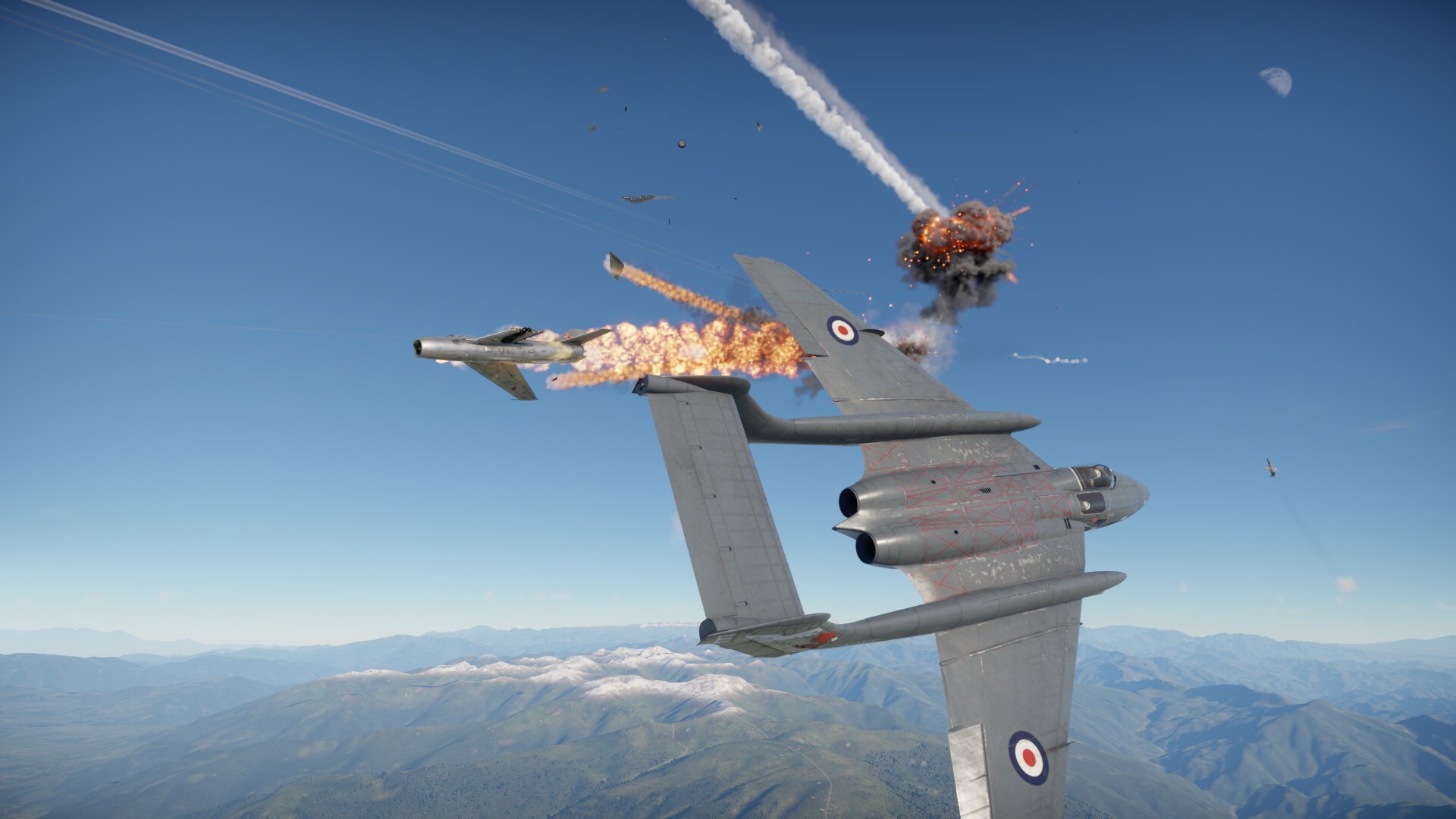
The de Havilland Sea Vixen is considered one of the most bizarre-looking aircraft ever employed by the Royal Navy, with an asymmetric side-by-side cockpit, no cannon armament, and a twin-boom design. In War Thunder, the Sea Vixen is one of the first examples many players will experience gunless jet combat with, and it introduces a completely new playstyle that throws the fundamentals of early jet combat out the window.
| Pros | Cons |
|---|---|
| Can take off and land on aircraft carriers, and can catch arrestor cables on airfields to land quickly | Zero cannon armament whatsoever, very ineffective in traditional dogfighting engagements |
| Surprisingly strong flight performance | Has a completely different learning curve from other early jets |
| Red Top missiles have great performance and have limited all-aspect capability | Can carry only 4 missiles at a time and requires careful positioning to avoid missing shots |
| Has a fast-scanning radar set and also a decent RWR for its rank | Massive airframe that does not respond well to taking damage |
| Decent ground ordnance, including AGM-12 Bullpups | Often faces supersonic jets which have superior flight performance |
Unorthodox Weaponry:
The key to any aircraft’s success in aerial combat is their weaponry, and the Sea Vixen is one of the first of a considerable collection of jets that do not possess any cannon armament whatsoever, a concept first experimented with during the early stages of the Cold War as air-to-air missile technology developed. Instead, the Sea Vixen relies on an excellent missile armament in order to inflict maximum damage on its opponents. The variant players receive in-game is the Sea Vixen FAW.2, granting it access to the venerable Firestreak and Red Top missiles.
Compared to other early missiles like the AIM-9B and R-3S, early British missiles are known for having uncaged seekers and above-average maneuverability but below-average range. One of the best examples of this is the Firestreak, first found on the Gloster Javelin interceptor, but also on the Sea Vixen. It has good 15G maneuverability and a moderately sized uncaged seeker, but suffers from very short range due to high drag and a guidance time of only 13 seconds. The Red Top missile, on the other hand, is one of the best IR missiles available at its BR, with competitors like the Shafrir-2 on the Israeli Sa’ar. It has slightly above-average maneuverability at 12G, decent range, and a very strong uncaged seeker with a particularly wide maximum lock angle of 30 degrees off-boresight.
The Sea Vixen, primarily designed as a missile-armed naval fighter, surprisingly features a robust set of ground ordnance. It can carry dumb bombs, rockets, and up to two MCLOS AGM-12B Bullpup missiles. The AGM-12B Bullpups are a standout, allowing you a degree of precision close air support. The only drawback is that MCLOS missiles are notoriously finicky to control, requiring excellent depth perception in order to guide your missile on target. There is a very important caveat to note, however. Equipping anything other than Bullpups or 1000-pound bombs on the outer wing pylons will reduce your Red Top missile payload. It’s also crucial to remember that the Sea Vixen lacks a ballistic computer, so extra care is needed to ensure your unguided ordnance hits its intended target.
A Missile’s Seeker Makes All The Difference
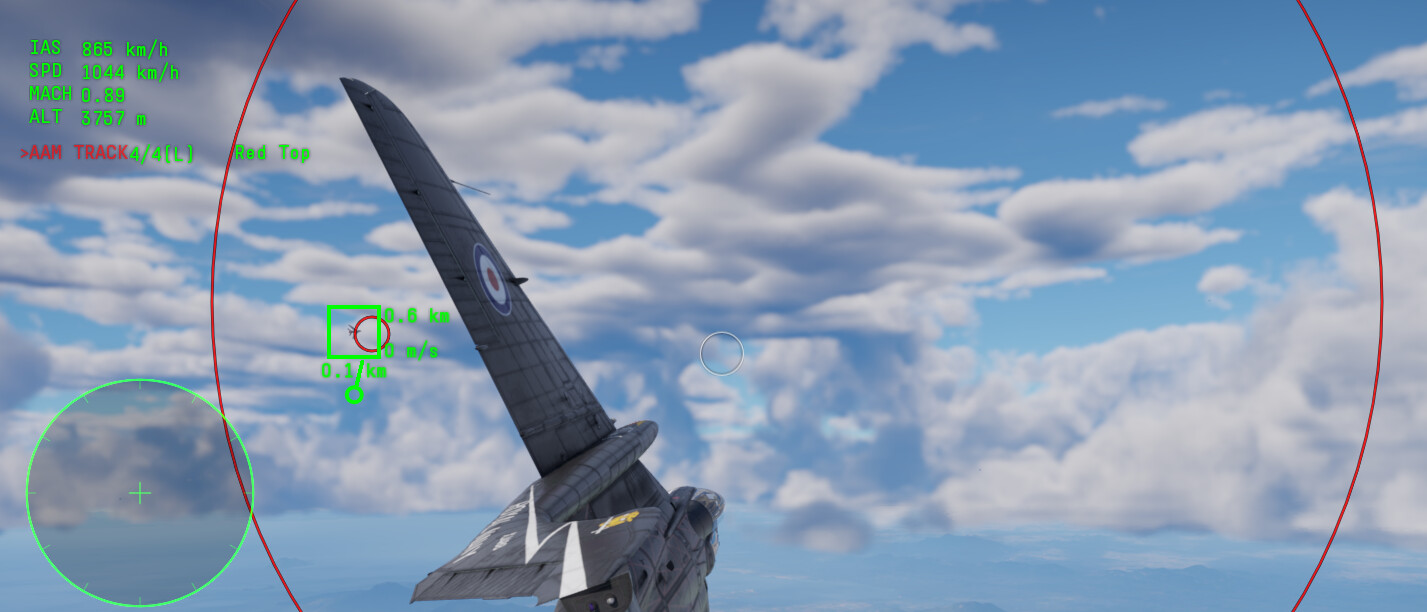
In an era where many jets carry very basic, caged-seeker missiles like the AIM-9B Sidewinder, utilizing a wide, uncaged seeker is like unlocking a whole new dimension in your missile’s firing envelope. A rather unusual way to understand this concept is imagining a plane carrying a basic caged-seeker missile like a tank with no vertical or horizontal turret traverse. The best example of this is the Swedish Stridsvagn 103, which relies on a complex hydro-pneumatic suspension system for both elevating and traversing the hull to aim. With no ability to independently aim the gun, the tank can only fire at something that is directly in front of it, with no exceptions. An uncaged seeker in this scenario is like giving that same Strv-103 the ability to independently aim its gun, irrespective of where its hull is turned towards. The Sea Vixen lacks any cannon armament whatsoever, and its missiles still pull 12Gs of overload at most, requiring you to utilize the capabilities of the Red Top’s seeker to their absolute limit in order to maximize your results with the missiles you have.
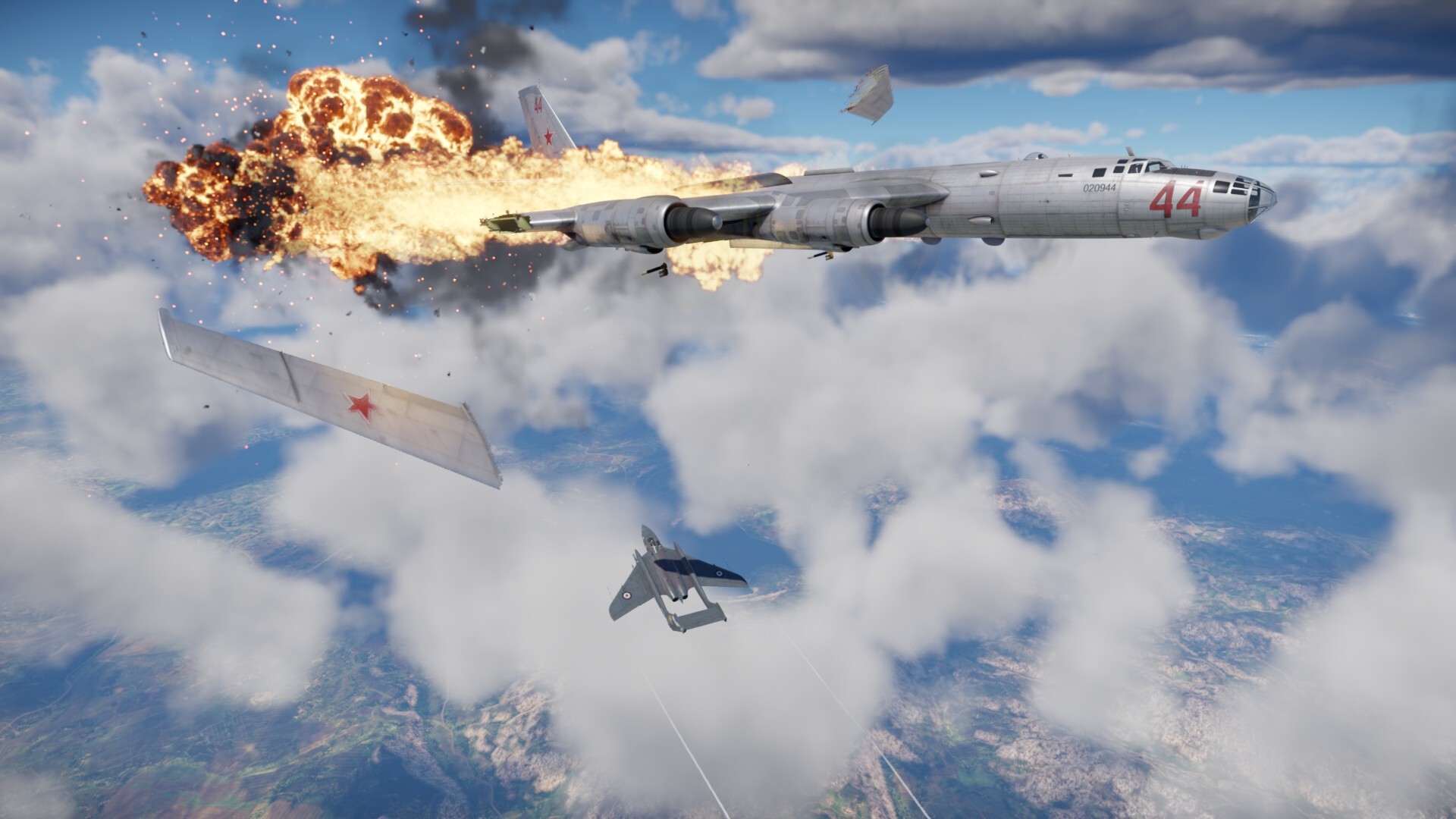
The Sea Vixen falls pitifully short of almost any peer aircraft it can face in a 1v1 dogfight scenario, especially against dedicated dogfighters like the F-86, G.91, and MiG-15/17, which can only, for the most part, be locked from the rear hemisphere due to lacking an afterburner for the Red Top’s seeker to grab onto. In these scenarios, usually the only thing you can do is run away or hope a teammate can distract your opponent so you can loop around and fire off a Red Top at them while they’re distracted. However, running away will not work against supersonic jets, which can and will catch up with you eventually if you try it. This is where the Red Top can properly utilize its secretive all-aspect capability. While predominantly a rear-aspect missile like most contemporaries at its rank, its seeker has some of the best heat sensitivity of any rear-aspect missile in the game, and can target certain aircraft head-on or from a side aspect at very close ranges, typically from roughly 2 kilometers away at most. This special trick only works in the vast majority of cases with aircraft that have extremely hot afterburners, such as the F-104 Starfighter, Su-7, F-4C, and F-106 Delta Dart. But it can also work in a side-aspect against other hot-running jets, such as early Harriers and Yak-38s. The most effective targets for the Red Top’s front-aspect capability, however, are B-52s and Tu-95s, which can often be targeted from up to 3-4 kilometers away from the front or sides.
Flight Performance:
The Sea Vixen is unique as the highest-rated twin-boom fighter in War Thunder and has the flight performance to match its rank. Possessing a pair of Rolls-Royce Avon engines outputting roughly 10,000 kgf of thrust, the Sea Vixen can maintain a quick climb rate compared to most subsonic jets it can face. However, when facing supersonic jets, the Sea Vixen often struggles to catch up and can feel slightly underpowered. Acceleration is very similar as well; it can outrun most subsonics, but can be chased down by almost all supersonics. What makes the Sea Vixen rather interesting in this regard, however, is that its engines produce 10,000 kgf of thrust without any afterburner. This gives it an enormous advantage in fuel efficiency, allowing you to carry comparatively light fuel loads compared to afterburning jets, which often have to top up their fuel tanks and thus incur a penalty to their flight performance.
With early missile combat often found around Rank VI, pre-shot maneuvering is extremely important. Despite the Sea Vixen’s Red Tops allowing a lot more flexibility in aiming with their wide uncaged seekers and radar slaving, their maneuverability still maxes out at only 12G, slightly higher than the AIM-9B. This is where the Sea Vixen has a second hidden ace up its sleeve. Its maneuverability is deceptively strong for such a large airframe, having great energy retention and a decent instantaneous turn rate. The only issue is that it is often outmatched by dedicated dogfighters such as the MiG-15, MiG-17, and the F-86 Saber.
Even at higher speeds, the Sea Vixen’s controls remain relatively responsive, which is crucial for evading enemy air-to-air missiles in the complete absence of countermeasures. While you can technically use rockets as makeshift flares, carrying them is generally not recommended, as your maneuverability, combined with good positioning and speed management, is typically more than enough to evade most missiles you can face.
Avionics
Avionics is where the Sea Vixen has a huge advantage over most opponents, both offensively and defensively. The Sea Vixen’s radar, the AI Mk. 18, has a very fast scan rate and a good selection of dish-sweep and range settings, including 100×16, 100×9, and 100×5 degrees, respectively. While it lacks an ACM mode, its very fast scan rate more than makes up for it, and you should have no problems locking a target. Be aware, however, that the AI Mk. 18 lacks a look-down mode and is particularly vulnerable to ground clutter, so it is most effective at higher altitudes.
You also possess an AN/APR-36 radar warning receiver, which, for all intents and purposes, can be considered functionally identical to the AN/APR-25, also found on various early Cold War jets operated by NATO-oriented countries. It has no track or launch warnings, but is entirely digital, being able to detect both the specific angle and direction of the threat and its distance/signal strength. The only significant differences between the two are their threat types: the AN/APR-36 notably includes a threat type for the 2K11 Krug SAM System (NATO Designation: SA-4 Ganef), which is not in the game.
Survivability
The Sea Vixen is a mixed bag in terms of survivability. Despite being well-endowed in maneuverability and having 38mm of bulletproof cockpit glass, it also has an enormous airframe. The tail, in particular, is a massive weak spot, placed well behind the wing in an elevated, easy-to-hit location. Damage to the tail is often enough to cause complete loss of pitch and/or yaw control due to it either snapping off or the control surfaces being disabled. Severe damage to the wings should be avoided at all costs, as the Sea Vixen is notorious for heavily listing to one side from wing damage, and any one-sided loss of flaps makes landing incredibly difficult. Something also to note is that the rip speed of your flaps is incredibly low, being only 324 km/h IAS, with your landing gear having a rip speed of only 407 km/h IAS. This requires you to slow down massively before landing to avoid ripping your gear apart.
The good news is that the survivability in the Sea Vixen’s other critical areas, such as the fuel tanks and engine, is surprisingly well-endowed. Your twin-engine layout, despite being very close together, does provide a degree of redundancy if one engine is destroyed. Furthermore, all of the Sea Vixen’s fuel tanks are located far away from the tail in the front of the fuselage, and are all self-sealing.
Notable enemies
The Sea Vixen’s favorable matchmaker prevents it from seeing terrifying all-aspect missile slingers like the A-10A and Su-25, but it can still see a handful of jets which prove a massive thorn in its side, given in a shortlist below:
- F3H-2 Demons: These 2nd generation American naval jets can be very dangerous in a head-on engagement as they possess AIM-7C sparrows, which despite having very weak performance for a radar missile, still allow the Demon to engage targets head-on. However, they are notorious for their very poor energy retention and climb rate.
- MiG-19s and F-101C Voodoos: Both known for their great engine performance and good maneuverability. Avoid engaging in vertical maneuvers with them.
- F-104 Starfighters: Mostly a nuisance, while you can out-turn them, they have some of the strongest engine performance at their battle rating and can out-run you in almost all circumstances, they can also alternatively be locked on by your Red Tops in a head-on engagement.
- F-102A Delta Daggers: F-102s are considerably less dangerous than F-106s, due to lacking a gun and utilizing the weaker J57 engine compared to the F-106’s J75 engine. However, they are still very capable of engaging targets in a head-on with up to six AIM-4F Falcons.
- F-106 Delta Darts: F-106s can be considered a mix between the formidable head-on threat of a MiG-21S and the incredible flight performance of an F-104 starfighter. However, their AIM-4 Falcons are considerably less dangerous than an R-3R, as they lack a proximity fuse.
- F-4C Phantom IIs: Although the F-4C is one of the strongest opponents the Sea Vixen can face, its lack of countermeasures and very hot heat signature, courtesy of its J79 engines, make it the perfect target to utilize your Red Top’s front-aspect capability against.
- MiG-21S: This 2nd generation MiG-21 carries the R-3R radar missile, which the Sea Vixen’s AN/APR-36 is completely blind to as it operates in J-band.
- MiG-21SPS-K: This 2nd generation MiG-21 has a very unusual weapon loadout, being able to carry R-3Rs, R-13M1s (roughly similar in performance to the AIM-9J sidewinder) and the extremely maneuverable R-60 short range dogfighting missile. However, SPS-Ks can only carry up to 2 R-60s or R-13s at once, and have to choose between either carrying a gunpod or carrying a countermeasures pod.
- Mirage IIIC/Shahak: 1st generation Mirage IIIs should be avoided at all costs, especially at high altitude, as they carry the extremely agile Matra Magic 1 or medium-range AIM-9D/Shafrir 2 IR missile, in addition to the long range Matra R530 IR or Radar missile.
- Sa’ar: While having inferior engine performance to the normal Super Mystere, these carry indigenously-made Shafrir 2 IR missiles which possess roughly 18G of overload, the same as American-made AIM-9D/G Sidewinders
- Yak-130/Ariete: Despite being subsonic, these two jets are some of the most competitive dogfighters that the Sea Vixen can face, and should be treated with extreme caution. Arietes in particular should be avoided at all costs, as they pair the great maneuverability of their airframe with incredible acceleration thanks to their extra jet engine mounted in the rear.
Miscellaneous information
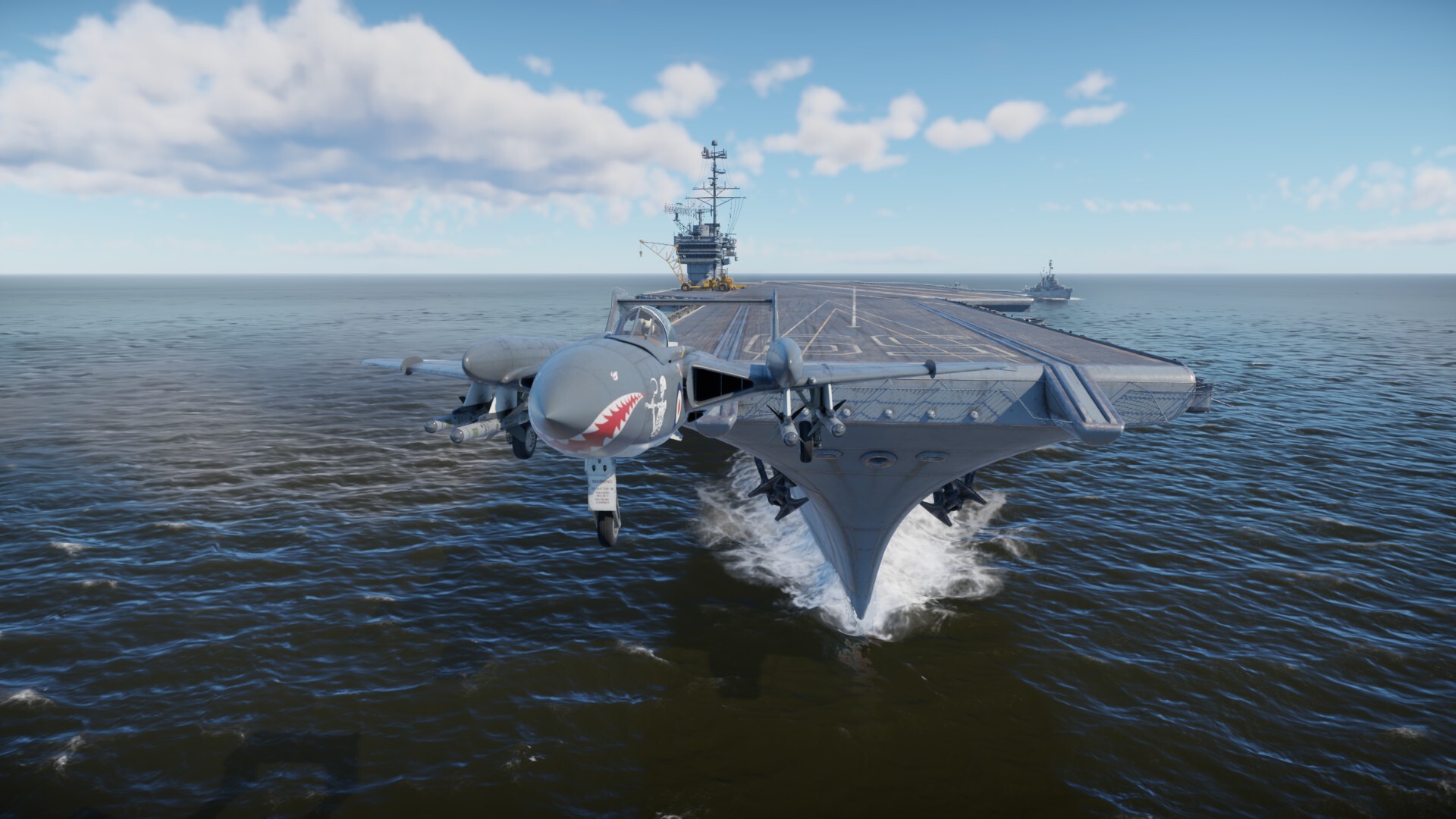
As a naval aircraft, the Sea Vixen has access to an arrestor hook, which gives it a degree of flexibility not afforded to many other aircraft when it comes to spawn locations. It can not only spawn on allied airfields like all other aircraft, but it can also take off and land from friendly aircraft carriers during a match on certain maps. This list includes the Golan Heights, Southeastern City, and the Falkland Islands, etc. Carrier Spawns are usually positioned differently on the map compared to the spawn airfield and forward airfield, and provide naval aircraft with an incredibly fast takeoff from spawn thanks to catapults located on the HMS Ark Royal, USS Forrestal, and Foch.
WARNING: The Admiral Kuznetsov does not have a catapult; instead, it has a Ski ramp. While it is possible to take off from this with the Sea Vixen, depending on where you spawn on the carrier, it is much more precarious than on CATOBAR aircraft carriers, especially given the Sea Vixen’s lack of afterburners.
Also introduced in the Heavy Cavalry update are airfield-based arrestor cables, located on either end of the airfield’s runway. This enables many aircraft with an arrestor cable to stop almost instantly after landing, as on an aircraft carrier. It is important to keep in mind that the Sea Vixen’s rip speed for its flaps is very low, only about 324 km/h IAS, so be sure to bleed off as much speed as you can before deploying them.
Tactics in Battles
The Sea Vixen throws almost all of the fundamentals learned in the early echelons of jet combat out the window. Having fire-and-forget IR missiles instead of guns does take the burden of fine-aiming off your shoulders, but it requires a much more nuanced approach towards picking and choosing targets to make the most of your limited number of Red Top missiles. Unlike guns, early missiles will do no good in a close-in dogfight, with some exceptions like the SRAAM, which has thrust vectoring. With the uncaged seeker of your Red Tops, you gain the ability to fire at targets that are mid-maneuver, but you should pay close attention to lead your missile ahead of your target as much as possible, preferably with the help of radar-slaving, to reduce the chances of a miss.
In a down-tier, the Sea Vixen works best with a superficial boom-and-zoom strategy, keeping your distance while picking off targets occupied in intense dogfights or flying in a straight line. An uptier is where things get interesting for the Sea Vixen. As you face more supersonic jets, the limited all-aspect capability of your Red Top missiles can come into play, giving you a critical edge in head-on engagements against a normally superior opponent. This is especially valuable in the later stages of a game, where you may not be able to reliably get a rear-aspect firing solution on a target that is focused solely on engaging you, but be mindful not to head-on the handful of enemy aircraft that CAN fire off missiles in a head-on as well, most notably 2nd-generation MiG-21s like the MiG-21S and MiG-21SPS-K.
For mixed battles, the Sea Vixen adopts a more diverse playstyle, where it can pull double duty as a capable CAP aircraft while performing close air support with its AGM-12B Bullpup missiles and 1,000-lb bombs. Your AN/APR-36 RWR is especially beneficial in this role, allowing you to pinpoint the rough locations of some enemy SPAA as you approach the battlefield. Be very aware, however, that some SPAA radars are in bands that your RWR cannot detect. This includes a shortlist of examples like the ZA-35, ZSU-23-4, ZSU-37-2, PGZ88, Roland 1, Rapier, and XM246.