
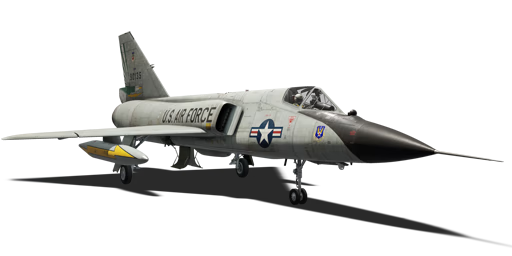
F-106A

The Convair F-106 Delta Dart is an American fighter-interceptor aircraft. It was developed in an attempt by the U.S. Air Force to improve upon the F-102 Delta Dagger, which failed to meet military expectations due to its poor flight characteristics. The interim solution was the F-102A, which had a modified fuselage shape and barely met the Air Force's requirements when it was ordered in 1954. However, the aircraft's weak J57 engine was a fundamental problem, and it was planned to be replaced with the more powerful Wright J67. Additionally, a more modern fire control system was to be installed. This new modification was named the F-102B. In 1955, the decision was made to install the J75 engine instead of the J67. Installing the new engine required changing the design of the air intakes and lengthening and simplifying the fuselage shape. Since the F-102A was a higher priority for the company and the Air Force, the order for the F-102B modification was not placed until April 18, 1956. On June 17, the modification was renamed the F-106A. The F-102A and F-106A were to be produced simultaneously.
The first flight of the F-106 prototype occurred on December 26, 1956. The second flight took place on February 26, 1957. Unlike the first flight, the plane was fully equipped with all onboard equipment. The military was disappointed by the flight characteristics, as the prototypes were not significantly better than the F-102 in terms of performance. However, the Air Force had already invested in the project and agreed with Convair to make improvements to the aircraft's aerodynamics and reliability. In October 1959, deliveries of the single-seat F-106A and the two-seat F-106B began. A total of 342 aircraft were built. As the aircraft became obsolete by 1972, a number of them were modified under the Six Shooter project, which involved installing different cockpit for better visibility, a new sight, and the ability to install a 20 mm M61 cannon. The F-106 remained in service with the U.S. Air Force and later the Air National Guard until 1988. NASA used several aircraft until 1998.
The F-106A was introduced as a reward for the 2025 Sky Guard event. It is a fast aircraft equipped with a powerful 20mm cannon and an HMD. However, the suspended weaponry is limited to AIM-4 missiles, which are extremely short range and slow. Additionally, the aircraft quickly loses energy and becomes vulnerable to enemy attacks at speeds below 750 km/h.

flaps
flaps
flaps
brake
| Belt | Belt filling | Armor penetration (mm) at a distance: | |||||
|---|---|---|---|---|---|---|---|
| 10 m | 100 m | 500 m | 1000 m | 1500 m | 2000 m | ||
| HEF-I/API-T/AP-I | 40 | 36 | 21 | 11 | 6 | 3 | |
| HEF-I/HEF-I/API-T/HEF-I/HEF-I/AP-I | 40 | 36 | 21 | 11 | 6 | 3 | |
| API-T/AP-I/AP-I/AP-I/HEF-I | 40 | 36 | 21 | 11 | 6 | 3 | |
| HEF-I/AP-I/AP-I | 40 | 36 | 21 | 11 | 6 | 3 | |
| Name | Weight | Slot | ||||||
|---|---|---|---|---|---|---|---|---|
| Drop tank (358 gal.) | 120 kg |  | | |||||
| 66.2 kg |  | | | | ||||
| 68.9 kg |  | | | | ||||



Flight performance | |
|---|---|
Survivability |
|---|
Weaponry | |
|---|---|