
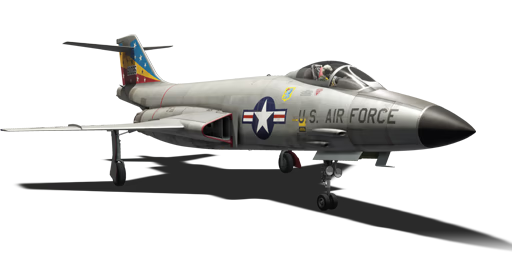
F-101C



The McDonnell F-101C Voodoo is an American supersonic fighter that was originally developed as a long-range escort interceptor. Its history began in 1946 when the U.S. Air Force issued a requirement for a long-range escort fighter to accompany bombers. McDonnell responded with the XF-88 project. The first of two prototypes flew on October 20, 1948. Although the aircraft demonstrated good maneuverability, it had an insufficient thrust-to-weight ratio and limited range. This led to the program's cancellation in 1950. However, everything changed with the outbreak of the Korean War and the emergence of new Air Force requirements. A supersonic aircraft capable of carrying out tactical nuclear strikes and penetrating air defenses at low altitudes was needed. McDonnell returned to the XF-88 design and made extensive revisions to the project. They enlarged the airframe, installed two J57 engines with afterburners, and redesigned the air intakes. The new aircraft received the designation F-101A Voodoo. The prototype made its first flight on September 29, 1954, and production began in 1957.
The F-101A was the first US Air Force fighter aircraft capable of carrying nuclear weapons at supersonic speeds. On December 12, 1957, the aircraft set an absolute world speed record of 1,943.4 kilometers per hour (1,208.8 miles per hour). However, operational experience revealed stability issues at the limits of the flight envelope, as well as airframe heating. To address these problems, the F-101C variant was developed with a reinforced fuselage, an increased takeoff weight, and an improved control system. Only 47 F-101C aircraft were built, most of which were later converted into RF-101C reconnaissance aircraft that saw extensive service in Vietnam. Other variants were developed in parallel, including the two-seat F-101B interceptor, which was equipped with radar and AIM-4 Falcon missiles for North American air defense; the RF-101 reconnaissance variant; and the CF-101 export version for Canada, which replaced the canceled Avro Arrow. The last Voodoos left service with the U.S. Air National Guard in the mid-1980s.
The F-101C was introduced in Update 2.57 "Heavy Cavalry". It stands out for its enormous straight-line speed compared to its peers. It can reach Mach 1.5 and maintain a high flight speed for a long time. However, its maneuverability is mediocre due to its large turn radius and modest climb rate, which prevent it from effectively engaging in traditional close-range dogfights. It is armed with four 20mm M39A1 cannons but has no air-to-air missiles or suspended armaments.
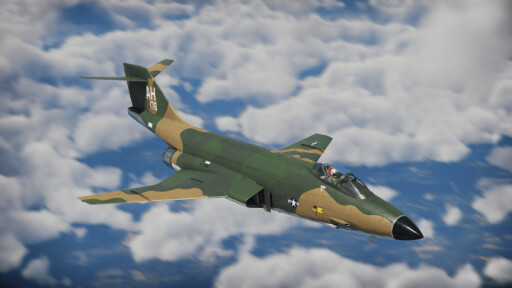
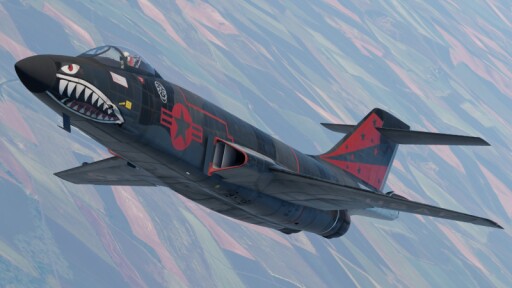

flaps
flaps
flaps
brake
| Belt | Belt filling | Armor penetration (mm) at a distance: | |||||
|---|---|---|---|---|---|---|---|
| 10 m | 100 m | 500 m | 1000 m | 1500 m | 2000 m | ||
| HEF-I/HEF-I/API-T/AP-I | 39 | 35 | 21 | 11 | 6 | 3 | |
| HEF-I/API-T/AP-I | 39 | 35 | 21 | 11 | 6 | 3 | |
| HEF-I/HEF-I/HEF-I/API-T/AP-I | 39 | 35 | 21 | 11 | 6 | 3 | |
| API-T/AP-I/AP-I | 39 | 35 | 21 | 11 | 6 | 3 | |
| HEF-I/HEF-I/HEF-I/AP-I | 39 | 35 | 21 | 11 | 6 | 3 | |


Flight performance | |
|---|---|
Survivability |
|---|
Weaponry |
|---|