
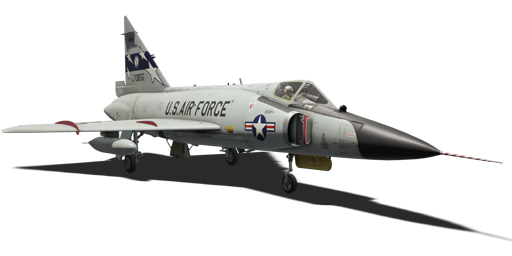
F-102A



In October 1948, the U.S. Air Force expressed interest in developing a new radar-equipped fighter interceptor. In January 1950, the military issued requirements for the radar and, in June, for the aircraft itself. Three companies were shortlisted to build the aircraft: Republic, Lockheed, and Convair. Despite its unconventional design featuring a delta wing and a missile bay, Convair's design was selected and designated the XF-102. Initially, the Curtiss-Wright J67 was considered for the interceptor's engine, but due to delays and issues with potential replacements, the designers settled for the Pratt & Whitney J57, which was less powerful. On October 23, 1953, the prototype made its first flight. A few days later, the aircraft was lost while attempting to reach supersonic speeds. The second prototype was also disappointing as it was limited to Mach 0.98.
To avoid losing such a promising contract, Convair redesigned the fighter. It was lengthened, featured new air intakes, and had a narrower cockpit. The larger, slimmer wing, a more powerful version of the J57 engine, and a lighter airframe also helped its flight performance. The redesigned YF-102A made its first flight on December 20, 1954, and broke the sound barrier the following day. The U.S. Air Force approved the fighter after the changes, and the aircraft entered mass production as the F-102A Delta Dagger. A total of 1,000 aircraft were built, some of which saw action in the Vietnam War. A few more were sold to Greece and Turkey. Due to the fighter’s mediocre flight characteristics, the F-102B variant with a J67 engine was developed; it was later designated the F-106A. The last American F-102A was withdrawn from service in 1968.
The F-102A was introduced in Update 2.59 "Sky Odyssey". This fighter is notable for its complete lack of a cannon armament; it relies entirely on infrared- and radar-guided AIM-4 missiles to shoot down enemy aircraft. However, these air-to-air missiles are difficult to use and lack a proximity fuse. Nevertheless, the aircraft may impresses with its decent speed and maneuverability.

flaps
flaps
flaps
brake
| Name | Weight | Slot | ||||||
|---|---|---|---|---|---|---|---|---|
| Drop tank (215 gal.) | 120 kg |  | | |||||
| 66.2 kg |  | | | |||||
| 2 × | 132.4 kg |  | | | ||||
| 68.9 kg |  | | | |||||
| 2 × | 137.8 kg |  | | | ||||
| 12 × | 107.2 kg |  | | |||||


Flight performance | |
|---|---|
Survivability |
|---|
Weaponry | |
|---|---|