
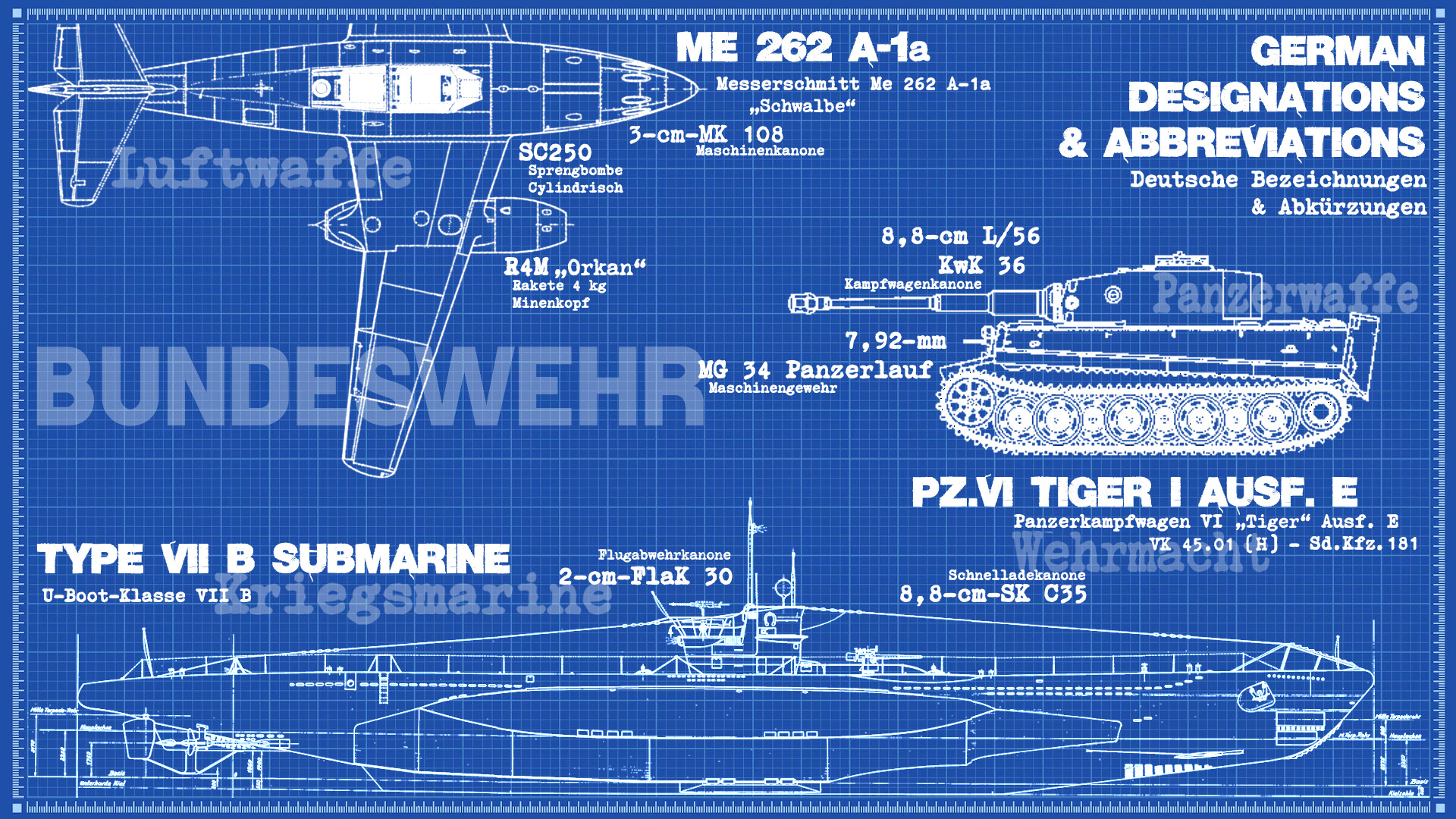
Common designation schemes
German alphabet
During World War II, Germany used a phonetic alphabet to clarify radio communications by assigning distinct words to each letter—helping avoid confusion in spoken transmissions. This system was also occasionally used for unofficial shorthand or variant nicknames, particularly in aircraft designation and markings.
Although a German phonetic alphabet already existed before the war (and continues to exist today in updated forms), the Nazi regime introduced changes to remove names with Jewish or perceived non-Aryan origins. For example:
Some terms were changed solely for Germanic spelling, even if the original wasn't specifically "Jewish."
- D: David → Dora
- N: Nathan → Nordpol
- Y: Ypsilon → Ypern
| A | Anton | N | Nordpol |
| B | Berta | O | Otto |
| C | Cäsar | P | Paula |
| D | Dora | Q | Quelle |
| E | Emil | R | Richard |
| F | Friedrich | S | Siegfried |
| G | Gustave | T | Theodor |
| H | Heinrich | U | Ulrich |
| I | Ida | V | Viktor |
| J | Julius | W | Wilhelm |
| K | Konrad | X | Xaver |
| L | Ludwig | Y | Ypern |
| M | Martha | Z | Zeppelin |
Abbreviations
Many German words and designations are compound words and are often abbreviated to save space. Therefore, only the most common in-game and vehicle-related military abbreviations are mentioned here and will be specifically clarified in their own sections.
The majority of German weapon designations begin with the weapon’s caliber, followed by its type and ending with the year of design or model number—for example: 7,92-mm-MG 34.
- 7,92-mm refers to the caliber (bore diameter) of the weapon. Germany used the metric system, listing calibers in millimeters for small arms and switching to centimeters for weapons with calibers of 2 cm and above.
- MG stands for Maschinengewehr (machine gun).
- 34 indicates the year the weapon was introduced or adopted—1934 in this case.
| German | Translation | |
|---|---|---|
| MG | Maschinengewehr | Machine gun |
| MK | Maschinenkanonen | Auto cannon |
| BK | Bordkanonen | (on-)board cannon |
| SK | Schnelladekanonen | Quick loading cannon |
| KwK | Kampfwagenkanonen | Tank cannon |
| StuK | Sturmkanonen | Assault cannon |
| PaK | Panzerabwehrkanonen | Anti-tank cannon |
| PjK | Panzerjägerkanonen | Anti-tank tank-cannon |
| FlaK | Fliegerabwehrkanonen | Anti-air cannon |
| IG | Infanteriegeschütz | Infantry gun |
| FH | Feldhaubitze | Light field howitzer |
| ... | ... | ... |
| German | Translation | |
|---|---|---|
| Pz. | Panzer | Tank |
| Kpfw. | Kampfwagen | Combat vehicle |
| Wg. | Wagen | Vehicle |
| Jg. | Jäger | Tank destroyer |
| Jgd. | Jagd | Tank destroyer |
| Sd.Kfz. | Sonderkraftfahrzeug | Special Purpose Vehicle |
| Sfl. | Selbstfahrlafette | Self propelled (gun) carriage |
| Sp.Wg. | Spähwagen | Reconnaissance vehicle |
| Bfw. | Befehlswagen | Command vehicle |
| StuG StuH | Sturmgeschütz Sturmhaubitze | Assault gun Assault howitzer |
| ... | ... | ... |
| German | Translation | |
|---|---|---|
| KPz | Kampfpanzer | MBT |
| JPz | Jagdpanzer | Tank destroyer |
| SPz | Schützenpanzer | APC / IFV |
| FlakPz | Flugabwehrkanonenpanzer | SPAA |
| FlaRakPz | Flugabwehrraketenpanzer | SAM |
| PzH | Panzerhaubitze | SPH |
| ... | ... | ... |
| German | Translation | |
|---|---|---|
| U | Unterseeboot | Submarine |
| Z | Zerstörer | Destroyer |
| T | Torpedoboot | Torpedo boat |
| K | Kanonenboot | Gun boat |
| S LS VS | Schnellboot Leichte- Versuchs- | Patrol boat Light- Prototype- |
| R | Räumboot | Minesweeper |
| SF | Siebelfähre | Siebel ferry |
| AF | Artilleriefährprahm | Artillery ferry barge |
| MZ | Mehrzweckboot | Multi-purpose boat |
Luftwaffe
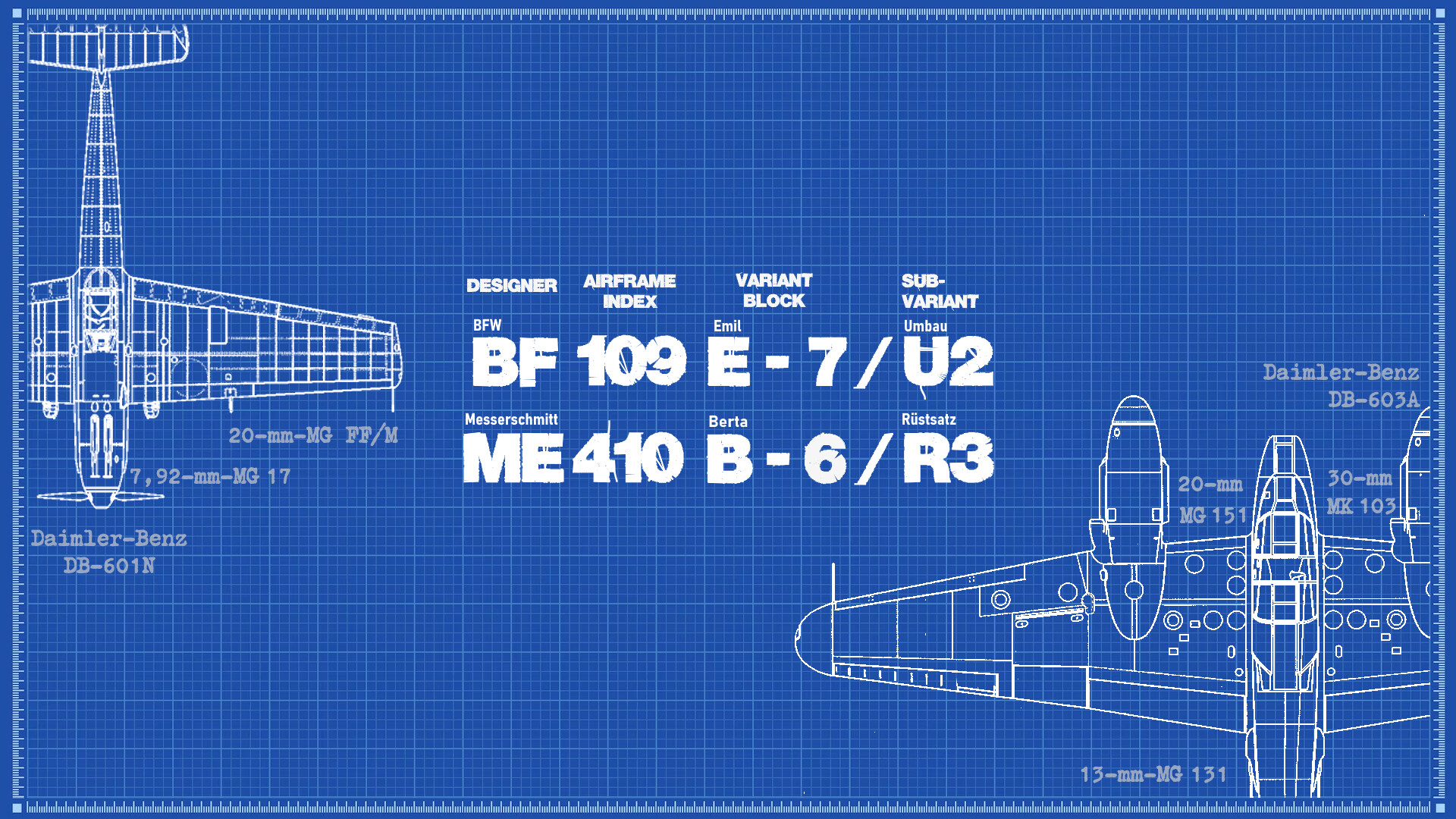
The Luftwaffe designation system, introduced by the Reichsluftfahrtministerium (RLM) around 1932–33, aimed to standardize the naming of all German aircraft, both civilian and military. This system replaced the previously inconsistent, manufacturer-specific designations by assigning each aircraft a unique three-digit number, paired with a standardized two-letter manufacturer code—such as "Bf" for Bayerische Flugzeugwerke or "Do" for Dornier. Initially, these codes followed a format of one capital and one lowercase letter, though later exceptions included two capitals (e.g., "BV" for Blohm & Voss).
Internally, aircraft were indexed with an “8-” prefix (e.g., Bf 109 = 8-109) and "108-" for gliders in RLM documentation. Number blocks were often reserved for individual manufacturers, though overlaps and reassignments occasionally occurred due to project cancellations, reorganizations, or legacy naming. Captured or foreign-built aircraft were also assigned RLM numbers, though typically without manufacturer codes. Despite its structure, the system was frequently supplemented with unofficial names, internal project numbers, or even fictional designations—some introduced for propaganda or mistakenly adopted by Allied forces, later persisting in postwar literature.
Manufacturer / Designer
| In-Game manufacturers | |
|---|---|
| Ar | Arado |
| Bf | Bayerische Flugzeugwerke (BFW) |
| BV | Blohm & Voss |
| Do | Dornier |
| Fw | Focke-Wulf |
| He | Heinkel |
| Hs | Henschel |
| Ho | Reimar und Walter Horten |
| Ju | Junkers |
Over time, some manufacturer designations were changed or reassigned. Bayerische Flugzeugwerke (BFW), originally a continuation of Udet Flugzeugbau, produced aircraft designed by Willy Messerschmitt, who initially worked as an independent designer. Due to political tensions—particularly between Messerschmitt and State Secretary Erhard Milch—the RLM assigned the prefix Bf to the company rather than Me for Messerschmitt himself. In 1938, BFW reorganized as Messerschmitt AG, and the RLM granted it the new prefix Me. However, aircraft designed before this change, like the Bf 108, Bf 109, and Bf 110, retained their original Bf designation throughout the war.
Blohm & Voss provides another example, having originally formed an aircraft division under the name Hamburger Flugzeugbau (Ha). Due to the prominence of the parent company, later designs used the prefix BV, which the RLM eventually formalized. Toward the end of the war, production was decentralized due to Allied bombing and rising demand, leading to some aircraft being identified by designer initials rather than strict manufacturer codes.
| Replacement for | ||
|---|---|---|
| BV | Blohm & Voss | Ha (Hamburger Flugzeugbau) |
| Me | Messerschmitt | Bf (BFW) |
Later in the war, as Allied bombing intensified and aircraft demand surged, the RLM increasingly distributed production across multiple factories, often involving different manufacturers. This decentralization, combined with the development of new designs under chaotic conditions, led to some aircraft being designated by the initials of their chief designers rather than the original manufacturers—marking a departure from the earlier standardized system.
| Designer | Former manufacturer | |
|---|---|---|
| Ta | Kurt Tank | Focke-Wulf |
| Ka | Albert Kalkert | Gothaer |
| Hü | Ulrich Hütter | n/a (University) |
| Li | Alexander Lippisch | DFS, Messerschmitt |
| Code | Designer | Replacement |
|---|---|---|
| Al | Albatros | |
| As | Argus Motoren | |
| Ba | Bachem | |
| Bü | Bücker Flugzeugbau | |
| DFS | Deutsche Forschungsanstalt für Segelflug | n/a (Rhön-Rossitten Gesellschaft) |
| Fa | Focke-Achgelis | |
| Fg | Flugtechnische Fertigungsgemeinschaft Prag | |
| Fh | Flugzeugwerke Halle | |
| Fi | Fieseler | |
| FK | Flugzeugbau Kiel | |
| Fl | Flettner | |
| Go | Gothaer Waggonfabrik | |
| Ha | Hamburger Flugzeugbau (HFB) | |
| HM | Hirth Motoren GmbH | |
| Kl | Klemm Flugzeugbau | |
| NR | Nagler-Rolz | |
| Si | Siebel | Fh (Flugzeugwerke Halle) |
| So | Heinz Sombold | |
| Sk | Škoda-Kauba | |
| We | Weser Flugzeugbau | |
| ZMe | Zeppelin/Messerschmitt | |
| ZSo | Zeppelin/SNCASO |
Variants & sub-variants
Variants and sub-variants in the RLM system were organized using a clear and consistent structure. Standard production variants were designated alphabetically by letter blocks (e.g., Ju 88 A, B, C), with minor changes within those blocks identified by numbers (e.g., Ju 88 A-1, A-4). Major redesigns that significantly altered the airframe received entirely new type numbers, typically increasing the hundreds digit (e.g., Ju 88 → Ju 188 → Ju 288 → Ju 388 → Ju 488).
Several additional suffixes were used to indicate specific sub-variant types:
- V (Versuchs) – Prototype aircraft, replacing the variant block entirely.
- R (Rüstsatz) – Pre-packaged field conversion kits allowing for mission-specific modifications without factory rework.
- U (Umrüst-Bausatz) – Factory- or depot-installed conversion kits applied to aircraft on production or during overhaul.
- trop (tropen) – Modifications for tropical climates, enabling aircraft to operate effectively in hot and dusty environments such as North Africa, the Mediterranean, or southern Russia.
Nicknames
German aircraft during World War II were often assigned nicknames—some officially designated by the RLM, others coined informally by aircrews, the public, or Allied forces. While formal designations such as Bf 109, He 111, or Fw 190 followed a structured system combining manufacturer codes and type numbers, nicknames helped make these aircraft more recognizable, easier to reference, or more suitable for propaganda purposes.
Some of the most iconic examples include:
- Bf 109 "Messerschmitt" – Though "Messerschmitt" referred to the manufacturer (initially BFW), the name became synonymous with the aircraft and was widely used as a shorthand nickname, especially by Allied forces. It was also commonly shortened verbally to "one-oh-nine."
- Fw 190 "Würger" (Shrike) – Officially named after a fierce predatory bird, reflecting its aggressive and high-performance fighter role.
- Ju 87 "Stuka" – A contraction of Sturzkampfflugzeug (dive bomber), a nickname that became so prominent it essentially replaced the full designation in both German and Allied vocabulary.
- Me 262 "Schwalbe" (Swallow) – Germany’s first operational jet fighter, earning a graceful yet lethal nickname befitting its revolutionary design.
- He 162 "Volksjäger" (People’s Fighter) – A late-war emergency fighter designed for simplified mass production, intended for use by hastily trained pilots.
These nicknames—whether born from official naming conventions or from front-line familiarity—remained deeply tied to each aircraft’s legacy and continue to be used in historical literature and popular culture today.
Engine designation
The RLM employed an internal engine designation system to classify German aircraft engines, using a numeric prefix to indicate the engine type: “9” for piston engines and “109” for jets, rockets, turbojets, and turboprops. This was followed by a manufacturer code (assigned numerically) and a model or series number. For example, the BMW 801 radial engine used in the Focke-Wulf Fw 190 was officially designated 9-801
- 9 for piston engine
- 8 for BMW — 01 as the engine series
However, this system was inconsistently applied even within the RLM, and in practice, engines were more commonly referred to by their manufacturer's name and model number (e.g., BMW 801, DB 605, Jumo 004). The 109-series engines, which included jet and rocket propulsion systems, did not strictly follow manufacturer-specific numbering, and designations were assigned more flexibly. Despite its formal structure, the internal system remained secondary to common usage naming conventions throughout the war.
- 090–099 – various minor manufacturers
- 1 – Bayerische Motorenwerke GmbH (BMW); later changed to 800 block
- 2 – Junkers Flugzeug- und Motorenwerke A.G.
- 3 – BMW-Flugmotorenwerke Brandenburg GmbH (BMW-Bramo)
- 4 – Argus Motoren GmbH
- 5 – Heinkel Hirth Motoren GmbH
- 6 – Daimler-Benz A.G.
- 7 – Brückner or Klöckner-Humboldt-Deutz A.G.
- 8 – Bayerische Motorenwerke GmbH (BMW)
Panzerwaffe
For additional clarification, refer to the abbreviation section above.
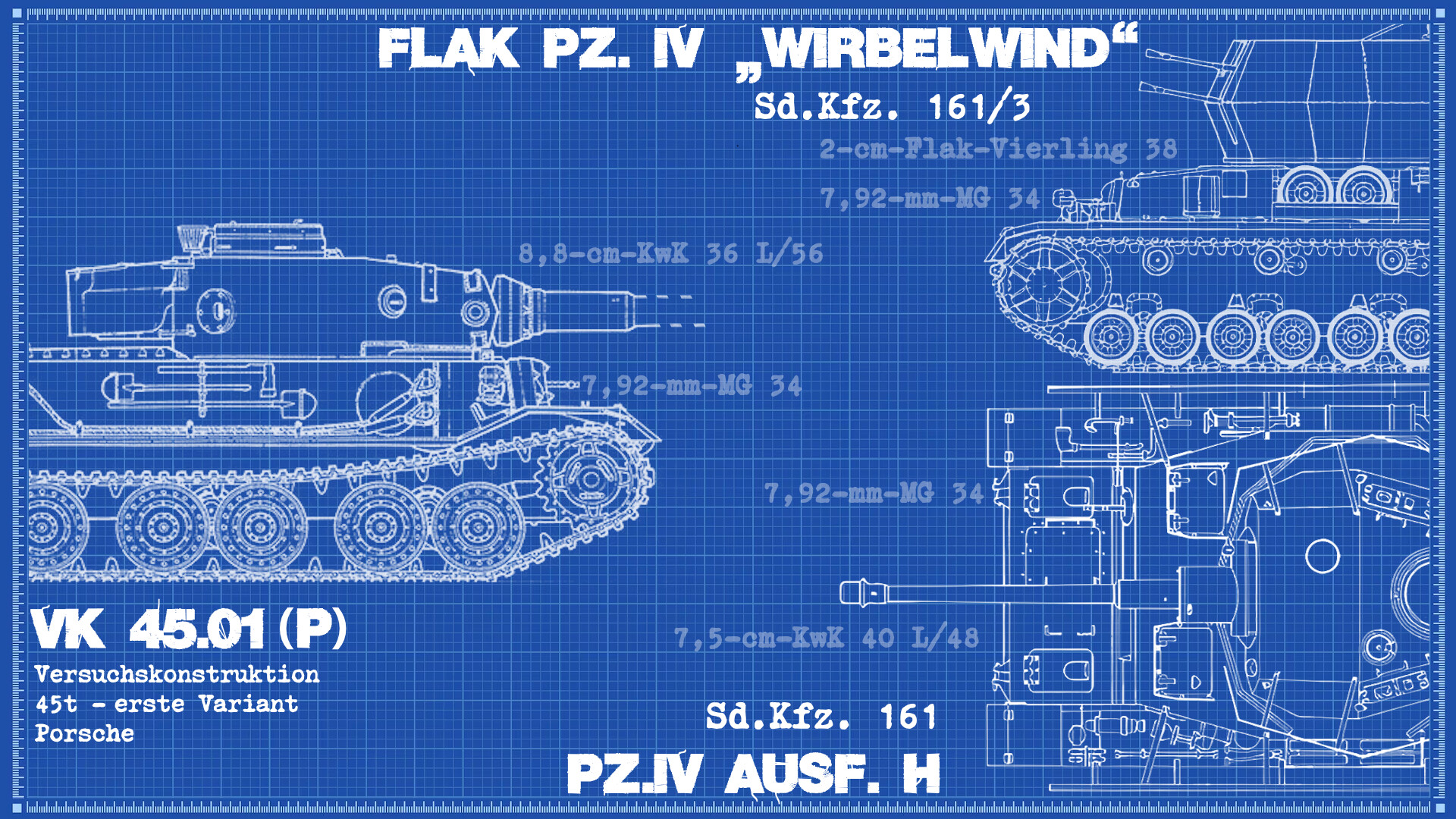
German tank designations during World War II followed a structured yet evolving system that combined formal names, prototype identifiers, and practical shorthand.
The core of the naming convention was the Pz.Kfw. / Pz. (Panzerkampfwagen), followed by a Roman numeral to denote the model series—from Pz. I through Pz. VIII. These were typically accompanied by variant identifiers such as Ausf. A, Ausf. G, and so on.
Experimental and pre-production vehicles were designated with the prefix VK (Vollkettenfahrzeuge), followed by a number indicating the vehicle’s target weight class and development sequence, often ending with a manufacturer initial—e.g., VK 30.02(M), the second 30-ton-target prototype (by MAN).
Other experimental vehicles were designated by the prefix Vs.Kfz. (Versuchskraftfahrzeug). These were assigned seemingly arbitrary numbers and were often highly classified; as a result, their designations were rarely mentioned and were frequently replaced with code names or internal development numbers at the manufacturing companies.
Other categories, such as Jagdpanzer and Panzerjäger, followed similar designation principles but applied to specialized vehicles like tank destroyers, many of which were based on modified or captured chassis.
From around 1940 onward, many German tanks were given nicknames—often selected or approved by Hitler himself—for propaganda purposes and to make them more memorable than their formal designations. Names like Panther (Pz.Kfw. V), Tiger (Pz.Kfw. VI), and Maus (Pz.Kfw.VIII) quickly became widespread in both military and public use. Though not always official, these nicknames were commonly adopted by crews and widely recognized in wartime communications and Allied reports.
Sd.Kfz. Index
Sonderkraftfahrzeug (abbreviated Sd.Kfz.) was the ordnance inventory designation used by Nazi Germany during World War II for military vehicles—ranging from armored and half-tracked to fully tracked platforms.
- Sd.Kfz. 1 – 99: Unarmoured half-tracked vehicles:
| Note | ||
| Sd.Kfz. 4 | Mercedes 4,5 t "Maultier" | |
| Sd.Kfz. 4/2 | 15 cm Pz.W.42 | |
| Sd.Kfz. 6 | m.Zg.Kw. 5 t Pionier | |
| Sd.Kfz. 6/1 | m.Zg.Kw. 5 t Artillerie | |
| Sd.Kfz. 6/2 | 3,7 cm FlaK 36 | |
| Sd.Kfz. 9 | s.Zg.Kw. 18 t "Famo" | |
| Sd.Kfz. 9 (FlaK 37) | 8,8 cm Flak 37 Sfl. |
- Sd.Kfz. 100 – 199: Tanks and tank variants, such as tank destroyers and self-propelled artillery:
| Vehicle(s) | Gun | ||
|---|---|---|---|
| Sd.Kfz. 121 | Pz.II A – F | ||
| Sd.Kfz. 138 | Marder III H | 7,5-cm-PaK 40/3 | |
| 138/2 | Jgd.Pz. 38(t) | ||
| Sd.Kfz. 139 | Marder III | 7,62-cm-PaK 36 | |
| Sd.Kfz. 140 | FlaK.Pz. 38(t) | ||
| 140/1 | Aufkl.Pz. 38(t) | ||
| Sd.Kfz. 141 | Pz.III A – J | 3,7-cm-KwK 36 or 5-cm-KwK L/42 | |
| 141/1 | Pz.III J1 – M | 5-cm-KwK 39 | |
| 141/2 | Pz.III N | 7,5-cm-KwK 37 | |
| Sd.Kfz. 142 | StuG III A – E | 7,5-cm-KwK 37 | |
| 142/1 | StuG III F – G | 7,5-cm-StuK 40 | |
| 142/2 | StuH 42 | 10,5-cm-leFH 18 | |
| Sd.Kfz. 161 | Pz.IV A – F1 | 7,5-cm-KwK 37 | |
| 161/1 | Pz.IV F2 – G | 7,5-cm-KwK 40 L/43 | |
| 161/2 | Pz.IV G – J | 7,5-cm-KwK 40 L/48 | |
| 161/3 | Ostwind, Möbelwagen Kugelblitz | 3,7-cm-FlaK 36 2x 3-cm-MK 103 | |
| 161/4 | Wirbelwind | 4x 2-cm-FlaK 38 | |
| Sd.Kfz. 162 | Jgd.Pz.IV | 7,5-cm-PaK 39 | |
| 162/1 | Pz.IV/70 (V) (A) | 7,5-cm-PaK 42 | |
| Sd.Kfz. 164 | Nashorn | ||
| Sd.Kfz. 166 | Brummbar | ||
| Sd.Kfz. 171 | Pz.V 'Panther' | ||
| Sd.Kfz. 172 | Pz.V 'Panther II' | ||
| Sd.Kfz. 173 | Jagdpanther | ||
| Sd.Kfz. 181 | Pz.VI 'Tiger' | ||
| Sd.Kfz. 182 | Pz.VI 'Tiger II' | ||
| Sd.Kfz. 184 | Ferdinand / Elefant | ||
| Sd.Kfz. 186 | Jagdtiger |
- Sd.Kfz. 200 – 299: Reconnaissance vehicles, armoured cars, armoured personnel carriers, and command tanks:
| Note | ||
|---|---|---|
| Sd.Kfz. 221 | le.Pz.Sp.Wg. (MG) | |
| Sd.Kfz. 221 (s.Pz.B.41) | ||
| Sd.Kfz. 222 | le.Pz.Sp.Wg. (2 cm) | |
| Sd.Kfz. 234 | s.Pz.Sp.Wg. | |
| Sd.Kfz. 234/1 | 2-cm-KwK 38 | |
| Sd.Kfz. 234/2 | 5-cm-KwK 39/1 | |
| Sd.Kfz. 234/3 | 7,5-cm-KwK 37 | |
| Sd.Kfz. 234/4 | 7,5-cm-PaK 40 | |
| Sd.Kfz. 251 | m.SPW. | |
| Sd.Kfz. 251/9 | 7,5-cm-KwK 37 | |
| Sd.Kfz. 251/10 | 3,7-cm-PaK 36 | |
| Sd.Kfz. 251/21 I | 3x MG151/15 | |
| Sd.Kfz. 251/21 II | 3x MG151/20 | |
| Sd.Kfz. 251/22 | 7,5-cm-PaK 40 |
- Sd.Kfz. 300+: Mine-clearing and demolition charge laying vehicles
Beutepanzer

During World War II, Germany systematically catalogued captured foreign military equipment under a documentation series titled Kennblätter fremden Geräts D 50 (“data sheets of foreign equipment, D 50 series”). This extensive register covered a wide array of materiel—including small arms, artillery, vehicles, and various technical equipment—used or studied by the Wehrmacht. Each volume within the series focused on a different category, offering technical specifications, identification guides, and operational notes. For example, small arms might appear in D 50/1, while vehicles were specifically documented in D 50/12.
Among the most notable entries were Beutepanzer (“loot tanks”), which were foreign armored vehicles either captured in combat or acquired from occupied production facilities. These were re-designated according to German conventions, often reflecting their type, caliber, year of origin, or fragments of the original designation. While the naming aimed to bring consistency, the system was sometimes irregular due to overlapping categories or rushed field usage.
| German | English | |
|---|---|---|
| 200 | Panzerwagen | Armoured cars |
| 300 | Halbkettenfahrzeuge | Half-tracks |
| 400 | Gepanzerte Halbkettenfahrzeuge | Armoured half-tracks |
| 600 | Vollketten-Artilleriezugmaschinen | Fully-tracked artillery tractors |
| 630 | Gepanzerte Artilleriezugmaschinen | Armored artillery tractors |
| 700 | Panzer | Tank |
| 800 | Waffenträger Selbstfahrlafetten | Self-propelled artillery Self-propelled guns |
| German | English | |
|---|---|---|
| (a) | amerikanisch | American |
| (b) | belgisch | Belgian |
| (d) | dänisch | Danish |
| (e) | englisch | English |
| (f) | französisch | French |
| (g) | griechisch | Greek |
| (h) | holländisch | Dutch |
| (i) | italienisch | Italian |
| (j) | jugoslawisch | Yugoslavian |
| (n) | norwegisch | Norwegian |
| (ö) | österreichisch | Austrian |
| (p) | polnisch | Polish |
| (r) | russisch | Russian |
| (s) | schweizerisch | Swiss |
| (t) | tschechisch | Czechoslovakian |
| (u) | ungarisch | Hungarian |
In-game examples:
This overview only covers vehicles available in the German tech tree; many more captured vehicles were used in reality, including non-captured vehicles represented in other nations' trees.
* Not all captured equipment were assigned an index, especially those used briefly after capture or only for evaluation.
Modifications based on captured hulls retained their designation, regardless of the extent of changes made to achieve the final design.
| Designation | Base vehicle |
|---|---|
| Pz.Jg. 38(t) "Marder III H" (Sd.Kfz.138) | LT-38 |
| Jgd.Pz. 38(t) (Sd.Kfz.138/2) | |
| Pz.Jg. 38(t) "Marder III" (Sd.Kfz.139) | |
| FlaK.Pz. 38(t) (Sd.Kfz.140) | |
| Aufkl.Pz. 38(t) (Sd.Kfz.140/1) | |
| Pz.Sp.Wg. P 204(f) mit 5 cm KwK 39/1 | AMD-35 (Panhard 178) |
| Pz. 756(r) KW IC mit 7.5 cm KwK 40 | KV-1 (Model 1942) |
Entwicklung Series
The E-Series (Entwicklung series) was a late-war German project aimed at streamlining armored vehicle production by standardizing design elements across multiple tank classes. Conceived in 1943–44 as a response to the increasingly complex and resource-intensive German tank industry, the E-Series sought to replace the diverse range of existing models—such as the Panzer IV, Panther, and Tiger—with a more modular and efficient lineup. The series was divided into weight classes, from the light E-10 and E-25 to the medium E-50, heavy E-75, and super-heavy E-100. Each design was intended to simplify maintenance, share common components, and incorporate sloped armor and advanced suspensions. However, none of the E-Series tanks reached mass production before the end of the war, with only prototypes or incomplete hulls constructed.
Bundeswehr
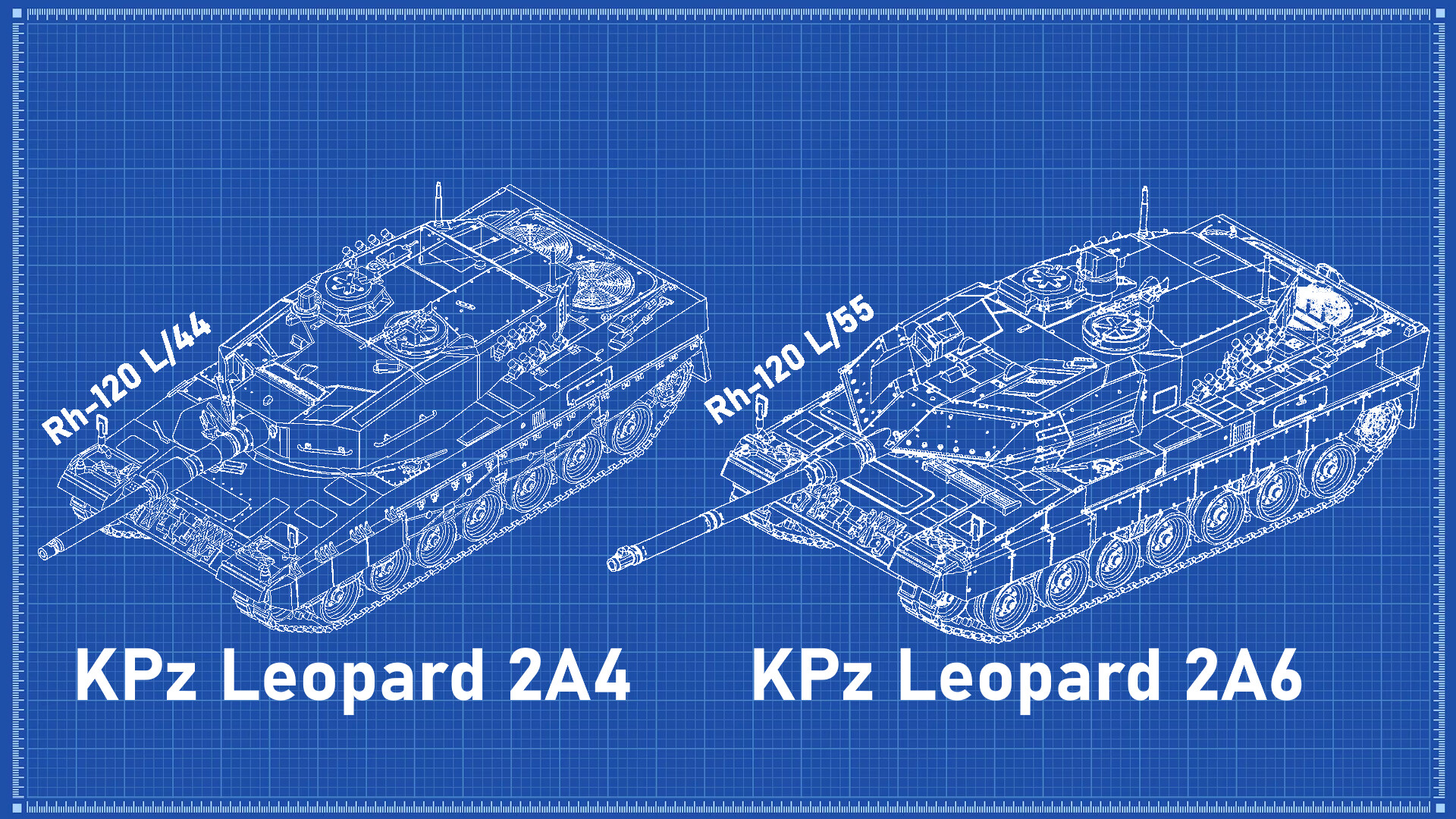
With the postwar restructuring of the German military, abbreviations were streamlined and modernized, slightly distancing them from their World War II predecessors. Comparable vehicle roles were renamed accordingly—for example, Pz.Kpfw. became KPz (Kampfpanzer), and Jagdpanzer, and Jägers were shortened to JPz.
| German | Translation | |
|---|---|---|
| KPz. | Kampfpanzer | MBT |
| JPz. | Jagdpanzer | Tank destroyer |
| SPz. | Schützenpanzer | APC / IFV |
| FlakPz. | Flugabwehrpanzer | SPAA |
| PzH. | Panzerhaubitze | SPH |
| ... | ... | ... |
Just like during World War II, postwar German vehicles often received animal-based nicknames that eventually became part of their official designations—such as the KPz Leopard main battle tank. Variants are designated similarly to U.S. tanks, using a sequential improvement system. For example, the original Leopard became the KPz Leopard A1, then A2, and so on. The designation KPz Leopard 1 was only retroactively applied after the introduction of its successor, the KPz Leopard 2, to distinguish between the two series.
Kriegsmarine
The Kriegsmarine, Germany’s navy during World War II, used a mixture of traditional ship class names, project codes, and internal designations to identify its vessels and design projects. While major warships followed naming conventions based on ship type and class, smaller craft and experimental designs were often labeled with project numbers or letter-based abbreviations.
Capital ships such as battleships (Schlachtschiffe), cruisers (Kreuzer), and destroyers (Zerstörer) were typically named after historical figures, cities, or regions. Ships up to destroyers and smaller vessels—including submarines (U-Boote)—used sequential numbering systems prefixed with type-specific codes, such as:
| German | Translation | |
|---|---|---|
| U | Unterseeboot | Submarine (SS) |
| Z | Zerstörer | Destroyer (DD) |
| T | Torpedoboot | Torpedo boat (TB) |
| K | Kanonenboot | Gun boat |
| S LS VS | Schnellboot Leichte- Versuchs- | Patrol boat Light- Prototype- |
| R | Räumboot | Minesweeper |
| SF | Siebelfähre | Siebel ferry |
| AF | Artilleriefährprahm | Artillery ferry barge |
| MZ | Mehrzweckboot | Multi-purpose boat |
Ship classes varied significantly in their naming conventions. Most followed a base class name, with subclasses denoted alphabetically (A, B, etc.). Some were tagged with (Mob) for Mobilmachung (“mobilization”), indicating simplified variants designed for quicker wartime construction:
| Class-name | Example | |
|---|---|---|
| Capital ships (CV/BB/BC/CA/CL) | Lead ship | Admiral Hipper-class |
| Destroyers (DD/TB) | Type [Design Year] | Type 1934-class |
| Submarines (SS) | Type [Roman Numeral] | Type VII-class |
| Other (...) | n/a |