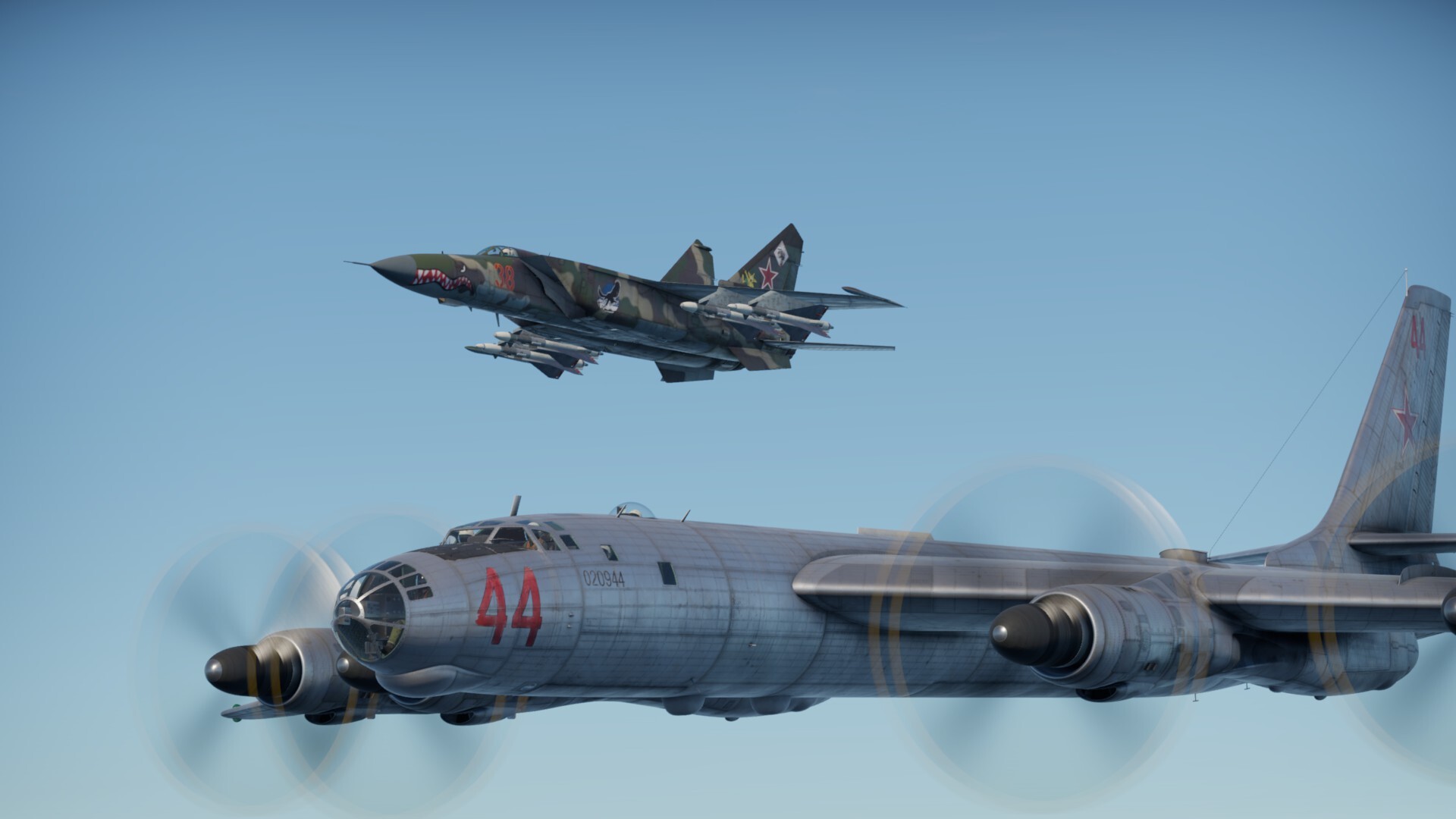
The MiG-25PD “Foxbat-E” was the Soviet Union’s brute-force answer to the blistering pace of technological advances in speed as the United States worked to produce Mach 3-capable aircraft. While the threat of Mach 3-capable nuclear bombers never came to fruition with the advent of ICBMs, the Lockheed A-12 and later SR-71 Blackbird presented a threat to the USSR’s national security sufficient to justify the production of a unique, record-breaking Mach 3-capable interceptor. In War Thunder, the MiG-25PD presents itself as a very unique aircraft that doesn’t fit the playstyle many players at Rank VII are accustomed to, but when played to its strengths, it becomes one of the most fun and enjoyable aircraft to fly in all of War Thunder.
| Pros | Cons |
| Fastest aircraft in the entire game, with blisteringly fast acceleration and climb rate past Mach 1 | No ACM mode for the radar, and the look-down mode is very situational |
| Amazing long-range missile armament | Acceleration at takeoff is noticeably poor |
| Has a decent amount of countermeasures and can easily outrun most missiles | Lack of gun or ground ordnance makes gameplay very one-dimensional |
| Radar has decent resistance to ground clutter with a look-down/MTI and IRST mode | Engines produce an absolutely enormous heat signature which makes flaring missiles difficult |
| Extremely difficult aircraft to intercept in a tail-chase | Very low IAS combined with extremely high thrust makes ripping the wings a serious risk |
| Shockingly good energy retention thanks to powerful engines | Very heavy airframe makes maneuvers past 7G almost impossible |
Table of Contents:
GAME REVIEW
2. Weaponry
A Brief History of the Foxbat’s Beginnings
The Soviet PVO (Air Defense Force) during the Cold War was an entirely separate division of the USSR’s vast armed forces, tasked with not only dealing with violations of airspace but also defending the colossal borders of the USSR from hostile intruders, such as the very frequent overflights by American U-2 spy planes. The more dangerous threats, however, were nuclear-armed intercontinental bombers such as the B-52 and B-47.
The Soviet Union invested vast quantities of resources into creating the most heavily fortified air defense systems possible at the time, which included SAM systems such as the infamous S-75 “Dvina” (NATO designation: SA-2 Guideline) that proved their value in the infamous shoot-down of a U-2 spy plane flown by Francis Gary Powers in 1960, as well as in the jungles of Vietnam where they proved to be an incredibly frustrating hurdle for the US military to navigate during the conflict.
While these surface-to-air missile systems helped to tackle the issue of nuclear-armed B-52s, B-47s, and U-2 reconnaissance flights, the threat posed by American Mach 3-capable aircraft like the Lockheed A-12 and XB-70 Valkyrie demonstrated a serious gap in the Soviets' interceptor force, which at the time was limited to the subsonic Yak-25 (NATO designation: Flashlight-A/Mandrake) and Mach 2-capable but technologically limited Su-9 (NATO designation: Fishpot).
A Herculean Project
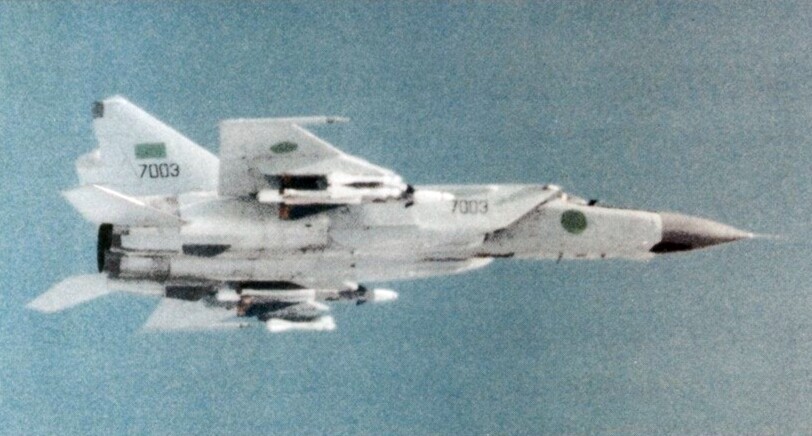
In 1958, the Mikoyan-Gurevich design bureau was tasked with producing a Mach 3 interceptor capable of climbing to 27 km (85,000 feet). And in 1959, real design work began on the project. The biggest hurdle Soviet engineers faced was the intense heat and stress imposed on the airframe at supersonic speeds, especially at Mach 3. The Soviet Union had an abundance of titanium, which would be the most practical solution for such a problem; however, the infrastructure to manufacture the titanium alloys needed was nearly nonexistent and nowhere near advanced enough for the scale of production the PVO wanted for its new interceptor.
Thus, the decision was made to make the fuselage mostly from heavy nickel steel, which was much easier to manufacture, while leaving small titanium inserts in heat-critical areas to prevent the aircraft from disintegrating mid-flight due to heat stress. While this solved the problem of preventing the airframe from melting at speeds approaching Mach 3, it made the aircraft’s handling and maneuvering so cumbersome that any maneuver exceeding roughly 5Gs would put the airframe at risk of overstress. Albeit this was considered a non-issue for the Soviet Union because the MiG-25 would be tasked with traveling in a mostly straight line anyway.
For the MiG-25’s avionics, such as its radar, the designers at Mikoyan-Gurevich opted for more rugged vacuum-tube electronics due to their superior tolerance for extreme temperatures and resistance to EMP. In a similar regard, it is very important to address the common misconception that Soviet engineers were often behind their American counterparts. Soviet and American engineers were often evenly matched in their knowledge base. Still, Soviet industry lagged behind American industry in electronics, often requiring Soviet engineers to make do with technology usually a generation or more behind the latest American designs. There was also significant prioritization of ease of maintenance in Soviet designs, along with ruggedness, which is why aircraft such as the MiG-25 received high praise from Soviet ground crews for being incredibly easy to repair and maintain.
Nuclear Nonsense
The next problem was the engines. Which, believe it or not, the Tumansky R-15 that we now know today was not explicitly built for the MiG-25 program. It was actually built for a nuclear-armed cruise missile and later reconnaissance drone, the Tu-121 and Tu-123 “Yastreb” respectively. In the late 1950s, the R-7 “Semyorka” 1st-generation ICBM (NATO designation: SS-6 “Sapwood”), which made up the majority of the Soviet Union’s ICBM fleet at the time, required almost an entire day to be set up for launch in the possible event of a nuclear war, and could only be held on “launch notice” for a span of roughly 24 hours.
This catastrophic lack of readiness was not due to the Soviets' inability to quickly prepare it for launch on their own, but because the highly corrosive liquid fuel powering the R-7's massive booster rockets would eat through the missile’s fuel tanks if left idle. This absolutely prohibited the Soviets from leaving their rockets fueled for launch and required the entire Soviet ballistic missile force to be given a minimum of a day’s notice to start prepping their ICBMs just in case a nuclear war were to possibly start.
The “day notice” policy was also part of what caused the 1962 Cuban Missile Crisis to creep so close to an all-out nuclear war. When American U-2s and satellites picked up photos of R-7 missiles being prepared for launch in Soviet territory, this was one of the factors that caused the United States to enter a full-blown panic mode and move its DEFCON level all the way down to DEFCON 2. The Soviets were originally intent on using Cuba as a way to “gambit” the United States with their quicker-to-deploy, shorter-range missiles like the R-12 “Dvina” (NATO designation: SS-4 “Sandal”), and R-14 “Chusovaya” (NATO designation: SS-5 “Skean”), which didn’t suffer from the same problem as the R-7s.
The Soviet Union, however, attempted to develop an alternative to its nuclear ballistic missile program in the form of supersonic nuclear cruise missiles, which held a number of advantages over ICBMS. Firstly, cruise missiles had an element of surprise because they were much more difficult to detect on radar at the time. This was not because of stealth technology, as that hadn’t been developed yet, but because the United States' early warning systems were not programmed to detect cruise missiles rather than ballistic missiles, as their trajectories were way different and cruise missiles flew lower to the ground. Secondly, they could be prepared for launch much more quickly than regular ballistic missiles like the Semyorka.
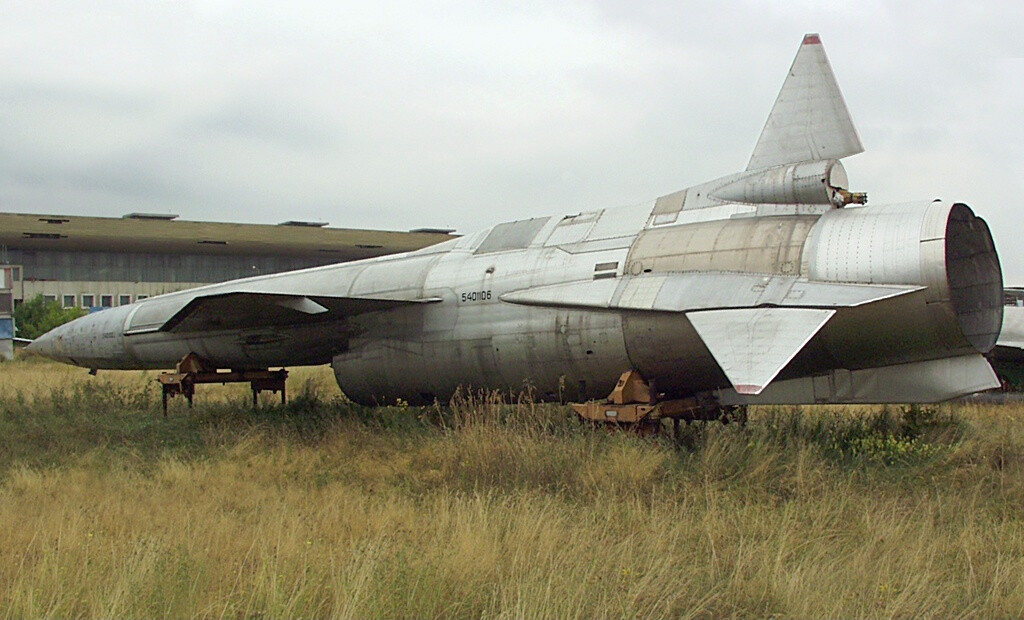
The Tupolev design bureau, famous for developing long-range bombers such as the Tu-4, Tu-95, Tu-16, and Tu-22 (NATO designations: “Bull”, “Bear”, “Badger”, and “Blinder”), was tasked with developing such a missile, codenamed the Tupolev Tu-121. Development, however, immediately ran into serious complications when it was determined that the technology being developed for the project was far too advanced for its time. Thus, the decision was made to repurpose the Tu-121's airframe and engine, both of which were structurally sound, into an expendable supersonic reconnaissance drone, codenamed the Tupolev Tu-123 “Yastreb”.
The Most Useful Engine
The Tu-123 “Yastreb” was an overall success, but the engine that powered it, the Tumansky R-15, would also be commandeered for a cutting-edge interceptor project under development at the Mikoyan design bureau. This was introduced to complement the cutting-edge Vozdukh-1 ground control interception (GCI) system, which was being pioneered at the same time by the Soviet Armed Forces.
The interceptor aspect of the project would be shelved due to a variety of reasons. But the Ye-150 and Ye-152 prototypes that were retained from the cancelled program would still prove useful as testbeds for the variety of systems being implemented in other projects. This included the Tumansky R-15 jet engine, originally intended for use with the Ye-150 series but later implemented in the Ye-155 (The MiG-25’s predecessor), as well as for testing the aircraft-side avionics of the Vozdukh-1 Ground-Control Interception (GCI) system, which would later be rolled out across the entire Soviet Air Defense Force.
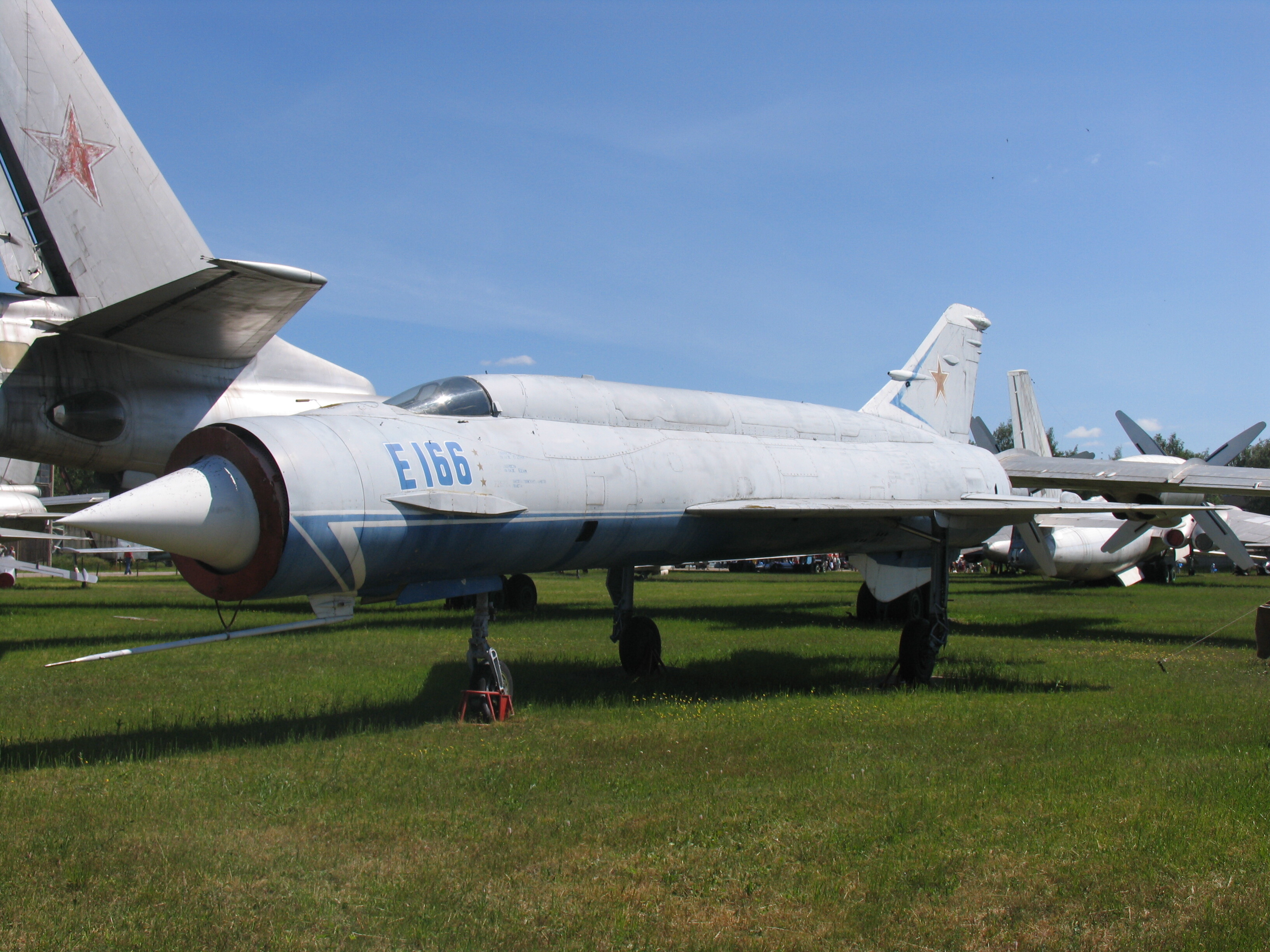
The flight data collected from the Ye-150 family of interceptor testbeds was nothing short of astonishing, most notably achieving a climb rate nearly double that of the MiG-21 currently in service at the time, and it could hit a top speed approaching Mach 2.8 in mere minutes, making the Ye-150/152 one of the fastest single-engine fighter jets in all of human history. Some of the records it established under the Ye-166 designation still stand today.
There were, of course, massive caveats to the astronomic performance of the Tumansky R-15. Most notably, the R-15 had a very short initial lifespan of around 25 hours and was highly unreliable at first. During flight tests, the R-15 was notorious for melting down and disintegrating mid-flight multiple times due to the intense heat and stress imposed on the turbine blades. Nevertheless, the flight tests performed by the Ye-150 and Ye-152 testbeds helped to resolve teething problems with the R-15's reliability, which would later make it a favorite among Soviet ground crews working on the MiG-25, despite its very short working lifespan.
The Flying Restaurant
The Soviet Union, like most armed forces, was often plagued by the never-ending issue of its soldiers attempting to make alcohol with whatever they had on hand. While the US Navy’s “Torpedo Juice” may come to mind, brought about by a ban on alcohol and spirits onboard US Navy ships during WWII, the stereotype of Russians being alcoholics was not an exaggeration in the slightest for two specific groups of the Soviet Armed Forces: The Soviet Air Forces (VVS) and the Soviet Air Defense Forces (PVO).
In the Soviet Union, aviation refrigerants, such as the 40% ethyl alcohol and 60% distilled water mixture used in the Tu-22, also commonly known to the Soviets as the “Supersonic Booze Carrier” for its massive amount of alcohol carried onboard, were very similar, if not identical, to regular Soviet Vodka. This immediate access to potable alcohol contributed to a plague of alcoholism among Soviet ground crews and pilots, with ground crews often falsifying maintenance records so they could drain the alcohol out of the coolant tanks of their aircraft once they returned from missions for use as an informal currency, among other things.
The plague of alcoholism was so far-reaching up the Soviet command structure that when engineers attempted to replace the alcohol-based refrigerants used on various aircraft with non-potable ones containing methanol, there were mass protests by aircrews who claimed the new methanol-based coolants either didn’t work as effectively as the old alcohol-based coolant or were too poisonous for aircrews to handle. Either way, the idea was dropped, and alcohol-based refrigerants remained in service across the entire Soviet Air Forces and Air Defense Forces.
Most Soviet aircraft had a special nickname for their alcohol “cocktail”. For example, the Tu-22's cocktail had the nickname “Shpaga” for the cabin cooling system, and the Su-15 (NATO designation: “Flagon”) had the nicknames “Sooltyga” and “Shylo” for the alcohol cocktails utilized by the landing gear brakes and radar cooling system, respectively. The MiG-25, however, was very well liked by pilots because, like the Tu-22 “Supersonic Booze Carrier”, it also carried a separate nickname of its own; “The Flying Restaurant.” Soviet air crews and pilots absolutely loved the MiG-25 not just because of its ease-of-maintenance, but also because of the alcohol mixture onboard; a mixture of 50% ethyl alcohol and 50% water, which was considered some of the best-tasting in the entire Soviet Air Force. This reputation earned it the cocktail nickname of “Massandra”, after a famous winery located in Crimea of the same name.
Terrifying the West with a Paper Tiger
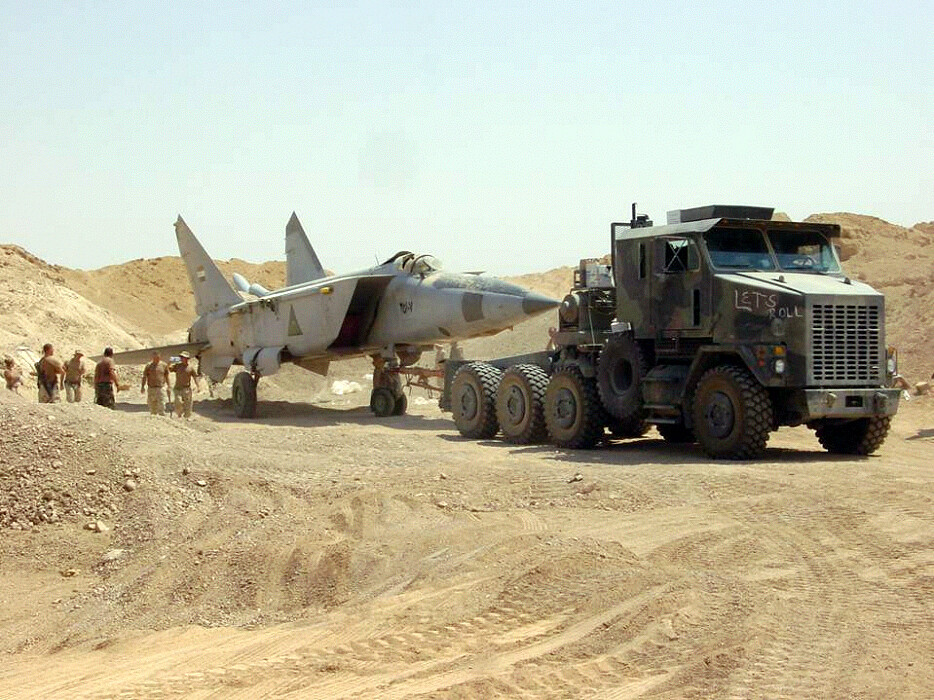
When it was first introduced in the late 1960s, one of the MiG-25’s claims to fame was that it was one of the rare instances that caused the American military to enter a full-blown panic state as the American Intelligence community interpreted the MiG-25’s appearance taken during a Soviet airshow in the 1960s, such as its huge wings and air intakes, as being a high-performance air superiority fighter. Even more convincing were multiple overflights of Israel and the Sinai Peninsula by MiG-25s that reached Mach 3.2 on several occasions. These conclusions were made even worse by photographs of the MiG-25 that eerily resembled the in-progress F-X program, which was under active development for the United States Air Force at the time, leading to the requirements for the F-X program being drastically increased to counter the perceived super-fighter the MiG-25 was expected to be.
In 1976, however, the fears of the American Military were assuaged following the defection of Soviet pilot Viktor Belenko, who brought a working MiG-25 interceptor to land at an airport in Hakodate, Japan. In Japan, the Americans were able to dissect the MiG-25’s inner workings and finally realized that the “super-fighter” the MiG-25 was perceived to be was merely a facade, and that the Soviet Union had massively overhyped the MiG-25 for propaganda purposes. Numerous deficiencies and design compromises were discovered, such as the MiG-25’s overwhelmingly powerful radar, which was almost immune to jamming but lacked a look-down radar mode because it used outdated vacuum-tube electronics.
What was the biggest surprise to the Americans, though, was that they had thought the Soviets had used special composite materials and high-grade titanium, while in reality the MiG-25 was composed almost entirely of nickel-steel alloy, and that its enormous wings and engines were necessary partially because of the MiG-25’s monstrous weight. The consequence of the Soviets’ overuse of the MiG-25 for propaganda purposes was that it inadvertently contributed to the F-15’s extreme performance metrics, driven by the United States' great fear.
With the Soviets now faced with the exposure of the MiG-25’s flaws, a hasty upgrade program was implemented, including better engines, a new radar with a look-down/shoot-down mode, and a wing-mounted countermeasures dispenser to decoy enemy missiles. The MiG-25PD program would be pushed out to the Soviet Union in the 1970s, while the MiG-25's compromised secrecy made the Soviets more open to exporting the aircraft to Middle Eastern client states such as Algeria, Syria, and Iraq.
Game review
Flight Performance
On the topic of speed, the MiG-25 is the undisputed fastest aircraft in the entire game, capable of reaching Mach 3 at altitudes of around 16,000 meters. While you are probably not going to hit Mach 3 in a regular battle, what is important is how quickly you can get up to speed and how well you can hold that speed. This is where the R-15s stop being regular jet engines and start to behave more like ramjets, with incredible thrust at higher speeds. Unlike most jet aircraft, which accelerate much more slowly past Mach 1 due to increased supersonic drag, the MiG-25 has a unique ability to brute-force its way through the air via the excessive amounts of thrust the twin Tumansky R-15 engines can output.
Its acceleration, however, can be bipolar at times. While it achieves frankly absurd levels of acceleration past supersonic speeds, its subsonic acceleration is uncharacteristically lackluster for such a fast aircraft. Thanks to its enormous weight, the MiG-25's acceleration and climb rate at lower speeds feel especially sluggish and cumbersome, best described as pushing a giant boulder up a hill. Energy management in the MiG-25 is not focused on preserving speed for and/or in a dogfight, but instead on ensuring you have as much speed as possible before entering a climb so your engines operate closer to peak thrust. This is one of your biggest flaws when trying to play conventionally. Being caught in a slow, vulnerable state would be a bad position in a normal jet, but in the MiG-25, it is an outright death sentence thanks to your weight and very poor low-speed engine thrust.
What may become obvious when you suddenly rip your wings after leaving your afterburner on for slightly too long is that the MiG-25’s IAS (Indicated Air Speed) limit is very low for an aircraft of its speed, being only 1320 km/h. This is even worse than some early supersonic jets, such as the MiG-19 and F-100 Super Sabre. This, combined with the overwhelming high-speed thrust of your engines, results in the MiG-25 being able to blow past its rip speed even quicker than almost any aircraft in the game. Effective speed management and deploying the airbrakes are necessary, especially at higher supersonic speeds, where even a slight dive with afterburners can have you blowing past your rip speed in seconds.
The MiG-25’s aerodynamically clean airframe and sheer thrust output of its two R-15 engines allow it to hold its speed surprisingly well in maneuvers, especially above Mach, despite its overwhelming weight. On the flip side, the MiG-25’s nickel-steel airframe gives it absolutely horrific agility in all other scenarios, making it more of a lumbering giant careening through the atmosphere than the nimble air superiority fighter the Americans initially perceived it to be. Even airframes like the F-4 Phantom, which are known for their awful maneuverability, can easily out-turn you without breaking a sweat. In reality, the MiG-25’s best analog for maneuverability is a supersonic jet bomber like the Yak-28. The point is that you should avoid dogfighting at all costs, as you not only have awful maneuverability, but almost every single characteristic of the MiG-25 is the antithesis of what is needed to make a good dogfighter.
Weaponry
As the MiG-25 was built exclusively as a Mach-3 capable interceptor, provisions for ground ordnance or even a cannon armament were completely removed in the interest of saving weight. In this regard, the MiG-25 actually inherits the characteristics that made the early variants of the F-4 Phantom so awful in the initial stages of the Vietnam conflict: an overreliance on missiles in its armament, a lack of a built-in cannon, and awful maneuverability. However, unlike the early F-4 Phantom, the MiG-25 actually has a phenomenal long-range missile kit, composed of two sets of air-to-air missiles: either the short-range R-60 “Aphid” or the absolutely enormous long-range R-40 “Acrid.” With the combination of your clunky radar (which will be elaborated on later), horrid turn performance, and the R-60's pitifully short range, the twin-mounts for the R-60s can be discarded immediately after you research the necessary modifications to bring a full set of R-40 missiles of either heat-seeking R-40TD variety for sneak attacks or SARH R-40RD variety for head-on jousting.
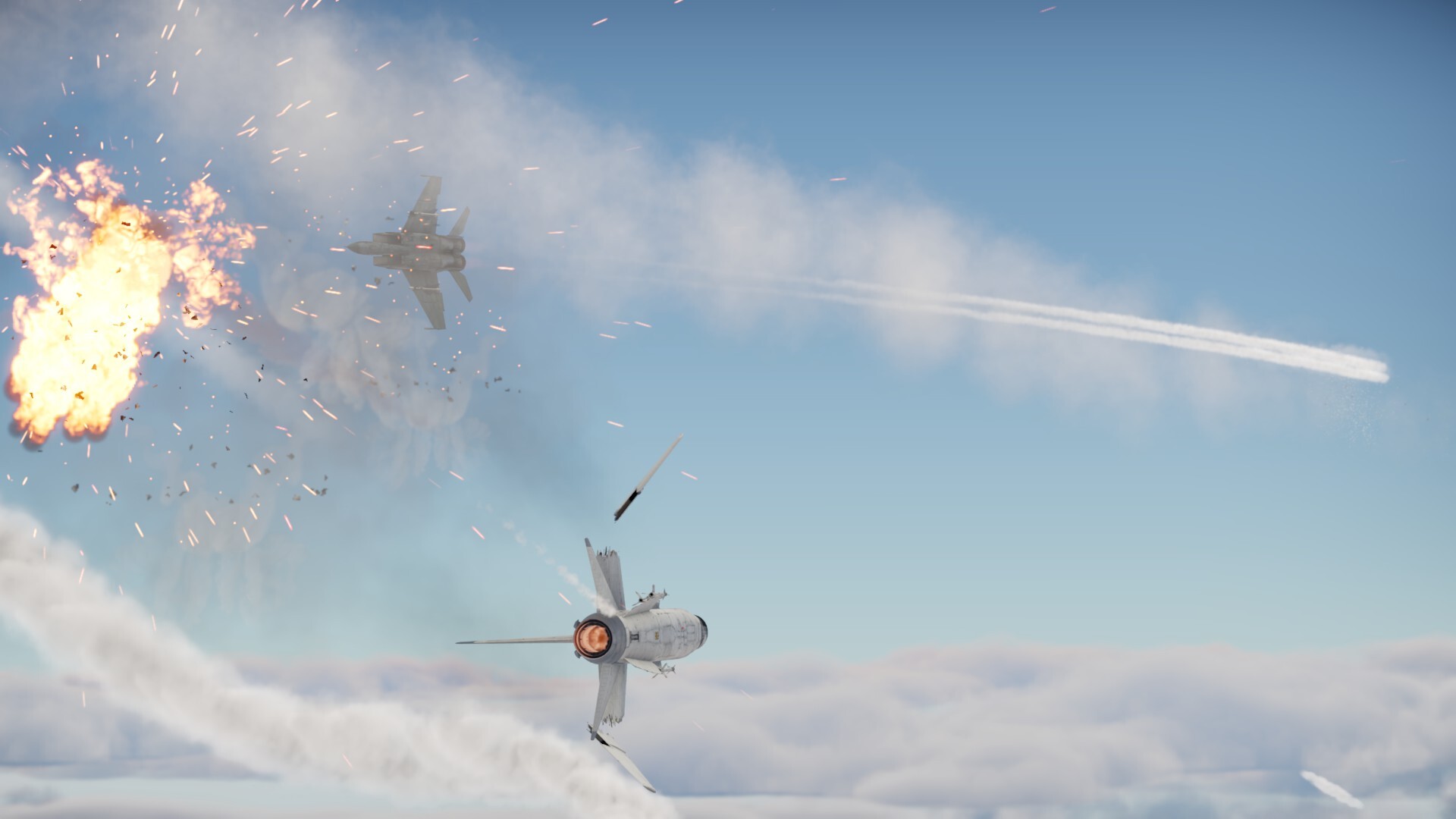
The R-40 “Acrid” missile has very good characteristics across the board. With good 20G maneuverability, a great booster motor with good range and guidance time, and a devastatingly powerful warhead, the R-40 is a dream come true for any enjoyer of early BVR combat found around the rank VII matchmaking bracket.
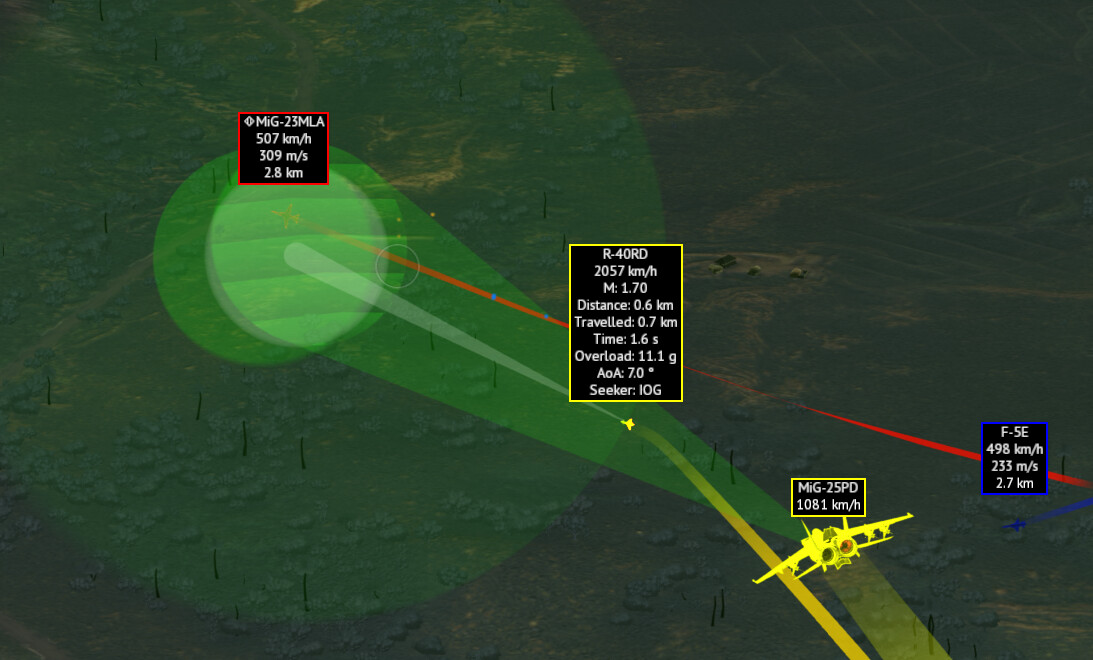
There is one massive caveat to the R-40’s amazing performance, however, and it is that it has a very long arming delay for its proximity fuse of up to four seconds. While the missile can still detonate before that time, a direct hit is required to trigger the warhead, a feat that can be very difficult to pull off with an enemy aircraft maneuvering in front of you sharply. This task is made far worse by the extremely clumsy close-range handling of your Sapfir-25 radar. There is a workaround to this, however, explained in the next section. Regarding the range of the R-40 missiles, in a head-on engagement, it is not uncommon for you to hit aircraft from up to 20 km away, but in a tail chase, expect the range to be limited to around 5-8 km. What makes the R-40RD even better in a head-on engagement is the addition of IOG (In-ordinance guidance) to help the missile stay on course even with a weak tracking signal.
Usage of the Radar
The Sapfir-25 J-band radar set on the MiG-25 is powerful but very clunky, designed primarily for very long-range combat. The biggest drawback of which, familiar to users of the early MiG-23M/MF model, is the complete lack of any ACM/Boresight or narrow-scan mode for the radar. This makes locking an enemy target difficult, if not completely impossible, when trying to enter a furball to pick off a single target with radar missiles.
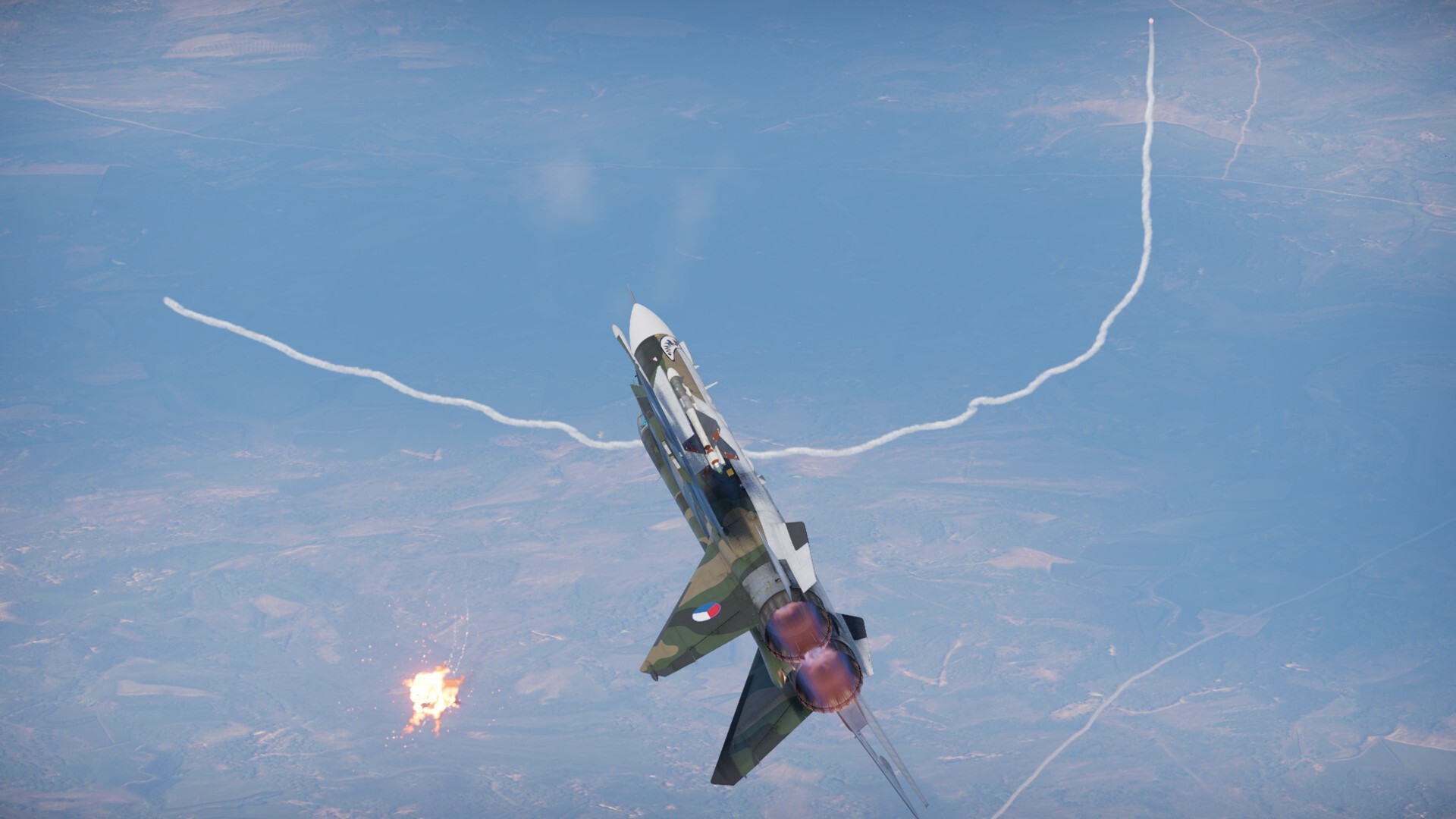
There is a silver lining to this, however: the MiG-25 also has a limited look-down MTI setting for the radar, though two conditions heavily limit it. Firstly, the radar dish must be pointing down at the ground. This does not mean the aircraft needs to be pointed at the ground; when you are tracking a target, the radar will remain in MTI mode so long as the target is below your aircraft. The second condition is that you must be below a certain altitude relative to the terrain’s height. Usually, this limit is between 1,400 and 1,600 meters above ground level.
The MiG-25, like most later Soviet fighter designs, also comes with an integrated IRST that allows you to silently “lock” a target. Such a system offers many benefits, most notably that it allows you to silently lock a target and slave your IR missiles with zero RWR pings or track warnings, and secondly, that the IRST has a narrow-scan option that functions as a stand-in for the lack of an ACM mode or a narrow-scan option on your radar. Using your Switch-to-IRST/Radar keybind, you can easily switch your IRST lock for a more useful radar lock that allows you to use your R-40RDs.
There are, however, numerous drawbacks to such a system. Most obvious is that IRST systems use infrared signatures/heat of enemy aircraft, usually their engine’s hot exhaust plumes, to detect them. This alone causes a list of problems, notably that the IRST system works best in the rear aspect, rather than the frontal aspect, where radars work best. Secondly, IRST systems are known for being very close-range; do not expect to get any sort of IRST signature from a target at more than around 10–15 km away from you. Lastly, IRST systems, especially the MiG-25’s early-model IRST, which is predominantly modeled on the MiG-23’s, can be decoyed by flares in a manner similar to how chaff can decoy enemy radar locks.
Survivability
This section will go into detail on certain unorthodox maneuvers a MiG-25 player needs to employ to enhance their survivability. If you have flown a very large twin-engine jet such as the F-14, you may have noticed that flaring off enemy missiles from the rear is more difficult than with a single-engine aircraft like the MiG-21. This problem is exacerbated by the MiG-25, which uses two of the largest afterburning jet engines in the game as its powerplants. This combination can make flaring off enemy missiles difficult, if not virtually impossible, despite your total count of 64 flares and chaff.
The key to surviving enemy missile attacks in a tail chase is not only cutting afterburner, but completely shutting down your engines and restarting them. Doing this causes your engine’s heat plume to go completely cold, giving the flares much better contrast and allowing you to decoy a heat-seeking missile much more effectively, but this also creates another issue: you risk the aircraft pursuing you taking advantage of your slow speed and closing the gap between the two of you. This is where your 2nd method of avoiding missiles comes into play: Outrunning.
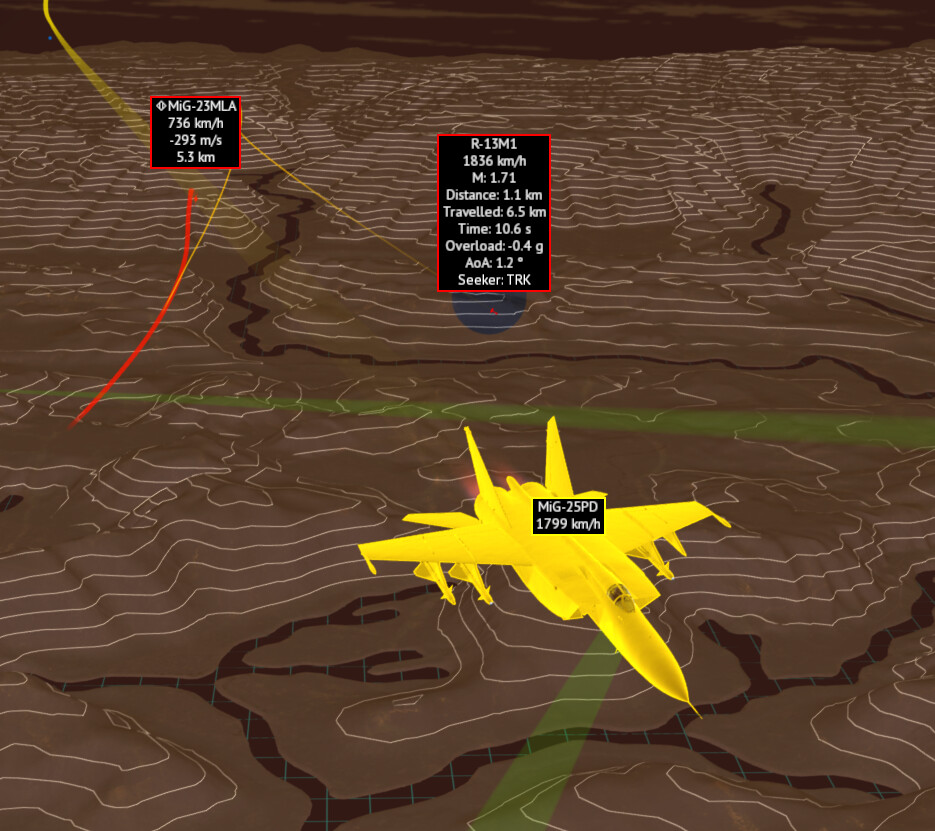
Outrunning enemy missiles is a very uncommon strategy in War Thunder, as almost no aircraft openly specialize in it. However, the MiG-25 is one of the few aircraft that actually specialize in outrunning missiles, thanks to its Mach 3 top speed and very good supersonic acceleration. Many missiles at the BR have decent maneuverability, but typically have rather short range. If you keep your speed above mach 1 and stay at high altitude, it isn’t uncommon for you to be able to outrun missiles like the AIM-9 Sidewinder, R-60, and even some radar missiles like the AIM-7E/E-2 Sparrow.
FUN FACT: It is even possible to outrun some of the longest-range missiles in-game, like the Fakour-90 and AIM-54 Phoenix, in the right circumstances. You won’t encounter extremely long-range missiles like these in regular matches due to your battle rating, but you can still encounter long-range missiles like the AIM-7F Sparrow, Skyflash SuperTEMPs, R-24R/T, and R-40RD/TD, carried by the F-4J/S, Panavia Tornado F.3/ADV, MiG-23ML/A/D, and other MiG-25s, respectively.
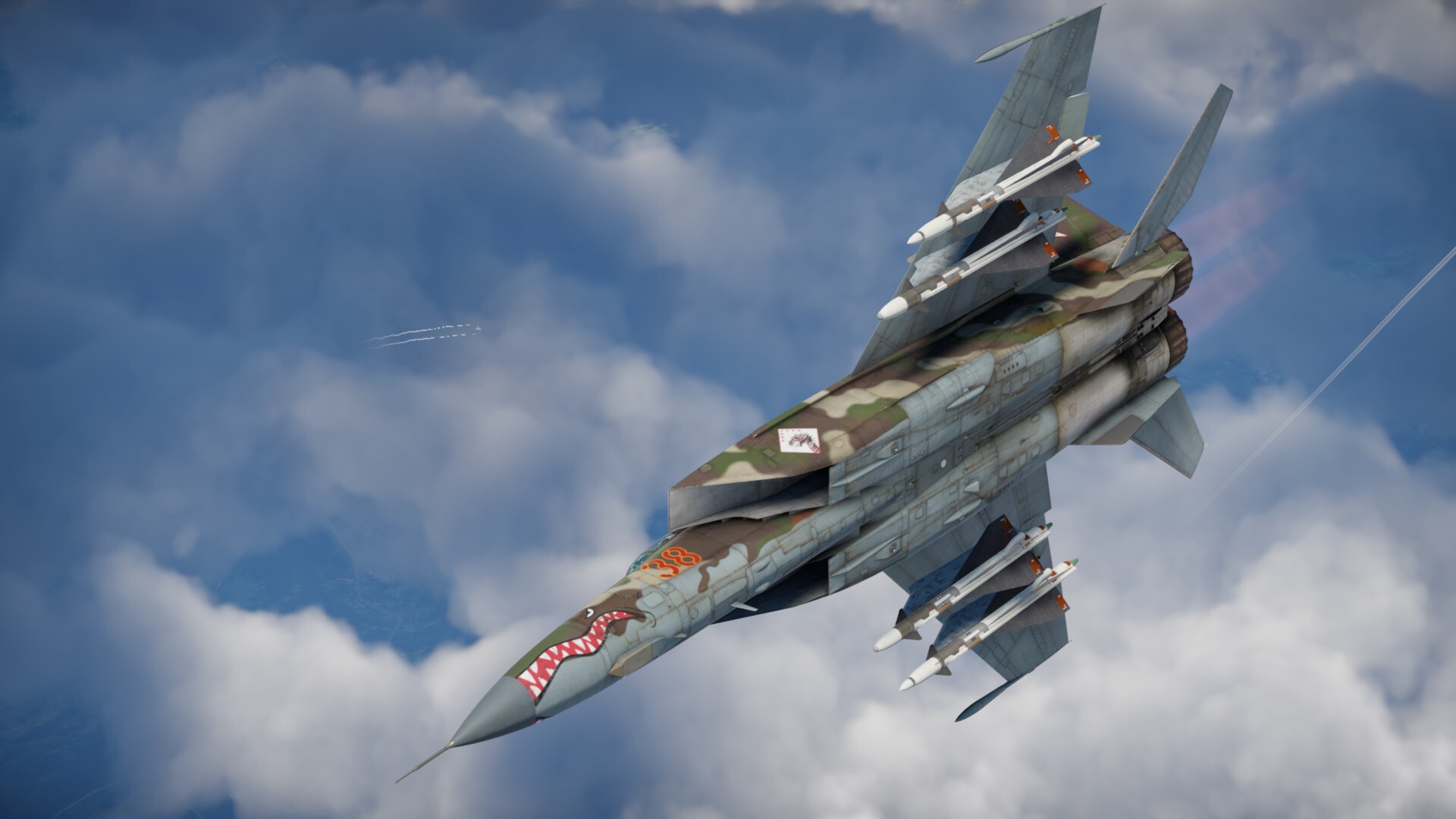
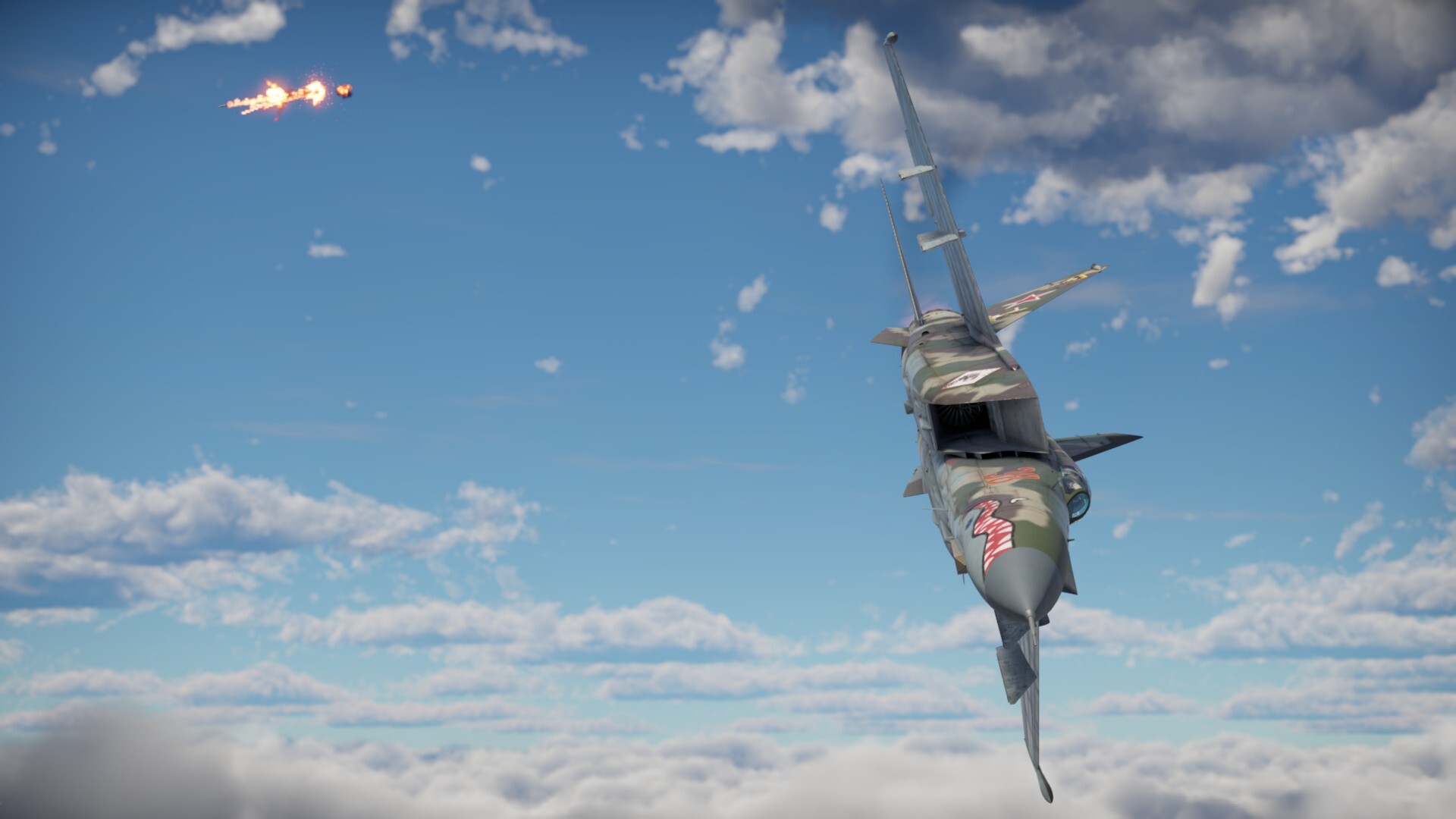
For actual survivability aside from outrunning and using countermeasures, however, your gigantic airframe filled with fuel will result in an almost-guaranteed fireball if you are hit by enemy cannons or missiles. You also have an SPO-10 RWR for detecting enemy radars, which, despite being a very simple sensor-based RWR set with 4 basic detection quadrants and tracking detection, can most crucially detect J-band radars like those from the MiG-23 and MiG-25.
Notable Enemies
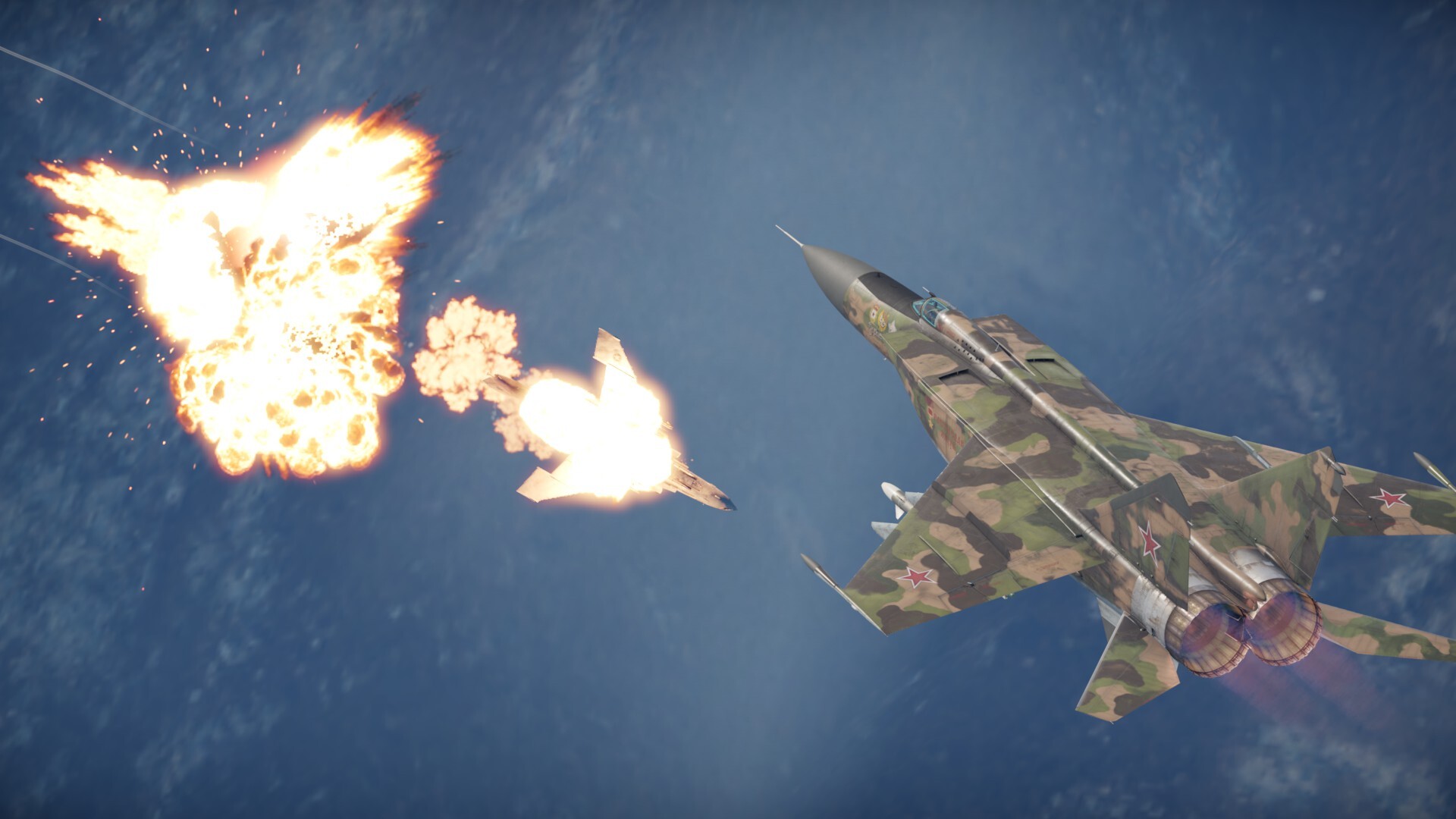
The MiG-25’s BR matchmaker allows it to face a very diverse cast of opponents and other aircraft, each with their own strengths and weaknesses over the MiG-25. Here are some key standouts among the crowd to pay attention to:
- Any aircraft with no RWR, or using an AN/APR-25 or SPO-15 RWR: These two RWRs cannot detect the MiG-25’s J-band radar whatsoever and thus are completely oblivious to when a MiG-25 locks them with radar. This list includes significant aircraft such as the F-5C, F-4C, F-4EJ, F-105D, MiG-23MLD, MiG-27, Su-17/22, Su-24, F-8C/E Crusader, J35D/XS Draken, Mirage IIIC, Nesher, and Kfir Canard.
- MiG-23ML/A/D: These later MiG-23 models have long-range R-24 missiles which perform very similarly to the R-40s carried on the MiG-25. However, they have an edge in that they also have an ACM boresight mode for their radar that allows them to get a lock much quicker than a MiG-25.
- Other MiG-25s: Another MiG-25 is your worst nightmare in a BVR scenario, as you are both on equal footing in terms of missile combat. Whoever can lock the other up first and fire off a missile is usually the one who comes out on top thanks to a lack of cannon armament.
- Later model F-4 Phantoms: While the F-4C is completely non-threatening and can very easily be destroyed with an R-40TD, later model Phantoms like the F-4E, F-4EJ, British FGR.2 and FG.1 (also known as the F-4M/K respectively), and F-4J/S all pose a serious threat if they are able to lock you from close range. While their Sparrows may not have as much range as your R-40s, they have radars which perform very well at close range and can get their missiles fired off very quickly after achieving a lock. F-4J and F-4S phantoms in particular are the most dangerous as they not only have HMD, but their pulse-doppler guided AIM-7F Sparrows can reach you from the longest range of all phantoms.
- Panavia Tornado F.3/ADV: Interceptor Tornados are arguably even more dangerous than F-4J/S phantoms in a head-on engagement as they have a fully digital RWR, a massive amount of countermeasures, AIM-9Ls, a very strong pulse-doppler radar, and Skyflash SuperTEMPs, which have a more powerful motor that gives the missile better range (but at very long range they are still beaten by AIM-7Fs). However they are exceptionally rare to see compared to F-4J or F-4S phantoms and have extremely poor maneuverability, especially with wings fully swept.
- Su-25TM/Su-39: These later-model Frogfoots have an IRCCM module in the tail which renders your R-40TDs useless. Furthermore, they possess R-73 missiles with FOV-based IRCCM, which makes them almost impossible to flare given the MiG-25's absolutely enormous engine heat signature.
- A-10 Warthogs: These aircraft are by far the most frustrating to deal with due to having a giant GAU-8 avenger gatling cannon in the nose, very good turn rate, an excessive abundance of countermeasures, and a tendency to fly close to the ground, making the usage of radar missiles against them difficult. While you are very easily able to outrun their missiles, any A-10 paying attention and hugging the ground is very easily able to defeat your missile attacks.
- Any aircraft in a close-range 1v1 dogfight: as a MiG-25, a one versus one dogfight is your worst nightmare, especially in the late stages of a match and/or if you’re the last person standing. While you can very easily outrun anyone, assuming you’re above Mach 1, getting a reversal is easier said than done thanks to having an absolutely enormous supersonic turning circle and no ACM mode whatsoever. You also lack a cannon and have missiles that lack a proximity fuse at very close ranges.
Playstyle and Sensor Intricacies
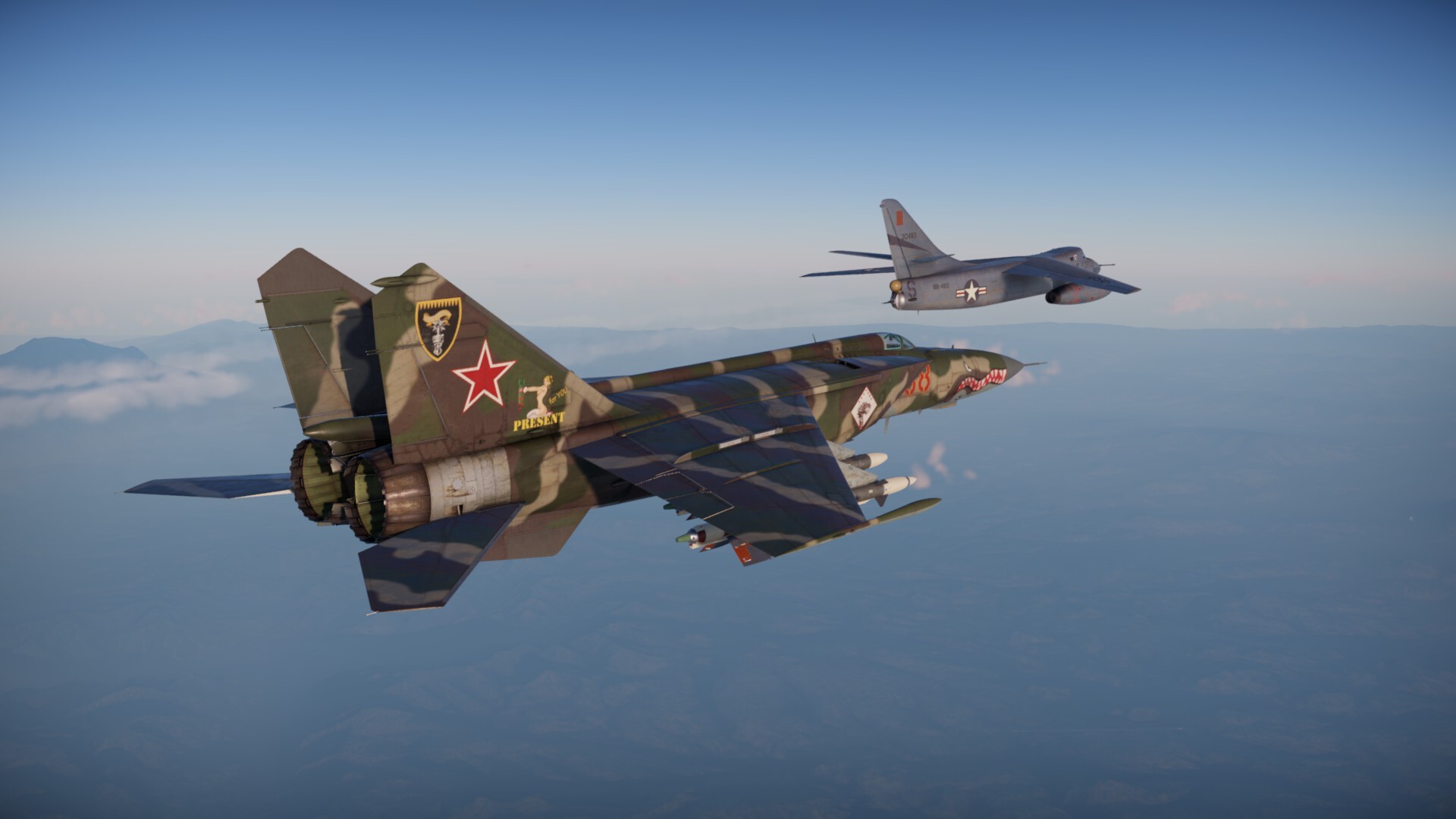
The MiG-25 tends to suffer from one glaring issue from an enjoyment standpoint: its gameplay loop is painfully one-dimensional, but on the flip side, it makes decision-making during a match much simpler. The MiG-25 is designed as a high altitude interceptor, which means that fighting at low altitude is not only disadvised, but drastically increases your risk of dying prematurely, thanks to the very likely possibility of an enemy aircraft chucking a missile at you and being completely unable to flare it off courtesy of your enormous heat signature. This is also where your speed comes into play. Maintaining a speed above Mach 1 at high altitudes is essential to outrunning enemy missiles. That is, unless you are diving down to the deck to shoot off an R-40TD missile at an unsuspecting enemy, in which case you should immediately throttle back and deploy airbrakes if needed to avoid ripping your wings off, then immediately put full afterburners back on and climb back to a safe altitude.
To start, you should bring approximately 35-40 minutes of fuel. Your engines are not as fuel-hungry as you might expect for such massive engines, but given that maneuverability is not your airframe’s strength and that you’ll be spending a lot of time loitering above the battlefield at speeds above Mach 1 and approaching Mach 2, you should definitely consider topping up on fuel. This is also because, as your fuel load decreases, your aircraft’s weight drops, allowing you to accelerate even faster than before. For countermeasures, you can experiment with bringing more flares or more chaff. But you should keep in mind that despite most of your time being spent at high altitudes, you may run into instances where you’re in a pinch and need to dump flares to decoy an enemy IR missile that’s in range. (Make sure you shut your engines off completely for the best chance of decoying the missile!)
What comes as a relief is that a majority of heat-seeking missiles are so short-ranged that just staying above Mach-1 is usually all you need. At the beginning of a match, you should focus on flying straight and level until you reach around Mach 1. At that point, you can begin a steady 10-20-degree side-climb up to about 6,000-10,000 meters, though 8,000-9,000 meters tends to be a good sweet spot where you can hit WEP and accelerate up to around Mach 1.8; above that altitude, you may form a contrail. This will make your position very obvious to the enemy and especially to other MiG-25s, even without a marker on you.
You should first begin the match by eliminating any high altitude targets approaching you from head-on at the start of a match by utilizing your R-40RDs. Once a furball begins to develop, you should switch to doing high-speed passes over the center of the battlefield, looking out for enemy planes that are not only separated from their team but are also not being pursued by allied aircraft. This is because if one of your allies fires off a missile while you have an R-40TD guiding onto them, and the enemy starts flaring, the R-40TD that you might’ve launched will also go for the flares, denying you the kill. However, if you need to briefly dive down towards the deck to get your R-40TD’s seeker to acquire a lock, you should cut your throttle back completely and deploy your air brakes. Once you’ve fired off your missile, you can immediately begin climbing back up to a safe altitude. The longer you linger at lower altitudes, the higher the chance is that an enemy aircraft will be able to close the gap and fling a missile at you.
Restocking fuel and missiles is handled differently in the MiG-25 than in other aircraft. This primarily comes down to the fact that you have zero ground ordnance or cannon armament, so once you run out of missiles, you are functionally defenseless. For this reason, the moment you expend all four missiles, you should make a beeline back to your airfield to refuel and restock on missiles. For most aircraft, you will usually want to go to the forward airfield, as that is the closest to the battlefield and will allow you to get back into the battle much quicker. However, in the MiG-25, you should try to go towards the spawn airfield located farther away from the battlefield.
The reasoning for doing this is twofold: One, the MiG-25 may be fast, but its takeoff performance and subsonic acceleration are very subpar, and you need the extra distance from the battlefield in order to safely climb to the roughly 8000-meter altitude where you can reach the supersonic speeds necessary to avoid being chased down by enemy aircraft. The second, and arguably more noticeable, reason is that the spawn airfield is protected by several surface-to-air missile batteries consisting of Finnish ITO-90s.
Unlike the sluggish Roland 1s they replaced, which were notoriously inadequate at preventing enemy aircraft from strafing you while you’re refueling and rearming, the ITO 90s provide a far more robust protective shield that stops enemy aircraft from getting close enough that they can potentially strafe you while you’re in the process of taking off. While landing at the spawn airfield may be more time-consuming, the added safety of knowing you’re not going to be strafed while re-arming is very beneficial, considering the MiG-25 has no way to defend itself in such a vulnerable scenario.
Regarding the use of your radar, manual adjustment of your radar dish is strongly recommended to pinpoint the exact location of an enemy aircraft at high altitude. In which you can do so by simply holding the Alt Key (This may differ depending on key-binds), and dragging the radar dish across your HUD with your mouse. Keep in mind that your radar is locked to a static 60-degree scan pattern with no ACM boresight mode and a rather slow scan speed, so mastering on-the-fly radar adjustments is key to success. Once you have a radar contact selected, you can quickly lock and unlock it to check its exact distance and heading.
You need to note that some aircraft, like the J-7E and F-4E Phantom, have RWRs that not only can detect J-band radars but can also detect radar missile launches. So there may be instances where you lock an aircraft that immediately starts dumping chaff or notching in response. Surprisingly, this isn’t too much of a problem if you’re guiding a missile and, midway through, your target starts panic-dumping chaff after realizing an R-40RD is barreling straight towards them. This is because CW-seeker radar missiles will keep homing in on the aircraft while attempting to ignore the chaff. This is ONLY IF you keep your radar locked; even if your radar is visually locked onto the chaff, there is a good chance your missile is still guiding onto the target.
The way to decisively defeat a radar missile with a CW seeker head is to notch it, like how you would do so with a regular Pulse-Doppler radar. Which, surprisingly, your SPO-10 RWR provides a deceptively helpful indicator of when you’re truly notching a missile. Despite the RWR having only 4 quadrants, each quadrant’s sensor has slight overlap with the others at the exact north, east, south, and west points of your RWR, respectively. So when you see both adjacent RWR quadrants lit up on either your left or right side, that means you are in the notch of the missile and can chaff it away effectively.
Usage of your Missiles
How you use your missiles is very important, as you have only four long-range R-40s at your disposal at any given point in time. Firing them off haphazardly, with little to no consideration for your positioning, will force you to immediately return to your airfield to restock on missiles. The good news is that the R-40RD and R-40TD usage cases can be best split into two categories: a slap in the face, and a stab in the back. These, when put into simple terms, are cases where the enemy knows where you are, and also when the enemy does not know where you are.
For cases where the enemy knows where you are, such as high-altitude head-on engagements or lower-altitude engagements where a target is spamming countermeasures, usually necessitating that you utilize your radar’s MTI mode, you should primarily rely on your R-40RDs. This is because their in-ordinance-guidance (IOG) will allow them to keep tracking a target with a decent degree of accuracy, even under heavy countermeasures usage.
For cases where the enemy does not know where you are, such as sneak attacks on unsuspecting low-flying targets while you’re at high altitude, an R-40TD is typically the best missile to use in such a scenario, as its fire-and-forget nature allows you to fire one off without needing a radar lock, which in the MiG-25's case can be very difficult to achieve while maneuvering for a missile shot. For the best chance of success, you should always use IRST in such scenarios, as your radar’s signal can easily give your location away on an enemy’s RWR. There are, however, aforementioned exceptions to this scenario. Some aircraft at your matches may not have RWRs capable of detecting J band. For this reason, you might be able to fire off an R-40RD in place of an R-40TD, depending on the aircraft.
Bonus Section: How to Intercept a MiG-25 at Over Mach 2
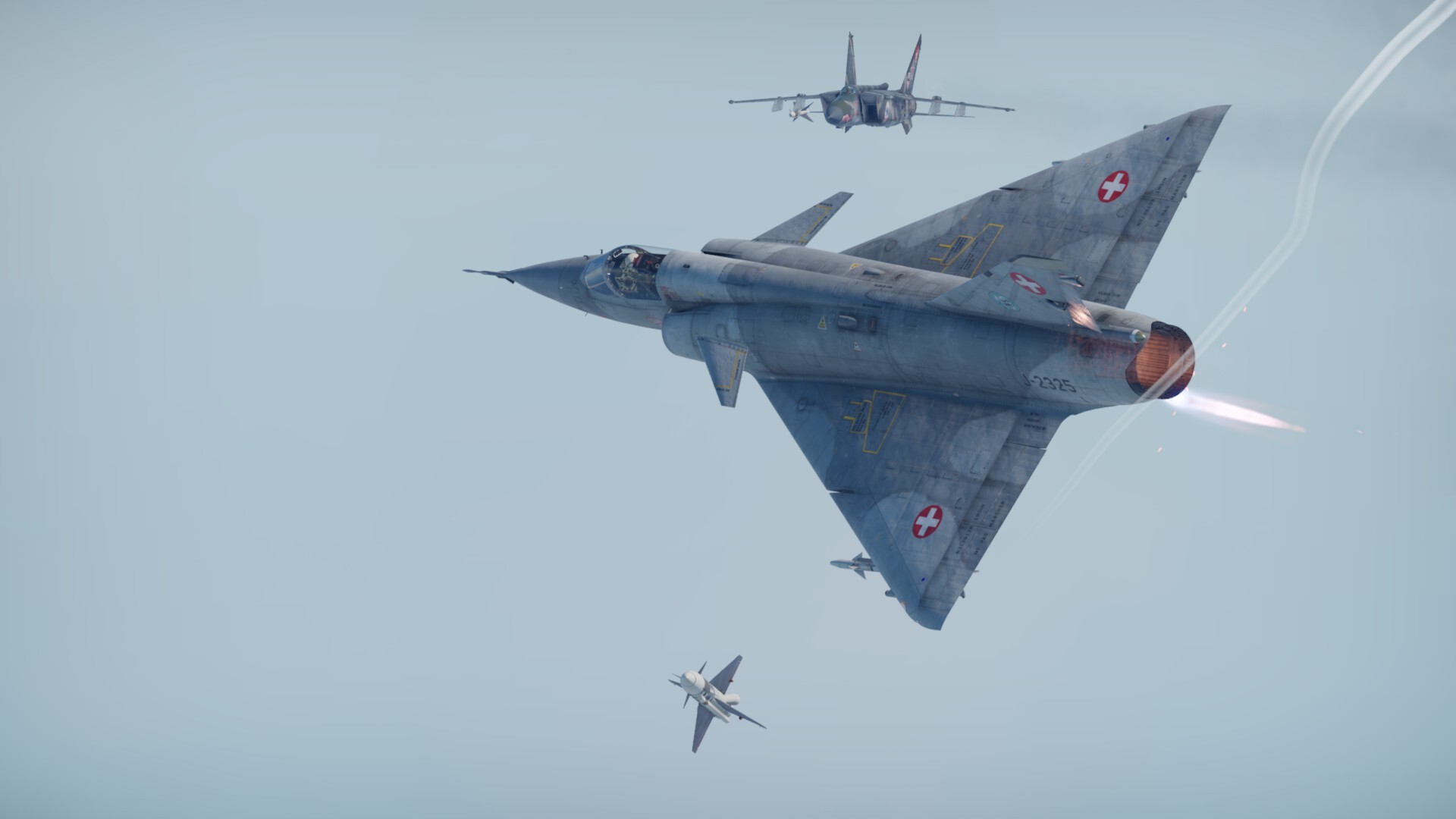
In very rare cases, especially in the late-game, you may come across the ungainly sight of a MiG-25 in the upper atmosphere zooming at speeds over Mach 2, preventing them from being reliably intercepted by a majority of aircraft in its matchmaking bracket. There are only a handful of aircraft types with missiles or flight performance capable of reliably countering the MiG-25's BVR capabilities, given its excessive speed and altitude advantage.
- F-4J/S Naval Phantoms: These Phantoms have AIM-7F Sparrows, which are the best American long-range option available for usage in the MiG-25's matchmaker. These not only have a look-down radar immune to chaff, but also a helmet-mounted sight for missile targeting. The best part, however, is that the AN/ALR-45 can detect missile launches from the MiG-25's Sapfir-25 radar set, enhancing your situational awareness. These are labeled as “AI HI” on your RWR scope, the general category that this RWR lumps all Soviet J-band radars into.
- Panavia Tornado F.3s: Arguably the best counter to the MiG-25 in terms of technological capability. These have AIM-9Ls, a very strong PD radar, a digital RWR that can identify the MiG-25’s specific radar signature, and long-range Skyflash SuperTEMP missiles, and to top it all off, a boatload of countermeasures courtesy of your BOL dispensers.
- MiG-23ML/A/D: These are among the few aircraft (other than another MiG-25) that can partially keep up with a MiG-25 in acceleration, thanks to their variable-geometry wings and powerful Tumansky R-35 engines. They also have R-24R/T missiles with a range similar to that of the MiG-25's R-40s. Be warned, however, that the MiG-23MLD cannot detect the MiG-25's radar whatsoever due to the SPO-15 completely lacking J-band radar detection.
- Kfir (Series): These Israeli delta-wing aircraft can accelerate to supersonic speeds almost as fast as a MiG-25 thanks to their J79 engines and delta wing configuration. Be aware, however, that the Kfirs do not carry any BVR armament or radar, and the Kfir Canard has the notoriously inadequate AN/APR-25 RWR, which cannot detect the MiG-25’s J-band radar.
- Other MiG-25s. If you can’t beat them, join them.
The MiG-25's speed comes with a drawback: Its turning circle is absolutely enormous above Mach 2 and especially approaching Mach 3. At these speeds, it is not uncommon to see MiG-25s taking tens of kilometers to complete a full turn. While it can keep its speed very high due to the excessive amounts of thrust offsetting any possible energy bleed, this also makes it nearly impossible for a MiG-25 above Mach 2 to notch enemy missiles in a head-on engagement, as it will be traveling too fast towards the missile to be able to react in time.
You can try to predict the MiG-25's flight path by the direction its contrails are turning, coordinating with a teammate to split up and block off its escape routes. You can also put extra pressure on a high-altitude MiG-25 by locking it with your radar, tricking it into thinking a missile is being launched at it. Despite the SPO-10 having tracking detection, it is otherwise inferior to most Western RWR sets, lacking range detection and having only 4 radar ping quadrants. The best way to intercept a MiG-25 is in a head-on engagement, but NOT directly in front of it. You want to take advantage of the very vague information that its RWR provides, attacking from an angle they don’t suspect.
With the MiG-25’s incredibly fast forward speed at high altitudes, it may be entirely unable to pick up a radar lock of a target beneath it due to the lack of ACM for the radar, slow scan speed and having only -42 degrees of depression for the radar dish, noticeably less than that of most western radar sets such as the F-4E which have -60 degrees of depression for the radar dish. You should keep in mind, however, that your missiles may have trouble reaching a MiG-25 with an extreme altitude and speed advantage due to the extensive height needed for the missile to travel.
Key Takeaways
- The MiG-25 punishes you heavily for taking it outside its intended play style. Patience is key, as you must learn to let the enemy come to you rather than you going to them.
- Arranging your key-binds optimally, especially for your radar, is one of the most valuable things you can do to give you an edge in the MiG-25. For example, if you have a mouse with additional side buttons, you can pair those buttons to your “Lock radar to target” and “fire countermeasures” bindings. Furthermore, you can also use your keyboard’s numpad to house your other various radar-related keybindings.
- The MiG-25 can be very frustrating to play in the late-game especially if you are the last man standing. Do not be surprised if you occasionally end up in a stalemate with opponents such as an A-10 Warthog.
- Teamwork is very important, especially in the late game. Make sure you communicate with your teammates when possible, as you cannot afford to be caught in a close-range ambush against any opponent.
- Playing in a squad is one of the best ways to properly enjoy the MiG-25’s extreme advantage in altitude and speed by balancing your squad out with dogfighting masters such as the F-5E and MiG-21bis, or other BVR-capable jets like the MiG-23M or other MiG-25s.
- Keep your eyes on your IAS at all times, while the MiG-25 can reach and maintain supersonic speeds better than nearly any aircraft it faces, its 1320 km/h rip speed is very unforgiving and will send you back to the hangar if you are not careful in keeping your speed in control.
Source List:
PRIMARY CIA REPORTS: