

MiG-25PD

The MiG-25PD is a Soviet supersonic, high-altitude interceptor. The appearance of supersonic strategic bombers, such as the B-58, in the United States in the late 1950s, as well as the development of even faster aircraft, like the XB-70 and SR-71, required the USSR to create an effective new interceptor. The A. I. Mikoyan Design Bureau, already experienced in developing supersonic interceptors (the E-150/152 series), began work in 1961 on an aircraft designated the E-155. A decree dated February 5, 1962, stated that two main variants were to be developed: the E-155P interceptor fighter and the E-155R high-altitude reconnaissance aircraft. The E-155P1 interceptor's first flight took place on September 9, 1964. After multi-stage state trials, the aircraft received the official designation MiG-25P (Izdeliye 84) in 1968. The MiG-25P interceptor was accepted into service in April 1972.
In 1976, Viktor Belenko hijacked a MiG-25P to Japan, which prompted the modernization of the fighter. The PD modification (Izdeliye "84D") began entering service in 1978. This version was equipped with a new Sapphire-25 (S-25) radar system, more powerful R15BD-300 engines, and upgraded avionics. Aircraft of this modification were built from scratch at Factory No. 21. MiG-25P aircraft already in service underwent the same modernization and received the designation MiG-25PDS. The MiG-25PD served in the Soviet Air Defense Forces until the early 1990s and was exported to other countries, where it participated in local conflicts, most notably the Iran–Iraq War, in which it was used to intercept high-altitude targets.
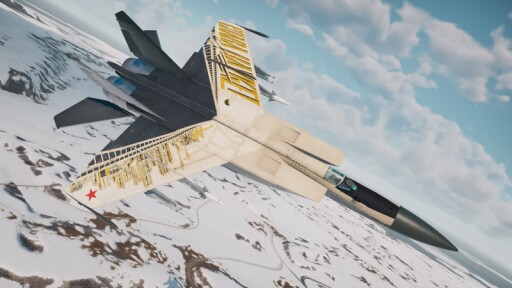
The MiG-25PD was introduced as one of the rewards for the 2025 "Winter Concert" event. This aircraft is a high-altitude interceptor. Its key strengths are its high speed and rate of climb. Its two powerful engines allow it to rapidly gain altitude and accelerate to supersonic speeds, making it a formidable fighter. Its primary armament consists of R-40RD and R-40TD air-to-air missiles, which offer excellent range and maneuverability. However, the aircraft has several drawbacks: it lacks a gun, has poor maneuverability, and is limited by IAS on low altitudes.

flaps
flaps
flaps
brake
| Name | Weight | Slot | ||||
|---|---|---|---|---|---|---|
| 2 × | 88 kg |  | | |||
| 465 kg |  | | | | ||
| 465 kg |  | | ||||
| Drop tank (5280 liters) | 68 kg |  | ||||



Flight performance | |
|---|---|
Survivability |
|---|
Weaponry |
|---|