
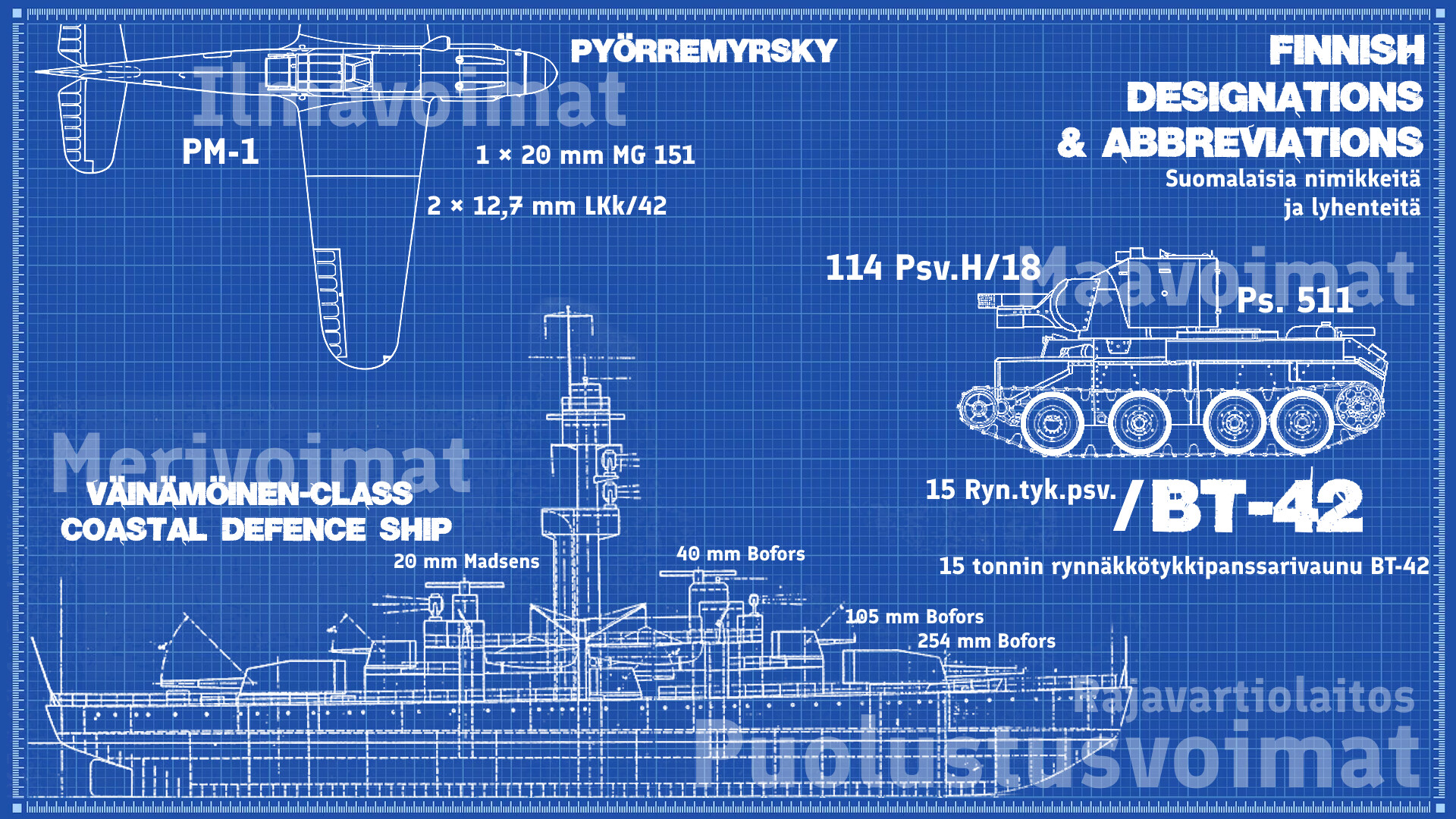
Abbreviations
Like German, Finnish makes extensive use of compound words to precisely describe equipment. As a result, many military terms and designations can be quite long, with most being abbreviated for practicality. This article will focus only on the currently implemented and relevant equipment featured in War Thunder.
- Psv. — Panssarivaunu: Tank
- Psv.K — Panssarivaunu Kanuuna: Tank Cannon
- Psv.H — Panssarivaunu Haupitsi: Tank Howitzer
- LKk — LentoKoneKivääri: Aircraft machine gun
- ItO — Ilmatorjuntaohjus: Anti-air missile
- ItPsv — Ilmatorjuntapanssarivaunu: Anti-air tank
Manufacturer / Designer
- IVL — Ilmailuvoimien Lentokonetehdas: Finnish Air Force Aircraft Factory
- VL — Valtion Lentokonetehdas: State Aircraft factory
- VKT — Valtion Kivääritehdas: State Rifle factory
Air Force designations
Initially, Finnish aircraft designations began with the country’s first military aircraft, a Thulin Typ D donated by Swedish Count Eric von Rosen, designated F.1 (Flygmaskin—Swedish for “aircraft”) in 1918. As the Finnish Air Force expanded its fleet, the system was revised several times to include additional details such as aircraft role, type, origin, and year of acquisition.
The fifth designation system, introduced in 1927 and still in use today, is structured as follows:
- Each aircraft series is assigned a two-letter code*, derived from the manufacturer’s name, original designation, or nickname.
- This is followed by a sequential number identifying the airframe.
| Plane | Code | Derived from |
| Ar 196 A-5 | AR | ARado |
| Fokker D.XXI | FR FRm FRw | FokkeR Mercury engine Wasp engine |
| Hawk H-75A-2 | CU CUc CUw | CUrtis Cyclone engine Wasp engine |
| B-239 (F2A “Buffalo”) | BW | BreWster |
| Hurricane Mk. I (& IIA) | HU | HUrricane |
| Ju 88 A-4 | JK | JunKers |
| Bf 109 | MT | MesserschmitT |
| M.S.406 / M.S.410 Mörkö-Morane | MS MSv | Morane-Saulnier Venäläinen (VK engine) |
| Myrsky | MY | MYrsky |
| Pyörremyrsky | PY | PYörremyrsky |
| Vampire FB 52A | VA | VAmpire |
| J 35XS “Draken” | DK | DraKen |
| MiG-21 | MG MGT MGBT | Mikoyan-Gurevich Reconnaissance Bis Reconnaissance |
| F/A-18 “Hornet” | HN | HorNet |
- AE — Aero A-11, A-32
- AN — Avro 652A Anson I
- AV — Avro 504K, Šavrov Sh-2
- BC — Beechcraft C17L, Beechcraft D17S
- BI — Blackburn Ripon IIF
- BL — Bristol Blenheim Mk I & IV
- BN — Britten-Norman BN-2A Islander
- BR — Breguet 14A.2
- BU — Bristol Bulldog IIA & IVA
- BW — Brewster B-239
- BV — De Havilland Canada DHC-2 Beaver
- CA — Caudron C.59, Caudron C.60, Caudron-Renault C.R.714
- CB — Cessna 402B Businessliner
- CC — CASA C-295
- CE — Cessna C-37
- CU — Curtiss Hawk 75 A-½/¾/6
- DC / DO — Douglas DC-2, Douglas C-47
- DF — Fairchild 24J 60 De Luxe, Iljušin DB-3f (Il-4)
- DN — Dornier Do 17 Z
- DR — Dornier Do 22Kl
- DS — Desoutter Mk.II
- EV — Airspeed A.S.6E Envoy
- FA — Fiat G.50 “Freccia”
- FD — Fairchild 24G (?)
- FE — Fokker F.VIIa, Fokker F.VIII
- FF — Fokker F.27 Friendship
- FK — Fokker C.X
- FM — Fouga CM170 Magister
- FO — Fokker C.V D & E
- FR — Fokker D.XXI
- GA — Gloster Gamecock II
- GL — Gourdou-Leseurre GL-21/22, Gloster Gladiator
- GN — Folland Gnat Mk.1
- GT — Gloster Gauntlet II
- HA — IVL D.26 Haukka I & II, Sud-Aviation S.E.3130 Alouette II
- HB — Agusta Bell 206 A
- HC — Hawker Hurricane I & IIA
- HE — Heinkel He 115
- HH — Hughes 369HS/HM/D (500C & 500D)
- HL — Heinkel He 59
- HM — VL Humu
- HN — McDonnell Douglas F/A-18 Hornet
- HR — Mil Mi-4
- HS — Mil Mi-8P / Mi-8PT
- HT — Hanriot H.232.2
- HW — BAE Systems Hawk Mk.51
- IH — Polikarpov I-15 M-22 & I-15bis
- IT — Polikarpov I-153 M-62
- JF — Jaktfalken II, Lockheed Martin F-35 Lightning II
- JK — Junkers Ju 88 A-4
- JU — Junkers W 34, Junkers K43F, Junkers F 13, Junkers A 50 Junior
- KA — VL Kotka I & II
- KH — Curtiss P-40 Kittyhawk
- KO — Koolhoven F.K.31, Koolhoven F.K.52
- LG — Lavochkin-Gorbunov-Gudkov LaGG-3
- LJ — Gates Learjet 35A
- LY — Westland Lysander I
- MA — Martinsyde F.4 Buzzard
- MB — MiG-21
- MK — MiG-21U, MiG-21US, MiG-21UM
- MO — De Havilland D.H.60/60X Moth
- MS — Morane-Saulnier M.S.406
- MT — Messerschmitt Bf 109 G-2/6/8
- MU — MiG-15UTI
- MY — VL Myrsky
- NH — Iljušin Il-28 / Il-28R
- NK — M.F.11
- PA — VL Paarma, Piper PA-28R-200 Cherokee Arrow II, PA-28RT-201 Arrow IV
- PC — Piper PA-31-350 Chieftain
- PE — Petljakov Pe-2, Petljakov Pe-3
- PI — Pilatus PC-12
- PM — VL Pyörremyrsky
- PN — Piper PA-31 Navajo
- PO — Potez 25 A2
- PR — Hunting Percival Pembroke C.Mk.53
- PY — VL Pyry
- RG — Valmet Redigo
- RI — Blackburn Ripon II F
- S — Junkers A 35
- SB — Tupolev SB 2M
- SF — Saab 91D Safir
- SH — Saab 17A
- SK — Junkers A 50 Junior
- SM — Letov S 218 A Smolik
- ST — Fieseler Fi 156 K-1 Storch
- SZ — Focke-Wulf Fw 44 J Stieglitz
- TL — Valmet Tuuli III
- TU — VL Tuisku I & II
- UT — Polikarpov I-16 UTI
- VA — De Havilland D.H.100 Vampire Mk.52
- VI — VL Viima I & II
- VN — Valmet Vinka
- VP — Tupolev SB 2M (Russian Bomber)
- VT — De Havilland D.H.115 Vampire Trainer Mk.55
- VU — Polikarpov U-2
- VV — Beriev MBR-2 & MBR-2bis
- VH — Polikarpov I-15, I-16 (early designation), Valmet Vihuri
Armour Registry
The Panssarirekisteri (Armour Registry), formally known as Suomen puolustusvoimien panssariajoneuvojen rekisterimerkinnät, serves as the official index for Finnish armoured vehicles. This registry began with a numerical system denoted by the prefix R, which was later replaced by the current Ps-based system introduced in 1927. The Ps system separates the vehicle type and individual number, providing a more structured classification.
Registration markings
Before the Winter War, the Finnish Defence Forces did not use standardized registration markings on their tanks. The Renault F.T. tanks retained their original French (Numéro de Matricule) registration numbers, painted either on the glacis or on the lower suspension frame. In addition, a Finnish serial number, following the French model, was painted in a white square on the inside of the driver’s left hatch, visible only when the hatch was open. Captured armored cars from the Civil War carried improvised markings, generally similar to those used on military automobiles.
The first standardized Finnish registration numbers were introduced with the Vickers 6-ton tanks, using a three-digit number painted in white on a registration plate mounted on the left rear fender. During the Winter War, this system was expanded to captured tanks as well. The revised format consisted of a one- to four-digit consecutive number, painted in white 100 mm-high digits on the front and rear of the hull. In official documents, the number was prefixed with the letter “R” (Rekisterinumero), for example R-210, although only the digits were painted on the vehicles themselves.
This system remained in use until the adoption of the Ps. code in 1943, though the last R-registered vehicles did not receive new Ps. codes until after the war in 1945, when they were repaired for peacetime service. The following sequences were used for R-numbers:
The R-designation system was neither systematic nor fully documented. Registrations were often assigned as vehicles were captured, resulting in gaps, overlaps, and inconsistencies. Much of what is known today is reconstructed from photographs and surviving examples, meaning some numbers may have gone unused, been reassigned, or grouped vehicles of entirely different types within the same cluster.
| R-0 — R-46 | Armoured cars (BA-6, BA-10, BA-20, …) |
| R-48 ~ R-199 | Battle tanks (T-26, T-28, T-34, …) |
| R-48 — R-49, 101 — 104 | T-28 |
| R-100 | KV-1 Mod. 1942 |
| R-105, 111, 155 | T-34 |
| R-110 | T-50 |
| R-152 | T-28E |
| R-170 | KV-1E Mod. 1940 |
| R-200 — R-246 | T-37A and T-38 |
| R-321 — R-499 | T-20 |
| R-646 — R-677 | Vickers 6-ton |
| R-701 — R-703 | BT-5 and BT-7 |
| R-704 — R-720 | BT-42 |
| R-901 — R-906 | Landsverk Anti II |
| R-1000 — R-1025 | Tracked tractors |
A few unusual registrations are worth noting. For example, R-0 was assigned to the Landsverk 182 armored car. The range R-96 to R-100 was used twice—first for BT-5 and BT-7 tanks, and later reassigned to T-26 and KV-1 tanks. Similarly, T-20 Komsomolets tractors were initially registered from R-400 upward until R-499 was reached, after which the numbering was applied in reverse order, running backward from R-399 to R-321.
Ps.
In the summer of 1943, the new Ps. registration system (Panssarivaunu, “armoured vehicle”) was adopted, replacing the earlier R-system with a more structured approach. Each code consisted of three parts: the prefix Ps., a 1—3 digit model number assigned in organized blocks by vehicle type, and a hyphen followed by the individual vehicle number (for example, Ps. 221-6 — Pz.IV (No.6)).
The period after Ps. was commonly painted during the war and the immediate post-war years, but it was dropped in the late 1950s when Soviet-supplied vehicles were repainted.
- Ps. 1 — 99 | Armoured car
- Ps. 101 — 349 | Battle tanks (light/medium/main battle tanks)
- Ps. 351 — 399 | Amphibious tanks
- Ps. 401 — 449 | Flamethrower tanks
- Ps. 451 — 499 | Anti-Air
- Ps. 501 — 549 | Assault guns
- Ps. 551 — 599 | Command vehicles
- Ps. 601 — 649 | Training tanks
- Ps. 651 — 699 | Transporters
- Ps. 701 — 749 | Recovery vehicles
- Ps. 751 — 799 | Armored tractors
In 1959, new vehicle categories such as bridge layers, mine-clearing tanks, and anti-tank vehicles were added to the Ps. register, though these types were never actually fielded, making the additions largely irrelevant. In 1978, the Ps. 800 block was created to include unarmoured tracked artillery tractors and tank transporters, which had previously been listed in the SA automotive register. Since 1967, with the arrival of the BTR-50PU command vehicles, certain vehicles also began to receive type codes that deviated from the established system. By the early 1990s, however, the introduction of modern tanks that did not fit within the older structure prompted a complete reform of the register. The new system was officially ordered in February 1992.
Ps (1992—)
- Ps 100 — 199 | Light vehicles (scout tanks, IFVs, light tanks <20t)
- Ps 200 — 299 | Main battle tanks (>20t)
- Ps 300 — 399 | Anti-tank vehicles
- Ps 400 — 499 | Air-defense vehicles (missile & support)
- Ps 500 — 599 | Artillery vehicles (SPGs, mortar carriers, artillery support)
- Ps 600 — 699 | Armoured personnel carriers & transports
- Ps 700 — 799 | Engineering, repair & recovery vehicles
- Ps 800 — 899 | Unarmoured tracked tractors & transporters
- Ps 900 — 999 | Command, signals & command post vehicles
In-Game Vehicle Ps. Numbers
- Ps. 221 — PzKw IV J
- Ps. 231 — T-34-76
- Ps. 241 — T-28
- Ps. 245 — T-34-85
- Ps. 251 — Charioteer Mk VII
- Ps. 252 — Comet I
- Ps. 261 — T-54
- Ps. 262 — T-55M
- Ps. 264 — T-72M1
- Ps. 271 — KV-1A
- Ps. 272 — KV-1B
- Ps. 273 — Leopard 2A4 FIN
- Ps. 274 — Leopard 2A6 FIN
- Ps. 455 — ItPsv 41 (L-62 ANTI II)
- Ps. 461 — ItPsv SU-57 (ZSU-57-2)
- Ps. 462 — ItPsv SU-57 (ZSU-57-2)
- Ps. 473 — ItPsv 90 (Leopard)
- Ps. 477 — ItO 90M