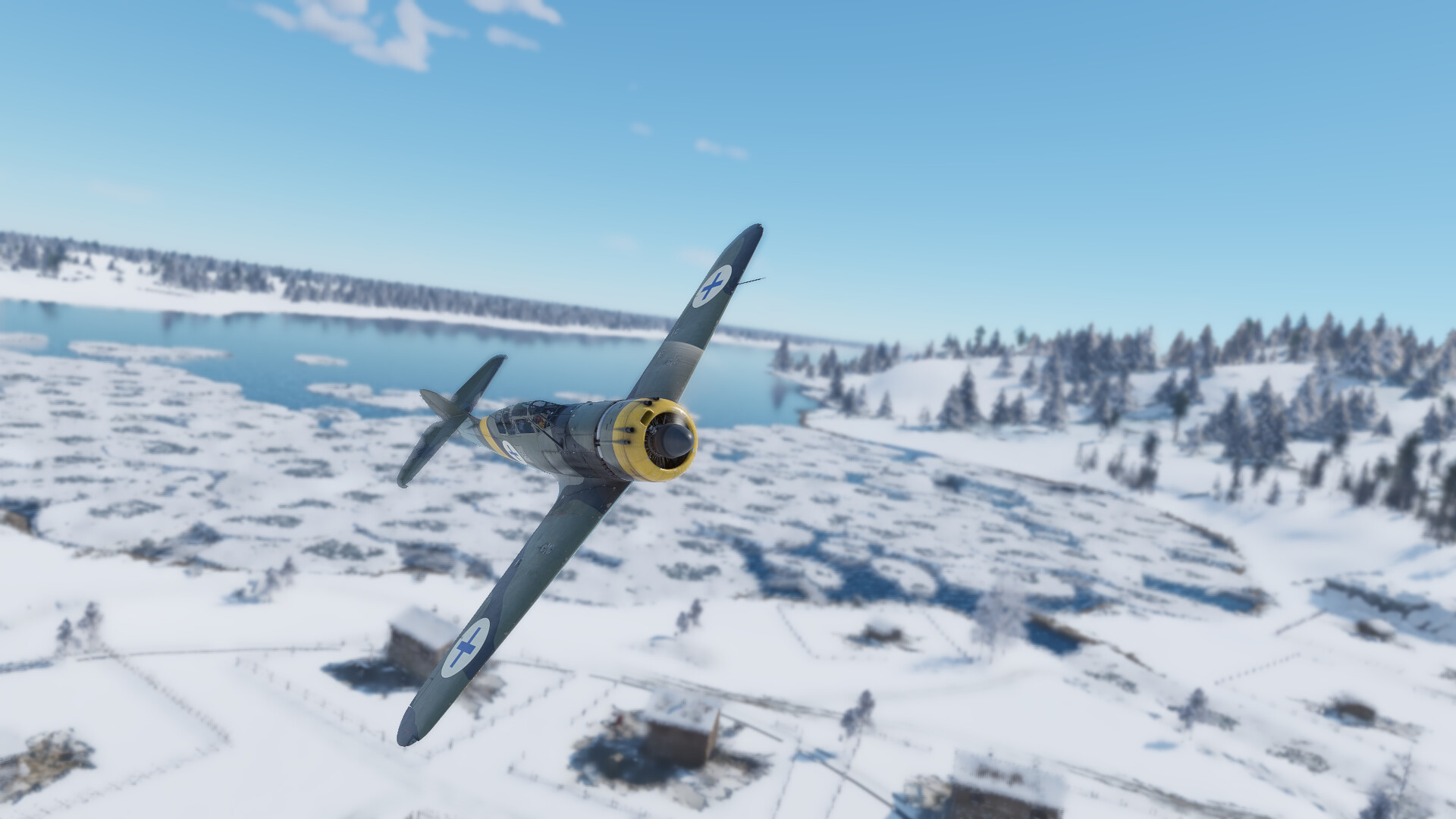
Back in WW2, the Finnish air force had to rely on foreign planes for the war such as the Fokker D.XXI, F2A, Bf 109Gs and Fiat G.50. Although using these planes was cheaper, the Defense Council decided to produce a local fighter in order to lessen reliance upon foreigners. This led to the VL Myrsky (translates as Storm), the first domestically produced Finnish fighter. Although the VL Myrsky had worse performance than other contemporary aircraft such as the Yak-9s and Bf 109Gs, the VL Myrsky still served in the Finnish air force with reconnaissance and ground attack missions. Added in the Summer Landing 2021 event, the VL Myrsky II remains a rare example of the few Finnish aircraft in the game.
Pros & Cons
| Pros | Cons |
|---|---|
| Great energy retention | Weak engine |
| Good firepower | Low wing rip speed |
| Good stall control | Poor reactivity |
| Bad compression |
Flight performance
The VL Myrsky II is powered by the American Pratt & Whitney SC3-G, an air-cooled engine producing 900 hp up until 3,700 m. The engine gets access to WEP making the engine produce 1,066 hp up until 3,000 m. Avoid exceeding these altitude limits as the power greatly decreases the more you go up.
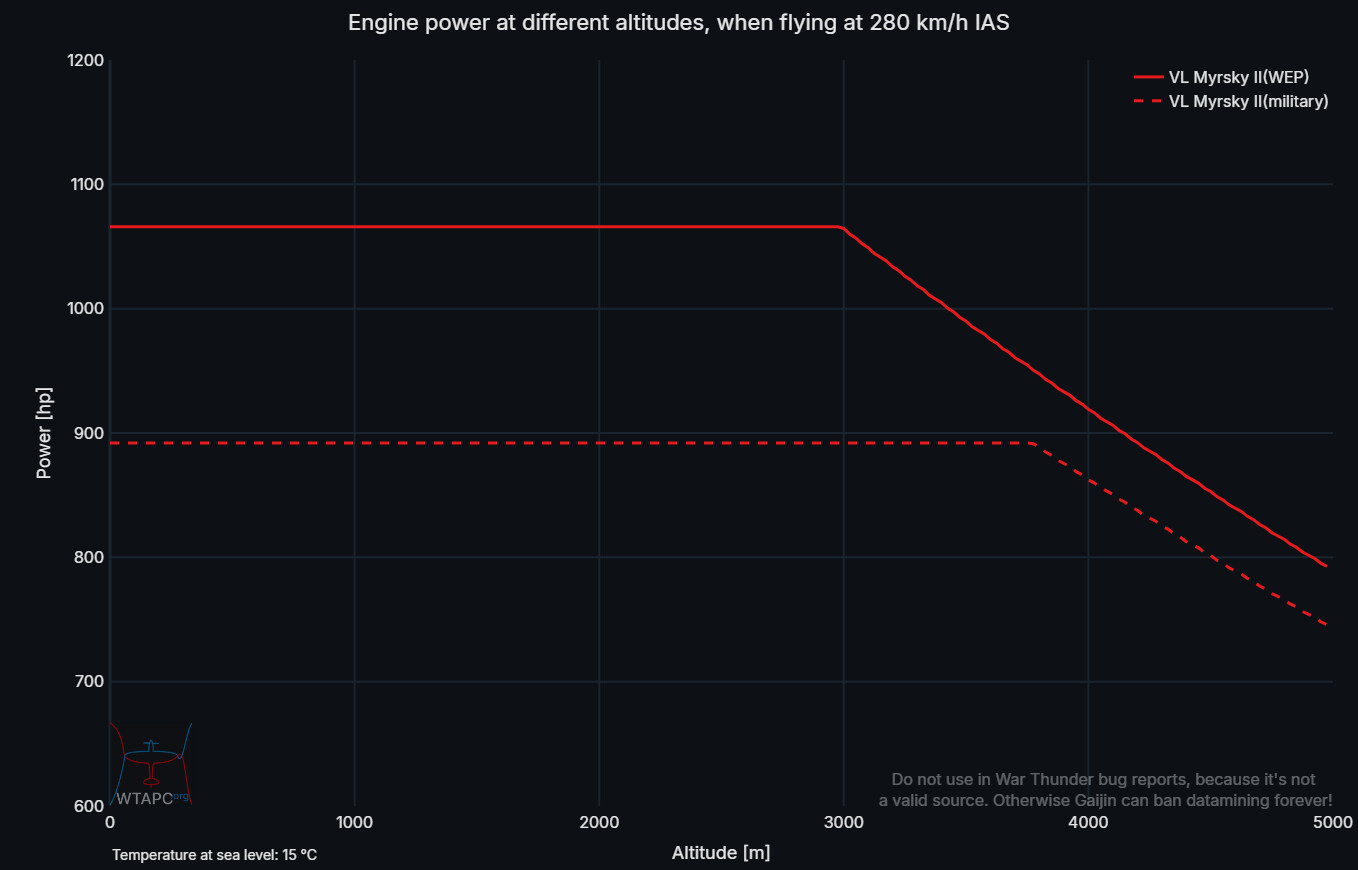
This gives the VL Myrsky II a climb rate of 18 m/s and a top speed of ~480 km/h at sea level.
The VL Myrsky II suffers from weak control surfaces and flaps. This gives it a rather slow roll rate from low to high speed. This makes defensive maneuvers and aiming difficult. On top of that, the flaps have very low structural limits which make them unreliable to use at medium speed during a dogfight.
Landing gears take a lot of time to deploy and store. When landing, you’ll have to stay at low speed for much longer just to wait for the landing gears to be fully deployed.

During a prolonged battle, the engine will start to overheat if you use WEP for too long, which will damage the engine or even kill it.
Structural limits (in IAS)
| Combat flaps | Take-off flaps | Landing flaps | Wings | Gear |
| 355 km/h | 323 km/h | 240 km/h | 650 km/h | 290 km/h |
Survivability
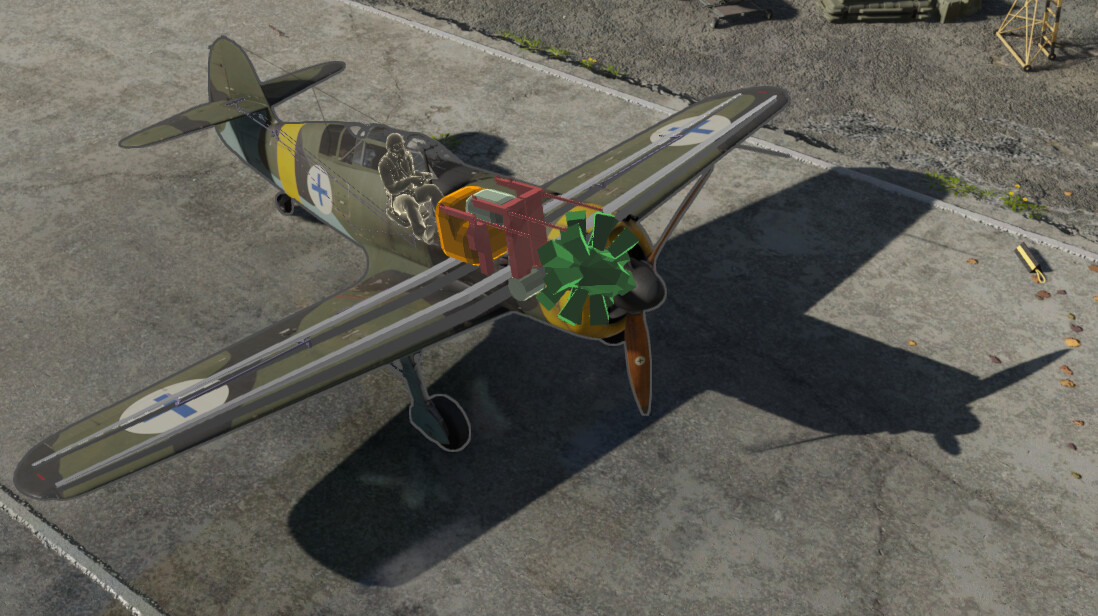
The VL Myrsky II is a relatively small plane, making it harder to hit. However, its sluggish and unresponsive control surfaces make dodging fire much harder. The airframe still remains quite tanky making it able to sustain quite a few hits but they will considerably reduce its flight performance.
The only fuel tank is located in the center part of the plane. The VL Myrsky II also gets access to EFS making it able to put engine fire out.
EFS will put the engine fire out, but this will also kill the engine.
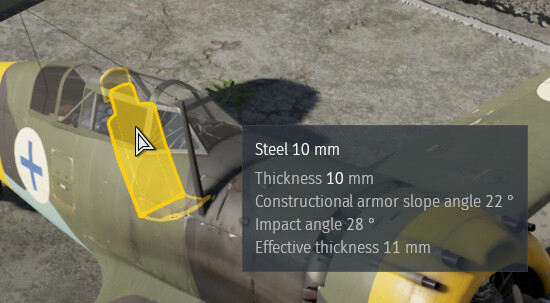
The VL Myrsky II doesn’t get a bulletproof cockpit but the seat of the pilot is protected by a 10 mm layer of steel.
Armament
The VL Myrsky II is armed with 4 12.7 mm LKk/42 machine guns, mounted on the nose of the plane, with 270 rounds for the outer machine guns and 225 for the inner ones, 990 rounds in total.These machine guns work similarly to the american 12.7 mm M2 Browning, with a fire-rate of 1,100 rounds / min and relatively good damage.
These machine guns work similarly to the American 12.7 mm M2 Browning, with a fire-rate of 1,100 rounds / min and relatively good damage.
The Ground Targets belt is the best one to use, being able to set enemies on fire quite easily
The VL Myrsky II is also capable of mounting small bombs under its wings.
- 2×50 kg Model 1938: best used for open top targets, SPAAs and howitzers.
- 2×50 kg SC50JA : very similar to the 50kg Model 1938 while being very slightly lighter
- 2×100 kg Model 1938: better suited for more armored targets such as medium tanks and light tanks. It would still require precision to land the bombs near the targets
Usage in battles
The VL Myrsky fulfills its fighter role in a slower pace than other fighters. Its flight performance doesn’t allow it to rush in to the enemies and win 1v3 dogfights. Standard “Boom & Zoom” tactics should be used instead. Climb until 3 000 meters (otherwise the VL Myrsky will lose a lot of engine power) and drop on isolated enemies who don’t pay attention. Don’t attack targets who are far beneath you as you will either compress and miss your shots or simply rip your wings.
If you are forced into a dogfight, try to utilize as much as possible your opponent’s mistakes, try to go into a slower speed (300/250 km/h) and use your flaps in order to make your enemy stall and drop on them. For ground battles, its payload doesn’t offer great CAS options unless for light and open-top targets. As a CAP plane the VL Myrsky II can work around the enemies attention to perform sneak attack from behind.
Enemies worth noting
Bf 109

Bf 109 Es and Bf 109Fs are your main competitors. They get much better engines (especially at higher altitudes) and have very good maneuverability and similarly to you they shine at energy retention. Dealing with them will either require you to have an energy advantage (speed or altitude) or to have teammates nearby to help you. Going into stall fight is not recommended as their stronger engines gives them the ability to stall after you in an equal energy state. Keep using Boom & Zoom tactics or try to stay behind them as your low speed performance is better than theirs.
Spitfire & Ki-43 / Ki-44

Early Spitfires and Ki-43 / Ki-44 are the opposite of the VL Myrsky II with very bad energy retention but excellent maneuverability, reactivity and stall control. Boom & Zoom is the only way to deal with them as their dogfight performance is much better than yours. Ideally having a teammate nearby will help you dealing with them with one being a “bait” and the other one destroying the target.
History
After their independence in late 1917, Finland remained a relatively small nation and suffered from severe financial limitations for its army. But as the tensions in Europe rose, in 1937 major funds were allocated to the defense budget in order to modernize the Finnish army. In 1938, Finland already bought 7 Fokker D.XXI and the manufacturing license in order to produce them locally in greater quantities. However the Head of the Defence Council, Marshal Carl Gustaf Emil Mannerheim, highlighted the need to produce a local fighter in order to lessen reliance on foreigners in case of war.
In April 1939, the Finnish Air Force invited the State Aircraft Factory (Valtion lentokonetehdas) for negotiations on the construction of a prototype fighter for Finland. On 4th May 1939, VL sent to the Ministry of Defence a preliminary proposal based on the Bristol Taurus engine. At the end of May, five total designs were proposed with various changes, mainly with the wing areas and fuel quantities.
The Ministry of Defence placed an order for 33 aircraft on June 1939. These aircraft were to be powered by the Bristol Taurus III engine, have semi-elliptical wings and retractable landing gears. However, Britain decided to ban all military exports after declaring war on Germany after their invasion of Poland, it was thus impossible to use the Taurus engine. As a replacement, the engineers chose the Pratt & Whitney R-1830-S3C3-G Twin Wasp which had a very similar design to the Bristol Taurus.
On November 30 1939, the Soviet Union attacked Finland which would lead to the infamous Winter War. As a result, many financial decisions had to be made including the termination of the now called VL Myrsky. It was only after the end of it that work could finally resume. Changes had to be made, including in terms of speed, but changing the engine was impossible as both the US and Germany refused to sell any materials. It was thus decided to shorten the wingspan at the cost of maneuverability in order to increase the speed of the aircraft.
On 20 December 1940, a prototype was ordered but would only be finished after a year in December 1941 because of the Continuation War. The prototype, designated MY-1, was flown on December 23 1941 by Lieutenant Erkki Itävuori. Many problems occurred during the test flight, including engine difficulties, tendency to yaw and high wing loading that were affecting climb and maneuverability. Major changes were made including a gain of 317 kg by changing the fuel tanks and engine gills, a new propeller design and modified exhaust pipes. The MY-1 finally achieved a top speed of 468 km/h at the deck and 518 km/h at an altitude of 3,250 meters. In the end, the prototype flew for over 142 hours.
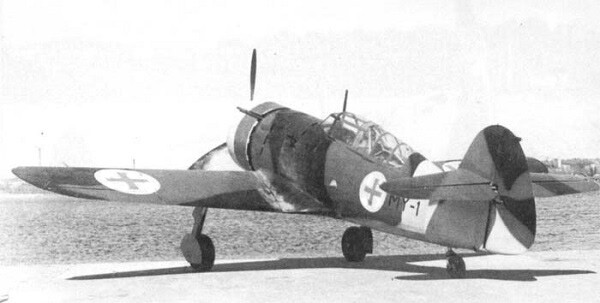
On 30th May 1942, VL was ordered to make 3 new prototypes in order to help test concepts and make mass production easier afterward. These 3 prototypes were designed MY-2, MY-3 and MY-4. These tests included different brake designs, a better cowling system, a removable engine and different wing thickness. These 3 prototypes would be known as the I Series.
The production series, called the II Series, comprised aircraft from MY-5 to MY-51, with a total of 47 aircraft, going from December 1943 to December 1944. During productions, new problems occurred such as elevator weakness which led to the reinforcement of all elevators. Unfortunately, due to their poor performance, the fighter squadrons were not interested and would rather use Bf 109's supplied by Germany. Only the No. 26 Squadron were equipped with VL Myrskys to replace their aging Fiat G.50s.
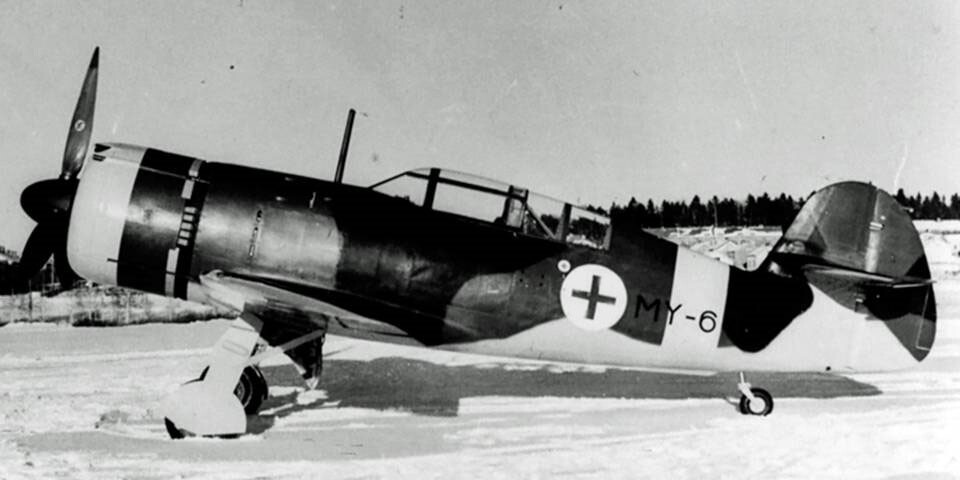
In the end, the VL Myrsky would only perform reconnaissance missions. The No. 12 reconnaissance squadron would become the first to use VL Myrskys in July 1944, with their first missions on the 9th of August 1944 with a patrol flight in the Suistamo area where they attempted to intercept a flight of Yak-7 fighters (although with no results).
In the later phase of the production it was decided that the planes should be able to mount two 100 kg bombs. Pilots at the Tampere testing facility practiced the concept using weighted concrete bricks but due to the planes relegation to reconnaissance, it was believed that the racks would not be used. However on the 3rd September, Captain Oiva Tylli led a six-plane formation to bomb the Soviet 7th Army Corps headquarters at Orusjärvi. They managed to damage the lightly defended headquarters and flew away before they could be intercepted.
The last flight of the Myrsky took place on 10th February 1948, when MY-50, was allowed to fly from its test hangar to Tampere for storage but as it came into land, it overshot the runway and landed on its belly. Today, a restoration project aims to bring back the MY-14 to a fully restored state for display at the Finnish Aviation Museum.
I strongly invite you to check this article made by Olenjoolemassa12 that goes into much more detail about the VL Myrsky history.
Sources
- https://plane-encyclopedia.com/ww2/vl-myrsky
- https://www.vlmyrsky.fi
- https://fi.wikipedia.org/wiki/VL_Myrsky
- War Planes of the Second World War: Fighters (Volume 1) — William Green
- The Complete Book of Fighters An Illustrated Encyclopedia of Every Fighter Aircraft Built and Flown — William Green, Gordon Swanborough