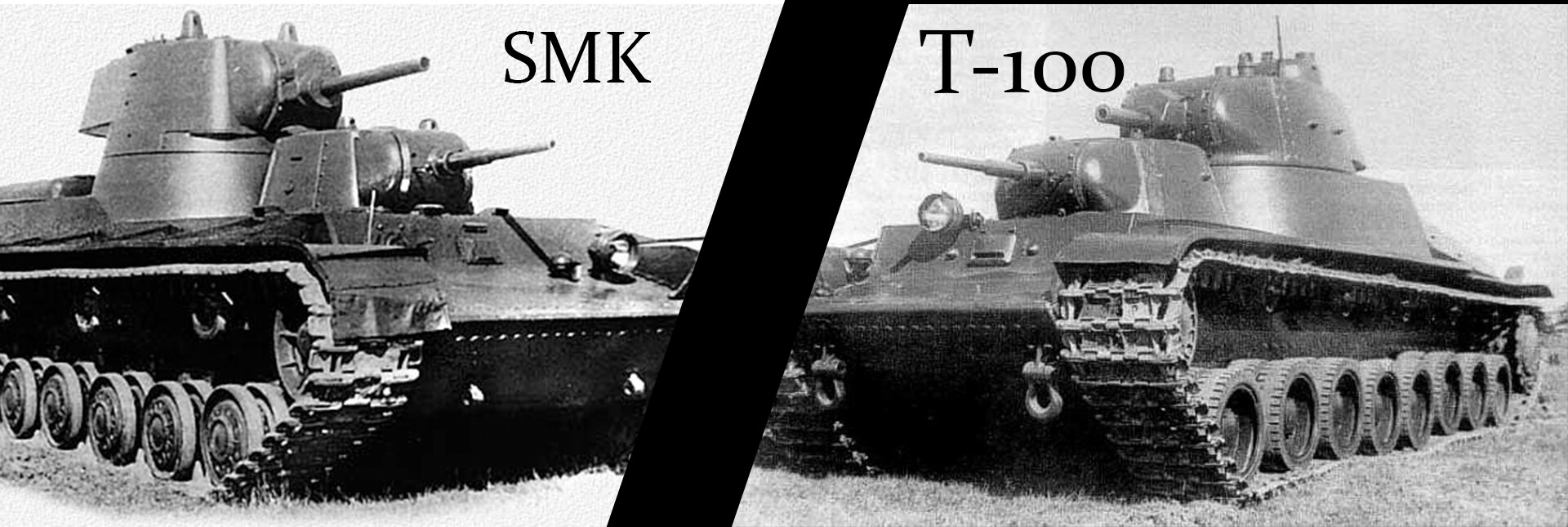
After WW1, a new type of tank emerged: the “Land Battleship”. This type of tank would be developed by multiple nations and in multiple forms. The Soviet Union was particularly keen on this design and continued work on it into WW2. This obsession would lead to two tanks in WW2, the SMK and T-100. Their complex development history would involve other well-known tanks that you may not know were linked.
Land Battleships
The “Land Battleships” were heavy tanks, much longer than their contemporaries (by over 5 meters), capable of crossing trenches and shooting at infantry and tanks simultaneously by having multiple armaments. The first noticeable tank of this class would be the French Char 2C, designed in 1917. But it would be with the British Vickers A1E1 Independent that the multi-turret design philosophy would first appear. It was armed with the 3-pounder gun and 4 subsidiary turrets, each armed with a .303-inch Vickers machine gun. This design, deemed revolutionary at the time, would lead to similar tanks from different nations, most noticeably in the Soviet Union.
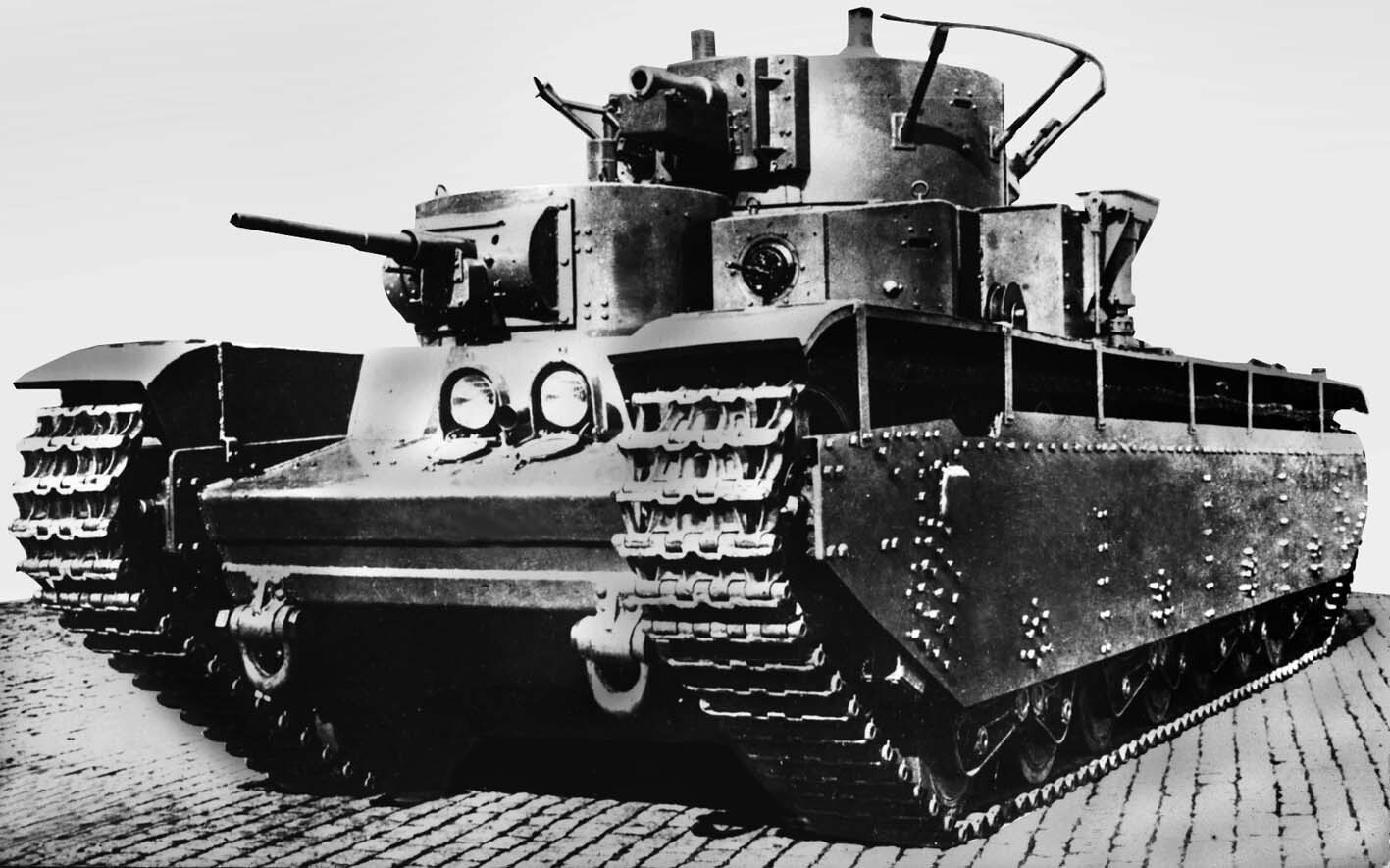
The Soviets started working on a multi-turret design following the same philosophy as the British Independent. Designed by the OKMO Tank Design Bureau in 1932, this new design would become the T-35. It was almost 10 meters long and armed with a 76 mm KT-28 cannon, two 45 mm 20-K cannons, and two 7.62 mm DT machine guns, each in their own independent turret. Although deemed successful at the time, it would quickly become obsolete by the end of the 1930s. The Red Army was firmly wedded to the appeal of a multi-turreted land battleship, and after plans of modernizing the T-35 (which would have led to the T-39 tank design) failed, a new tank would have to be designed to replace the T-35.
Harsh debut
After the trials to up-armor the T-35 failed and had to be abandoned, the search for an entirely new concept began. As KhPZ 183 was already busy working on the A-20 and A-32 tanks (which would lead to the T-34), this task was given in April 1938 to the design bureau SKB-2 (under Zhosef Yakovlevich Kotin) at the Kirov Factory in Leningrad and to SKB-1 (under Nikolai Vsevolodovich Barykov) at Factory No.185 in Leningrad too.
The experience of Soviet tank crews in the Spanish Civil War made it clear that armor was needed and tanks should be able to withstand anti-tank guns of 37 mm or greater. The new heavy tank should emphasize heavier armor rather than heavier firepower. The original requirements were as follows: armor able to withstand 37–45 mm anti-tank guns at point-blank range and 75 mm field guns fired at 1,200 meters, and the same turret layout as the T-35 (i.e., five turrets). Engineers quickly convinced the generals to eliminate the “decorative” MG turrets, reducing the requirement to three turrets: the main turret with a 76 mm gun and two turrets with a 45 mm gun.
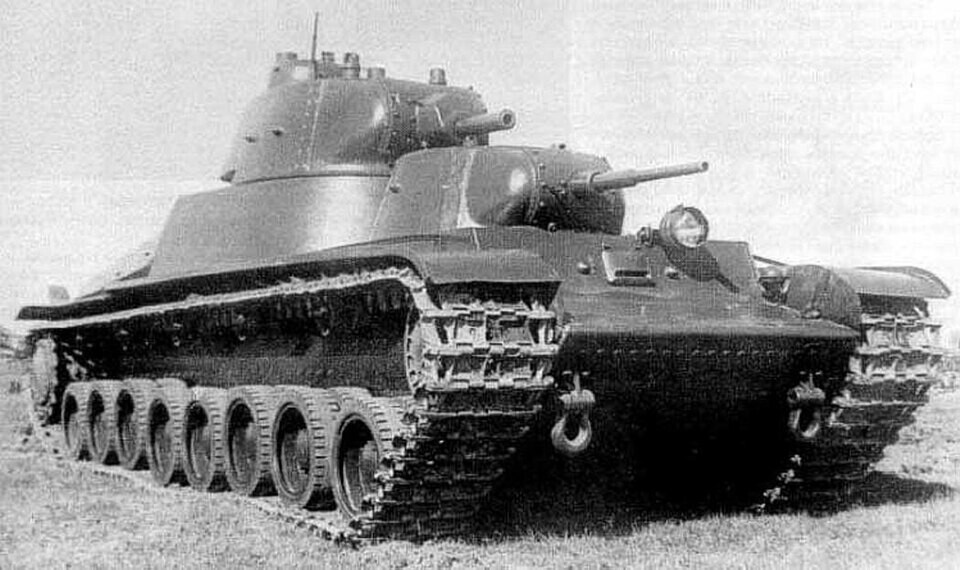
Quickly, each team came up with a name for their projects, respectively T-100 for SKB-1 and SMK (after the deceased Sergey Mironovich Kirov) for SKB-2. On December 9, 1938, both designs were shown as wooden mockups to superiors in Moscow. The tanks were deemed too heavy, too lightly armored, and unsuitable. Legends say that Stalin himself climbed one of the wooden models, smashed one of the turrets, and said, “Why make a tank into a department store!”
New Tanks on the Horizon
After that harsh meeting, both teams went back to the drawing board. Now having only two turrets, the tanks could get much better armor (60 mm of armor all around). Both chassis had eight paired steel road wheels, but the T-100 had rubber tires around the rims. The SMK had torsion-bar suspension, while the T-100 had leaf-spring suspension. Both used the same engine, a GAM-34T liquid-cooled diesel engine producing 850 hp. In the end, both tanks were still very similar in many respects (armor, layout, engines). The main difference was their armament; the T-100 was armed with the 76.2 mm L-10 gun, while the SMK had the longer 76.2 mm L-11 gun, and the main turret of the SMK had a rear-mounted 12.7 mm DShK machine gun.
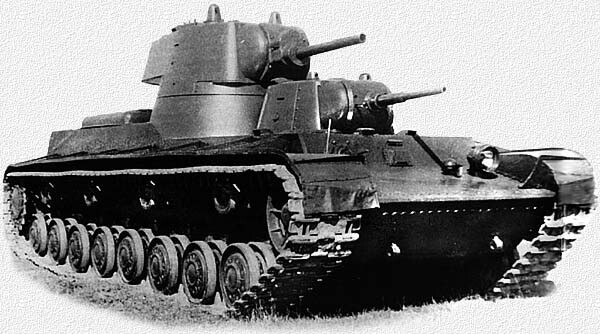
Construction of both tanks began in January 1939. The SMK was ready on May 1st, but the T‑100 was delayed and was completed two months later. Both tanks were sent to Moscow for evaluation and testing at the Kubinka test ground. The SMK had an advantage over the T-100, being three tons lighter, but both tanks suffered major drivetrain problems. At the end of the trials in November, the SMK had covered 1,700 km and the T-100 1,000 km. The trials were not deemed sufficient, but a new test ground was just appearing, and that test ground spoke Finnish.
Winter War
Near the end of the trials, Russia began its invasion of Finland on November 30, 1939, in what became known as the Winter War. In order to prove their combat effectiveness, both the SMK and T-100 were sent to Finland. They were assigned to the 91st Tank Battalion of the 20th Heavy Tank Brigade. Both tanks received some modifications before being sent, primarily replacing the L-10 gun of the T-100 with the L-11 gun (same as on the SMK). The tanks were accompanied by factory personnel for evaluation in the field, alongside expert crew:
| Crew | T-100 | SMK |
|---|---|---|
| Commander | Lieutenant Astakhov | Lieutenant Petin |
| Gunner | Lieutenant Artmanov | Lieutenant Mogilchenko |
| Driver | A. Plukhin | I. Ignatiev |
| Mechanic | V. Kaplanov | A. Kunitsyn |
Other crew members were conscripts or personnel of their respective design bureau.
Both tanks arrived at the front on the Karelian Isthmus on December 10, 1939. Because of the terrain and the many trees in the region, tank operations were limited to the few poor roads throughout Karelia
Incident on the Field
On December 18, the SMK, T-100 and other tanks, such as the T-28, were traveling on the road to attack fortified positions. However, as the SMK was leading the column, it drove over what seemed to be Finnish supplies. They concealed a Finnish anti‑tank mine, and it detonated under the tank’s forward left track. The SMK suffered heavy damage to its tracks and frontal suspension, and the blast even damaged the transmission and electrical systems of the tank.
The T-100 and other tanks that were accompanying the SMK moved into position in front of the SMK to protect it from direct fire. The damage was too severe to be repaired in the field, and attempts to tow the SMK proved unsuccessful. The SMK’s crew was evacuated by the T‑100, which had enough room for both tank crews.
The Soviets tried multiple times to retrieve the damaged SMK, each attempt ending in multiple casualties and failure. The Finns even managed to reach the tanks and took what is now the last known photograph of the SMK.
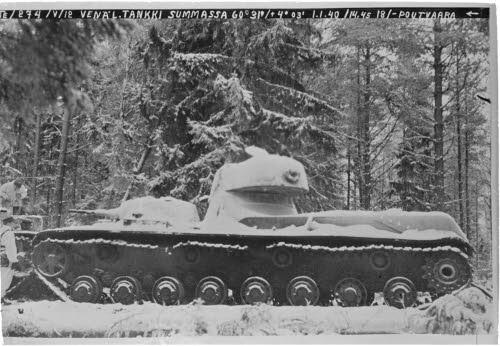
The SMK was finally evacuated in early March 1940. It was transported to Pirkjarvi station and, because of its size, had to be dismantled into several components before being shipped to the manufacturer, where it was most likely scrapped.
The T-100 was redeployed to the front on February 18, 1940, after engine repairs. It saw combat as part of the 20th (February 22–March 1) and 1st (March 1–13) Tank Brigades. During this period, it covered 155 km and sustained 14 hits from anti-tank guns (none of which penetrated its armor). After the war, the T-100 was returned to the manufacturer, and by April 1, 1940, the tank had covered a total of 1,745 km, including 315 km of combat operations on the Karelian Isthmus.
In the end, test field reports on the SMK and T-100 concluded that both tanks met the tactical and technical requirements despite some mechanical and cooling-system problems. However, neither was recommended for production because the KV tank prototype, which featured superior armor and mobility, was already scheduled to enter service.
Future Horizons
After coming back from the meeting in December 1939, the engineers from the Kirov bureau (the one designing the SMK) were thinking that a more practical approach would be to eliminate the second 45 mm turret as well and simply use a single turret design housing the 76 mm gun. As you can imagine, that idea would lead to the development of the KV-1 heavy tank, which would be, alongside the T-34, the backbone of the Soviet tank forces. It was sent for testing in Finland alongside the SMK and T-100, with much better results than they had.
While the T-100 was being used in Finland, in mid-December 1939, Factory No.185 received an order from the Military Council of the Northwestern Front to design an engineering vehicle based on the T-100 chassis. It was intended for bridge-laying, transporting sappers and explosives, and recovering damaged tanks (which would have been helpful for the SMK). However, during the design phase, the design bureau received an order from the Chief of Armored and Motorized Forces to mount a 152 mm gun “or another suitable weapon capable of high muzzle velocity” to engage fortified defensive positions. Barykov (the director of Factory No.185) asked the Military Council of the Northwestern Front to alter the concept and approve the mounting of a 100–130 mm naval gun on the T-100 chassis.
The request was granted, and Factory No.185 began working on it. As early as January 8, 1940, the hull drawings for the T-100X (the designation given to the self-propelled gun) were handed over to the Izhora factory so they could start producing the hull. The T-100X had a conical superstructure mounting a 130 mm B-13 naval gun. During development, the hull was redesigned and simplified to reduce shell loading time. This new version was designated T-100Y. The T-100Y armored hull was delivered by the Izhora factory on February 24, 1940, and assembly of the hull began on March 1. On March 14, 1940, the completed self-propelled gun rolled out of the production hall.
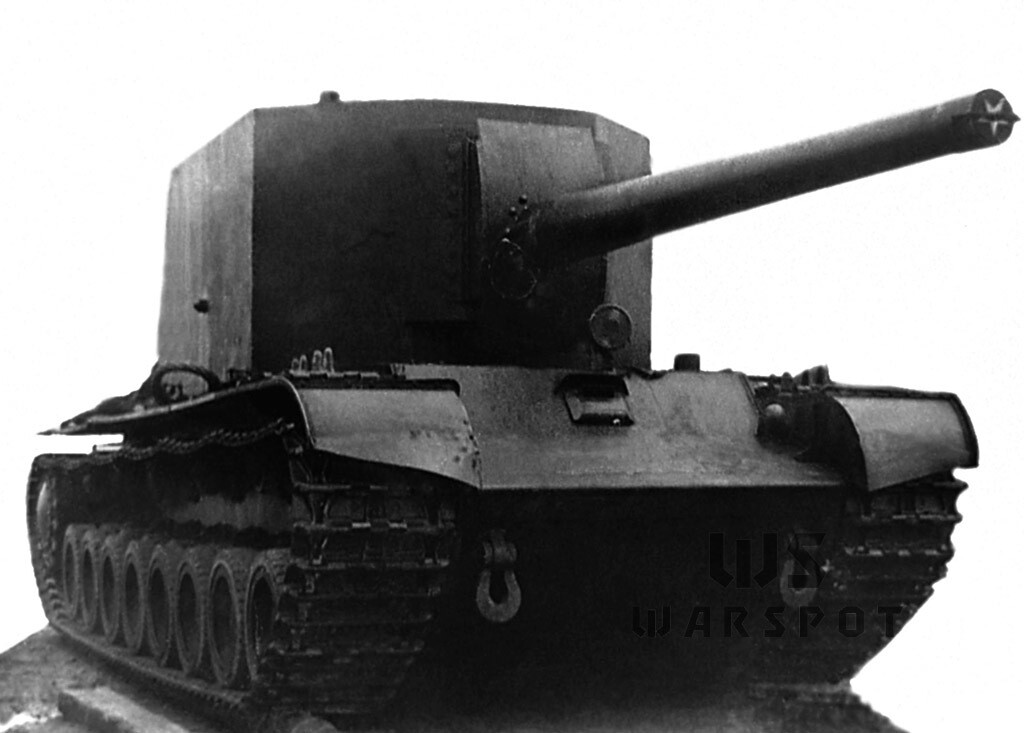
Funnily enough, the Military Council of the Northwestern Front was still certain that Factory No.185 was working on the initial engineering tank, and on January 21, 1940, the Contract No. 8-8-087 for this vehicle was signed. Barykov had to send a letter to the council a few days later with a proposal for his 130 mm SPG prototype. Luckily, the council approved the idea and ordered continued work on it.
On June 15, 1940, the T-100Y was sent to the Gorohovets Artillery Proving Grounds for trials, alongside other experimental tanks like the SU-14-1 and SU-14. The T-100Y fired six shots. Many complaints about the tank included: lack of mantlet balance, making aiming difficult; cramped fighting compartments; and poor ammunition rack arrangements, which needed changes (shells on the right side and propellant on the left side).
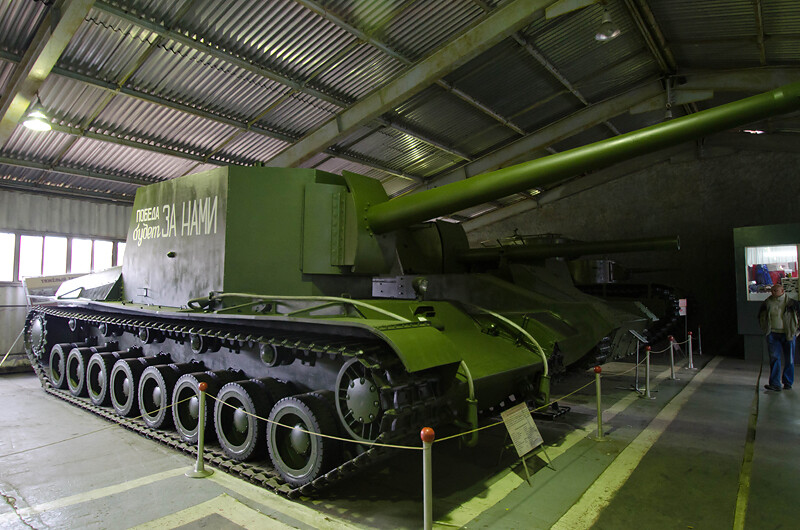
The T-100Y was sent to Factory No.174 (Factory No.185 was reabsorbed into Factory No.174), for further refinements. Unfortunately, interest in the T-100Y began to fall as new heavy tanks and SPGs based on the hull of the KV-1 started to emerge. The T-100Y was sent back to Kubinka in 1943. By 1945, it was redesignated as the SU-100Y.
As of today, the SU-100Y is the only survivor of this battle between the SMK and the T-100 and is displayed at the Kubinka Tank Museum.
Additionally, during the Winter War, attempts were made to upgrade the T-100's armament. In January 1940, Deputy People’s Commissar for Defense G. Kulik issued an order to “strengthen the T-100's armament by mounting a 152 mm howitzer on it for the purpose of engaging stone anti-tank pillars.” By mid-March 1940, a new turret mounting a 152 mm howitzer had been produced. The tank was equipped with a 152 mm howitzer and was designated the T-100Z. However, the new turret was never installed, as the KV-1 and KV-2 tanks were adopted into service, and work on the T-100Z was halted by a decision of the Armored and Motorized Forces Directorate. Ultimately, the T-100Z led to another project called the T-103 (or Object 103), a T-100Z with a turret-mounted B-13 130 mm gun, which never went further than a model.
Sources
- SMK article on Tank Encyclopedia
- T-100 article on panzernet
- T-100Y article on tankarchives
- T-35 / SMK / T-100 Wydawnictwo Militaria N°159 — Maksym Kołomyjec, llja Moszczański
- Soviet Heavy Tanks — Steven J. Zaloga, James Grandsen
- KV-1 & 2 Heavy Tanks 1939-1945 — Steven J. Zaloga, Jim Kinnear, Peter Sarson