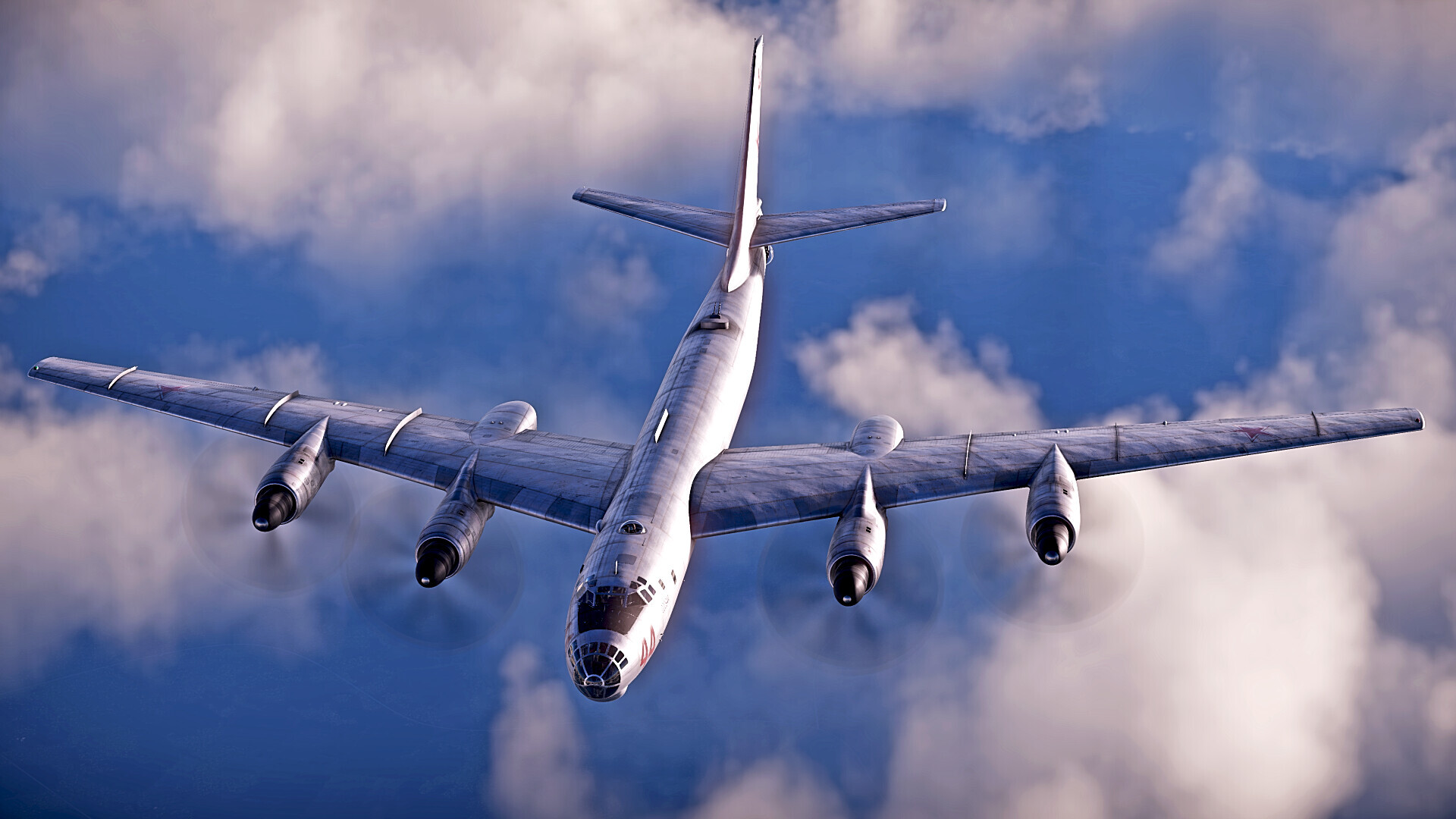
The Tu-95 (NATO reporting name: “Bear”) is a renowned Soviet turboprop strategic bomber. Originally developed as a replacement for the Tu-4, the Bear served as a heavy bomber, capable of carrying various bombs and missiles and even as a carrier for the “Tsar Bomba” — the most powerful nuclear bomb in the world. But how does the Tupolev perform in the game? What is the history of the world’s loudest turboprop bomber? Read the article to find the answers!
| Pros | Cons |
| Large number of countermeasures | Low top speed, big silhouette |
| Good defensive turrets at close range | Poor manouverability |
| Heavy payload | Aircraft’s nose is vulnerable to enemy attacks |
Flight performance
The Tu-95M most closely resembles the Tu-4, but it is several times larger. While being powered by four NK-12M engines, each producing 15,000 horsepower, the aircraft’s speed is low compared to its competitors, with an average of 680–700 km/h. At low altitudes, below 5 km, the Tupolev can easily rip its wings at speeds exceeding 750 km/h, especially when turning or performing prolonged maneuvers.
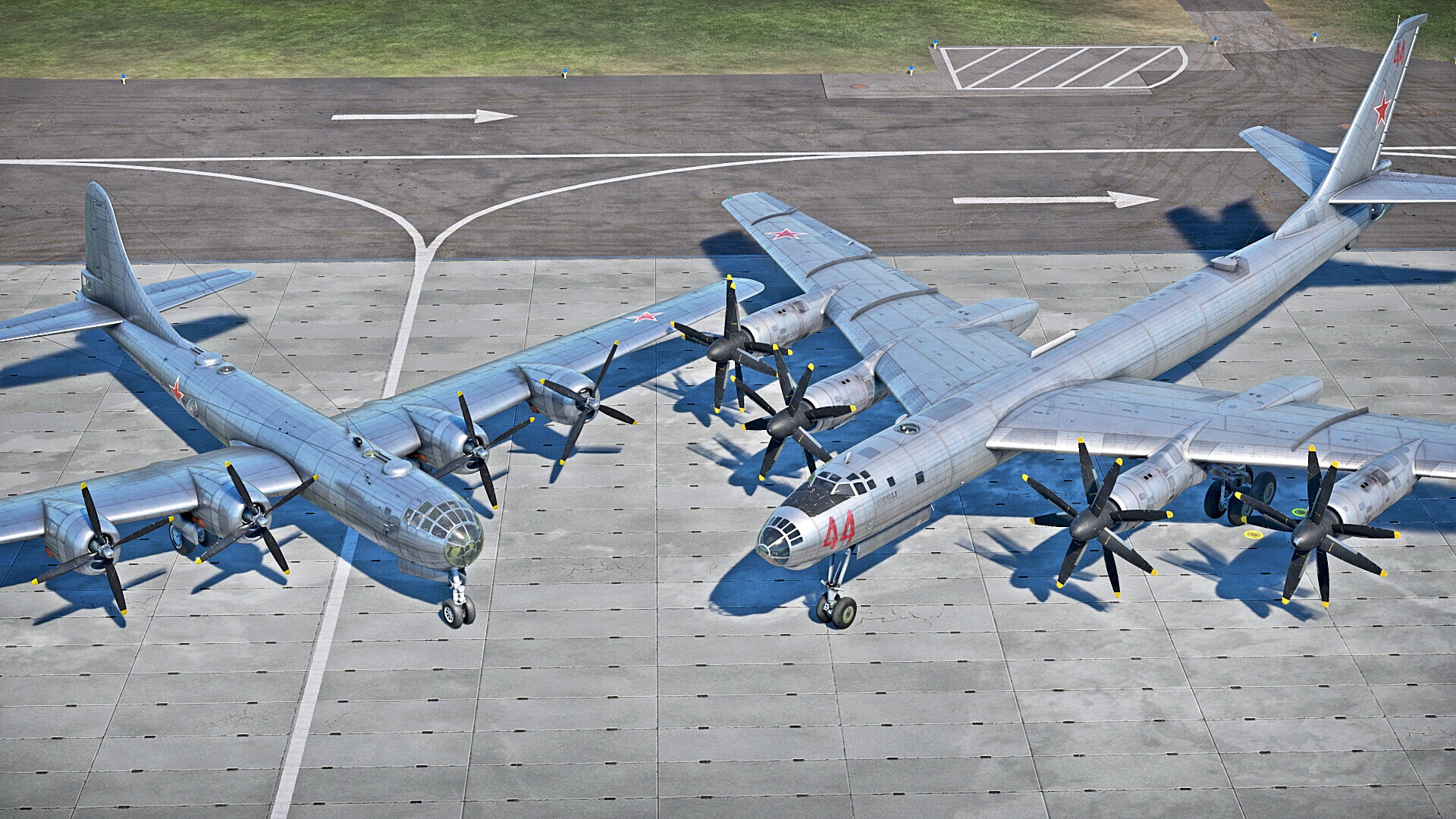
The Tupolev holds the record for base weight, at a whopping 84.5 tons. It struggles to gain speed during take-off and to reduce it during landing. Landing a bomber is a different challenge — the Tu-95M is very large and hard to slow down. Furthermore, the Tupolev lacks an airbrake, making braking distance another challenge during landing.
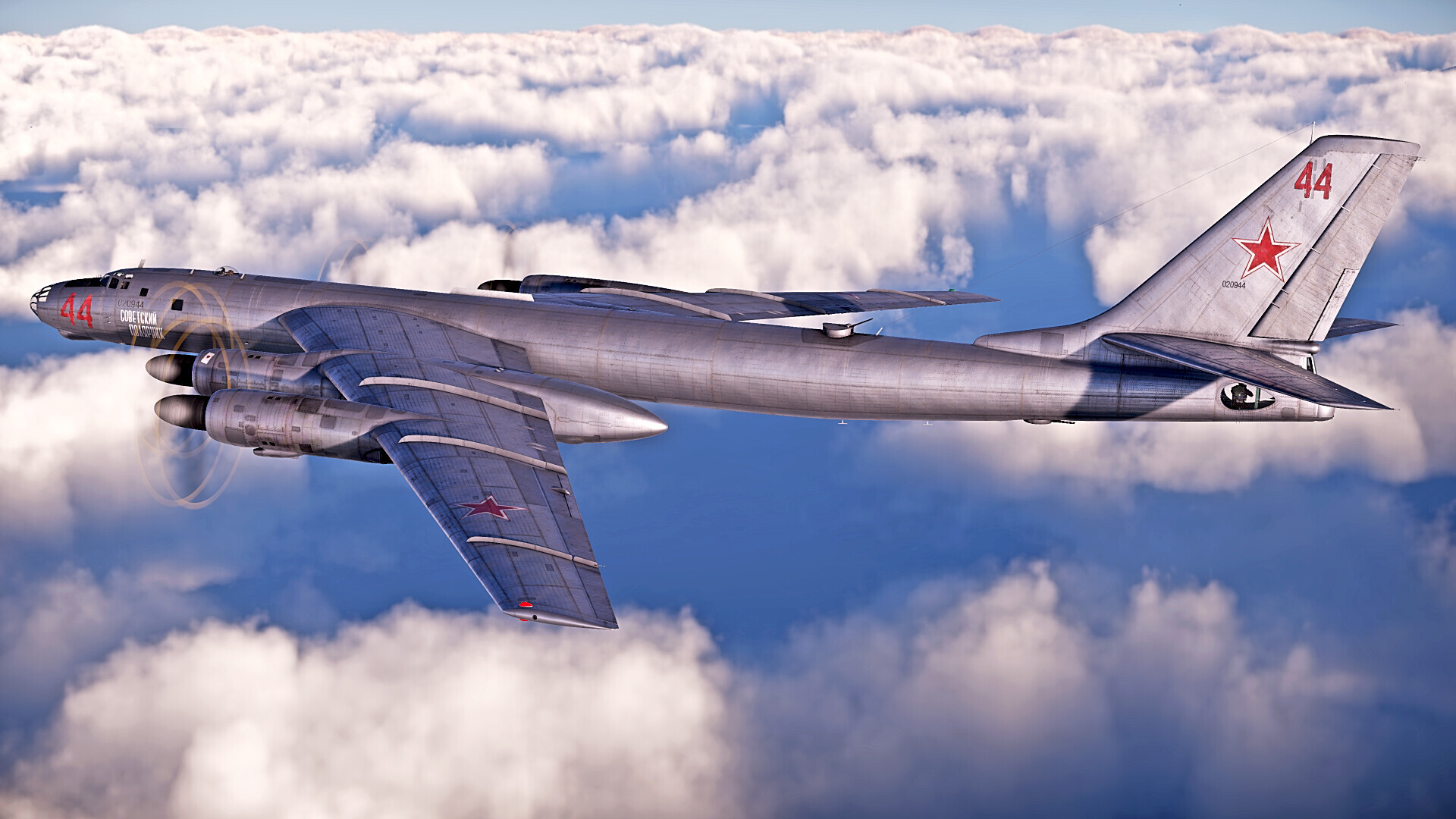
The Tu-95M’s maneuverability most closely resembles that of the Tu-4, the aircraft that launched the bomber’s history. However, the Tu-95M is much heavier than the Tu-4. A dogfight in a bomber would be more comical than realistic. The best solution is to use defensive turrets or countermeasures. At worst, the Tupolev would be unable to do anything but be sent to the hangar.
Armor and survivability
Although the Tu-95M is a large bomber, it has quite good armor. The tail gunner is protected by a 20 mm steel plate that can withstand 12.7 mm caliber machine guns, such as the M2 Browning, and smaller ones. Another protective feature is the 155 mm bulletproof glass, which can withstand almost every aircraft cannon up to 15 mm; however, larger cannons can still easily penetrate the Tu-95. Between the bomb bays are steel plates with a thinner armor thickness of 10 mm. The cockpit is also well armored, with protection distributed around its entire perimeter.
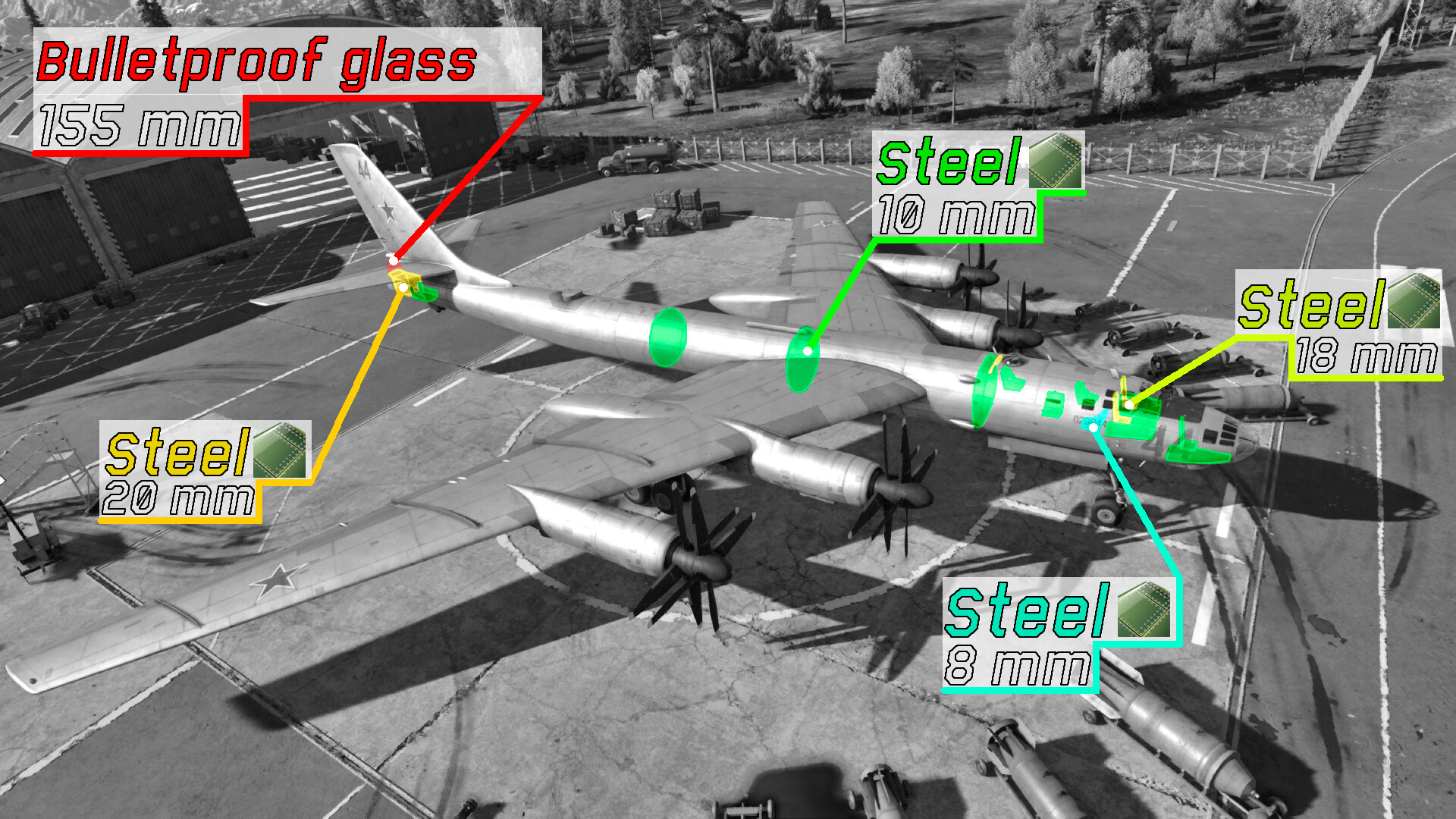
The bomber’s survivability is low. As one of the largest aircraft in the game, the Tu-95M reaches up to 50 metres, making it extremely easy to hit. Although it has defensive turrets that effectively cover its rear and lateral hemispheres, the Tu-95M remains defenceless from the front due to the turrets' dead zone. Another major problem is the low probability of reaching the airfield with three or fewer engines.
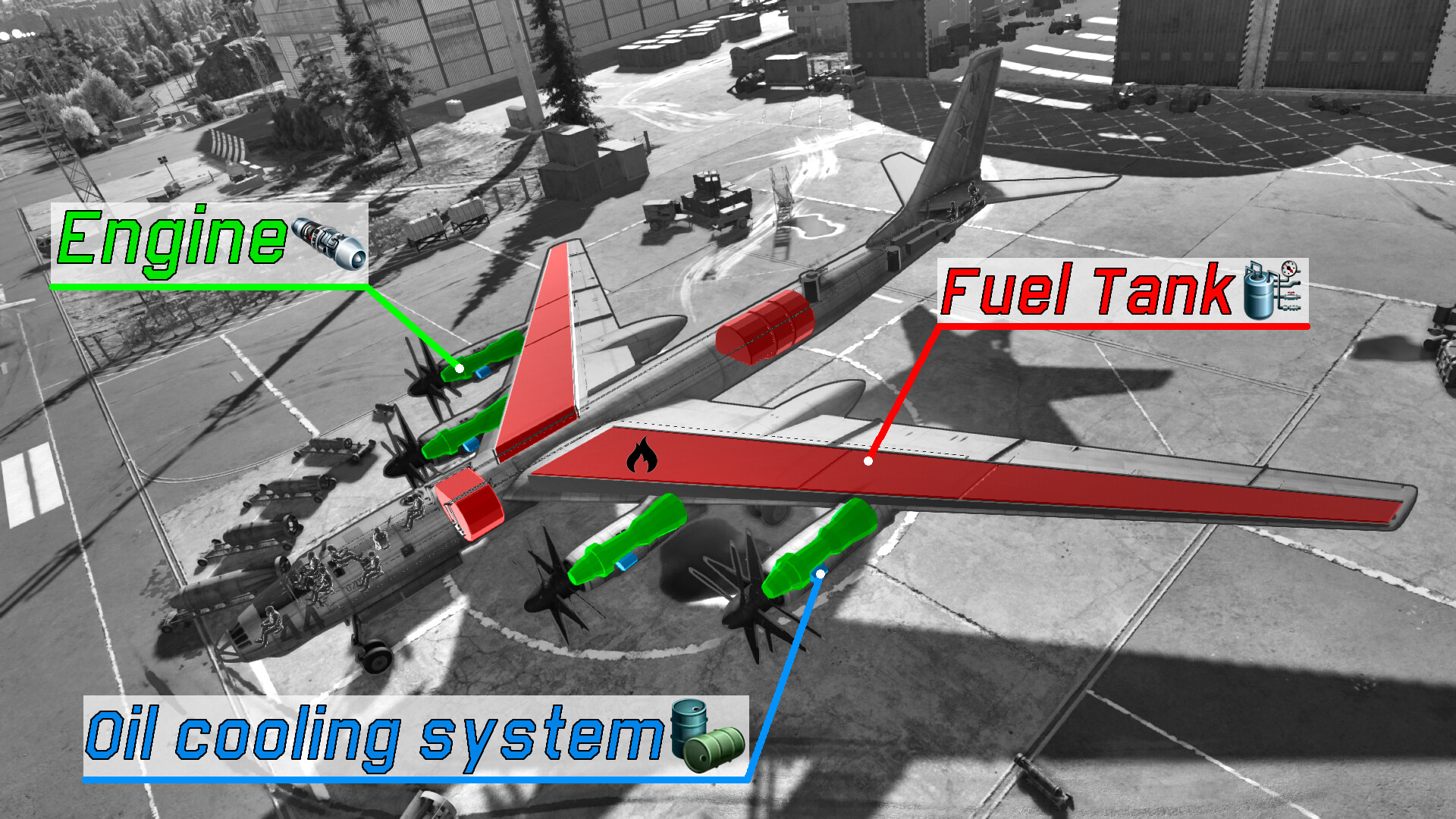
The Tupolev 95M is also equipped with 1,400 countermeasures, of which 400 are flares, protecting the aircraft from IR-guided missiles, and the other 1,000 are large-caliber chaff, which can protect the bomber from radar-guided missiles.
The Tu-95 is also equipped with an RWR called “SPO-2”, the same as on the Su-7. It alerts the Tu-95M pilot to radar signals within a 30 km range, although it can only detect radars to the rear. It is practically useless on the Tupolev, as it does not recognise threat type or missile lock, so the pilot should still keep an eye out for enemies, especially those capable of using missiles.
Armament
Suspended weapons
One of the Tu-95M’s main advantages is its wide range of weapons. It carries bombs of various calibers, including the record-breaking FAB-9000, the largest bomb in the game by size, though the Lancaster B Mk.I still holds the record for explosive mass with its 12,000-pound bomb. For convenient use at high altitudes, the Tupolev is equipped with a ballistic computer that has CCRP and CCIP. These features are especially helpful for high-altitude bombing.
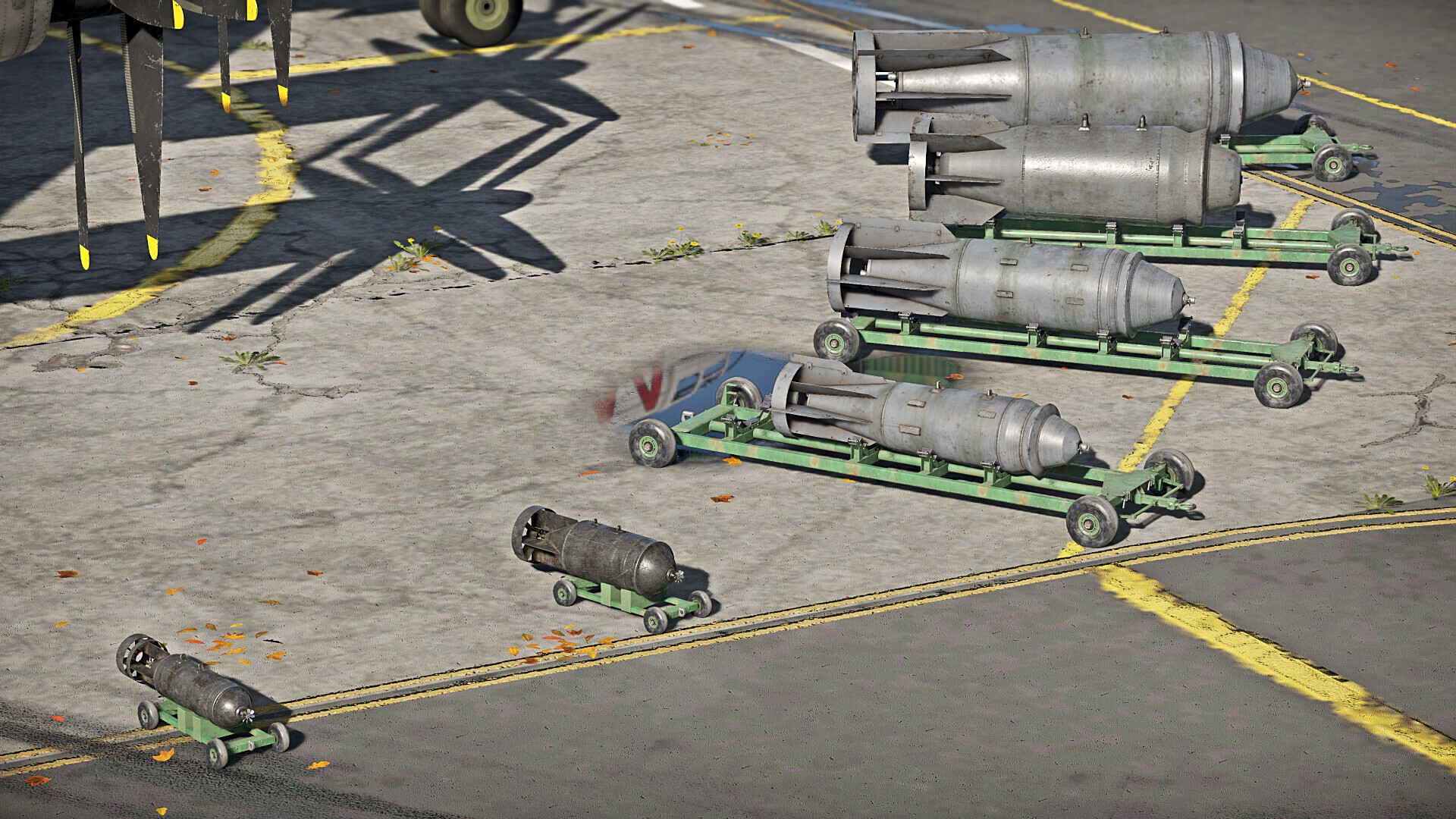
The range of suspended weapons includes:
- 6 x FAB-250M-46 — the smallest caliber available on the aircraft. They have a small explosive mass of 122.3 kg and a limited fragmentation spread, making them ineffective even against light vehicles, especially when dropped from high altitudes;
- 4 x FAB-500M-46 — a slightly larger bomb with almost three times the amount of explosives. 325 kg is enough to destroy light equipment with shrapnel;
- 4 x FAB-1500M-54 — good for destroying well-armored vehicles. Ideal for heavy and medium tanks. Still, the Tu-95M can carry larger ones;
- 4 x FAB-3000M-54 — four excellent bombs, each containing 1,387 kg of explosives. This is sufficient for a multi-strike on an enemy capture point, and the 300-metre fragmentation radius can easily destroy open-top vehicles;
- 2 x FAB-5000M-54 — the second-largest caliber bombs the Tu-95M can carry. While the shrapnel spread remains the same, it now disperses 2,207 kilograms instead of 1,387 in the previous ones. Still, that is enough to destroy all vehicles on small maps with a single spawn point;
- FAB-9000 — the largest bomb in the game by size. Although it weighs 9.4 tons, it contains only 4,297 kg of explosive mass. However, its fragmentation radius is 373 metres, enough not only to destroy an enemy spawn point but also to leave a huge crater.
Defensive weapons
The Tu-95M is certainly not lacking in features: three AM-23 23 mm turrets. These guns reliably protect against approaching aircraft. They are accurate at ranges below 1.5 kilometers. The following belts are available:
- Standard
- Universal
- FI-T
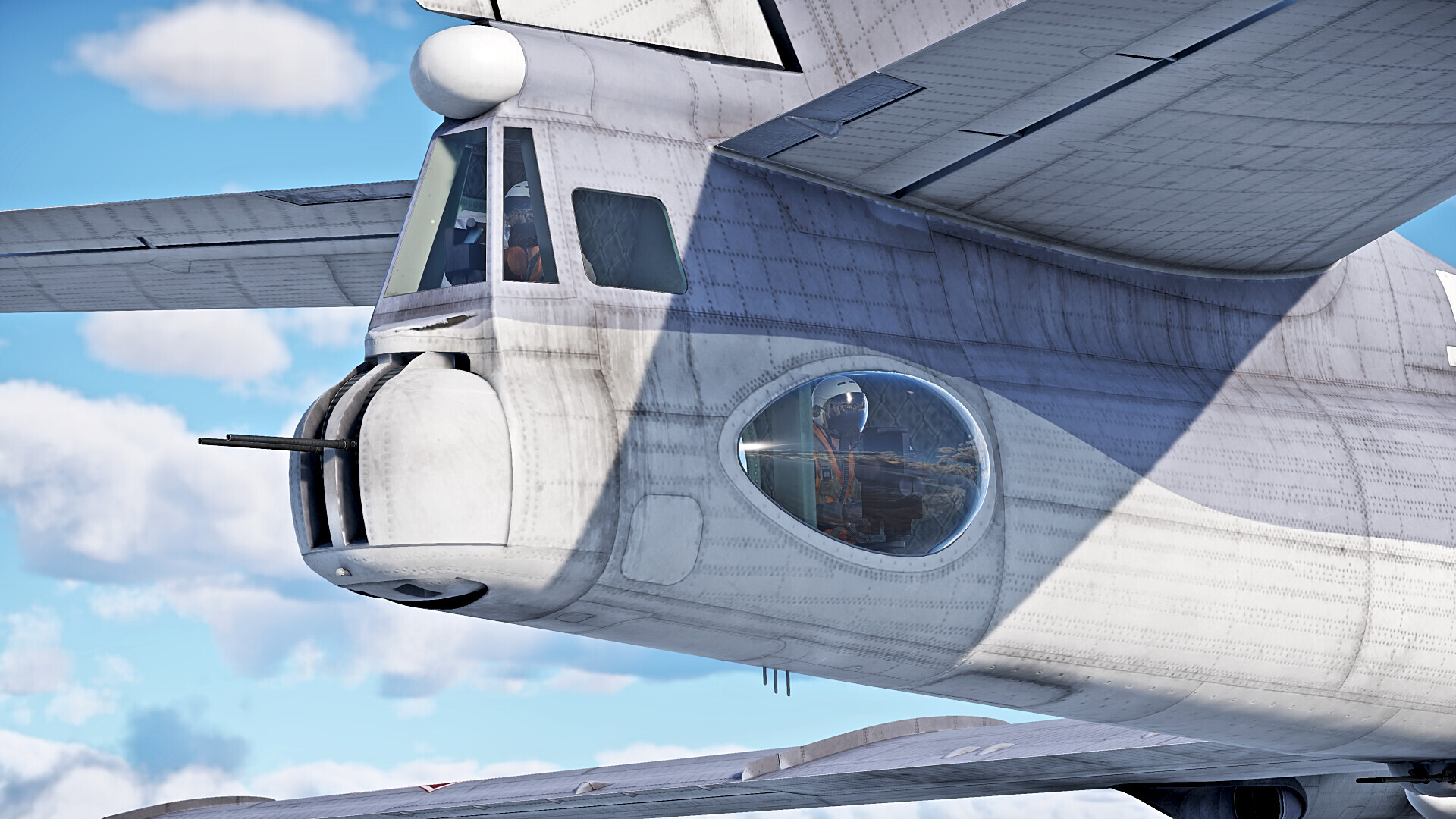
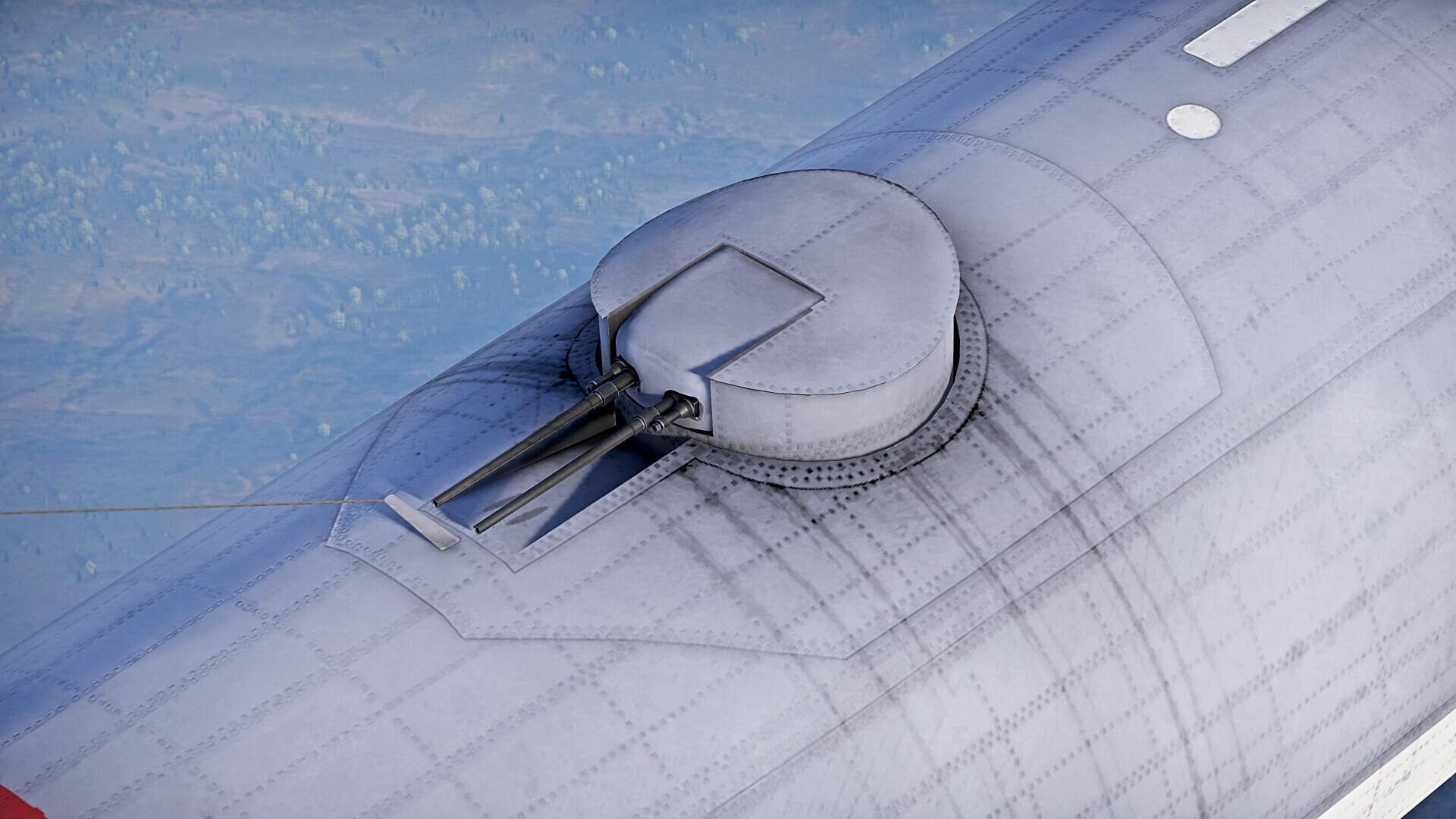
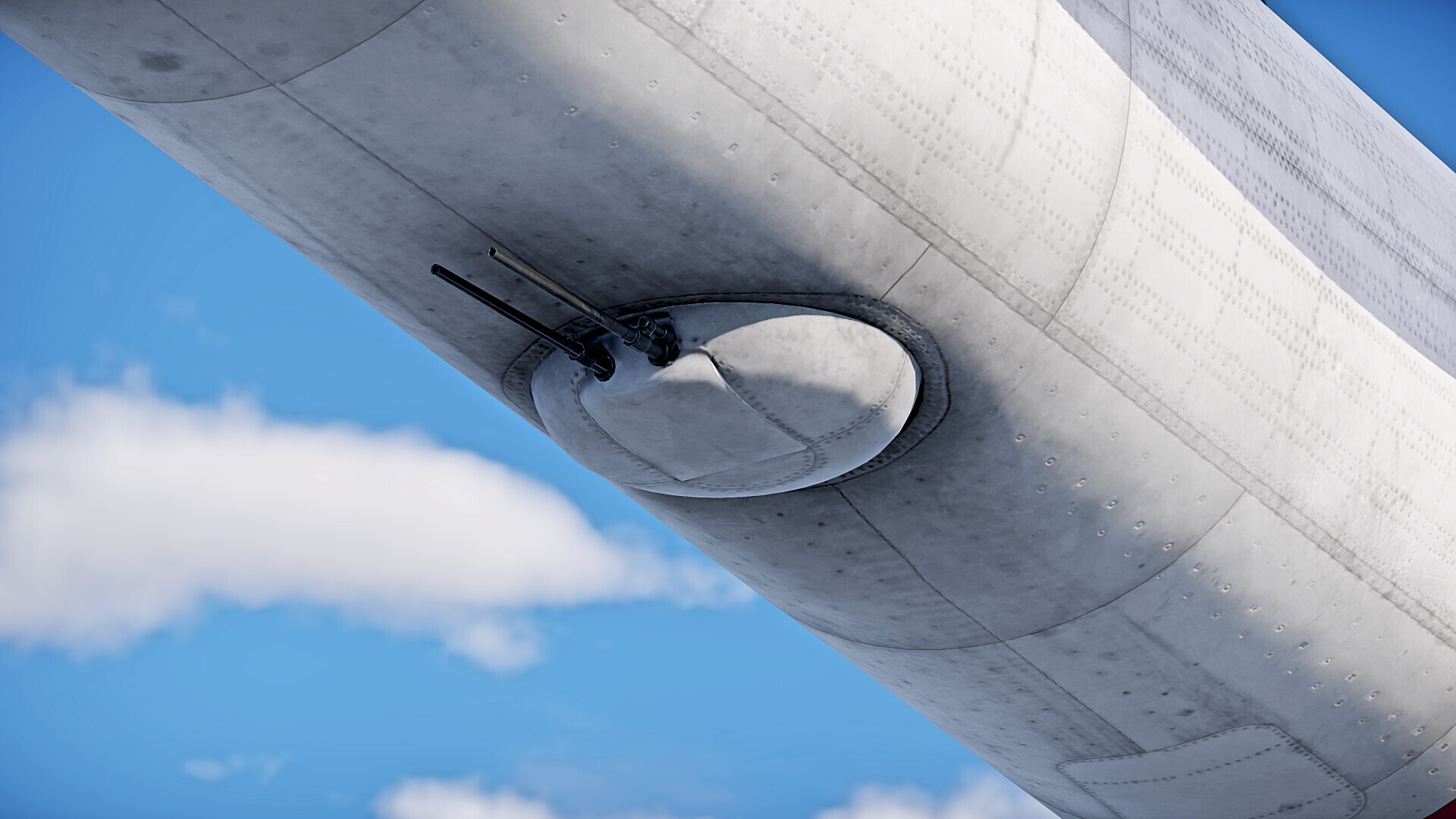
There’s no real difference between them for a bomber. Each belt deals significant damage to aircraft and is generally similar to the others.
Usage in battle
The Tupolev is difficult to use effectively in mixed battles. Although enemy SPAAs can have difficulty destroying it, the main problem is fighter jets. Enemy aircraft will eagerly try to shoot down the Tu-95M because it is a huge bomber with poor defensive coverage. Furthermore, enemy fighters have no visible markers, so potential threats must be detected primarily by sight. Although the Tu-95M has excellent bomb armament, it would be difficult to spot an enemy on a tank map, especially when using bombs smaller than 1,500 kilograms.
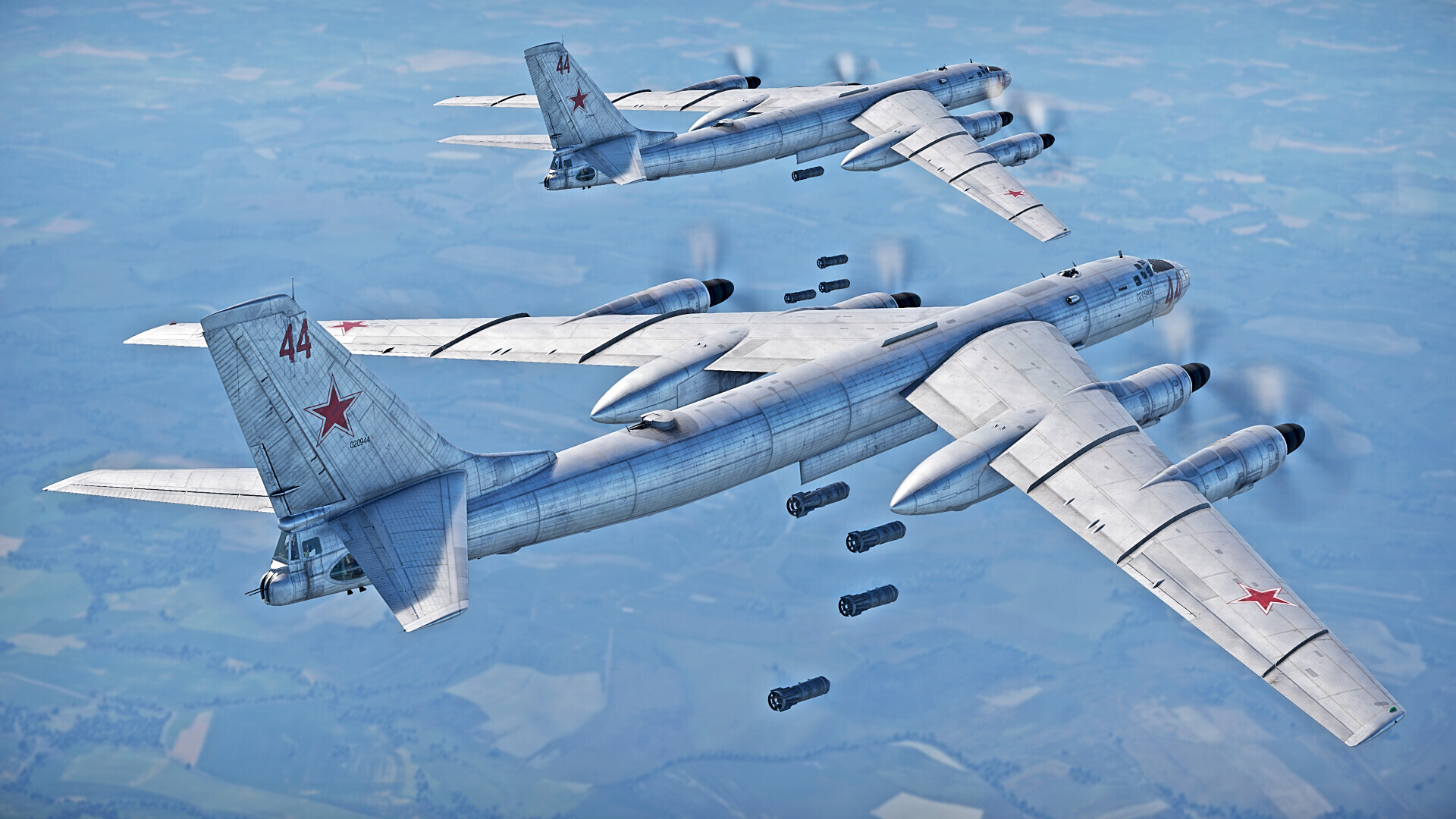
The Tupolev bomber also struggles in air battles. The Tu-95 spawns at a standard bomber altitude and has no distinct advantage over other aircraft of the same rank. It faces early Meteors on one hand, and F-104As and F-104Cs on the other. The latter can easily gain altitude and shoot down the bomber’s poorly protected nose with a short burst of M61 fire. The Tu-95 excels in its primary role of destroying enemy bases. Four FAB-3000s are sufficient to destroy four enemy bases, but the bomber still has to reach them. Most attackers, such as the F-84F Thunderstreak, are already equipped with napalm and can easily outrun the Tupolev from its spawn point.
History
The history of the Soviet “Bear” began with the Tu-4, a B-29 Superfortress that was converted to Soviet standards. The Tu-4 also served as the basis for the new Tupolev bomber. However, the rapid development of jet aircraft and the emergence of potential enemy military bases near the USSR’s borders rendered the aircraft obsolete.
The task was clear for the engineers. The VVS needed a new bomber with a range of at least 7,000 kilometers and a large payload capacity. Andrei Tupolev knew that neither early jet designs nor later piston engines were suitable for building such an aircraft. The only option was to rely on Nikolai Kuznetsov to quickly implement turboprop engine developments, as the development of the new bomber could no longer be postponed.
Nikolai Dmitrievich Kuznetsov, who had experience working with experimental German engines, finalized the 5,000 horsepower TV-2 turboprop engines for the Tu-4 modification. Kuznetsov and Tupolev reached a compromise on the feasibility and timeframe for developing a twin-turbine version of the TV-2, in which two adjacent engines would feed a single reduction gearbox to produce a total of 12,000 horsepower. The designers also discussed possible timeframes for a single turboprop engine with 15,000 horsepower.
Engineers decided that the first test flight of aircraft “95” would be equipped with four TV-2F engines, each producing at least 12,000 horsepower. With these engines, the aircraft would have a tactical radius of up to 6,000 kilometres and a payload capacity of nine tons.
On June 11, 1951, the government issued a decree instructing Tupolev to develop a high-speed bomber with four 2TV-2F engines. The first version was scheduled for flight tests in September 1952, and the second version, with four TV-12 engines, was scheduled for testing in September 1953. However, during testing, the 95-1 prototype with 2TV-2F engines crashed. Following the investigation, development of the twin engines was discontinued.
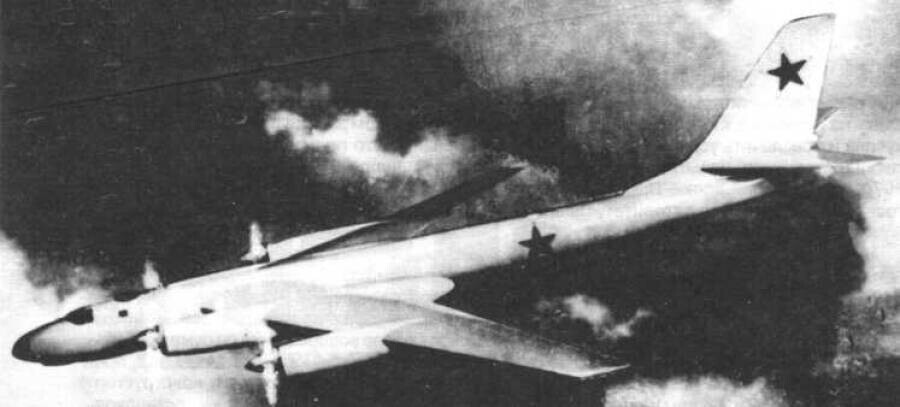
During a meeting of experts who blamed Kuznetsov for the crash of the prototype, Andrei Nikolaevich Tupolev said: “No engine, no plane. You nearly ruined everything with your own hands: a good engine and a good plane.” The project was on the brink of collapse; the crash nearly brought an end to the Tu-95's entire history. However, they decided to heed Tupolev’s advice and continued working on the second prototype, which was equipped with TV-12 engines.
Did you know? The TV-12 engine was also used on Soviet planes, such as Tu-114, Tu-126, An-22 Antey and A-90 Orlyonok
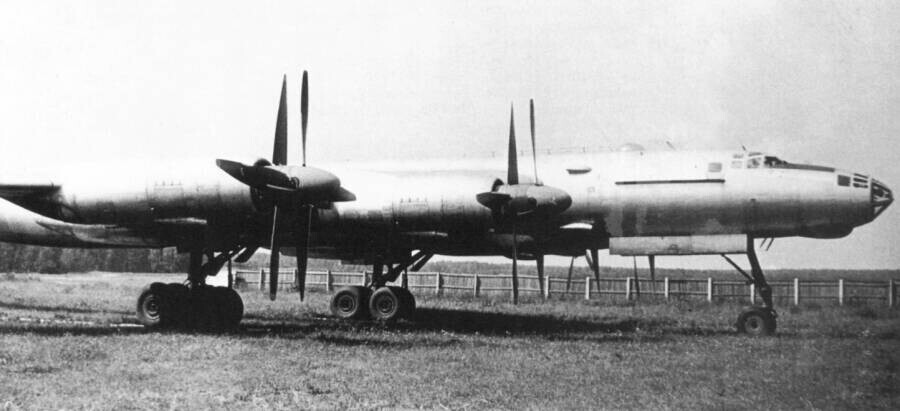
The development of the TV-12, the world’s most powerful turboprop engine at the time, was completed in record time. The first tests were completed in October 1952, and engine bench testing was successfully finished by the end of 1953. On December 25, 1954, the TV-12 passed the 100-hour state tests and entered serial production. The second prototype, “95-2”, was also completed alongside the new turboprop engines. On February 16, 1955, the aircraft successfully took to the skies and completed its maiden flight. Serial production of the Tu-95 began that same year. It was initially intended to be called the Tu-20, but since all the drawings had the index “95”, the name remained unchanged.
Modifications of the Tu-95
The new bomber was unveiled at the Aviation Day parade in August 1956. The following year, the aircraft was outfitted with new NK-12M engines and adopted by the Soviet Army under the new designation Tu-95M. A total of 19 Tu-95M bombers were produced. Preliminary tests were conducted with a takeoff weight of 182 tons, a bomb load of six tons, and five percent fuel remaining. Tupolev demonstrated a practical range of 13,200 kilometers (8,200 miles) and a maximum speed of 902 kilometers per hour (560 miles per hour), though the cruising speed was 700–750 kilometers per hour (435–466 miles per hour). In the early 1970s, the Tu-95M and Tu-95 underwent modifications and improvements that allowed the bomber to remain in service until the 1980s. At the end of their careers, they were converted into training aircraft. Several modifications of the Tu-95M bomber were released in addition to the original model.
Among them was the Tu-95V, a modified Tu-95 used to test the powerful thermonuclear “Tsar Bomba”. On October 30, 1961, the aircraft took off for a test flight during which it dropped an AN-602 from an altitude of 11.5 kilometers. 89 seconds later, the bomb detonated at an altitude of 4,200 meters above sea level.
The Tu-95K was the first aircraft to carry the Kh-20 supersonic cruise missile. The missile was suspended in the former bomb bay. All evaluations of the system were positive. The Tu-95K was used to create the “KD”, "KM” (NATO reporting name: “Bear-C”), “VK-22” (NATO reporting name: “Bear-G”), and “KU” modifications, which were used in training exercises for Kh-20 pilots.
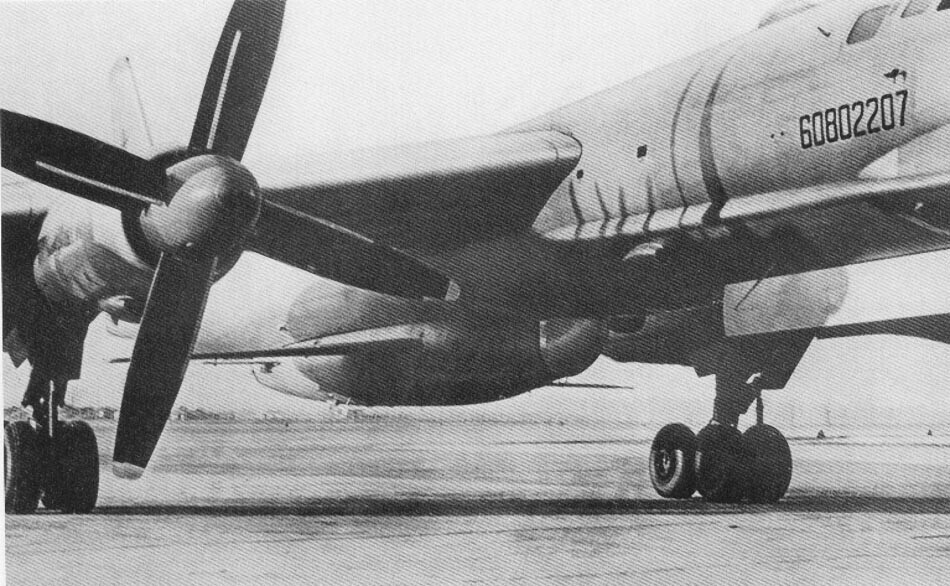
What about the most iconic reconnaissance versions of the Bear? These include the Tu-95MR (NATO reporting name: “Bear-E”) and the Tu-95RTs (“Bear-D”). The former is a photo reconnaissance aircraft, and the latter is a reconnaissance and target designator aircraft. The “RTs” modification was developed for the Soviet Navy’s needs. Designed for maritime reconnaissance, the aircraft served as a target designator for “P-6” cruise missiles used by submarines and “P-35” missiles used by Project 58 cruisers. During its career, the Bear-D experienced seven fatal crashes, two accidents, and two malfunctions, resulting in 69 fatalities. Sailors fondly remembered this reconnaissance and target designator, whose takeoff weight exceeded that of several tanks combined, though it was neither the best nor the worst.
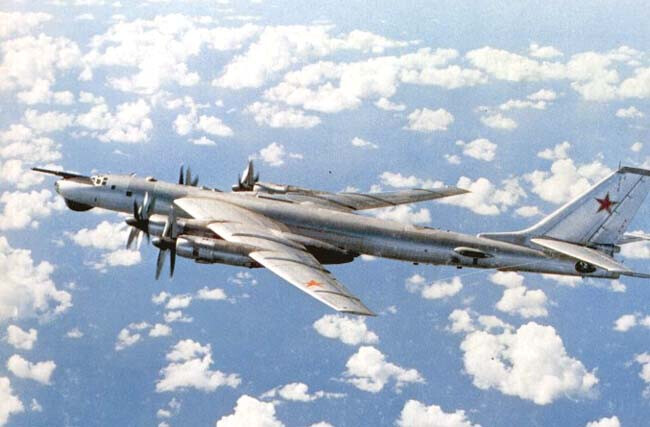
In addition to reconnaissance capabilities, the Navy required a long-range anti-submarine warfare (ASW) aircraft. Development of a new aircraft based on the existing Bear-D modification began. In 1962, scientific organizations within the USSR Ministry of Defense compiled a report revealing that maritime patrol aircraft (MPA) with a range twice that of the Il-38 (NATO reporting name: “May”) were the most effective at encountering ballistic missile submarines. According to some publications, the Il-38's detection range was 1,000 to 1,200 kilometers.
The Bear-D used a modified Berkut magnetic anomaly detector system, which was primarily used on an Il-38. On February 28, 1963, a decree was issued to develop the Tu-142 MPA with a Berkut search radar. After nine years and ten months of development, the aircraft entered service on December 14, 1972.
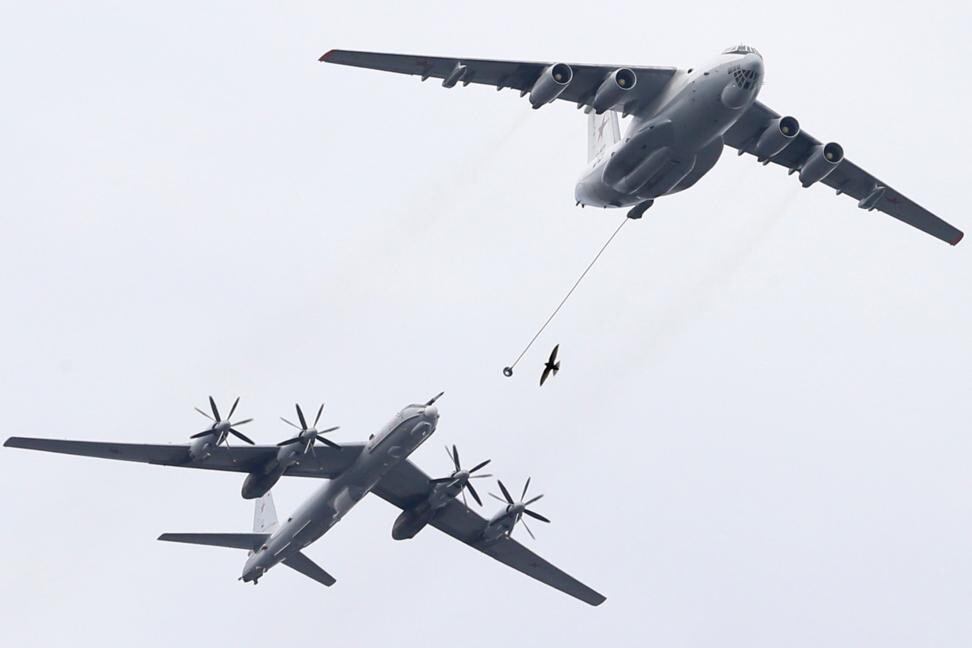
Later, several more modifications were made based on the Tu-142. Among them:
- Tu-142LL — a flying laboratory designed for testing and fine-tuning new powerful engines destined for the Tu-160, Tu-22M3, and the Tu-144 passenger aircraft. All armament was removed, and a special cut-out was made to accommodate the engine module being tested;
- Tu-142M and Tu-142MK — modifications with the new “Korshun” search radar and other improved avionics. They were focused specifically on navigation equipment. A second Tu-142MP laboratory was developed on this basis;
- Tu-142MR — an aircraft for the relay complex of the backup command system for naval nuclear forces. All windows on the aircraft, except the pilots' windshields, were equipped with metal mesh screens to protect against radiation;
- Tu-142M3 — entered service in 1985. It underwent a wide range of modifications, including the replacement of the AM-23 turrets with modern GSh-23L turrets and new avionics systems.
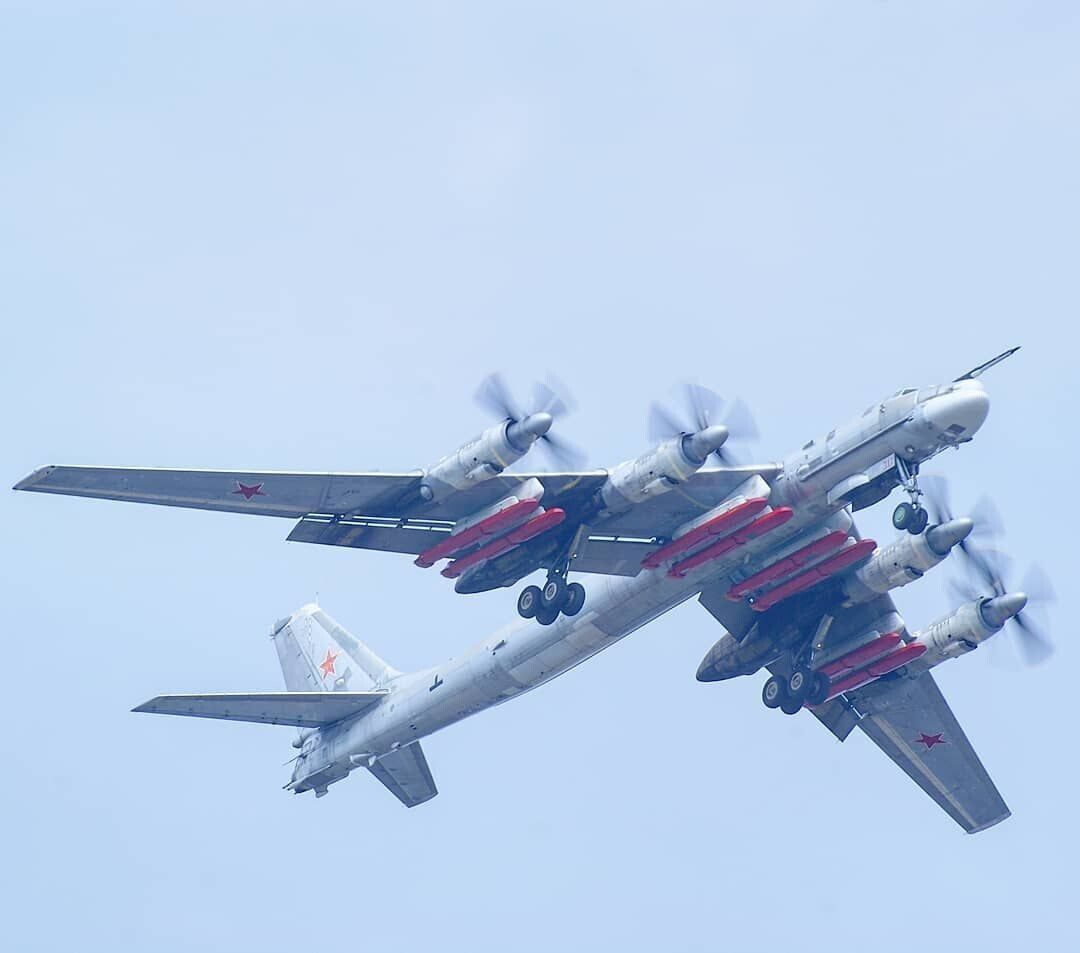
The Tu-142 (NATO reporting name — "Bear-F") now flew alongside the Tu-95 on equal terms. The Tu-95MS, also known as the “Bear-H” modification and based on the Tu-142MK, first flew in September 1979. In 1983, the new “Bear” entered serial production. The Tupolev carries six Kh-55 cruise missiles in a drum launcher located in the bomb bay, as well as four more missiles on external hardpoints. The aircraft can also be equipped with conventional bombs.
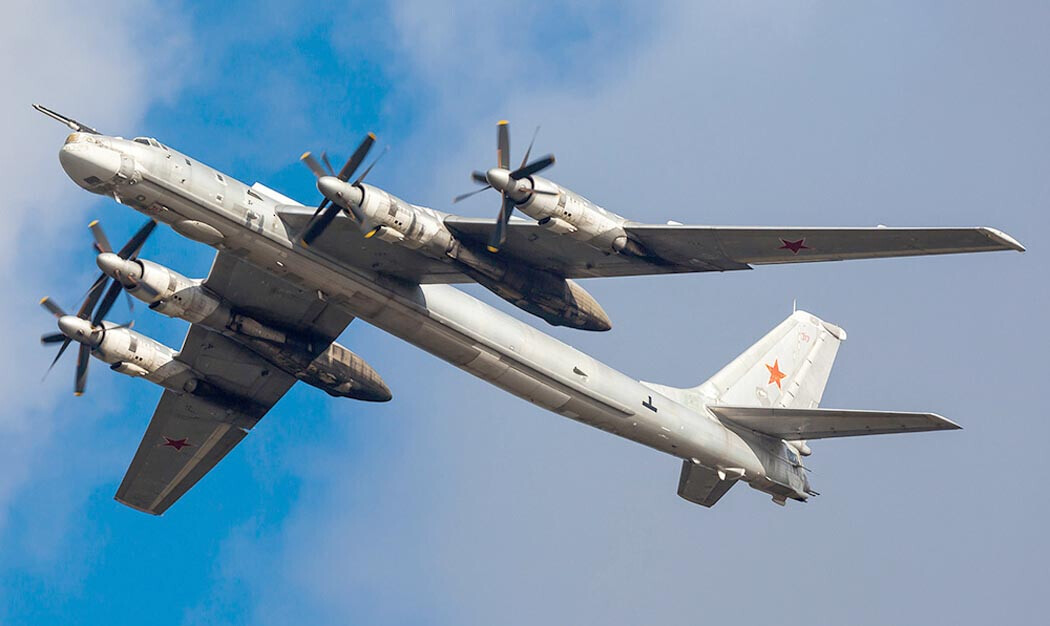
The Tu-95MS-16 and Tu-95MSM are the latest modifications developed from the Tu-95MS. The Tu-95MSM received a new NVS-021M navigation computer system, a KSU-21 integrated control system, a “Novella-1.021” radar, and an ANS-2009 celestial navigation system. Due to significant internal modifications, starting with the MS-16, the aircraft acquired the capability to carry Kh-101 strategic cruise missiles. The Tu-95MSM’s maiden flight occurred on August 22, 2020, and lasted 2 hours and 33 minutes. The missile carrier’s equipment operated flawlessly.
The new “Bear” aircraft can carry up to eight Kh-101 cruise missiles mounted directly under the wings of the outer fuselage. The missiles have a range of up to 5,000 kilometers and carry a 400-kilogram warhead. However, the missiles' cruising speed is only 190–200 meters per second, which is sufficient for a 10-hour flight.
Combat use of the Tu-95
Although the “Bear” never actually saw combat, Tu-95RCs patrolled maritime borders for a long time, and to expand their deployment, reconnaissance aircraft were based at airfields abroad — Cuba, Guinea, Somalia, and Angola. The Bear-E and Bear-F variants regularly flew sorties in the Pacific Ocean during the Vietnam War from 1964 to 1972.
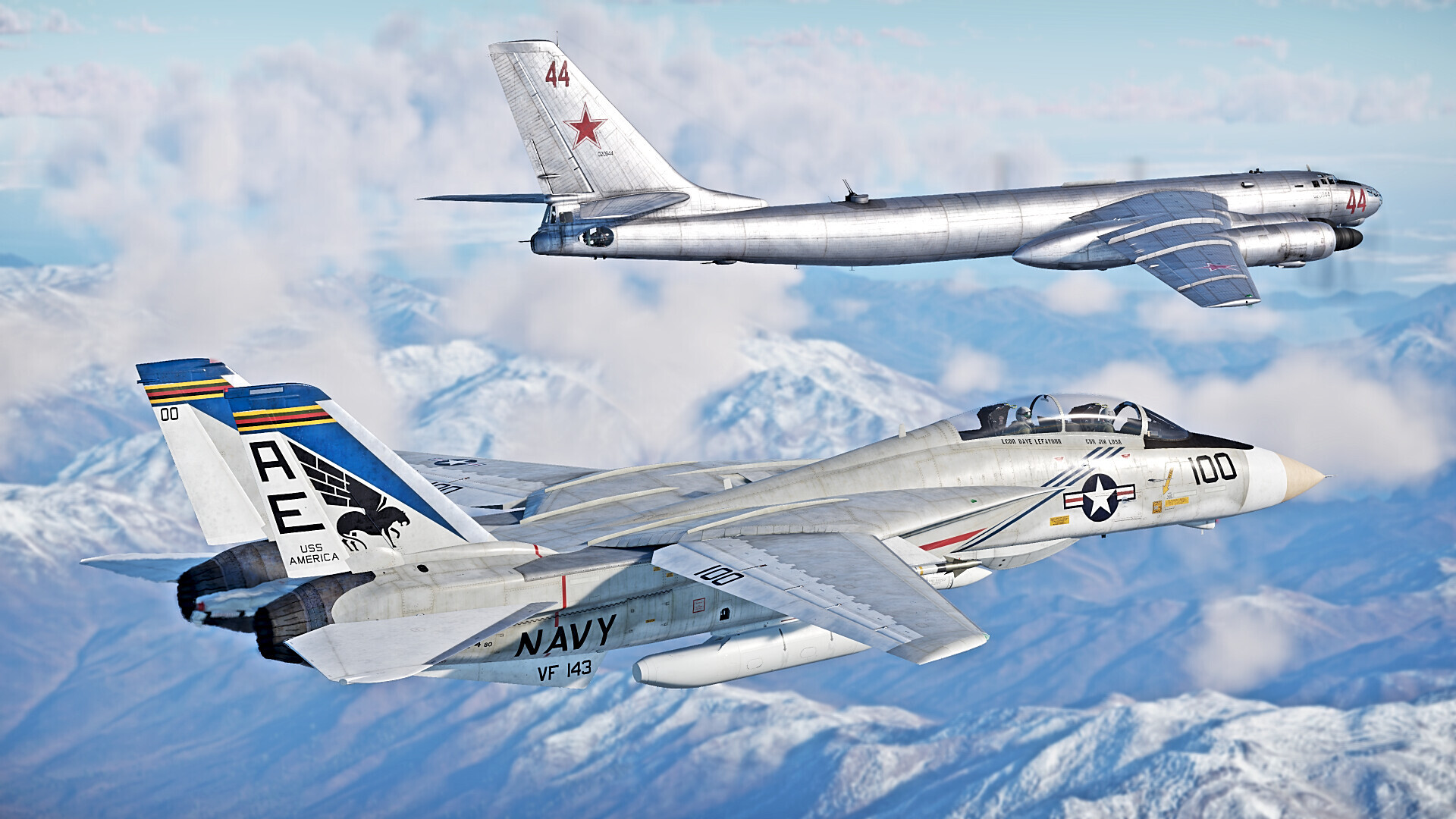
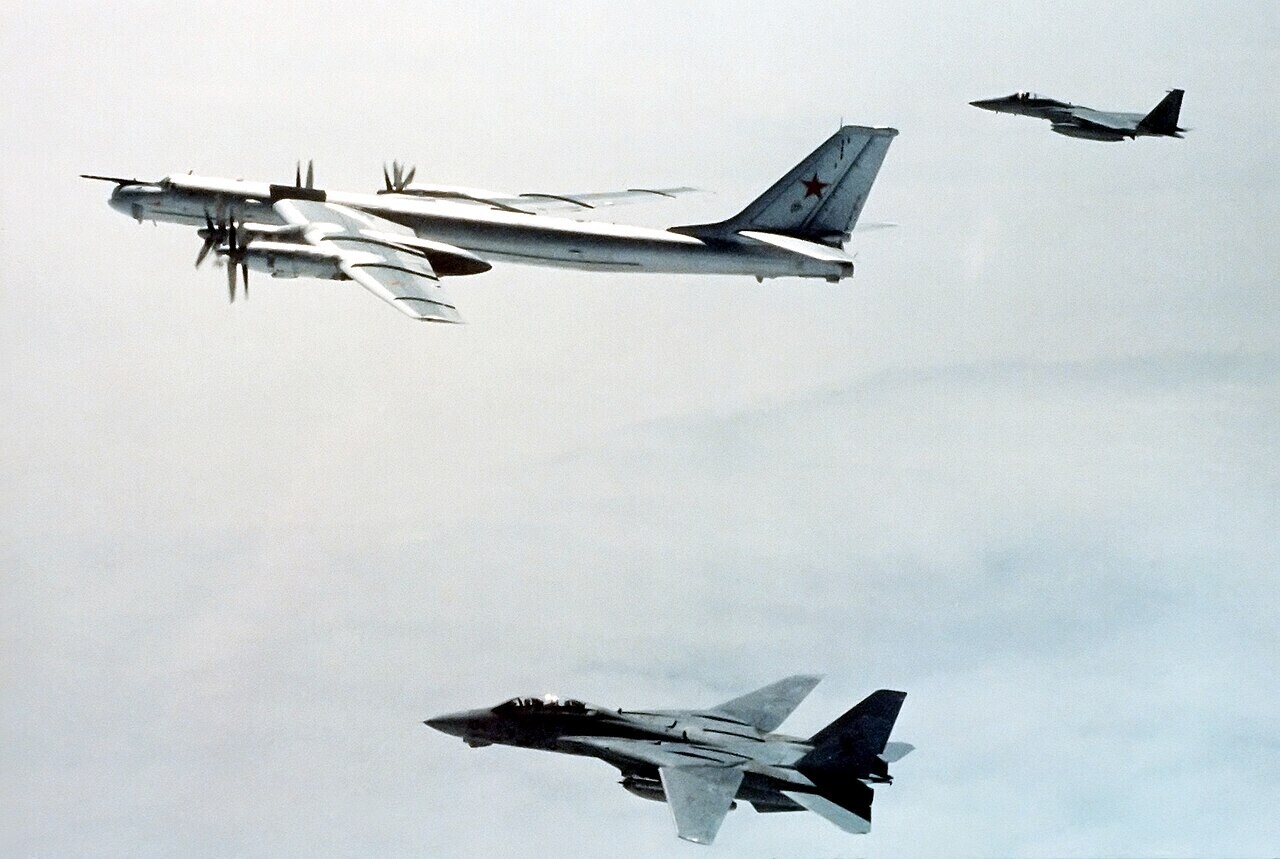
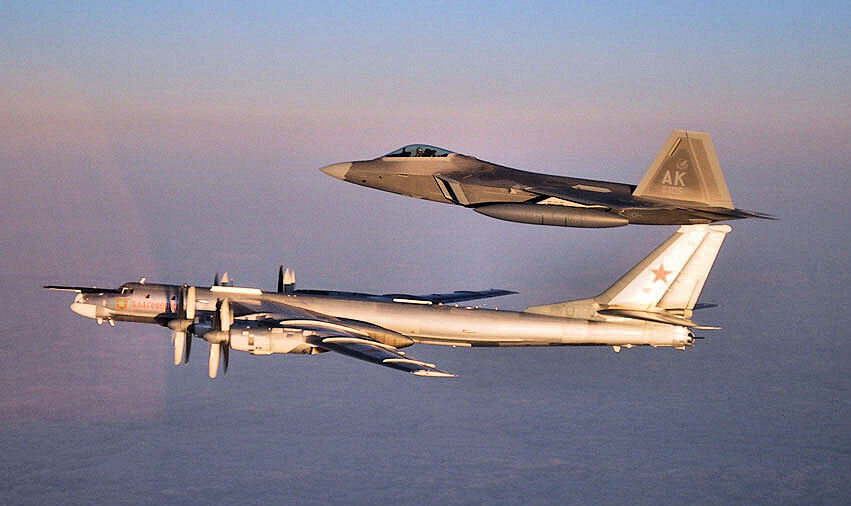
The Tu-95 was intercepted so many times by American pilots that photos of the two aircraft illustrate the gradual transition of generations of aircraft. The aircraft have changed, but the Tupolev has always remained 95.
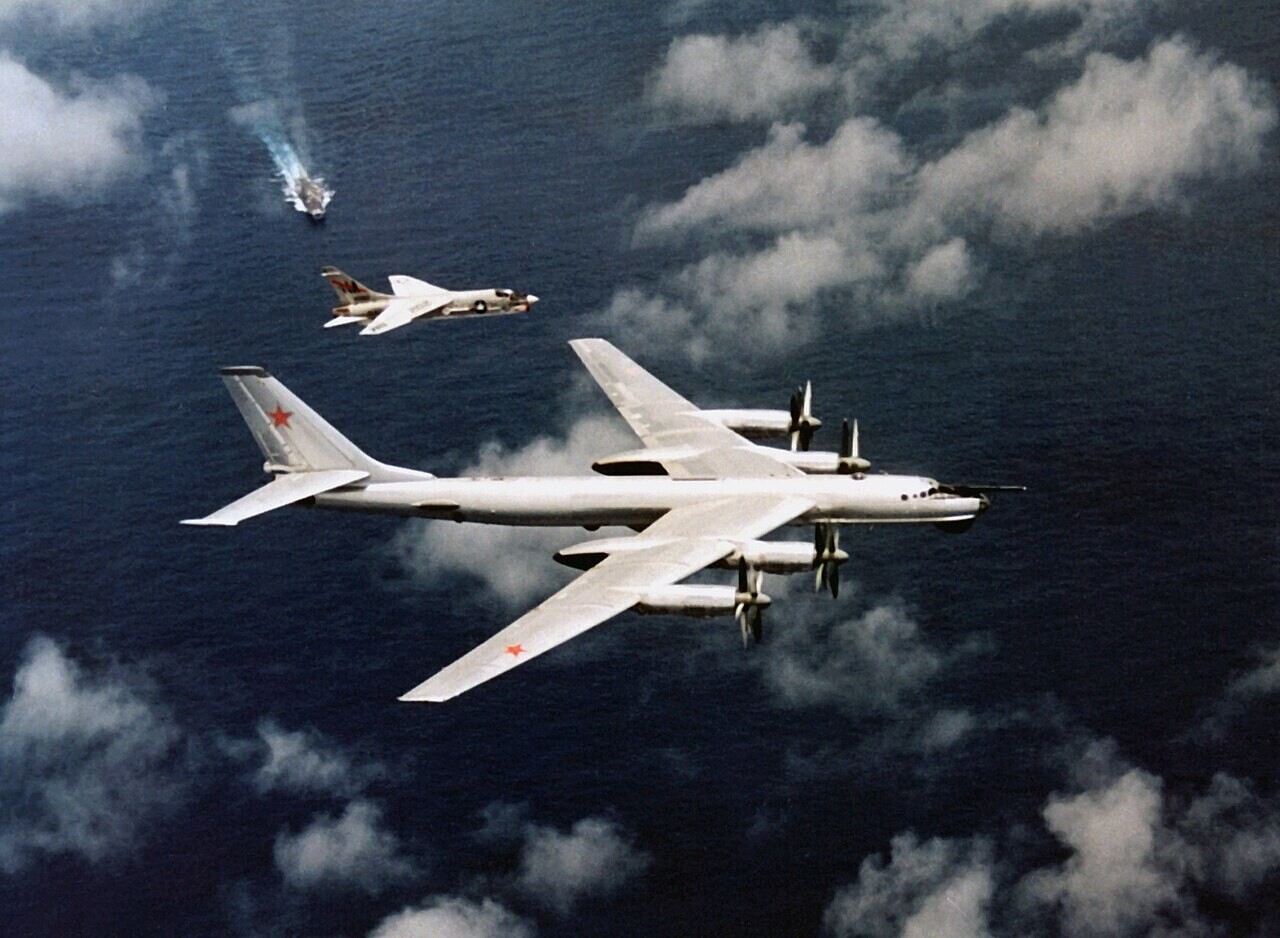
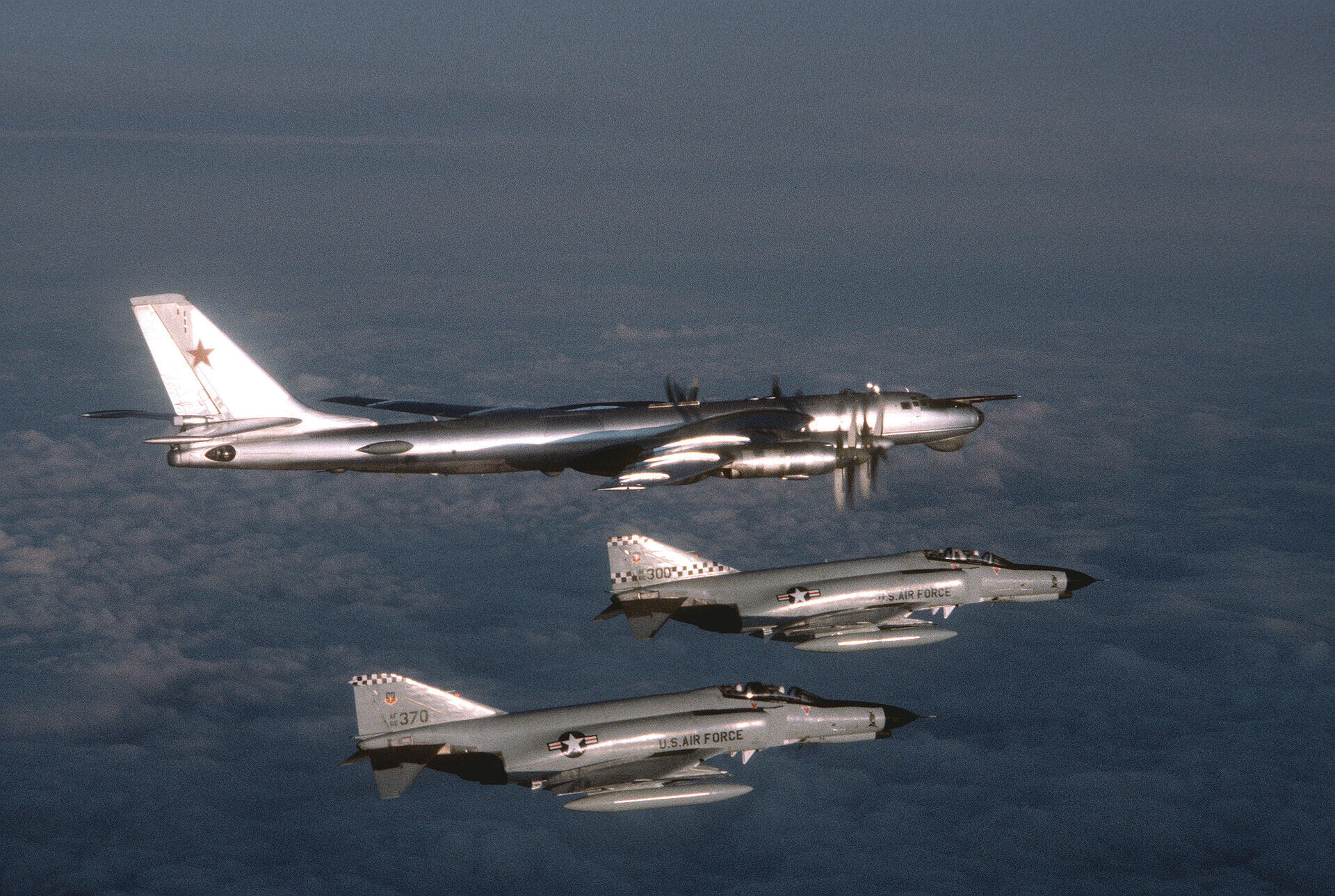
2. Pair of F-4E Phantom IIs escort a Tu-95RC, 1980;
3. F-14 and F-15 escort a Tu-95MS approximately 350 miles from Alaska, 1987;
4. F-22A Raptor intercepts a Russian Tu-95 near Alaskan airspace, 2007.
Source for all photos
Sources
Note: some of the links below may not work because of their Russian domains.
- The Russian History Portal — The Tu-95 Bomber. A Long-Lived Historical Aircraft
- Tu-95 on Wikipedia;
- The journal “Wings of the Motherland” tells the story of Nikolai Kuznetsov and his development of the TV-12. source;
- Tsar Bomba on Wikipedia;
- Tu-95 modifications on Wikipedia;
- Tu-142 on Wikipedia;
- Airwar 's Kh-101 missile;