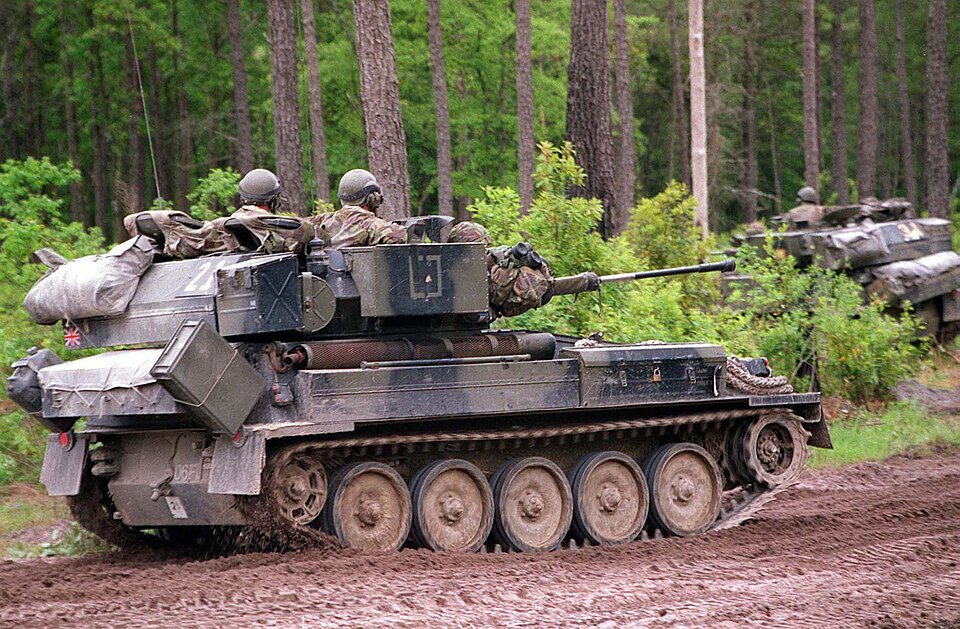
The diminutive Scimitar armed reconnaissance vehicle is one of the more famous British armoured vehicles from the Cold War. It is one of the members of the versatile Combat Vehicle Reconnaissance (Tracked) or CVR(T) family and has seen service in all corners of the globe. Its small and almost endearing shape has been flown the British flag in conflicts all across the world for 50 years, and has become something of a favourite among its crews and the wider public.
Genesis
In the 1960s, the British Army was faced with the looming possibility of becoming badly overstretched as it had garrisons in almost every corner of the globe, all of which needed men, munitions and armoured vehicles. The proposed solution to this was to procure a fleet of air-portable armoured vehicles which could be rapidly flown out if needed to support existing airborne units such as the Parachute Regiment. In addition, the MoD was looking to replace their Saladin armoured cars which were fast becoming obsolete.
Thus, in 1960, design work began on the Armoured Vehicle Reconnaissance programme which aimed to create a vehicle to meet these requirements. The resulting design boasted a 3-man crew, a 76mm gun and mounted Swingfire missiles on the rear of the turret. It also weighed 13 tonnes. This was too heavy for the vehicle to be moved by aeroplane and, with a new demand for a family of vehicles all based on a similar base chassis, the designers went back to the drawing board.
Over the next few years many ideas were explored, from cutting-edge hydro-pneumatic suspension, to 1000hp Rolls-Royce engines, to a transmission so complex that the designer allegedly had a nervous breakdown when trying to figure out how to make the final drives.
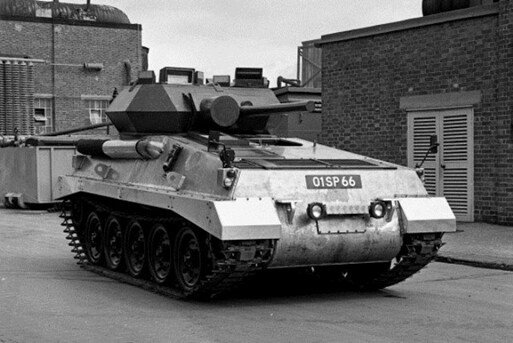
The final CVR(T) design was deceptively simple. It met the size and weight requirements perfectly and promised the British Army a powerful new steed for years to come. It was around this time that other countries were also trying to create light air-transportable vehicles for an armed reconnaissance role. As it turned out, almost none of these plans came to fruition, leaving the CVR(T) as essentially the only vehicle in its class.
The FV101 — the first of the CVR(T) models — was given the name Scorpion due to its rear-mounted turret giving it a “sting in the tail”. It toted a 76mm L23A1 low-pressure cannon firing primarily HESH rounds in a two-man turret.
The FV107 Scimitar was the last of the original CVR(T) siblings; designed in response to an MoD request for a light vehicle armed with a 30mm cannon. It carried the new RARDEN cannon in a very similar turret to the Scorpion and, aside from the cannon, looked visually identical to its sister.
The Scimitar was capable of reaching speeds of up to 80km/h (50mph), giving it the joint honour of being the fastest tank in the world, alongside, of course, the Scorpion. It had a range of around 600km in its initial form, though this later changed as different engines were used.
Design
As it was originally designed, the FV107 was powered by a 4.2l, ~200hp, Jaguar J60 6-cylinder petrol engine — the same model used in their sports cars. Power was then sent forwards to a six speed reversible gearbox in the front of the vehicle, enabling the Scimitar to reach its top speed both forwards and backwards — useful for running away from ambushes. The track was a relatively conventional setup, with five rubber-rimmed aluminium road-wheels and a rear idler. The tracks were designed to be as light as possible and included rubber pads to minimise damage to road surfaces. They gave the Scimitar and Scorpion a ground pressure of roughly 35kPa — for reference, a person exerts a pressure of about 60–80kPa.
Torsion bars were used for the suspension, allowing greater internal space and a lower parts count.
Inside, the driver sat to the left of the engine, peering out through a single periscope, on an adjustable seat that could be raised when the hatch was open. Behind them, in the fighting compartment, The gunner and commander sat side-by-side (gunner on left, commander on right) in the compact turret, either side of the L21 Rarden. The turret was manually traversed and elevated, and has remained so for the Scimitar’s entire career. The radio was behind the gunner, and 165 rounds of 30mm ammunition was stored in the hull below the turret. A GPMG (later L37 chain gun) coaxial machine gun sat to the left of the Rarden, fired by the gunner. The turret crew would often share loading duties, while the gunner had to operate the radio when not engaged in combat. The commander had 360 degree vision from 8 periscopes, while the gunner had three, plus the main gunsight. Passive night vision was included for all crew members in the original spec.
Crew comforts were in the form of the ubiquitous Boiling Vessel, a toilet under the commanders seat, and ample storage bins around the outside of the turret and on the all sides of the vehicle.
As with all British vehicles of the time, the Scimitar incorporated a positive pressure system to protect the crew from Chemical, Biological, Nuclear, and Radiological threats. It also helped keep fumes from the gun out of the fighting compartment. Physical protection came in the form of relatively novel aluminium armour that was up to 40mm thick on the front, 20-30 on the sides and rear. In theory this armour was proof against everything up to heavy machine guns and shell fragments, though in practice, HMG fire could disable the tank by jamming the turret or damaging optics.
Fully armed and crewed, the Scimitar came to a total of 7.8 tonnes, slightly lighter than its Scorpion sister and one of the lightest tanks ever made.
466 Scimitars were built for the British Army by Alvis in Coventry, with another 150 built for export. Alvis were responsible for the maintenance and upgrades to the CVR(T)s until they became part of BAe in the early 2000s.
Upgrades
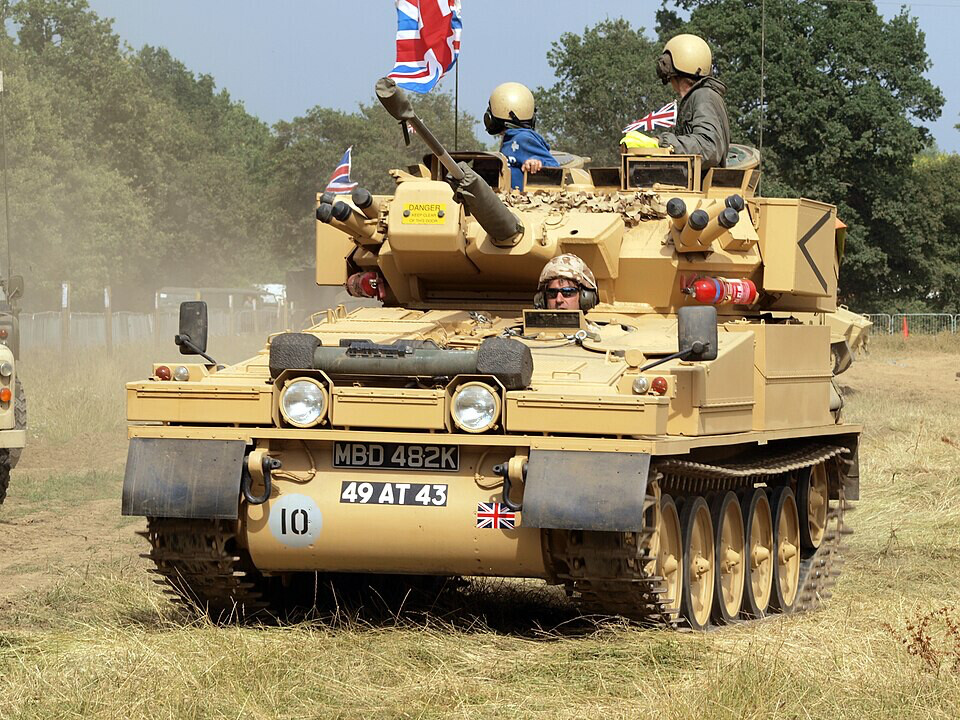
As the Scimitar has been in service for so long, numerous upgrades have taken place. These have typically come in waves, often as part of an upgrade for the entire family of vehicles. Other upgrades however were done piecemeal, only affecting some members of the fleet due to cost or need. This led to a host of differently-equipped sub-fleets by the 2010s.
Life Extension Programme
The LEP began in 1995, as a need was seen to keep the Scimitar in service for another decade or so until a replacement (the TRACER programme) was ready. This was the same year that the Scorpion was retired and the Sabre hybrid was introduced. The main pillars of this upgrade were to the powertrain and the optics. The Jaguar petrol was swapped out for a Cummins BTA 5.9l diesel engine which produced 215-220hp though also reduced the tanks range. This had the secondary benefit of getting rid of the highly explosive petrol tank. The transmission was also upgraded to a TN15E setup. New radios were also installed, along with the OTIS thermal sight, which could be more easily used on the move. Minor upgrades were also made to the electrics, ammunition, and navigation equipment. All Scimitars in the fleet received this upgrade package.
Separately to the LEP, a large number of Scimitars were re-equipped with an upgraded thermal system for both observation and aiming. The Avimo Sight Periscopic Infrared Equipment (SPIRE) was selected to be installed and 100 Scimitars had it fitted in 1997. A number of others were also hastily equipped with SPIRE so they could be sent to Bosnia. 40 of the SPIRE Scimitars additionally received digital compasses and navigation upgrades. Later, SPIRE was upgraded to E-SPIRE (Enhanced SPIRE).
At the end of the 20th century, the entire CVR(T) fleet was fitted with a new single-pin track which was lighter and more durable.
BGTI
In 2001, a new contract to upgrade the Scimitar was created. Thales won and began to produce the Battle Group Thermal Imaging system for both Warrior and Scimitar. This system was centred around the sharing of information, most importantly the ability to share target information with Challenger 2 MBTs. This upgrade also featured integration with the new Bowman radios that were being rolled out across the Army and yet more navigational equipment upgrades. By this point the TRACER replacement programme had been cancelled, to be replaced by FRES — the forerunner of the precursor to Ajax.
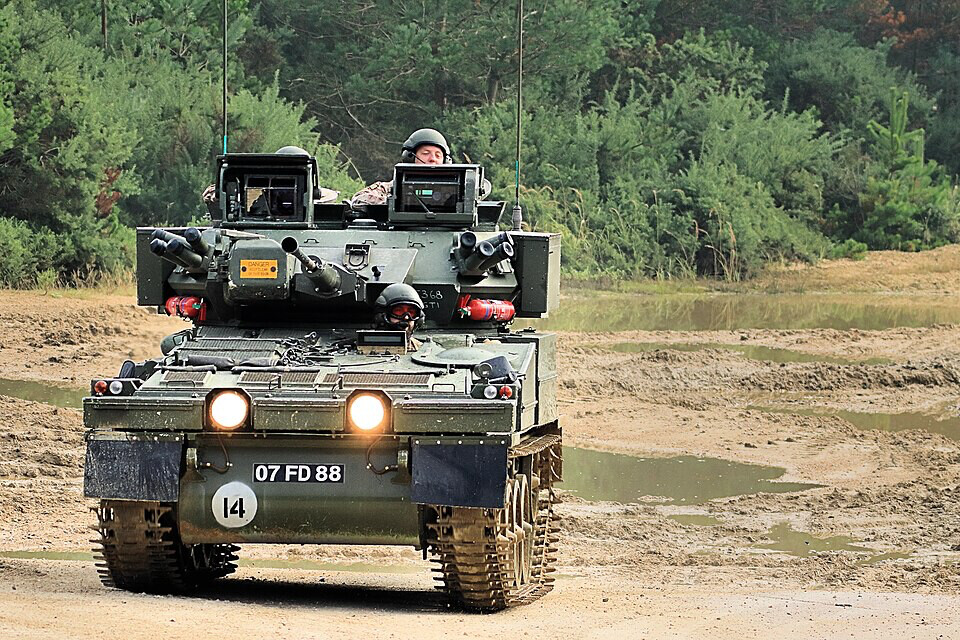
In August 2005, during the Iraq War, a large portion of the Scimitar fleet received extra mine and blast protection, to counter the threat of IEDs and mines.
Scimitar and Spartan 235
Before deployment to Afghanistan, having learnt from the asymmetrical warfare in Iraq, the Scimitar 235 project was initiated to upgrade the Scimitar and Spartan for their new mission. More IED protection was fitted along with IED jammers, cooling systems for the crew, an overhauled drivetrain to increase power to 235hp, and a better battery system. Slat armour was also added to counter shaped-charge warheads. The hull was also strengthened to cope with the additional weight, raising the total to 11 tonnes.
Service History
When they entered service in 1973, the Scimitars quickly proved a hit with their crews. They were considerably faster than the Saladin armoured cars they replaced, as well as much more capable over a wider variety of terrains. Crews also quickly worked out that pootling along at night and at low revs made the Scimitars very hard to detect, something they quickly put to use on exercises, causing many an unpleasant surprise for the “enemy” commander. The diminutive size of the Scorpions and Scimitars allowed them to slip almost anywhere, down narrow alleys, between trees, and, of course, in and out of cargo planes. This last quality was put to good use, as the vehicles were flown out to Belize and Cyprus, among other places, to respond to rising tensions in those regions.
By the late 70s, it was noticed that Scimitars and Scorpions exhibited stress fractures in their aluminium armour, especially around the Scimitar’s mantlet. As such several armour pieces were replaced with a different aluminium alloy to resolve the issue.
The Falklands War
One of the Scimitar’s most famous campaigns was that to retake the Falkland Islands in 1982. The marshy islands were unable to support heavy main battle tanks, plus the logistics of carting a detachment of Chieftains halfway across the world to get plonked onto a beach on San Carlos Water would have been difficult to say the least. Thus, Scimitars and their Scorpion sisters formed the task force’s armoured support. Only 3 and 4 Troop of B Squadron, Blues and Royals were sent with the task force. These crews had all volunteered for this mission. This meant the sum total of the force’s armoured support comprised of four Scimitars, four Scorpions and their Samson Armoured Recovery Vehicle.
Upon landing on San Carlos on the 21st of May, the CVR(T)s were put to their first use: shoving the landing craft back into the sea. Once the beachhead was established the following morning, they hid in a barn with the help of a local and prepared for battle. The little tanks were to assist 2 and 3 Para as well as the Scots Guards on the advance towards Port Stanley and assisted the infantry in multiple battles. Due to the threat of Argentinian airstrikes, the tanks were often concealed in barns when not in use.
The first Scimitar to land on the Islands was named “23 Charlie” after its callsign 23C. It was this Scimitar that, on the morning of the 24th of May, as it was driving from its barn to an assault, became the first to shoot down an Argentinian fighter jet. It was crewed by Corporal of Horse (equivalent to a Sergeant) Klause Fisher; driver Trooper Jim Holdsworth; and Gunner 18-year-old Reg Hastings who gave this account:
“As we were driving along a track towards our firing position, Klause called out and said there was an Argie jet coming across our front. I was bringing the Rarden Cannon round to bear on the target, but initially, all I could see was a flock of seagulls. We had six rounds of 30mm high explosive shells loaded. Then suddenly I could see this Argentinian Mirage coming in very fast beyond the seagulls. I half panicked and started firing on automatic while at the same time traversing the turret from left to right towards the target.The plane turned revealing its underside. Suddenly we saw a flash from the fourth HE round hitting just below the cockpit. It continued to roll over and turned upside-down, then crashed into the ground and exploded. It had crashed into a large field where some horses were grazing but luckily none of them was harmed.We turned to each other in disbelief. Had we actually just shot the plane down? Still, with an element of doubt, it seemed we had, but this took time to sink in. We were used to firing at canvas targets in peacetime training but there was no aftereffect like this one.”
A few days later, another Scimitar shot down a second Argentinian jet whilst sitting inside a barn. Strangely, neither of these events were mentioned very much in the news back home.
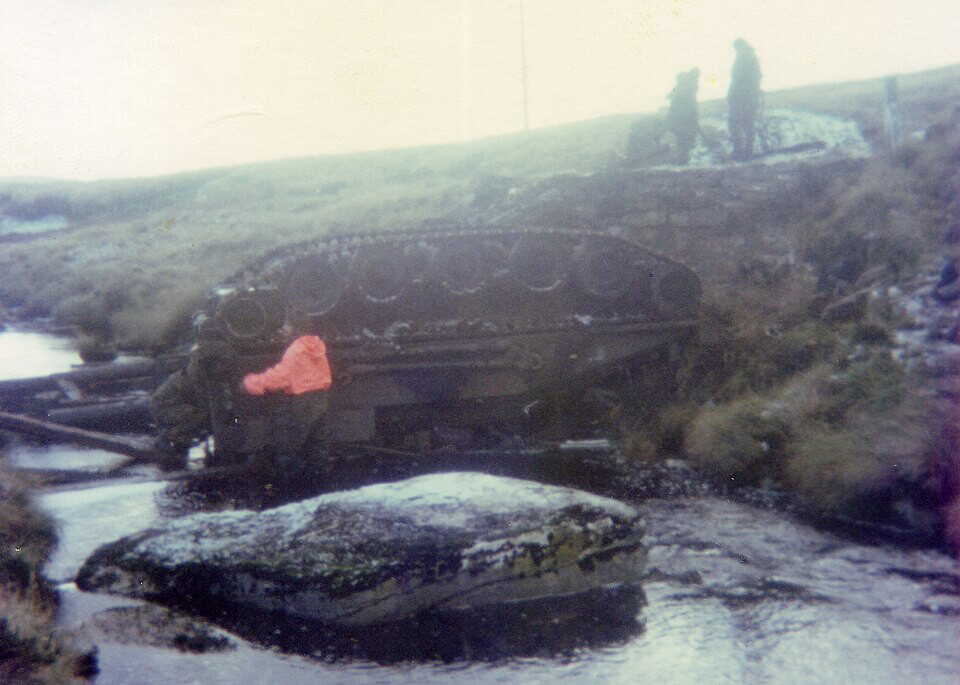
The CVR(T)s proved invaluable to British forces on the ground. It was found that they were so light and had such little ground pressure that they were able to speed across almost anything, even places where the infantry became bogged down. At one point, in an ironic turn of events, the Scimitars even had to rescue their Samson ARV, when it broke a bridge and landed upside down in a ditch. Samson was nearly two tonnes heavier than Scorpion and Scimitar — hence the accident.
The 12 Argentinian Panhard armoured cars were largely deployed in static positions near Stanley, and never engaged the Blues and Royals, so Scimitars only had to deal with static targets. From disguised artillery positions to entrenched infantry, the CVR(T)s quickly gained the respect of the cold, wet, and often miserable infantry, and their ability to keep up with the notoriously aggressive Paras was also recognised. Their night vision sights were a great asset, allowing the tanks to operate through the dark and stormy nights.
No Scimitars were knocked out during the war, though one lost a wheel and track to a landmine. Its crew were unharmed and the vehicle was repaired and sent back into combat.
Bosnia
After the dissolution of Yugoslavia in 1992, a UN peacekeeping force from several dozen countries was deployed. Among these were the white-painted Scimitars of the Queens Dragoon Guard and Queens Royal Lancers. They were put to use escorting aid convoys from 1993 and enjoyed a better success than many of their contemporaries, due to both the reputation of British forces, and the presence of armour. It was noticed that the insurgents seemed less afraid of Scimitars than of other armoured vehicles — likely due to their small stature. The much chunkier Warrior IFVs, in comparison, were found to have much more of an impact, despite toting the same main armament. As such, the two vehicles were typically mixed when out on patrol or escort.
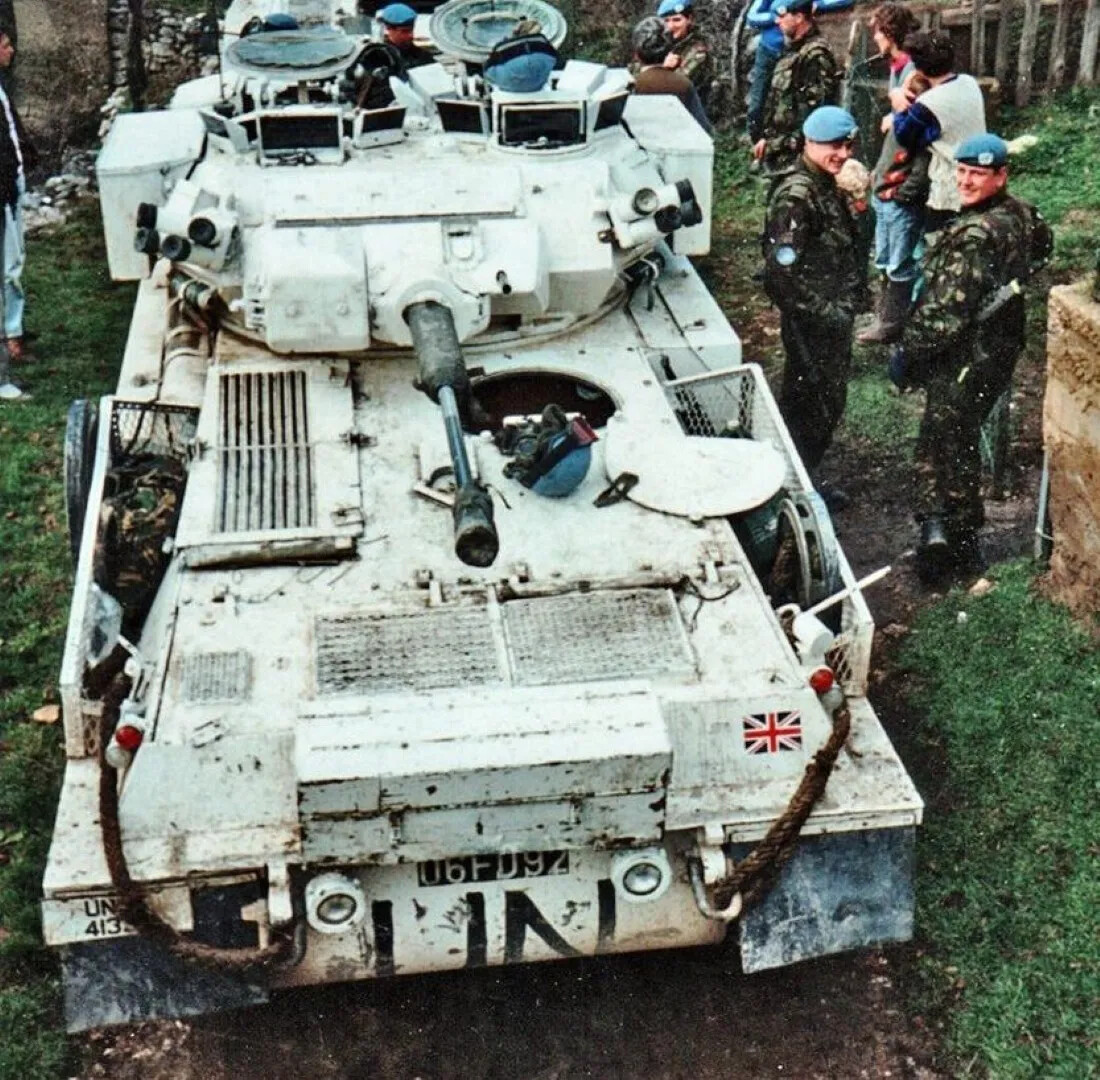
The Scimitar’s design brief again proved its use in 1994 when a full Armoured Recce troop of The Dragoon Guards was deployed to north Bosnia and operations within a week of being given the heads-up to make ready. Additionally. they were found to be much more capable on the icy and snowy roads during the winter than other vehicles — something that endeared them to their crews. According to one crew, although it was sometimes a struggle to stay on track, the Scimitar was considerably nicer to drive than heavier machines.
In 1998, conflict flared up again in Kosovo, an area outside of the UN task force’s remit. As such it was NATO forces that took to lead here. The white UN colours were quickly replaced by camouflage and the Scimitars went back to war. It was during this conflict that the ability to sling-load Scimitars under a Chinook helicopter to quickly move them around and plonk them down where needed was put to good use.
The Gulf War
Scimitars saw extensive action in the First Gulf War where they performed high-speed armed reconnaissance and hit-and-run raids on Iraqi forces. The British 1st Armoured Division included 3 squadrons of Scimitars from the 16th/5th Queens Royal Hussars, reinforced by a fourth squadron from 1st Queens Dragoon Guards.
On the 26th of February, several troops engaged Iraqi forces in support of am assault by the Division’s 7th Armoured Brigade, where they helped to coordinate air-strikes on Iraqi units and engaged some enemy tanks themselves. One troop was able to knock out several Iraqi T-62s with sabot rounds while another Scimitar was struck by an armour-piercing round from a T-55 which passed clean through the tank without injuring the crew.
Iraq
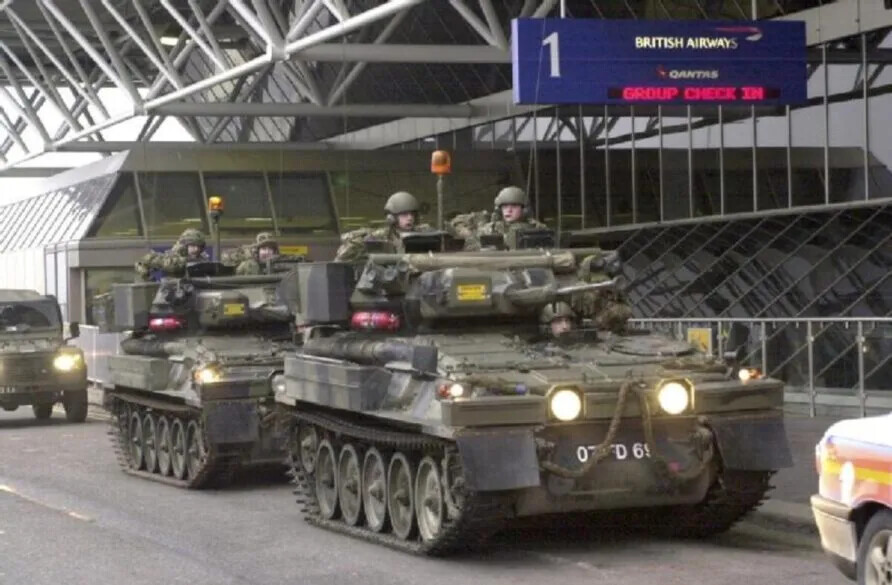
In Iraq, the Scimitars were put to work much as they had been during the Gulf War — as fast-moving recce elements. While there was some doubt that they would be able to keep up with the more powerful heavy armour (CR2s and Warriors) across long desert engagements, they exceeded expectations and performed admirably. Commanders found the highly mobile Scimitar troops and the information they sent back to be highly valuable during missions. The machines were praised for being small enough to remain largely undetected, whilst also being able to defend themselves if spotted until support caught up. The little tanks again sometimes found themselves up against old Soviet T-series tanks, and would often come out on top, either due to their own armament or due to calling in an airstrike on the enemy units. The Scimitar troops would rarely seek out direct confrontation with enemy armour, unless forced to, or with support.
The Scimitars had particularly dark day on the 28th of March 2003 when a pair of Scimitars and a pair of Spartans from D Squadron Blues and Royals were mistakenly engaged by a pair of American A-10 Thunderbolts which knocked out all four vehicles in two passes. Five British crew were injured and one was killed in the tragic incident. The exact circumstances regarding the incident are still debated, and it was one of a number of blue-on blue incidents caused by the A-10. The incident showed clearly the need for better communication and attack procedures between NATO forces, and highlighted Scimitar’s lack of armour protection compared to larger vehicles.
Afghanistan
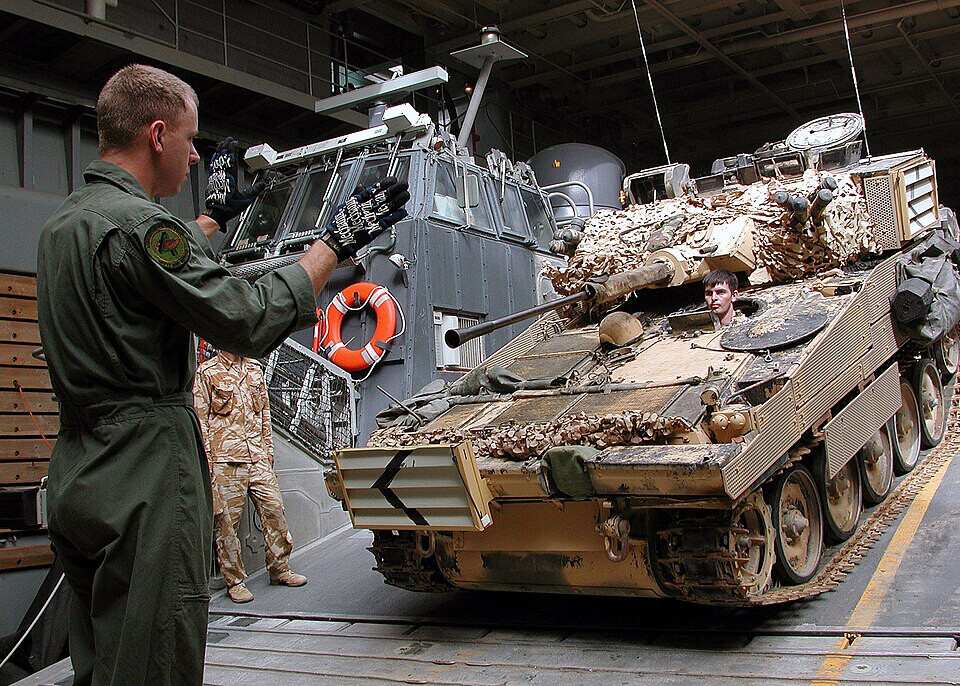
Once again the now venerable FV107s found themselves waging war in the hot dry and dusty Middle East. Scimitars were some of the only armoured fighting vehicles that could operate in the mountainous and cramped regions of Afghanistan. Even Warrior IFVs struggled in the narrow streets of many villages. This left only the Royal Marines’ Viking transports, other CVR(T) variants, Land Rover WMIKs, and other MRAPs or soft-skinned vehicles as the main vehicles of British forces in large parts of the country.
They could often be found trundling along roads, looking for signs of enemy activity. The 30mm Rarden proved invaluable as it was one of the most potent weapons available to British commanders, short of calling in an air strike. The combination of the cannons accuracy, range, and most importantly, thermal sights, made facing a Scimitar troop an almost certain death sentence for the Taliban insurgents. When operating in conjunction with infantry, they were lethally effective.
Taliban snipers, wary of aircraft and counter-snipers would typically setup shop deep within buildings, firing through holes in the walls. This would protect them from small arms fire, but not from a brace of 30mm APSE shells tearing through the building. According to one commander: “The Taliban… had to learn one eternal truth of war: when there’s armour in the offing, sniping is a mug’s game”.
By now though, the 30 year old Scimitars, often crewed by men who hadn’t been born when the vehicles began their service, were beginning to show their age. Among these men however was Mick Flynn, a veteran of the Falklands, who documented his experiences. Wear and tear caused reliability issues, particularly for troops that were stationed far away from Camp Bastion, which had a harder time getting resupplied. These isolated troops also lacked the workshop equipment needed to enact major repairs, such as replacing snapped torsion bars. Sometimes parts had to be cannibalised from other CVR(T)s to keep the Scimitars combat effective.
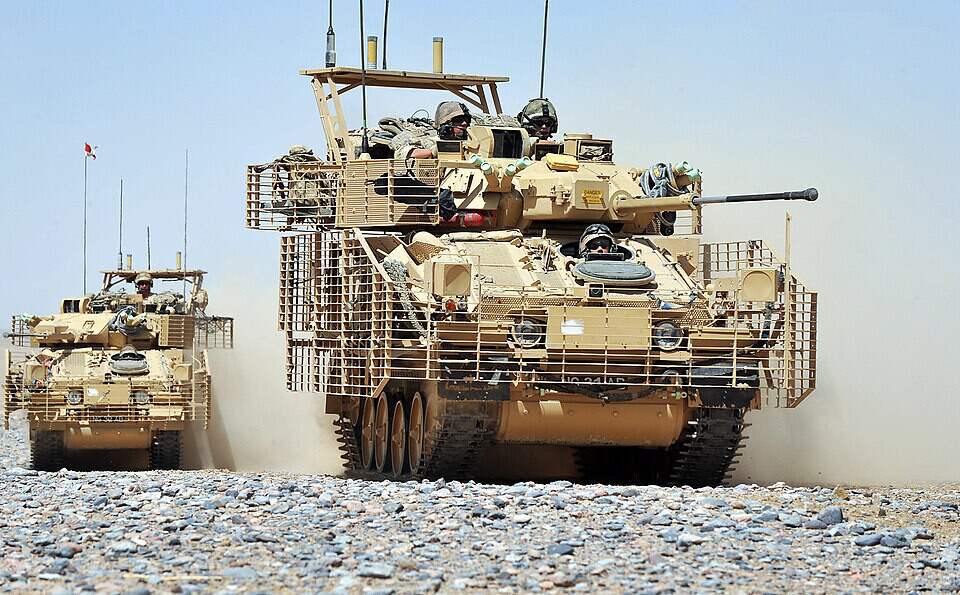
The Scimitars that were deployed to Afghanistan were fitted with slat armour, either before being shipped out, or very soon after they arrived. This “shopping trolley armour” made the little tanks bulkier, but was invaluable against insurgents who lacked many weapons larger than RPG-7s. On at least one occasion, a Scimitar survived two hits from RPG rounds, with no major damage or injury, thanks to the slat armour.
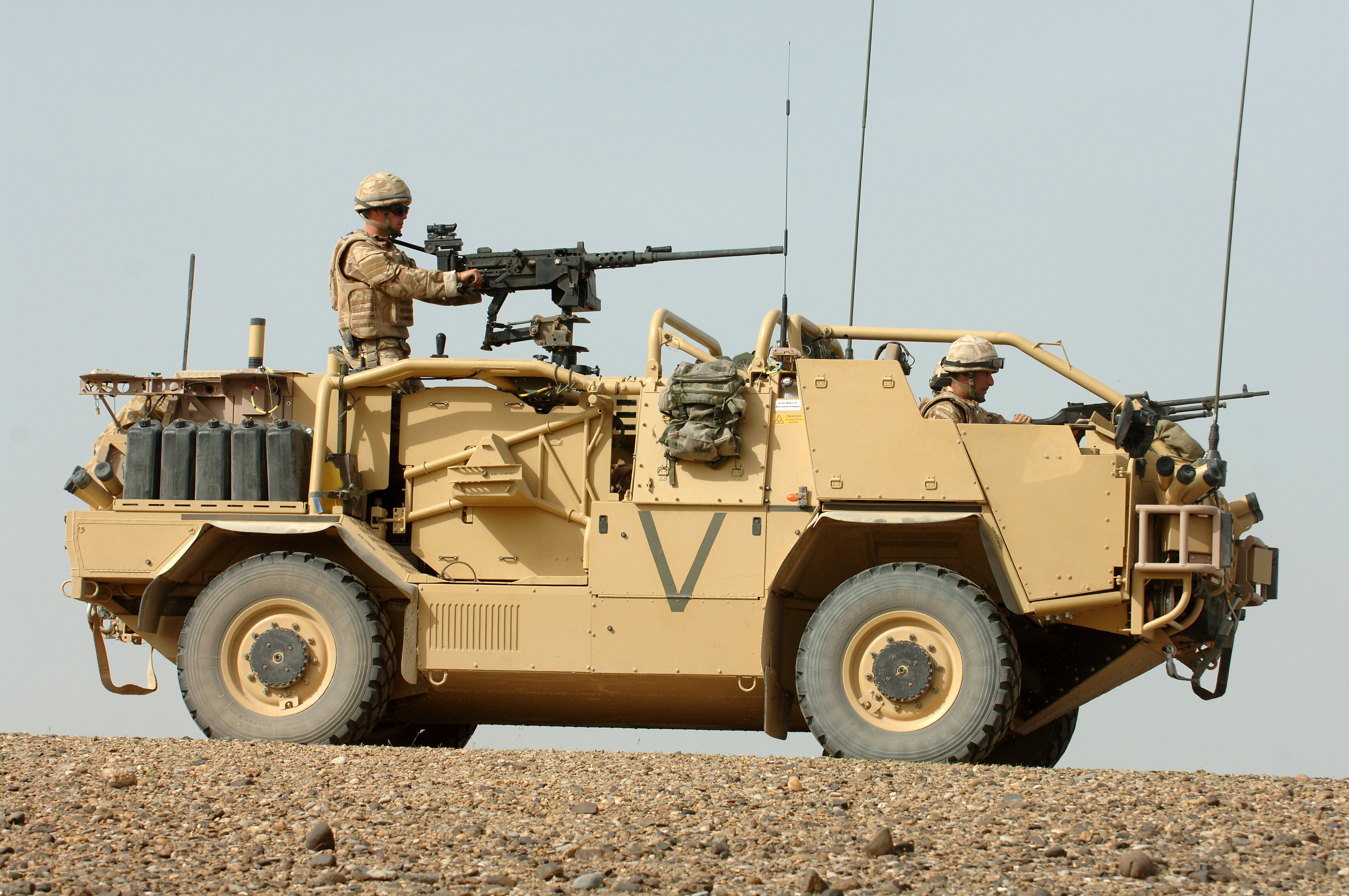
Reliability issues worsened however, as the fine afghan dust and constant use took their toll. By 2008 these eventually forced several troops, including Flynn’s, to reequip with the new Jackal reconnaissance vehicles. These large machines weighed as much as a Scimitar Mk.1, but had almost no armour, save for better mine protection. Many crews used to the cosy and enclosed interiors of their tanks found the new, completely exposed and much larger Jackals slightly disconcerting. While on paper the Jackals had less firepower than the venerable Scimitars, crews found the two separate gun mounts very useful for engaging multiple targets. While some may have hankered after their little tanks, many crews were very grateful for their new steeds, acknowledging that the Jackals mine protection was far better than that of the Scimitars and undoubtedly saved lives. While some Scimitars remained in Helmand, most were shipped back to the UK for much needed TLC.
As the war progressed, and the threat of IEDs grew, a new version of the Scimitar appeared in 2010. It had the same turret from the Mk.1 but now used a modified and overhauled Spartan hull, which was taller and allowed for the addition of mine protection in the bottom of the hull. This scheme was named Project Transformer and produced the Scimitar Mk.2. This variant was also fitted with a new suite of anti-IED systems, including jammers and detectors, to counter the ever prevalent threat posed by roadside bombs, all of which took its weight up to around 12 tonnes.
Ukraine
As part of NATO support for Ukraine, many Scimitars and their siblings have been shipped to Ukraine. They have proven popular with Ukrainian forces for their mobility; their low ground pressure again giving them unmatched mobility across the mud of Eastern Europe that has defeated so many other armoured vehicles, from Panzers to T-90s. Their Boiling Vessels have been very popular with crews — as expected given the freezing Ukrainian winters.
One notable field modification is the replacement of the Rarden with a DShK 14.5mm heavy machine gun. This allows the crew to engage small and fast-flying drones more easily than with the slower-firing Rarden, and simplifies the logistics of keeping the little tanks armed, as 30×170mm ammunition is scarcer than the 14.5mm DShk ammo.
Modern Day
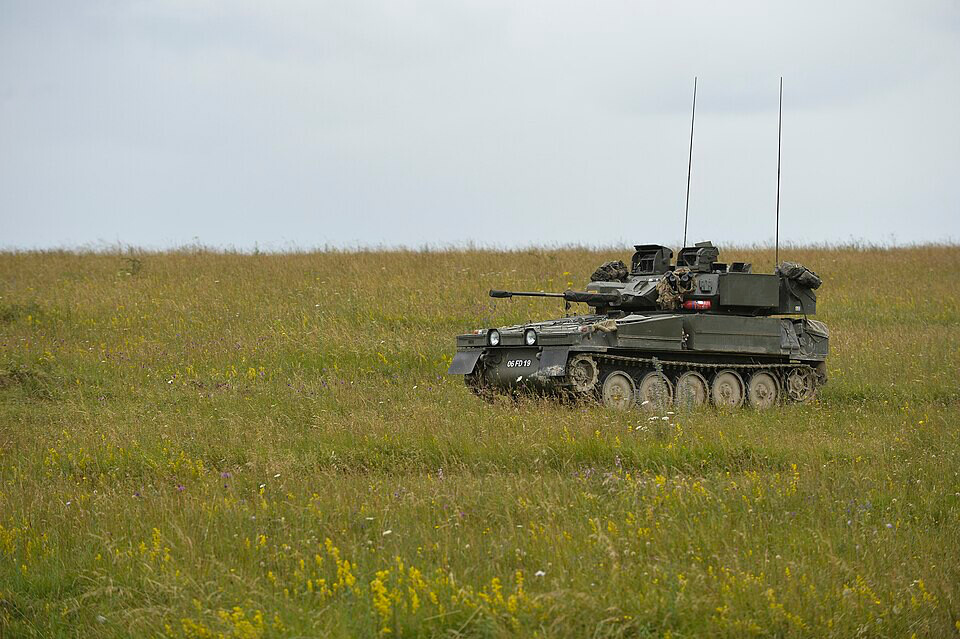
The venerable Scimitar officially retired from British service in 2023, though the last few Mk1s were not retired until 2024. The few that remain for training or OPFOR purposes continue on, now with crews half their age. The MoD’s current replacement programme for the CVR(T)s is Ajax — a project that has been beset by innumerable reliability, quality, manufacturing, scope creep, and supply issues for the last 20 years. Ajax traces its roots back to the 2001 FRES project that was largely cancelled, except for the Special Vehicle element, which became ASCOD, which in turn became Ajax. Like the CVR(T), the Ajax programme will be a family of similar vehicles, all specialised to a specific role, just as the CVR(T)s were.
The Ajax variant of Ajax has been pitched as the natural successor to Scimitar, fulfilling the armed reconnaissance role for armoured units. Despite this, Ajax is 5 times heavier than Scimitar, considerably larger (despite still only carrying three crew), somewhat slower, and with only a relatively modest increase in firepower and protection — even for the 2000s when it was first designed. It remains to be seen whether this machine will ever enter full service.
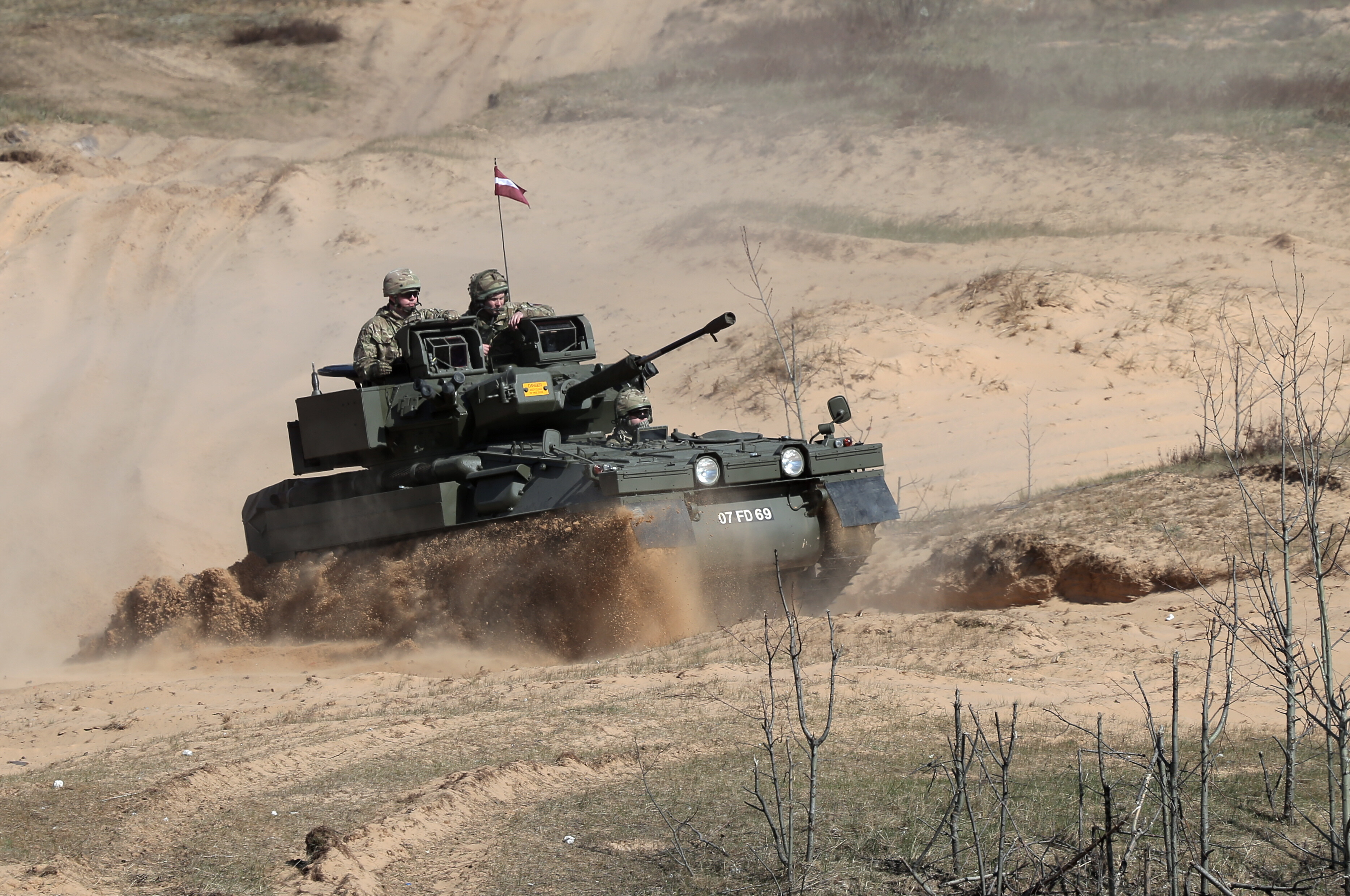
Many other countries, such as Latvia, Jordan, and Honduras still maintain the Scimitar in active service, 53 years after it first trundled into service. This is testament to the well-balanced and capable design put forward all those years ago.
Due to the long service life of the Scimitar, generations of crews have developed a fondness for the little tanks. This affection can best be seen by the sheer number of surviving Scimitars, many in running order. Among these are Reg Hastings' 23 Charlie which now resides, fully restored, in a museum in Yorkshire, as well as many others still trundling around in private hands or museum collections. Hopefully, thanks to the efforts of restoration teams and owners around the country, the Scimitars will continue to grace our roads and vehicle shows for another 50 years.
The Crew’s View
Scimitar crews were on the whole very positive about their steeds. Their small size, high speed and great handling made them both very potent battlefield weapons and, admittedly, quite fun during peacetime. In addition, visibility was good for the commander, and gunners liked the accurate and powerful RARDEN.
Although they were cramped, hot and noisy — something that can be said of any tank — they had all of the comforts of the larger Chieftain and Challenger Main Battle Tanks, such as a toilet and the all-important Boiling Vessel which allowed the crew to have a cup of tea and some warm scran from the safety of their tank. The BVs made these tanks especially popular in the freezing sleet of the Falklands and the Balkans, which, even in May and June, often drop below freezing.
It can be hard to sift out a general opinion of the Scimitar, due to just how long it served, to how varied the conflicts were it served in, and to the innumerable different upgrades. After all, a tanker in the biting cold and deep mud of the Falklands would encounter different issues than one in the 50°C dustbowl of Afghanistan hunting Taliban mortars with advanced thermals. Overall though, the vehicles were routinely praised for their stealthy (for a tank) nature, decent gun, fantastic speed, and reasonable protection. It was felt by many that the Scimitar’s ability to move fast and remain unnoticed was crucial in the vehicles success, and many view the Ajax with raised eyebrows as it appears to ignore the lessons of the Scimitar.
Brigade commanders and generals highly appreciated the Scimitar troops' mobility and ability to project armoured force wherever it was needed quickly. Anywhere infantry could go, so could the Scimitars — something that has stayed true for over 40 years. As any tank commander knows, being able to attack from unexpected quarters and in areas where the enemy has no armour of their own is very conducive to success.
Bibliography
- KeyMilitary — Historic Falkland CVR(T)s saved for the nation [28/8/2026]
- Aspects of History — My Falklands War: The Journey and Wireless Ridge [28/8/2026]
- Wikipedia — Falklands War [28/8/2026]
- Wikipedia — FV107 Scimitar [28/8/2026]
- Think Defence — Combat Vehicle Reconnaissance (Tracked) [29/8/2026]
- Flynn, M. (2011) Trigger Time, Orion Books
- Defense Archives — Development and variants of the British CVR(T) [31/8/2026]
- Tanks-AFV — FV107 Scimitar [31/8/2026]
- Royal Tank Regiment — Scimitar [31/8/2026]