
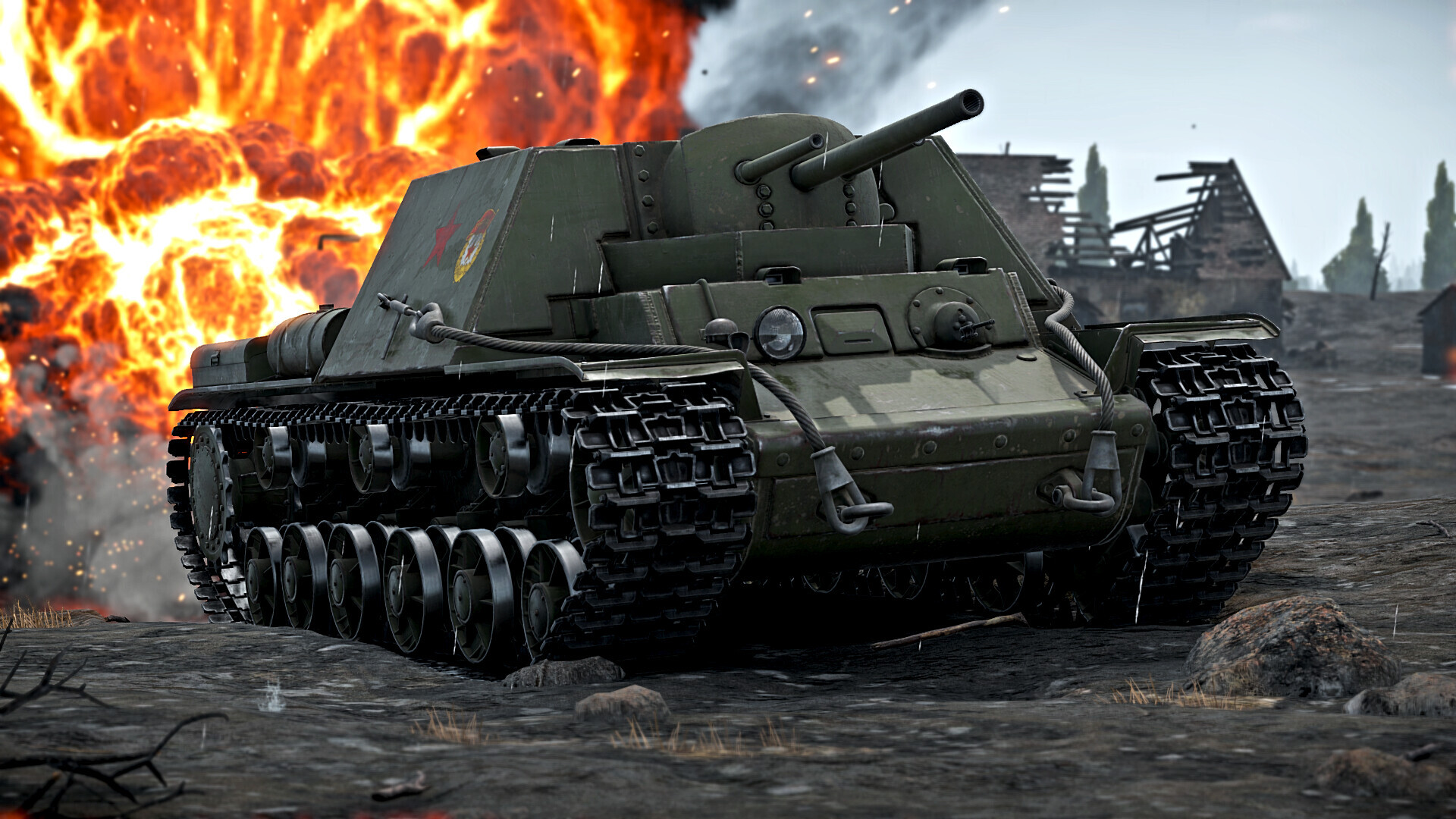
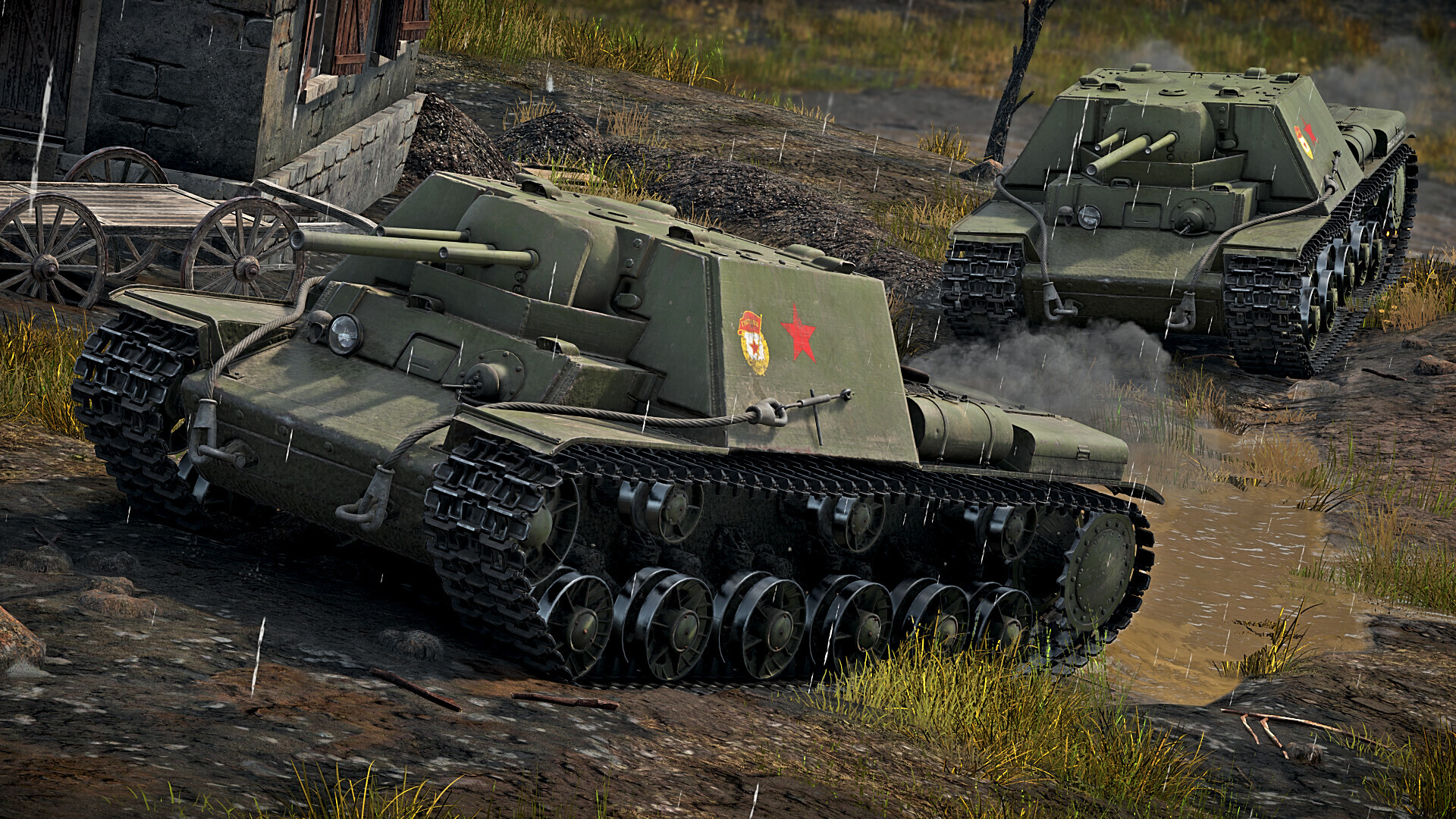
The KV-7 was developed in response to the Red Army’s need for an artillery support vehicle with greater firepower than the T-34 or KV-1. In the game, this self-propelled gun is known for its unique triple-gun arrangement housed in a common mantlet. This setup, combined with its respectable armor, makes it a significant threat to any opponent. But how does one master this machine, considering its distinct characteristics and drawbacks? Let’s find out.
Pros
- Three guns
- Excellent frontal armor
- Wide ammo selection
- Decent survivability
Cons
- Mediocre mobility
- Limited gun depression angles
- Different gun ballistics
Armor and Survivability
The lower glacis plate consists of 75 mm of armor sloped at 26°, augmented by a 25 mm armor plate, bringing its effective thickness to approximately 100 mm. The upper glacis plate is 70 mm thick. Thanks to its steep 70° slope, its effective protection is increased to roughly 200 mm, making it nearly impervious to direct fire.
The upper front plate is 75 mm thick and sloped at 30°. It also features an additional 25 mm armor plate, resulting in a total thickness of 100 mm. However, this section contains critical weak spots: the driver’s viewport hatch and the machine gun ball mount. Consequently, this becomes the primary area for enemies to target.
The front of the casemate is well-protected by a 75 mm plate with an added 30 mm armor plate, making it the vehicle’s strongest frontal section. In contrast, the sides and rear of the casemate are only 75 mm thick, leaving the vehicle highly vulnerable to flanking fire.
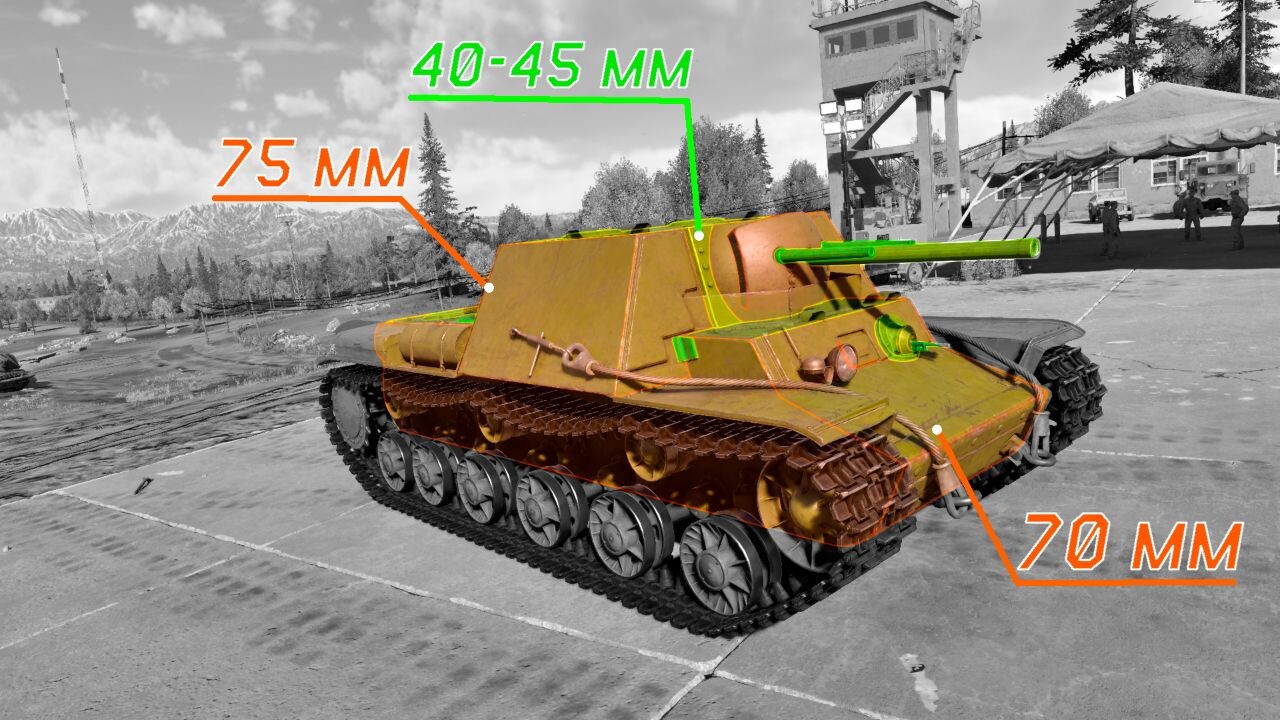
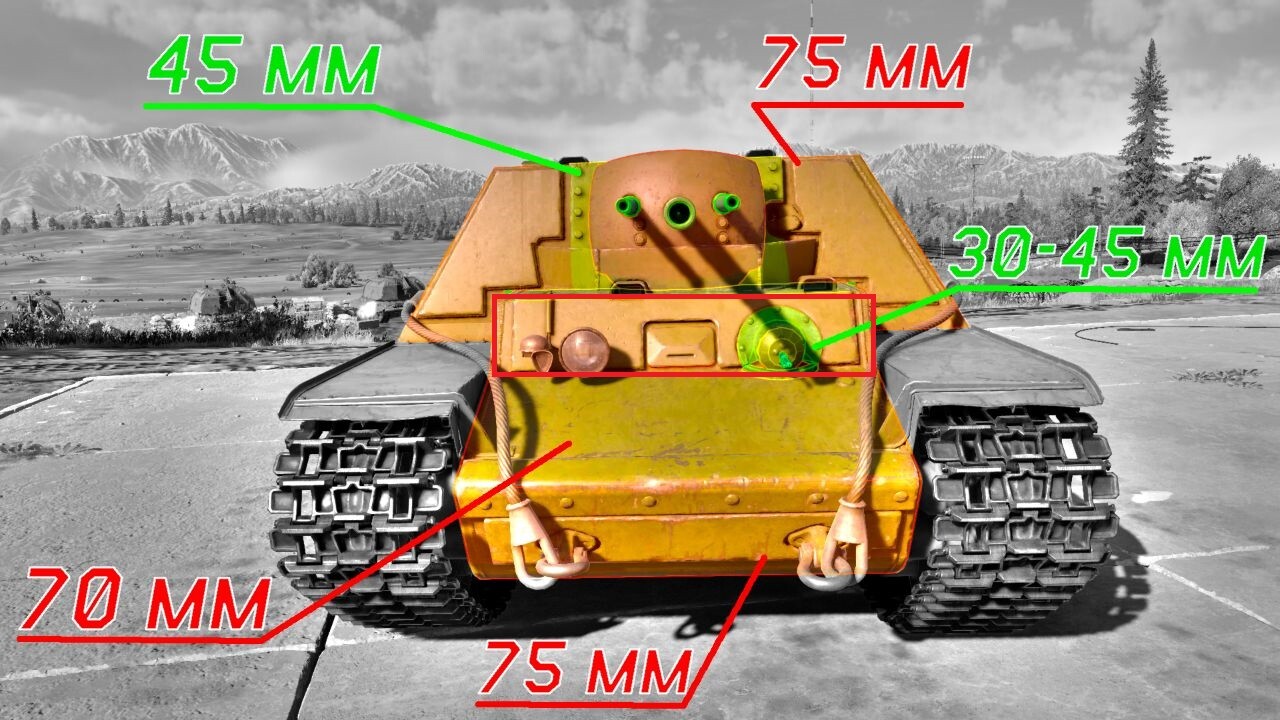
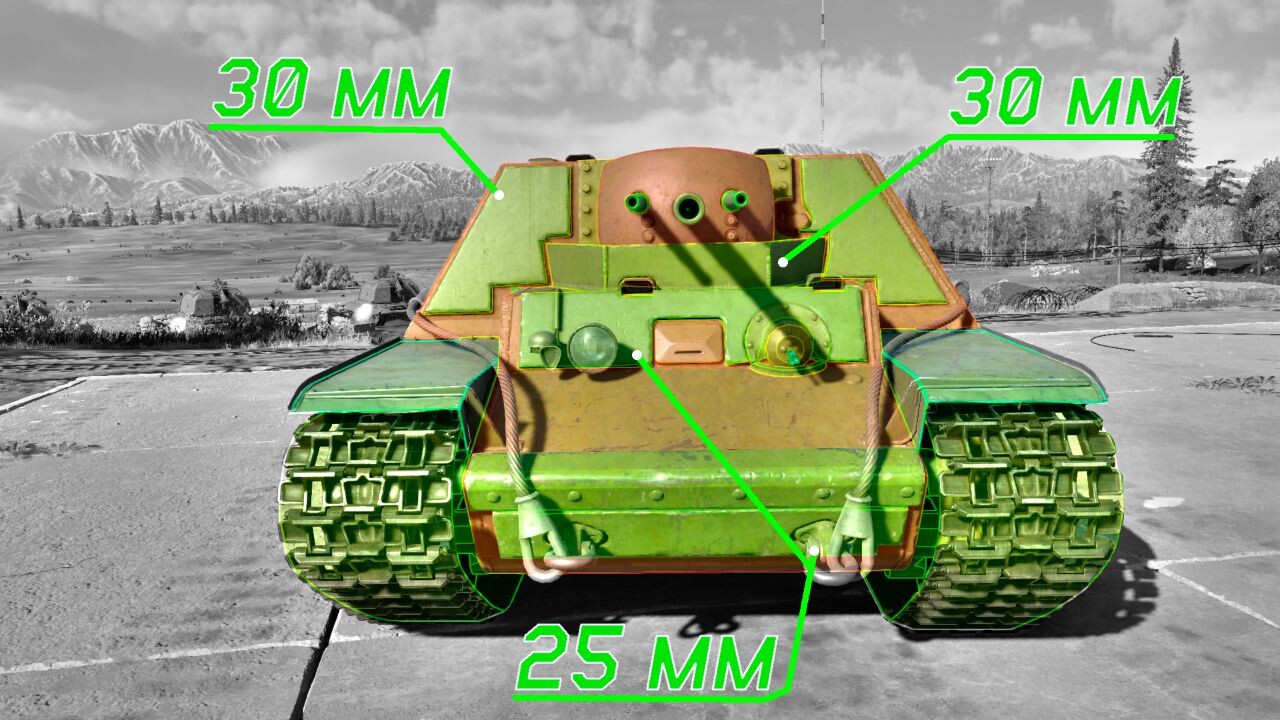
Although its frontal armor is among the best in its class, the KV-7 remains vulnerable to dedicated anti-tank guns of 75 mm and larger. It is therefore advisable to avoid direct engagements with well-armed opponents whenever possible.
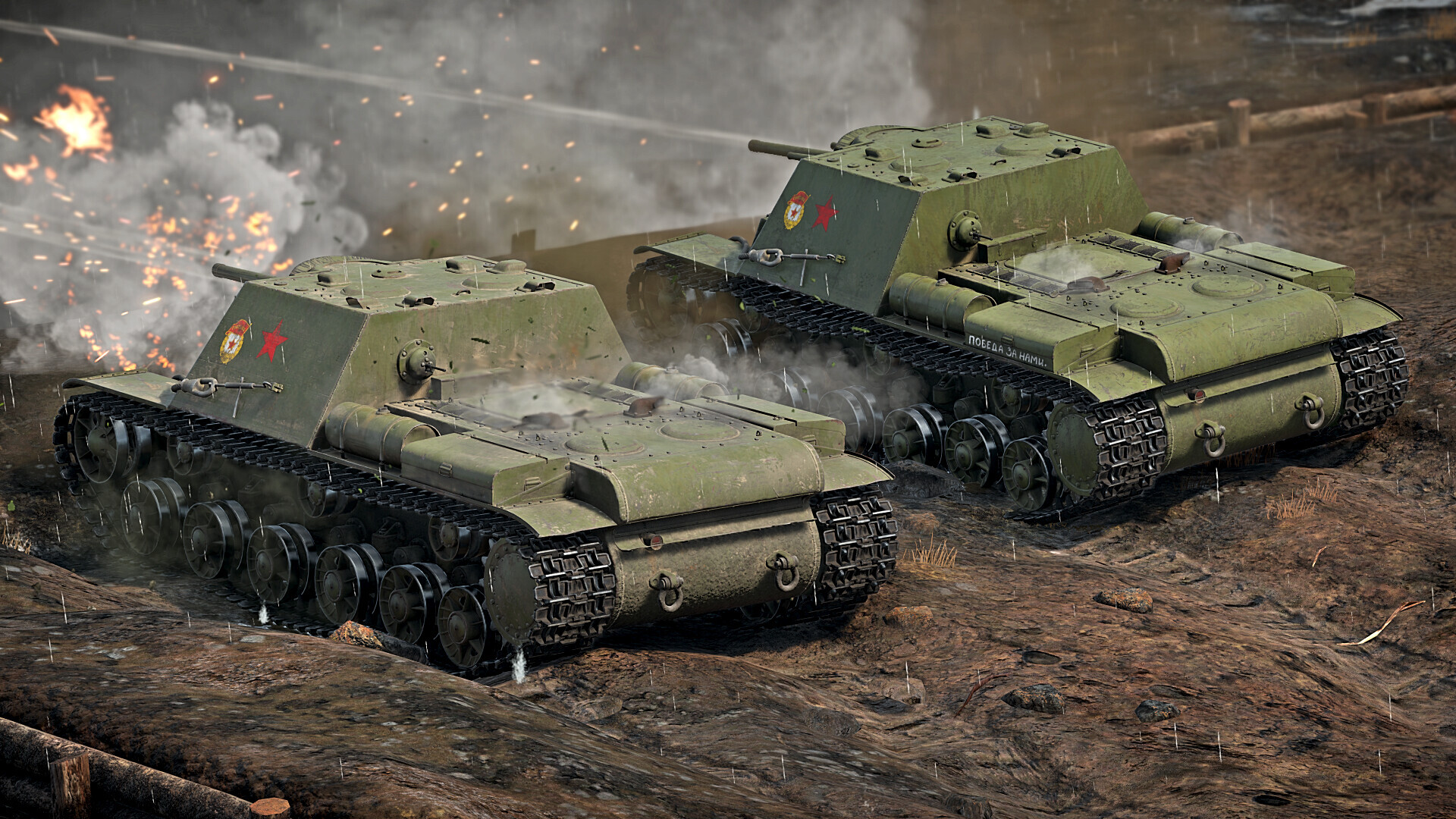
Another significant vulnerability is an unprotected gap between the lower edge of the casemate and the track guard. The fuel tanks are located directly behind this area. A penetrating hit here by a high-explosive shell is likely to cause a fuel fire.
The vehicle is operated by a crew of six:
- Radio operator-gunner and driver are stationed in the front hull;
- Commander and loader № 1 are located on the right side of the casemate;
- Gunner and loader № 2 are positioned on the left side of the casemate.
The vehicle’s survivability is at an acceptable level. The crew is relatively spaced out, meaning that even a penetrating hit to the casemate cheeks may not cause critical damage. For instance, if an enemy shell penetrates the driver’s hatch, the resulting explosion typically incapacitates only two crew members.
However, a critical vulnerability lies in the side ammunition racks, which store the 45 mm gun shells. A penetrating hit that detonates this ammunition almost always leads to the vehicle’s complete destruction.
Mobility
The KV-7 is powered by a 600-horsepower engine. With a combat weight of 47.5 tons, this results in a power-to-weight ratio of 12.6 hp/ton. The vehicle can reach a top speed of 34 km/h forwards and 6 km/h in reverse. While this is sufficient for moving comfortably in a straight line, it may prove inadequate during a tactical retreat. For comparison, the SU-152 can reach 43 km/h forwards and 16 km/h in reverse, while the Jagdpanzer IV manages 40 km/h forwards and 7 km/h in reverse.
Accelerating to its maximum speed on solid ground takes approximately 11 seconds. These mobility characteristics prevent the KV-7 from being the first to engage the enemy or to quickly capture strategic positions. However, they are adequate for effectively supporting allied forces from the second line.
The vehicle’s turning capability is modest; it takes about 7.5 seconds to perform a 180-degree turn in place. This is slower than the average for tank destroyers of its class, such as the StuG III G (~4.5 seconds) or the Jagdpanzer IV (~6 seconds). That said, this drawback is less noticeable during sharp turns while the vehicle is already in motion.
Armament
Main gun
The main weapon of the KV-7 is a 76 mm F-34 cannon. It can easily destroy opponents like the Pz.IV H or the M10 GMC. However, it might not have enough penetrating power against tougher targets such as the Churchill III or the M4A2. The reload time for the main gun is 9 seconds (or 6.9 seconds for aces), which is quite good.
The horizontal aiming angles are limited to 7° on each side, often forcing the vehicle to turn its entire hull to aim at the enemy. The aiming speed is 4.9°/s (or 7°/s for aces). Depression angles are -5°, similar to other Soviet vehicles; the Jagdpanzer IV has -8°, and the 75/46 M43 has -10°.
The available shells for the main gun include:
- BR-350A (MD-5 fuze) — APHE with ballistic cap shell. Penetration up to 87 mm, adequate for most opponents. Explosive weight is 150 g, enough to destroy tanks with spacious fighting compartments. The muzzle velocity is 662 m/s, which limits effectiveness against moving targets at long distances.
- OF-350M — high-explosive fragmentation shell, capable of penetrating up to 13 mm of armor. Suitable for lightly armored targets. Contains 621 grams of explosive, ideal for anti-aircraft or lightly armored vehicles.
- Sh-354T — shrapnel shell with up to 35 mm penetration. Useful for lightly armored targets, but more powerful HE shell are better suited.
- BR-354P — APCR shell capable of penetrating up to 117 mm at 100 meters. Initial velocity is 950 m/s, effective against distant moving targets. Best used against heavily armored vehicles like the Churchill VII.
- BP-343A — HEAT shell capable of penetrating 80 mm of armor at any distance. The TNT equivalent is 600 grams, making it effective against lightly armored vehicles with dense crew compartments. Its main disadvantage is a low initial velocity of 355 m/s, limiting range and effectiveness against fast-moving targets.
- BR-350B (with MD-8 fuse) — APHE with ballistic cap shell with up to 96 mm penetration, packing 100 grams of explosive. Slightly less powerful than the BR-350A but still effective for most combat situations, with a velocity of 655 m/s, facing the same long-range challenges.
Secondary gun
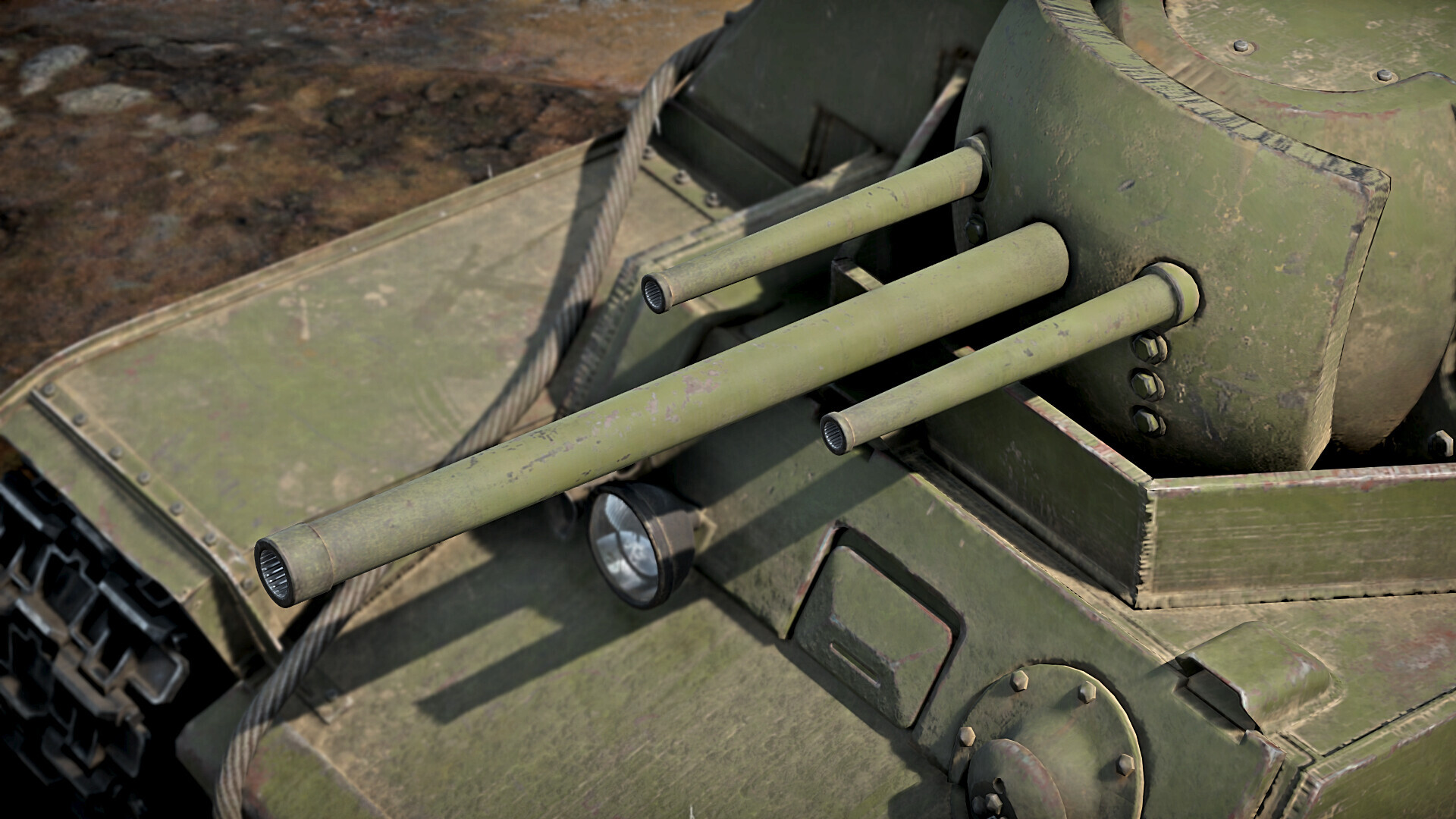
As auxiliary weapons, there are two 45 mm 20-K cannon paired with the main gun, so their aiming angles remain the same. Reload time is 3.8 seconds (2.9 seconds for aces), allowing effective engagement of multiple targets simultaneously. At close range, the difference in ballistics is negligible, enabling firing all guns together with increased firepower. The ammunition supply is a generous 200 rounds (100 per gun), so ammo quantity won’t be a concern during battle. The best tactic is to use the main gun against heavily armored targets, all guns against medium tanks, and only the 45-mm guns against lightly armored vehicles.
Shell Types:
- BR-240 — APHE with ballistic cap shell, the most useful ammo for secondary guns. Penetrates 67 mm at 100 meters, effective against lightly armored tanks. TNT equivalent is only 29 grams, but two guns hitting a target make penetration deadly. Initial velocity is 760 m/s, sufficient for long-range shooting.
- BR-240SP — APBC shell, penetration slightly higher at 70 mm at 100 meters, with velocity around 757 m/s. No explosive filler makes it the least effective round.
- BR-240P — APCR shell with 94 mm penetration at point-blank range, enabling it to defeat more heavily armored opponents. Initial velocity is 985 m/s for comfortable long-range fire. Despite better penetration, lack of explosives restricts combat effectiveness.
Machine gun armament
The 7.62 mm DT machine gun is mounted on the upper front plate, operated by the radio-operator gunner. It can penetrate up to 13 mm, suitable only for unarmored or lightly armored targets. It’s useful for spotting enemies or clearing small obstacles.
Combat usage
Due to the different ballistics of the guns and the limited horizontal and vertical aiming angles, there are essentially two styles of combat for this vehicle: aggressive and passive.
The aggressive playstyle involves using the vehicle to break through the main line. It is optimal to choose a direction where the enemy has little chance to flank the self-propelled gun. On large maps with open areas, it’s better to stay close to allies who will cover the KV-7’s flanks.
The defensive combat strategy involves selecting a position hidden from the enemy. This could be bushes where the enemy won’t immediately spot the self-propelled gun, or strategic points where ammunition can be replenished regularly. This tactic allows defending important directions or zones. Thanks to the multiple guns, the vehicle can hold its position even after a missed shot without needing to retreat behind cover.
For the KV-7, the most suitable maps are “Advance to the Rhine", “Battle of Hürtgen Forest", “Eastern Europe", and “North Holland". These maps offer enough routes or positions that can be used for clearing the main path or firing from fixed positions.
On the maps, green lines show the main optimal directions, while red and blue dots indicate positions for firing from cover.
Advance to the Rhine
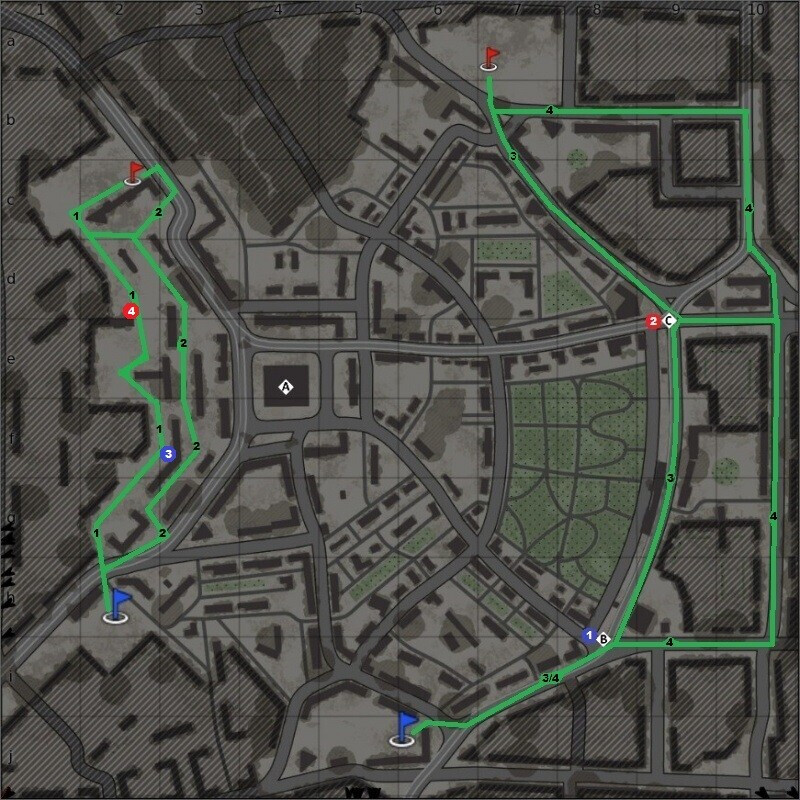
Paths 1 and 2 lead to the enemy base, and the purpose of positions 3 and 4 is to prevent this, keeping the enemy from crossing into your half of the map.
Directions 3 and 4 are necessary to capture points C and B. Positions 1 and 2, in turn, are needed to defend these points or to engage in direct firefights.
Battle of Hürtgen Forest
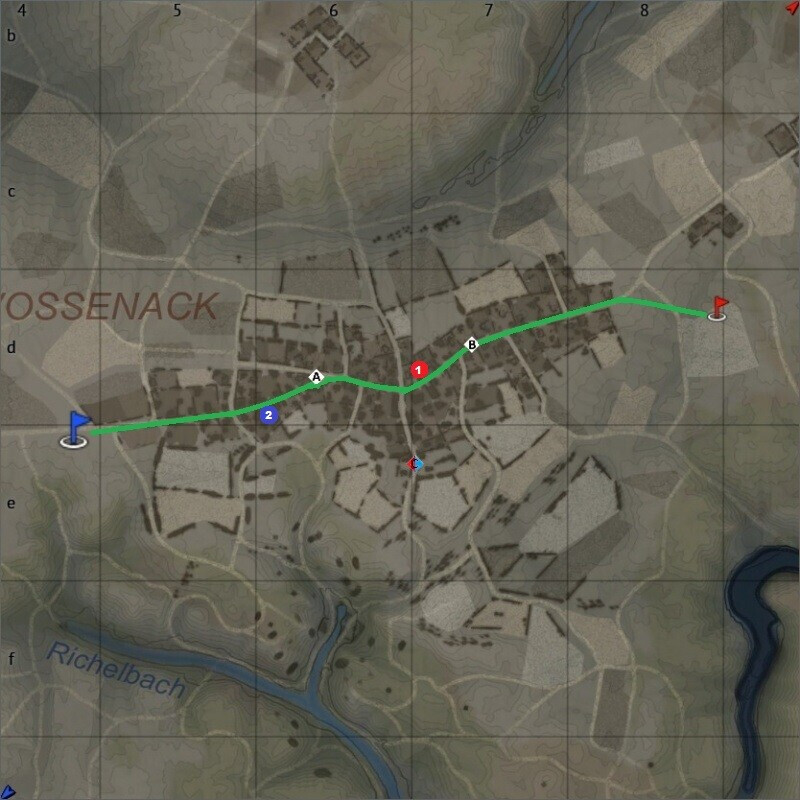
The map has only one route between points A and B. You can travel off the main road, between buildings, which increases your chance of survival.
Positions 1 and 2 block access to strategic points. Moreover, position 2 offers a view of point C, from where you can fire while replenishing ammunition.
Eastern Europe
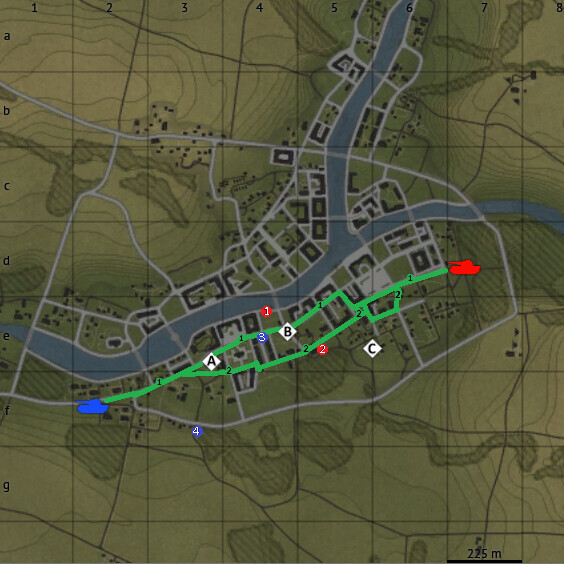
Directions 1 and 2 are similar; the first is needed to capture point B, while the second is to cover and advance toward points A or C.
Position 1 blocks access to point B via the first route and creates difficulties for allies at the third point who are also trying to prevent the capture of point B.
Positions 2 and 4 prevent the enemy from using the second route. Position 4, located on a height, provides a view of point C and allows destroying enemies trying to escape from there.
North Holland
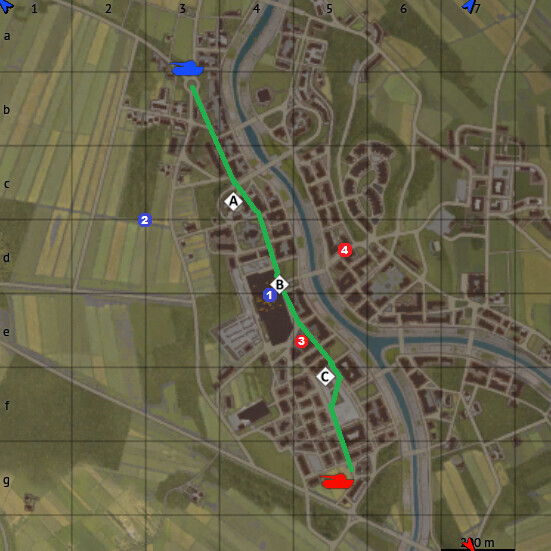
The only path passes through all three points, with capturing point B as the main objective for both teams.
Position 1 blocks access to point B through a building and the main path. Enemies can be destroyed at this position only by flanking the building from the left, but this may be obstructed by enemies at position 2 who control the entire left side of the map.
Position 3 covers the main route to point A but does not protect point B due to the risk of enemy passage through the building. Position 4 provides full protection and a clear view of the approach to point B.
Historical Background
In November 1941, the Ural Heavy Machinery Plant (UZTM) and the Chelyabinsk Kirov Plant (ChKZ) received an order from the People’s Commissariat of the Tank Industry to develop a self-propelled gun armed with one 76.2-mm and two 45-mm guns. The need for a new self-propelled gun to support tanks in battle arose from reports by tank unit commanders stating that the firepower of tank guns was insufficient.
The base was taken from the repaired KV-1 tank with factory number 5161. The KV-7, known as Object 227, was designed in November 1941. The gun mount was developed by G. Moskvin from ChKZ and K. Ilyin along with G. Efimov from UZTM. The chief engineer was L. Sychev, and the project was led by J. Kotin.
The test program for the “triple artillery installation on the KV tank” was approved on December 17, 1941. At the same time, preparation for serial production of the KV-7 began. Even before testing, production preparation for the first batch of 20 units started at Plant № 200.
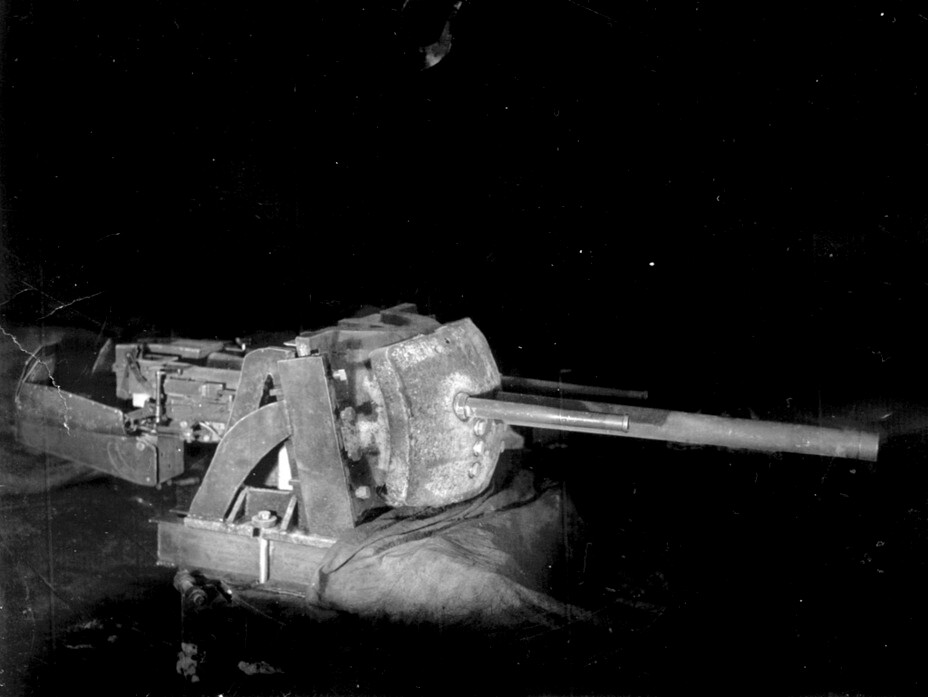
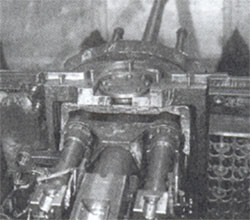
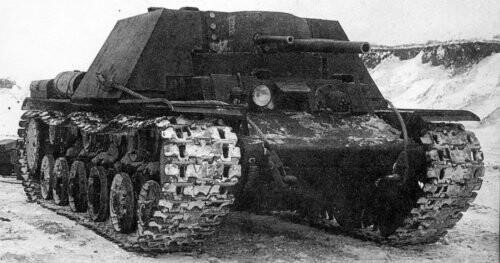
The first prototype of the U-13 artillery installation was ready in December 1941 at UZTM, with final assembly completed in early 1942 at ChKZ. Tests on December 27, 1942, showed that the 76-mm and two 45-mm guns could not fire simultaneous aimed volleys due to different ballistics. Furthermore, firing from one of the side guns disrupted horizontal aiming. On January 5, the KV-7 arrived in Moscow for further tests, where it was only on the third salvo that all three guns fired together, but the accuracy at 400 meters was low. The idea of salvo fire was questioned since the 76-mm gun could fire 3 rounds in 34 seconds while the 45-mm guns could fire 5.
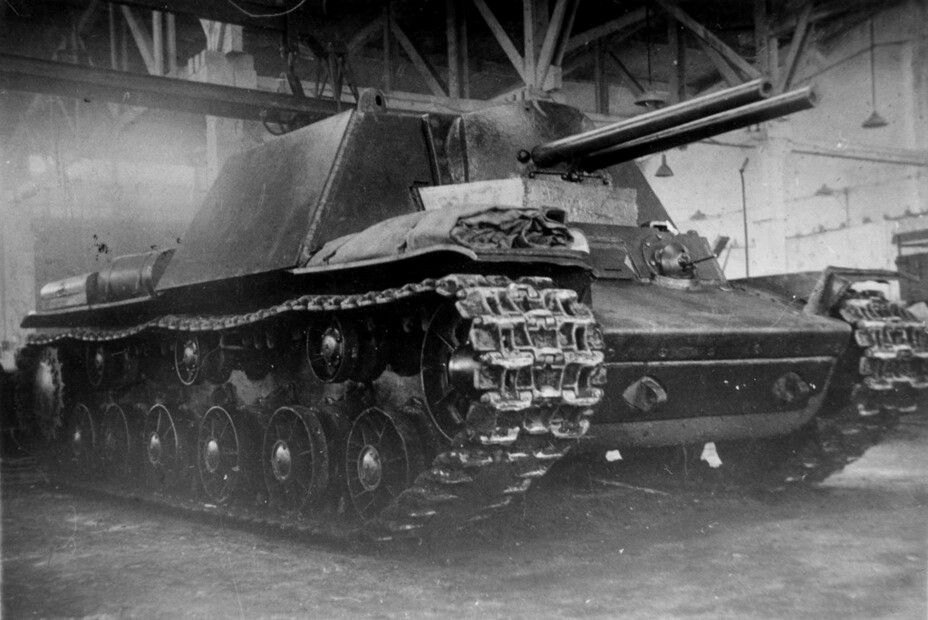
The commission proposed replacing the tank’s three different-caliber guns with two 76-mm guns in a paired U-14 mount. Project leaders were N. Kurin and G. Ksumin. Development continued until mid-February, followed by modernization of the KV-7. The tank was not built from scratch but modified based on the existing model. Changes affected the gun mantlet armor and ammunition stowage, while the casemate remained unchanged.
Tests conducted on May 14, 1942, showed a significant improvement in fire accuracy compared to the previous version, though the problem of synchronized salvo fire still reduced effectiveness. The rate of fire was 6-7 rounds per minute, comparable to the KV-1. New tests in October 1942 planned to install a commander’s turret from the KV-1S and upgrade the mount for frontline use. However, these plans were not realized. Instead, the tank was used for testing a transmission developed by the Moscow Bauman Machine-Building Institute.
The improved version was never adopted due to the arrival of the Tiger I tanks, which the 76-mm guns could no longer handle. The development of the self-propelled gun was not in vain. The experience gained was used by ChKZ and UZTM designers under J. Kotin in creating the SU-152. The only KV-7 prototype stood in a museum area at plant № 100 in its final days and, according to documents, was scrapped by the end of 1943.
- Wikipedia page
- Штурмовая трехстволка на базе КВ-1 — dzen page
- А. Г. Солянкин, М. В. Павлов, И. В. Павлов, И. Г. Желтов. Советские тяжёлые самоходные артиллерийские установки 1941–1945 гг. М.: Экспринт, 2005.