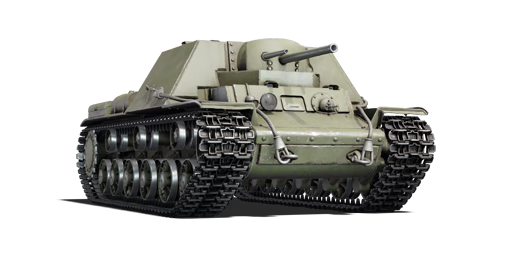
KV-7 (U-13)


The Soviet Army's journey to developing heavy self-propelled guns was long and filled with setbacks. Initially, self-propelled howitzers on tracks were believed to be the best option, which resulted in the unsuccessful SU-14 and SAU 212 projects. With the start of the Great Patriotic War, these developments came to a complete standstill and were carried out on an ad hoc basis. Suddenly, the creation of a new tank began at the Chelyabinsk Kirov Plant. In November 1941, Stalin ordered the development of a KV tank with a triple gun mount. This was intended to compensate for the shortcomings of the weak 76 mm gun by firing two additional 45 mm guns in salvo.
The vehicle, named the KV-7, was ready by December. The guns were installed in a U-13 mount, placed on a hull. A new loader was also added. Otherwise, the designers tried to retain as many original KV-1 parts as possible. However, the concept of firing in salvo proved to be the project's undoing. It was nearly impossible to fire three guns simultaneously, and even if it were possible, the dispersion would remain too large. Additionally, the sight was inconveniently located, and the lower rate of fire of the 76 mm gun forced the rate of fire of the other 45 mm guns to be reduced. Later, the designers attempted to correct these issues by installing a U-14 turret with two 76 mm guns, but this solution was unsuccessful as well. Consequently, the project was canceled in the spring of 1942, and the knowledge gained was applied to the development of the SU-152.
The KV-7 (U-13) was introduced as a reward for the 2024 Dreams Come True event. This highly unusual tank features a 76mm gun complemented by two 45mm cannons. The three guns make up for aiming errors, and the armor allows you to withstand enemy fire with confidence. However, such 45 mm guns often have insufficient armor penetration, and the aiming angles are quite limited.

| Ammunition | Type | Armor penetration (mm) at a distance: | |||||
|---|---|---|---|---|---|---|---|
| 10 m | 100 m | 500 m | 1000 m | 1500 m | 2000 m | ||
| APHEBC | 87 | 85 | 77 | 69 | 62 | 55 | |
| HE | 13 | 12 | 11 | 10 | 10 | 10 | |
| Shrapnel | 35 | 34 | 30 | 26 | 22 | 19 | |
| APCR | 125 | 117 | 87 | 60 | 41 | 28 | |
| HEAT | 80 | 80 | 80 | 80 | 80 | 80 | |
| APHEBC | 96 | 94 | 84 | 74 | 64 | 56 | |
| Ammunition | Type | Armor penetration (mm) at a distance: | |||||
|---|---|---|---|---|---|---|---|
| 10 m | 100 m | 500 m | 1000 m | 1500 m | 2000 m | ||
| APHEBC | 70 | 67 | 58 | 47 | 39 | 32 | |
| APBC | 73 | 70 | 60 | 50 | 41 | 34 | |
| APCR | 94 | 87 | 64 | 43 | 29 | 20 | |
| Belt | Belt filling | Armor penetration (mm) at a distance: | |||||
|---|---|---|---|---|---|---|---|
| 10 m | 100 m | 500 m | 1000 m | 1500 m | 2000 m | ||
| AP-I/API-T | 13 | 12 | 7 | 3 | 2 | 0 | |


 2 x (80 / 120 / 150) %
2 x 142 %
2 x (80 / 120 / 150) %
2 x 142 %
Mobility | |
|---|---|
Protection |
|---|
Firepower | ||
|---|---|---|