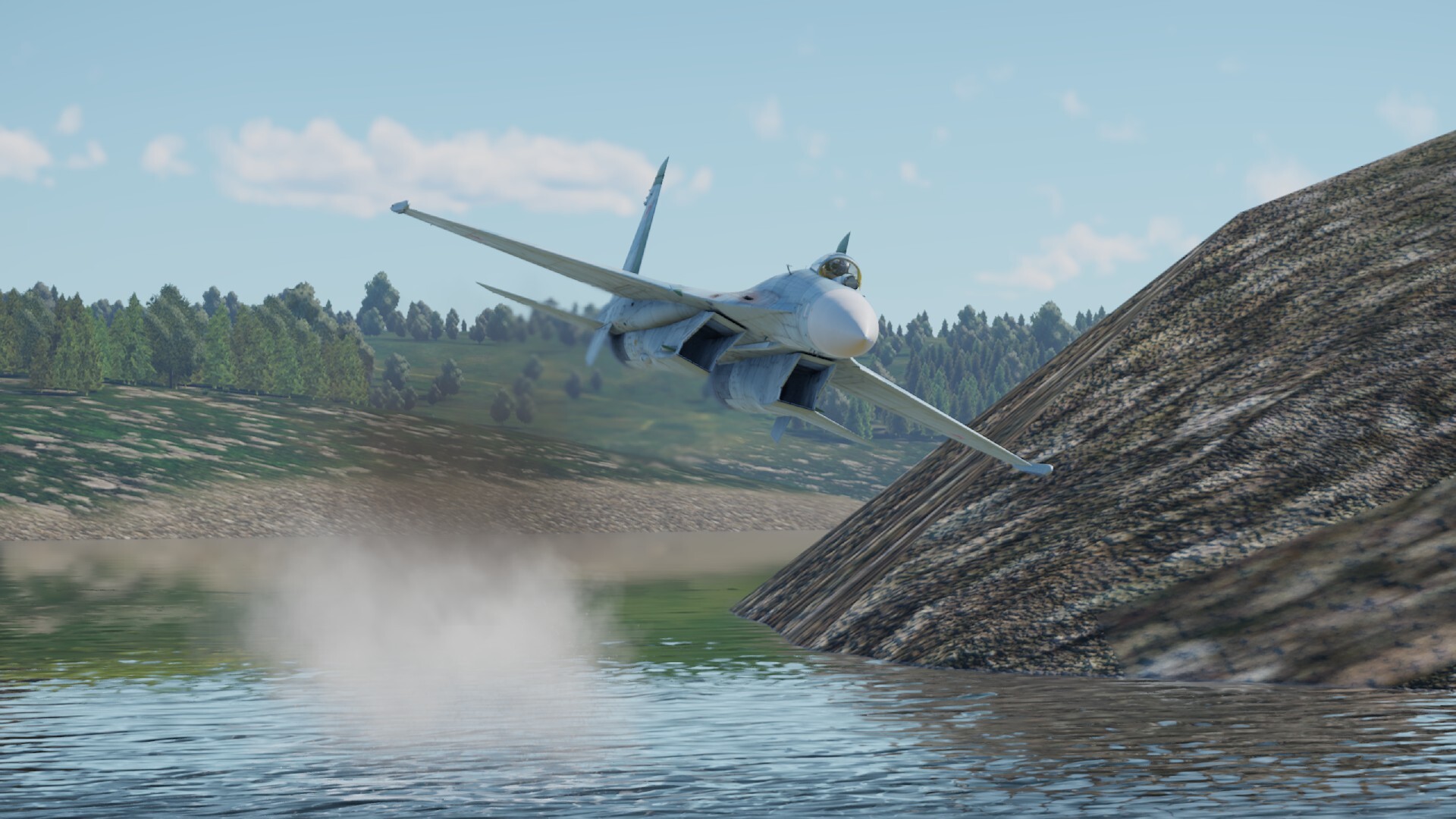
The Su-27 is a fourth-generation Soviet fighter jet developed by the Sukhoi Design Bureau to achieve air superiority. It first took to the skies in 1977 and entered service in 1985. Created as a response to the American F-15 and F-14, the Su-27 was distinguished by its long range, high maneuverability, and ability to engage in air combat at both long and short ranges. It became the basis for further modifications, in particular the Su-30, Su-33, Su-34 and Su-35. The Su-27 is still in service in many countries and is considered one of the most successful developments of Soviet aircraft manufacturing.
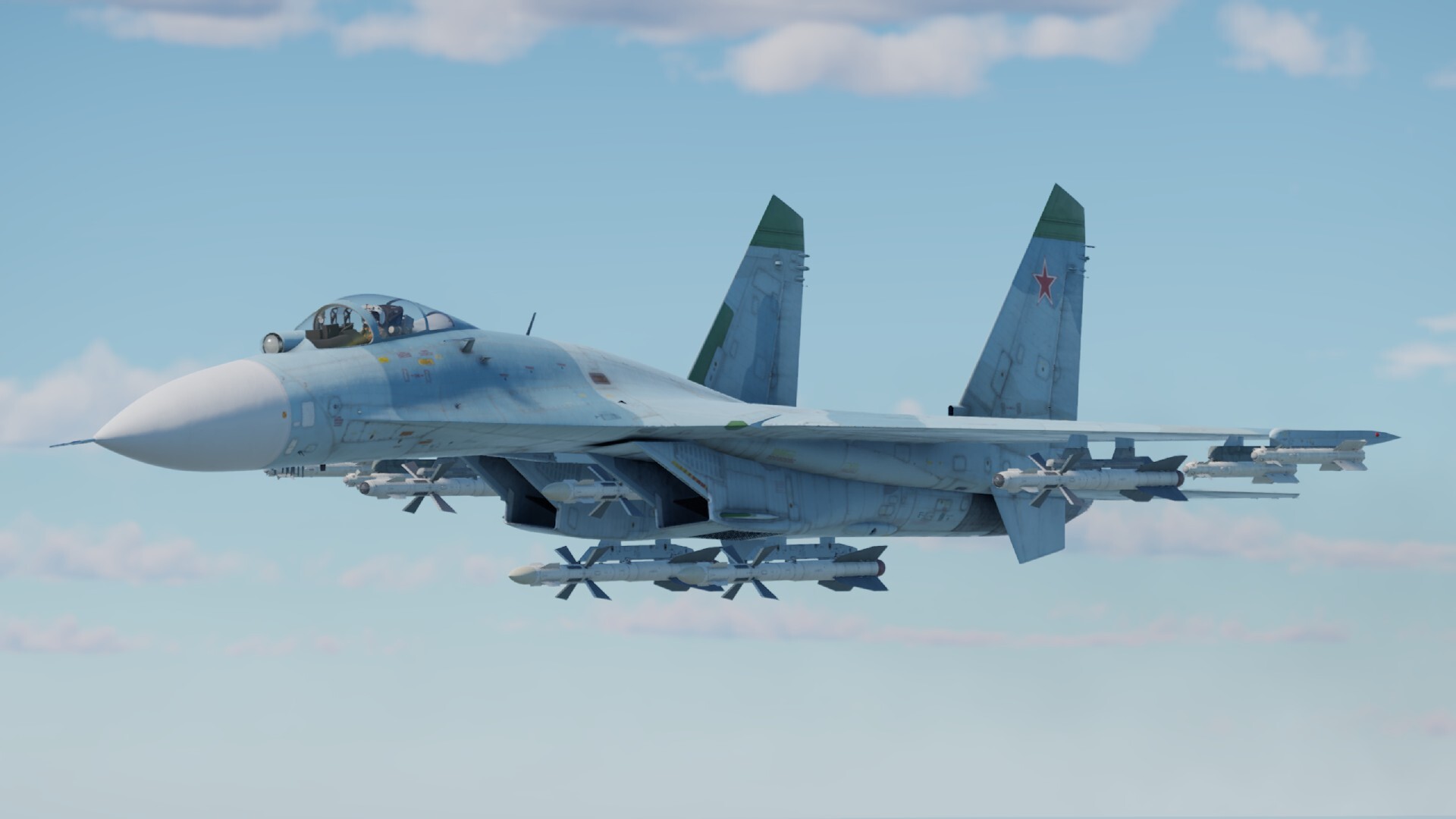
| Pros | Cons |
| Good maneuverability | Low thrust-to-weight ratio |
| Number of suspended weapons | Aircraft size |
| R-27ER (ET) and R-73 missiles | Radar scanning speed |
| Presence of HMD | Lack of guided weapons for ground targets |
| Presence of Optical Detection “IRST” |
Flight Performance
The Su-27 has a high maximum speed and can keep it up, but its acceleration is pretty average, especially without full afterburner. This isn’t a big deal on a straight run, but when you add in its weight and size, you need to keep a close eye on your energy levels. The aircraft maintains speed well over a large radius, but requires caution when engaging in dogfights with active use of the rudders.
A common tactic is to use afterburner (110%) for a long time to gradually burn fuel and pick up speed. This lowers the plane’s weight, which makes it a bit more maneuverable. Although the Su-27 is quite fuel-efficient compared to similar aircraft such as the MiG-29, this does not mean that it has an endless supply of fuel. This approach is only justified if you are sure that you will not get into a protracted battle afterwards — otherwise, you may find yourself in a situation where you are out of fuel and the enemy is still in the air. And you may not have enough distance and speed to return to the nearest airfield.
Thanks to the aerodynamics of its fuselage and large wings, the Su-27 can exchange speed for a short-term instantaneous turn, performing a “cobra” maneuver or similar stopping maneuvers. This allows you to disrupt the enemy’s attack or force them to pass by. However, it is rarely useful in jet combat and if used incorrectly — especially without controlling the angles of attack — often results in a complete loss of energy and turning into an easy target. Sharp maneuvers should only be used when you know that the target is directly in front of you and you have a clear plan of action afterwards.
Survivability
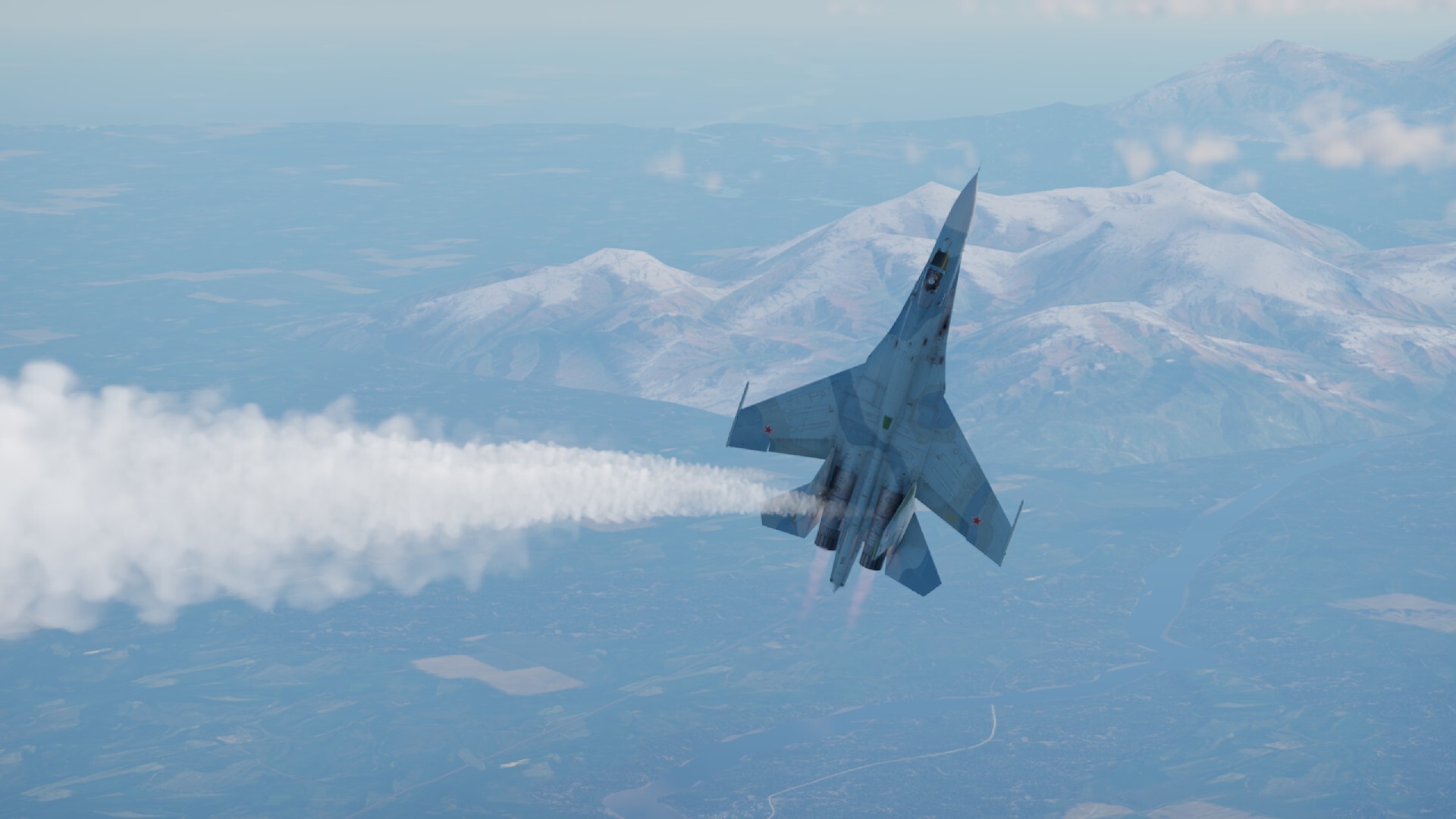
Unlike previous Soviet fighters, the Su-27 received significant improvements in survivability and situational awareness. The cockpit design does not feature armored glass or metal plates to protect the pilot or other critical aircraft components. Getting hit will either destroy Su-27 or make it extremely hard to fly. However, electronic systems have become key, significantly increasing the chances of survival in combat situations.
One of the main elements is the Bereza radar warning system (SPO-15), which, unlike the primitive systems of previous generations, is capable of determining the type and direction of the radiation source, as well as informing the pilot of the degree of threat at long distances. This allows for a quick response to the activity of enemy air defense systems or aircraft.
The Su-27’s RWR is equipped with an integrated Identification Friend or Foe (IFF) system, which prevents it from displaying target designations from friendly aircraft. However, the detection capabilities themselves are quite limited: it does not recognize most modern SAM systems and does not notify the pilot about target locks or missile launches. For example, systems like the Pantsir or ITO are only shown as radar illumination — meaning you can see that you’re being painted by a radar, but you won’t know if a lock has been established or if a missile has already been launched.
The system deploys 96 large caliber flares, specifically designed to produce more heat than normal flares, making them more effective against modern heat-seeking missiles. Dipole reflectors provide additional defense against radar-guided threats.
Additionally, it should be noted that aircraft engines are very hot, and therefore flares will not be effective with afterburners are engaged. For flares to be effective, ideally decrease thrust to 0%.
Weaponry
Offensive armament
The aircraft’s main armament is a 30 mm GSh-30-1 cannon, which has 150 rounds and a rate of fire of 1,800 rounds per minute. This allows it to engage in close combat with enemy aircraft, having sufficiently serious armament capable of shooting down or damaging any other aircraft to the point of incapacitation with a few accurate hits. However, it should be noted that the Su-27's cannon has a terrible ammunition velocity, which limits its effectiveness.
Armor penetration of up to 55 mm allows it to attack ground-based air defense systems, infantry fighting vehicles, armored personnel carriers, and similar lightly armored targets.
Air-to-Air Ordnance
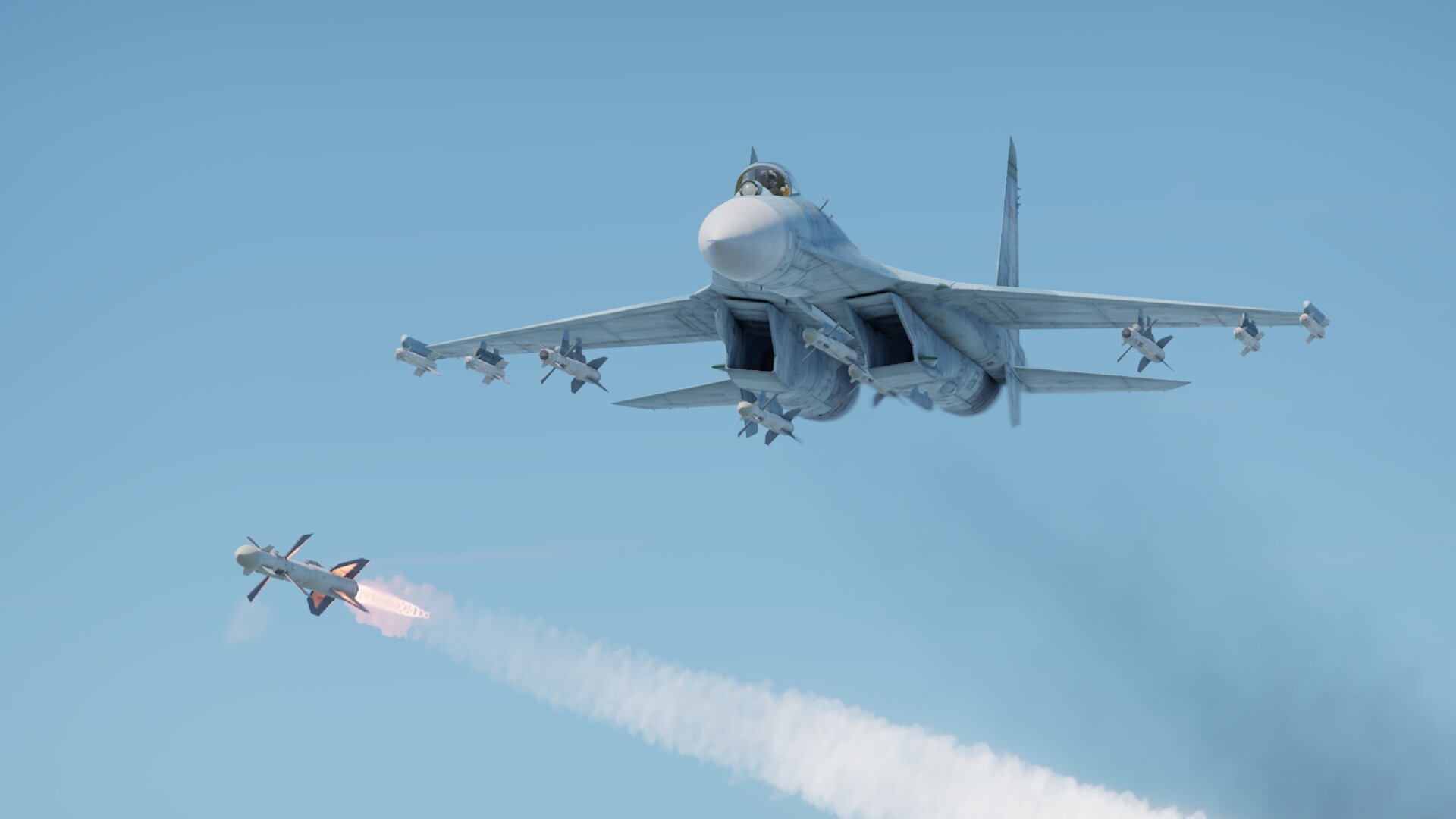
The Su-27 offers a diverse and powerful range of air-to-air missiles adapted for various ranges and combat conditions. Its armament is centered around the R-73 and R-27 missile families, which provide good flexibility in close and medium-range combat.
The R-73 is a short-range maneuverable missile. It is equipped with an uncaged infrared seeker with excellent tracking capabilities and high guidance accuracy when used in conjunction with a helmet-mounted sight. With maneuverability of up to 40G, it can easily hit highly maneuverable targets and has a very wide field of view, making it deadly in air combat. Its range is short, but this is compensated for by its maneuverability and accuracy.
The R-73's seeker has a lower probability of being decoyed at short range due to the presence of a counter-countermeasure system. However, its resistance to flares is not perfect, and smart opponents can still fool it under the right conditions.
The R-27R is a basic medium-range missile with a semi-active radar homing (SARH) seeker. It requires radar lock-on until impact, making it vulnerable to notching and terrain masking. Its acceleration is decent, but it lacks power in rear pursuit or evasion scenarios. However, it performs well in head-on collisions, especially against unaware targets.
The R-27ER is a significant improvement over the R-27R. It has a longer booster and increased range, better speed and energy conservation, and retains the same SARH guidance system. This gives the Su-27 a serious range, allowing it to engage targets well beyond visual range—provided you can maintain radar lock. It is a key component of air superiority and significantly more threatening than the basic R-27R.
As for infrared missiles, the R-27T and R-27ET offer silent target engagement capabilities. The R-27ET has a more powerful engine, like the ER, which provides much greater range while maintaining infrared guidance. It is ideal for ambushing the enemy or striking targets that are unaware of the danger, without warning them with radar warning receivers.
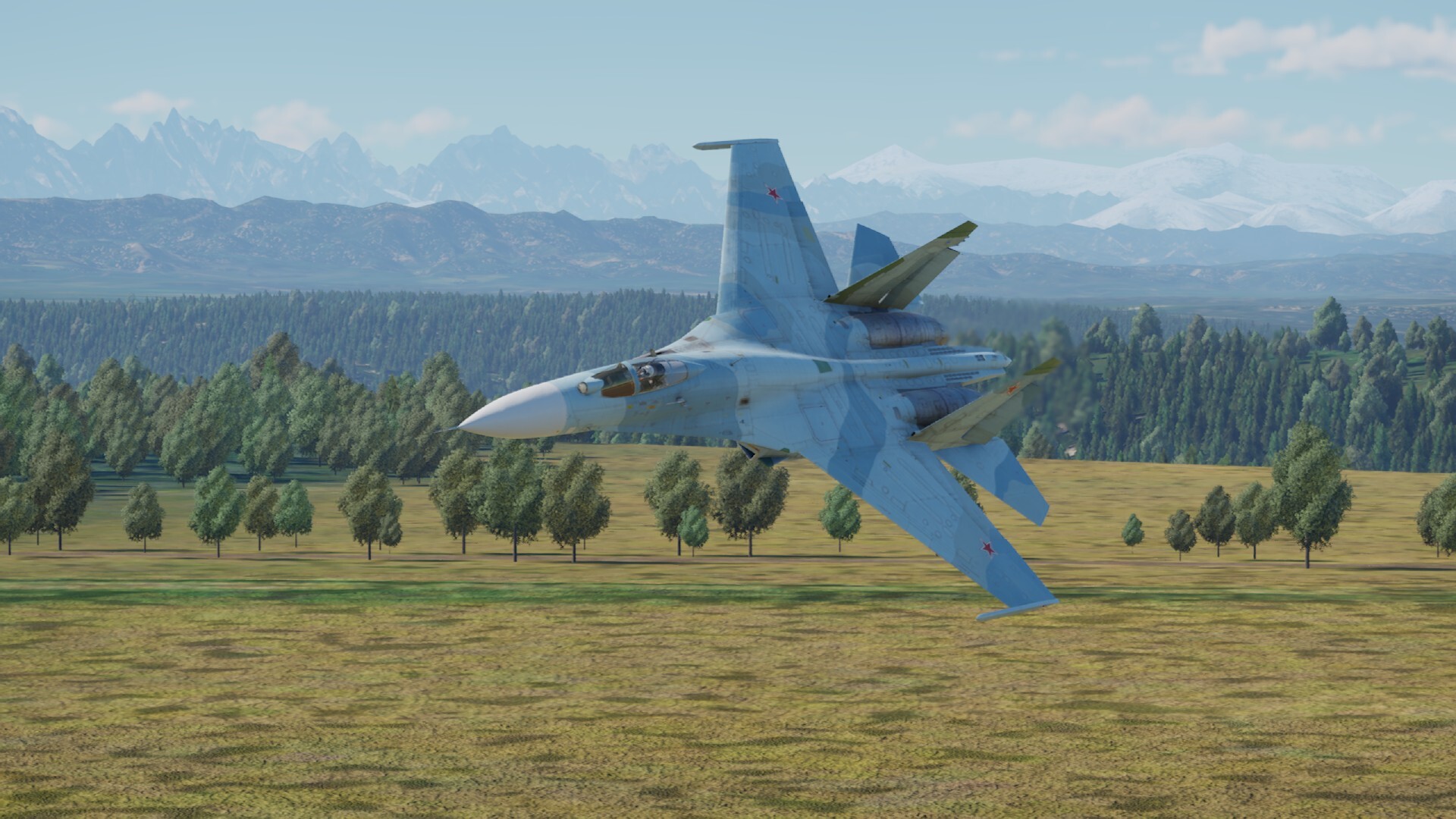
The Su-27 can carry a combination of these missiles — usually four R-73s on the outer pylons and a combination of R-27R/ER or T/ET on the inner pylons. This allows for a versatile configuration, balancing stealth, range, and maneuverability depending on your tactics and threats.
| Missile | Lock-on range (Front hemisphere) | Lock-on range (Rear hemisphere) | Launch range (Front hemisphere) | Launch range (Rear hemisphere) |
| R-27R | 25km | 25km | 15km | 3km |
| R-27T | 6-7km | 15-20km | 15km | 3km |
| R-27ER | 25km | 25km | 40km | 10km |
| R-27ET | 6-7km | 15-20km | 40km | 10km |
| R-73 | 4-5km | 8-9km | 7km | 3km |
Air-to-Ground Ordnance
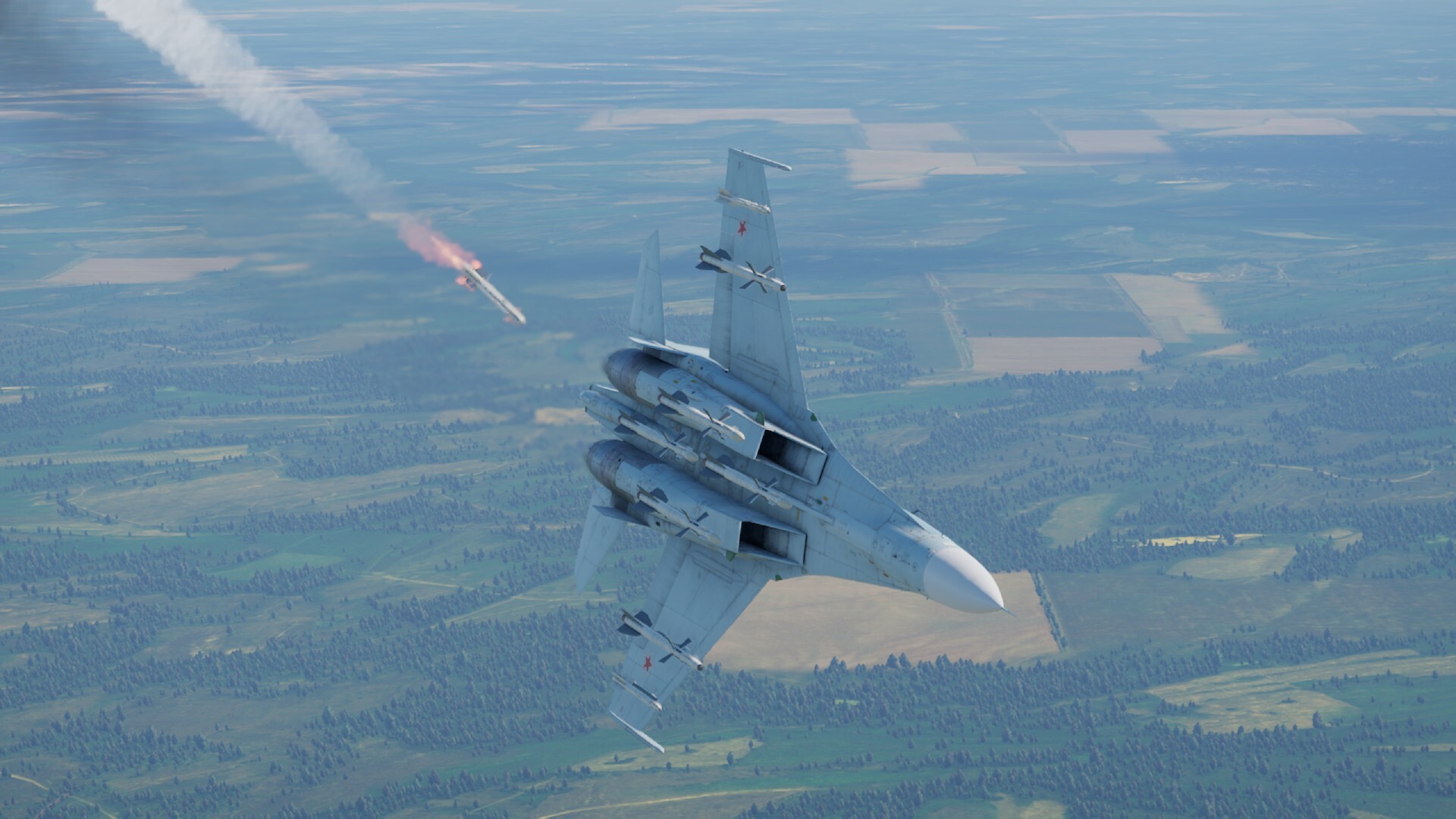
The Su-27 can carry up to 8,040 kg of bombs, and a large number of slots allow you to assemble weapons for any situation on the battlefield, changing combat tactics right in the air.
Although the Su-27 is primarily an air superiority fighter, it can be used in a limited ground attack role if necessary. It is not a specialized strike aircraft, as it is not equipped with targeting pods or air-to-ground guided munitions. Its standard configuration does not include laser or television bombs, nor does it include guided anti-tank or anti-ship missiles.
Nevertheless, the aircraft has basic unguided munitions at its disposal, including high-explosive bombs weighing from 100 to 500 kg, as well as unguided rockets. These weapons can be used against lightly armored ground targets such as AA, self-propelled artillery, IFV, or even MBT with precision fire. However, their effectiveness depends heavily on the pilot’s skills, the angle of approach, the location of the target, as well as enemy air defense and aviation.
Without special targeting devices, strikes must be carried out visually, at low and medium altitudes, which exposes the aircraft to fire.
In short: the Su-27 can perform occasional strike missions, but this is not its strong suit. Its ability to strike ground targets is strictly secondary, more of a backup option than a reliable mission profile.
Navigation Bombing Mode
Although the Su-27 is not equipped with air-to-ground guided munitions, it can still perform long-range bombing in navigation bombing mode. This allows you to mark the desired strike point on the mini-map. Once the point is set, you must level the aircraft, align the course, and hold down the bomb release button. The bomb will be automatically released as soon as the aircraft reaches the correct release point for a ballistic strike on the target area.
This type of bombing is useful for striking general enemy positions, especially static targets such as air defense systems, stationary equipment, or enemy spawn areas. It allows the Su-27 to drop bombs from a higher altitude or a safe distance, remaining outside the range of most anti-aircraft systems.
However, the accuracy of such bombing is limited. Without real-time targeting or visual confirmation, this method works best when there is a coordinated ground partner, especially in tank battles. A ground ally can mark enemy SAMs or other stationary threats, giving you a better chance of hitting the target with unguided bombs.
Air combat on the Su-27
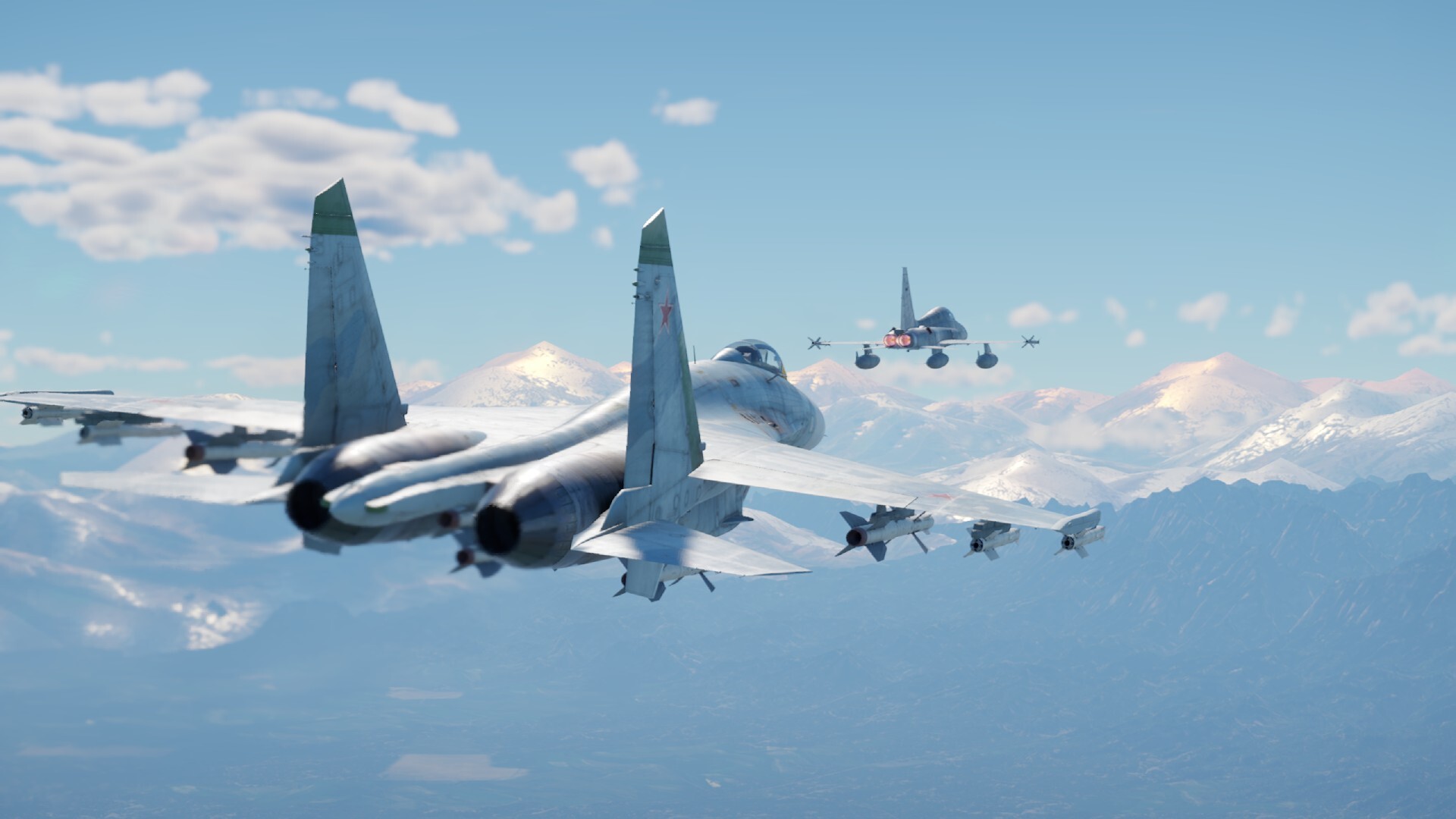
Despite its relatively low thrust-to-weight ratio compared to some other modern fighters, the Su-27 should not be underestimated in close air combat. Although it is more difficult for it to maintain a constant speed after active turns in prolonged maneuvering combat, thanks to its sophisticated aerodynamics, large energy reserve at the start of combat, and high angular turn rate, the aircraft is capable of effectively conducting close combat both in the horizontal plane and using its energy advantage through vertical maneuvers with altitude gain.
The key factor that allows the Su-27 to remain a dangerous opponent in dogfights is the combination of its onboard weapons and maneuverability. Thanks to the R-73 missiles and the ability to perform a “Cobra,” it is possible to achieve instant victory in close combat. Combined with the helmet-mounted targeting system, this turns the Su-27 into a fast “kill shot” platform — a brief target acquisition and maneuver is enough to launch a missile.
Although the Cobra maneuver has questionable value in prolonged combat due to the loss of speed, it can provide a decisive advantage in a single aerial combat: a sudden decrease in speed allows the enemy to “fly ahead,” putting the Su-27 in a position to launch a missile or fire a cannon.
Also, thanks to the R-27ER missiles, the Su-27 is also capable of conducting long-range air combat at a distance of more than 40 km against a non-maneuvering target. This allows it to conduct effective combat at a distance.
So, even though the Su-27 isn’t your typical “agile fighter,” it can adapt to close combat, and in skilled hands, this plane is still a serious threat even in close combat, which isn’t really its strong suit.
Missile Evasion Tactics: AIM-9M and R-73
In this section, it’s important to mention that simply deploying flares is not always enough — effective evasion of IR-guided missiles like the AIM-9M and R-73 often requires proper maneuvering and timing in addition to flare use.
Also note that these two missiles have different IRCCM systems, which significantly affects how they respond to countermeasures: The R-73 uses seeker cone narrowing as its IRCCM method — it focuses more tightly on the target’s heat signature to ignore nearby flares. The AIM-9M, on the other hand, uses a more advanced method: temporarily turning off the seeker and reacquiring the strongest engine signature after flare separation. This makes it potentially more resistant to poorly timed flares.
R-73
The R-73 is a highly maneuverable IR missile with a wide seeker angle, so to defeat it you need to do the following:
- Disable afterburner immediately to reduce engine heat signature.
- Orient the flare dispenser toward the missile — ideally, the flares should pass between the seeker and the engine, effectively masking the heat source.
- After the missile begins to drift away from its course, break in the opposite direction to maximize distance and angle.
AIM-9M
The AIM-9M has better IRCCM (infrared counter-countermeasures) than older Sidewinder variants, so it can ignore flares if used incorrectly. The evasion method depends on the direction of the launch:
- Rear-aspect launch (directly at six o’clock): This is the easiest to evade. Perform a barrel roll while deploying flares to confuse the missile’s seeker.
- Head-on launch (frontal aspect): Also relatively simple. Use periodic flare drops while performing small trajectory shifts (weaving maneuvers) to mislead the missile.
- Oblique rear launch (around 5–7 o’clock): Turn toward the incoming missile while deploying flares, then follow with a slanted barrel roll to break the lock.
- Side launch (3 or 9 o’clock position): At a distance of roughly 1.5 km, make a sharp upward maneuver in the direction of the missile while dropping flares — this sudden change in vector, combined with flares, helps break the track.
Ground RB
In Ground RB, the Su-27 proves itself to be an effective fighter thanks to its high speed, maneuverability, and wide range of air-to-air weapons, allowing even a single Su-27 to completely control the skies.
Although it does not have access to guided bombs or air-to-ground missiles, thanks to its unguided missile and unguided high-explosive bomb (e.g., FAB-500) suspension, the Su-27 can effectively destroy armored vehicles, air defense systems, and other ground targets with the right approach and accurate aiming. Navigation bombing remains the most effective method, allowing attacks even with such weapons while remaining out of reach of enemy air defense systems. High speed allows it to quickly reach the front and exit the strike zone, while maneuverability allows it to avoid anti-aircraft fire or attacks from enemy fighters.
The built-in 30 mm GSh-30-1 cannon adds another tool for fighting light equipment or air defense. This allows the Su-27 to remain a threat even after dropping all its weapons.
Despite the lack of precision weapons, the Su-27 can perform a strike role thanks to its speed, survivability, and payload capacity. It is the perfect choice for players who want to fly out, strike, and come out alive, although it is limited in its effectiveness for attacking ground targets.