The Gloster Meteor was the first operational jet fighter to enter Allied service, marking the United Kingdom’s transition into the jet age during the final phase of the Second World War. In Belgian service, it played a central role in the post-war reconstruction and modernization of the Belgian Air Force, equipping the nation’s first generation of jet fighter squadrons from the late 1940s through the early 1960s and forming the backbone of its emerging Cold War air defense capability. The Meteor operated both at home and abroad, most notably seeing combat during the Korean War. Although it was rapidly overtaken by more advanced swept-wing designs, the aircraft proved invaluable as a transitional platform, enabling Belgian pilots to develop proficiency in jet operations, air defense, and ground attack, while establishing the doctrinal and operational foundations for later aircraft such as the Hawker Hunter and SABCA F-104G Starfighter.
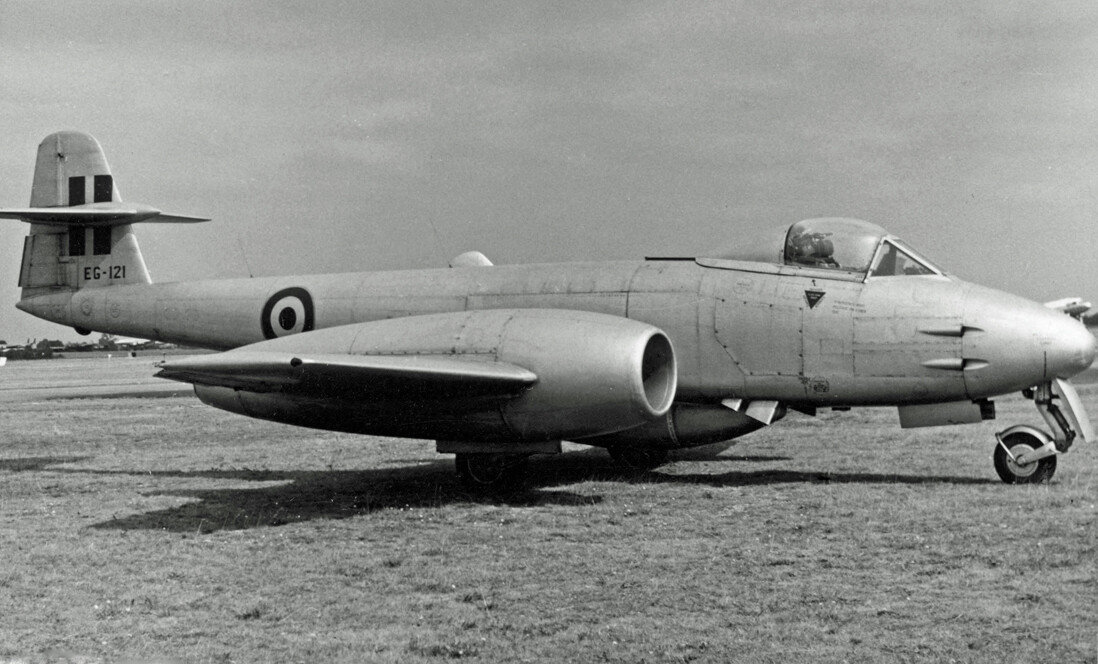
Development and Belgian Acquisition
Post-war reconstruction and jet transition
In the aftermath of the Second World War, Belgium faced the challenge of rebuilding its military aviation capability. Although many Belgian pilots had gained valuable operational experience while serving with the Royal Air Force during the war, the newly re-established Belgian Air Force lacked a modern fleet of its own. Initially equipped with surplus piston-engined aircraft such as the Supermarine Spitfire, it quickly became apparent that these fighters would be inadequate in an era increasingly dominated by jet propulsion.
The emergence of the Cold War further accelerated the need for modernization. As one of the founding members of the North Atlantic Treaty Organization (NATO) on 4 April 1949, Belgium committed itself to contributing a substantial fighter force to the collective defence of Western Europe. Plans called for twelve day-fighter squadrons and eight night-fighter squadrons, creating an urgent requirement for a modern jet aircraft that was already proven, readily available, and suitable for rapid introduction into service.
The Gloster Meteor fulfilled these requirements. As the first operational Allied jet fighter and one of the few mature jet designs available at the time, it provided Belgium with an opportunity to transition directly from piston-engined fighters to jet aircraft without an intermediate step. The Meteor would become the foundation upon which the post-war Belgian Air Force rebuilt its fighter capability and developed the operational experience required for the jet age.
On 12 March 1949, Belgium placed an order with the Gloster Aircraft Company for 48 Meteor F. Mk. 4 fighters at a unit cost of £29,400, with deliveries scheduled for completion before the end of November that year. The aircraft, allocated Belgian serial numbers EF1–EF48, were intended to equip No. 349 Squadron, followed by No. 350 Squadron and the newly formed 4th Day Fighter Squadron. Deliveries began in April 1949, when the first aircraft arrived from Gloster’s Brockworth factory, marking the beginning of Belgium’s operational jet era.
Early deliveries and unit formation
Deliveries of the Meteor F. Mk. 4 began in April 1949, only weeks after the aircraft had been ordered. The first examples, including EF2, EF6, and EF7, were delivered from Gloster’s Brockworth factory to No. 349 Squadron, making it the first Belgian unit to operate jet aircraft. Under the command of Major Marcel Mullenders, the squadron became the nucleus of Belgium’s emerging jet fighter force and pioneered the operational procedures that would later be adopted throughout the Belgian Air Force.
By the early 1950s, Belgium had established multiple operational squadrons equipped with Meteors, forming the core of its early Cold War air defense capability.
The expansion of Belgium’s jet force proceeded rapidly throughout 1949. By 15 May, No. 349 Squadron had become the first Belgian squadron to be fully equipped with the Meteor F. Mk. 4 No. 350 Squadron began its conversion in July 1949, and by the end of that month both squadrons of the 1st Fighter Wing were fully operational on the Meteor. In December 1949, the newly established 4th Day Fighter Squadron also received Meteor F.4s, completing the transition of the wing’s day-fighter component to jet aircraft.
By the end of 1949, the 1st Fighter Wing comprised three Meteor-equipped day-fighter squadrons, No. 349, No. 350 and No. 4 Squadrons, supported by the Night Fighter No. 10 Squadron and an Auxiliary Squadron. The Meteor had become the backbone of Belgium’s frontline fighter force, providing the operational capability required to meet the country’s growing NATO commitments and forming the foundation of its early Cold War air defence network.
Design and Variants
The Gloster Meteor featured a conventional straight-wing layout with twin turbojet engines mounted in nacelles along the wings. While conservative compared to later swept-wing designs, this configuration provided stability and ease of handling, important characteristics for air forces transitioning into jet aviation.
Meteor F. Mk. 4
The Meteor F. Mk. 4 was the first true post-war production variant of the Gloster Meteor and the initial model to equip the Belgian Air Force as it entered the jet age. Derived from late-war Meteor developments, the F. Mk. 4 represented an important transitional design, bridging the gap between early operational jets and more refined fighters such as the later F.8. While externally similar to its predecessors, it incorporated a number of structural and propulsion improvements that enhanced overall performance, albeit without fundamentally altering the aircraft’s original configuration.
One of the most notable design changes was the introduction of more powerful Rolls-Royce Derwent Mk. 5 turbojet engines, which provided a significant increase in thrust compared to earlier Meteors. This improvement translated into higher maximum speed, better climb performance, and more responsive acceleration. However, the increased power also imposed greater stresses on the airframe, necessitating structural reinforcement in critical areas.
To complement these performance gains, the F. Mk. 4 featured a reduced wingspan, achieved by clipping the wingtips. This modification improved the aircraft’s roll rate and maneuverability, particularly at medium altitudes, making it more agile in combat situations. The trade-off was a slight reduction in high-altitude efficiency and stability, but within the operational envelope expected at the time, the benefits were considered worthwhile.
The fuselage design remained largely consistent with earlier Meteors, retaining its relatively short length and conventional tail unit. As a result, the F. Mk. 4 did not yet benefit from the improved longitudinal stability seen in the later F. Mk. 8, and pilots occasionally noted sensitivity in pitch, especially at higher speeds. The aircraft’s straight-wing configuration, while aerodynamically conservative, provided predictable handling characteristics and forgiving flight behavior.
The cockpit retained a heavily framed canopy, which limited rearward visibility compared to later bubble designs. Instrumentation and layout reflected late-war standards, functional but not yet optimized for the higher workload associated with jet operations. Despite these limitations, the F. Mk. 4 served effectively as a conversion platform, allowing pilots to become accustomed to the higher speeds, different throttle response, and new operational considerations of jet flight.
Armament remained concentrated in the nose, consisting of four 20 mm Hispano Mk. V cannons. Mounting the guns centrally eliminated the convergence issues of wing-mounted guns, giving a stable and accurate gun platform suited to the short firing windows typical of jet combat. While primarily designed as a fighter, the F. Mk. 4 could also be adapted for limited ground-attack roles, though this was not its primary function in Belgian service. Nos. 349 and 4 continued with the F. Mk. 4 until February and April 1953 respectively
Meteor F. Mk. 8
Experience gained with the F. Mk. 4 quickly demonstrated the need for a more capable fighter. In late 1949 Belgium therefore placed an initial order for 23 Meteor F.8s, which entered service with 350 Squadron before replacing the remaining F. Mk. 4s in frontline service. Belgium would eventually acquire approximately 240 F. Mk. 8s, many assembled under licence by Fokker in the Netherlands and Avions Fairey at Gosselies, making the F. Mk. 8 by far the most numerous Meteor variant operated by the Belgian Air Force. No. 350 Squadron won an inter-squadron competition in 1950 and was the first to receive the F. Mk. 8.
The Meteor F. Mk. 8 represented the ultimate and most refined single-seat fighter development of the Gloster Meteor family, incorporating a series of structural and aerodynamic improvements that addressed many of the shortcomings observed in earlier variants. While retaining the Meteor’s characteristic straight-wing configuration and twin-engine layout, the F. Mk. 8 introduced a substantially redesigned fuselage and empennage, resulting in a markedly more stable and effective combat aircraft.
One of the most significant changes was the lengthening of the fuselage, achieved by inserting a plug section forward of the tailplane. This modification shifted the aircraft’s center of gravity and improved longitudinal stability, particularly at higher speeds and during gunnery passes. Complementing this was a completely redesigned tail unit, replacing the earlier rounded vertical stabilizer with a taller, more angular fin and a broader rudder. These changes enhanced directional stability and control authority, especially during high-speed flight and asymmetric thrust situations, an important consideration for twin-engine jet operations.
The cockpit underwent equally important refinement. The earlier framed canopy was replaced with a clear-view “bubble” canopy, significantly improving all-round visibility. This was a critical improvement for combat effectiveness, particularly in air-to-air engagements where situational awareness was paramount. Internally, cockpit ergonomics were improved with a more logical instrument layout.
Structurally, the F. Mk. 8 retained the Meteor’s robust construction, with a straight, mid-mounted wing housing the twin turbojet engines in nacelles. While this configuration imposed aerodynamic limitations compared to emerging swept-wing designs, it offered predictable handling characteristics and good low-speed performance. The aircraft remained particularly stable as a gun platform, making it well-suited for both interception and ground-attack roles.
The F. Mk. 8 retained the effective armament of the F. Mk. 4, and could also carry external stores such as bombs and rockets for ground attack.
Meteor T. Mk. 7
Belgium acquired the Meteor T. Mk. 7 to support the rapid expansion of its jet force. The trainers were distributed among operational wings and later concentrated within the newly established PSV (Pilotage Sans Visibilité) Flight, where they became central to instrument flying instruction and conversion training for successive generations of Belgian jet pilots.
The Meteor T. Mk. 7 was the dedicated two-seat training variant of the Gloster Meteor, developed to support the transition of pilots from piston-engined aircraft to jet-powered flight. As one of the earliest operational jet trainers in widespread use, it played a critical role in preparing aircrew for the demands of high-speed aviation, while preserving the core handling characteristics of the single-seat fighter variants.
Structurally, the T. Mk. 7 was derived from earlier Meteor fighter airframes but featured a lengthened forward fuselage to accommodate a second cockpit. The two seats were arranged in tandem under a long, continuous canopy, which replaced the more compact fighter-style cockpit enclosure. This canopy provided improved visibility for both instructor and student, while maintaining aerodynamic efficiency as much as possible within the constraints of the redesign.
A defining feature of the T. Mk. 7 was its dual-control configuration, allowing the instructor to monitor and, when necessary, override the student’s inputs. This was essential for safe conversion training, particularly given the markedly different handling characteristics of jet aircraft compared to piston-engine types, such as throttle lag, higher landing speeds, and different stall behavior.
Despite its training role, the T. Mk. 7 retained much of the Meteor’s original aerodynamic layout, including the straight wing and twin-engine nacelle configuration. This ensured that its flight characteristics remained broadly representative of operational variants like the F. Mk. 4 and F. Mk. 8, allowing skills learned during training to transfer directly to frontline aircraft. However, the addition of the second cockpit and associated structural modifications resulted in a slight reduction in performance, particularly in speed and climb rate.
Unlike its fighter counterparts, the T. Mk. 7 was typically unarmed, as its primary function was instruction rather than combat. Internally, instrumentation was duplicated or adapted to facilitate teaching, with emphasis on clear layout and accessibility for both occupants.
Meteor N.F. Mk. 11
Belgium introduced the Meteor N.F. Mk. 11 to provide an all-weather interception capability for its expanding NATO commitments. Operated initially by No. 10 Squadron and later No. 11 Squadron, the type formed the backbone of Belgium’s night-fighter force throughout the first half of the 1950s. A second batch of twelve ex-RAF aircraft entered service in 1956, replacing earlier examples and extending the type’s operational life until the arrival of the Avro CF-100 Canuck.
The Meteor N.F. Mk. 11 was the first dedicated night fighter variant of the Gloster Meteor family to achieve large-scale operational service, representing a significant evolution from the single-seat day fighters. Designed specifically for all-weather interception, it incorporated major structural and systems changes to accommodate airborne radar, a second crew member, and the specialized equipment required for night and poor-visibility operations.
The most immediately recognizable feature of the N.F. Mk. 11 was its extended nose section, which housed an airborne interception radar set. This radar installation fundamentally altered the aircraft’s role and design, allowing it to detect and track targets independently of ground control in darkness or adverse weather. The elongated nose also improved directional stability to some extent, though it added weight and aerodynamic drag.
To operate the radar effectively, the N.F. Mk. 11 introduced a two-seat cockpit configuration, with the pilot seated forward and a radar operator positioned behind. The canopy was redesigned into a longer, framed unit that provided adequate visibility while accommodating both crew members and their respective instrumentation. Internally, the cockpit layout became significantly more complex, integrating radar displays, communication systems, and navigation equipment alongside standard flight controls.
The airframe itself was based broadly on the Meteor F. Mk. 8, incorporating its lengthened fuselage and improved tail unit, which provided better stability compared to earlier Meteors. However, the addition of radar equipment and a second crew member increased overall weight, resulting in reduced top speed and climb performance relative to single-seat fighter variants. Despite this, the N.F. Mk. 11 remained a stable and effective platform for interception duties.
Armament was retained in the nose and consisted of four 20 mm Hispano cannons, allowing the aircraft to engage targets detected by its radar without the need for complex gun harmonization. This configuration was particularly effective in night interception, where closing distances were often short and firing opportunities brief.
In operational use, the N.F. Mk. 11 relied heavily on coordination with ground-based radar stations, but its onboard radar provided a crucial degree of autonomy. Pilots and radar operators worked as a coordinated team, with the operator guiding the pilot into position for interception.
Operational History
Formation of Belgian Jet Units
The Gloster Meteor entered Belgian service in April 1949, marking the beginning of the country’s transition from piston-engined fighters to jet-powered aviation. The first Meteor F.4s were delivered directly from Gloster’s Brockworth factory to No. 349 Squadron, which became the first Belgian unit equipped with jet aircraft. By May 1949 the squadron had completed its conversion and was fully operational on the type.
Throughout the summer of 1949 deliveries continued, allowing No. 350 Squadron to begin its own conversion training before becoming operational later that year. In December 1949 the newly established 4th Day Fighter Squadron also received Meteor F. Mk. 4s, giving Belgium three frontline jet fighter squadrons within the 1st Fighter Wing.
The rapid expansion reflected Belgium’s growing commitments to Western European collective defence following the signing of the North Atlantic Treaty in April 1949. The original order of forty-eight Meteor F. Mk. 4s soon proved insufficient to maintain three fully equipped squadrons, leading to an additional order for Meteor F. Mk. 8 fighters before the end of the year.
Korean War Deployment
The Meteor’s only combat service with Belgian pilots occurred during the Korean War. Belgian personnel serving with No. 350 Squadron operated Meteor F. Mk. 8s as part of United Nations air operations.
Initially employed as an air superiority fighter, the Meteor soon faced the Soviet-built MiG-15, whose swept-wing design significantly outperformed the straight-wing British fighter in speed, climb rate and high-altitude performance. As a result, Belgian Meteors were increasingly assigned to fighter-bomber and close air support missions, where their stability and heavy armament proved highly effective.
Although no longer competitive as a front-line interceptor, the Meteor performed thousands of operational sorties throughout the conflict and provided Belgian pilots with invaluable combat experience in jet warfare. Lessons learned during Korea directly influenced later Belgian fighter doctrine and accelerated the transition to more capable aircraft such as the Hawker Hunter.
The “Acrobobs” and Demonstration Flying
Beyond its operational role, the Meteor became one of the most recognizable aircraft in Belgian military aviation through its participation in demonstration flying.
Several fighter squadrons established informal aerobatic teams during the early 1950s, but the best known was the Acrobobs, created within No. 350 Squadron under the leadership of Robert “Bobby” Bladt. Flying Meteor F. Mk. 8s in close formation, the team became renowned for precision aerobatics both in Belgium and abroad.
In 1956 the Belgian Air Force officially selected the Acrobobs as its national demonstration team after a competition between several squadron teams. Their performances helped establish Belgium’s reputation at international air shows and directly influenced later demonstration teams, most notably the Red Devils, the Belgian Air Force’s Hawker Hunter display team of the late 1950s.
NATO Service and European Operations
Following the Korean War, the Meteor continued to serve within NATO’s integrated air defense system.
Meteor F.8s equipped the country’s day-fighter squadrons, while Meteor NF. Mk. 11 night fighters entered service with the 10th and later the 11th Night Fighter Squadrons, significantly improving Belgium’s all-weather interception capability through the use of airborne radar.
The introduction of dedicated Meteor T. Mk. 7 trainers also enabled the Belgian Air Force to standardize jet conversion training. In 1957 the establishment of the PSV Flight centralized instrument-flying instruction, reducing accident rates and improving operational readiness throughout the Meteor force.
By the middle of the decade Belgian Meteors regularly participated in NATO exercises and maintained high readiness levels. Following the Suez Crisis of 1956, Meteor F. Mk. 8s of No. 350 Squadron became the first Belgian fighters assigned to permanent Quick Reaction Alert (QRA) duties, maintaining armed aircraft on standby for immediate interception missions.
Replacement and Secondary Service
By the mid-1950s the Meteor had become increasingly obsolete as swept-wing fighters entered service across NATO. Belgium began replacing the Meteor F. Mk. 8 with the Hawker Hunter in 1957, while the Meteor NF. Mk. 11 was eventually superseded by the Avro CF-100 Canuck as the country’s principal all-weather interceptor.
Rather than being immediately retired, many surviving Meteor F. Mk. 8s were reassigned to secondary duties. In particular, several aircraft were transferred to the Target Towing Flight (TTF), where they towed aerial targets for live-fire training. These aircraft were distinguished by highly visible dayglo orange markings and initially operated from Koksijde before deploying regularly to NATO training ranges at Sylt in West Germany and Solenzara in Corsica.
The Target Towing Flight remained the last Belgian unit to operate the Meteor. Its disbandment on 9 November 1963 marked the end of nearly fifteen years of Meteor service and closed the first chapter of Belgium’s jet aviation history.
Survivors and Preserved Aircraft
Several Meteors have been preserved in Belgium and abroad. Examples can be found in museum collections and static displays, often restored in Belgian markings.
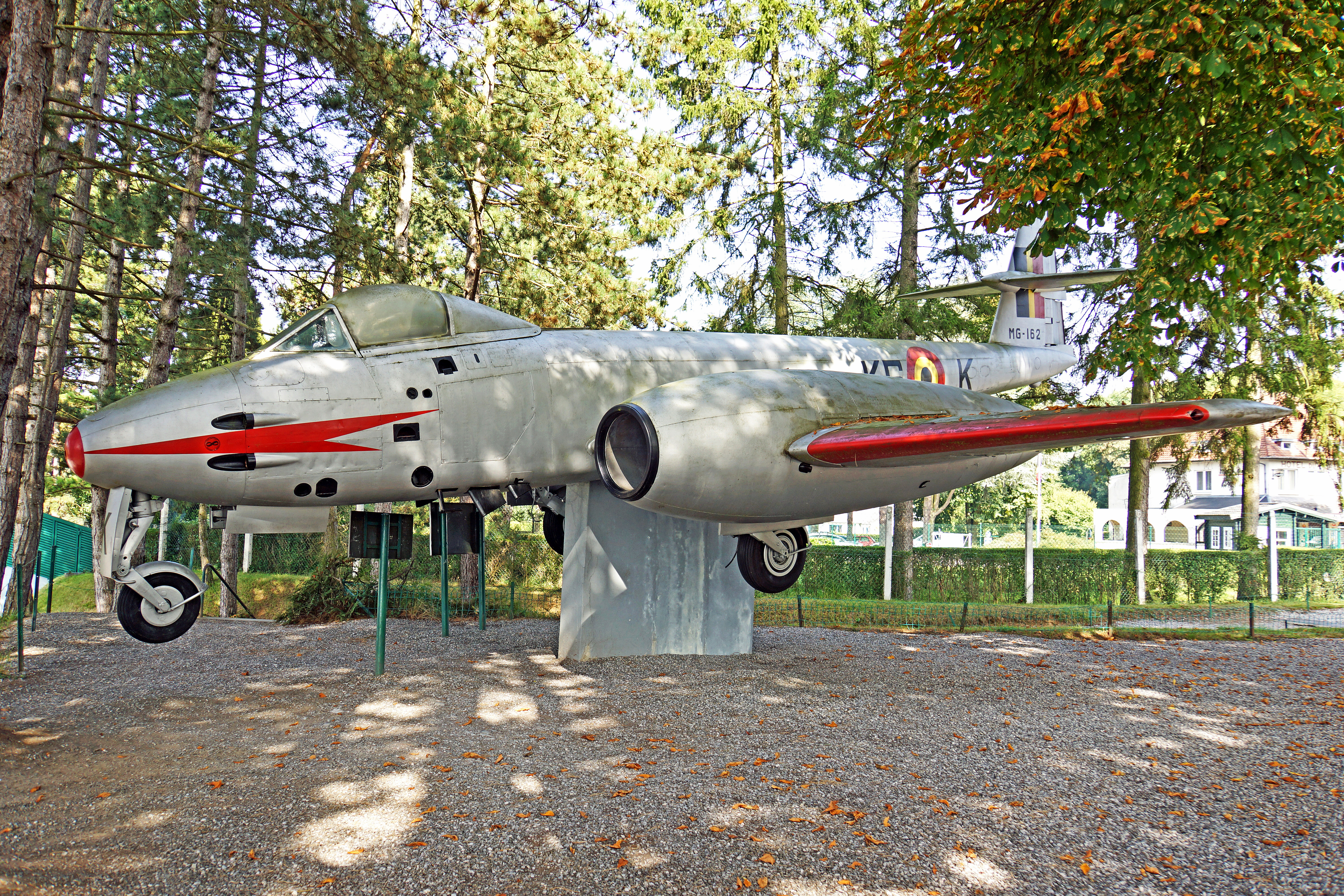
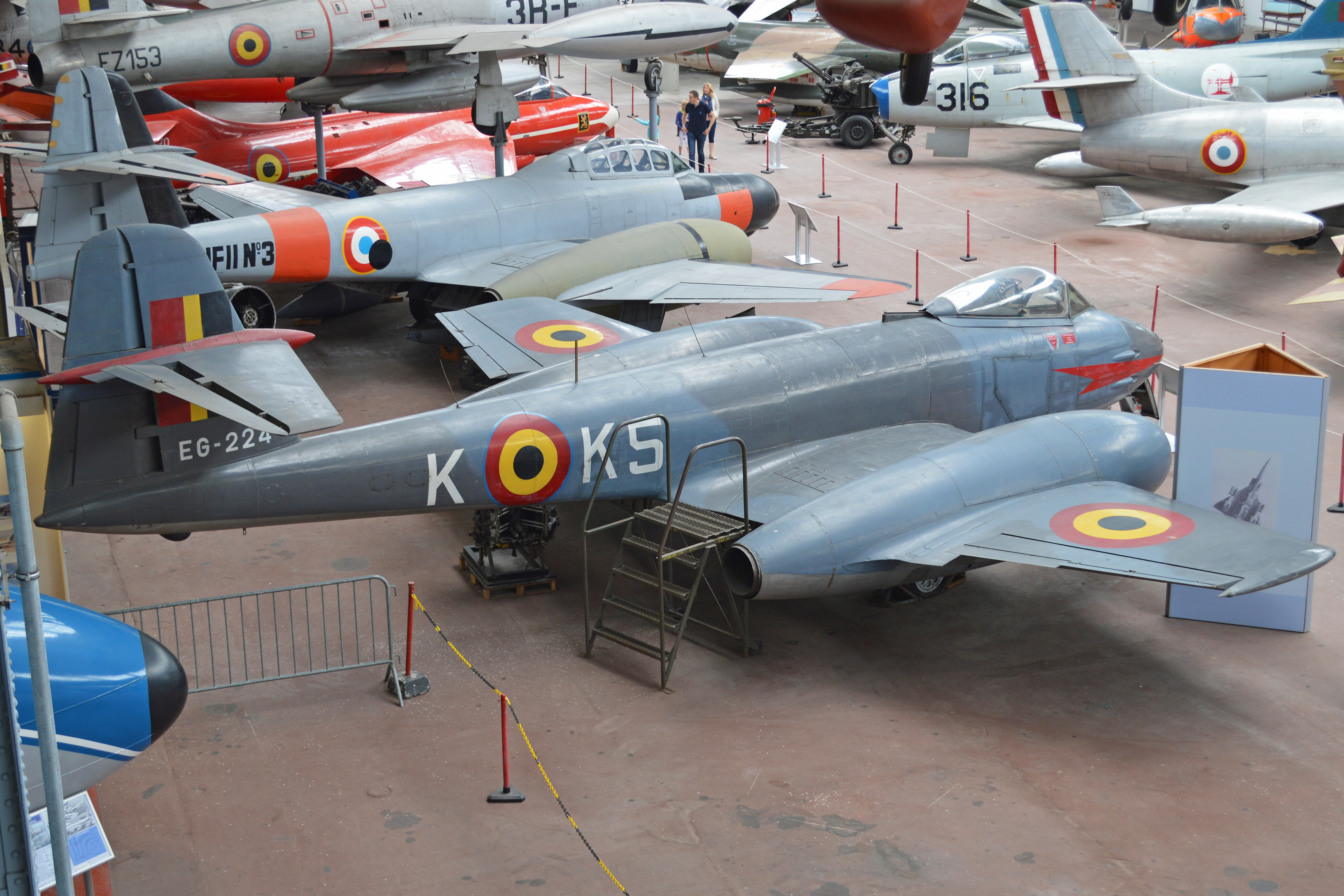
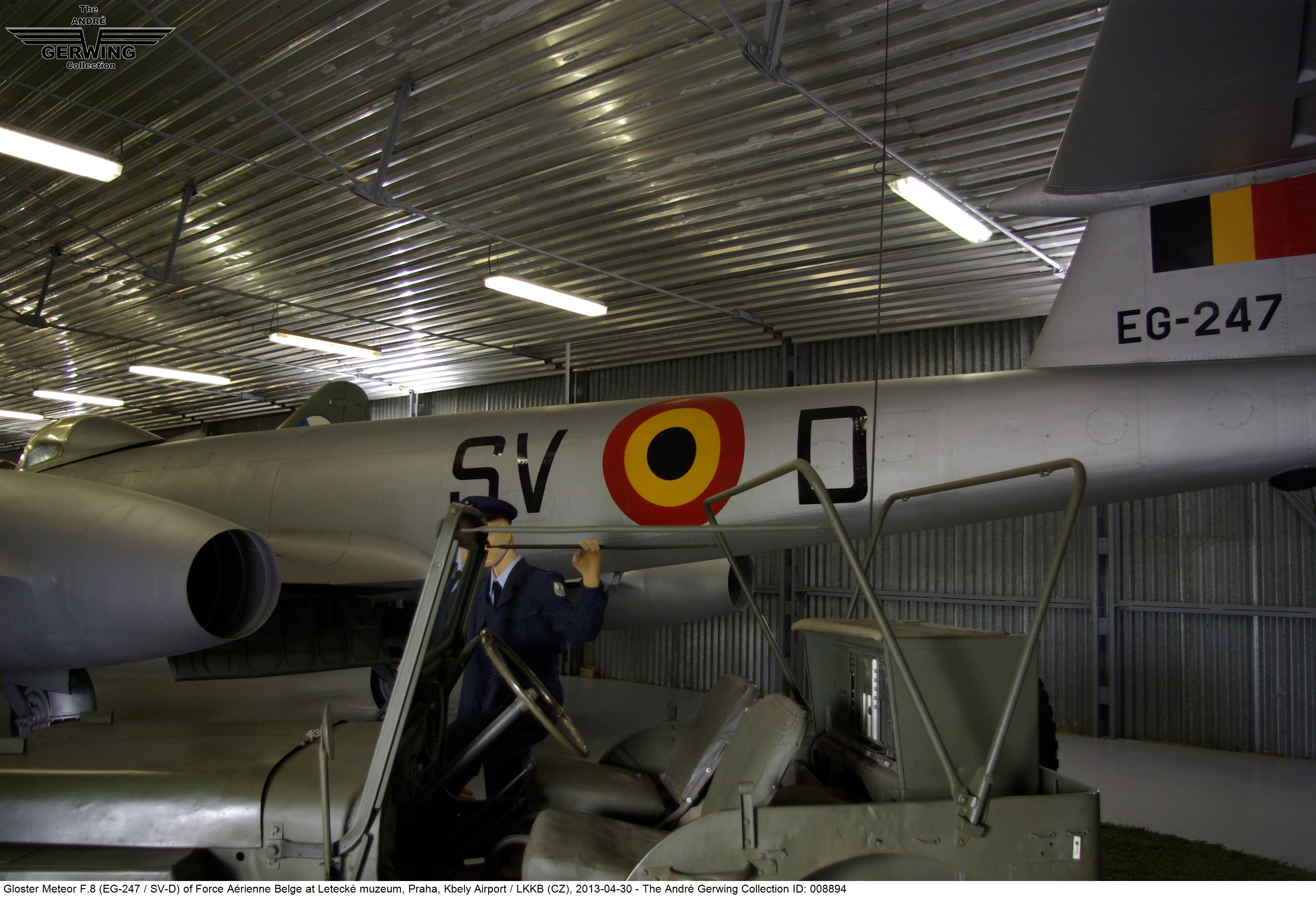
Notable preserved aircraft are displayed at institutions such as the Royal Museum of the Armed Forces and Military History in Brussels as shown in the images above.
Summary
The Gloster Meteor was far more than Belgium’s first jet fighter; it was the aircraft that ushered the Belgian Air Force into the jet age. Entering service in 1949, it transformed a force still equipped with wartime piston-engined aircraft into a modern fighter arm capable of meeting the demands of the emerging Cold War. The Meteor equipped Belgium’s first operational jet squadrons, introduced new training and maintenance procedures, and formed the backbone of the country’s contribution to NATO’s integrated air defence system.
Throughout its service career, the Meteor proved remarkably versatile. Belgian-operated F. Mk. 4s and F. Mk. 8s served as day fighters, the T. Mk. 7 became the principal jet conversion trainer, and the NF. Mk. 11 provided Belgium with its first effective all-weather interception capability. The type also saw combat during the Korean War, participated in major NATO exercises, served with the renowned Acrobobs aerobatic team, and concluded its career performing target-towing and training duties.
Although rapidly overtaken by more advanced swept-wing aircraft such as the Hawker Hunter and later the SABCA F-104G Starfighter, the Meteor’s significance cannot be measured solely by its combat performance. It established the operational experience, technical expertise, and organisational foundations upon which the modern Belgian Air Force was built. For nearly fifteen years, the Gloster Meteor was the aircraft that defined Belgian military aviation’s transition into the jet era, making it one of the most influential aircraft ever to serve in Belgian colours.
Sources and References
- Paul Debacker, La reconstruction de la force aérienne belge vue par un pilote de chasse, Le ed de l’officine, ISBN 2914614837
- Pacco, J. (2009). De vliegtuigen van de Belgische luchtmacht 1946–1962 [Les avions de la Force Aérienne Belge 1946–1962]. J.P. Publications.
- Belgian Wings. (n.d.). Gloster Meteor F.8., from https://www.belgian-wings.be/gloster-meteor-f-8-part-i
- Belgian Wings. (n.d.). Gloster Meteor F.4., from https://www.belgian-wings.be/gloster-meteor-f-4
- Belgian Wings. (n.d.). Gloster Meteor T.7., from https://www.belgian-wings.be/gloster-meteor-t-7
- Ministère de la Défense / Defensie. (2022). Aircraft of the Belgian Air Force. Belgian Air Force. ISBN 9789464517057
- Butler, P., & Buttler, T. (2006). Gloster Meteor: Britain’s celebrated first-generation jet. Midland Publishing. ISBN 9781857802306