
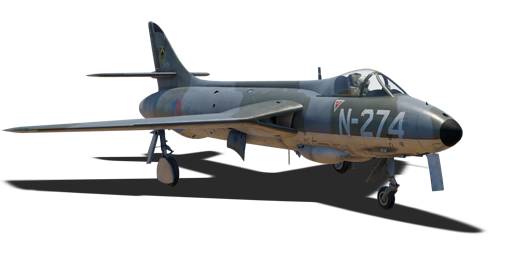
◘Hunter F.6




In 1955, the Royal Netherlands Air Force ordered Hunter aircraft from the UK to replace its outdated piston- and early-jet-powered fighters. The plan was to purchase Hunter F.4 fighter aircraft, Hunter F.6 fighter aircraft, and Hunter T.7 trainer aircraft. The Dutch company Fokker obtained a license to produce the F.4 and T.7 modifications and manufactured 117 aircraft, 20 of which were trainers. The Hunter F.6 was produced in England, and the Dutch Air Force received 93 of them. These fighters remained in service until 1968, when they were replaced by the F-104G Starfighter.
The Dutch Hunter F.6 was introduced in Update 2.37 "Seek & Destroy", as a part of the French aviation research tree. It is a fighter with powerful armament and good energy conservation. However, its maneuverability is mediocre and it is slower than supersonics. It differs from the British Hunter F.6 in that it only has AIM-9Bs as suspended weapons.

flaps
flaps
flaps
brake
| Belt | Belt filling | Armor penetration (mm) at a distance: | |||||
|---|---|---|---|---|---|---|---|
| 10 m | 100 m | 500 m | 1000 m | 1500 m | 2000 m | ||
| AP/HEI-T | 37 | 34 | 22 | 13 | 8 | 5 | |
| AP/HEI-T/AP | 37 | 34 | 22 | 13 | 8 | 5 | |
| HEF-I/HEI-T | 4 | 4 | 4 | 4 | 4 | 4 | |
| AP/HEF-I | 37 | 34 | 22 | 13 | 8 | 5 | |
| Name | Weight | Slot | ||||
|---|---|---|---|---|---|---|
| 74.4 kg |  | | ||||
| Drop tank (150 gal.) | 73 kg |  | | |||


Flight performance | |
|---|---|
Survivability |
|---|
Weaponry | |
|---|---|