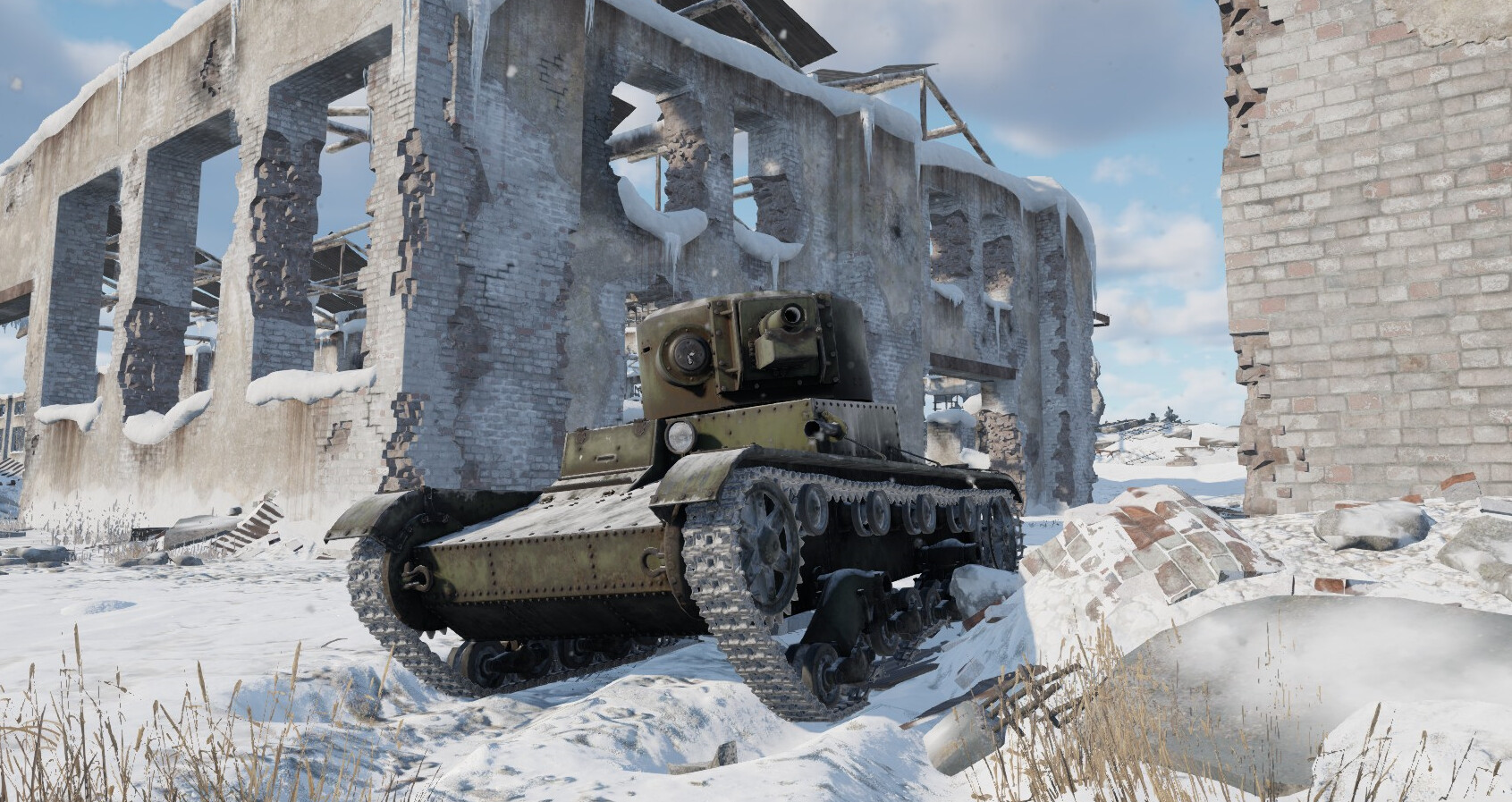
The T-26-4 was an experimental “artillery tank” designed in the interwar period by the Soviet Union. In War Thunder, this tank can be tricky to play and requires some experience. Its several weaknesses, such as thin armor and slow speed, force the player to maneuver it cautiously in battle. However, it can be fun to play once you master both its drawbacks and advantages.
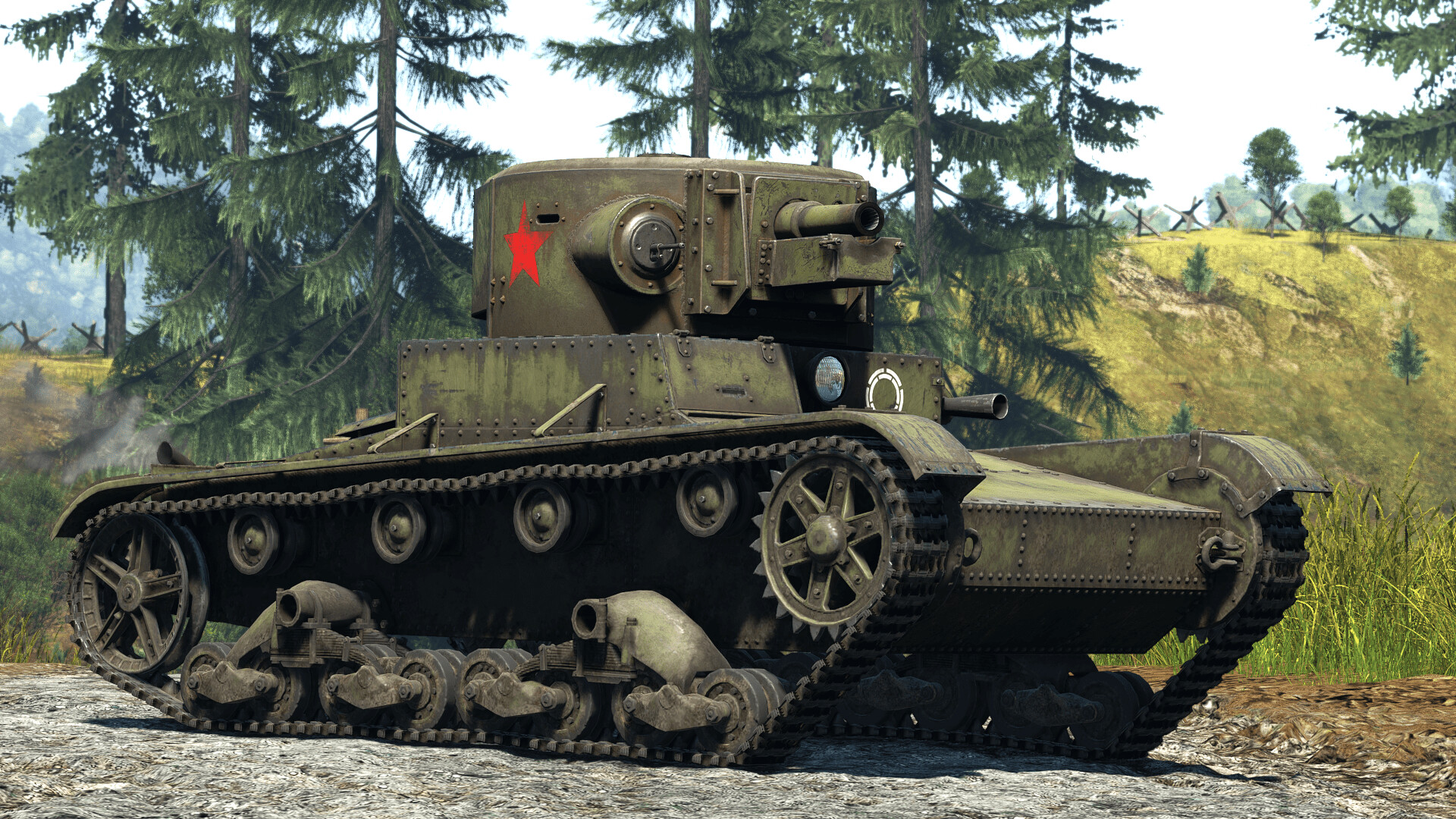
| Pros | Cons |
| High-Explosive rounds deliver a powerful blast against light targets. | The tank has poor mobility due to its weak engine. |
| The tank’s multiple machine guns allow it to strike exposed crew members, even at the back. | The thin armor is easily penetrable. |
| The tank has low shell velocity and weaker penetration compared to its contemporaries. |
Mobility
This vehicle, like many interwar Soviet light tanks, is built on the standard T-26 chassis. Its 91 HP engine and 11-ton weight provide a power-to-weight ratio of roughly 8.3 HP/t. The maximum forward speed is 30 km/h, while reverse speed reaches only 3 km/h. On rough terrain, the vehicle usually manages 15–25 km/h. Even minor steering corrections or driving over small obstacles can significantly reduce its speed. Its mobility is mediocre but still acceptable for this chassis. Players must be cautious not to overextend, as the reverse speed is extremely poor. Overall, the vehicle’s mobility stands out as one of its major drawbacks.
Armor and Survivability
Armor
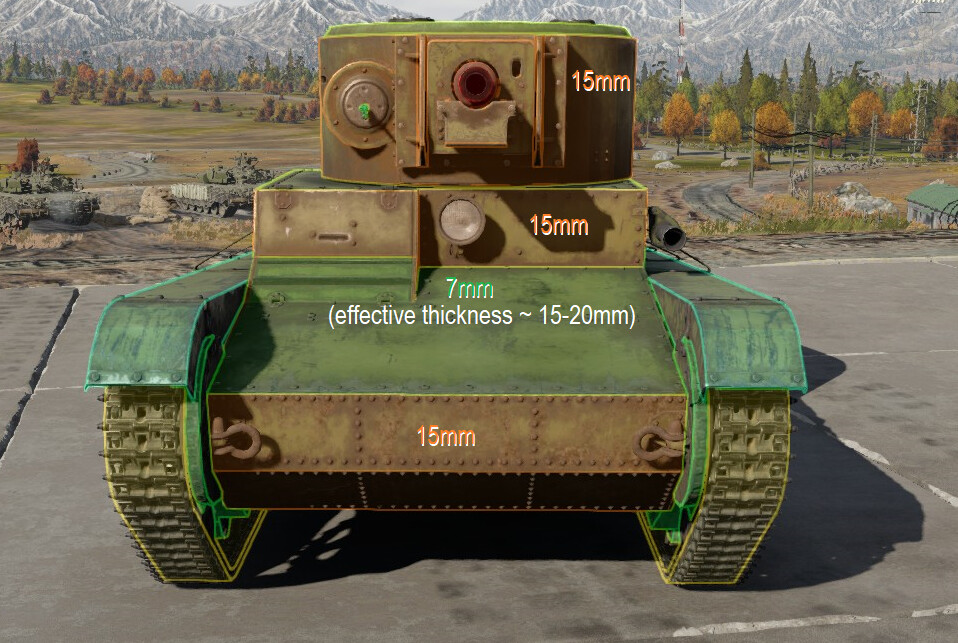
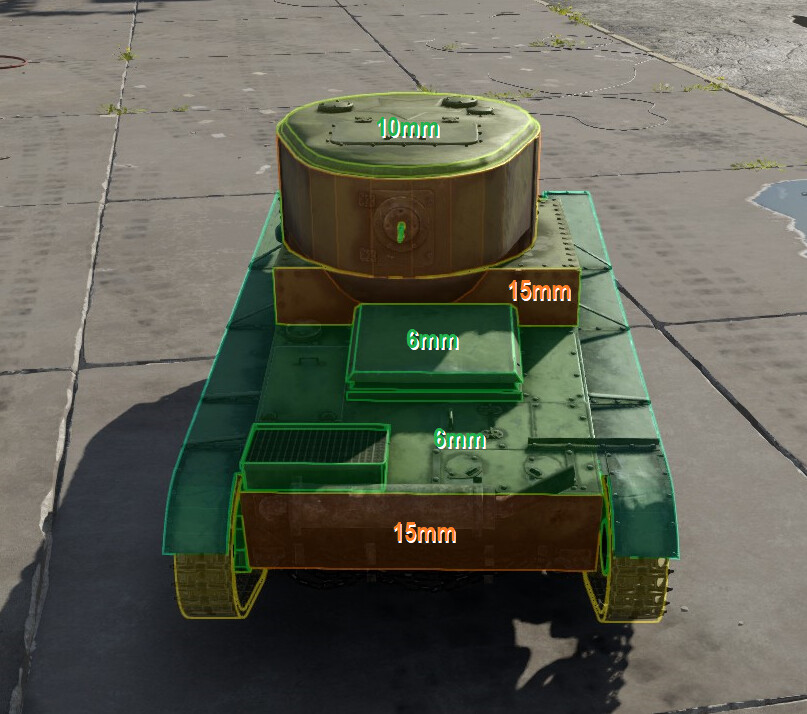
The armor of this tank is very thin and can be penetrated by almost any opponent. The sides of the turret are 15 mm thick, but the armor has a higher effective thickness due to its shape. The turret cheeks, seen from the front, can have an effective thickness of 20 to 25 mm. This is enough to stop machine guns and most SPAA armament, but can be easily penetrated by tank guns. Next, there is another 15 mm plate: the upper glacis plate. The elongated part of the left side protects the driver and is slightly sloped. However, the part on the right is vertical, making it easy to penetrate — even heavy machine guns will pass through it. Below, there is a large metal plate 7 mm thick. Because it is sloped, the effective thickness (from the perspective of an enemy gun) ranges from 15 to 20 mm. The final and lowest plate protects the transmission. It is 15 mm thick, and if penetrated, the entire transmission will likely be destroyed.
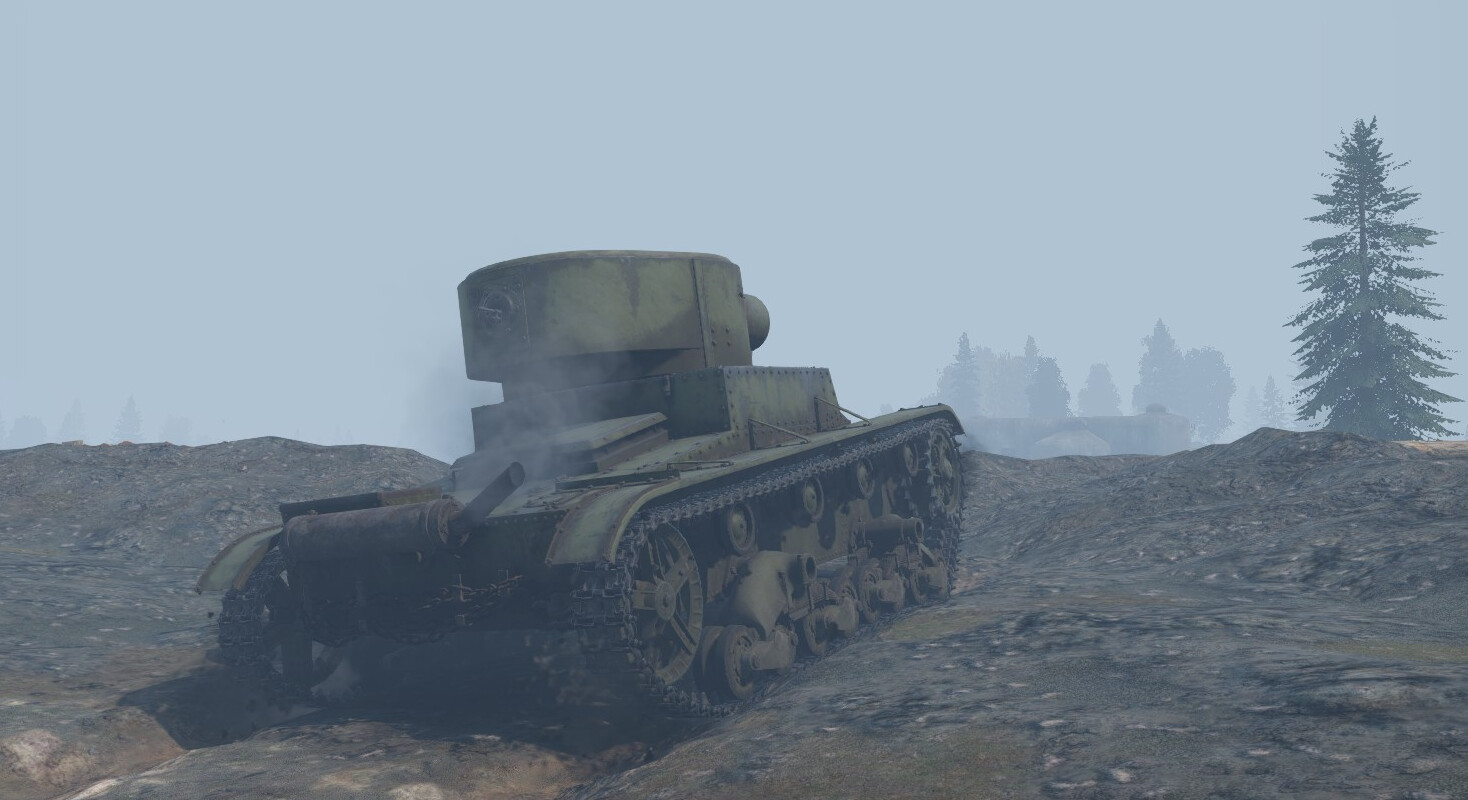
The roof has 10mm of armor, which is enough to stop normal MG fire from aircraft of its era. The plate on which the turret sits is 15mm thick, the same as at the front. The plate that protects the engine is 6mm thick, but it is almost horizontal, giving it a higher effective thickness. The lower rear plate is 15mm thick.
Survivability
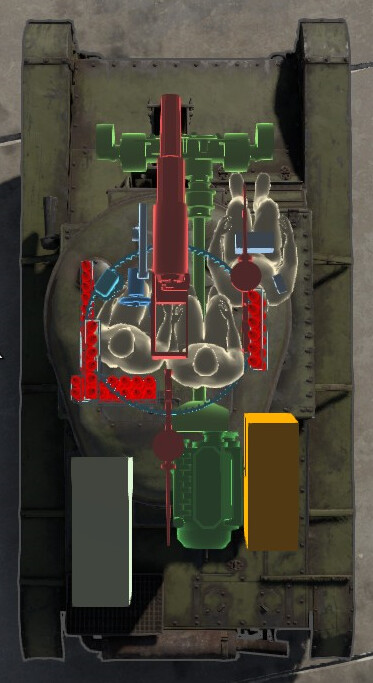
This tank has 3 crew members: a loader, a gunner and a driver. The gunner and the loader are both in the turret operating the gun. If the turret or turret platform are penetrated they are likely to be killed. Given the small crew, taking out the tankers operating the gun will result in the vehicle being knocked out. The driver (from this point of view) sits in the right side of the tank. Again, the elongated part protecting his head is not very armored, and can be penetrated by heavier machine guns in a weak spot. The sloped 7mm plate has a higher effective thickness, resulting a relatively good protection from a shot placed here. If the plate that protects the transmission is penetrated, the transmission will be destroyed, but it will absorb the shock, preventing the damage of the crew or other components.
Ammunition is stored at the bottom of the tank and on the sides of the turret. If the turret is hit from the sides, they will likely be detonated. If the enemy places a shot on the lower left zone from this view, the crew will escape, but then the round will reach the ammunition, often resulting in an explosion. Moving to the back of the tank, the player will notice the engine and two big “boxes”. The “box” on the left is the radiator, cooling the engine and preventing overheating. On the other side, there are two fuel tanks, stacked on top of each other and the engine is in the center. Due to their placement, even a normal shot from the side can destroy them in a row. Overall, it can take some shots, but the survivability isn’t very good.
Firepower
Main Armament / Secondary Armament
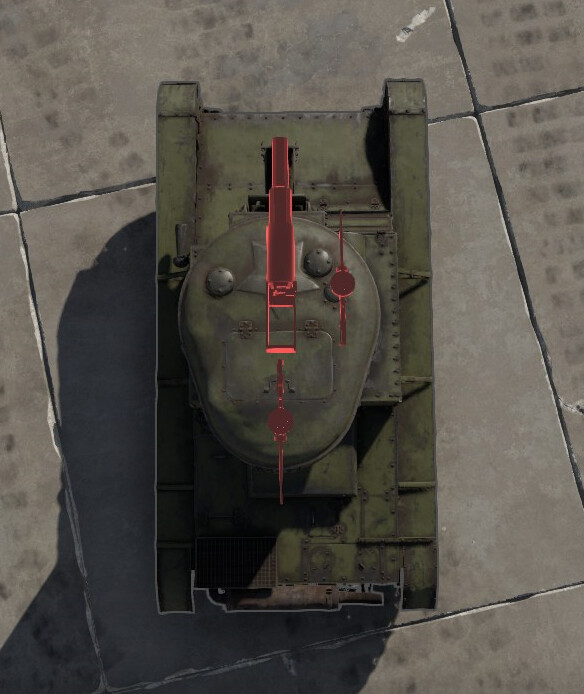
The main gun of this tank is a 76mm KT-28 cannon. The turret rotation speed is 11.2°/s for a basic crew and 16°/s for an aced crew. The gun’s vertical guidance is from -5° to 21° and the speed can be 2.8°/s for a basic crew and 4°/s for a top crew. This tank’s reload speed ranges from 5.2s for a novice crew and 4s for an experienced crew. This reload speed is acceptable, but it’s still slower than the one on the standard T-26.
Two 7.62mm DT machine guns are mounted on this tank. One in the front, next to the main gun, while the other one is in the back of the turret. They can be used either to clear obstacles like fences and roadblocks or to engage enemy vehicles that have extremely thin armor or exposed crew. Each machine gun has a total of 1890 bullets available.
Main Gun’s Ammunition
This vehicle gets access to only two types of ammunition:
- BR-350A (APHEBC) — The default round of this tank. It can penetrate 37mm of armor and has a velocity of 370 m/s. Compared to the contemporary Soviet tanks with much better penetration, this tank falls behind in terms of anti-tank capability, but it’s still enough to deal with the opponents you’ll face. This is the main type of shell used in the battle.
- OF-350M (HE) — The high explosive fragmentation shell available for this tank. This shell can penetrate only 10mm of steel, and its muzzle velocity is of 387 m/s. The explosive mass is of 710 grams, enough to knock out the enemy crews. The player should take a few of this type in case open-top vehicles are encountered.
T-26-4 can take a maximum of 50 shells, enough for the player to choose how to balance their load. However, to reduce the chances of ammo detonation, it’s recommended that you should calculate how many you want before deploying onto the battlefield and not take too many extra shells. Taking 10-20 BR-350A shells and 3-6 OF-350M shells is usually enough and balanced.
Usage in Battles
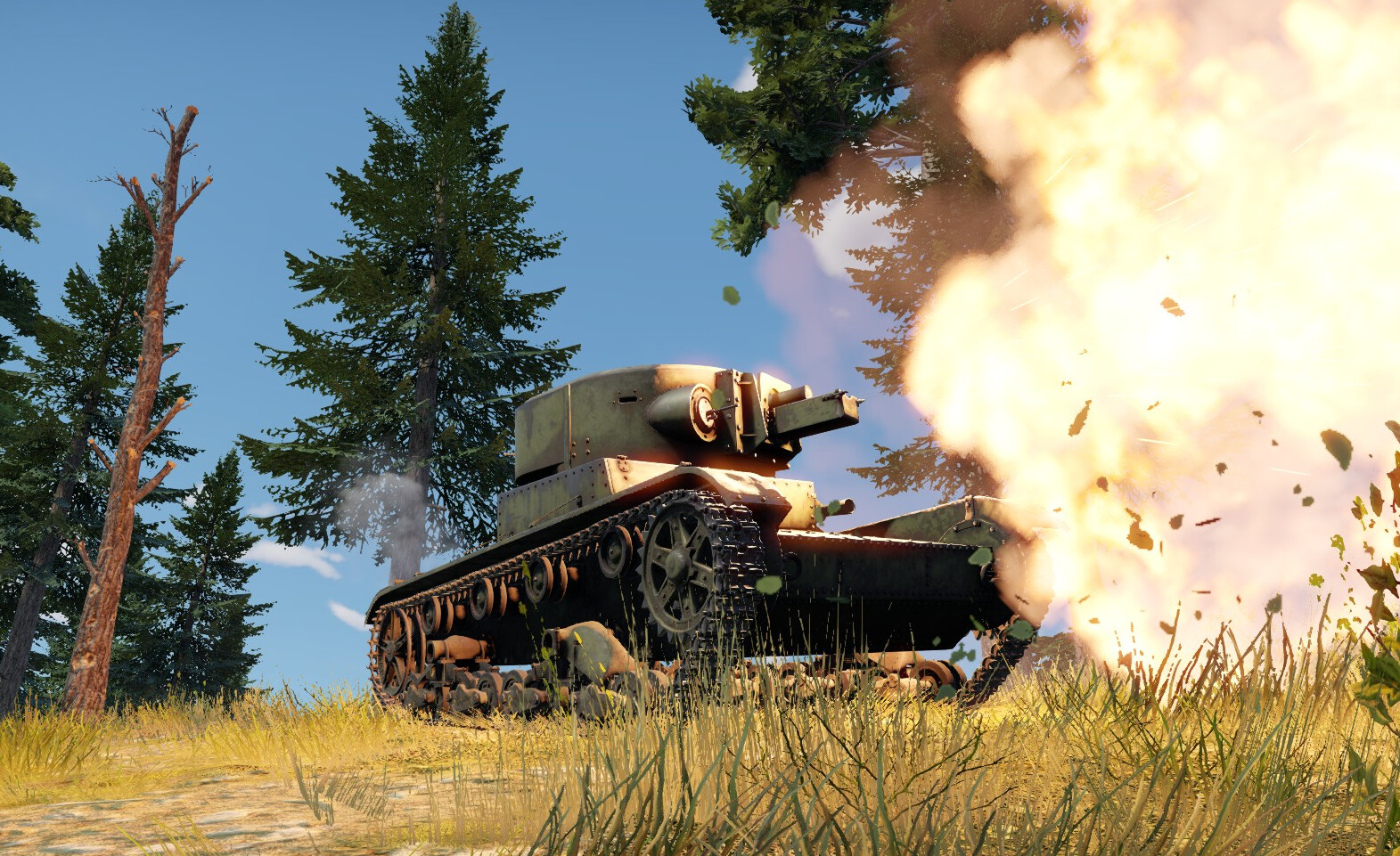
Overall, this is a weak tank, but it can still be useful on the battlefield.
One of the ways this tank can be used is to defend a point/overwatch in maps with buildings. Position the tank next to an allied zone, where it can engage enemies trying to capture it. Be careful not to expose the T-26-4 to the line of enemy fire as it can easily be destroyed due to the weak armor and small crew. You can use obstacles like berms, destroyed tanks and other objects to hide yourself.
Another approach is to snipe from a safe position. On maps, you can look for remote spots at the edge of the map that are usually not frequented by enemies. From here, you get a good view of the battlefield, enemy lines, and more. When shooting, keep in mind the low velocity — at long distances, you need to fire the shells in a high arc and aim ahead of the target if it’s moving.
If you choose to attack the enemy, your strategy should change depending on whether the map is urban or an open field. In urban maps, make sure you do not expose yourself to hidden enemies, as a single shot can send you back to the hangar. Don’t rely on your backward speed — it is extremely weak. On open fields, pay attention to enemy positions before leaving cover.
History
The first T-26 “artillery tank” appeared when an A-43 turret, developed by the self-taught inventor N. Dyrenkov, was mounted on this chassis. The Izhora Factory produced two types of turrets, each armed with a 76 mm regimental gun mod. 1927 and DT machine guns in a ball mount. Later, it was discovered that the turret was too cramped for two crew members, had a limited field of observation, and lacked any ventilation. Because of this, continuous fire was very difficult. At the beginning of 1933, a new 76 mm KT tank gun mod. 1927/32 replaced the old gun in the turret. However, ammunition stowage was inefficient, and the military rejected this version.
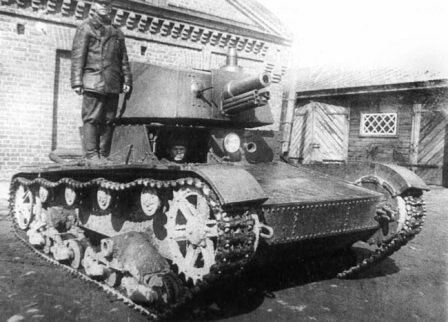
Later came the T-26-4. This version had a new turret equipped with the 76.2 mm KT tank gun mod. 1927/32 and was developed by the Bolshevik Factory during 1931 and 1932. This turret was installed on T-26 mod. 1931. Compared to the previous turret, this one was significantly larger, making it more suitable for the crew.
The T-26-4 successfully passed the tests, and five vehicles were built in 1933-1934. It was planned to equip three of the tanks with the 76.2 mm KT tank gun mod. 1927/32 and the other two with the 76.2 mm PS-3 tank gun. However, it was found that the PS-3 was too powerful for the T-26 light chassis—the turret ring and hull roof were deformed during firing, and the suspension was also damaged. As a result, it was decided to arm all the vehicles with the KT gun. These tanks were tested near Leningrad before the planned production of 50 such vehicles in 1935.
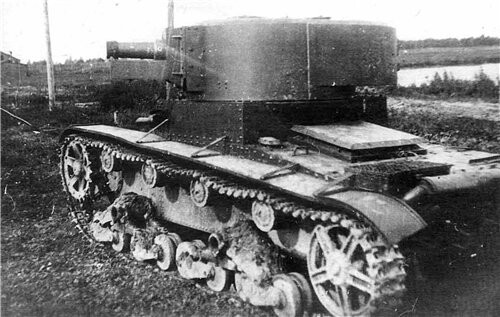
Unfortunately, on 19 September 1934, an incident marked the end of development: a shell caused a blow-back, damaging the internal parts of the tank. The military representatives canceled the production of this tank, even though the incident was not related to the turret design. However, this turret was still used for the BT-7A “artillery tank”. Overall, it was an interesting project, showing how the Soviet Union experimented with various prototypes.