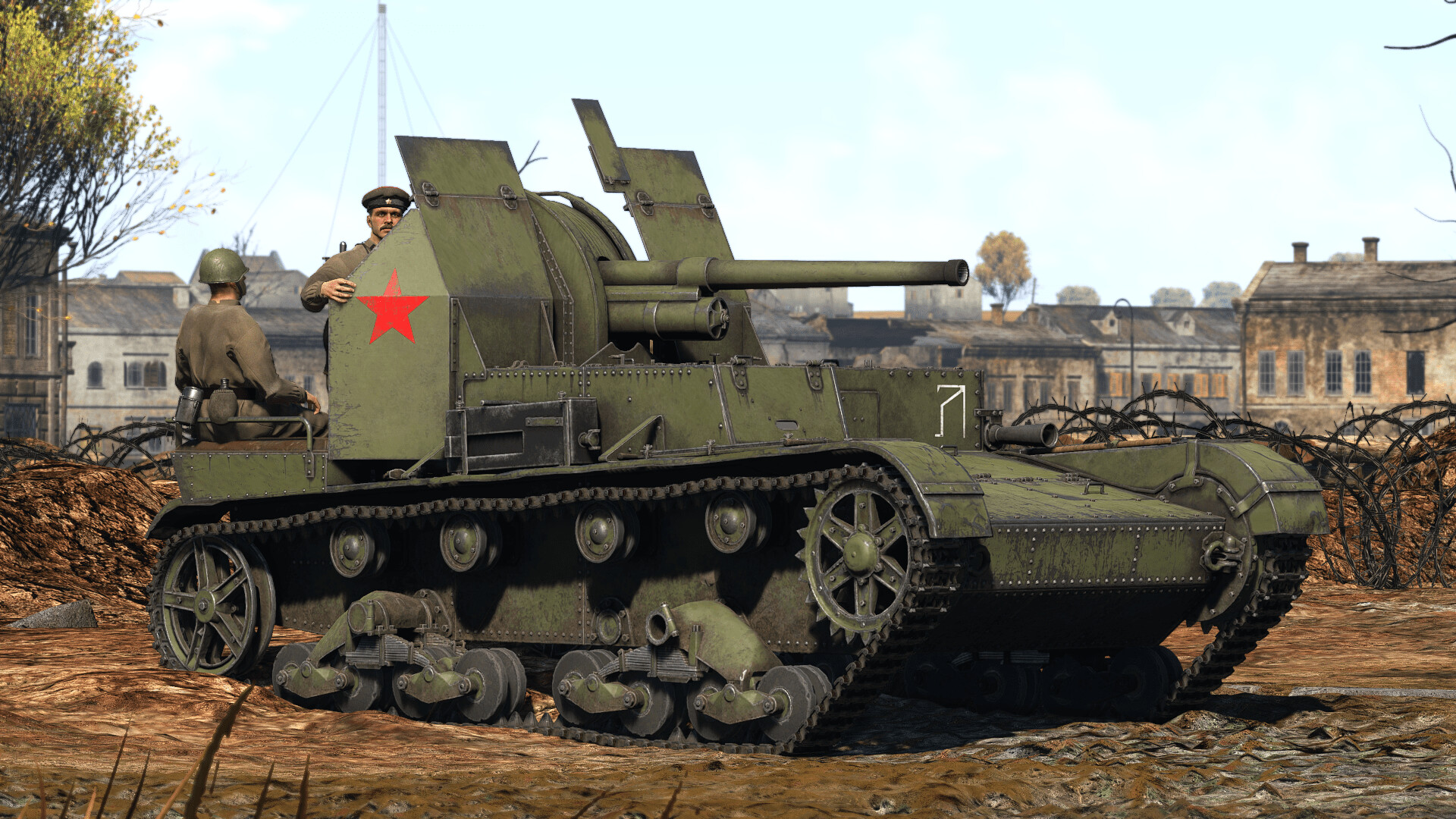
The SU-5-1 is an experimental Soviet tank destroyer. Even though it doesn’t have the best mobility, this tank has formidable firepower. Despite its limitations, the SU-5-1 offers a unique combat experience that every War Thunder player should try at least once.
| Pros | Cons |
| Most enemies can be easily destroyed thanks to the powerful 76 mm gun. | From the rear, the crew is completely exposed. |
| Fast reload for a tank destroyer. | A very limited ammunition capacity — only a few shells can be carried. |
| Forward speed is acceptable for its class. | Reverse speed is painfully slow. |
Mobility
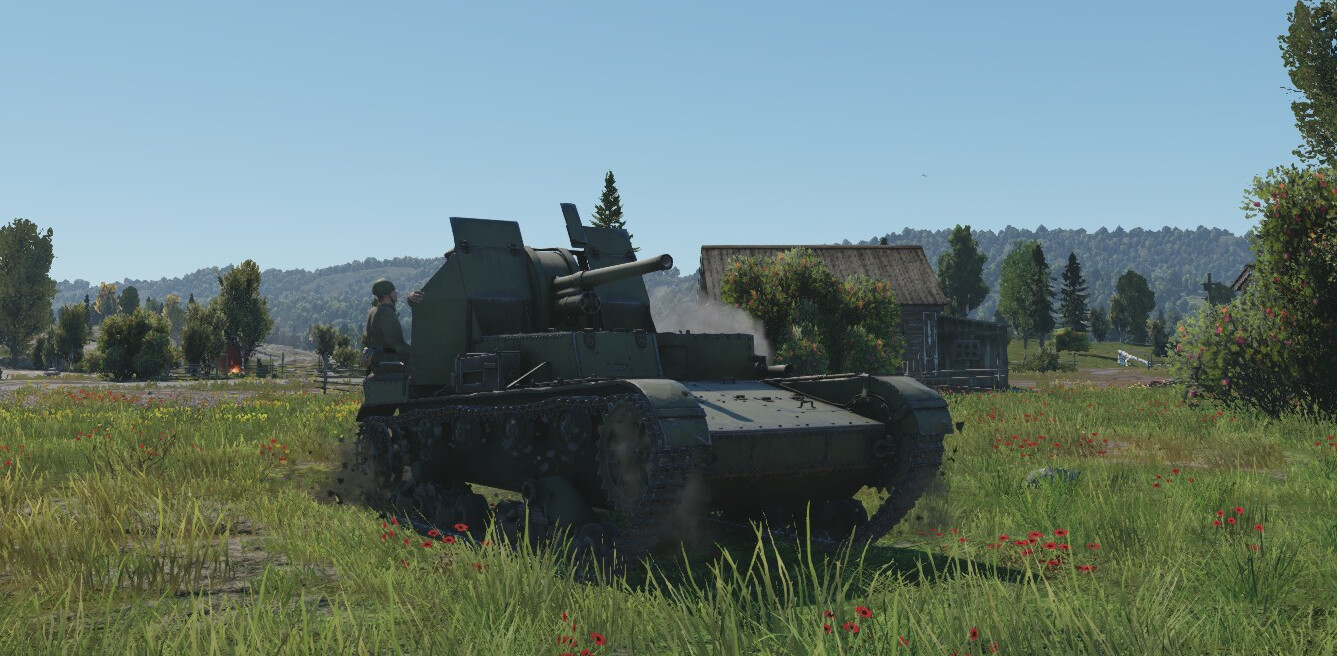
This vehicle is based on a T-26 chassis and weighs 10 tons. With an engine producing only 90 HP, the mobility of this tank destroyer is mediocre. Its maximum forward speed is 30 km/h. On rough terrain, you can still reach that speed, but only if you drive in a straight line. However, its reverse speed is only 3 km/h, making emergency retreats extremely slow. The SU-5-1 struggles on steep hills, often dropping to 3–6 km/h. The engine is located in the middle of the vehicle near the radiator, making it an easy target. The tank features a front-mounted transmission, providing extra protection for the driver.
Armor and Survivability
Armor
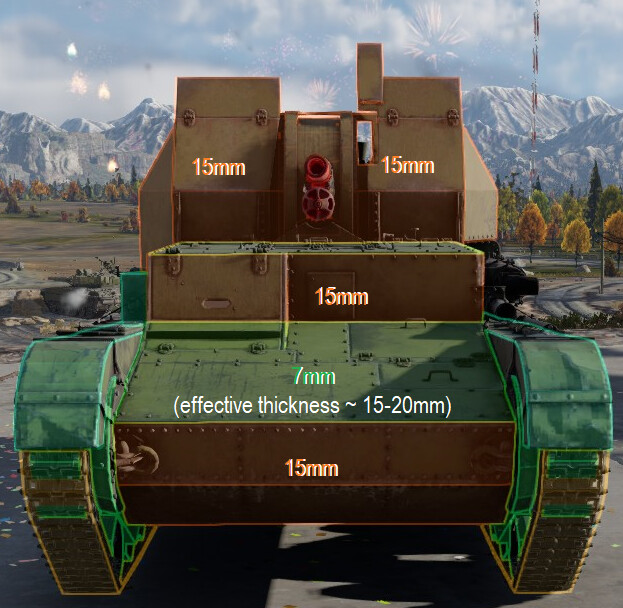
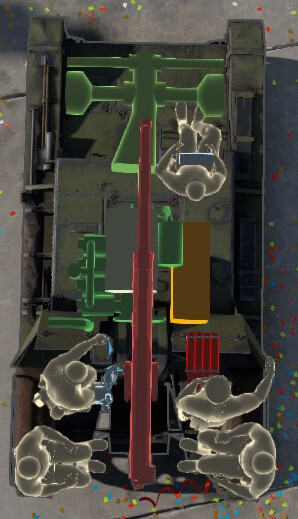
Every vehicle equipped with a tank gun can penetrate the front armor of this SPG. Moreover, heavier machine guns can penetrate the gunshield at close range. The crew operating the gun is protected by two plates of armor. The next 15 mm armor layer protects the radiator and the driver. If the radiator is hit, the shell will detonate, often damaging both the driver and the engine. Below that is a 7 mm armor plate. Because it’s sloped, the effective thickness is about 15–20 mm (from the perspective of a tank gun at normal height). This plate protects the driver on the left and the engine and transmission on the right. The final 15 mm plate protects only the transmission. Any hit here will completely destroy the transmission, but it will absorb most of the impact. Unfortunately, having the engine and driver fine won’t help if the transmission is busted. The sides are protected by just 15 mm of armor, and in the back, the crew is completely exposed.
Survivability
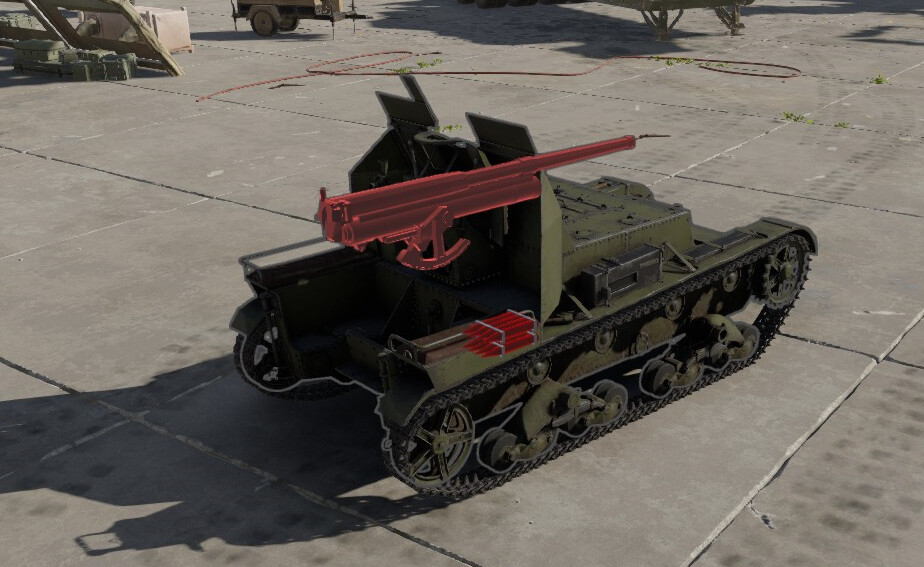
The tank’s luck lies in the crew placement: the crew operating the gun are put at the edges of the tank; because most inexperienced players shoot for the center, this tank has a better chance to survive. However, some shells will penetrate the armor, then explode and incapacitate or wound most of the crew. As for HE shells, there’s no need to even mention them because one hit can instantly wipe out the entire crew. On the right side are the commander and one loader; on the left are the gunner and the other loader. The driver sits at the left-front of the vehicle; while he is partially protected by the transmission, the 15 mm armor does not shield him well. For side attacks from the left, the engine and radiator can provide some cover. The engine, radiator and fuel tank are arranged in a row and can be destroyed by a normal side shot. Ammo is the least likely cause of incapacitation: there are only eight shells in the small wooden drawer next to the commander. If the tank is attacked from behind, you’re already dead in most cases — take out the four gun crew and you’re back to the hangar. The SU-5-1 is also a fighter’s treat — just a few MG bursts and you’re gone.
Firepower
Gun
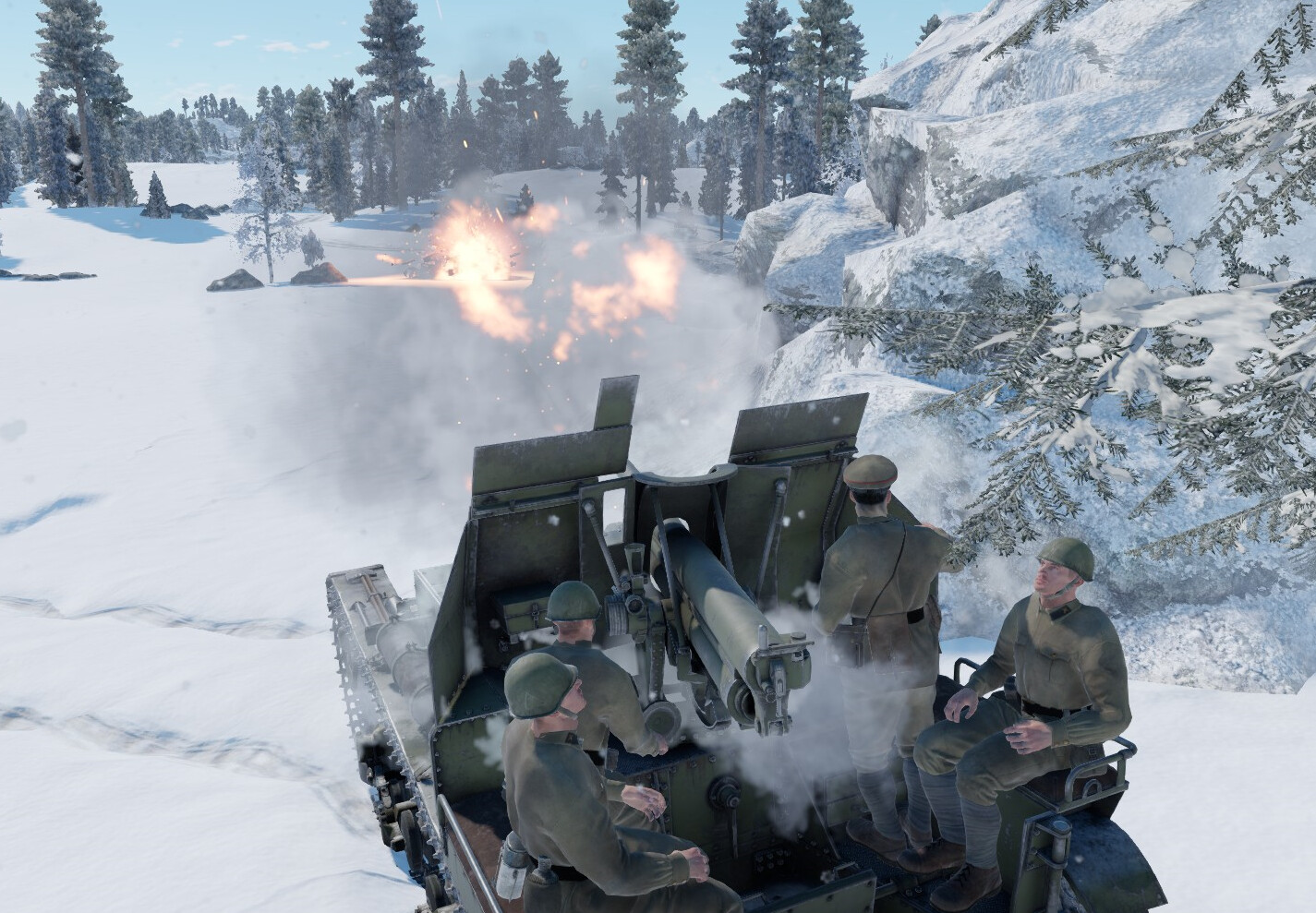
The SU-5-1 is armed with a 76 mm 1902/30 cannon, capable of penetrating most opponents. Its horizontal traverse is ±15°, which is acceptable for a tank without a turret. The vertical elevation ranges from -5° to +60°, allowing the gun to be raised almost vertically, while its depression is limited. This design reflects its original role as a self-propelled artillery vehicle intended for long-range fire. The horizontal traverse speed is 5.6°/s, and the vertical elevation speed is 2.8°/s. The reload time is 5.6 seconds with a standard crew and 4.3 seconds with an elite crew — a respectable rate for a tank destroyer.
Ammunition
This tank has access to 3 types of shells:
- BR-350A (APHEBC) — the SU-5-1’s default round. It can penetrate 85 mm of armor, enough to deal with its contemporary opponents. With a muzzle velocity of 662 m/s, you rarely need to aim high over the target, even at longer ranges. The shell also has a solid bursting charge, offering a good balance between penetration and explosive effect — an ideal all‑round choice for this vehicle.
- BR-250SP (APBC) — This shell offers improved penetration (96 mm), but it delivers relatively little post-penetration damage. Its muzzle velocity is 655 m/s, nearly identical to the default round. Equip this shell for uptiers, where you’re likely to encounter thicker armor.
- OF-350M (HE) — The SU-5-1’s high‑explosive shell is of limited use. It has a velocity of 680m/s and can penetrate 12mm of armor. Given the vehicle’s small maximum ammunition count and the fact that open‑topped targets are relatively uncommon at this rank, this round rarely proves worthwhile.
One of the biggest problems with this tank is its limited ammunition capacity. While some tanks at this rank can carry hundreds of rounds, the SU-5-1 can only equip 8 shells. This means you need to carefully plan which rounds to bring before the battle starts.
Usage in Battles
Ground Realistic Battles
For this tank destroyer, one of the most effective ways to play it is overwatch. The player should position the tank in a hidden spot with good visibility over advancing enemy terrain. From there, the tank can engage any target that comes into view. Due to the limited ammunition, choosing the right shells is vital: most should be BR-350A, a few BR-250SP if you are facing higher-tier opponents, and optionally 1 HE for open-topped vehicles.
Firing from behind a hill can be risky due to the tank’s weak armor and slow reverse speed. Likewise, advancing alone into open enemy territory without cover is not advisable, as the SU-5-1 has low speed and fragile armor. Also, watch out for SPAAs — self-propelled anti-aircraft guns are extremely dangerous for the SU-5-1. A few bursts from their guns can easily destroy your crew or damage key components, leaving you helpless. Always keep cover and avoid exposing yourself to their line of fire, especially when repositioning or firing from open terrain.
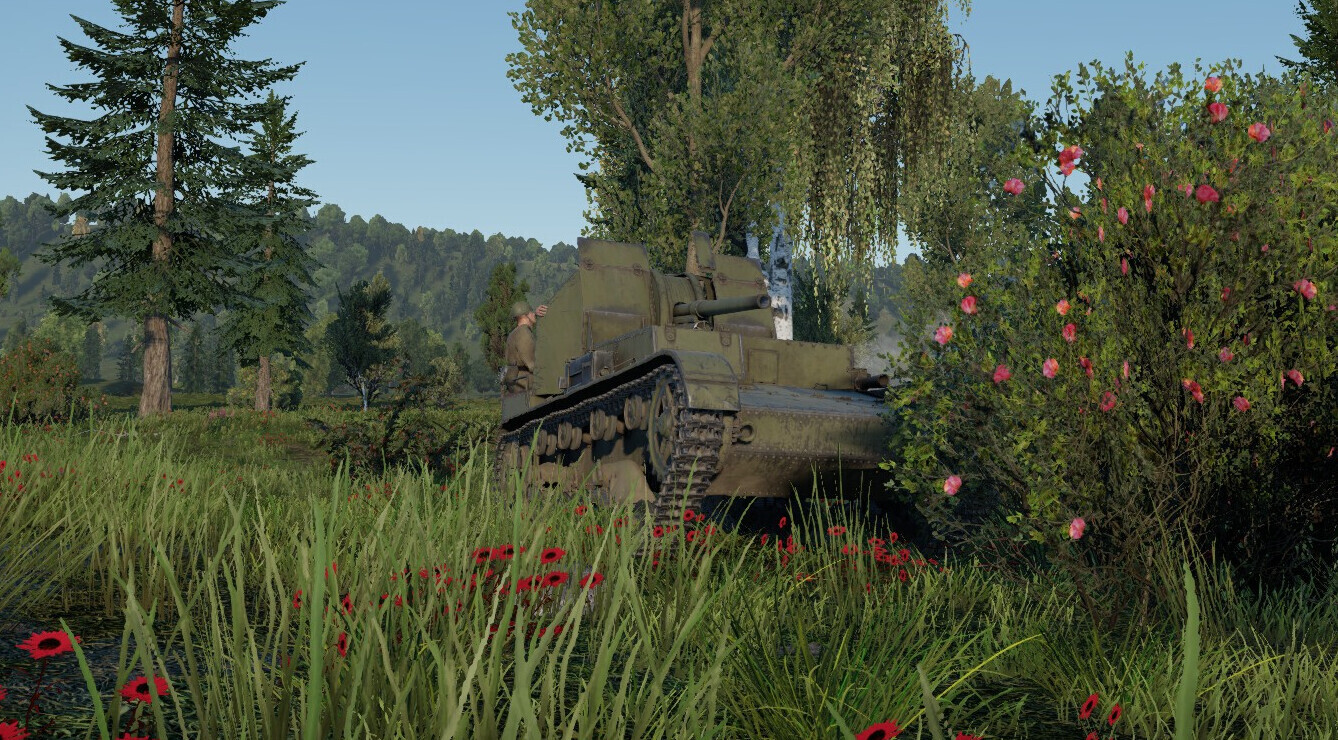
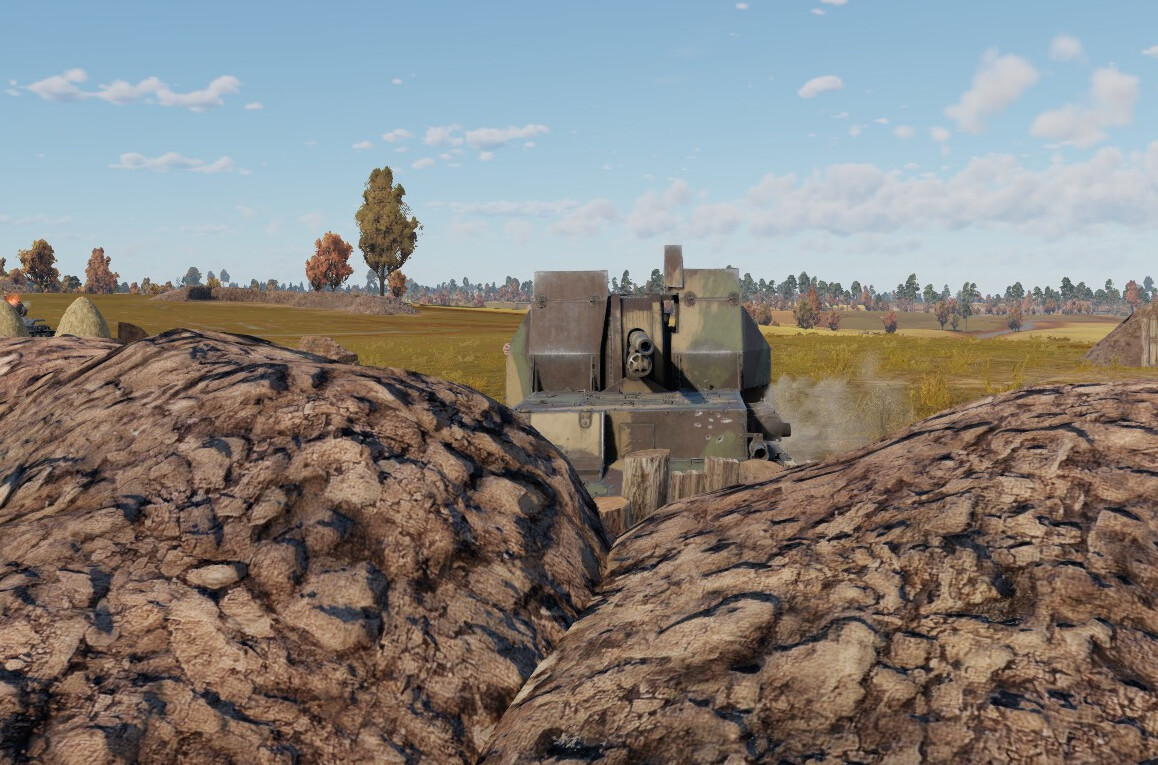
This vehicle is poorly suited for close‑range engagements. It performs best when positioned in a concealed location such as behind a building, a wrecked tank, or a mound of debris — and used as an ambush platform. From a hidden spot, you can engage enemy vehicles as soon as they enter your line of sight, often before they even notice your presence. If advancing into contested areas becomes necessary, proceed with extreme caution. The vehicle struggles to track and fire accurately at fast, lightly armored targets like the Csaba or AB 41, making aggressive pushes highly risky.
The SU-5-1 can also be used effectively for sniping. Place the tank on elevated positions whenever possible, where it is less likely to be spotted by enemies. From these locations, you can engage targets without being noticed. On common maps, certain areas provide better sniping opportunities. Green circles indicate the most effective sniping positions. Choosing the right location can significantly improve your survivability and damage output.
Ash River
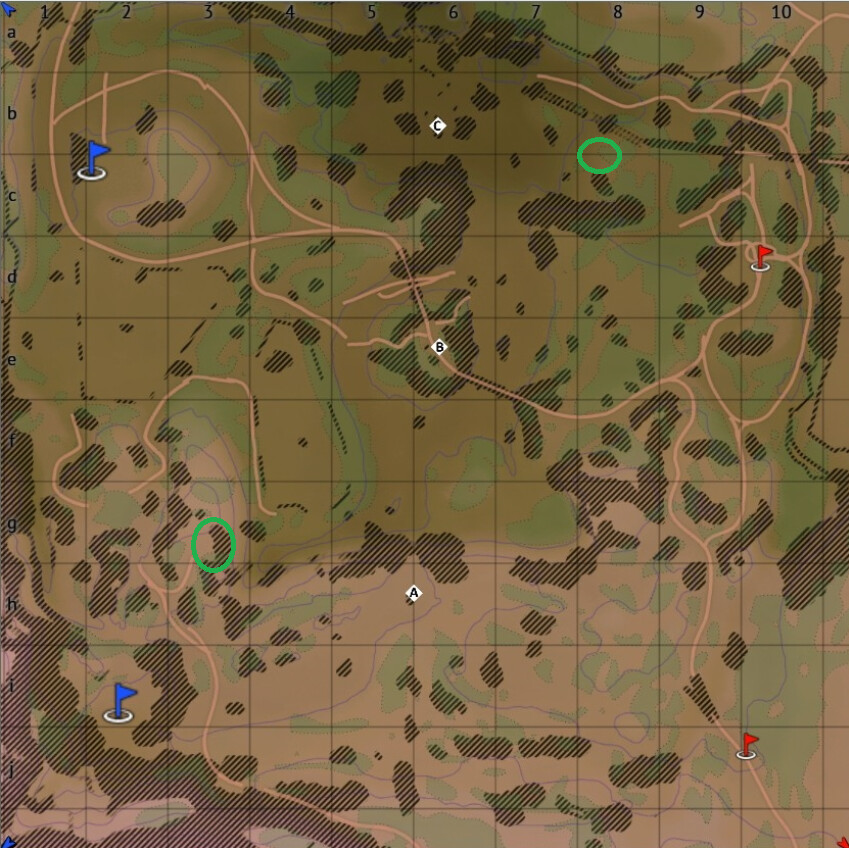
This is an excellent sniping map. From the lower green circle, you have a clear view of point B, the bridge, and its surroundings, allowing you to even target inside the point. Most enemies at this rank are unlikely to notice your position. You can also eliminate anyone attempting to cross the bridge. If you move toward point A, you remain on the edge and can engage enemies, but you become more exposed. On the opposite side of the map, positions are generally less favorable. Point C is located in a depression, allowing you to snipe and defend it from the edge.
Karelia
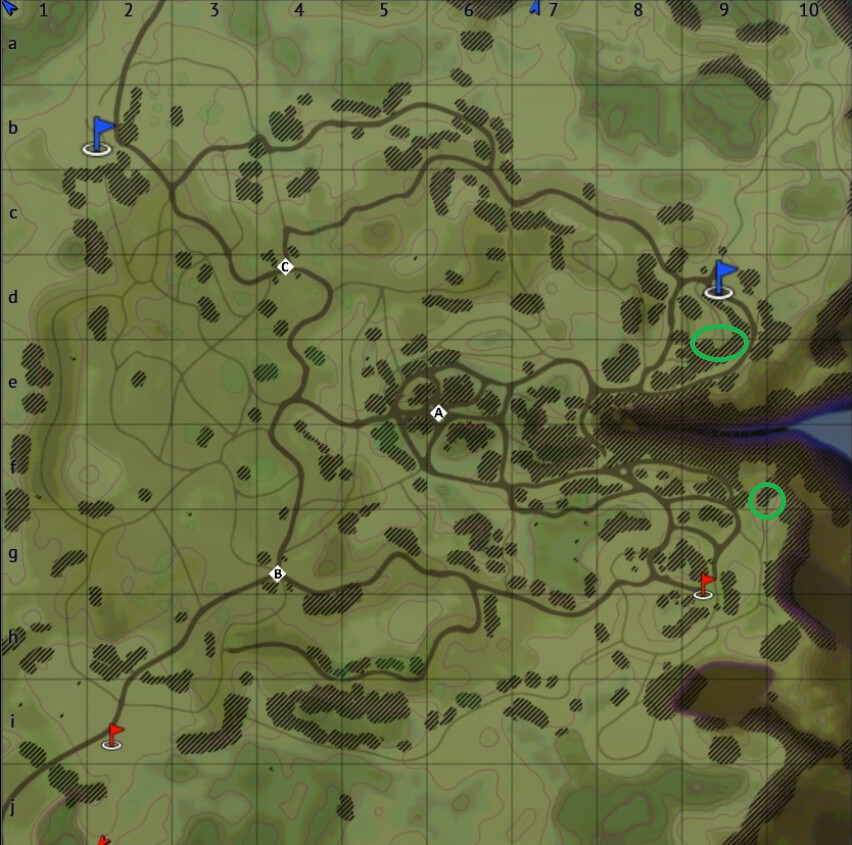
Another map suitable for sniping. If you are on the lower team (from this view), you can advance up the hill. From this position, you can engage any vehicle attempting to cross the road around the depression. Be careful not to expose yourself, as the SU-5-1 has very slow reverse speed. On the opposite side, you still have a good sniping opportunity from the upper green circle. From there, you can target any vehicle leaving the enemy spawn in that direction. Regardless of which side you are on, always be aware of enemy sniping positions. Rocks along the road next to the canyon provide poor sniping options due to the tank’s limited mobility.
Every map has its own sniping positions; however, these two are among the most effective for the SU‑5‑1.
Assault. Ground Arcade
This vehicle also fits perfectly in Assault mode. In this case, you should take only APHEBC and APBC shells. The first ones are best for normal vehicles, but if you encounter armored enemies, keep the APBC shells ready. Another big problem here is the limited 8 shells. Because of that, you should sit on the point if enemies are in your sight to take new shells constantly. In this mode, you don’t have to choose — you need to snipe. Considering that enemies are AI-controlled, hiding options are not effective. Position the tank at the back of the berms and try to destroy as many enemies as you can. Don’t waste any shell, and try to one-shot kill all the enemies. Also make sure you are not exposed to the wave behind you, because you could be machine-gunned.
History
In 1934, the Soviet Union launched the “Small Triplex” project, aimed at creating a series of self-propelled guns based on the T‑26 light tank chassis. The turret was removed and the chassis was extensively modified, including relocating the engine to the center of the hull and redesigning the layout to accommodate a rear fighting compartment. The project reflected the Red Army’s growing emphasis on mobile artillery capable of supporting mechanized formations, providing firepower that could keep pace with tanks and enhance operational flexibility on the battlefield. The Small Triplex program marked an important early step in Soviet experimentation with self-propelled artillery and mechanized fire support.
SU-5-1
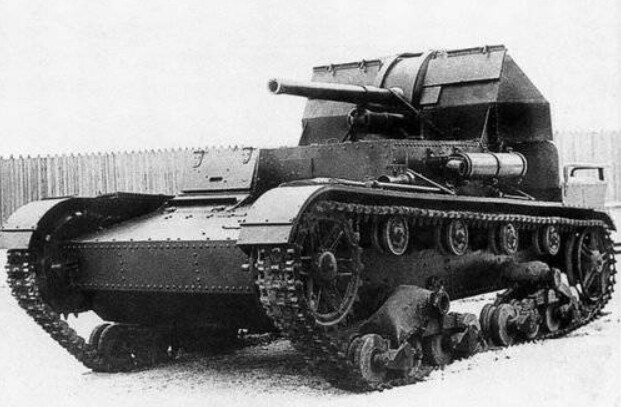
The SU‑5‑1 was armed with a 76.2 mm divisional gun M1902/30 with a barrel length of 30 calibers. The gun fired projectiles at an initial velocity of 338 m/s. Its vertical elevation ranged from –5° to +60°, while the horizontal traverse covered 30° without rotating the vehicle itself. The crew aimed the gun using a telescopic sight along with a Hertz panoramic sight. At an elevation of 40°, the weapon could reach a maximum distance of 8,760 meters. It could fire up to 12 rounds per minute, and shooting was performed from a stationary position without additional stabilizing devices, with the loader positioned low in the fighting compartment. The vehicle carried 8 rounds of ammunition on board for immediate use.
SU-5-2
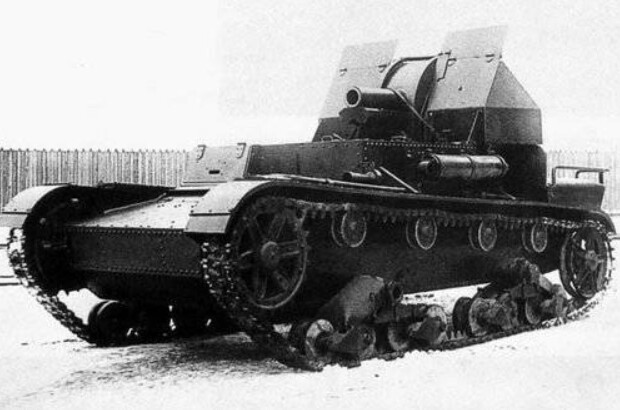
The SU‑5‑2 was equipped with a 122 mm howitzer Model 1910/30, featuring a 12.8‑caliber barrel and a redesigned cradle. The gun fired projectiles at an initial velocity of 335.3 m/s. Its elevation range extended from 0° to +60°, while the horizontal traverse covered 30° without turning the vehicle. Targeting was performed using a telescopic sight together with a Hertz panoramic sight. The maximum firing range reached 7,680 meters. Thanks to its piston breech, the weapon maintained a practical rate of fire of 5–6 rounds per minute. The vehicle fired from a stationary position without the use of additional ground anchors. The ammunition load included 4 shells and 6 separate propellant charges.
SU-5-3

The SU‑5‑3 carried a 152.4 mm divisional mortar Model 1931, fitted with a barrel measuring 9.3 calibers in length. Its projectiles left the barrel at an initial speed of 250 m/s. The mortar could be elevated between 0° and +72°, while horizontal traverse was limited to 12° without rotating the vehicle. Aiming was performed using a Hertz panoramic sight. The weapon had a maximum range of 5,285 meters. Thanks to its wedge‑type breech, the firing rate reached 4–5 rounds per minute at elevations up to 30°, dropping to 1–1.5 rounds per minute at higher angles. The vehicle carried 4 complete rounds of ammunition. During firing, two ground spades mounted at the rear of the vehicle were deployed for additional stability.
Despite successful testing and a clear demonstration of the potential of mobile artillery, only the SU-5-2 ultimately entered full production. Thirty SU-5-2 units were built in 1936, but the Red Army soon shifted its attention to other designs, such as the AT-1 artillery tank and more capable self-propelled guns that better met evolving tactical requirements. Problems such as limited firepower, the restricted capacity of the T-26 chassis, and changing doctrinal needs contributed to the decision to discontinue the SU-5 program.
Even so, the SU-5 project played an important role in Soviet armored development. It provided valuable experience in integrating artillery systems onto tracked platforms and laid the groundwork for the more advanced self-propelled guns that would appear later.