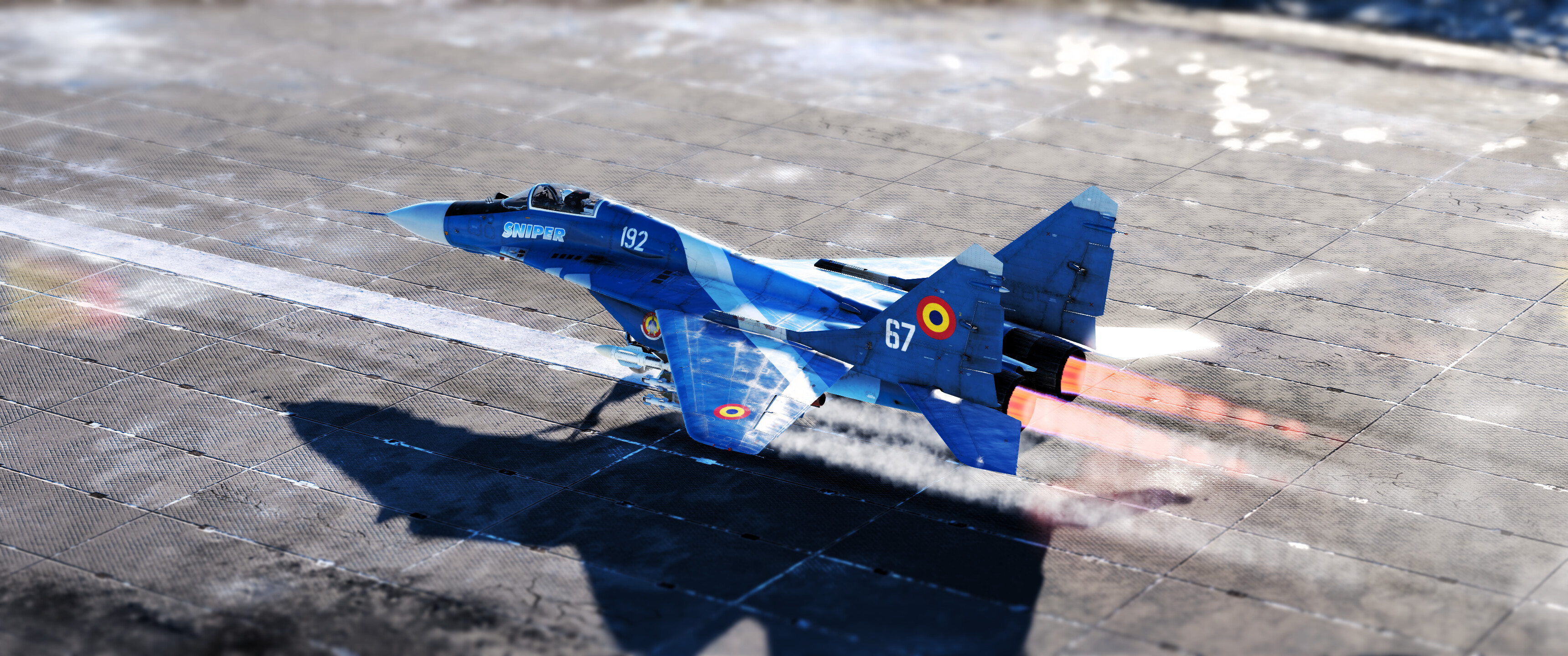
The Romanian MiG-29 Sniper was a cancelled program to upgrade Romania’s fleet of MiG-29 Fulcrum aircraft with modern Western technology. These upgrades include the addition of a digital radar warning receiver and a modernized cockpit with colored MFDs and a western-style HUD. In the skies, the Sniper performs like its Soviet, Hungarian, and German counterparts, but it has the added advantage of being equipped with more modern avionics.
| Pros | Cons |
|---|---|
| Has the new Elisra SPS-20(V) RWR instead of the regular SPO-15 | R-60MK missiles have poor range and flare resistance |
| R-27ER1 missiles are extremely potent and great for missile jousting | Can be outmaneuvered by all 4th-Gen NATO jets and bleeds energy in turns |
| Quick acceleration and high top speed | Engines consume fuel very quick |
| Pilot has an HMD to guide radar and R-60Ms | Radar is finicky and can fail to lock onto targets |
Flight performance
The MiG-29 Sniper does not have the best agility or dogfighting capability, but it makes up for it with its excellent acceleration and top speed.
Engines
Two Klimov RD-33 turbofan engines power the Sniper, with each engine producing 6,820 kg/f of thrust when on full afterburner. Thanks to these engines, the Sniper has excellent acceleration and can reach speeds over 1,450 km/h. The Sniper can handily outrun most planes at altitude and on the deck, but be wary not to exceed the rip speed (1,575 km/h).
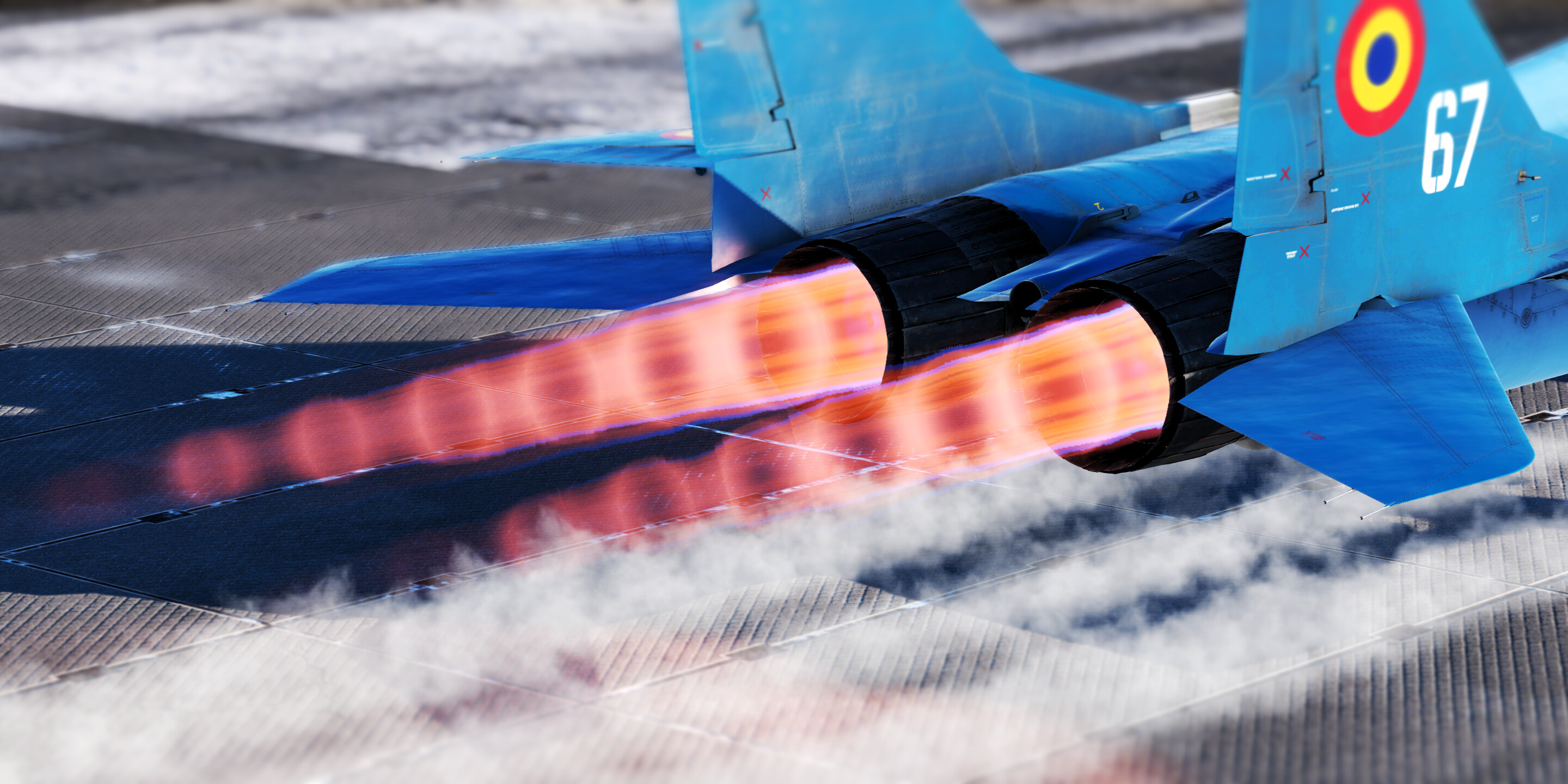
The twin Klimovs burn through fuel quickly when on full afterburner, so taking the 1520-liter drop tank is a necessity in most situations. When cruising, set the engines to half-afterburner or lower to conserve fuel.
Maneuverability
The Sniper is somewhat lacking in maneuverability due to its poor energy retention. Most 4th-generation fighters like the JAS39 will be able to easily outmaneuver the Sniper due to their superior agility. Avoid engaging these planes in 1-on-1 dogfights unless there are teammates nearby that can assist.
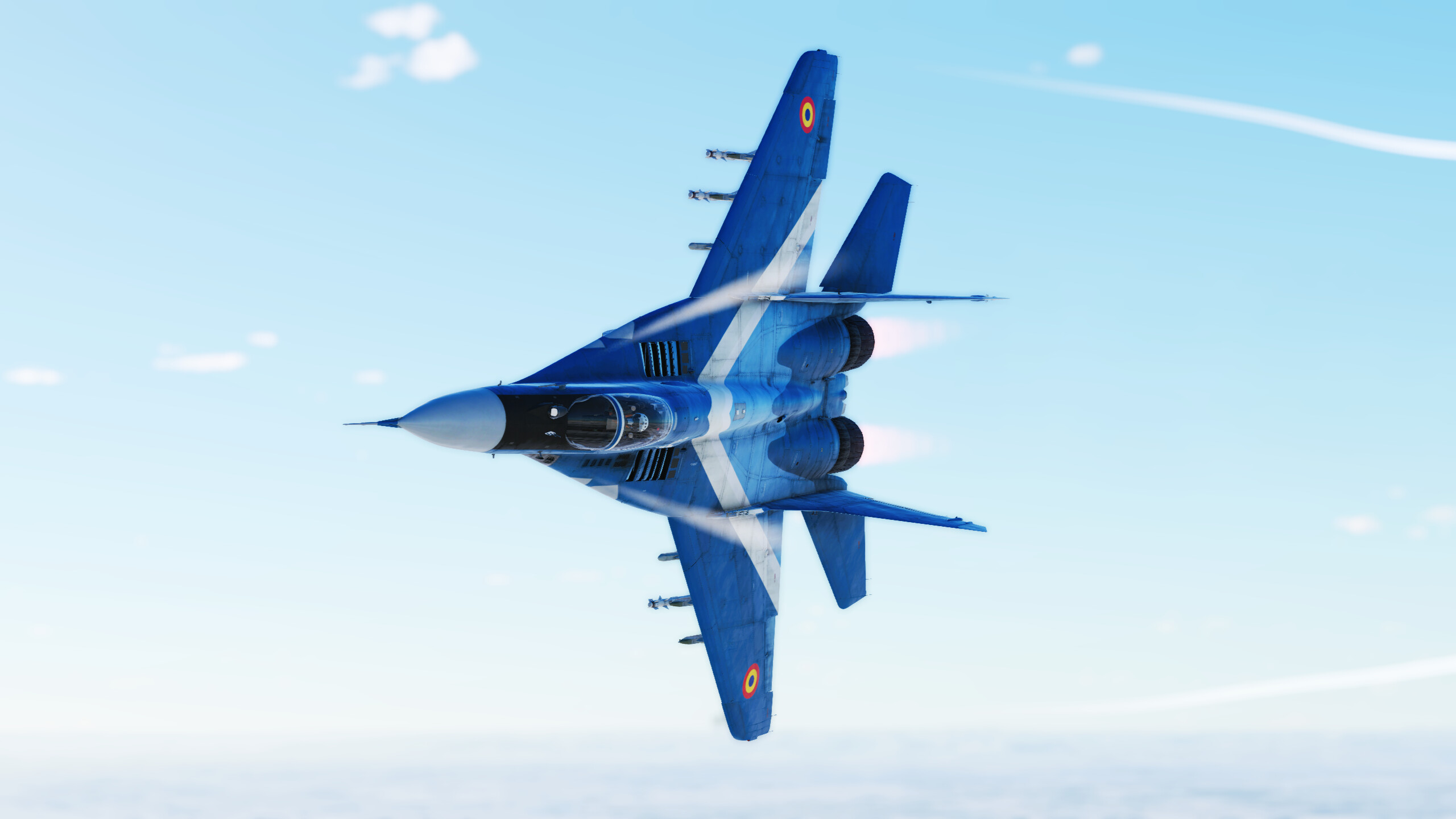
Older and less nimble jets, such as the MiG-23 or the F-4, can be easily dealt with since the Sniper can outmaneuver them without much issue. However, be careful of delta-winged aircraft like the Kfir or the more modern Mirage 2000, since they can pull extremely sharp turns to gain an advantageous position at the beginning of a dogfight.
The Sniper is also equipped with a “Maneuver Mode” button, which disables the angle of attack limiter. This allows the plane to pull high AoA maneuvers (e.g., cobra maneuver) in exchange for airspeed.
Warning: Maneuver Mode is not an instant win key.
The Maneuver Mode feature should be used sparingly, but it can be useful when needing to turn into an opponent immediately. However, turning with the maneuver mode enabled will bleed extreme amounts of speed in a very short amount of time and leave the aircraft with little to no energy and airspeed left.
Sensors and avionics
The MiG-29 Sniper retains the same radar, IRST, and countermeasures found on the early MiG-29s, but it is equipped with a much better radar warning receiver.
Radar
The Sniper is equipped with the mechanical N019E Topaz radar. The Topaz can search and acquire targets with its pulse-doppler SRC, TWS, ACM, and HMS modes.
Like most other Soviet radars before the N011M on the Su-30SM, the Topaz frequently fails to lock onto targets when using the ACM and HMS modes, which can be frustrating for the pilot.
Radar specs
| Band | I |
| Range | 65 km |
| Search zone | 60° x 30° |
| IFF | Yes |
| DL targets | 1 DL channel for R-27R1/ER1 |
Radar modes
| Mode | Abbreviation | Use |
|---|---|---|
| SRC PD | Search, Pulse Doppler | Default mode to search for targets and contacts show up on the radar scope. |
| SRC PD HDN | Search, Pulse Doppler, Head On | SRC PD but only in head-on scenarios. |
| TWS | Track While Scan | Different search mode that displays radar contacts on the screen. Allows the pilot to cycle between different targets without hardlocking them. |
| TWS HDN | Track While Scan, Head On | TWS but only in head-on scenarios. |
| ACM PD | Air Combat Maneuvering, Pulse Doppler | Acquisition mode to lock onto targets in front of the aircraft. |
| HMS PD | Head Mounted Sign, Pulse Doppler | Alternative acquisition mode that allows the pilot to cue the radar to lock onto targets that they are directly looking at via the HMS. Useful for locking off-boresight targets. |
| TRK PD | Track, Pulse Doppler | Signifies that the radar is locked onto and tracking a target. R-27R1 and R-27ER1 radar missiles can be fired at the locked target. |
IRST
The OEPS-29E Infrared Search and Track module can be used to passively search for airborne targets by detecting their heat signature. IRST is effective for stealthier attacks because it does not trigger RWR or reveal the aircraft’s location to enemies.
However, radar missiles like the R-27R1 and R-27ER1 cannot be used when locking a target with IRST since they require a hard radar lock to operate.
Radar Warning Receiver
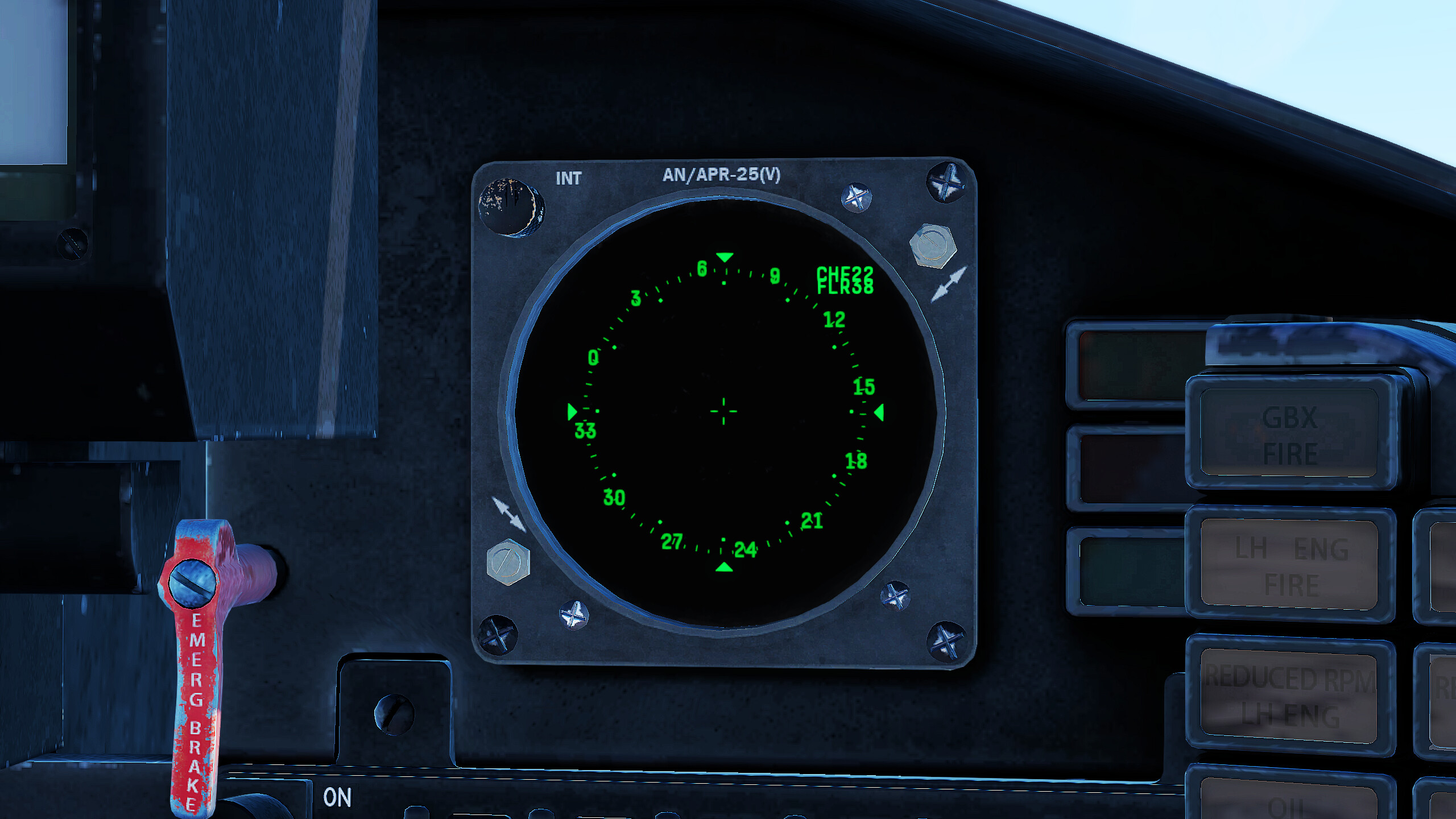
During the Sniper upgrade program, the existing SPO-15 on the MiG-29 was replaced with Elbit’s Elisra SPS-20(V) radar warning receiver. The SPS-20(V) has vastly superior threat detection than the SPO-15; the main difference is the SPS-20(V)'s ability to display aircraft names on the RWR.
Note: The SPS-20(V) is unable to detect C and D radar bands.
| Band | E — J |
| Range | 70 km |
| Threat types on scope | 43 |
| Tracked threats | 12 |
| Launch detection | 27 |
| IFF | Yes |
Countermeasures
There are 60x large-caliber countermeasures mounted in dispensers above the aircraft. Two countermeasures are fired every pop. Flares are effective against IR missiles, and chaff should be used for defeating radar missiles while in a notch position. Large-caliber countermeasures are more effective than regular-caliber or BOL-size countermeasures due to their higher heat signature (2x more than regular-caliber countermeasures).
Note: When flaring IR missiles, make sure to turn off the afterburner temporarily and maneuver appropriately so the flares go towards the missile’s seeker.
Cockpit
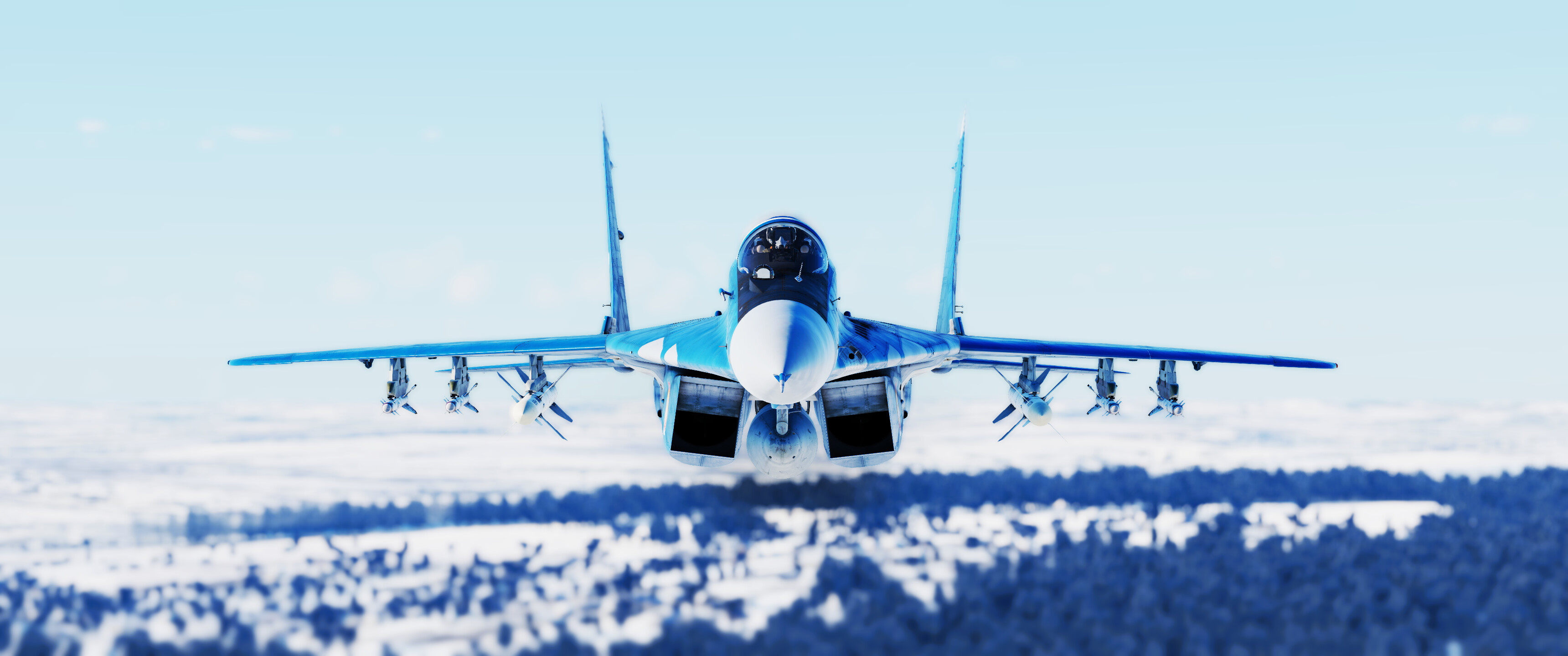
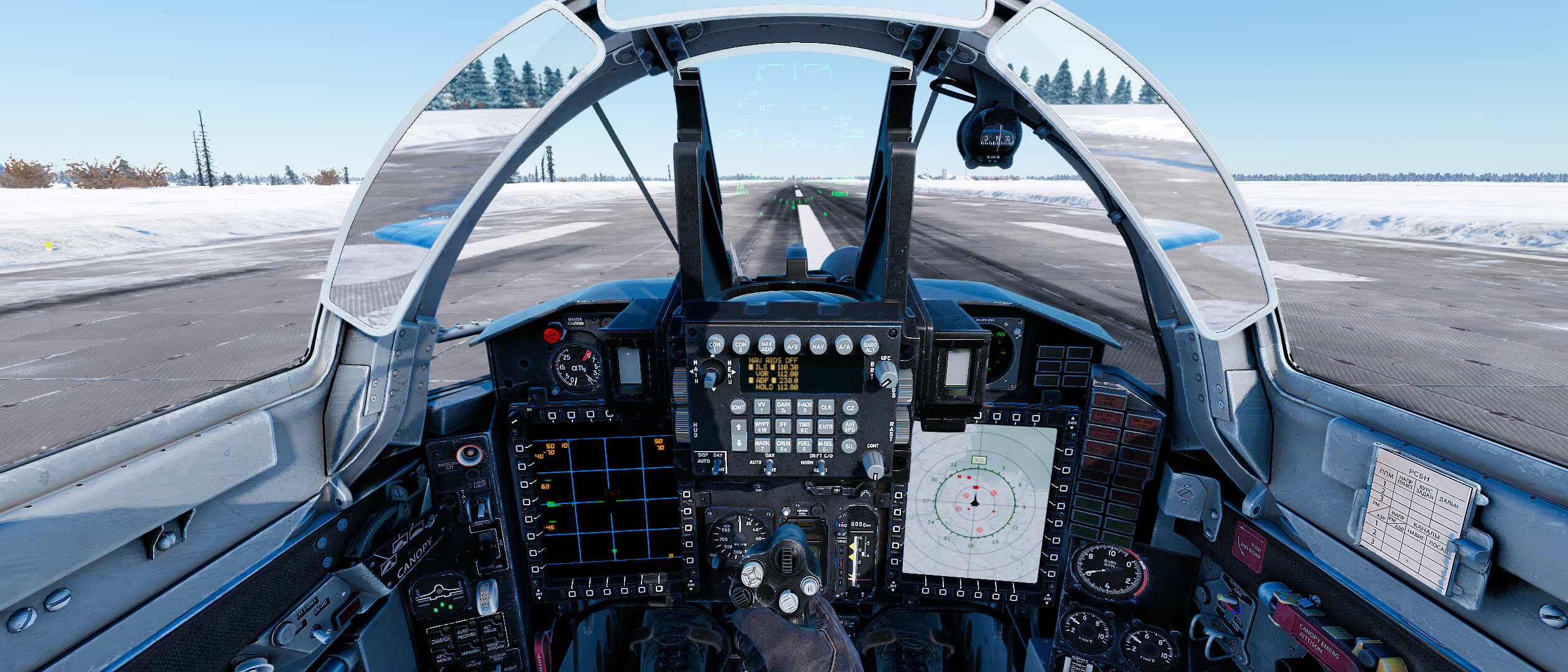
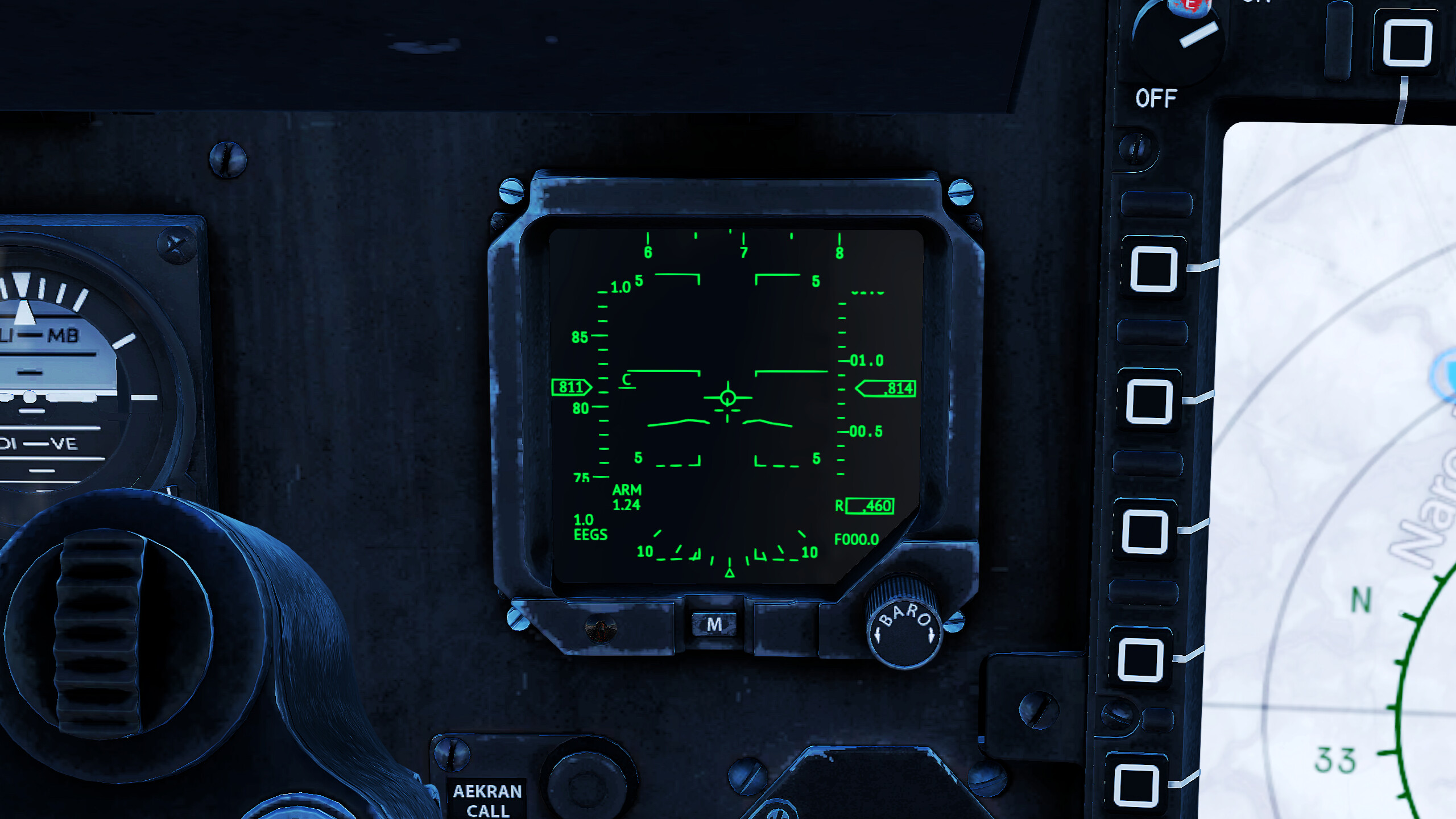
The MiG-29 Sniper can be easily mistaken for a NATO jet since its cockpit is extremely different from the standard MiG-29 due to the addition of a new HUD and two colored MFDs. Both MFDs are customizable and have 3 preset displays.
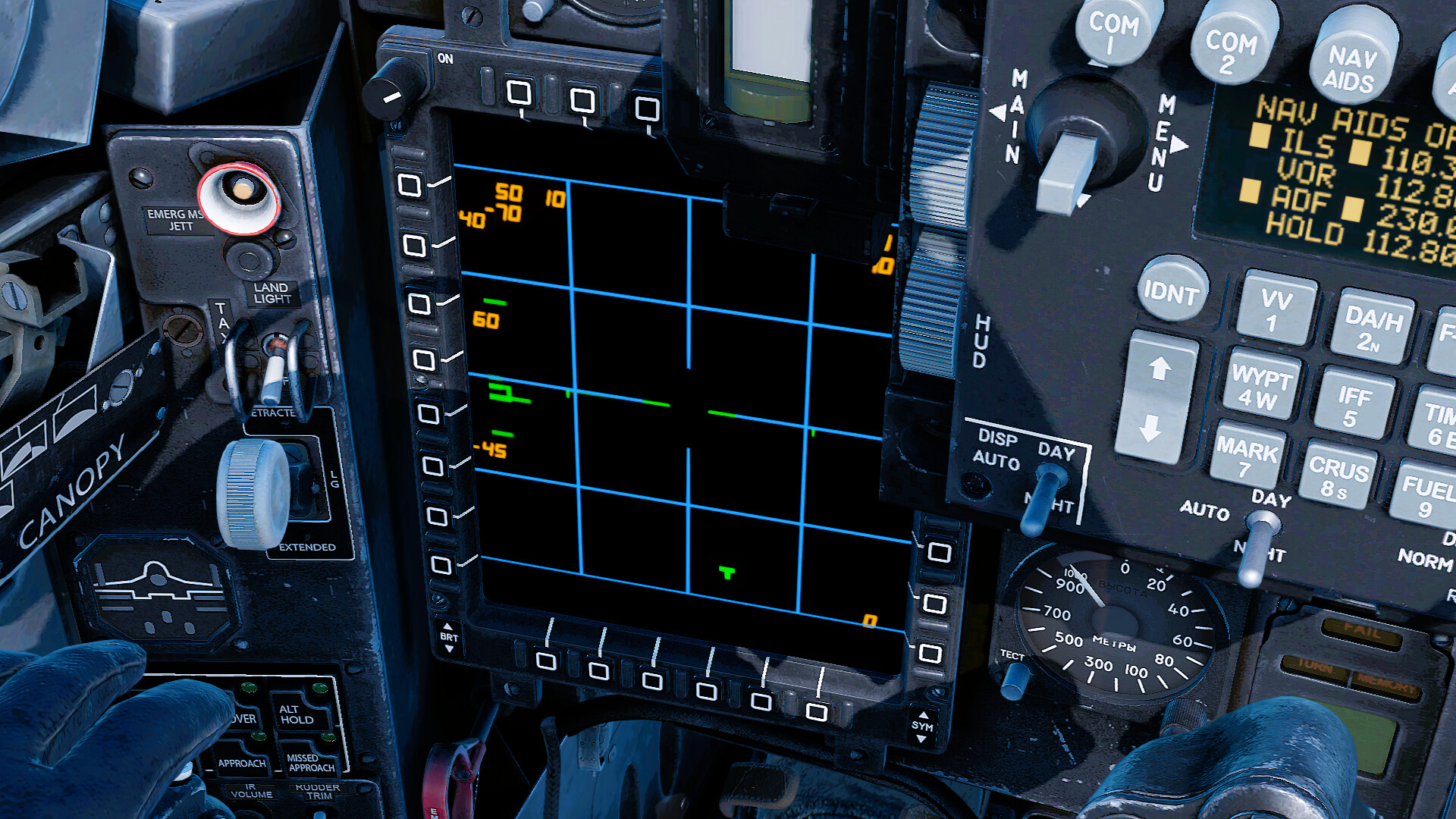
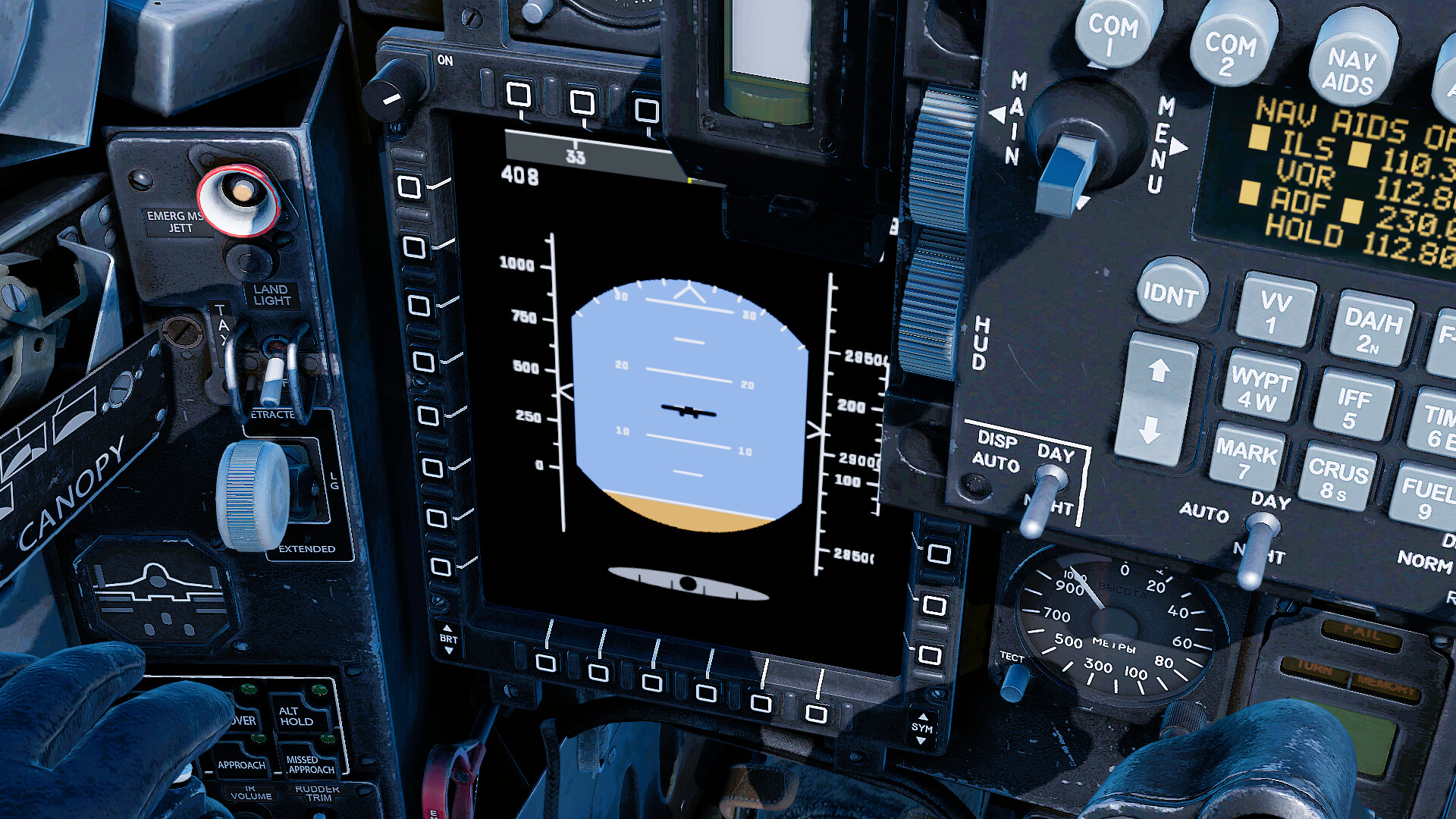
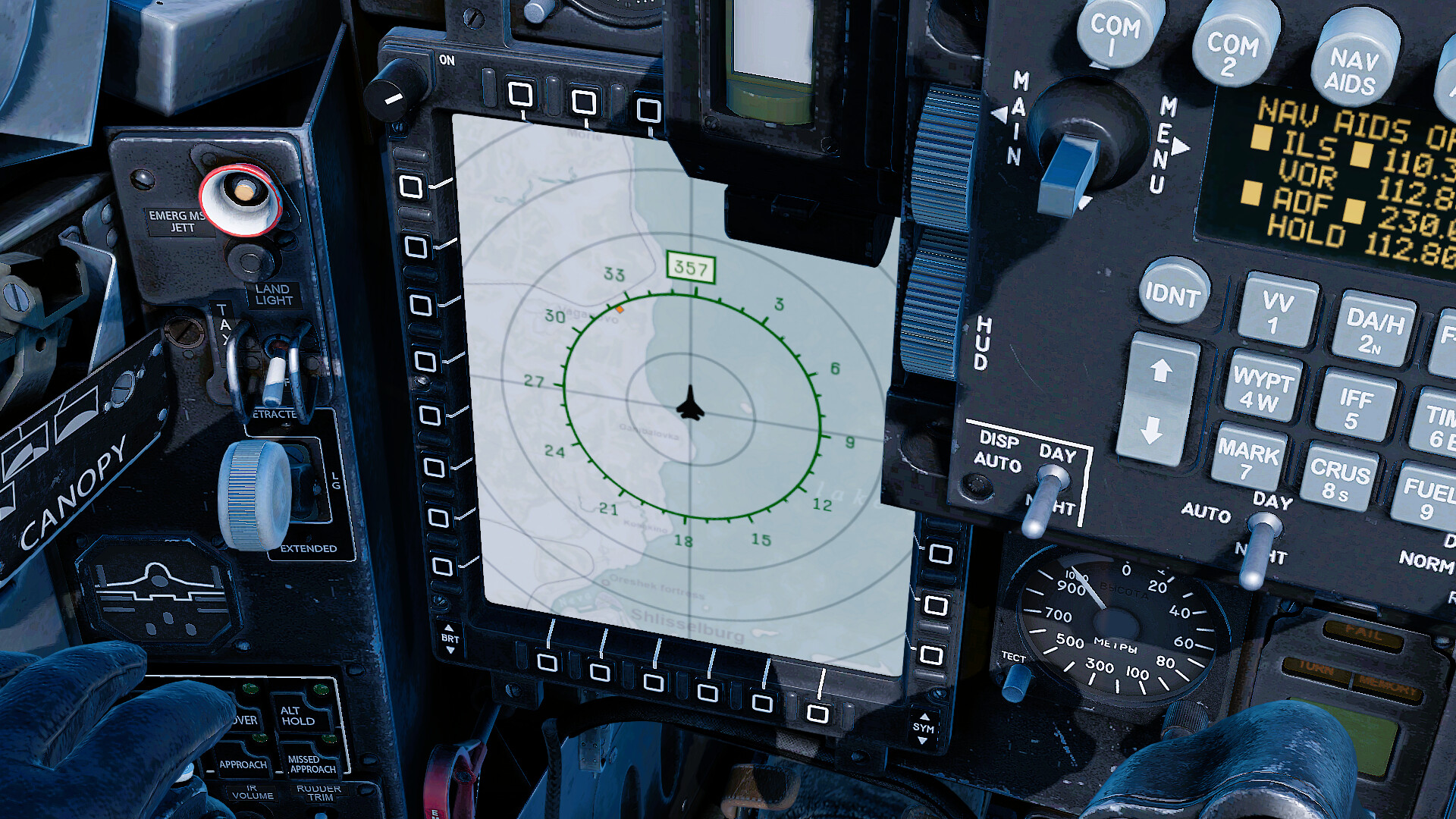
Note: The Attitude Indicator screen can only be used on the first (left) MFD.
Air-to-air armaments
The MiG-29 Sniper is equipped with a 30 mm GSh-30-1 autocannon and can carry up to six air-to-air missiles.
GSh-30-1
The GSh-30-1 is the standard autocannon armament of most modern Soviet and Russian jets. It is mounted in the left wing root of the plane and has 150 rounds of ammo. While having a slower rate of fire and being harder to aim than the M61 Vulcan, the GSh-30-1 is effective against all aircraft and typically shreds most aircraft apart with a short and well-aimed burst.
- Default: AP-T / HEF-I
- Universal: AP-T / HEF-I / APHE / HEF-I
- Ground targets: AP-T / APHE
- Air targets: AP-T / HEF-I / HEF-I
- Stealth: APHE / HEF-I / HEF-I
An EEGS lead indicator for the autocannon can also be shown by locking onto an aircraft with the radar. This lead indicator is not 100% accurate, and the system can over or undercompensate for lead, so some adjustment may be necessary.
R-27R1/ER1
The R-27R1 and R-27ER1 missiles are the Sniper’s primary method of engaging aircraft from longer distances. The R-27R1 and R-27ER1 are semi-active radar homing missiles and require a continuous radar lock for guidance.
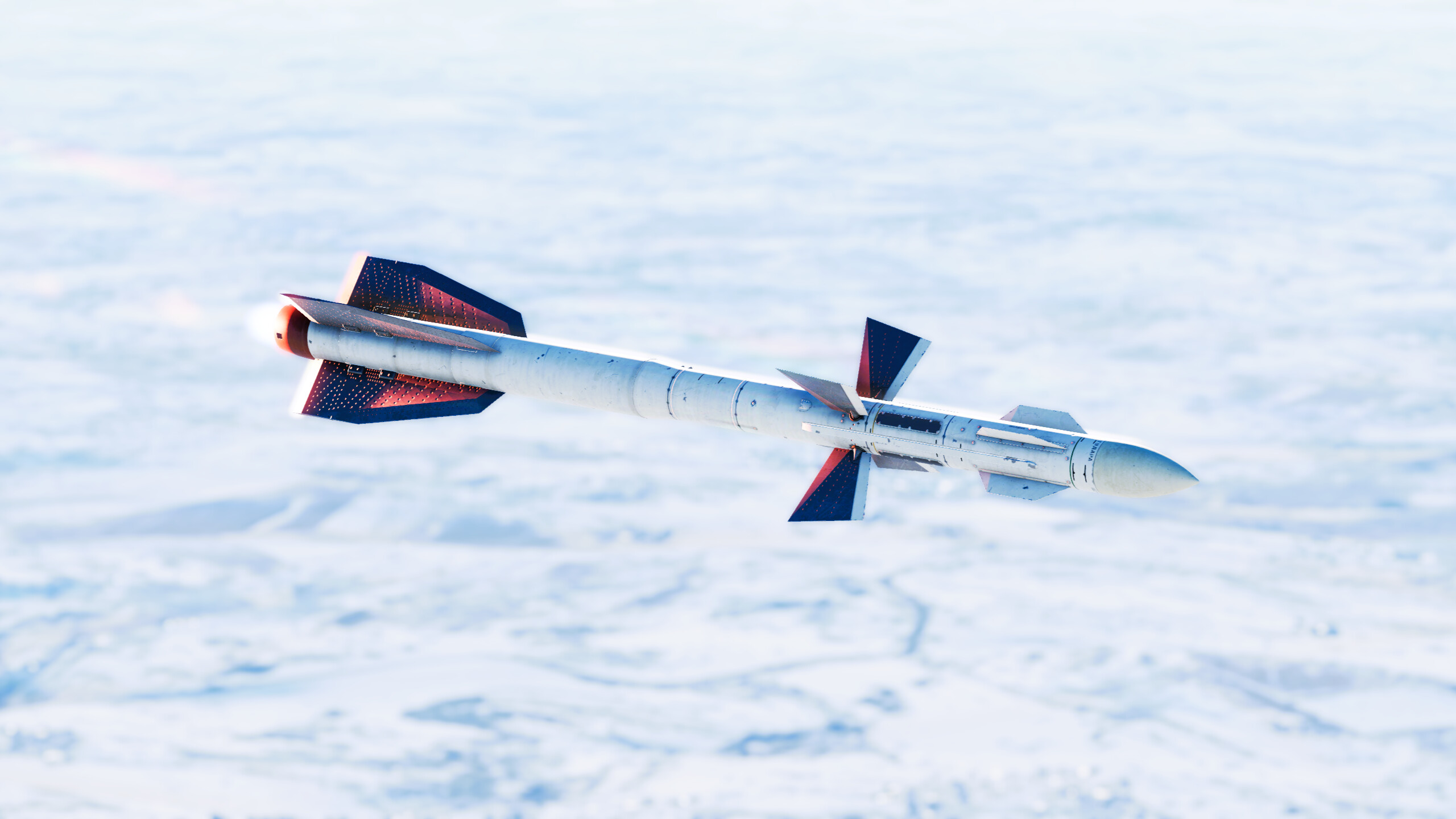
The R-27ER1 offers the best performance, thanks to its more powerful motor and booster, so it has greater speed, range, and maneuverability compared to the 27R1.
Due to their inertial guidance and datalink, both of these missiles are very potent and can be difficult to notch, especially at closer distances. Shooting them at targets that are above multipathing altitude and not actively defending usually is a near-guaranteed kill.
Tip: The R-27R1 and ER1 can continue tracking even after radar lock is broken if the radar is relocked onto a target. This is useful when combating targets that are notching/defending against the missile: if they successfully notch the missile, unlock the radar from their chaff, and relock it onto their plane.
When on the deck, the effective range for the R-27ER1 is anywhere from 5 km to 12 km (the missile can travel much further, but launching the missile from a closer distance increases the chance of getting a successful kill). At altitude, the R-27ER1 can be launched head-on at much further distances (15 km to 30 km). The effective distance for the R-27R1 is shorter due to its less effective booster and motor.
R-27T1
The R-27T1 is an infrared-guided alternative to the R-27R1. It serves as a larger and longer-ranged version of the smaller R-60MK.
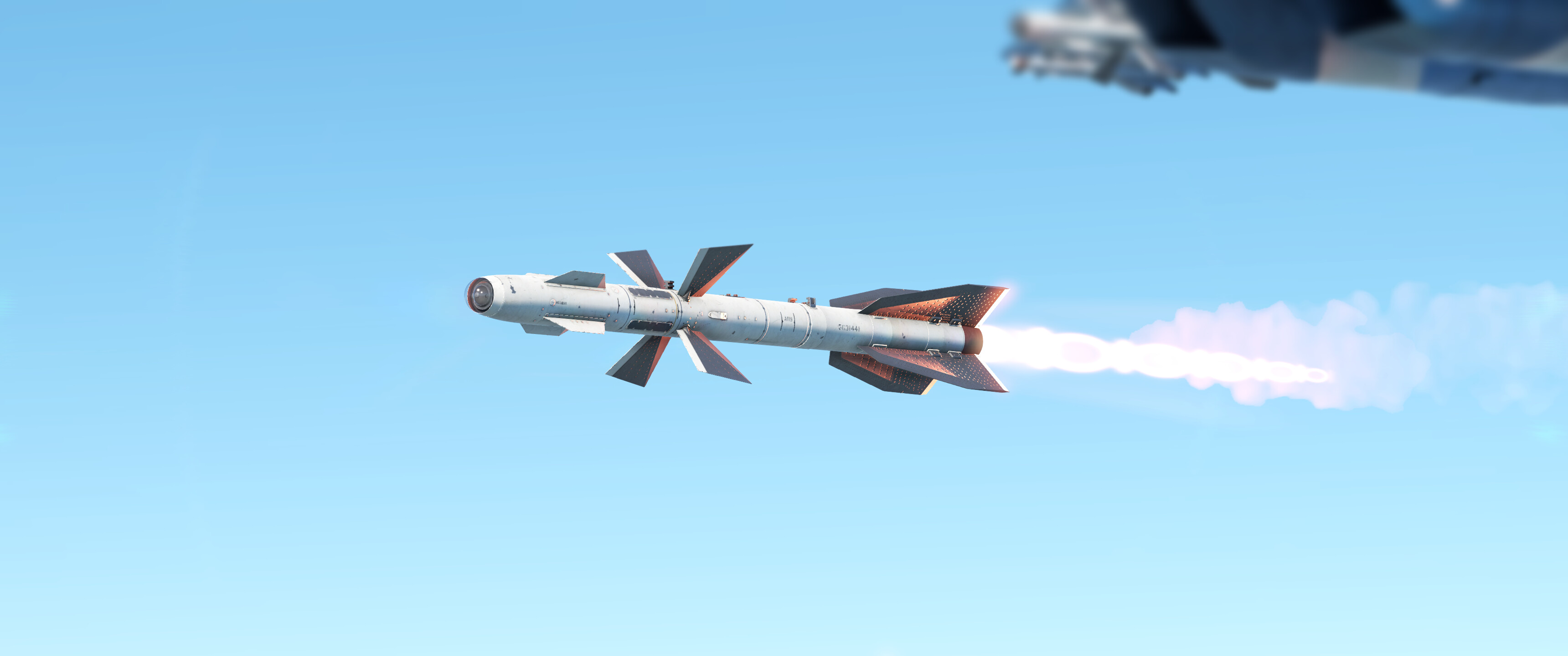
Note: The R-27T1 has the same flight performance as the R-27R1, and not the R-27ER1 (the R-27ET1 is the IR counterpart of the R-27ER1).
Generally, the R-27R1/ER1 missiles are more suited for the typical ARB environment since they are harder to defeat, but the R-27T1 can be useful when carrying out stealth attacks with the IRST in Simulator battles. It is a bit more difficult to flare than the R-60MK since it has FoV or gatewidth IRCCM.
R-60MK
The smaller R-60MK is more suited for close-range engagements. It can be inconsistent to use due to its poor range, flare resistance, and small warhead, so it is best used against unaware targets or targets with engines that produce a strong heat signature (e.g., the Tornado or F-14A).
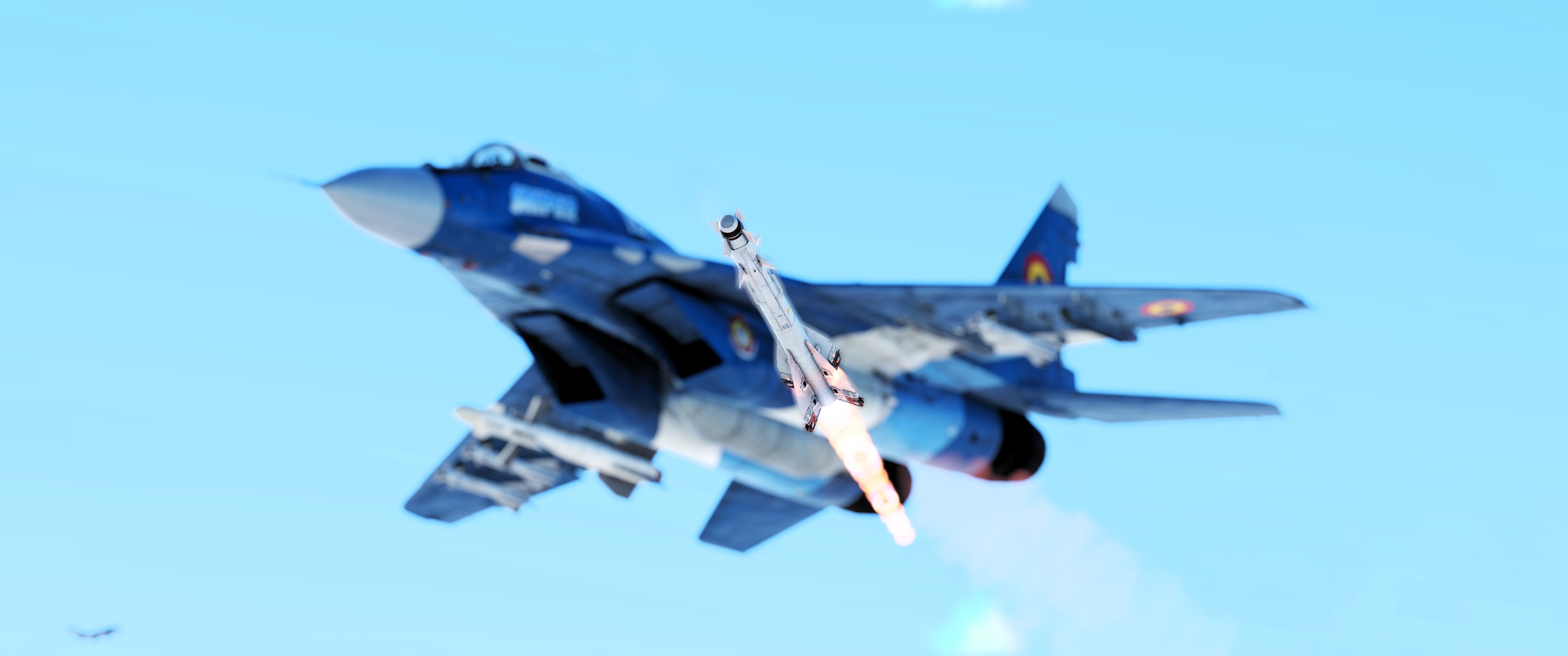
To compensate for its underwhelming flare resistance, an effective strategy can be to “shotgun” the missile in head-ons at an extremely close distance (under 1 km). This will give the opponent less time to flare the missile, and even if they successfully flare it, the R-60MK’s proxy fuse may activate and explode near their aircraft.
Air-to-ground armaments
The MiG-29 Sniper offers limited air-to-ground armaments besides rockets and unguided bombs, so players looking for a dedicated CAS attacker with “smart” weaponry should find a more suitable plane, such as the Panavia Tornado IDS. However, the Sniper is more than capable of being used in a CAP role and can lessen the burden on friendly SPAA units by destroying enemy CAS before they can drop or launch their payload.
Bombs
The Sniper has access to both Western and Soviet bomb types. For bombing vehicles and other ground targets, the 500 kg FAB-500M-62 offers the most explosive mass. The incendiary ZB-500 is more suited for base bombing.
Regular
| Bomb | Weight | Explosive mass (TNTe) | Max # of bombs |
|---|---|---|---|
| 100 kg OFAB-100 | 100 kg | 38 kg | 16 |
| 250 kg FAB-250M-62 | 227 kg | 160 kg | 8 |
| 500 lb LDGP Mk 82 | 240.9 kg | 117.6 kg | 8 |
| 500 kg FAB-500M-62 | 508.3 kg | 340.8 kg | 6 |
| 1000 lb LDGP Mk 83 | 446.8 kg | 272.4 kg | 4 |
Regular (Parachute)
| Bomb | Weight | Explosive mass (TNTe) | Max # of bombs |
|---|---|---|---|
| 250 kg OFAB-250Sh | 275 kg | 131.7 kg | 8 |
| 500 kg FAB-500Sh | 515 kg | 362.6 kg | 4 |
Napalm
| Bomb | Weight | Explosive mass (TNTe) | Max # of bombs |
|---|---|---|---|
| ZB-500 | 374 kg | 250 kg | 4 |
Rockets
The Sniper can also carry small and large-caliber unguided rockets. These are lighter than bombs, but bombs should generally be used instead of these due to their higher explosive mass.
| Rocket | Weight | Explosive mass (TNTe) | Max # of rockets |
|---|---|---|---|
| S-8KO | 11.3 kg | 1.4 kg | 80 |
| S-24B | 235 kg | 25.5 kg | 4 |
Usage in battles
Although it has inferior flight performance when compared to some other jets it may face, the MiG-29 Sniper can still perform well in most engagements. To be more successful, pilots should try to avoid directly contesting more maneuverable aircraft.
Recommended loadout: 2x R-27ER1, 4x R-60MK, 1x 1520 liter drop tank, 30 flares/30 chaff, 27 minutes of fuel (96%)
Missile jousting at high altitudes
The R-27ER1 will be the best tool for medium- to long-range combat at high altitudes (typically above 5,400 meters). This is a good strategy to combat other high-climbing aircraft like an F-14A. Note that the R-27ER1 is still a SARH missile and requires constant guidance, unlike the ARH missiles that some other planes may carry.
Generally, R-27ER1 missiles are the most effective against targets that are below 20 km away and that are travelling toward the aircraft head-on. After launching the missile, always go into a semi-notch or crank position and keep the radar lock near the radar’s gimbal limit. This makes it so that enemy missiles fired in return will take longer to reach the aircraft.
If you survive the initial stages of missile jousting, the Sniper will typically be in a very good position directly above or to the flank of the enemy team. From here, you can begin to assist teammates and slowly make your way down to ground level.
Warning: Be careful when going at high altitudes. A contrail will appear above ~5,500 meters and make the location of the aircraft very noticeable.

Engaging enemies at closer distances
The MiG-29 Sniper can also be an effective combatant in close-range engagements. Avoid diving into the furball immediately and instead pick off enemies that are either distracted or already in an engagement. Climbing up to a higher altitude or into some clouds and then launching R-60MKs or R-27ER1s from above is a good strategy to gain some kills before enemies are aware of the Sniper’s location. Note that climbing makes you vulnerable to radar missiles, however, so be prepared to notch or dive to the deck to multipath them.
Try to avoid one-on-one engagements with more nimble aircraft such as the F-16 and engage them with teammates or retreat. The Sniper’s great top speed and quick acceleration will be useful when needing to get away from enemies.