The Supermarine Attacker was a fighter that emerged in the 1940s with the aim of replacing the legendary Gloster Meteor, the UK’s first jet fighter, which had already made aviation history, and simultaneously becoming the Royal Navy’s first frontline jet fighter. The Attacker failed to achieve its primary objective: the introduction of a modern, efficient single-engine jet aircraft for the Royal Air Force, and its service life was short due to poor overall performance and maintenance issues. Its history and service, spanning from 1950 to 1964, reflects the challenges of the transition to the jet age in the United Kingdom and the introduction of the first jet aircraft of the Royal Pakistan Air Force (RPAF). Throughout its 14 years of service, the aircraft never took part in any conflict or combat.
Background
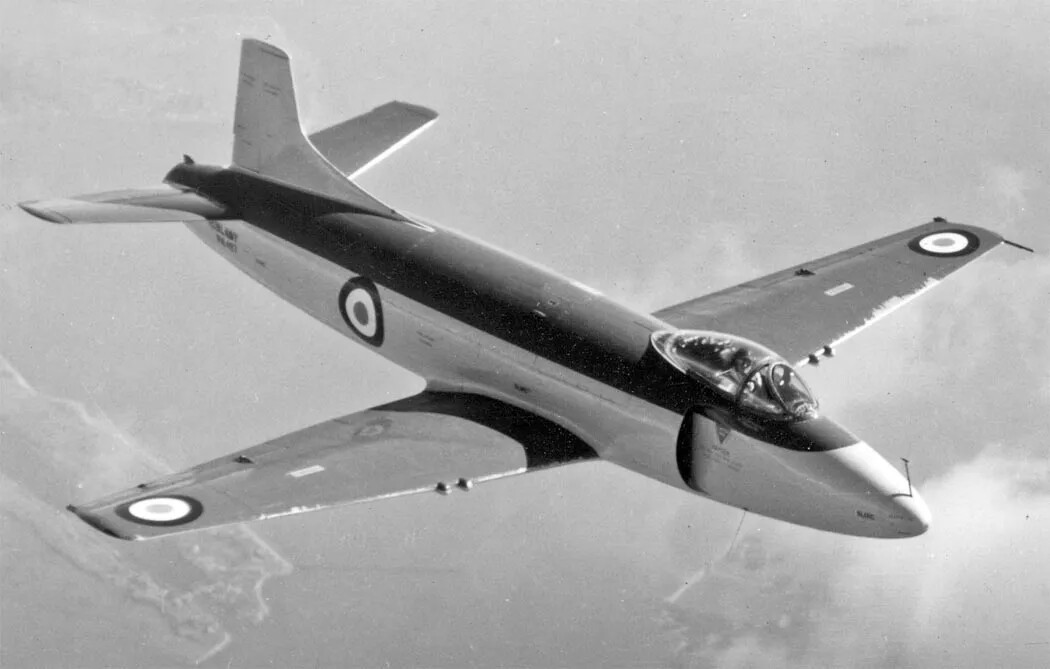
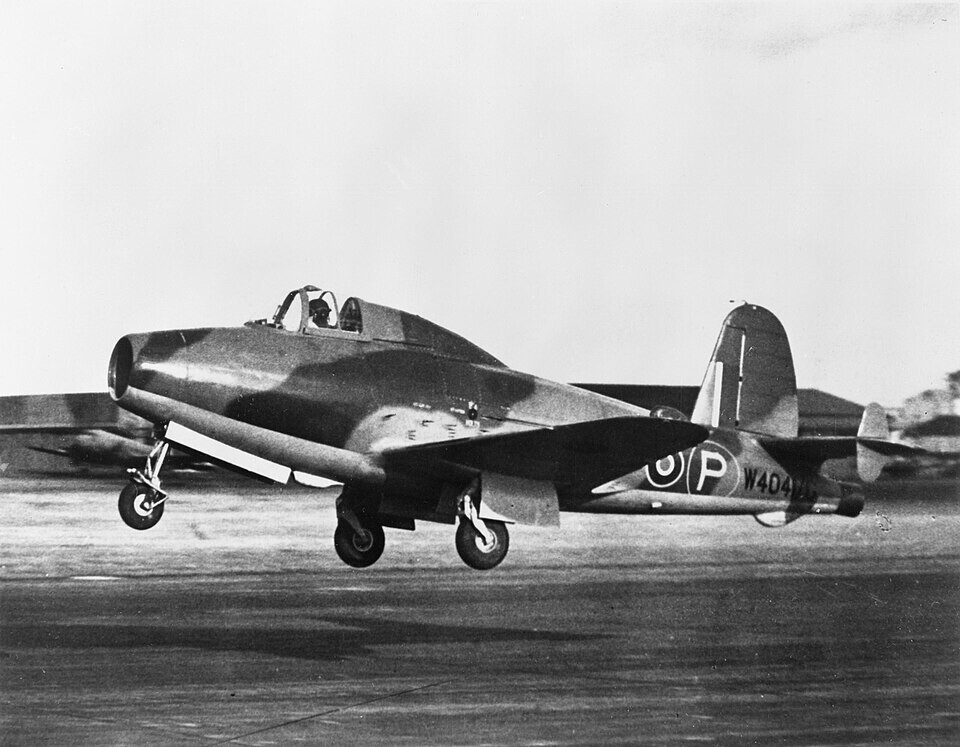
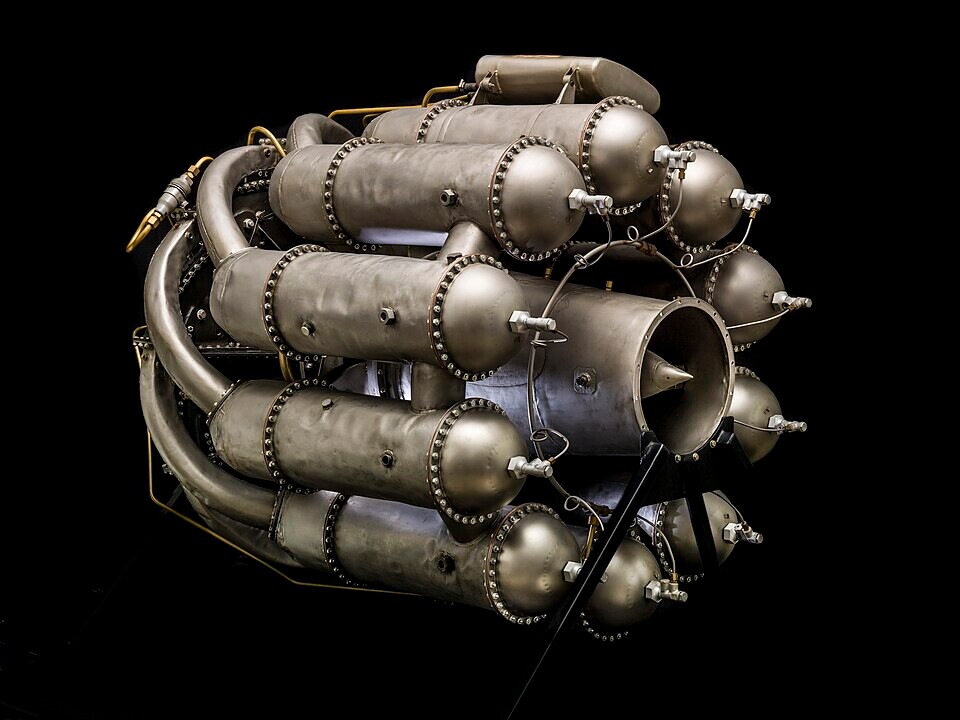
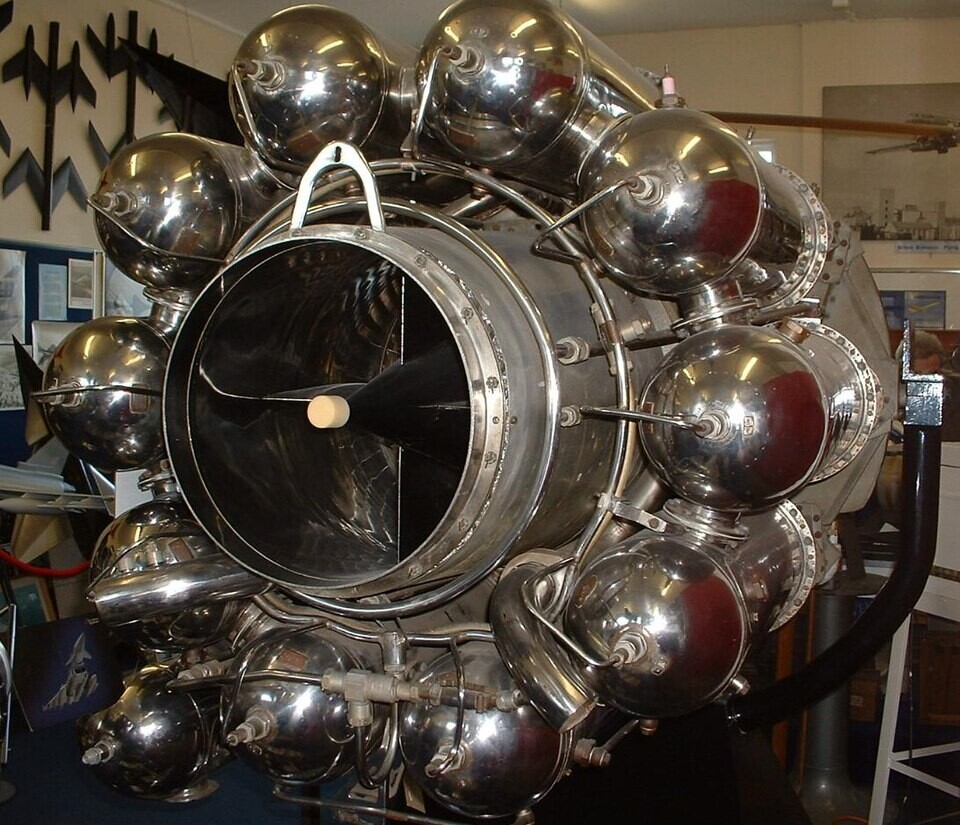
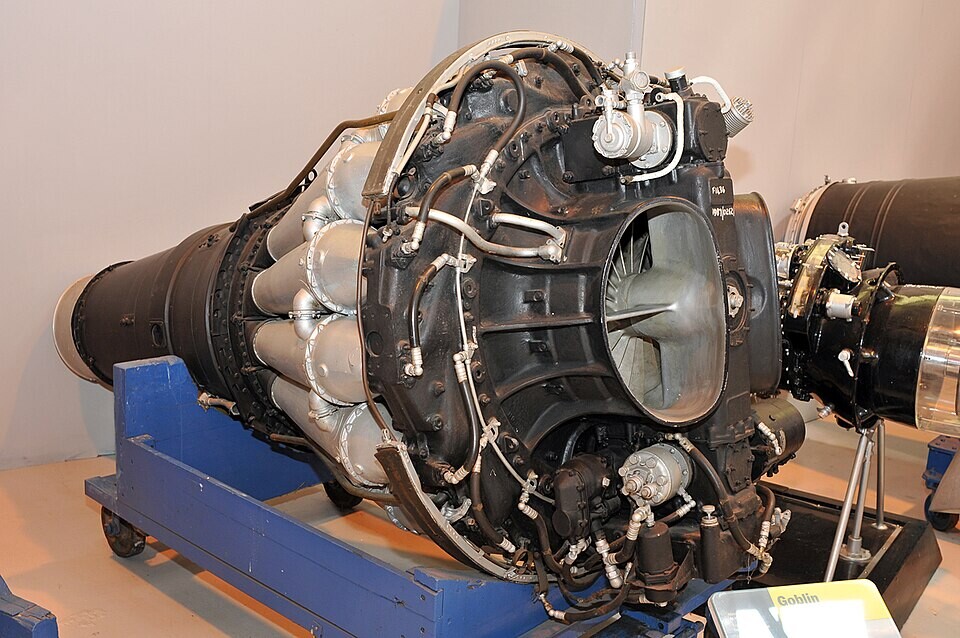
In 1941, following the successful trials of the first British jet aircraft, the Gloster E.28/39, derived from Specification E.28/39 (Experimental aircraft using jet-propulsion, Power Jets W.1 engine with provision for 4 × 0.303 inch machine guns), there was considerable interest in applying the new propulsion technology to fighter aircraft. In 1942, development began on a larger twin-engine fighter that would become the Gloster Meteor, the Allies' first jet fighter. The British manufacturer Rover, already contracted to produce the Power Jets W.2 engine (which powered the Gloster Meteor), faced considerable difficulties in achieving sufficient engine production volume during the war. Concerned about the wider consequences of this production shortage, the Air Ministry recognized the potential value of adopting a single-engine aircraft instead of the Meteor’s twin-engine configuration, leading to the issuance of Specification E.5/42 (Experimental single-engined jet fighter), which called for the design and manufacture of such a fighter, optionally powered by a single de Havilland Halford H.1, later designated the Goblin, or a Rolls-Royce RB.40 engine, a development of the RB.37 Derwent Mk. 8. Following this request, the Attacker was developed.
Development
In the mid-1940s, the position of the British aircraft manufacturer Supermarine seemed absolutely unshakable. Their signature aircraft, the famous single-seat Spitfire fighter, had performed brilliantly in combat during World War II. The fighter was incredibly successful in both its standard land-based and carrier-based variants.
The company boasted a highly skilled workforce and their engineers could always draw on a massive amount of operational experience with their aircraft. Supermarine constantly kept its fingers on the pulse of the latest aviation design trends and actively invested in developing ambitious new projects.
The earliest mentions of the company developing a jet fighter actually surfaced back in the 1940s, reinforced, in June 1942, with the issuance of Specification E.5/42 by the Air Ministry, which was a request for a new jet-powered aircraft.
That is when they pitched a concept for a completely new aircraft called Jet Spitfire. It was a bold hybrid combining the familiar wing from the classic Spitfire with a brand new fuselage housing a Halford H.1 jet engine, the same engine already used in the de Havilland Vampire. But at the time, the military wasn’t very impressed with the idea. They were much more focused on rapidly ramping up production of their existing, combat-proven fighters, upgrades to those aircraft, and projects like the Gloster Meteor. Most importantly, they wanted to maintain parity with the latest German fighters coming from Messerschmitt and Focke-Wulf.
Meanwhile, the development of piston-engined Spitfires showed no signs of slowing down. The next leap in this legendary aeroplane’s evolution happened when engineers worked closely with top British research centers. Together they developed a new wing with a laminar-flow airfoil, known as a laminar-flow wing. This innovation promised a major boost in top speed. A modified Spitfire F. Mk. XIV fighter equipped with this wing was given its own name, the Spiteful. It first took to the skies in June 1944.
The laminar-flow wing is an aerodynamic design engineered to keep the airflow over the wing surface as smooth and orderly as possible, avoiding turbulence. This drastically reduces surface friction drag, sometimes by up to 80%, resulting in lower fuel consumption and greater range for the aircraft.
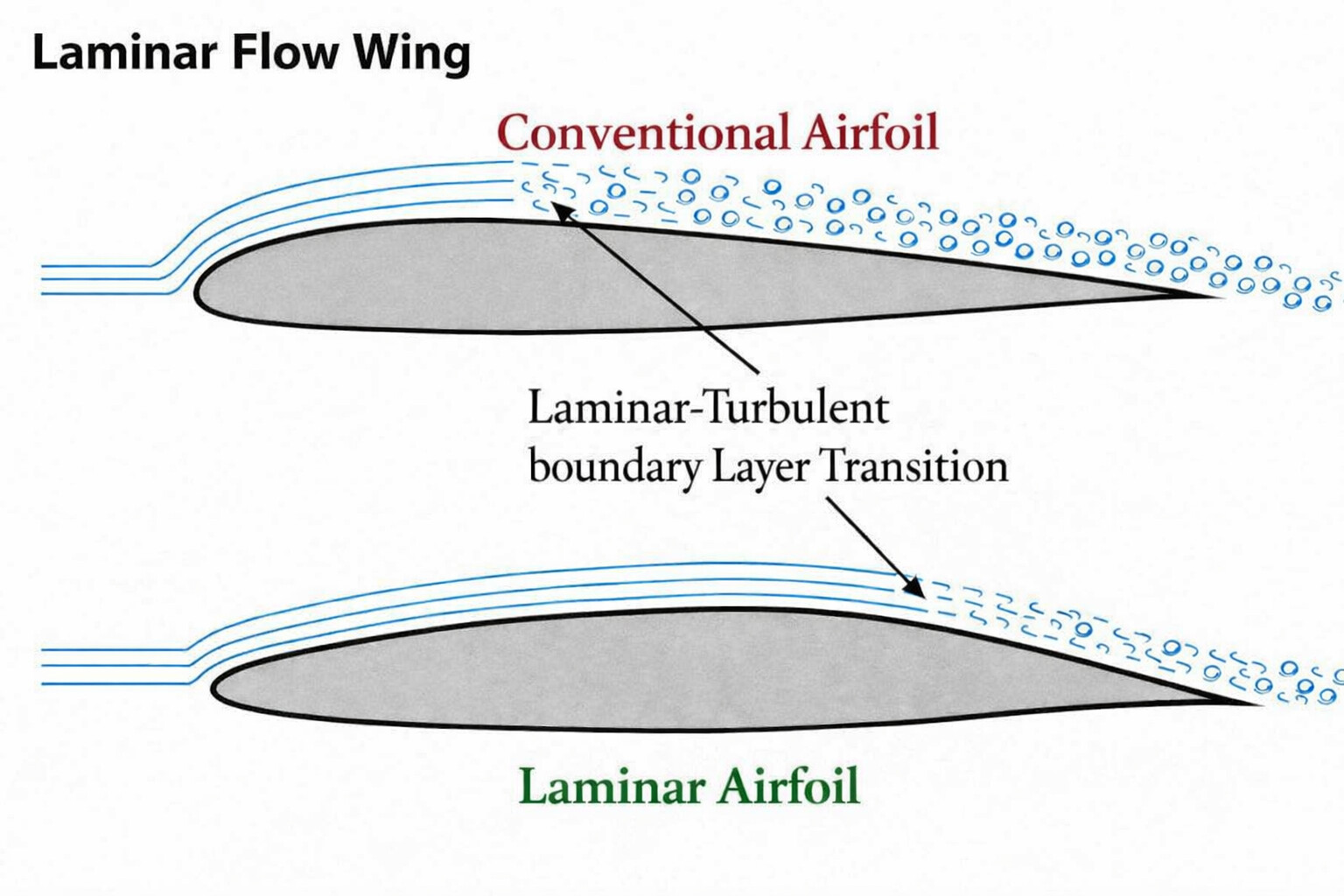
Although extremely efficient, laminar flow wings pose significant practical challenges.
- Extremely sensitive to dirt: Small insects, dust, or any irregularity on the surface create turbulence and negate the design advantage.
- Vulnerable to ice: A thin layer of ice completely destabilizes laminar flow, causing severe risks of stalling (loss of lift).
- Manufacturing tolerances: They require perfectly smooth surfaces and extremely precise manufacturing methods.
Right alongside it, they were also developing a carrier-based version specifically for the Navy, which they called the Seafang. Traditionally, the heart of these aircraft had been a Rolls-Royce piston engine. Rolls-Royce produced excellent and reliable piston engines at the time, but it was already clear that the era of piston engines was coming to an end, and Rolls-Royce was already investing in jet engines rapidly in the design and improvement of these engines, for example, the classic Rolls-Royce Derwent engines, used by the Gloster Meteor, which had already proved very successful, with proven excellent performance. Supermarine, a loyal Rolls-Royce customer, took advantage of the excellent opportunity when the Rolls-Royce RB.40 turbojet engine was launched.
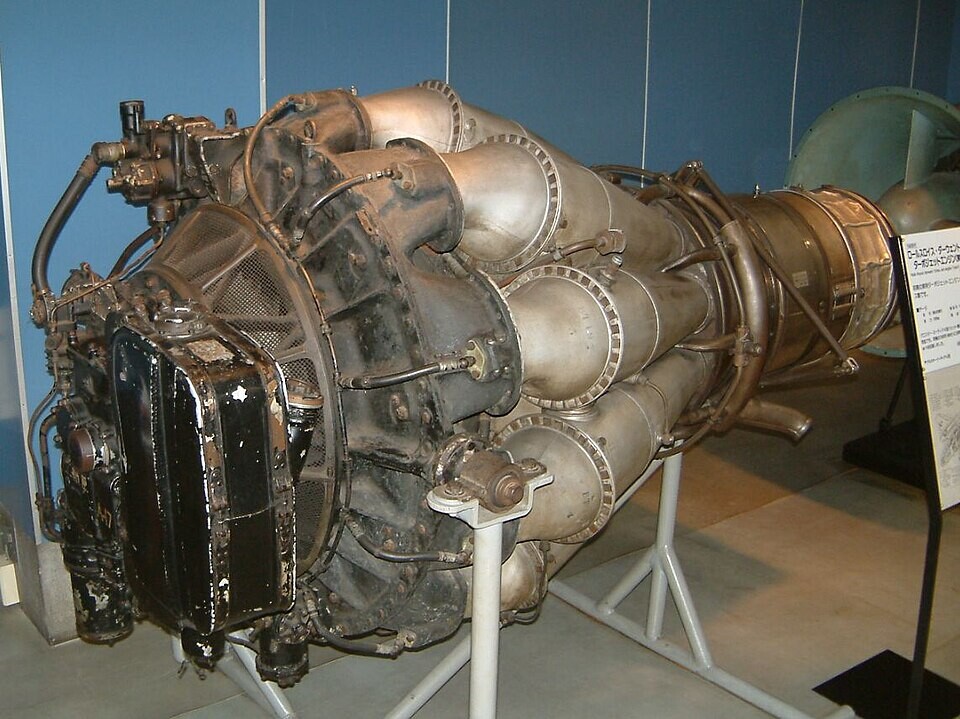
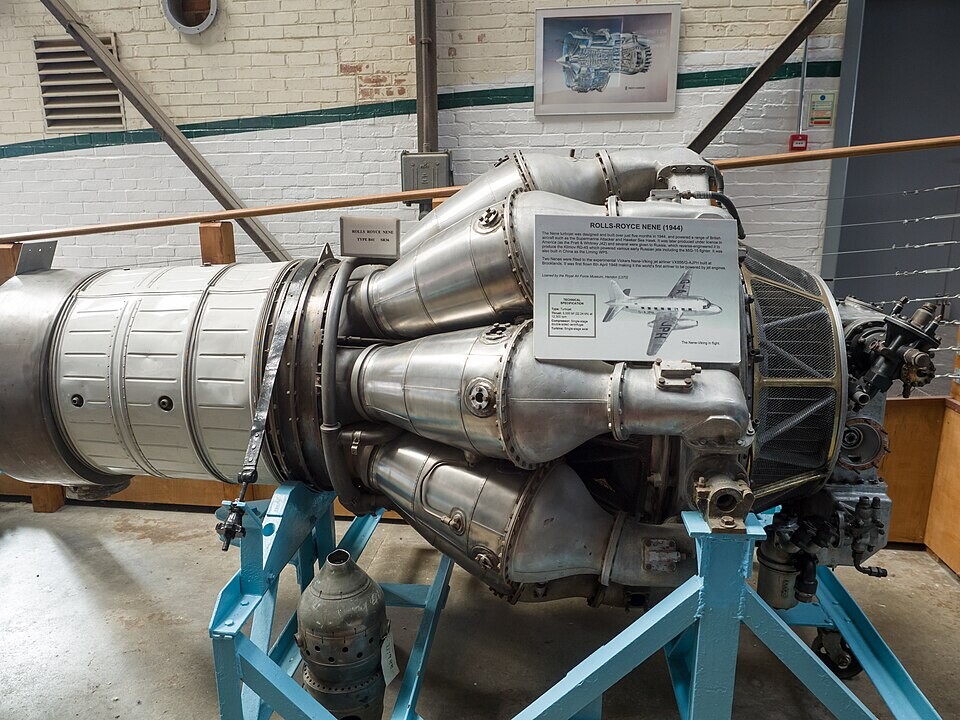
In early 1944, a development team led by chief designer Joseph Smith started preliminary research for a completely new jet aircraft. At first, they planned to power it with the promising Rolls-Royce RB.40 turbojet engine, but engineering calculations quickly showed that an effective fighter needed an engine with a much smaller diameter. They also needed to get their hands on one as fast as possible. That was when Rolls-Royce stepped in with a great alternative. It was the soon-to-be-famous Rolls-Royce RB.41 Nene, which traces its roots directly back the development program for this British fighter. The Nene was a completely new project, not an enlarged version of the Rolls-Royce Derwent.
Developed in 1944, the Rolls-Royce RB.41 Nene stood out as one of the most powerful turbojets of its era and opened doors for post-war aeronautical development. As a result, a new specification, E.1/44, was issued requiring that future aircraft use exclusively this new Nene engine, cancelling the previous E.5/42.
Official development of the new jet aircraft kicked off in the summer of 1944. This was intended to meet the latest requirements from the RAF under Specification E.1/44, and because the company had the foresight to do extensive research ahead of time, the preliminary design for the new airplane was ready in a matter of days.
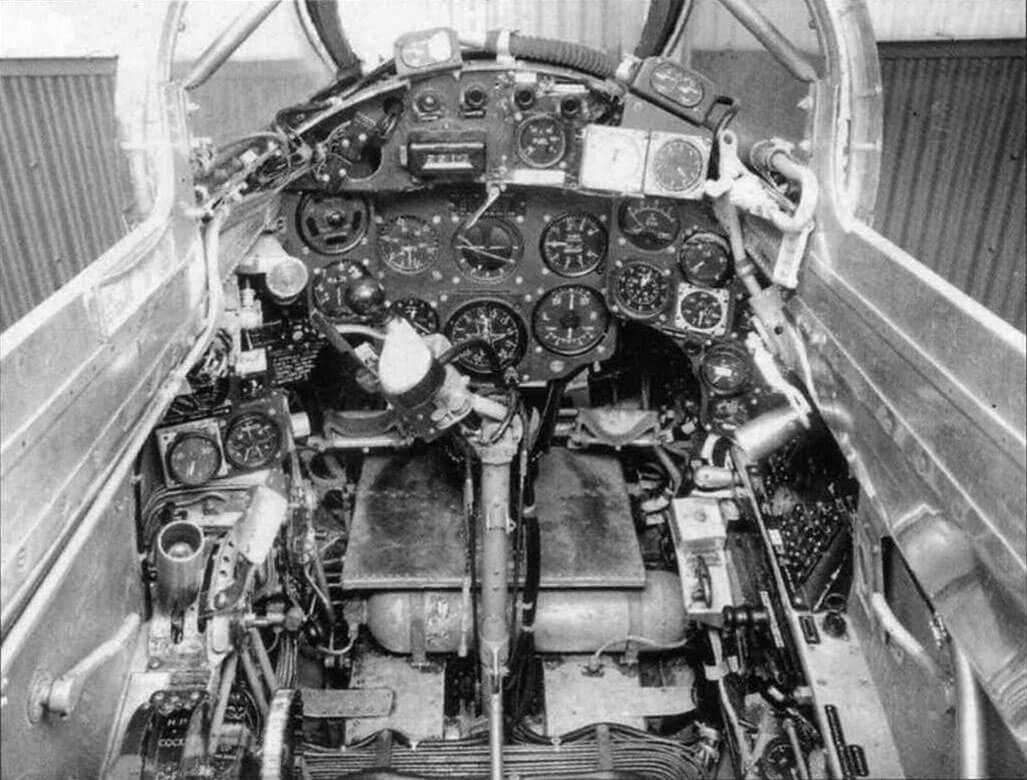
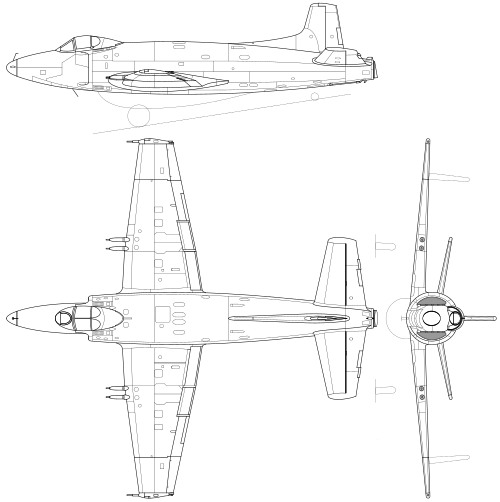
The fighter inherited the rugged, all-metal tapered wing from the Supermarine Spiteful, complete with flaps and specialized ailerons, but the engine was housed inside a brand new, all-metal fuselage. Fixed air intakes were positioned on either side of the pressurized cockpit. The cockpit itself was covered by a bubble canopy, giving the pilot very good visibility. This closely resembled the later versions of the piston-engined Spitfires. Interestingly, at first they did not consider installing an ejection seat to make it easier for the mechanics to service the engine because the engine sat very far forward in the fuselage. The entire upper section of the fuselage was removable. An extended exhaust pipe was routed straight through the tail section of the airplane.
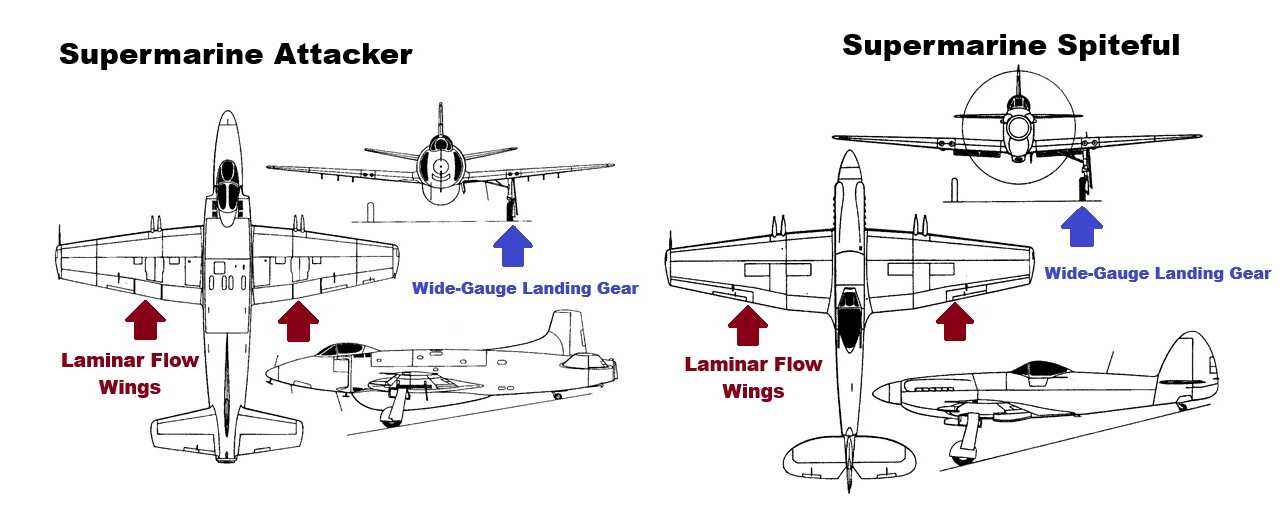
The aircraft itself kept a conventional tail assembly and a tail wheel landing gear. The British designers deliberately passed on a modern tricycle gear, figuring that a three-point landing would be much more familiar to the pilots of the day, and as a bonus, it let them keep the main landing gear struts completely unchanged. The team also adopted wide-gauge landing gear as an option. The Supermarine Attacker was neither the only nor the first jet aircraft to be equipped with this type of landing gear, which was also used on the experimental Heinkel He 178 and several early Messerschmitt Me 262 variants. Supermarine’s chief designer, Joseph Smith, stated that testing validated the performance of the conventional landing gear as acceptable.
Wide-gauge, or wide-track (landing gear) refers to a configuration in which the left and right main wheels are positioned significantly farther apart relative to the width of the fuselage. This design is primarily intended to enhance the aircraft’s lateral stability during taxiing, landing, and takeoff, drastically reducing the risk of tipping over due to tailwinds or crosswinds. A classic example is the McDonnell Douglas F-15 Eagle features a wide track compared to smaller fighters (such as the F-16), ensuring safer landings on wet or frozen runways.
Later in this article, you will find a more detailed technical section on this subject of landing gear.
Fuel was stored in tanks inside the fuselage and wing, giving it a pretty hefty total capacity. As for the armament, they brought it over from its predecessor without a single change. Each wing housed two 20mm cannons.
The following image does not represent the realistic sizes of the aircraft (side by side); it is merely an illustration intended to show the models mentioned in the article on wide-gauge landing gear and laminar flow wings.
Spiteful
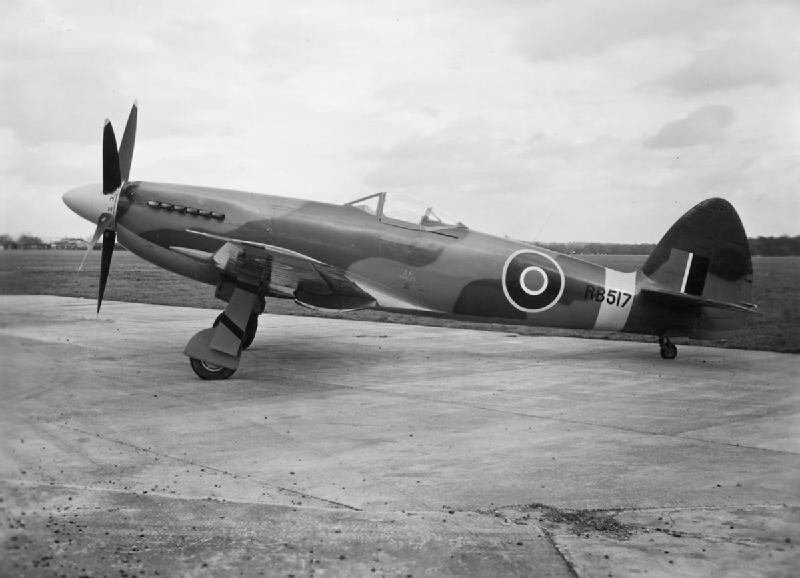
The Supermarine Spiteful was a British fighter aircraft designed by Supermarine during World War II as a successor to the Spitfire. The Spiteful was ready for production at the end of the war, but tests showed only marginal improvements over existing models and it was now being overtaken by jet designs. Of the original order for 150 Spitefuls, only 19 were built. The Royal Navy opted for a navalized variation of the Spiteful, the Supermarine Seafang, but few examples were produced. The wing developed for the Spiteful was used on the jet Supermarine Attacker.
| Specification | OR | Type | Designs |
|---|---|---|---|
| F.1/43 | OR.120 | Development of Spitfire with Griffon & laminar flow wing. | Supermarine Spiteful |
The first Attackers
By August 1944, Supermarine had secured an official contract to build the first three prototypes of this ambitious project. The engineers internally dubbed the aircraft the Jet Spiteful, with the Jet Seafang being the navalized version. The development of the Supermarine Attacker was approved as “Type 392 Attacker” and was submitted for evaluation by the Air Ministry, with three prototypes (TS409, TS413, and TS416) ordered by the Ministry of Supply.
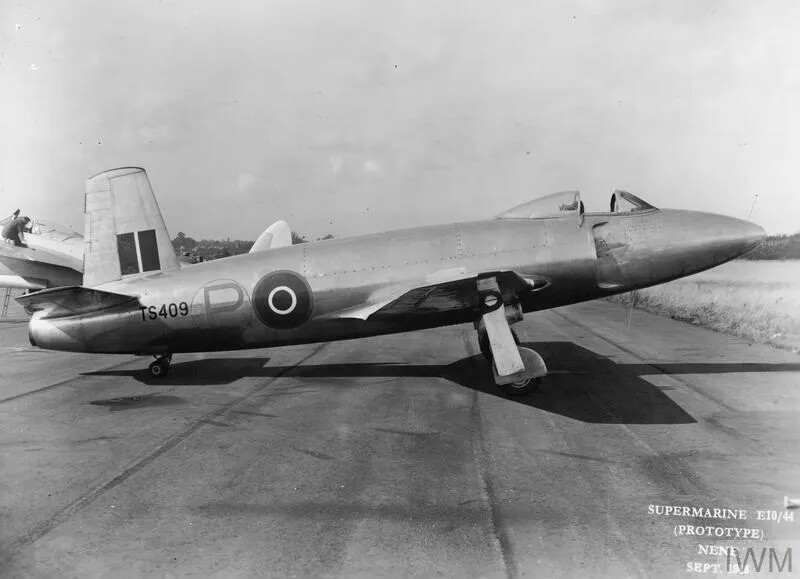
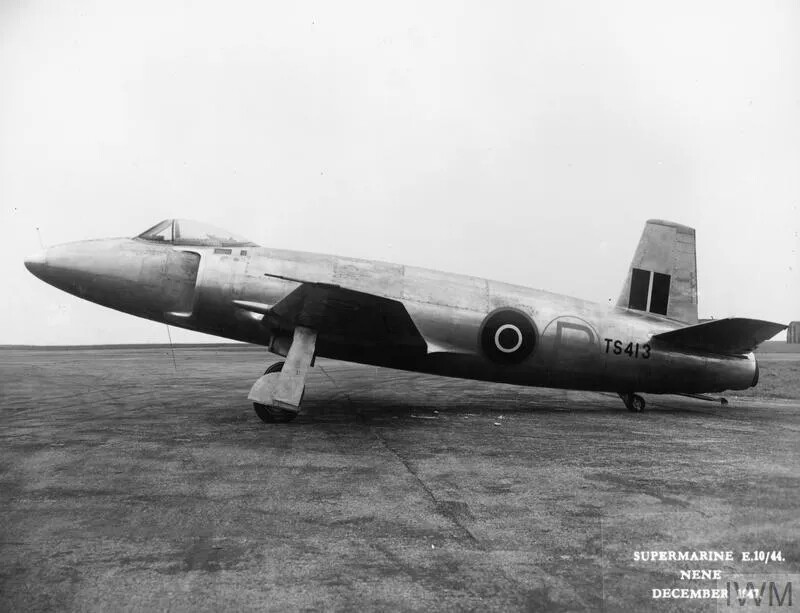
In January 1945, Supermarine had been ordered to stop work on their Seagull air-sea rescue amphibian and give the Type 392 maximum priority. In fact, that same month, the project was even granted priority status. Come February, an updated set of specifications was issued. These clearly set out the following performance targets:
- A top speed of ~480 kt at 30,000 ft
- A service ceiling of 45,000 ft
- Climb rate of 5,000 ft/min
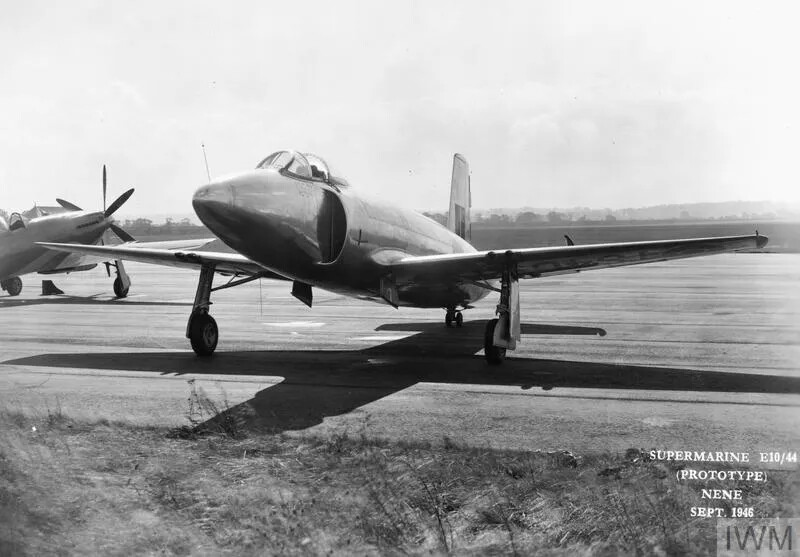
At this stage, the top brass was not thinking about building a carrier fighter for the Navy. Thus, all the development work was aimed strictly at the RAF. On July 9th, Supermarine was awarded a contract to build 24 pre-production jets based on the Spiteful. However, handling problems with the Spiteful prototype delayed progress on the jet-powered version, although work on the three prototypes continued. Due to the delay, the Royal Navy Fleet Air Arm (FAA) instead ordered a batch of 18 Sea Vampire F. Mk. 20s for the purpose of gaining experience with jet aircraft. After evaluating both the Jet Spiteful and the Gloster E.1/44, the RAF decided to reject both designs since neither aircraft offered any noticeable performance advantage over contemporary fighters such as the Gloster Meteor and the de Havilland Vampire, which were the RAF’s first two operational jet aircraft. The Air Ministry then issued a new Specification, E.1/45N (N for naval designation), for a carrier-based fighter, now exclusively for the FAA. Shortly thereafter, Supermarine incorporated the new features of the recent Specification E.1/45N into the prototypes.
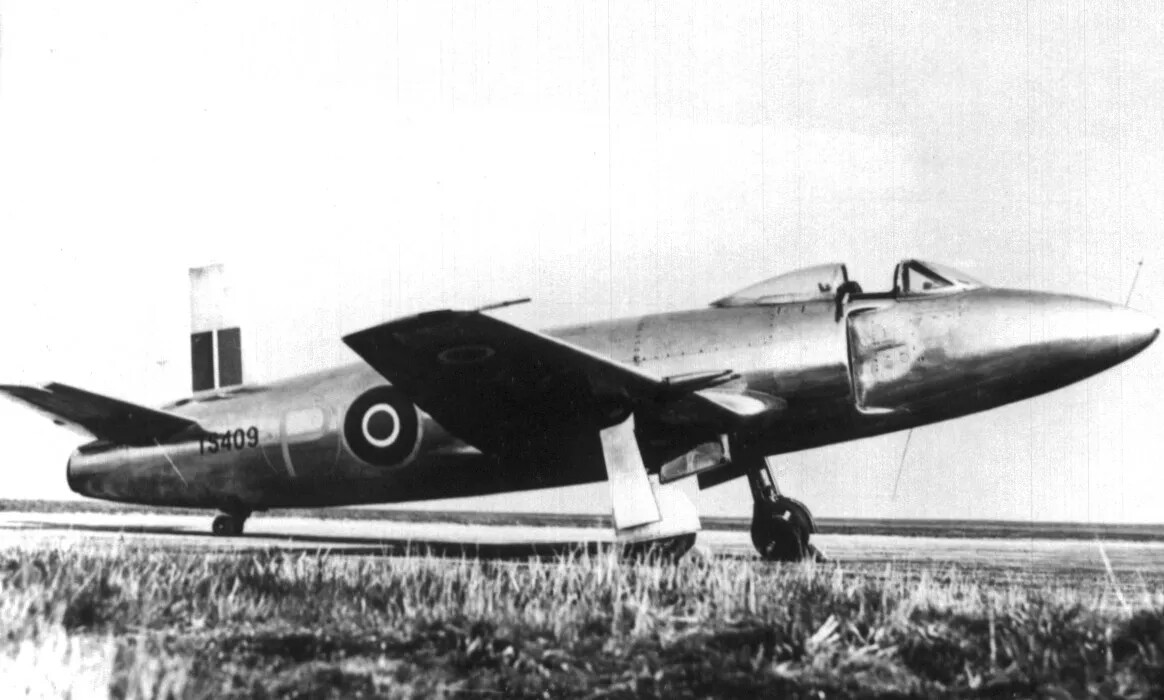
In September of 1945, engineers modified some of the prototypes. They fitted them with arresting hooks, beefed up the landing gear struts, and added speed brakes to the upper wing surfaces. By that point, test flights of the basic piston engine Spiteful already revealed a major flaw. Thanks to its unforgiving laminar flow wing, the aircraft was incredibly unstable and tough to handle at low speeds. For a plane expected to safely trap on short carrier decks, that was a dealbreaker. Despite the red flag, Supermarine pushed ahead anyway with development.
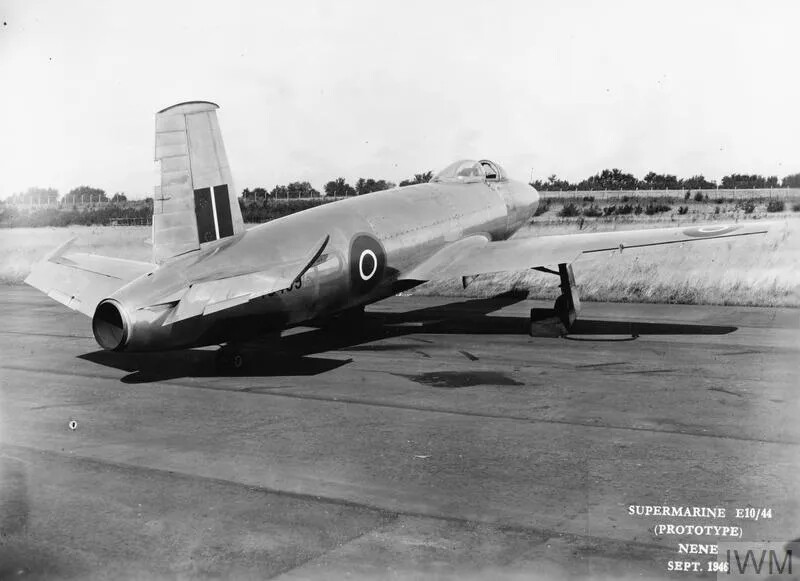
On November 23rd, the Central Fighter Establishment carried out a detailed inspection of the new fighter. After looking it over carefully, the board came with requested changes. Some of their suggestions were actually quite major. For instance, the brass really wanted to see a modern tricycle landing gear. They also wanted the guns from the wing directly into the fuselage. Supermarine refused the design requests because they wanted to keep the new airframe as close to their older models as possible to simplify production. Design work continued to press on.
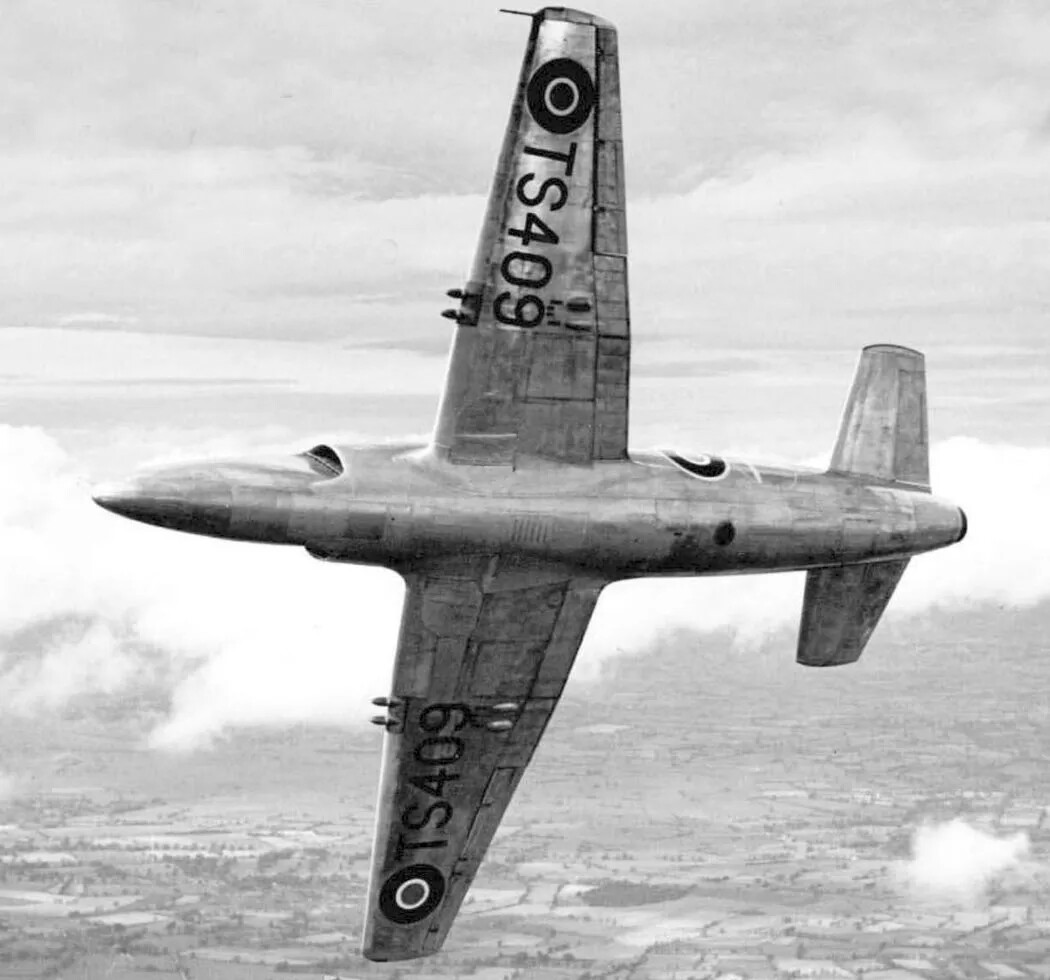
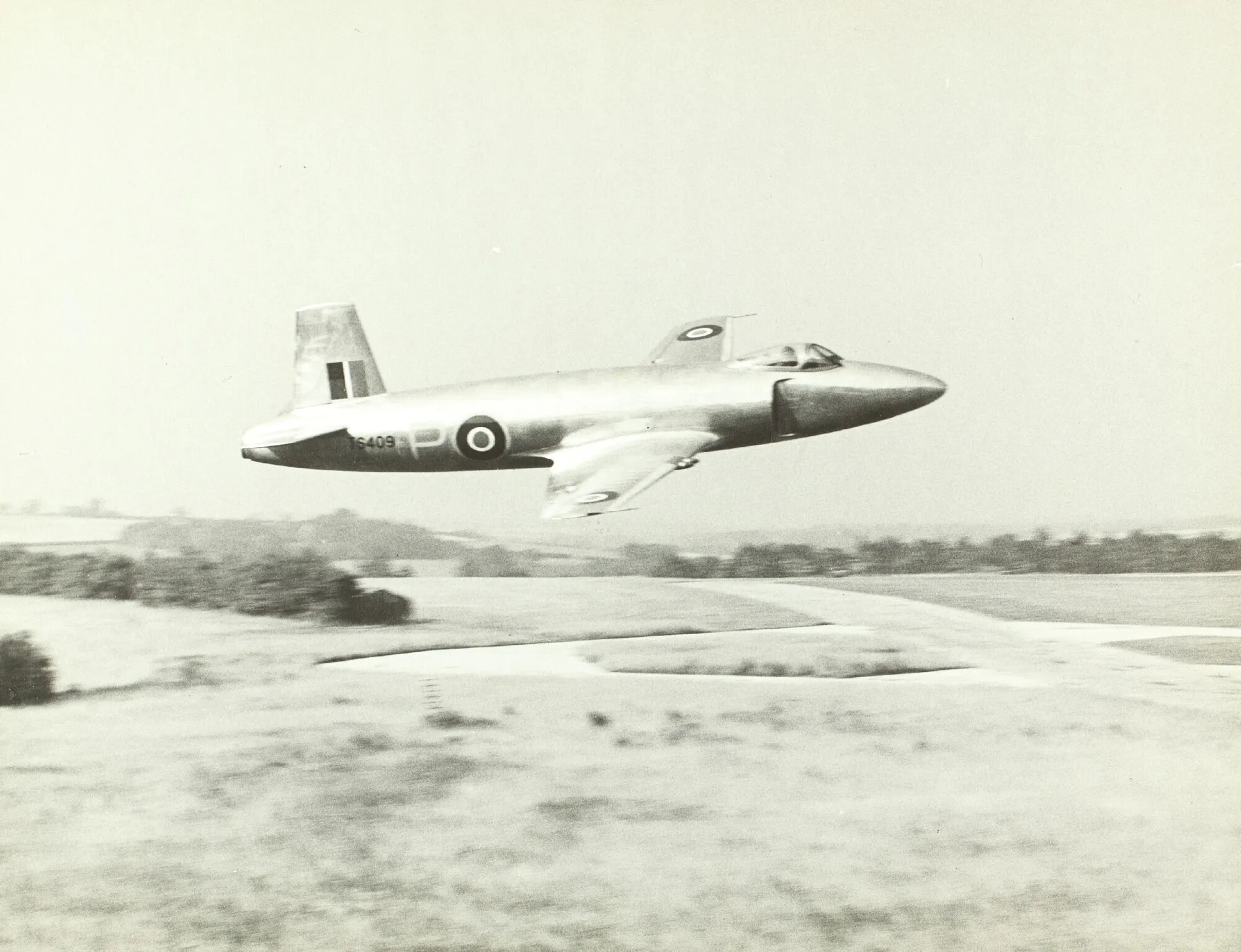
Six of the aircraft were to be standard land-based fighters, while the other 18 were going to be navalized for carrier operations. On top of that, they wanted to split the naval batch right down the middle. Half of them would feature fixed wings. and the other half would get folding wings to save precious hanger space on the carries. But, skipping ahead for a moment, these plans never materialized.
Testing schedule
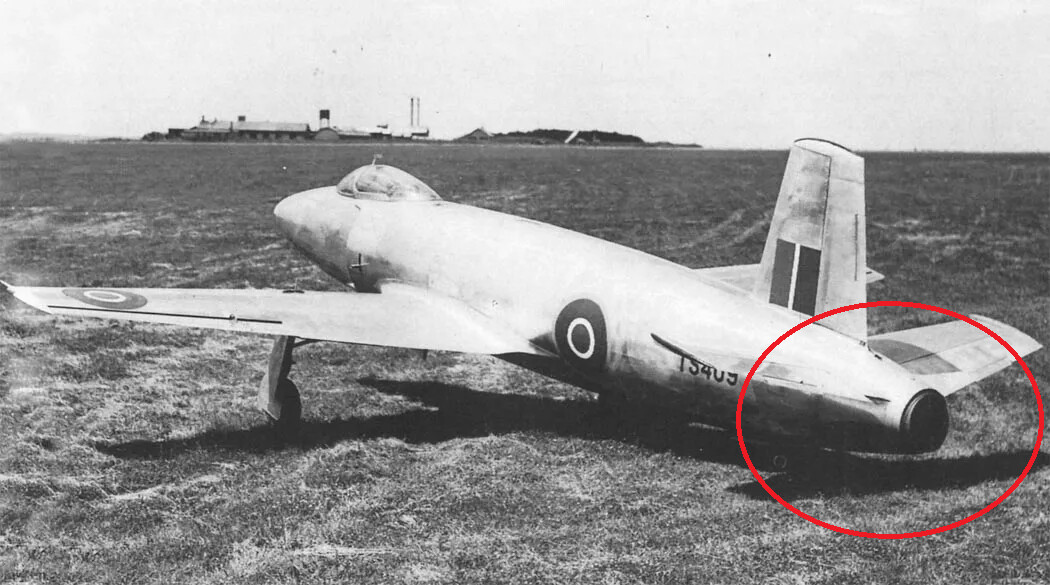
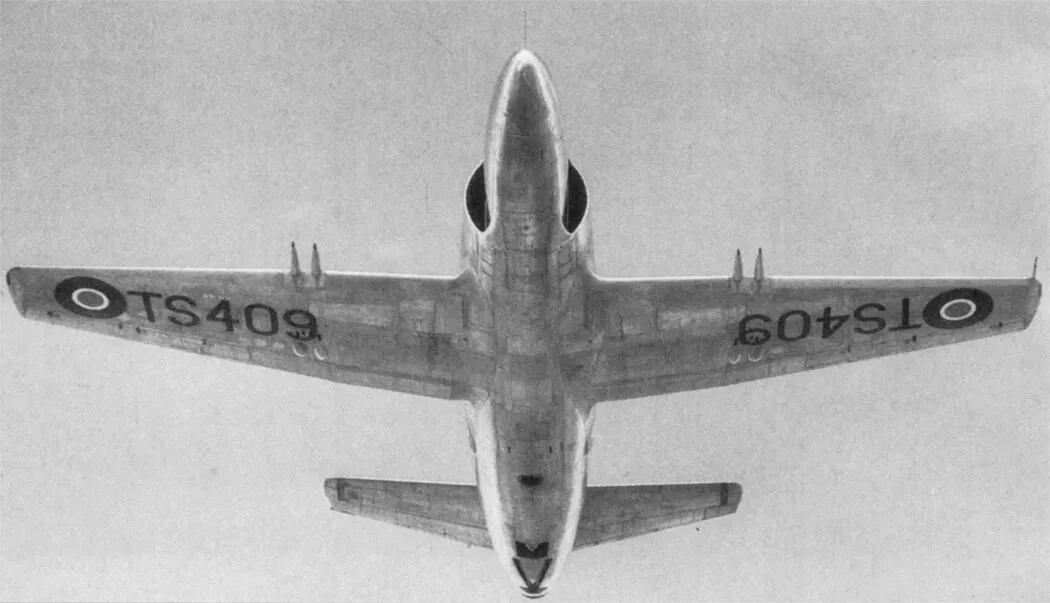
On July 27th, 1946 test pilot Jeffrey Kindersley Quill, took the first prototype, TS409, up for its maiden flight. He flew it from A& AEE Boscombe Down. By then, designers had significantly upgraded the Nene engine. This pushed it to nearly 4,500 lbf of thrust, but they ran into unexpected issues right out of the gate. The jet exhaust was angled downwards and aft. Just taxiing around made it obvious that operating a jet-powered tail-dragger from grass or unpaved strips was going to be a nightmare. Once in the air, Quill discovered serious directional stability issues, too. As it turned out, the engineers had simply undersized the vertical stabilizer.
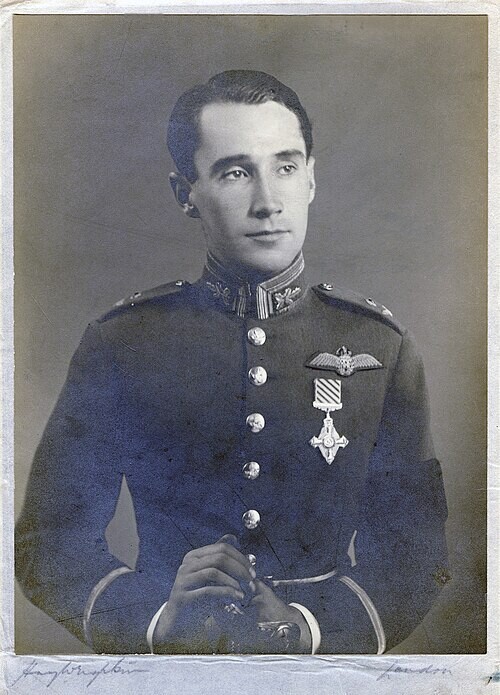
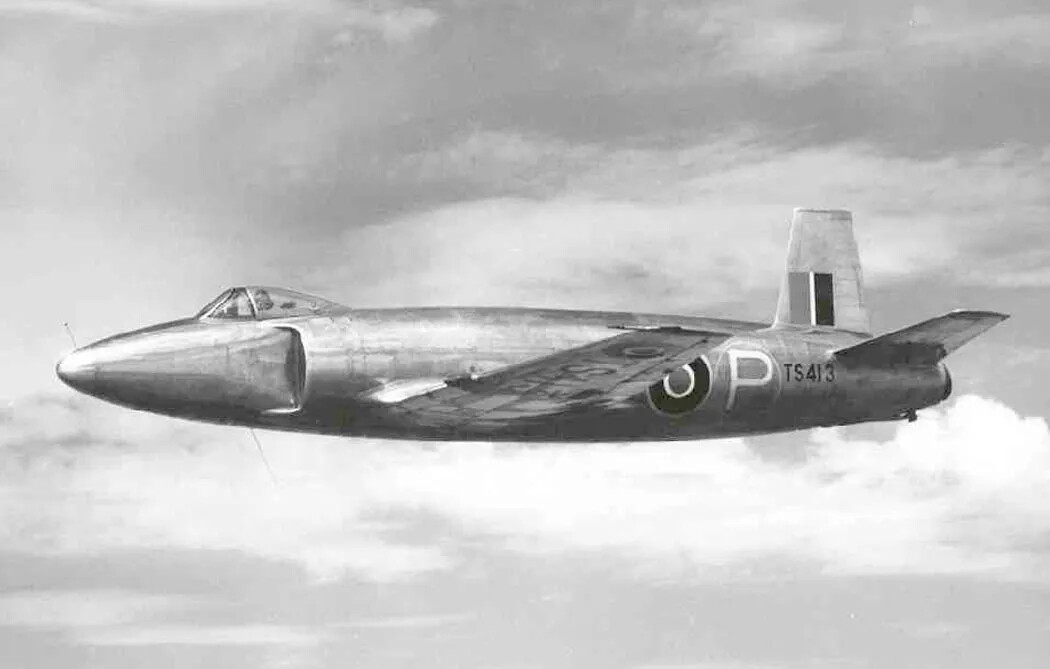
The second prototype was flown by Michael “Mike"John Lithgow, and it did not get off the ground until nearly a year later on June 17th, 1947. The version was built as a proper carrier-based fighter. It featured a modified tail and flaps, increased fuel capacity, and an in-house Supermarine ejection seat. On top of that, it was powered by an upgraded Nene Mk. 3 engine. This power plant put out around 5,000 lb of thrust, but once again, the test results were a letdown. The climb rate was still abysmal. Furthermore, the old directional stability issues had not gone away. The aircraft was constantly yawing in flight. Because of this, tracking a target and firing the guns accurately would have been nearly impossible.
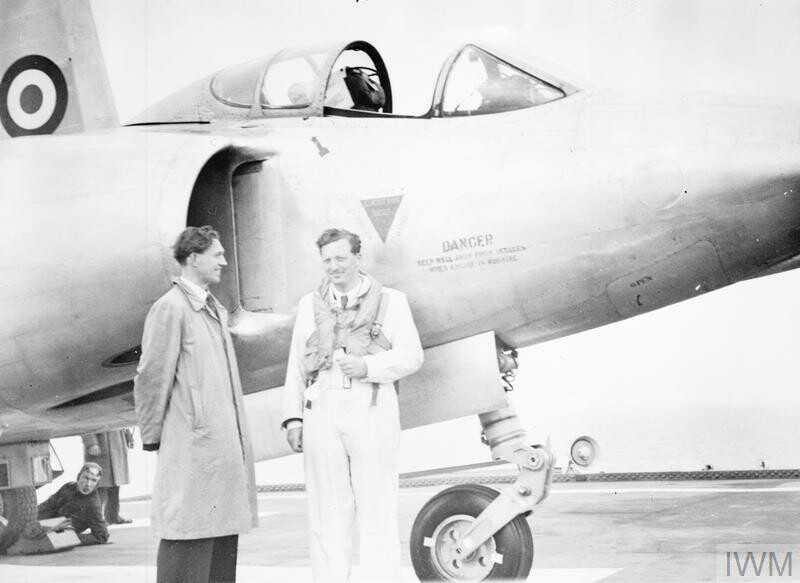
Lithgow made the first carrier landing aboard HMS Illustrious on October 15th, 1947. By October 28th, they had kicked off an intensive series of nearly 30 carrier launches and traps.
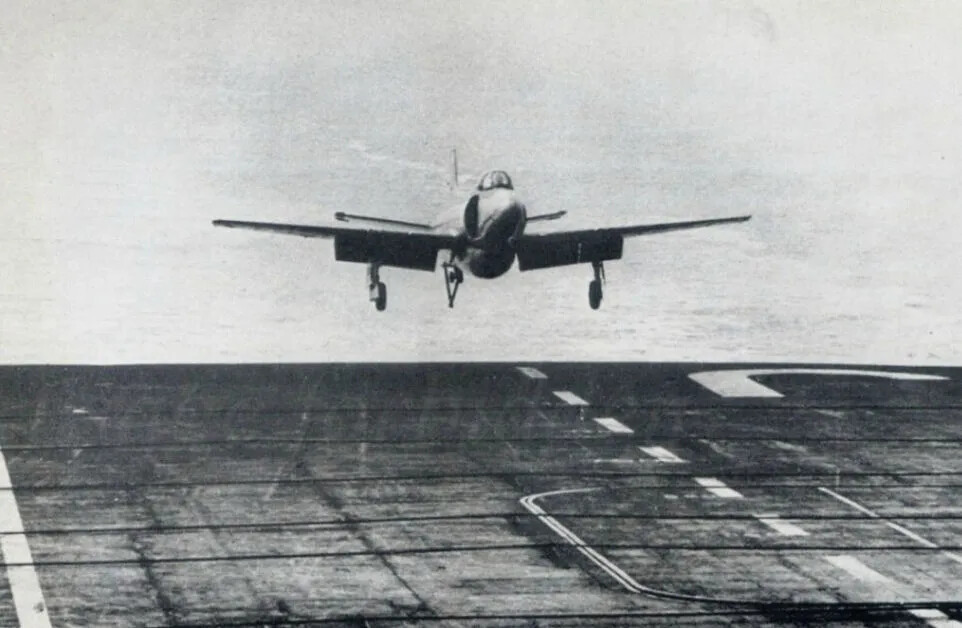
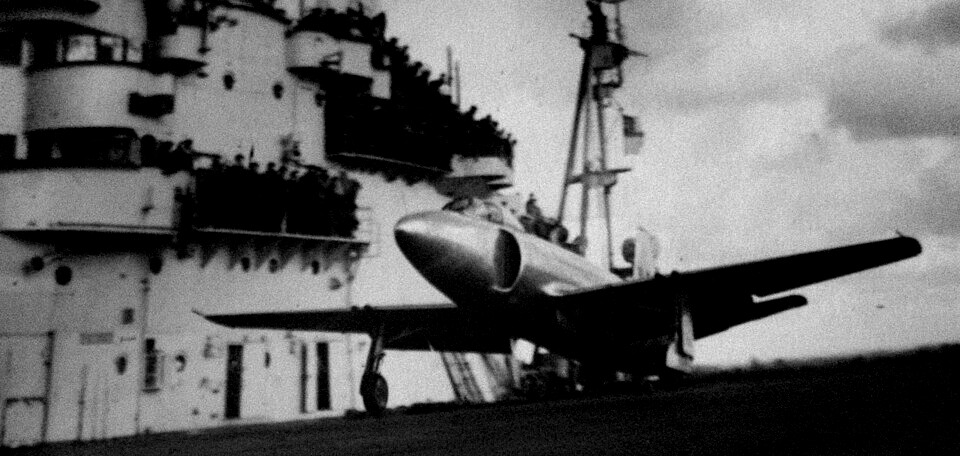
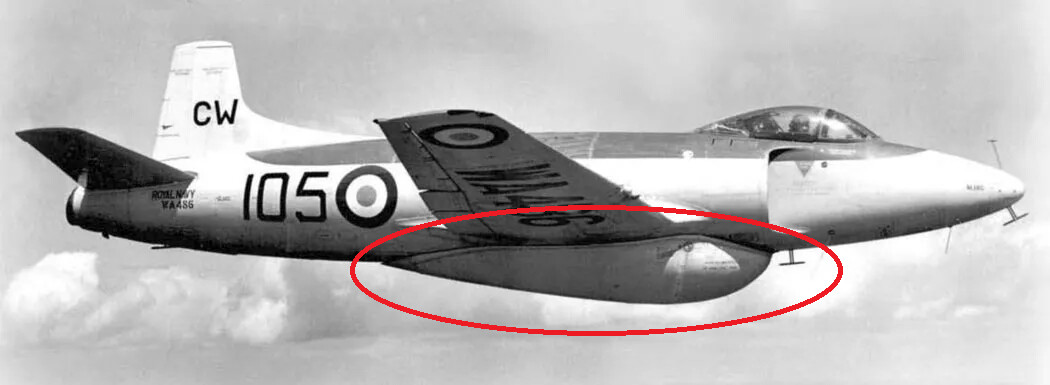
Legendary test pilots Eric Melrose “Winkle” Brown and Stanley Gordon Orr “Stan” also joined in on these risky trials. Following these grueling flight trials, engineers had to quickly stiffen the tail wheel shock strut. They also adjusted the angle of the tail hook so the jet could catch the arresting wires more reliably. Finally, to address the jet’s notoriously short range, they fitted a massive conformal belly tank under the fuselage. This tank held about 324 gal of fuel. The Royal Navy was growing increasingly disappointed with the jet’s performance. Even so, testing, once again, continued to push forward.
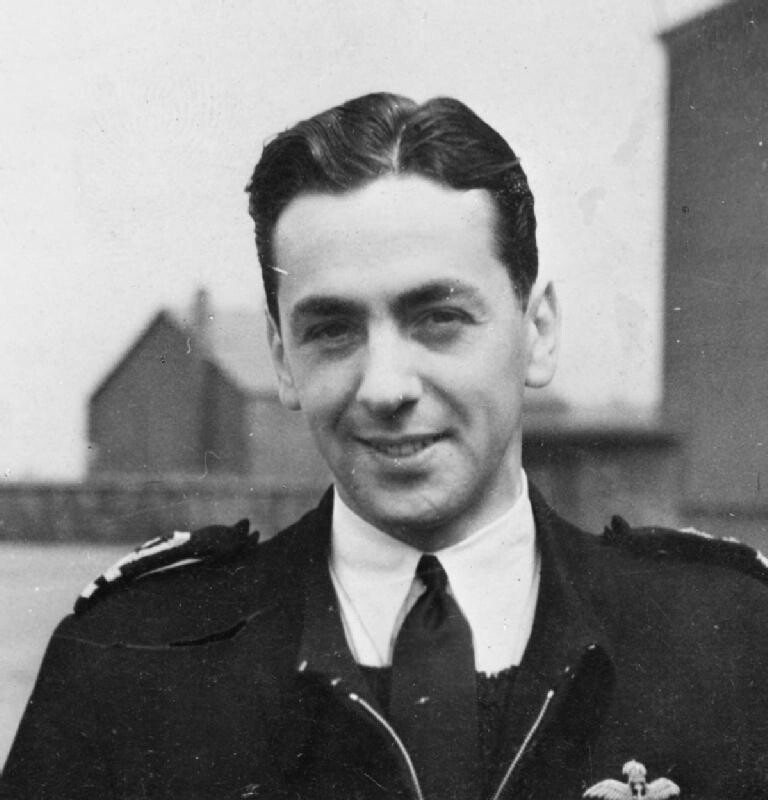
On February 26th, 1948, Lithgow took the controls of the first prototype. During this test flight, he set a new world speed record. Flying a standard 100 km closed circuit, he pushed the jet to an impressive 565 mph. Shortly after, on March 31st, the fighter finally received its official name: the Attacker. But during flight testing in the spring of 1948, another major issue emerged. When the aircraft was flying at low altitude near the speed of sound, aerodynamic loads on the elevator would suddenly spike to dangerous levels. This caused the aircraft to pitch down aggressively. It forced the jet into an uncommanded steep dive. Unfortunately, this instability soon led to tragedy.
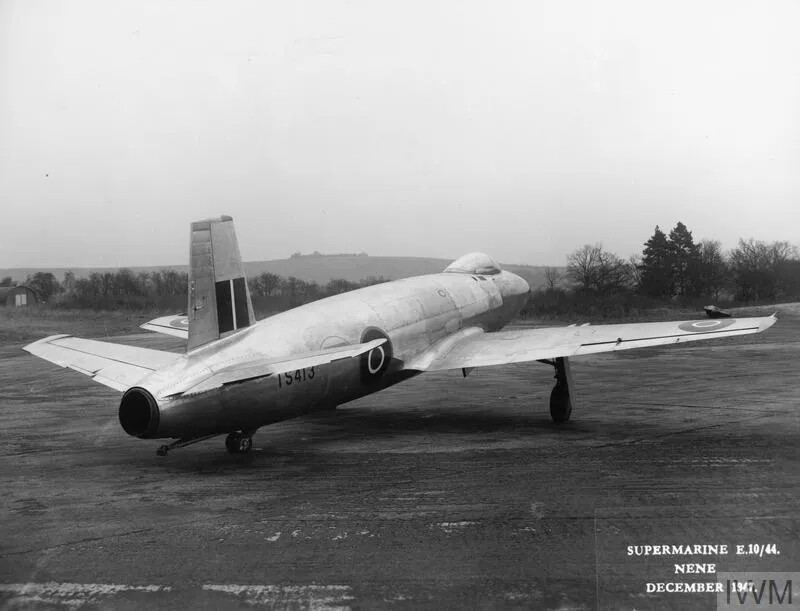
In June of that year, the second prototype crashed. This claimed the life of Royal Navy pilot John King Joyce. The exact cause of the crash was never fully established at the time. However, engineers strongly suspected violent in-flight oscillations.
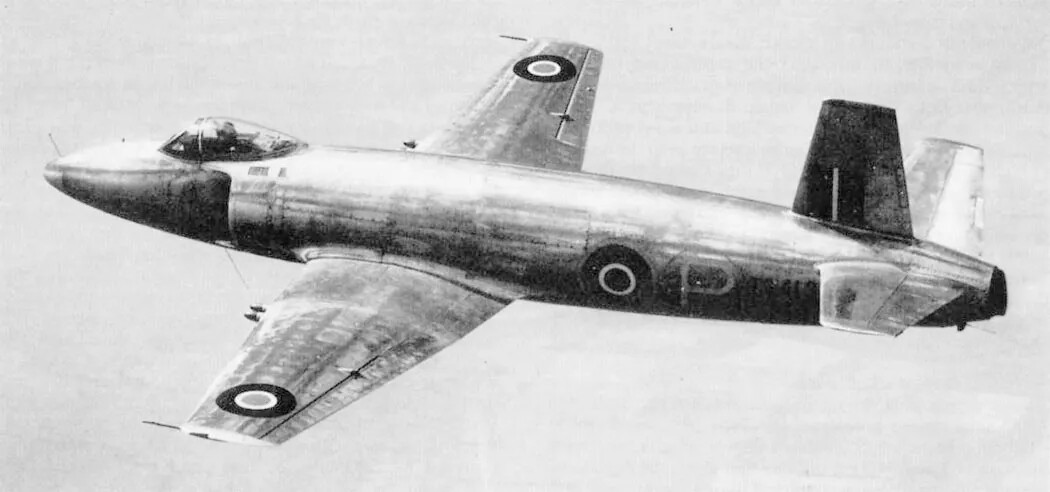
Furthermore, tests showed that the aircraft had terrible spin recovery characteristics. To solve this and improve directional stability, designers decided to fit the aircraft with a dorsal fin. This was an aerodynamic fairing placed just ahead of the vertical stabilizer. However, development dragged on. Because of this delay, the updated aircraft did not take to the skies until January of 1950.
The third prototype, TS416, was also modified with a swept wing and swept tailplane. It was designated as the Supermarine Type 510 and re-registered with serial number VV106. It would first fly in December of 1948 and eventually led to the development of the Swift.
Back with the Attacker itself, engineers had to rebuild the first prototype into a fully capable carrier variant just to keep the testing schedule on track. Additionally, a contract was signed for a fourth prototype. Its primary difference was the wing, which was shifted aft by about 13 in. It also featured enlarged air intakes for improved engine cooling. Meanwhile, the Royal Navy’s situation remained difficult. The competing Sea Vampire never truly caught on for carrier operations due to its low thrust and painfully short combat radius. As a result, the fleet was still flying ageing piston-engined fighters from the Second World War.
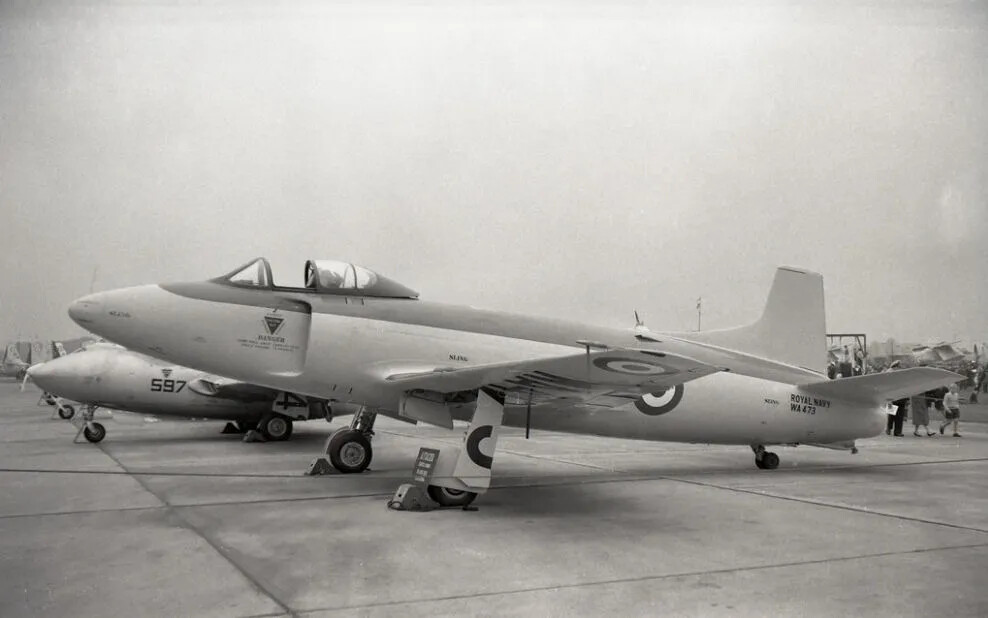
Given the situation, the Attacker unexpectedly became the only viable modern alternative. Faced with no other options and despite its known technical flaws, the British Admiralty placed an inital order for 63 aircraft. This took place in late October 1948. The production fighters were designated as the Attacker F. Mk. 1. ccording to military doctrine, the new aircraft’s primary roles were daytime interception, combat air patrol and long-range strike operations. To ensure the fighter fit aboard aircraft carriers, it was equipped with folding wing tips, and, for pilot safety, it was fitted with a modern Martin-Baker Mk. 1 ejection seat. The first production aircraft successfully took to the skies on April 4th, 1950.
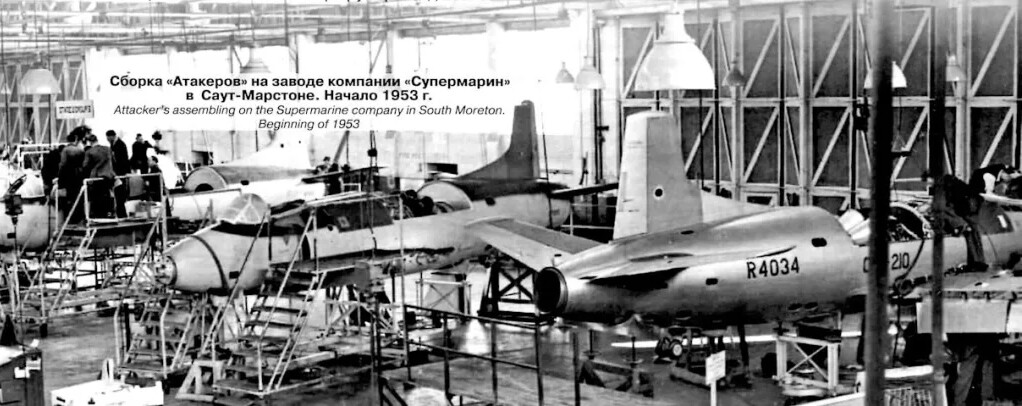
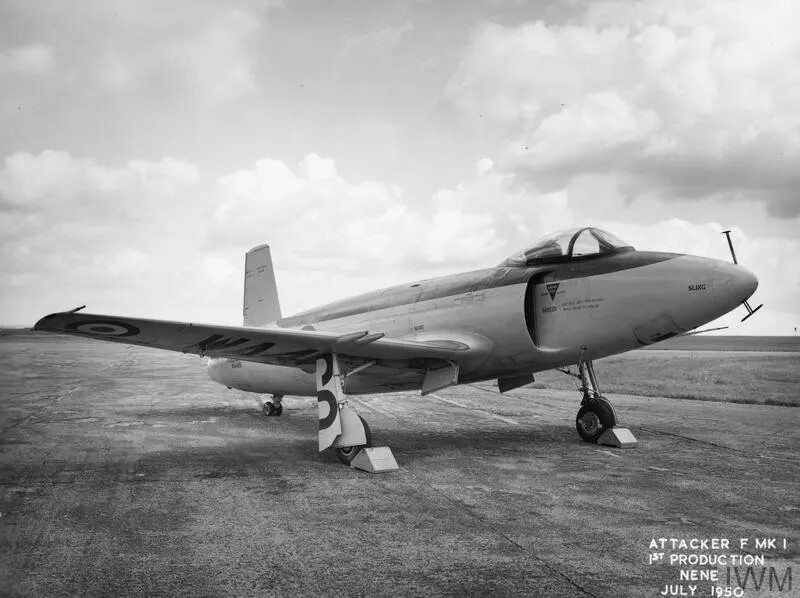
Just a month later, during a routine test flight, the pilot decided to evaluate the effectiveness of the speed brakes. During the third steep dive, as the airspeed approached 430 kt, a critical emergency occurred. The right wingtip suddenly folded upwards, causing the aircraft to instantly and violently roll to the right. However, by applying full left rudder, the pilot miraculously managed to somewhat maintain his altitude and heading. After bleeding off airspeed to around 270 knots, he made a risky decision. He was going to try and land the damaged fighter. Because the folded wing tip had completely jammed the ailerons, lateral control was incredibly difficult. After extending the landing gear, the pilot began a very wide left turn, controlling the aircraft using nothing but the rudder.
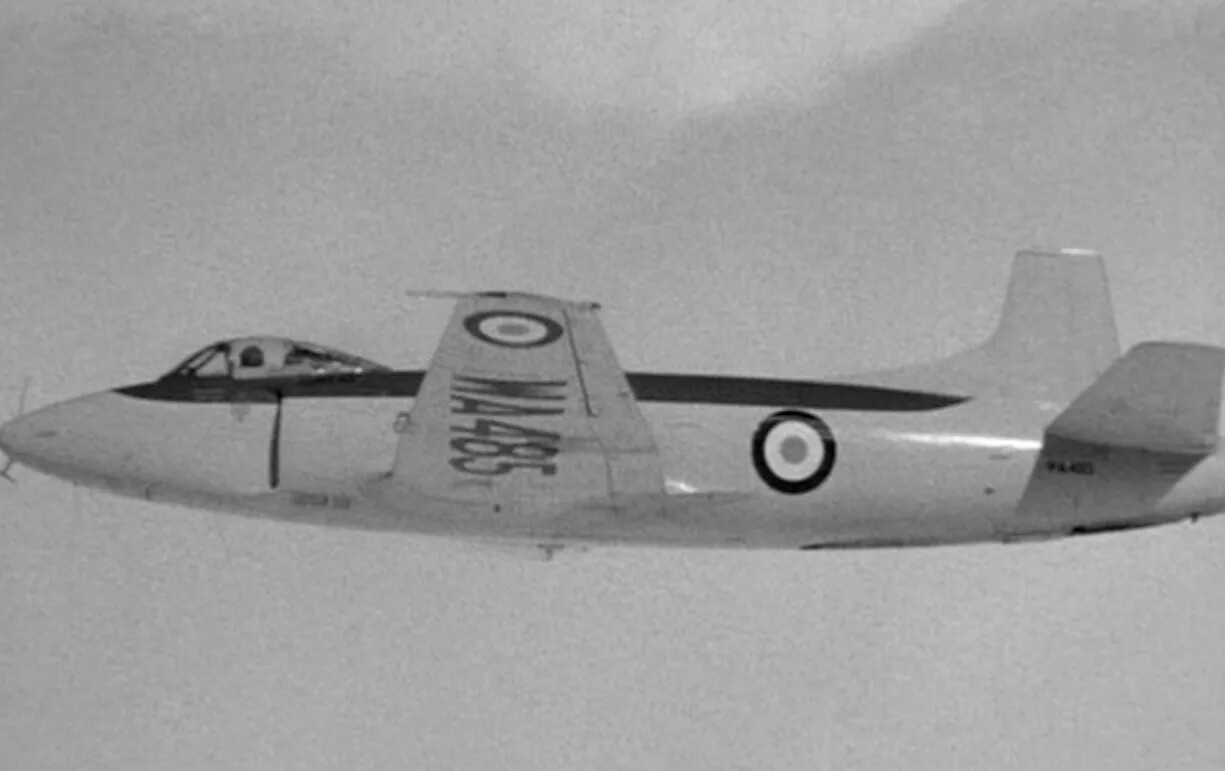
The pilot was Leslie Richard Kulkhone and he actually managed to limp the crippled fighter all the way back to South Marston. Incredibly, on the final descent, he even managed to drop the flaps, which seemed almost impossible. The aircraft touched down hard on the runway at roughly 200 kt, yawing wildly to the side. For the last 300 ft of the landing roll, a massive shower of sparks shot out from under the left main gear.
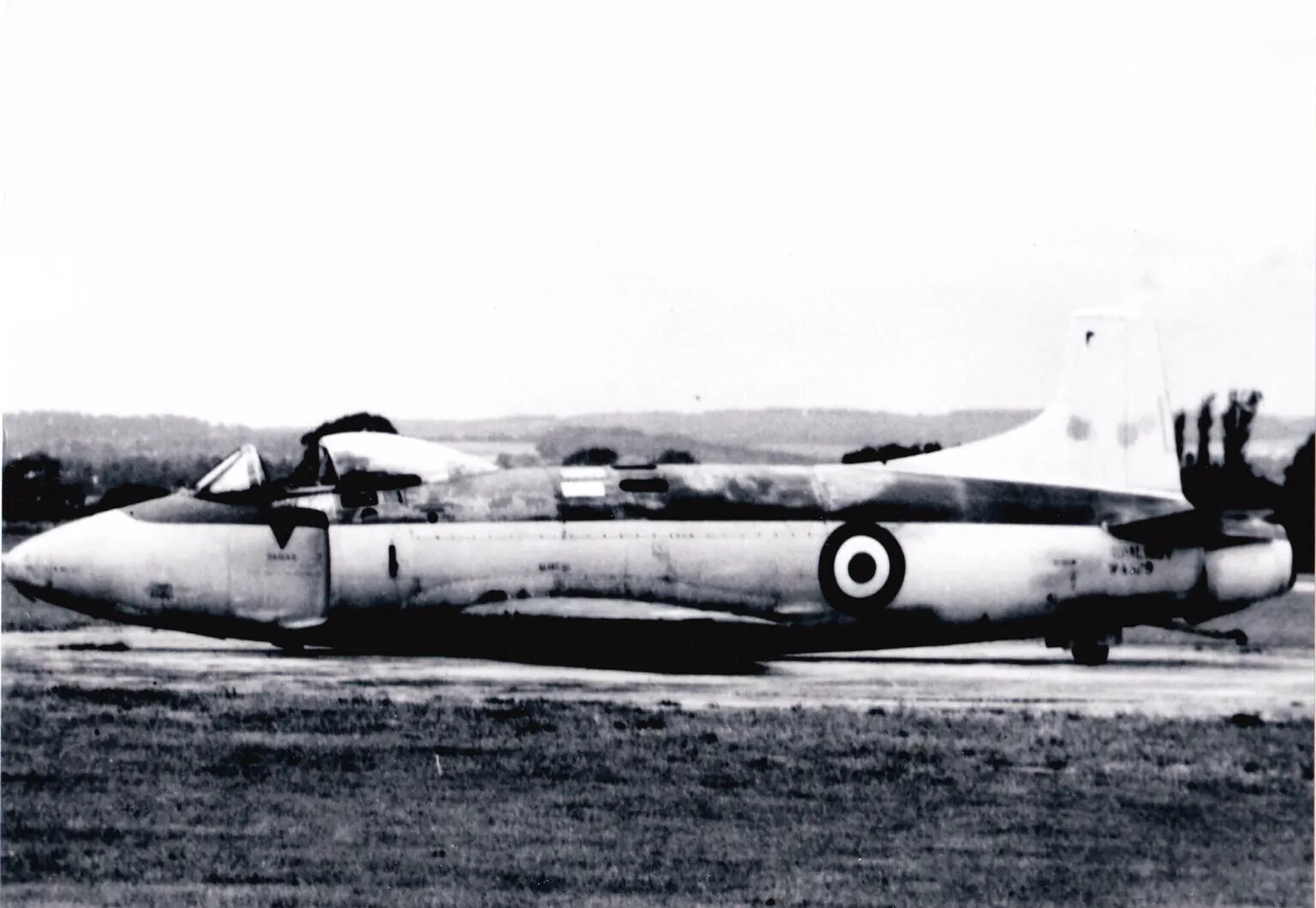
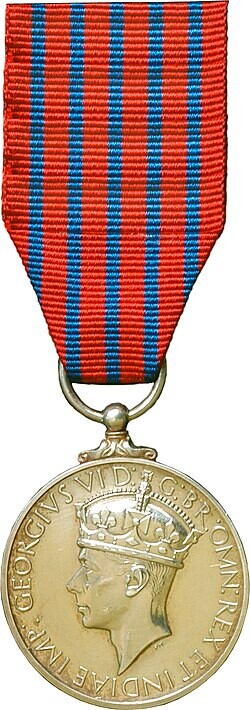
The friction had completely shredded the tire, and the heavy fighter was skidding across the concrete left wing low, in the end, it miraculously came to a stop just 30ft from the runway edge for an incredible courage, composure and superb airmanship. Leslie Richard Kulkhone was officially awarded the George Medal — an award given to citizens, usually civilians, of the United Kingdom and the Commonwealth for bravery in circumstances where military honours are not considered appropriate.
Improvements
Following the Attacker’s acceptance into the Fleet Air Arm in August 1951, changes followed to improve the aircraft.
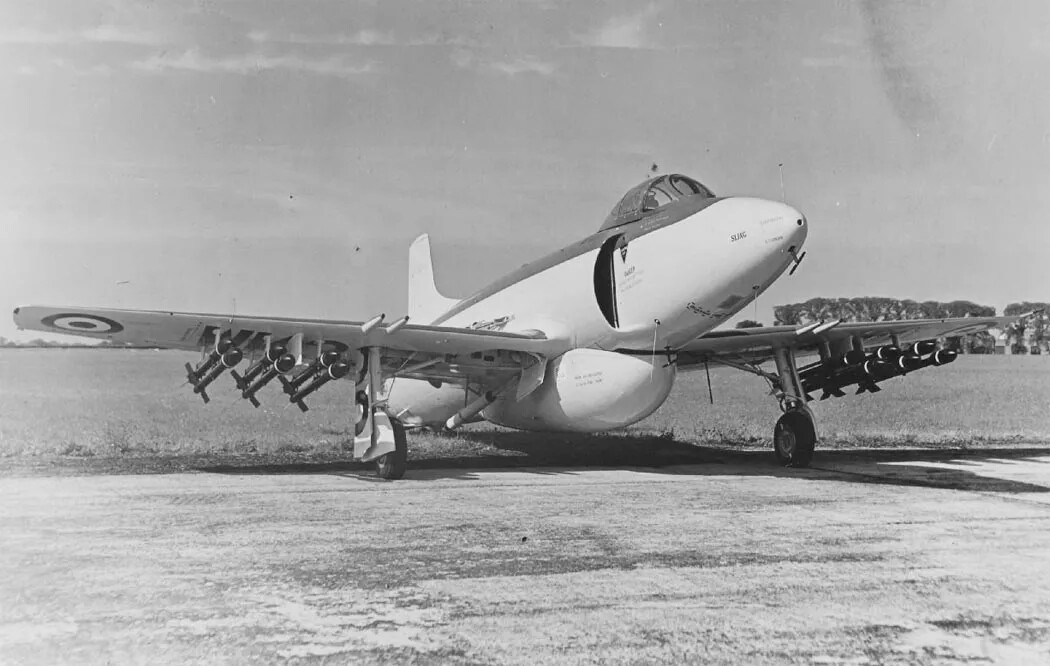
The first was the Attacker F.B. Mk. 1, packing extra firepower. It featured underwing hardpoints for two 1,000 lb bombs along with eight rails for unguided rockets (four on each wing). Interestingly, those early production aircraft did not originally feature the stabilizing dorsal fin on the tail. Because of this, all of those jets eventually had to be sent back to the factory for a mandatory retrofit. In total, 43 Attackers F. Mk. 1s and 16 F.B. Mk. 1s were built for the FAA.
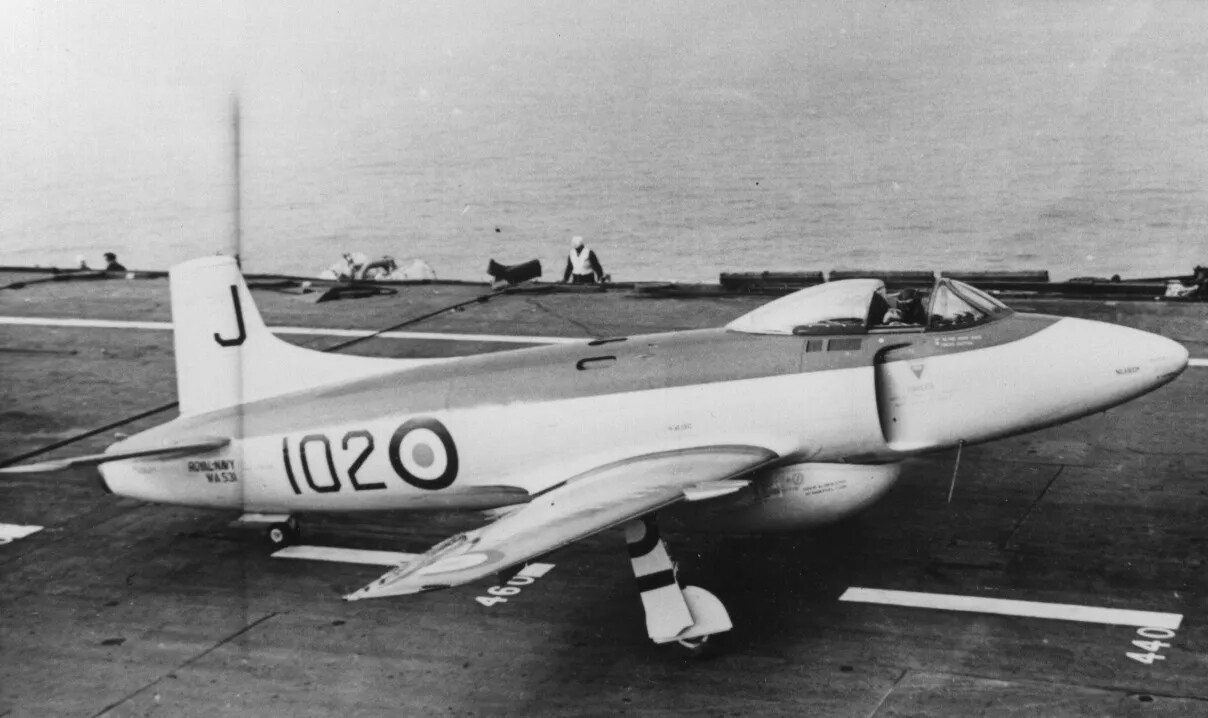
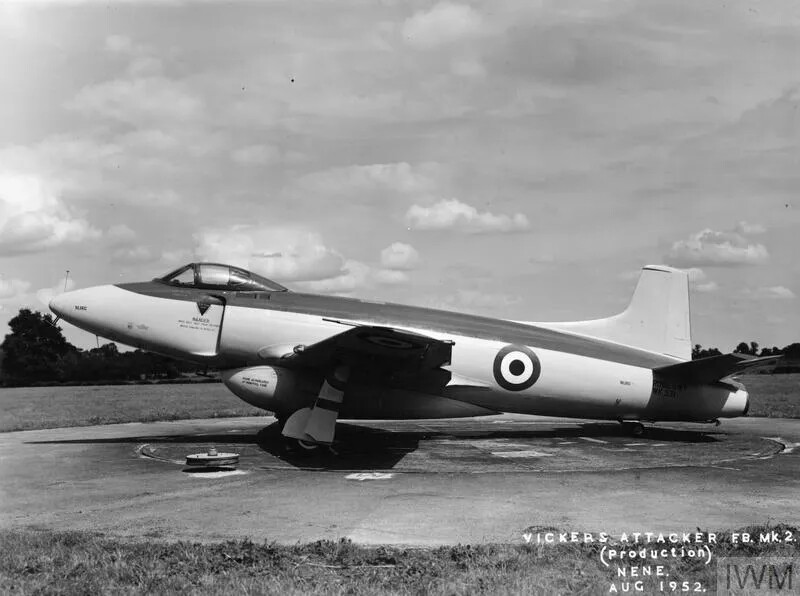
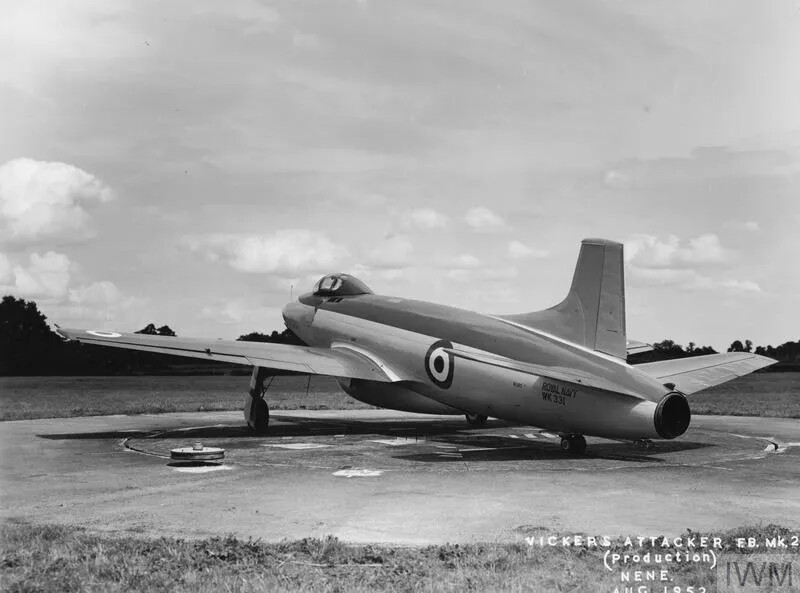
The next, and ultimately most widely produced, variant of the aircraft was the F.B. Mk. 2. Its key upgrades included a more powerful Rolls-Royce Nene Mk. 102 engine, with an electric starter, along with a much-improved sliding canopy. The armament, meanwhile, remained identical to its predecessor. They built 84 examples of this successful variant. The Royal Navy officially accepted the final airframe into service in March 1954.
Attacker F.B. Mk.1
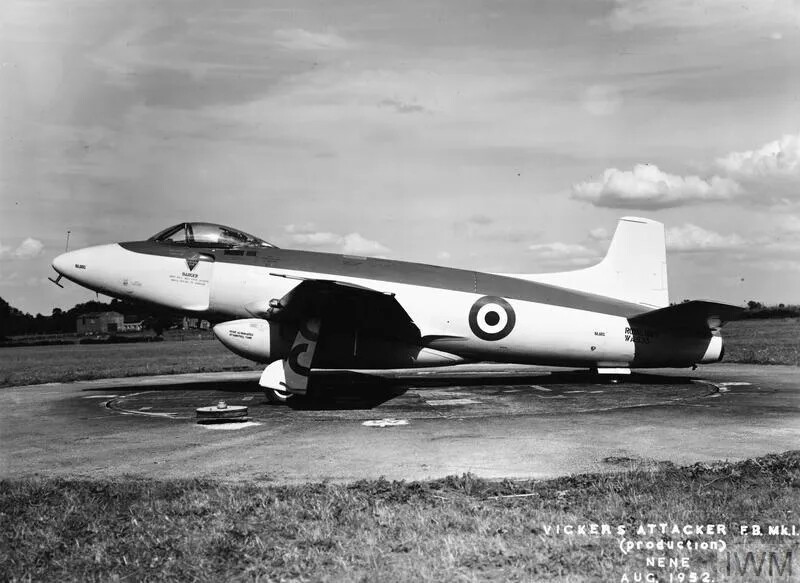
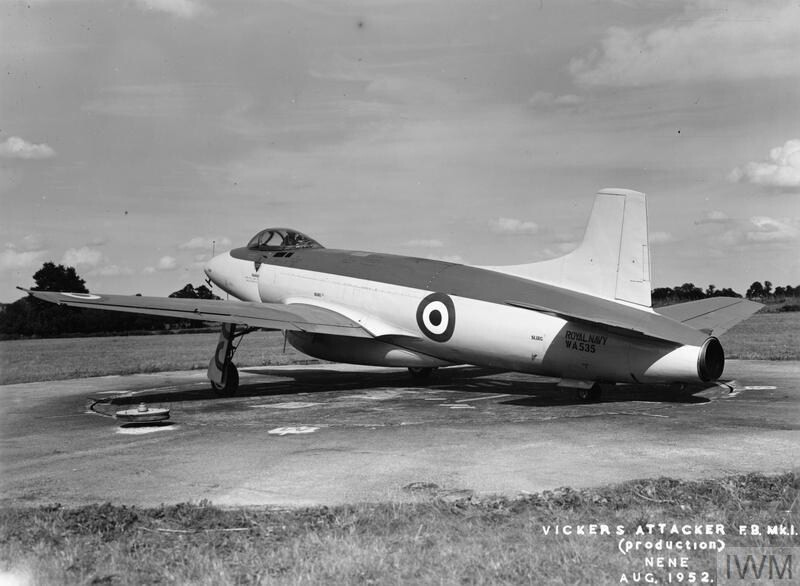
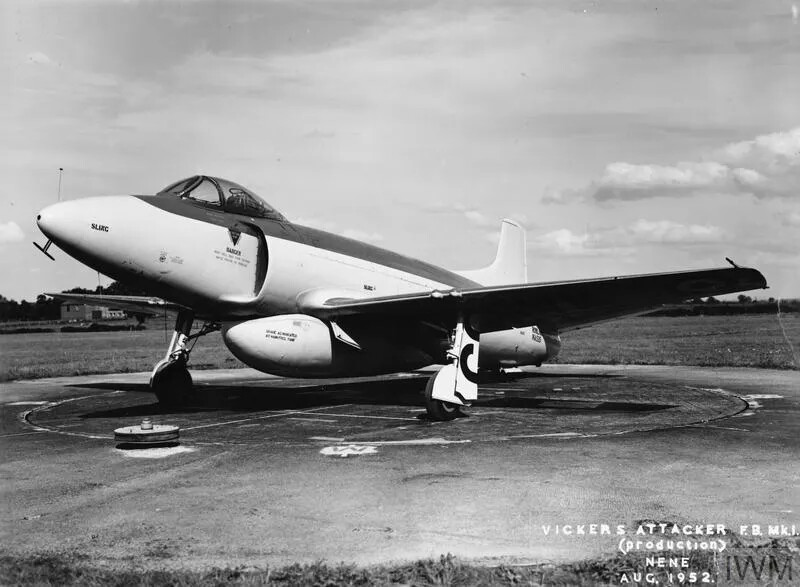
Attacker F.B. Mk.2
Export Service
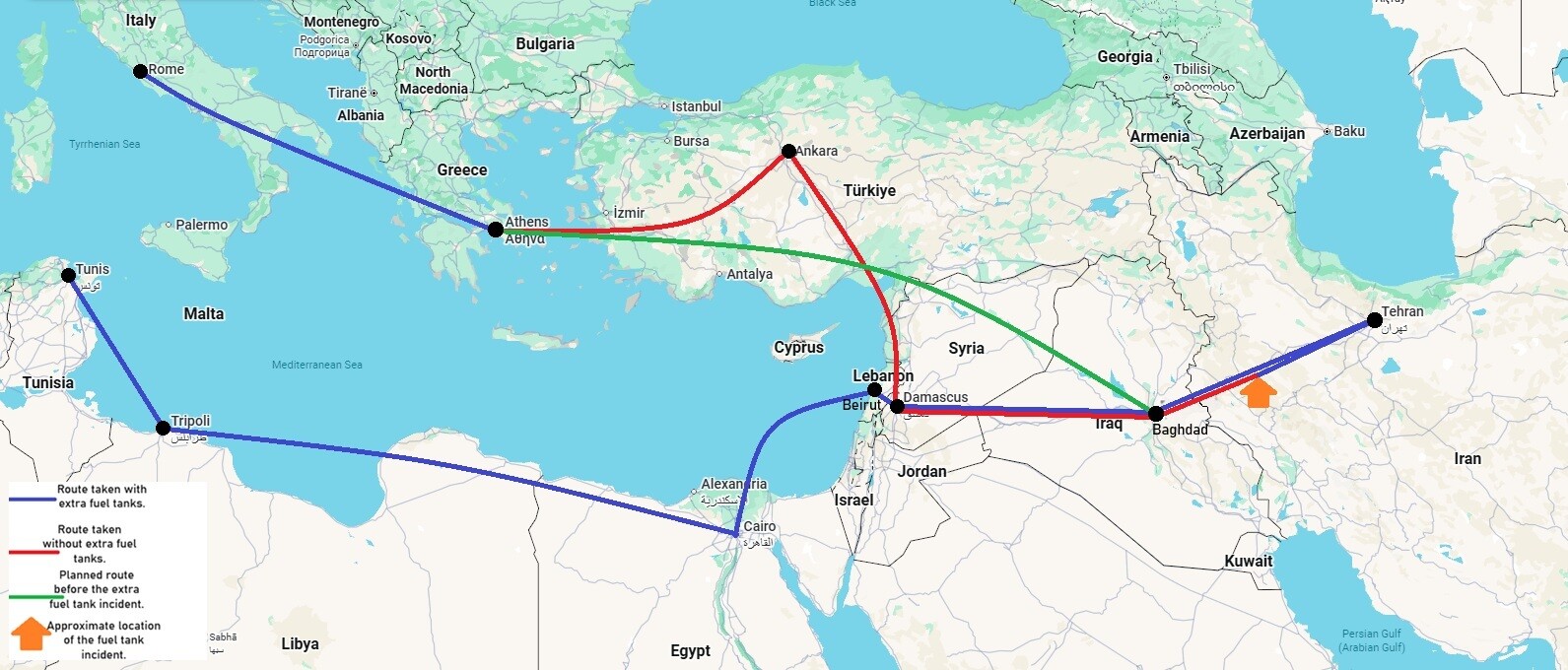
In early 1950, Supermarines management decided to organize a major sales tour for their new Attacker jet fighter across the Near and Middle East. They carefully planned the route to take full advantage of Royal Air Force bases as the RAF still maintained a strong military presence in the region back then. On May 19th, 1950, test pilot Mike Lithgow was at the controls, and the first prototype took off from the UK. It headed out on its long journey, the ground support crew followed close behind in a Vickers Valetta transport.
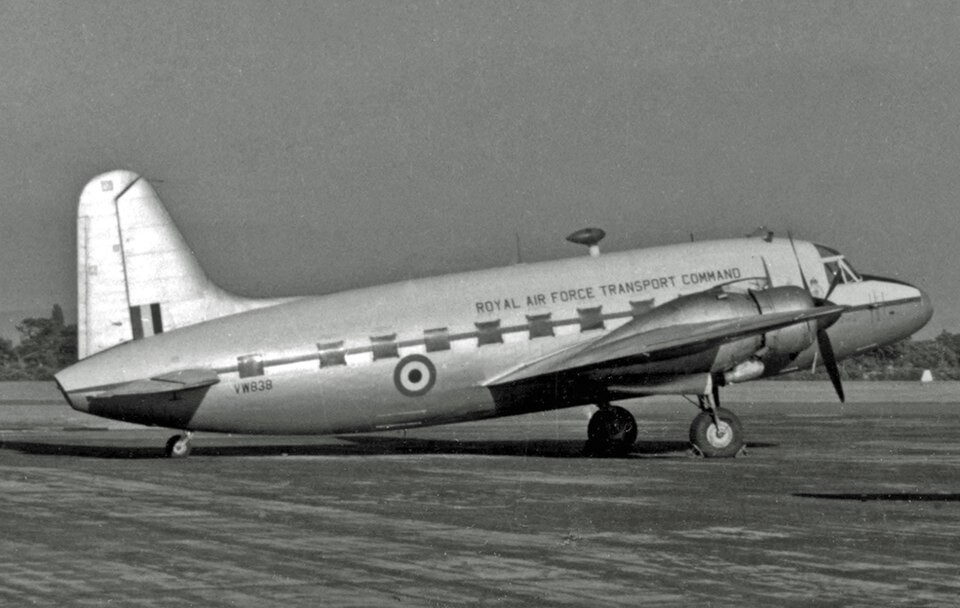
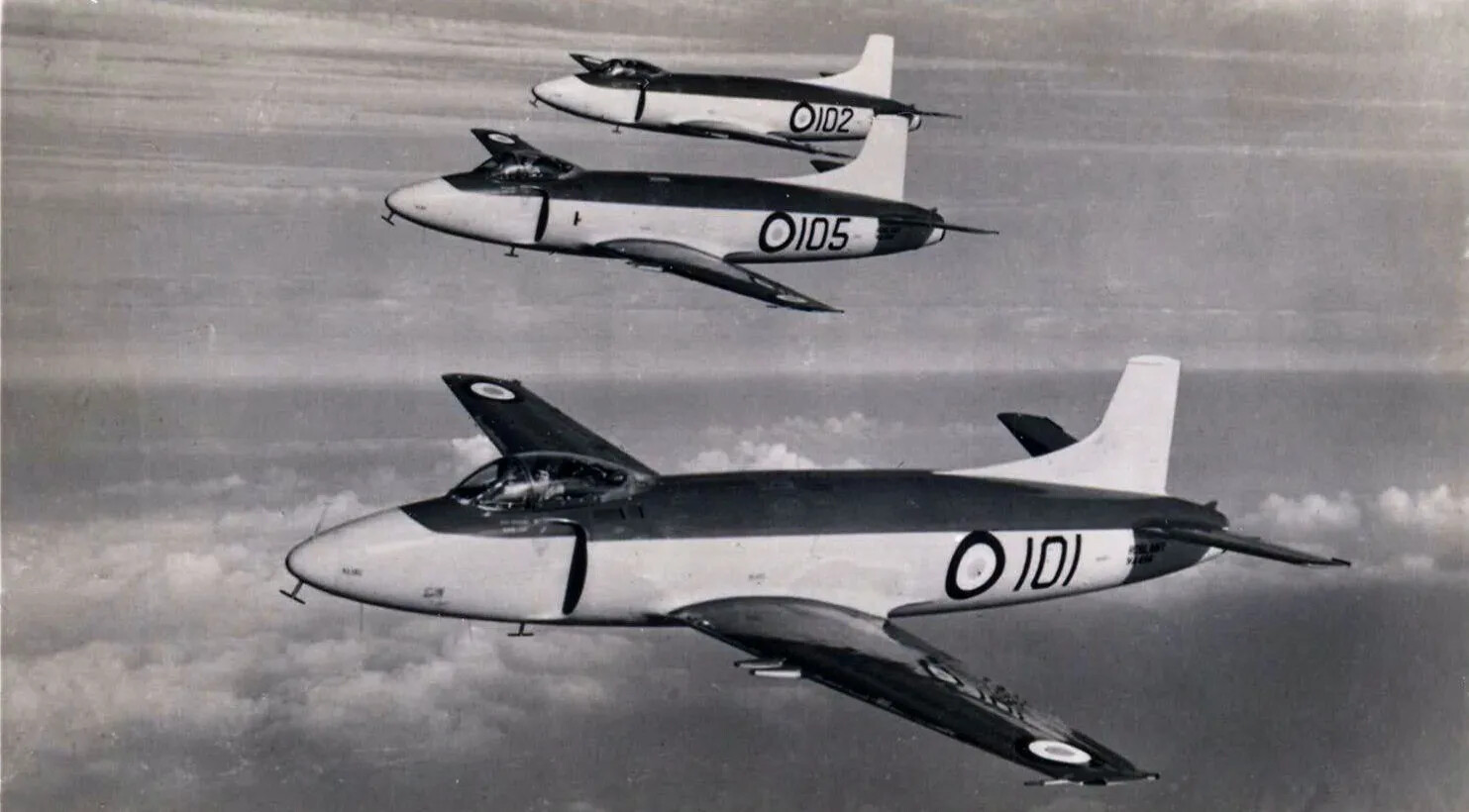
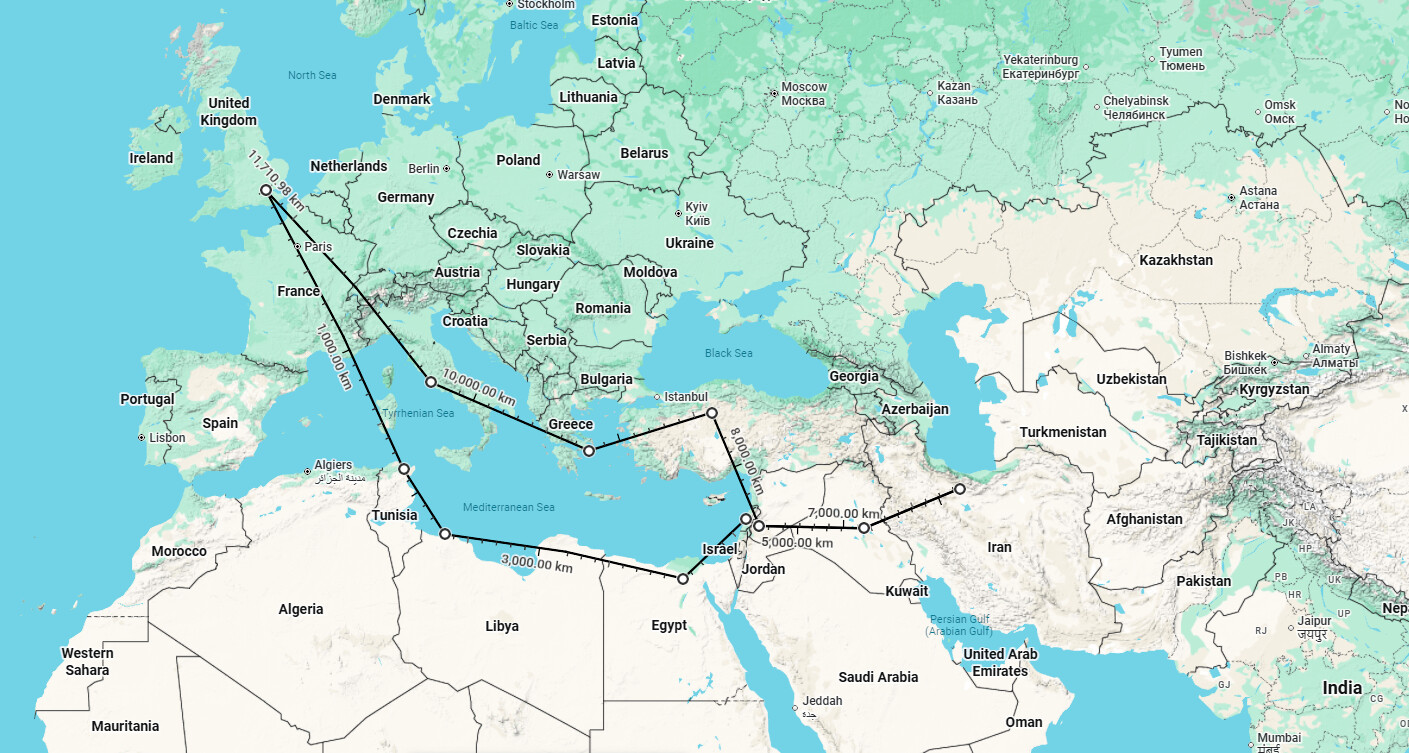
The new jet flew its first demonstration in Tunis, the capital of Tunisia, under French protectorate at the time. Then, the delegation departed for Libya and performed impressive aerial demonstrations over the skies of Tripoli. Leaving Tripoli, the British delegation arrived in Cairo, Egypt, where they were received by King Farouk I (Arabic: فاروق الاول) of Egypt. From there, they headed to Beirut, Lebanon. Interestingly, while flying over the Mediterranean, the small formation tried to stay as far away from the eastern coast as possible, as they feared an unpredictable response from the newly formed Israeli Air Force. From there, the route continued through Damascus, Syria, and Baghdad, Iraq. Finally, they reached Tehran, Iran.
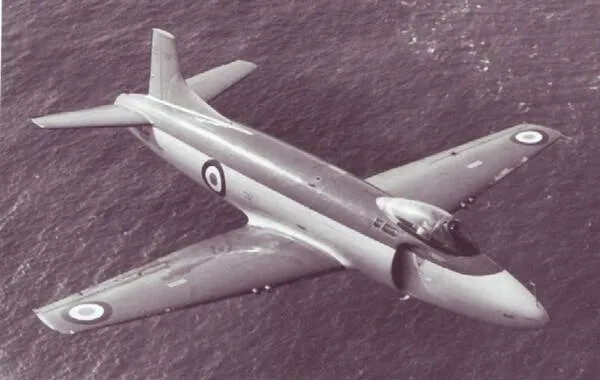
In the Iranian capital, the British put on two major flight demonstrations. The second one was flown specifically for Shah Mohammad Reza Pahlavi (محمد رضا شاه پهلوی). The Iranian ruler was not an experienced pilot himself, but he was extremely interested in the new jet. He started heavily pressuring his guests to let him fly it himself. However, the British could not risk letting a foreign head of state fly along in an unfamiliar jet.
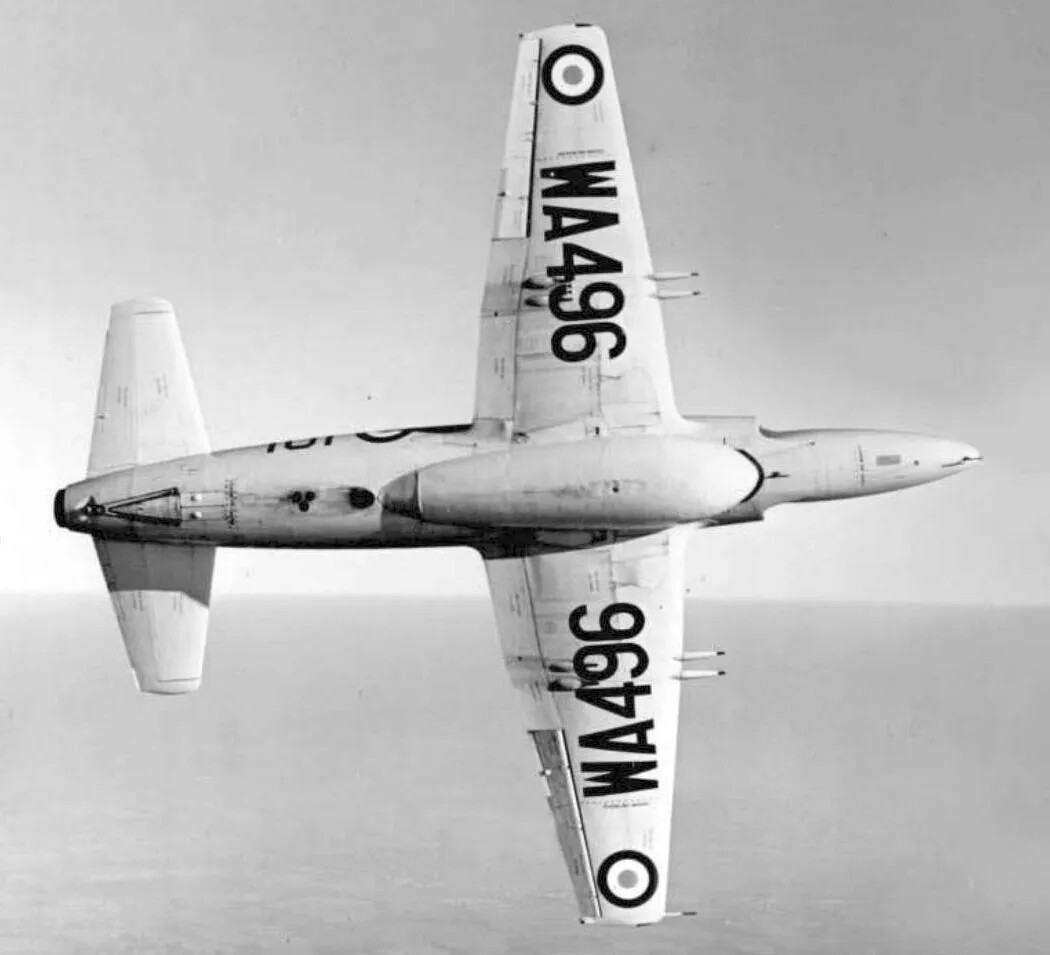
From Iran, the delegation headed home, but during the flight to Baghdad, a serious issue arose: the fighter suddenly lost its centerline drop tank, near Kermanshah and Bisotun. In 1950, Iran’s aviation network was small and primitive, with only Tehran and Abadan serving as adequately operational airports for scheduled flights. While rudimentary airfields for basic operations existed, they lacked the infrastructure seen in later decades. The country’s first scheduled flights linked the capital to major cities including Mashhad, Isfahan, Shiraz, Bushehr, and Ahvaz. None of these airfields were near the Tehran-Baghdad route. The jet ran dangerously low on fuel, forcing Lithgow to do everything possible to conserve fuel drop by drop.
Lithgow was forced to make an emergency landing. They could only source a replacement tank in Athens, Greece. Getting there meant relying entirely on the meager capacity of the internal tanks. This required unscheduled fuel stops first in Damascus, then in Ankara, Türkiye. From Greece, the British were supposed to fly straight home, but unexpectedly received an invitation to Rome, Italy. The Italians were not actually interested in the Attacker at all. They were actually looking at its accompanying support aircraft. After the visit to Italy, the fighter finally set course for Britain. It soon landed safely back home. A long journey of almost 12,000 km was behind them.
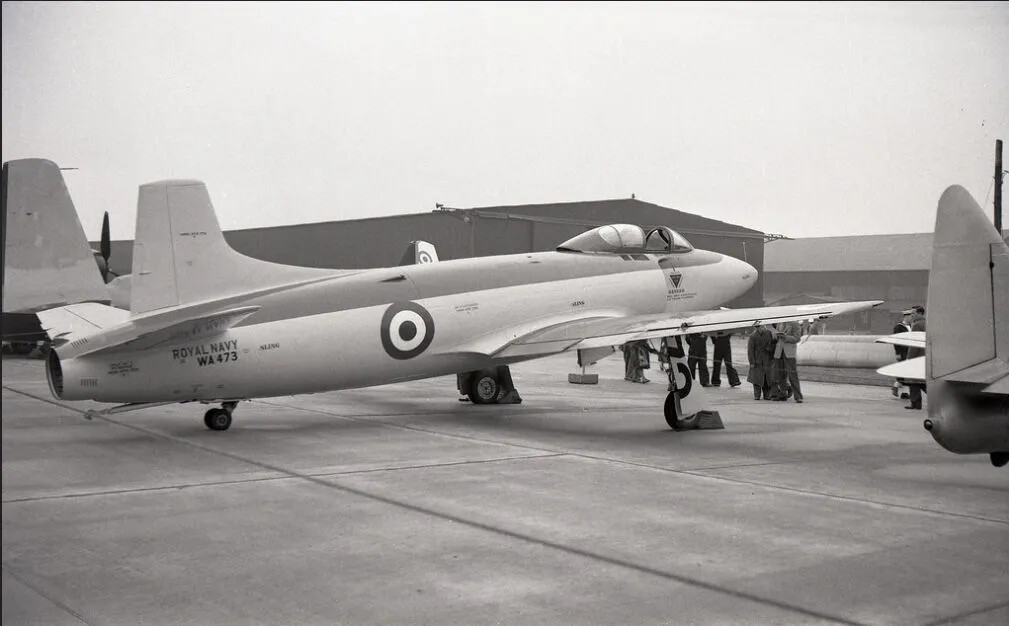
From a technical standpoint, the tour went almost perfectly. Aside from losing the drop tank and a minor hydraulic pump failure, the aircraft proved incredibly reliable. It was an undeniable triumph for the engineers. But commercially, the massive undertaking was a complete failure. Not a single country visited by the delegation ended up placing an order. This was true even though the Turkish Government had seriously considered 72 airframes at one point.
Brief foray into service
In August 1951, the first operational combat squadron equipped exclusively with the Attackers was formed. It boasted a complement of eight jets. Heading into winter, a second identical squadron was formed. Together, these two units became the Royal Navy’s first all-jet carrier strike group. In early spring 1952, one of the squadrons deployed aboard the newly commissioned aircraft carrier, the HMS Eagle, where they performed intensive combat workups. For almost a month, the massive ship cruised the rough waters of the English Channel. During this time, the fighters completed over 100 deck launches and logged 72 flight hours. They often flew in less than ideal weather conditions. The aircraft took an active part in a series of fleet exercises. One jet even successfully simulated an incoming enemy anti-ship missile.
By early summer, the second squadron arrived aboard the same carrier, but on their final day at sea, tragedy struck. Right after taking off, the fighter flown by Lieutenant Chandler suddenly caught fire and plunged into the sea. Fortunately, the pilot was quickly rescued. But following the incident, High Command immediately suspended all Attacker carrier operations pending an investigation. The detailed inquiry took just over a week, and experts reached an unexpected conclusion. The crash was caused by an excessively high concentration of sulfur in the jet fuel. Because of this critical issue, every single fighter that had operated from the deck of HMS Eagle was urgently pulled in for unscheduled heavy maintenance.
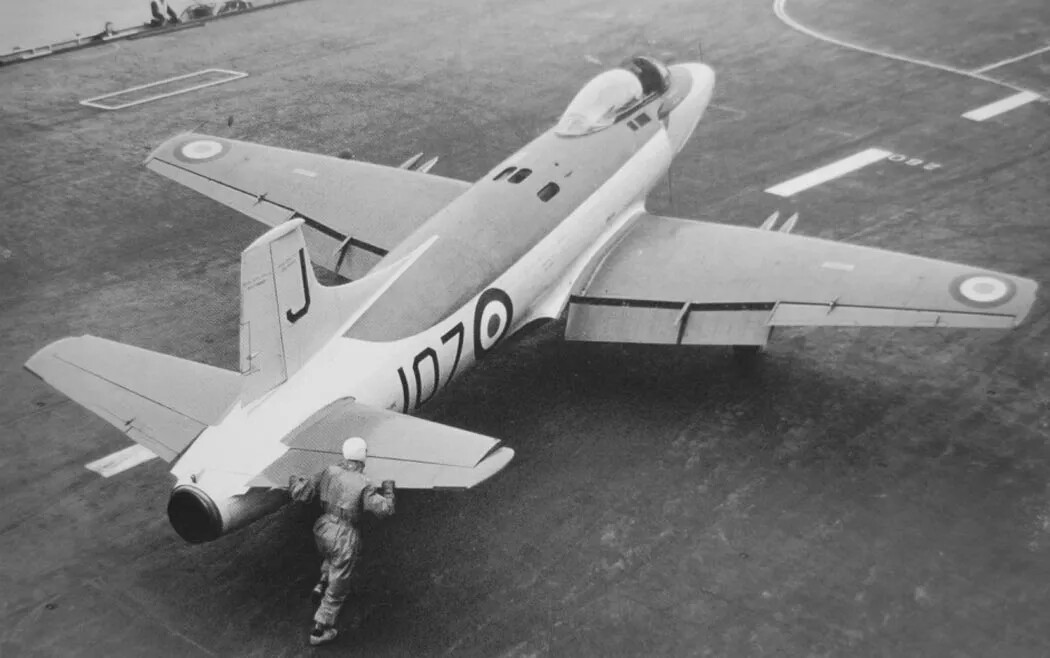
In January 1952, the Royal Navy formed 890 Squadron, and they received their aircraft from 800 Squadron.
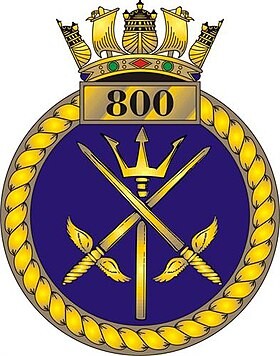
This squadron was transitioning to the newer F.B. Mk. 1 variant at the time. However, getting the initial operations off the ground was far from easy. The Attackers of the new squadron began showing widespread and serious issues with their fuel systems. The situation got so critical that there were days when the entire Squadron was completely grounded. These technical faults were finally ironed out toward the beginning of the summer. After that, things improved, they even formed a four-ship aerobatic team within the squadron. By July of the same year, the squadron deployed for a brief stint aboard the aircraft carrier HMS Illustrious. Between April and July 1952, 800 and 890 Squadrons began re-equipping with the F.B. Mk. 1 and F.B. Mk. 2 variants. However, 890 Squadron did not last long, and it was disbanded on December 3rd. All aircrews and maintenance personnel were reassigned to the two remaining units. This allowed the number of aircraft in each squadron to be brought up to the standard complement of 12.
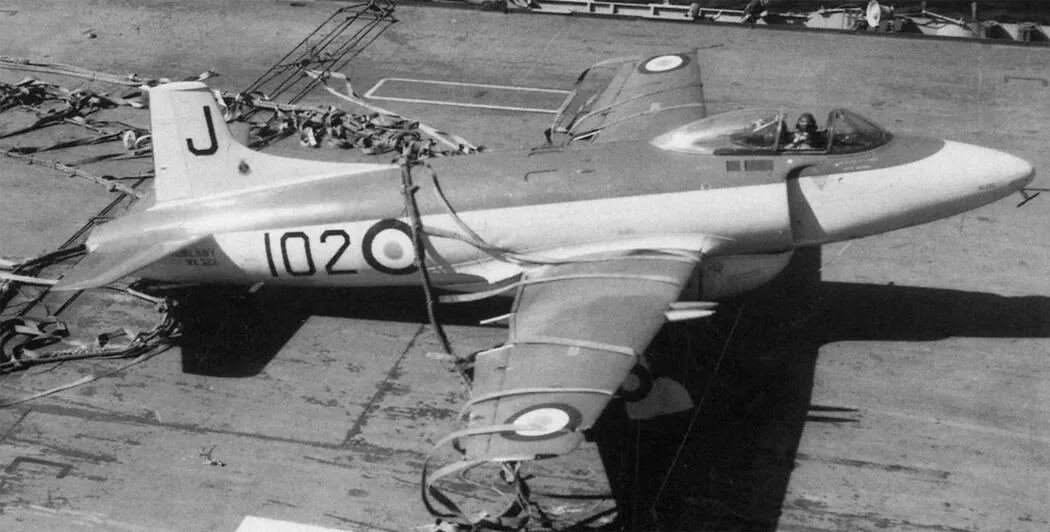
A boost in combat effectiveness was expected, but the actual operational readiness of squadrons barely improved. The main reason was that most of the Attackers sat idle in the hangar, being plagued by constant maintenance issues.
In early 1953, both squadrons fully transitioned to the upgraded F.B. Mk. 2, and soon after, 803 Squadron also formed its own aerobatic team. The pilots started rushing their airshow workups. Unfortunately, pushing through training so aggressively led to yet another tragedy. On May 19th at roughly 4,000 ft, two aircraft collided in mid-air, and both pilots were killed. Later that same year, these two squadrons deployed twice to the Mediterranean Sea aboard the aircraft carrier HMS Eagle. They returned for another Mediterranean deployment from February 3rd to May 26th, 1954.
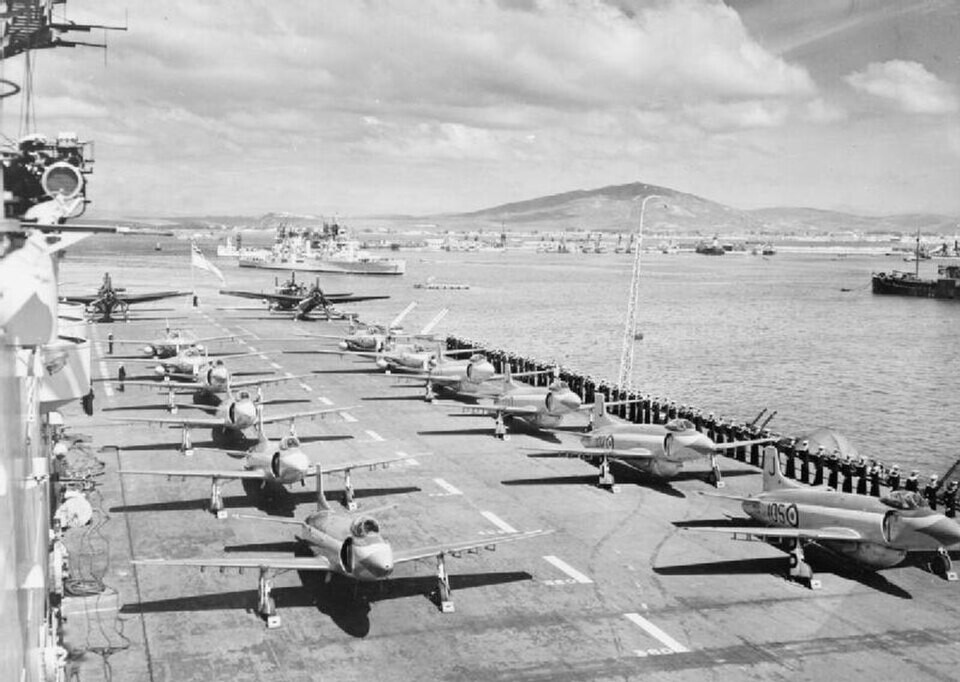
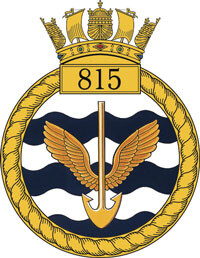
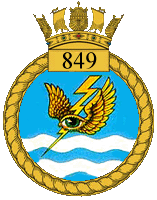
It was during this lengthy cruise that the Attacker really showed its flaws. The aircraft proved so temperamental that the jets spent a lot more time down for maintenance than up in the air. Maintainers struggled to keep more than two aircraft airworthy at any given time. The abysmal deployment record sealed the fighter’s fate. On June 11th, 800 Squadron was disbanded, 4 months later, 803 Squadron transitioned to the much more capable and reliable Sea Hawk.
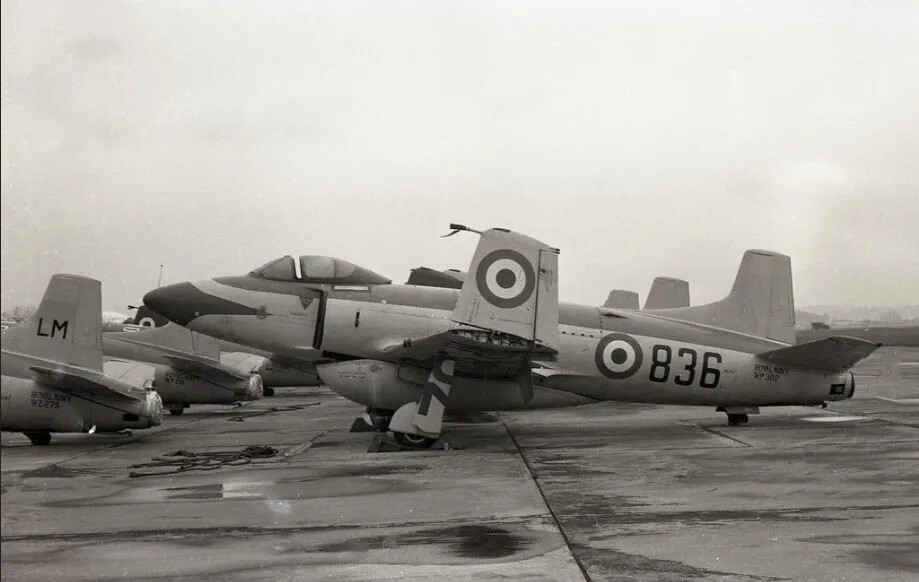
From April 25th, 1955, through March 10th, 1957, more than 80 F.B. Mk. 2 flew with five squadrons of Royal Naval Volunteer Reserve (RNVR). This is where reservist pilots who had previously only flown older piston engine aircraft transitioned to jets. When this reserve branch was eventually disbanded, the Attacker’s days in Royal Navy service were officially over.
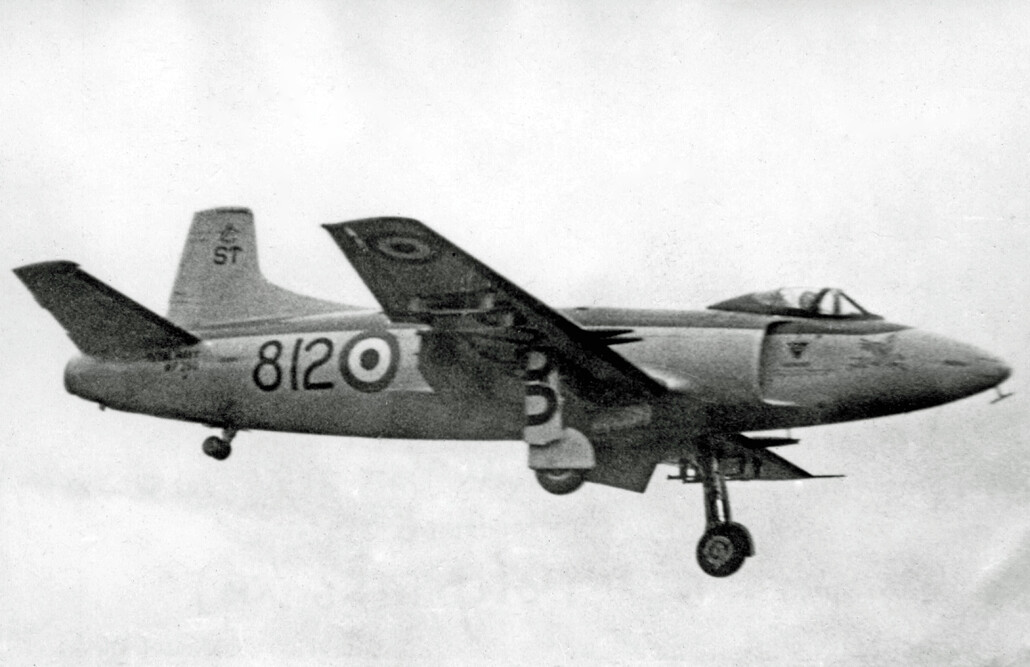
It was no secret that Royal Navy pilots disliked the Attacker. They even gave it the rather fitting nickname of the “Disgusting Aircraft”. One of the main reasons for this was its ground handling. Pilots had spent years flying piston engine fighters, in those planes the rudder caught plenty of prop wash, because of this, they had a really hard time getting the hang of taxiing a jet. On top of that, the designer’s decision to reuse the old wing from the Spiteful harsh criticism. Because of this, transonic handling issues kicked in at just Mach 0.76. For comparison, the contemporary Gloster Meteor had a much higher critical Mach number of around Mach 0.82.
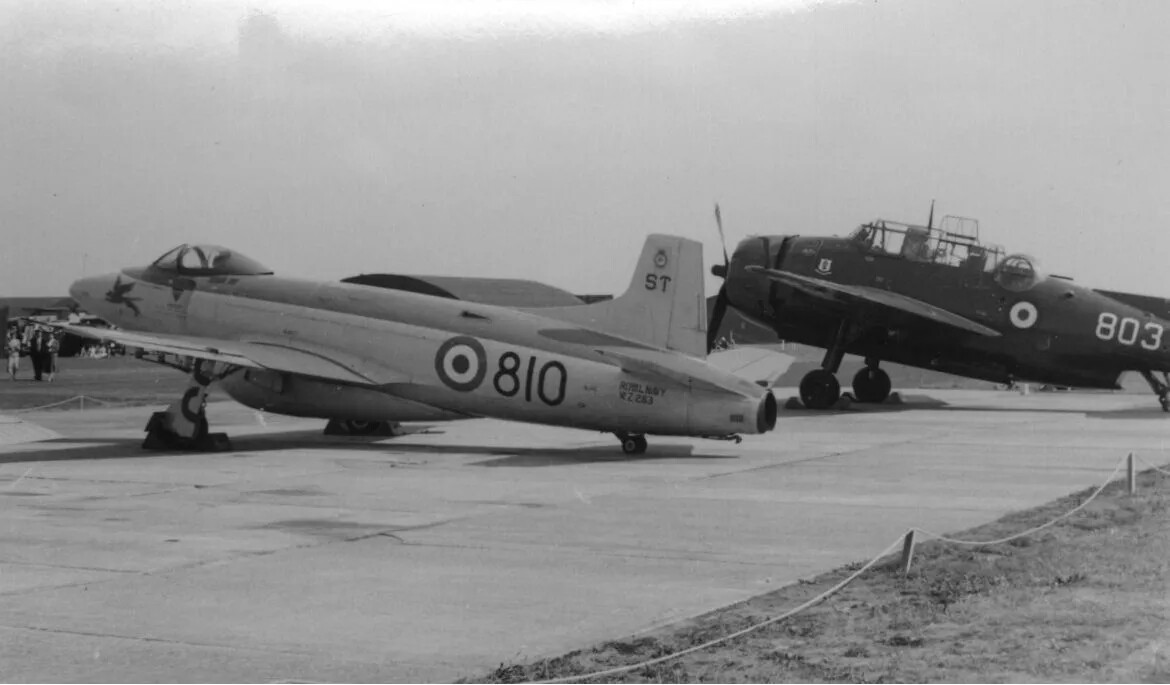
Commander John Nethersole logged plenty of flight hours in the Attackers, he recalled his experience with the fighter, he noted that without a drop tank, it was a perfectly capable aircraft for aerobatics, but it heavily suffered from a lack of speed. As soon as the airspeed hit Mach 0.76, compressibility kicked in hard, to the point that the pilot would completely lose elevator control. The heavy jet would then inevitably pitch down into a dangerous dive. In addition to this serious flaw, the great difficulty the ground crew had in keeping the fleet operational and the failure of foreign sales were decisive factors in its retirement. Like most other first-generation jet fighters, the Attacker had a relatively short service life before being replaced. In 1958, nearly all of the FAA Attackers were scrapped.
Structure and Design
Landing Gear
The landing gear of an aircraft is an important part of the aircraft structure. The landing and the taking off are the most critical parts of a flight mission. As mentioned earlier, true to their conservative nature, the British designers opted not to include a modern tricycle landing gear. Supermarine engineers concluded that a three-point landing gear would be much more familiar to pilots of the time and, as a bonus, allowed the main landing gear struts to remain completely unchanged. The team also adopted wide-gauge landing gear as an option.
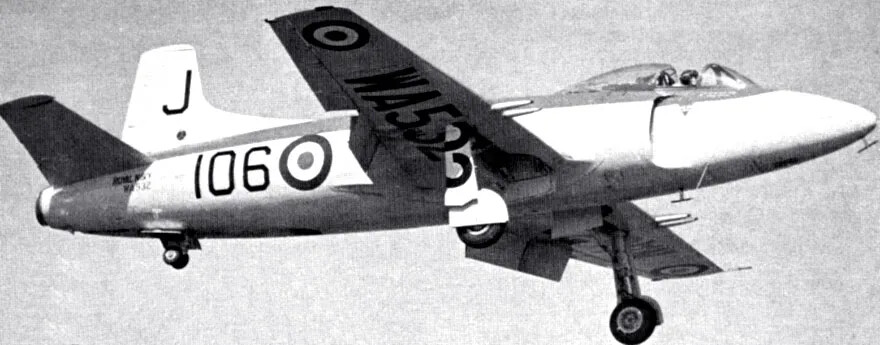
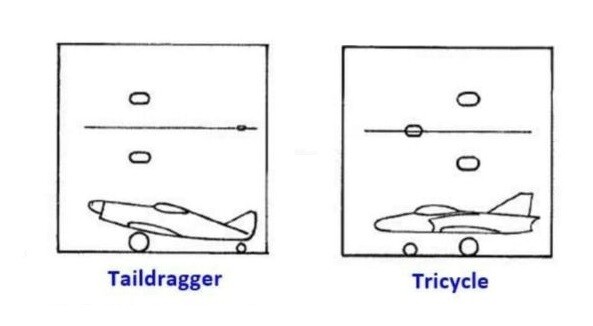
Although the tricycle landing gear configuration is the most popular today, it wasn’t always so. Conventional landing gear (with a tail wheel), also known as a “tail dragger” configuration, dominated aircraft design during the first four decades of aviation and is still widely used on many small piston-engined aircraft. The conventional landing gear configuration consists of two main landing gear units located near the center of gravity that support most of the aircraft’s weight. A much smaller support is also located at the rear of the fuselage, so the aircraft appears to drag its tail, hence the name. This tail unit is usually a very small wheel, but it can even be a skid in a very simple design.
What makes this form of landing gear most attractive is its simplicity. The gear is usually relatively lightweight, and the two main wheels can also be easily encased in streamlined fairings to produce low drag in flight. Another potential advantage results from the fact that the plane is already tilted to a large angle of attack as it rolls down the runway. This attitude helps to generate greater lift and reduce the distance needed for takeoff or landing. This attitude is also an advantage on propeller-driven planes since it provides a large clearance between the propeller tips and the ground. Furthermore, tail dragger planes are generally easier for ground personnel to maneuver around in confined spaces like a hangar.
However, the greatest liability of this landing gear layout is its handling characteristics. This design is inherently unstable because the plane’s center of gravity is located behind the main gear. If the plane is landing and one wheel touches down first, the plane has a tendency to veer off in the direction of that wheel. This behavior can cause the aircraft to turn in an increasingly tighter “ground loop” that may eventually result in scraping a wingtip on the ground, collapsing the gear, or veering off the runway. Landing a tail dragger can be difficult since the pilot must line up his approach very carefully while making constant rudder adjustments to keep the plane on a straight path until it comes to a stop. Another disadvantage of the tail dragger is poor pilot visibility during taxiing since they are forced to peer over a nose that is tilted upward at a steep angle.
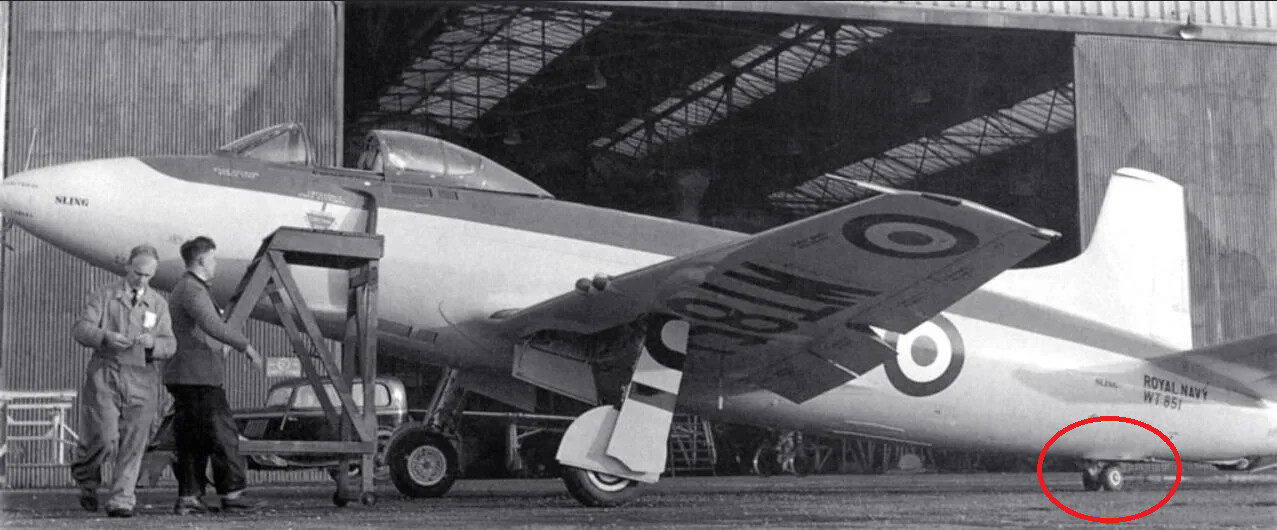
Many taildragger designs alleviate these handling problems by fitting a tailwheel that can be locked instead of swiveling on a castor. Locking the tailwheel helps keep the plane rolling in a straight line during landing. Another solution was the use of wide-gauge landing gear (a.k.a. wide-track landing gear).
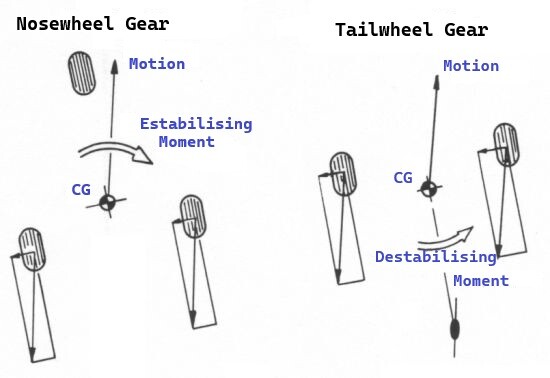
Wide-gauge landing gear is a configuration in which an aircraft’s undercarriage is designed to have a large space between the two main gear wheels. This spacing provides a highly stable platform on the ground, making the aircraft less prone to tipping over during high-speed taxiing, sharp turns, or harsh crosswind landings. It considerably mitigates the stability issues, but does not eliminate them.
Because of this stability disadvantage, the Supermarine technical team chose a taildragger with wide-gauge landing gear, commonly called wide-track landing gear. This refers to an aircraft undercarriage design in which the distance between the two main wheels, or track gauge, is relatively large. This spacing provides a highly stable platform on the ground, making the aircraft less prone to tipping over during high-speed taxiing, sharp turns, or harsh crosswind landings, mitigating the stability problem considerably, but not completely.
Main advantages of wide-gauge landing gear:
- Greater stability: Minimizes lateral sway induced by strong winds on the runway.
- Rollover prevention: Improves the distribution of the center of gravity during high-speed ground maneuvers.
- Operating on irregular runways: Common for military and cargo aircraft landing on unprepared terrain.
- Improved impact absorption: Allows for more efficient load distribution across the wing structure.
These benefits are why Supermarine chose a wide-gauge configuration for the undercarriage of the Attacker.
The landing-gear stability disadvantage of the Attacker is reproduced exceptionally well in the game’s Simulator Battles mode; all the issues described in the article are clearly noticeable.
Engine characteristics
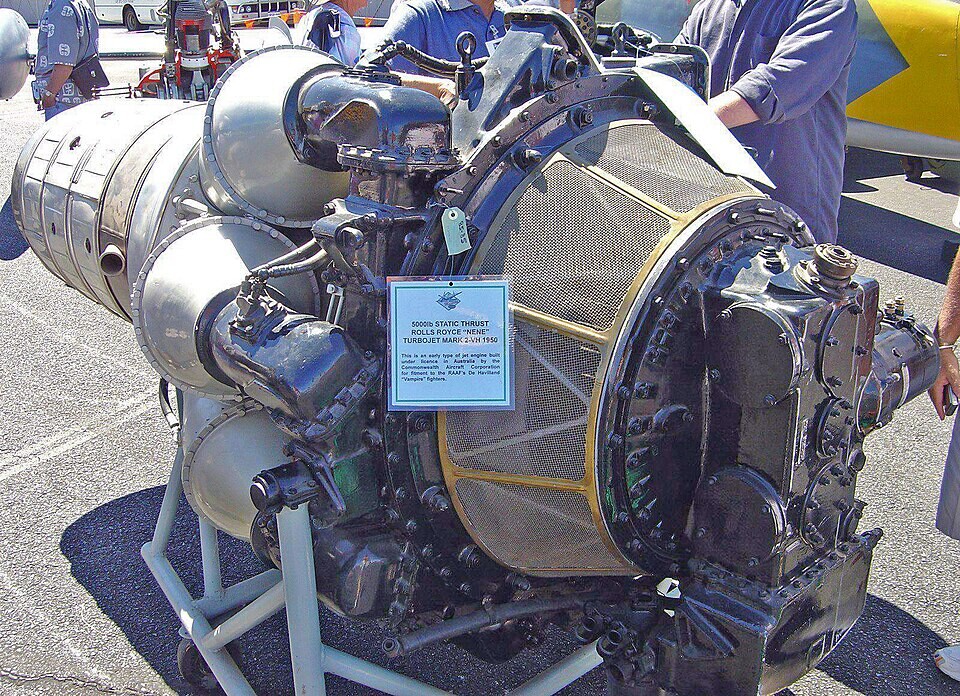
The Attacker was powered by a single Nene Mk. 3 engine in the F.B. Mk. 1, and the more powerful Nene Mk. 102 in the F.B. Mk. 2 was among the most powerful jet engines in the world when it was introduced. The engine was supported by a robust, box-shaped rear structure, which was reinforced longitudinally to the main frame. Because the exhaust pipe was relatively long, a manually operated variable exhaust outlet was used during engine start-up to prevent exhaust pipe resonances and excessive turbine temperatures.
Structural characteristics
The Attacker had a relatively strong structure, making extensive use of thick materials, primarily aluminum alloy, which were used with tensioned skin construction and supported by 24 closely spaced stringers and frames.
The nose had an unusual lobster claw-shaped structure, composed of a thick laminated sheet of aluminum alloy on the upper and lower parts, without reinforcing elements. It provided armored protection for the pilot and supported pressurization loads. The nose tip was detachable to accommodate a gunner or ballast camera; between this and the cockpit was an avionics compartment. Behind the cockpit was the semi-monocoque fuel tank, followed by the engine compartment.
The fuselage was continuously curved, with no straight lines. It was shaped to have some of the laminar flow characteristics of the wing, and its lines were interrupted only by the faired cockpit canopy and the engine air intakes on either side of the cockpit.
The wing design remained virtually unchanged from the Spiteful, except for a slight increase in size to accommodate the larger Attacker. It used split flaps along the trailing edge, as well as slotted ailerons and electrically operated trim tabs.
With a single main spar and a sub-spar, the wing was bolted directly onto short struts, as there was no center section. The outer skins were riveted flush and manufactured with considerable care, in an attempt to achieve the laminar flow predicted in wind tunnel tests.
Armament
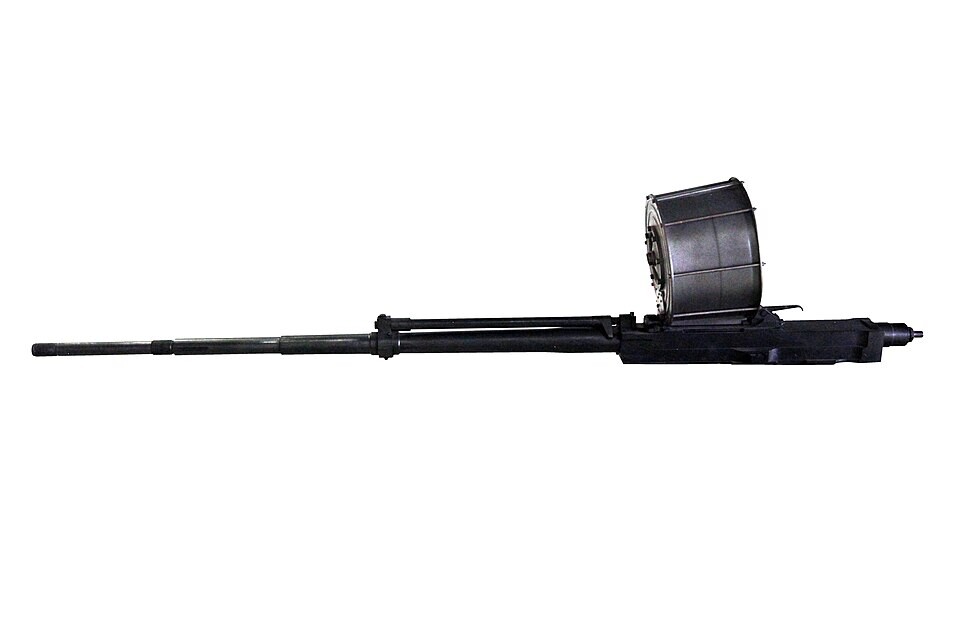
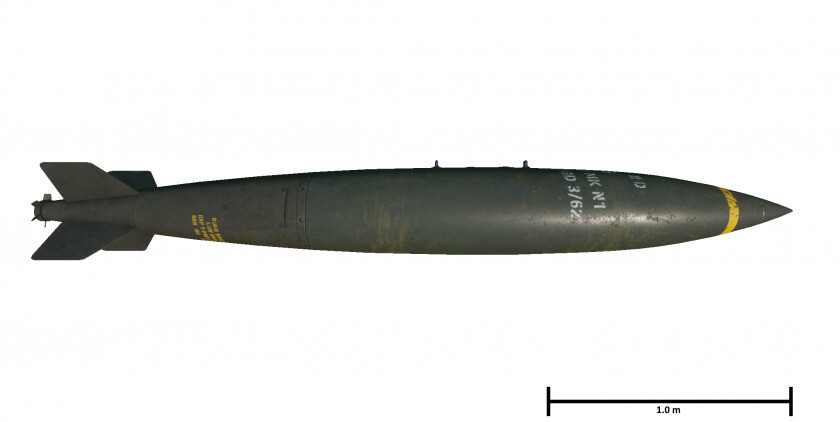
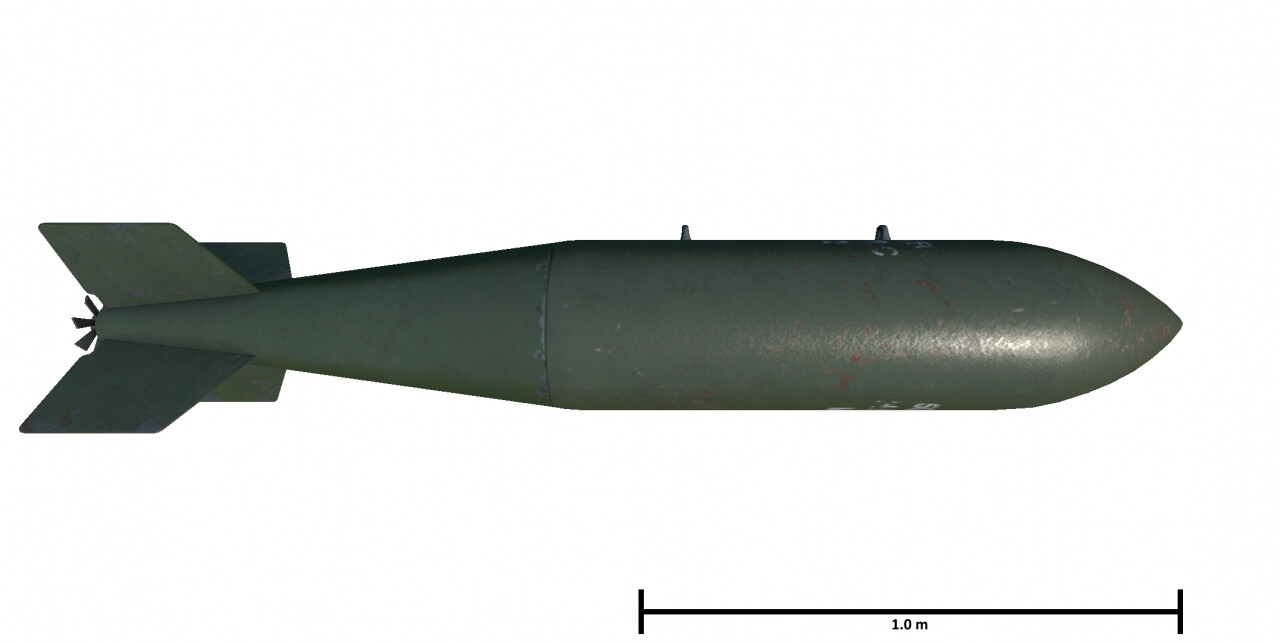
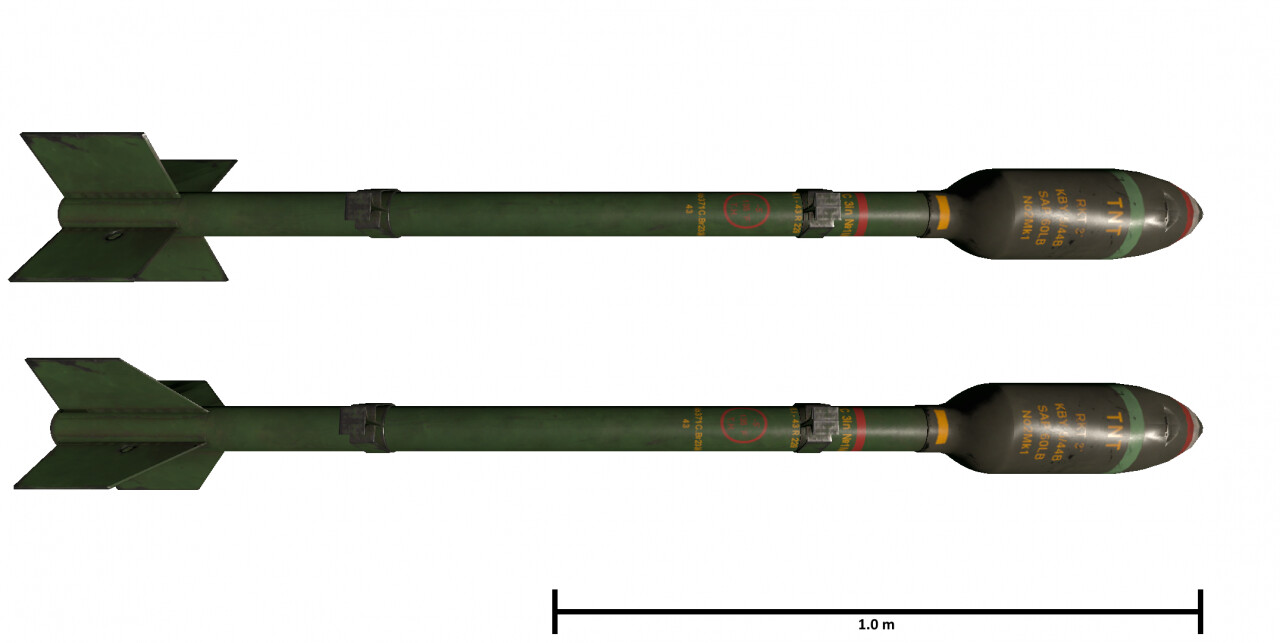
The Attackers had four 20 mm Hispano Mk. V cannons; at the time, this was considered standard armament for a front-line RAF fighter. Two fixed points on the wings existed to mount 500 lb H.E. M.C. Mk. II bombs or 1000 lb M.C. Mk. I bombs, and eight rocket hard points (four per wing) for RP-3 rockets.
20 mm Hispano-Suiza Mk. V
L.D H.E. M.C. Mk. 1 (1,000 lb)
H.E. M.C. Mk. II (500 lb) bomb
RP-3 (from Rocket Projectile 3 inch)
Pakistan Air Force (PAF)
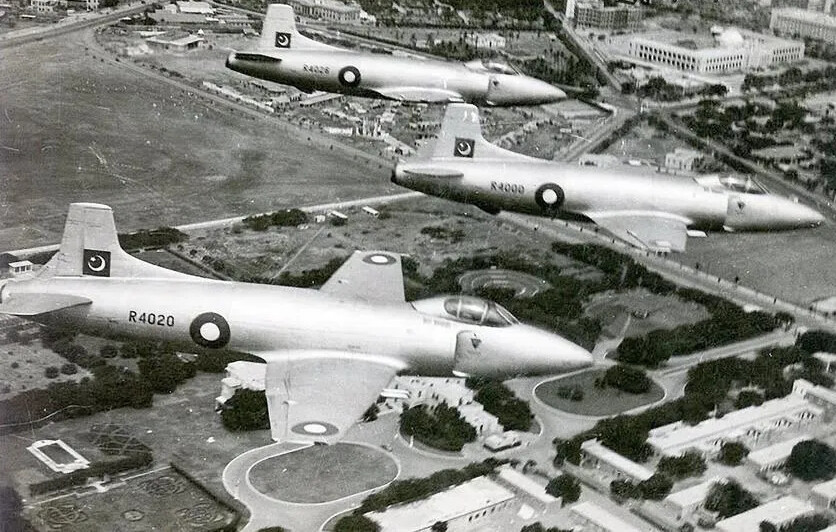
Despite being withdrawn from active service by the FAA in 1954, just three years after its introduction, the Attacker was adopted by the newly formed Royal Pakistan Air Force (RPAF), which continued to operate the model possibly until 1964, making it the only other air force to operate the Attacker.
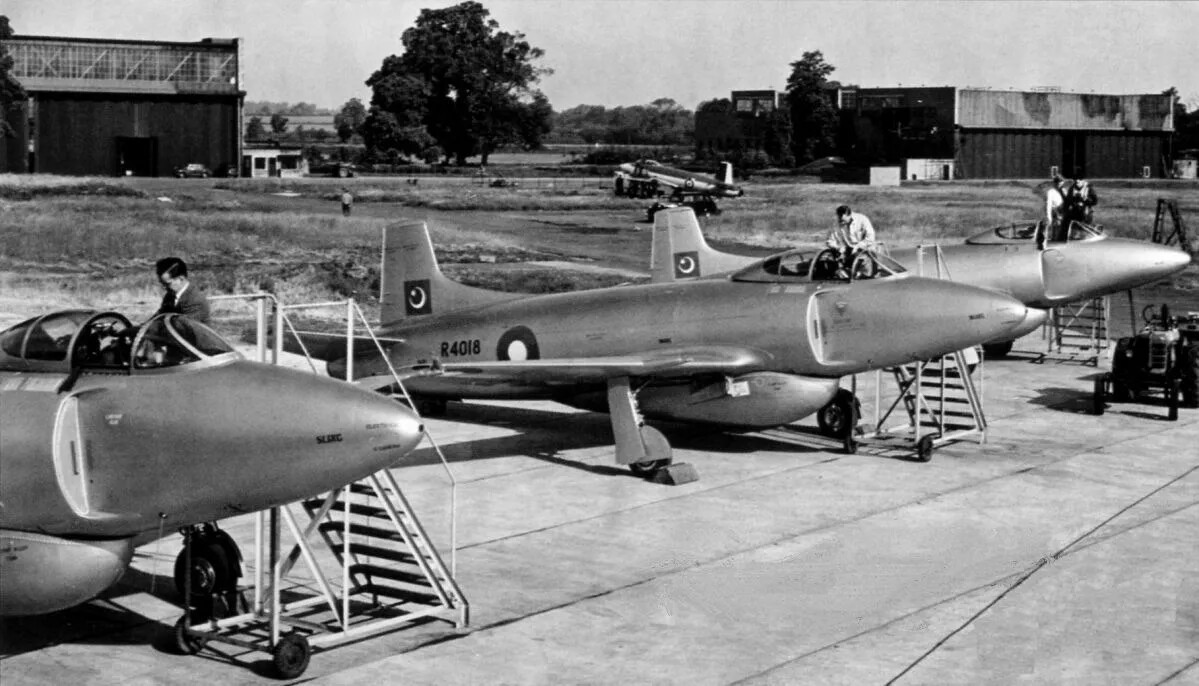
The RPAF sought to acquire its first jet aircraft in the early 1950s. Lack of funds and political pressure exerted by British suppliers persuaded the air force to acquire a variant of the Attacker designated internally by Supermarine as the Type 538 and officially as the Attacker Mk. 50. It was essentially a de-navalized FAA Attacker, and 36 were built for the RPAF.
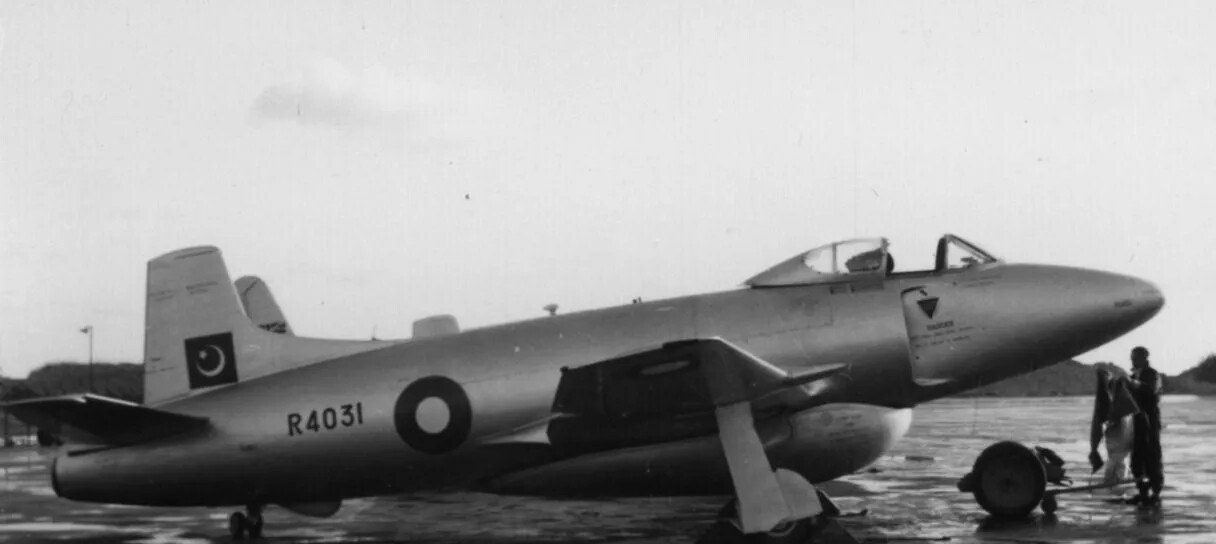
The RPAF placed its order in 1950. Deliveries began in August of 1951 and were completed on March 6th, 1953, when the last two of the 36 aircraft ordered were delivered to the High Commissioner for Pakistan at the Vickers-Supermarine factory in South Marston, Wiltshire in the United Kingdom.
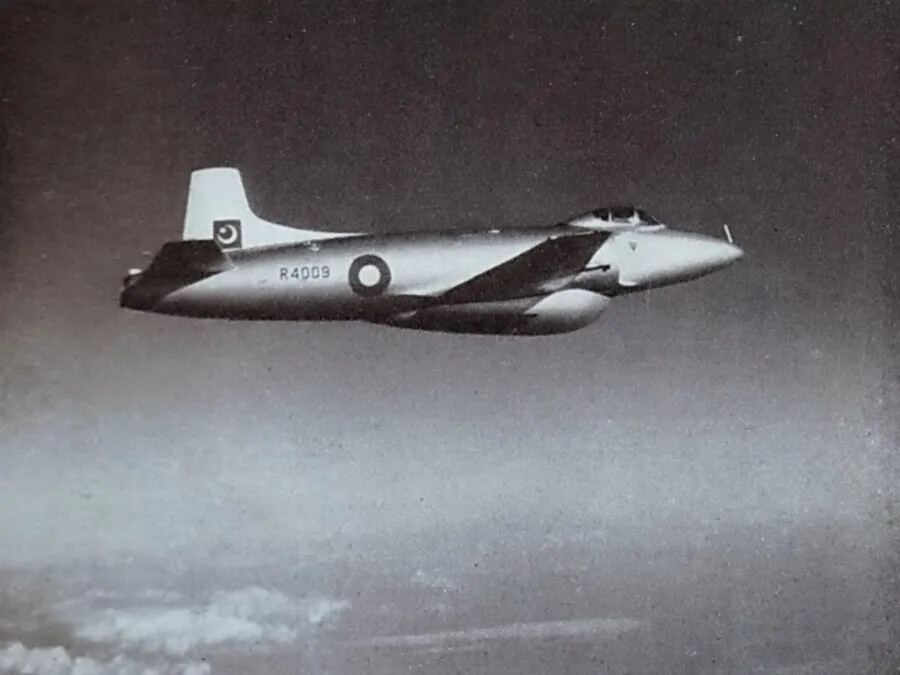
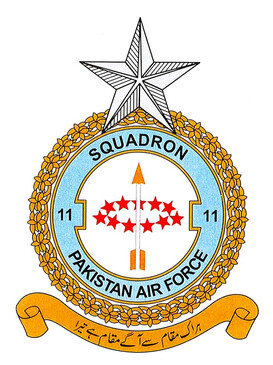
Only No. 11 Squadron, an interceptor unit, was equipped with these aircraft.
Paybills (پے بلز)
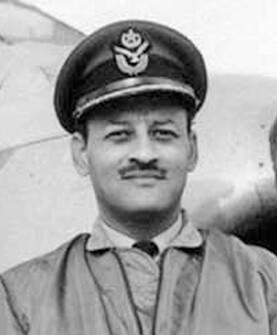
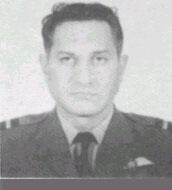
Due to its pioneering role in the fleet, the squadron operating the Supermarine Attacker also formed the “Paybills,” Pakistan’s first jet aerobatics team. The team was formed in 1952 and was based at Faisal Air Base (then Drigh Road) in Karachi. “Paybills” was, in fact, the operational radio call sign of No. 11 Squadron “Arrows”, the unit to which the team belonged. The team was formed in 1952 with 5 Supermarine Attacker Mk. 50s by then Squadron Leader and flight commander F. S. Hussain. The team also included renowned RPAF pilots Jamal A. Khan and Zafar Masud.
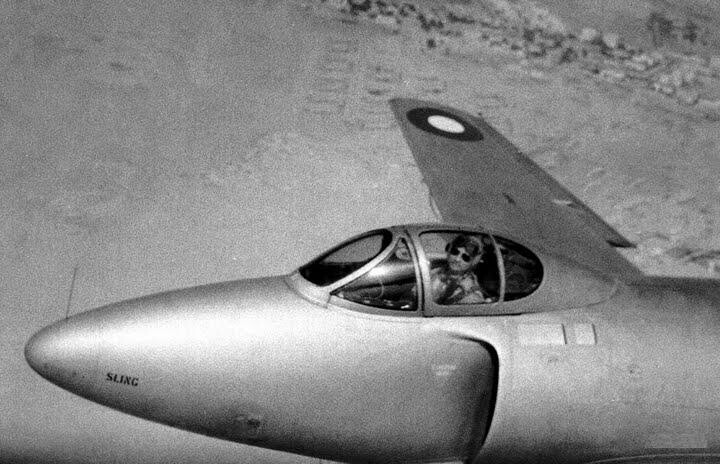
Paybills Team
| Rank | Name |
|---|---|
| Squadron Leader | Fuad Shahid Hussain |
| Flight Lieutenant | Muhammad Zafar Masud |
| Flight Lieutenant | Pete Malik |
| Flying Officer | A. U. Ahmed |
| Flying Officer | Jamal Ahmad Khan Afridi |
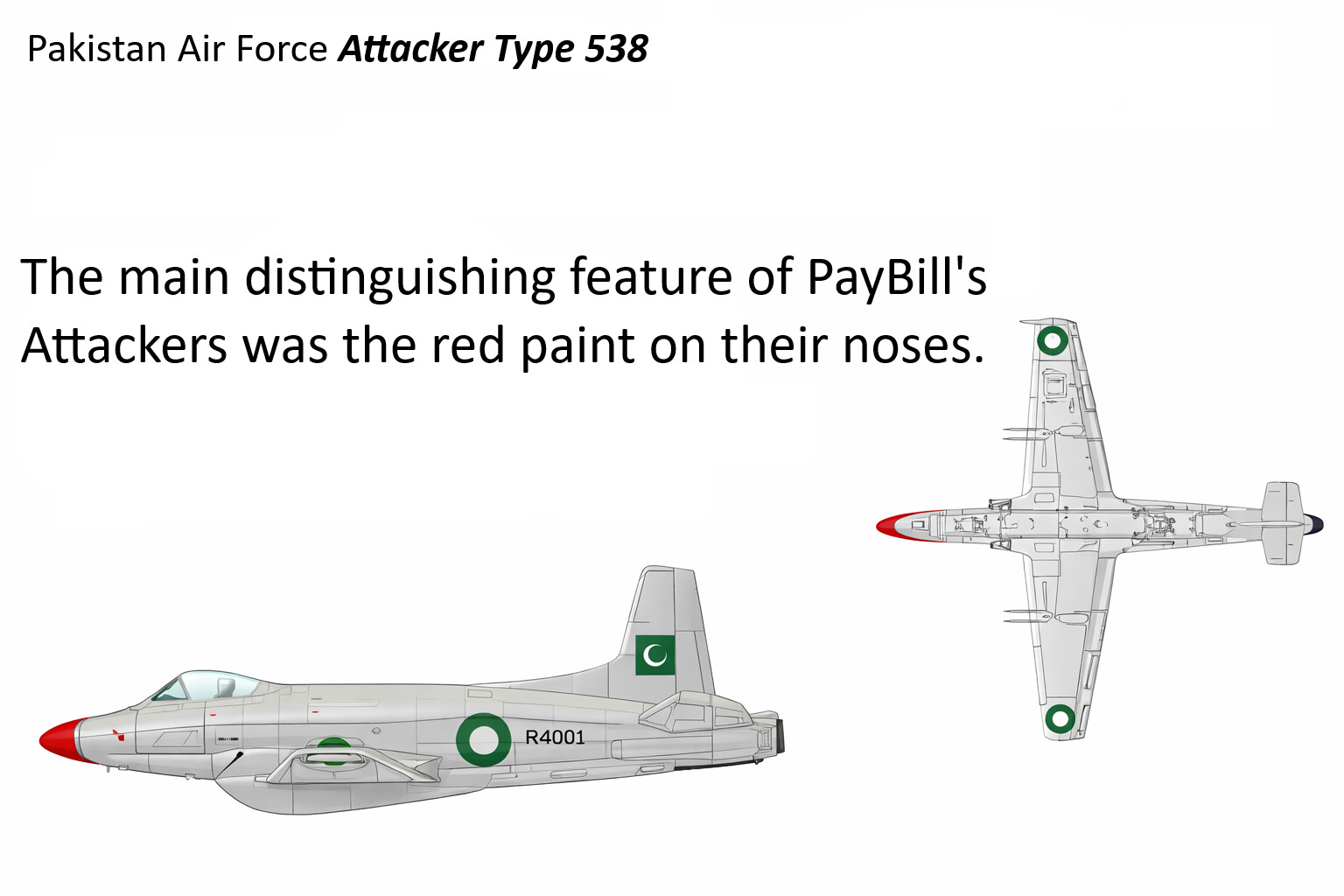
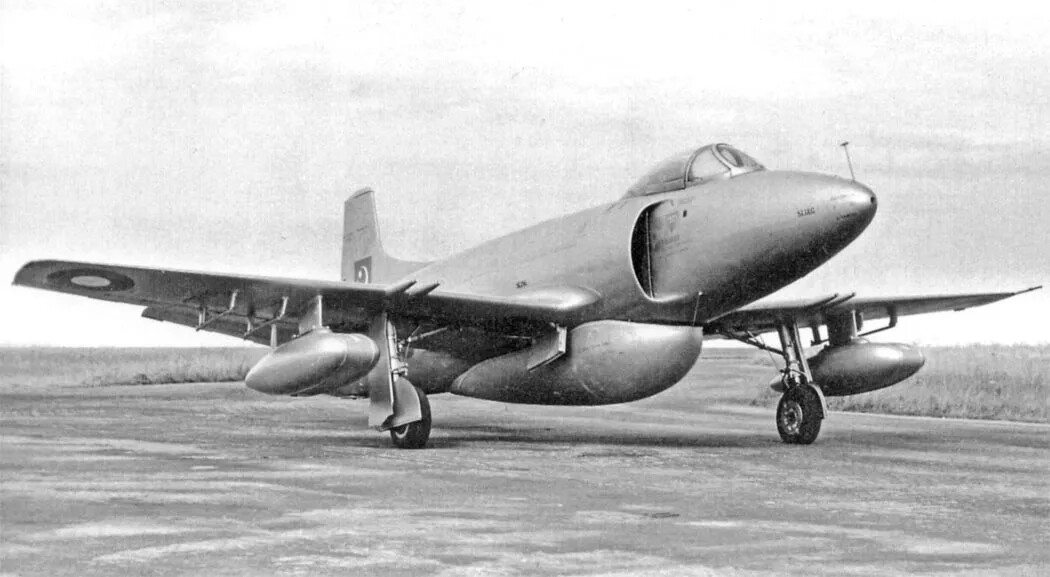
The Attackers of No. 11 Squadron remained operational for seven years, with the last examples being withdrawn from service in 1956, when they were replaced by North American F-86F Sabres. Officially, the Attacker remained in Pakistani service until 1958, although some sources claim that the aircraft were still being used until 1964.
General characteristics
- Crew: 1
- Length: 11.43 m (37 ft, 6 in)
- Wingspan: 11.25 m (36 ft, 11 in)
- Height: 3.02 m (9 ft, 11 in)
- Wing area: 226 square feet (21 m²)
- Empty weight: 8,434 lb (3,826 kg)
- Gross weight: 12,211 lb (5,339 kg)
- Engine: 1 × Rolls-Royce Nene turbojet, 5,000 lbf (22 kN) of thrust
Performance
- Maximum speed: 590 mph (950 km/h, 512 kt)
- Range: 590 mi (950 km, 510 nm)
- Service ceiling: 45,000 ft (13,700 m)
- Rate of climb: 6,350 ft/min (32.3 m/s)
Supermarine Attacker Versions:
| Version | Supermarine internal designation | Main characteristics |
|---|---|---|
| Type 392 | Prototype land version to specification E.10/44, ordered as one of three prototypes on 30 August 1944, one built and first flown 27 July 1946. | |
| Type 398 | Prototype navalised variant ordered on 30 August 1944, one built and first flown 17 June 1947. | |
| Type 510 | Prototype with swept wings and tail whose development led to the Supermarine Swift | |
| Type 513 | Prototype second naval prototype to specification E.1/45 ordered on 30 August 1943, one built and first flown 24 January 1950. | |
| Attacker F. Mk. 1 | Type 398 | Production Nene 3 powered variant, 63 ordered on 29 October 1948 and built at South Marston, 50 built as F. Mk. 1 as two were canceled and the last 11 built as F.B. Mk. 1. First flight of production F. Mk. 1 was on 4 April 1950. |
| Attacker F.B. Mk. 1 | Type 398 | The F.B. Mk. 1 had been modified from the original design to allow it to carry rocket projectiles or bombs under the wings. |
| Attacker F.B. Mk. 2 | Type 398 | Updated variant of the fighter-bomber, equipped with the Nene Mk. 102, 24 ordered on November 21, 1950, 30 ordered on February 16, 1950, and another 30 ordered on September 7, 1950, totaling 84 units. |
| Attacker Mk. 50 | Type 538 | De-navalized variant made specifically for export to the Royal Pakistan Air Force, 36 built with the first delivered in 1953, but were delivered demilitarized. |
Usage Timeline:
Pakistan:
- Pakistan Air Force, 36 aircraft, Attacker Type 538 and Attacker Mk. 50 (1951-1958).
- No. 11 Squadron Arrows, Attacker Mk. 50 (1951-1956).
- Paybills Aerobatic Team, Attacker Type 538 and Attacker Mk. 50 (later) (1952-1958).
United Kingdom:
- Fleet Air Arm, 146 aircraft, Attacker models, F. Mk. 1, F.B. Mk. 1 and F.B. Mk. 2 (1951-1956).
- Royal Naval Volunteer Reserve, Attacker F.B. Mk. 2 (1955-1957).
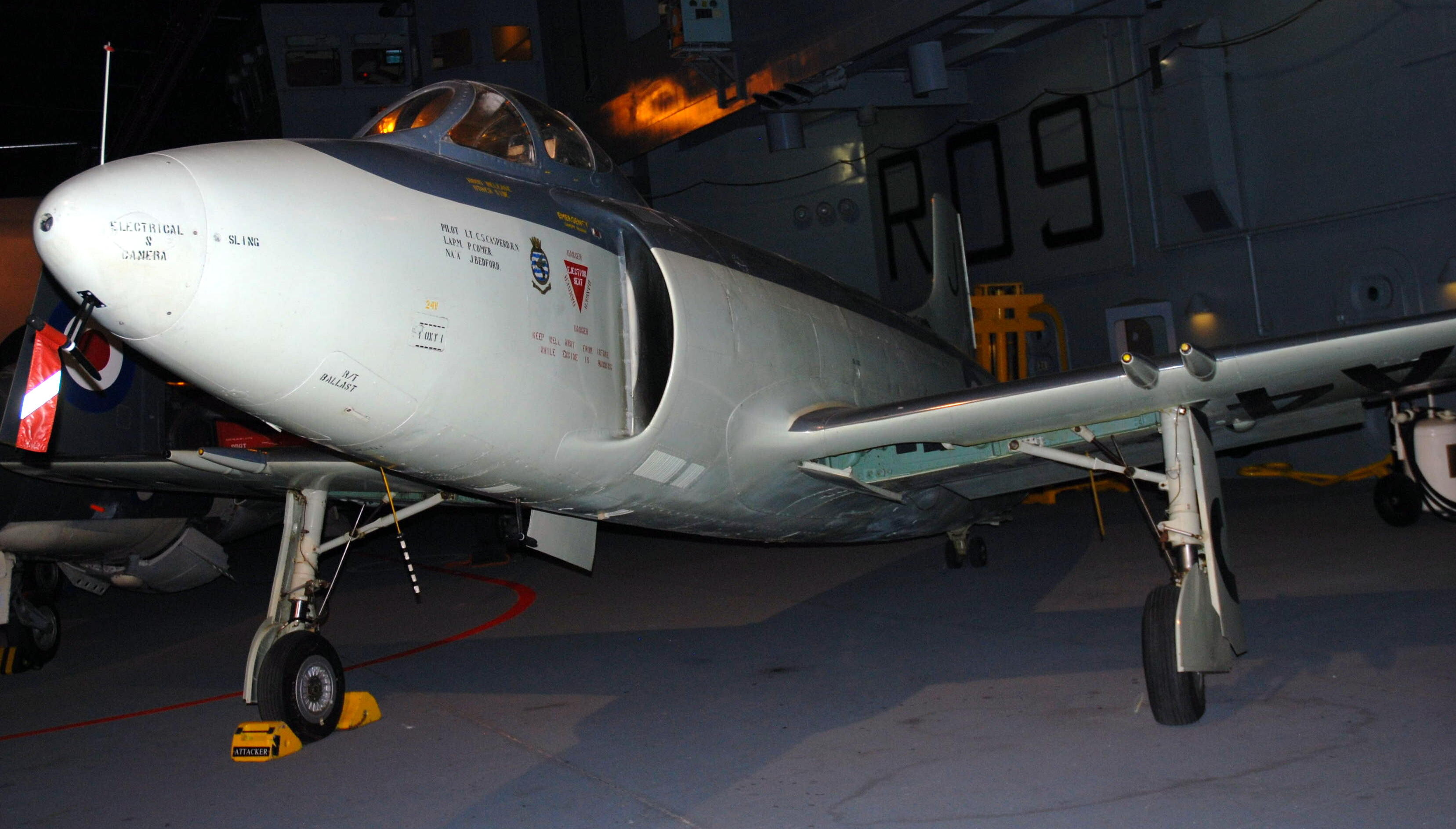
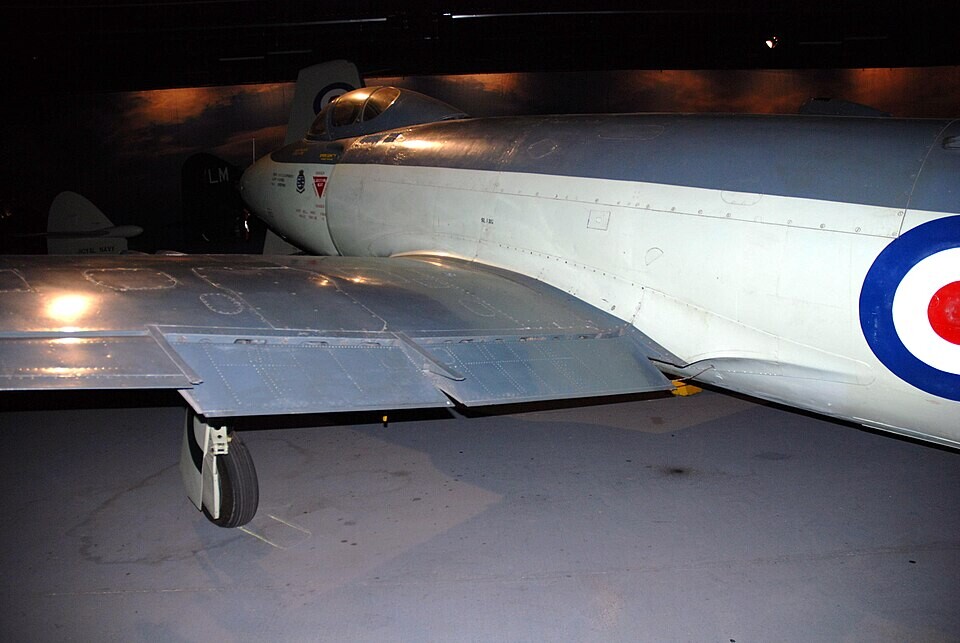
The Last Attacker
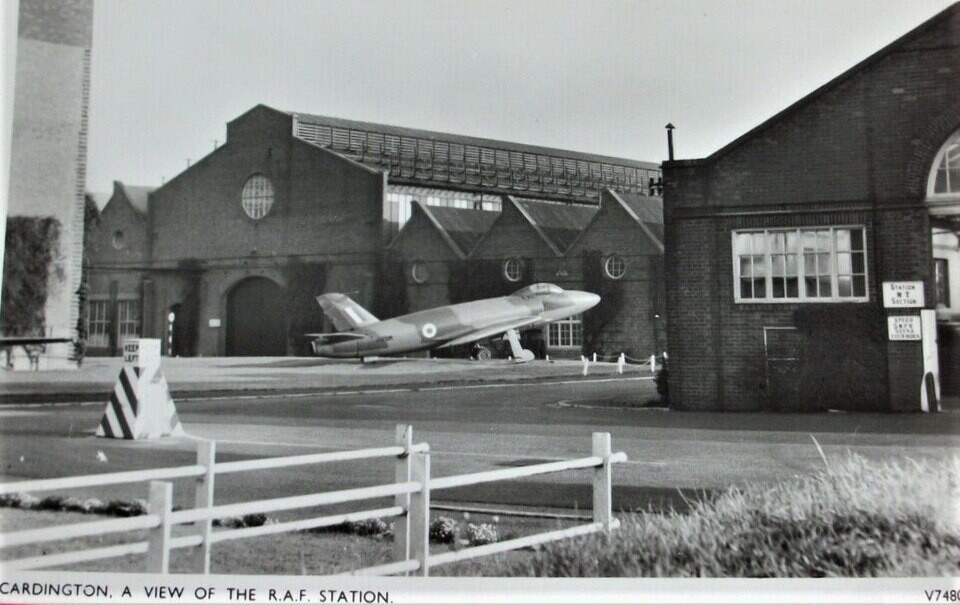
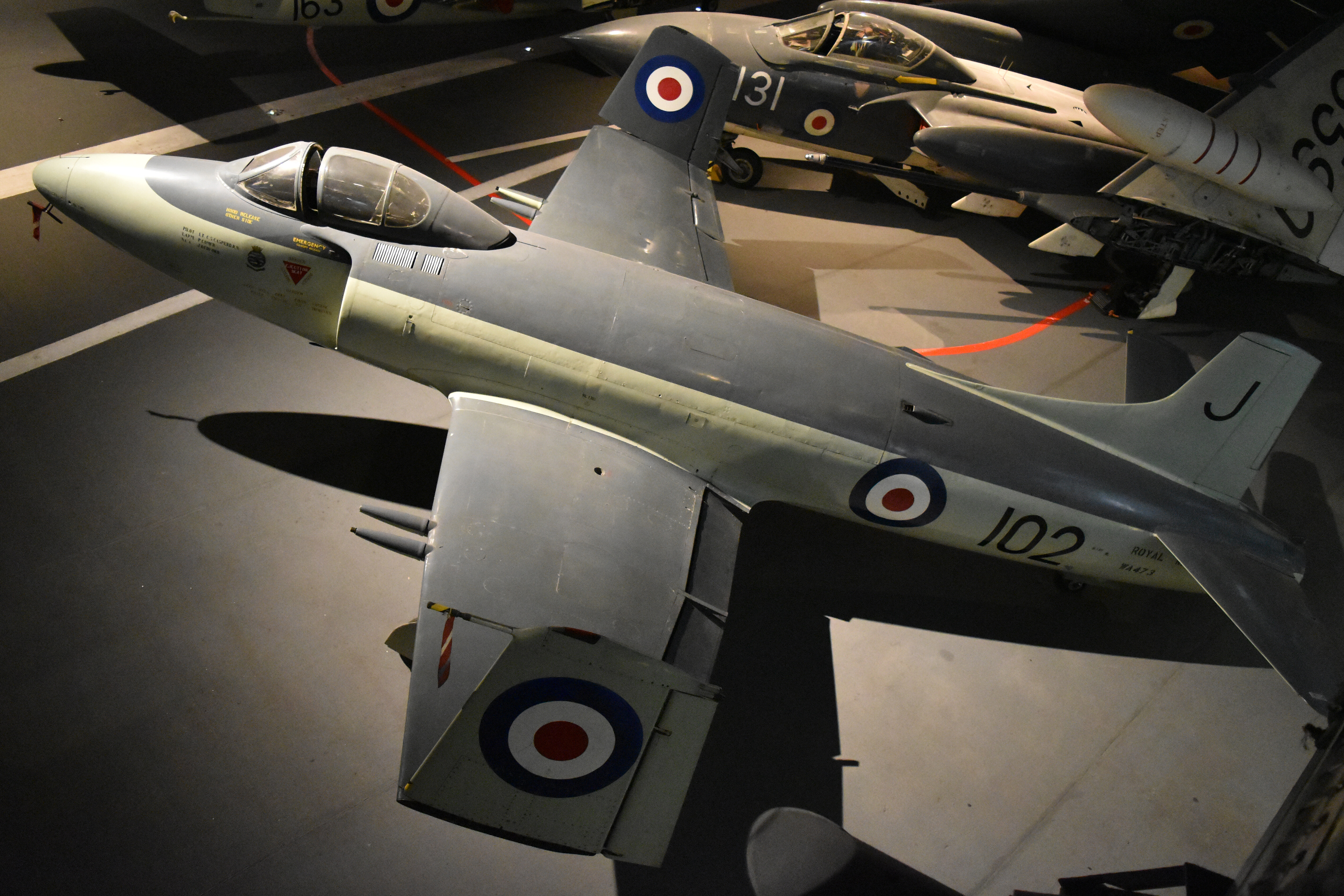
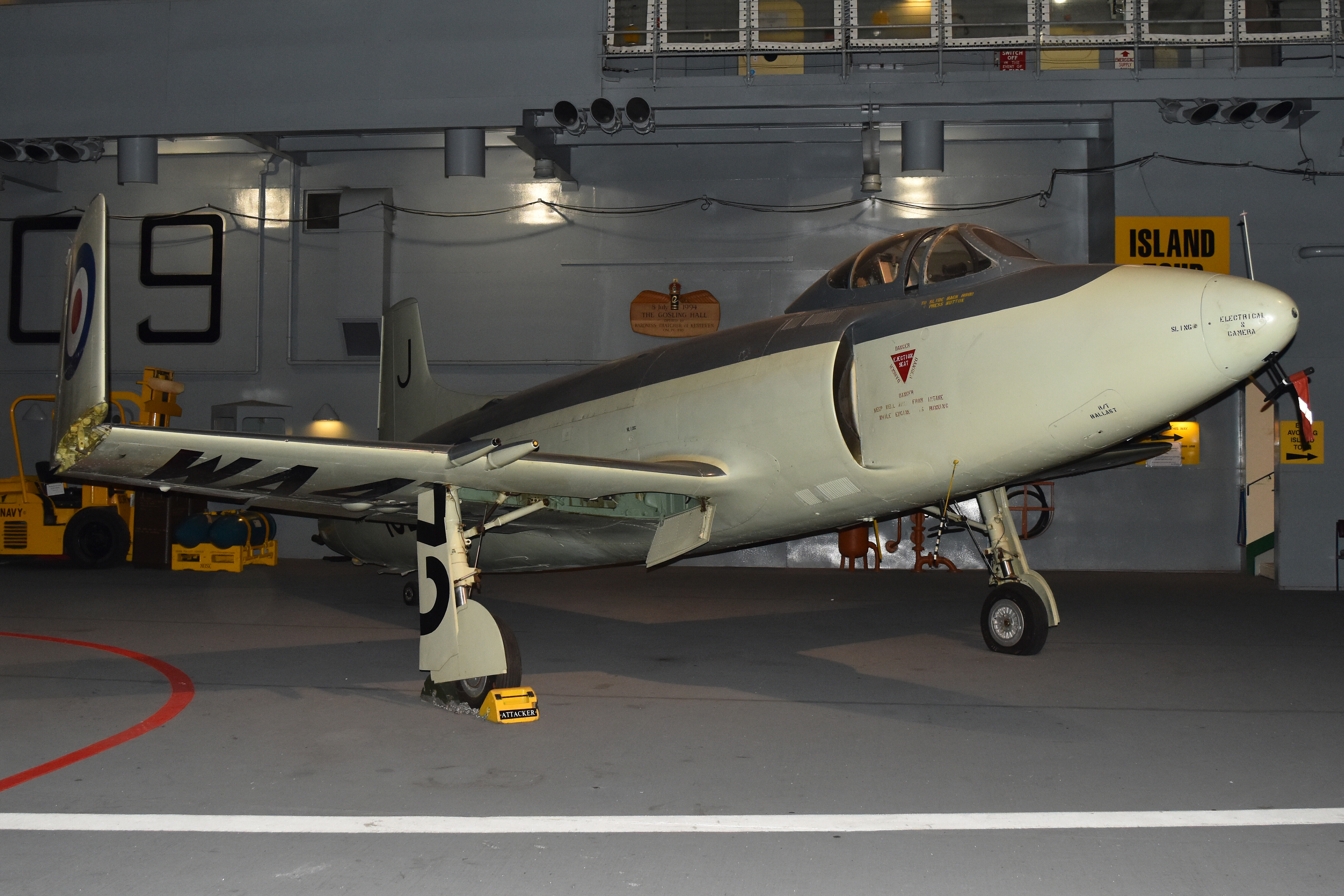
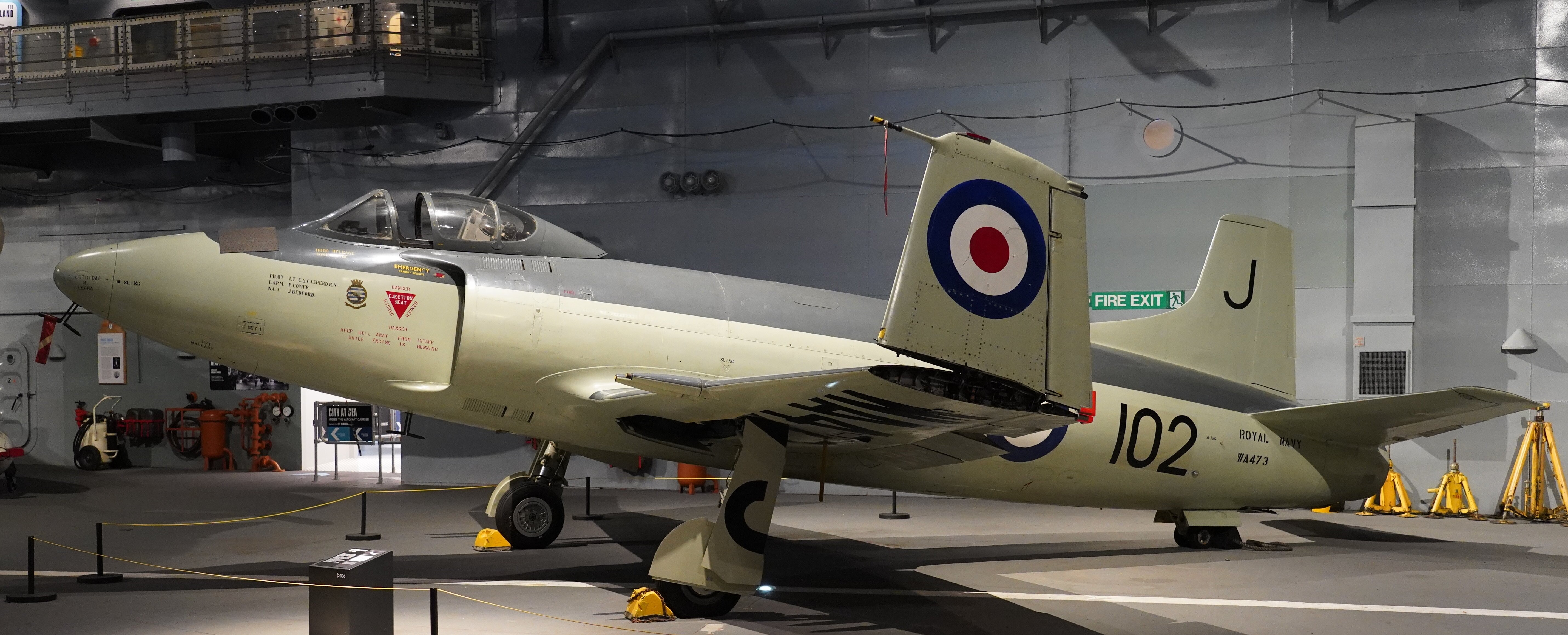
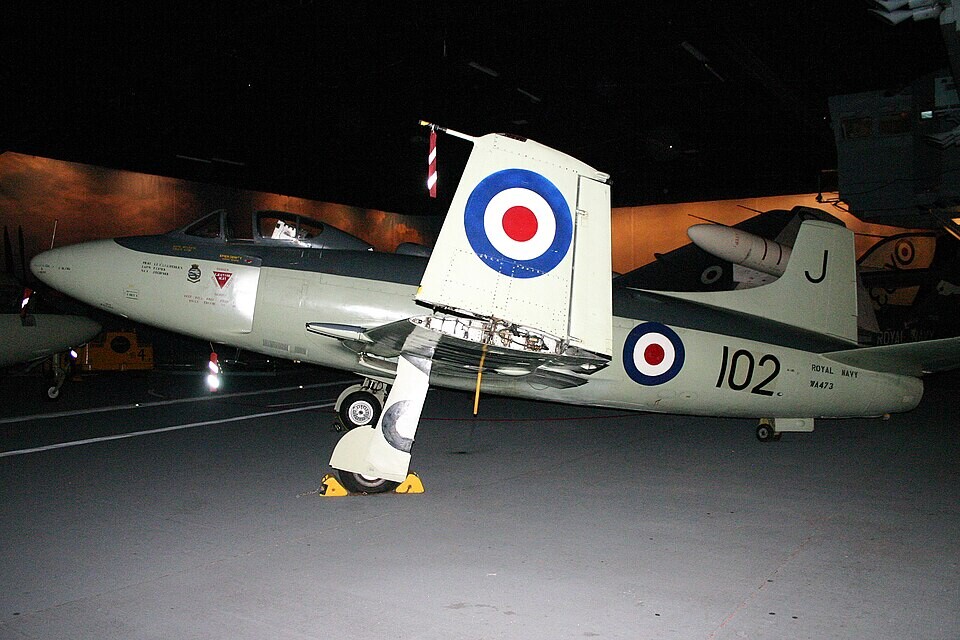
It’s always important to highlight and showcase the aircraft that remain and were part of history. Visit museums and enrich your knowledge. Unfortunately, of all the units manufactured, only one remains, which we will see below.
- https://en.wikipedia.org/wiki/Gloster_E.1/44
- https://en.wikipedia.org/wiki/Supermarine_Spiteful
- https://en.wikipedia.org/wiki/Supermarine_Attacker
- https://web.archive.org/web/20120114150004/https://www.flightglobal.com/pdfarchive/view/1953/1953%20-%200322.html
- https://www.pafmuseum.com.pk/history/
- https://web.archive.org/web/20160311022425/https://www.flightglobal.com/pdfarchive/view/1947/1947%20-%200762.html
- https://www.flight-manuals-online.com/product/supermarine-attacker/
- https://en.wikipedia.org/wiki/History_of_the_Pakistan_Air_Force
- Book — Attacker: The Royal Navy’s First Operational Jet Fighter; published by Dalrymple & Verdun Publishing; author Richard A. Franks.
Acknowledgements:
Special thanks to war_Tinder for their invaluable help with this article.