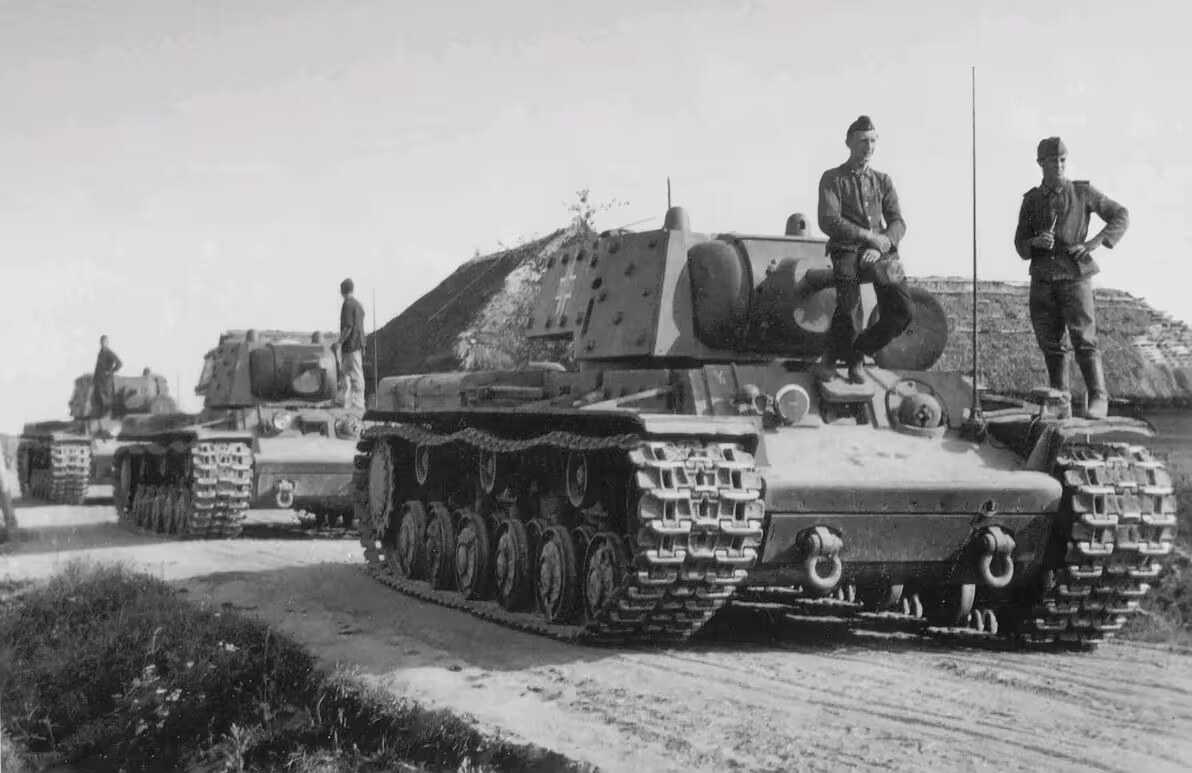
The Soviet KV series, most notably the KV‑1 and KV‑2, were among the heaviest tanks of the early war. When they were put to operational use during the midst of Operation Barbarossa, German forces found most of their anti‑tank weapons far too weak against the thick armor; even a single KV could stall an advance and demonstrate capabilities the Germans themselves lacked. That display of strength made captured examples highly prized. Yet the tanks were far from perfect. They consumed fuel at alarming rates, broke down often, and were difficult to supply, and as such many were left behind in retreat or captured intact. The Wehrmacht quickly put these tanks to use, repainting their insignia and assigning them new designations as Beutepanzer (lit. loot tank).
1. Development and Operational use of the KV-1 and KV-2 by the Soviets
2. German Encounters and Captures of the KVs
3. German Modifications to the KVs
4. Operational use of the KVs by the Wehrmacht
5. Influence on later German tanks
6. Gallery
Development and Operational use of the KVs by the Soviets
The KV-1 was developed following the unsuccessful results yielded by the T-35 heavy tank, which despite its classification had relatively minimal armor protection. The Spanish Civil War also demonstrated the need for much heavier armor on tanks, with the light T-26s being easily penetrated by enemy armor. The KV-1 proved to be much more effective at its role than competing designs, and was thus ordered right off the drawing board. During the war, the Soviets found it difficult to deal with the concrete bunkers used by the Finns and a request was made for a tank with a large howitzer. One of the rushed projects to meet the request was to fit a 152mm M-10T howitzer in a new turret on one of the new KV tanks, eventually leading to the KV-2.
The KV-1 was first put to operational use against the Germans during Operation Barbarossa; and to great effect. No German anti-tank guns (minus the 8,8cm Flak) could reliably penetrate the KV’s armor, and its 76mm L-11/ZiS-5 cannon was easily capable of penetrating the German armor of the time. The KV-2 was equally formidable; It was also very heavily-armored, and its 152mm Howitzer proved to be a nightmare for both fortifications and tanks alike, reducing anything it came into contact with to heaps of burning metal
German Encounter and Capture of the KVs
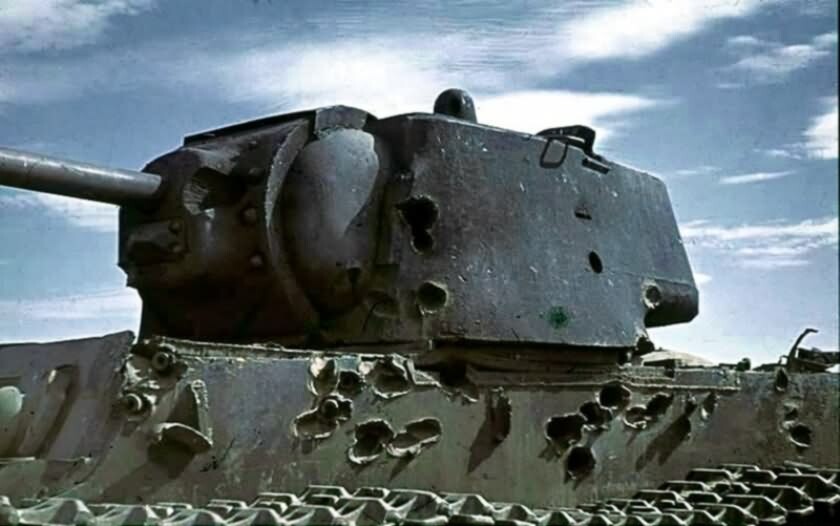
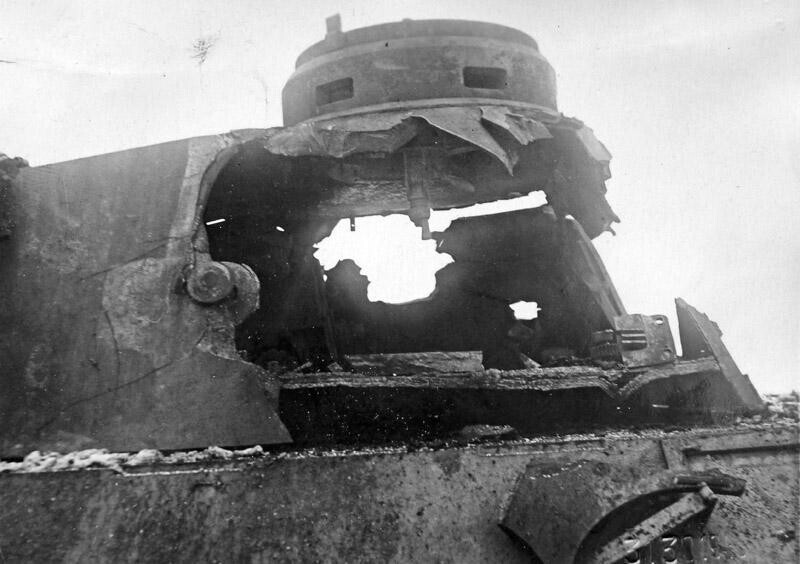
The Wehrmacht did not expect the deployment of any heavily armored tank from the Soviets, and so understandably, it came as a major shock when they first encountered them. Upon the inevitable realization that only their most powerful anti-tank weapon could effectively deal with the heavy armor, the Germans started deploying the 88s in a direct‑fire role and concentrated artillery against the KVs. Despite their best efforts, the sheer resilience of the KV-1 and KV-2 meant that many were not destroyed outright. However, the rather complex transmission and engine systems led to numerous mechanical failures, which gave the Germans a rare look inside the Soviet Colossus.
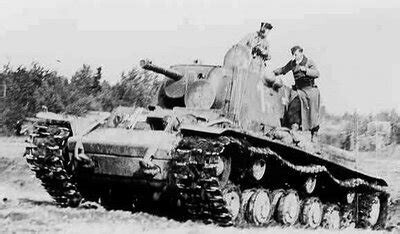
Captured KV‑1s were redesignated by the Wehrmacht as Panzerkampfwagen KV‑1 753(r), with the number 753 serving as the universal index for the type. Sub‑designations A, B, and C were used to distinguish between the Soviet production variants throughout the years. The suffix (r) indicated their Russian origin.
| Model (A/B/C) | Production Years | Main Armament | Frontal Armor Dimensions |
| KV-1A 753(r) | 1940 | 76.2mm L-11 | ~75mm |
| KV-1B 753(r) | 1941 | 76.2mm ZiS-5 | 75-90mm |
| KV-1C 753(r) | 1942 onwards | 76.2mm ZiS-5 | up to 110mm (glacis) |
Repainted with German markings, some were pushed into service with units such as Panzer‑Abteilung z.b.V. 66, while others were sent for evaluation.
German Modifications to the KVs
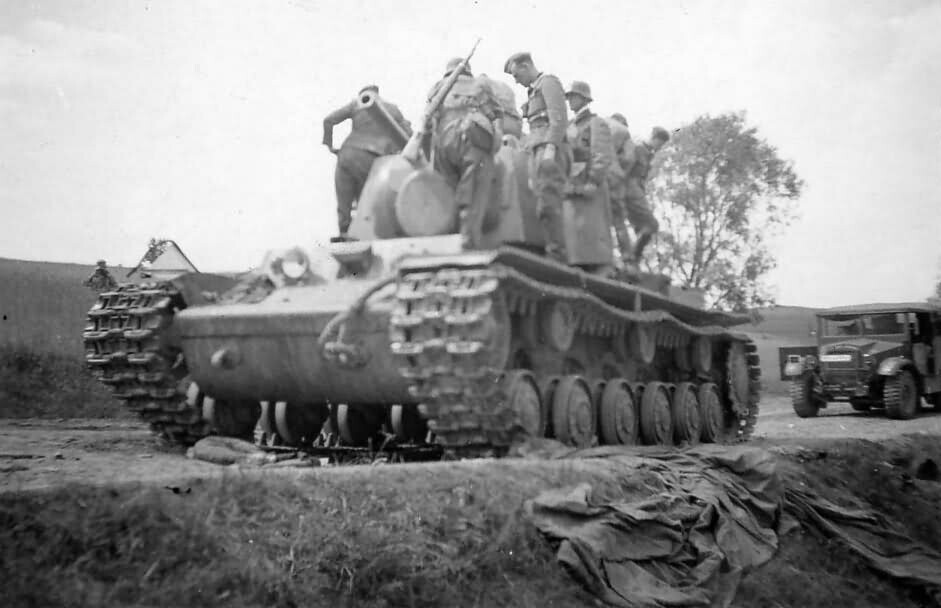
When the Wehrmacht captured the KVs, they faced the challenge of operating vehicles built to Soviet standards; with parts and systems unfamiliar to German crews. As a result, modifications were often aimed at being practical rather than ambitious, at attempts to make the KVs usable in German service. Listed below are some common changes that were made to the KVs by maintenance crews.
- Repainting and Redesignation: Captured KVs were repainted in Panzer grey or field camouflage and marked with Balkenkreuz insignia to prevent friendly fire. Tactical numbers were sometimes added, just as on German‑built tanks.
- Radio Equipment: Soviet tanks often lacked reliable radios, so German crews installed their own FuG radios to standardize communication. This was one of the most common modifications.
- Cupolas: Visibility was a major issue in Soviet designs, and thus some KV‑2s were fitted with German commander’s cupolas, aligning with German tank doctrine.
- Armament: the Soviet Degtyaryov DP light machine guns were often replaced with MG‑34s or MG‑42s, simply due to the lack of spare parts and 7.62 ammunition.
There are a few other notable examples of modifications made to the KVs, such as one KV‑1 being re‑fitted with the German 7.5 cm KwK 40. However, conversions like this were rare due to technical complexity, and were often seen as a waste of manpower and time.
German engineers conducted evaluations of captured KVs, to which they gathered mixed results. They praised the KV’s armor, firepower, and spacious interior, but criticized its poor visibility and unreliable transmission. These reports influenced German doctrine by emphasizing the importance of crew ergonomics and mechanical reliability.
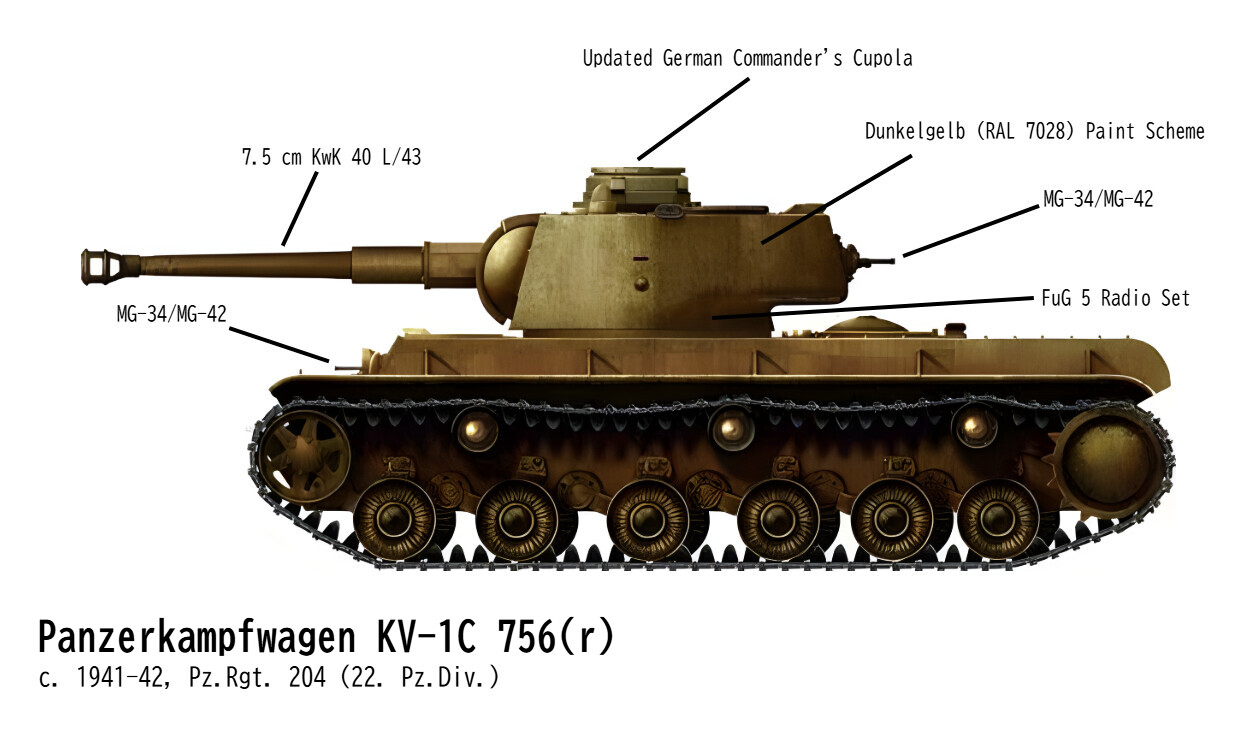
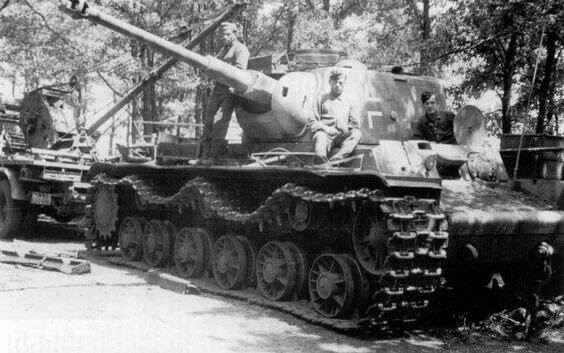
Right: The only known image of a KV-1 fitted with a 7,5cm KwK40 (source)
Operational Use of the KVs by the Wehrmacht
While most captured KVs were sent back to Berlin for testing and evaluation, numerous examples were used in frontline combat after being fitted with the required modifications. Logistics proved to be a major problem: once a KV broke down, it was often abandoned due to the fact that German supply chains couldn’t support Soviet designs.
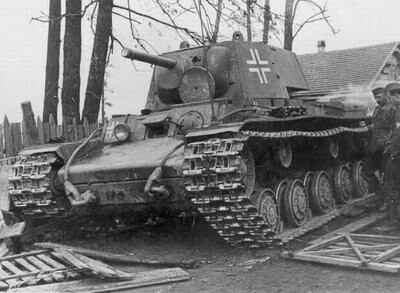
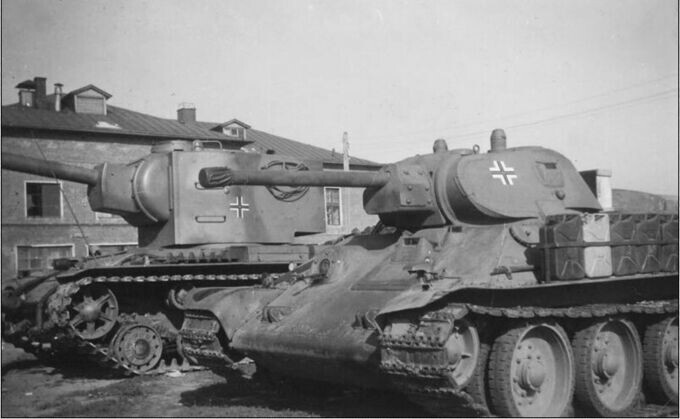
One of the best‑known formations to operate these tanks was Panzer‑Abteilung z.b.V. 66. Formed in 1942, the battalion was first stationed in France and earmarked for the planned invasion of Malta, before eventually being transferred to the Eastern Front. Its inventory included not only KV-1s and KV-2s, but also captured T-34s, German VK 16/1801s, and standard Panzer IV Gs. Apart from combat, some captured KVs were used for training. This gave the German crews a far better understanding of the Soviet technology, and enabled them to counter the KVs more effectively. A few even appeared in propaganda films, attempting to symbolize German ingenuity in turning enemy weapons against their creators.
Influence on Later German Tanks
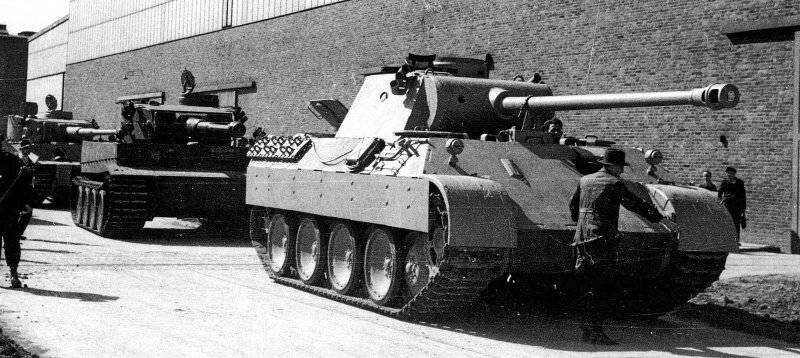
The KV series was not the only Soviet tank pressed into German service. The more numerous T‑34s were also captured and used extensively, often preferred for their balance of mobility and firepower. Compared to the T‑34, the KV was far more difficult to maintain, limiting its long‑term usefulness despite its impressive armor. While the KV’s direct influence on German tank designs later in the war is debatable, there is no doubt that the Germans learned a thing or two about the importance of strong armor and good weaponry in tanks. Many German tanks later in the war did indeed share many of these traits with the KV, notably the Tiger I/IIs and Panthers, as well as a handful of tank destroyers. Although Germany achieved many significant advances in technology and design, by this stage of the war the overall situation was already turning against them, leading to their eventual defeat in 1945.
Sources and Notes
- German encounter of Soviet T-34 and KV tanks — Wikipedia
- KV-2 — The Soviet Union’s Red Colossus — The Armory Life
- KV Soviet Heavy Tanks: Prototypes, Pre-Series KV-1/KV-2 and German Beute Panzer Captured Tanks — Armorama
- Tankograd Catalogue — KV Soviet Heavy Tanks and German Beutepanzer
- Captured KV-2 tanks in German service
- Panzer-Abteilung z.b.V. 66 — Lexikon der Wehrmacht
Thanks for Reading! : D