We’ve already discussed the T14 (more about the T14 here in my article: T14: The Super Heavy Sherman). Now we want to take a closer look at its British counterpart, the Excelsior. Like the American T14, the Excelsior resulted from the same development project, although the Excelsior also never went into serial production; only two prototypes were built.
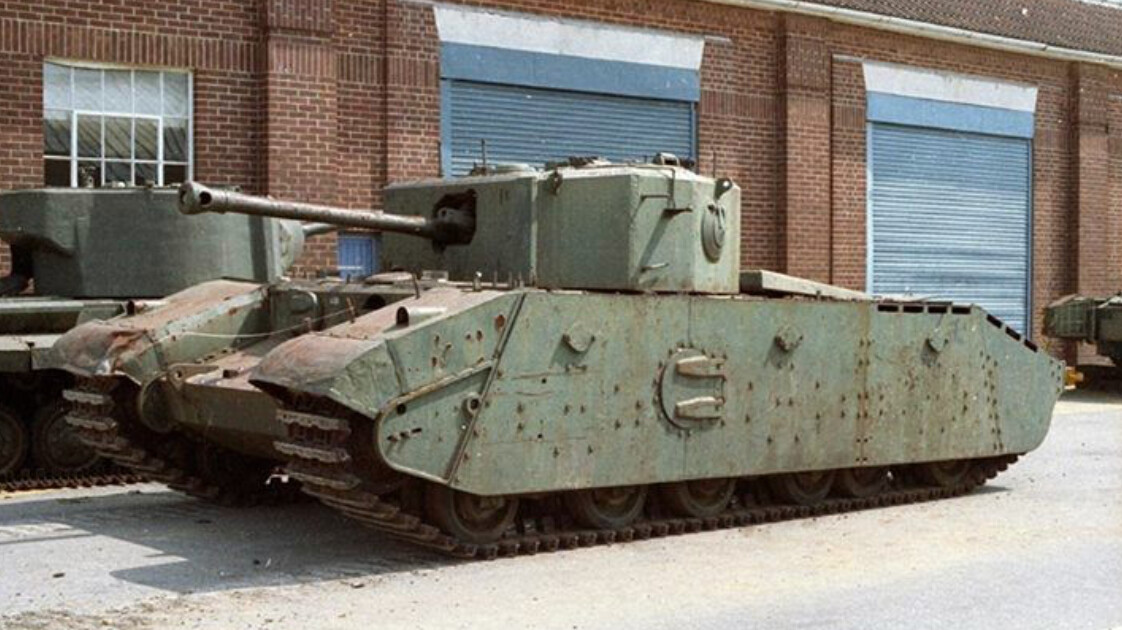
Technical data
| High | 2.41 Meters |
| Width | 3.40 Meters |
| Length | 6.91 Meters |
| Mass | 40 t |
| Armour | 20 — 114 mm |
| Main Armament | Ordnance QF 75 mm |
| Secondary Armament | 2×7.92 mm Besa MG |
| Engine | Rolls-Royce Meteor V12 petrol |
| Power | 620 Hp |
| Range | 160 km |
| Top Speed | 39 km/h |
Development
As previously mentioned, the Excelsior was the direct British counterpart in the project to develop a new assault tank. Both the Excelsior and the T14 had the same capabilities to meet the contract requirements. They drew inspiration from existing designs, such as the Sherman-like appearance of the T14.
The reason this project came about in the first place was due to the Dieppe Raid. This was an operation in the French town of Dieppe, which was attacked by British and Canadian troops using landing craft. Among other things, the heavy infantry tank Churchill (More about Churchill in my article: The Churchill: The Iron Prime Minister) saw its first action here. 58 Churchills were deployed on the beach at Dieppe with a total of 6,000 British and Canadian soldiers, five-sixths of whom were Canadian. Their purpose in this attack was to reinforce the defenses of the German Wehrmacht along the Atlantic Wall, which stretched 2,685 km from the French Atlantic coast to Norway.
Due to the crushing defeat at the Dieppe Raid, with the loss of all tanks, approximately 1,770 Allied dead, 3,045 wounded, and 1,970 prisoners, while the Wehrmacht suffered only 280 wounded and 311 dead, the usefulness of the Churchill tank was questioned, and efforts were made to develop a possible successor in cooperation with the USA.
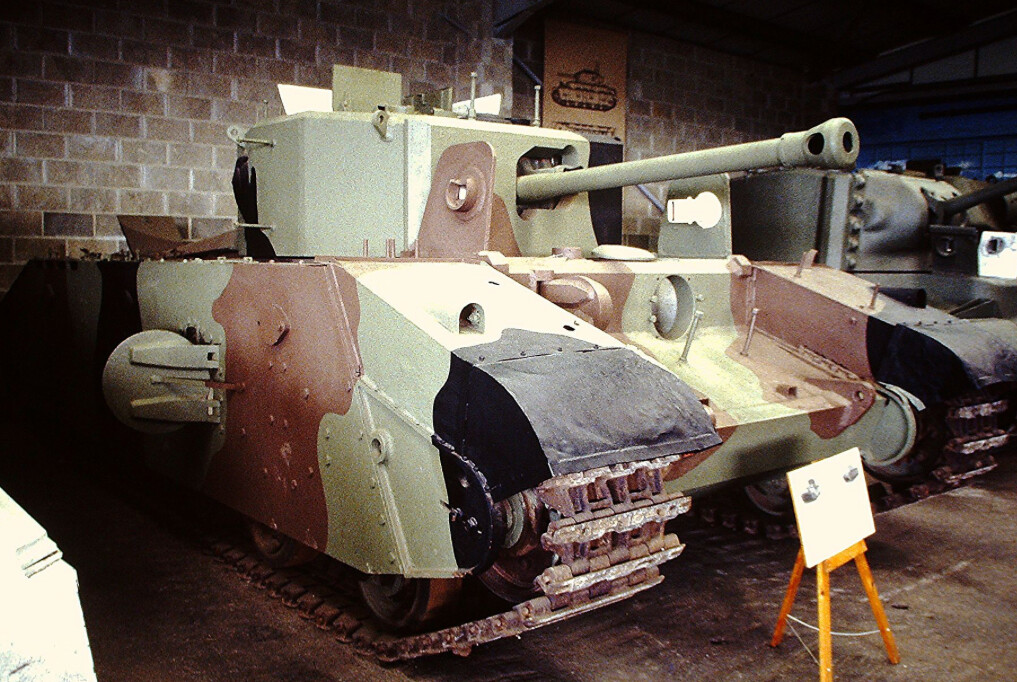
The development of the Excelsior began when Rolls-Royce proposed designing the new assault tank based on the A27 Cromwell, significantly reinforcing it. As with the T14, it was decided to utilize components from the American M6 heavy tank. The Excelsior adopted the M6's track links and suspension. The armor was considerably strengthened, more than doubling its thickness across the board, resulting in the Excelsior achieving up to 114 mm of armor on the front turret and hull, compared to the Cromwell’s 64 mm. The sides were armored up to 76 mm on the turret and up to 89 mm on the hull, whereas the Cromwell only managed 46 mm and 51 mm on the turret and hull, respectively. The Excelsior’s armament was adopted from the Cromwell V; both vehicles used the 75 mm OQF Mk.V cannon. Both also had two 7.92 mm BESA machine guns each, one coaxial and one in the chassis.
Finally, English Electric was awarded the contract to build two prototypes. These were completed in 1943 and both modified in different ways. The first prototype was equipped with the M6 suspension and, instead of a 75 mm gun, initially fitted with a 57 mm 6 pounder gun, as this had been planned before the 75 mm version. The second prototype had a special Rolls-Royce suspension, called the “R.L. type suspension.” However, because this was complex to build, difficult to maintain, and required a lot of material, it was only used in the second prototype instead of the M6 suspension and was equipped with the subsequently planned 75 mm OQF Mk.V gun with an 80 round magazine. To give the Excelsior its power, the Rolls-Royce Meteor V12 engine was installed, which gave it 620 hp and a top speed of up to 39 km/h.
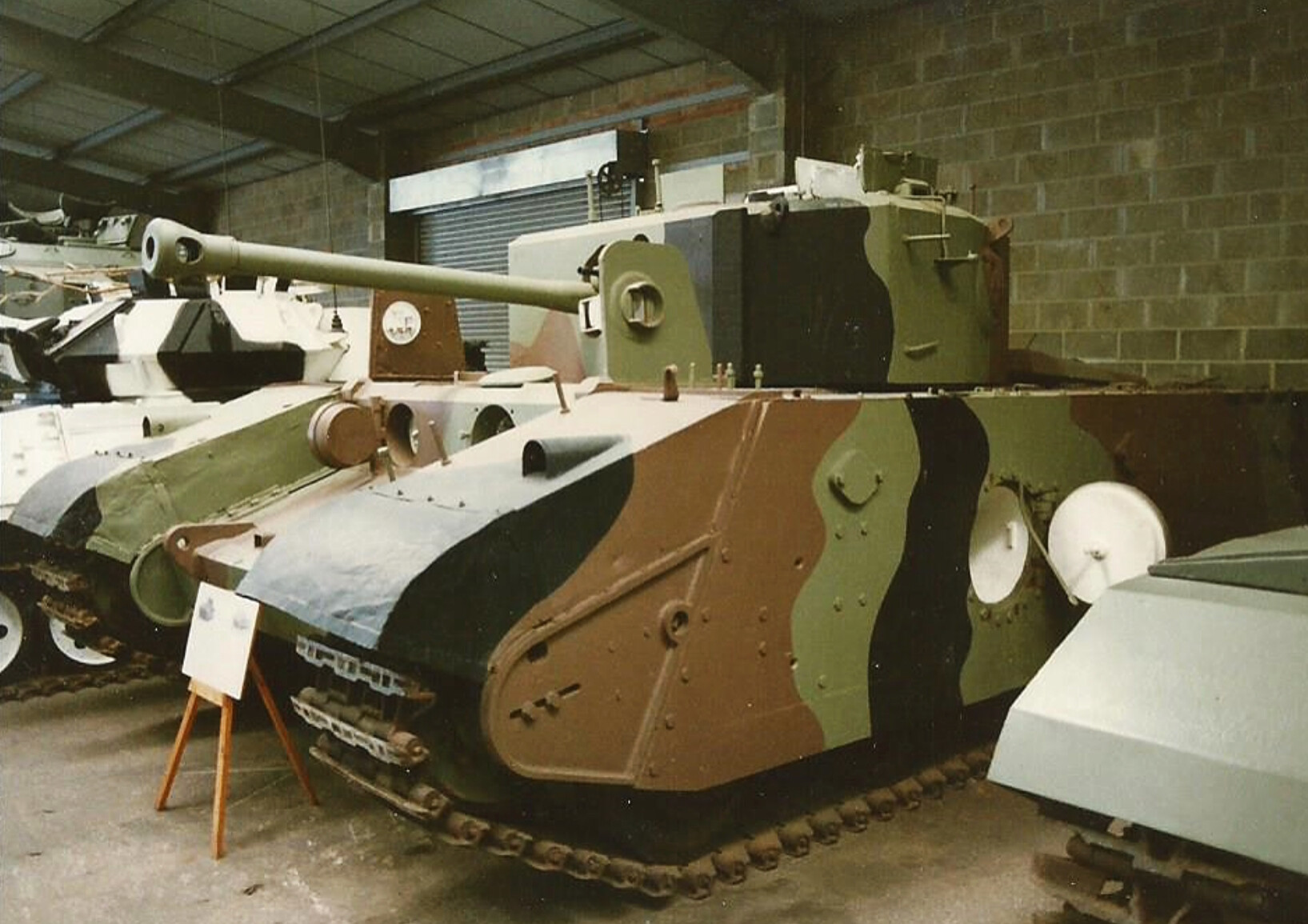
In 1943, the first test drives with the two prototypes took place, which exhibited several problems. These included oil leaks due to weathering and leaky lines, hydraulic leaks due to wear on the hydraulic pipes, an underdeveloped electrical system (which was also found in the Cromwell tanks), brakes that wore out very quickly, the suspension of the M6 in the Excelsior was inadequate and suffered from high wear, and it also had the notorious problem of dirt and mud accumulation, which could reach up to two tons on the tank. Furthermore, the Excelsior itself had difficulty driving in mud. However, the Excelsior also demonstrated good qualities in the tests; namely, it could drive well on normal ground and terrain and was said to have good driving quality. Its tub construction was said to be very robust, which meant that the wear and tear on the tub itself was minimal, and it was also quite maintenance-free.
However, the Churchill was further developed by then, and had become more than satisfactory, and therefore a successor to the Churchill was superfluous, which is why the project was discontinued.
Nowadays, one can still see the second prototype of the Excelsior in the Bovington Tank Museum, as it has been preserved to this day.