
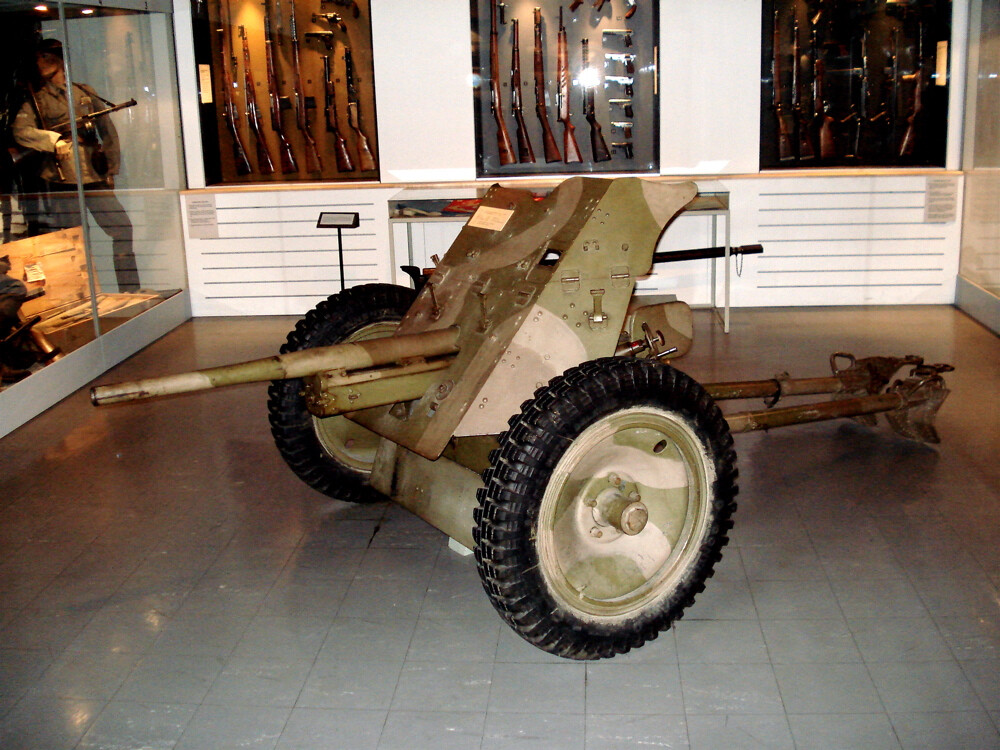
This article is about the history of the German 3.7 cm L/45 guns — mainly the PaK 36* and KwK 36 — as well as the tangentially related Navy 3.7 cm FlaK M42 L/69. The PaK 36 was the mainstay of towed anti-tank guns for Germany during World War II, being used from the war’s onset until the last days of the war, and were used in all sorts of roles, ranging from anti-tank operations in the late 1930s to infantry support using HE and fin-stabilized HEAT grenades during the closing days of the war. While the PaK 36 and its derivatives were largely obsolete by the end of World War II, their large production volume (20,000 units) meant that it wasn’t too hard to find them across various frontlines, still putting in work.
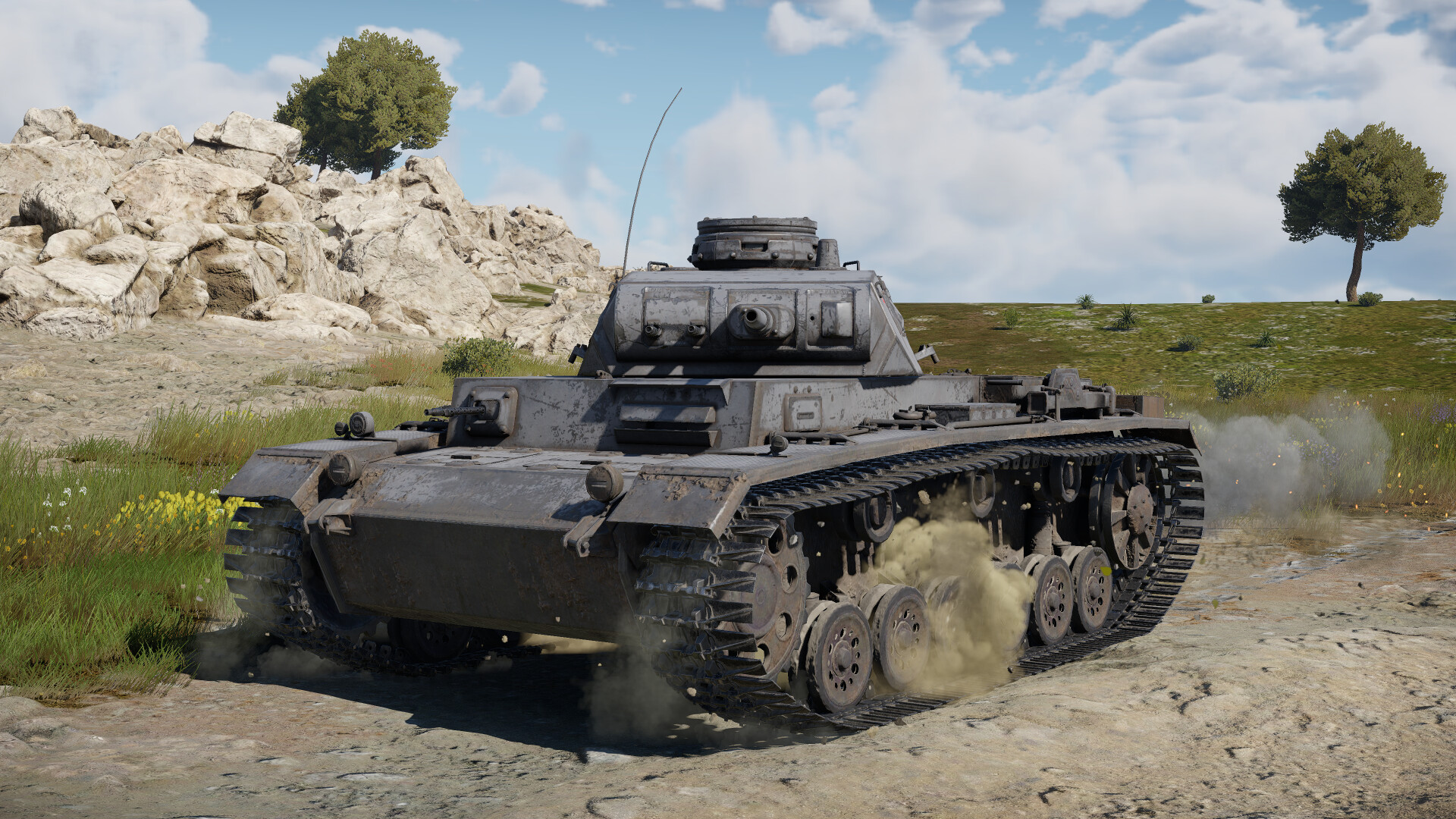
*Note: This article will use the name “PaK 36” often throughout this article, as this is what the gun is generally called by people; however, the historically accurate term for it is in fact “3.7cm PaK L/45”, especially for its pre-WWII iterations. German sources do not include the numbers 35/36 at the end when describing the gun; this is most likely a post-war addition and an erroneous one.
Sources also disagree between the use of “Pak”, “PAK” and “PaK” — this article will use “PaK” and “TaK” for consistency, as it seems to be the most widely used of all the iterations, but please keep in mind that this can ultimately depend on what source you’re using!
History
Early beginnings
With the introduction of the first tanks in World War I, it was only logical that the development of countermeasures against them would follow shortly after. Various weapons of differing calibers, tactics and engagement rules were created at the time, including everything from AP ammunition for regular machine guns to the Mauser Tankgewehr M1918 (the world’s first dedicated anti-tank rifle, and the only one to see service in WW1) that could fire a 13mm steel core projectile. Most designs of the time tended to be variants of existing designs or simple armor-piercing shells created based on Navy experience given to existing firearms, as the constraints of the war meant that developing entirely new systems at this point in time was generally unfeasible.
This included the 5.7cm and 7.7cm field guns such as the 7.7cm FK 96 and 16, as well as a very simple 3.7cm AT gun, the 3.7cm TaK 1918. The 3.7cm TaK was an amalgamation of various other guns of the time, such as its barrel coming from a Hotchkiss rotary cannon and its carriage based on a German mortar carrier, though it still deserves recognition for being the first cannon purposefully designed and put together to deal with enemy tanks. Unfortunately, the end of WW1 heralded the end of the 3.7cm TaK. While it would stay in service with the Reichswehr, it was hopelessly outdated; after all, from the beginning it was designed as a stopgap solution. However, the desire to create a better AT gun didn’t go away inside military circles; while prohibited by the Treaty of Versailles, Germany still wanted to rearm in some capacity. During this time, German arms manufacturers were often encouraged to look abroad to form development pacts with countries such as Russia, Sweden and Switzerland, as to keep researching military technologies in some capacity while circumventing many of the restrictions set out by the treaty.
Revival of the TaK
The 3.7cm calibre was chosen for development during this time due to the available ballistic data on the ammunition types fired from the TaK and the 3.7cm M14. This was useful both for AT performance and for the development of new 3.7cm AA guns, such as for the 3.7cm Flak 18 L/57 in 1930.
These guns even shared the same AP and HE ammo, with the exception of the casing: the PaK (or at that time still TaK) used a 250mmR casing and the Flak (at that time M.Flak) a 265mmB casing, allowing for a 20g larger propellant charge for the standard HE and AP rounds. In general, this allowed for streamlined production, as the Heer, Luftwaffe and Kriegsmarine shared the ammo and production lines for said ammo, though sometimes with slightly different names and ammunition colors. Examples include the Pzgr. and Psgr shells. While the addition of “gr.” (Granate) already indicated that it contained an explosive filler, an exception was the Pzgr.40. In the navy, all AP shells with HE filler had the addition of an “s” instead of “z”, while AP shells with high HE filler in the army instead used Pzsprgr. (Panzersprenggranate).
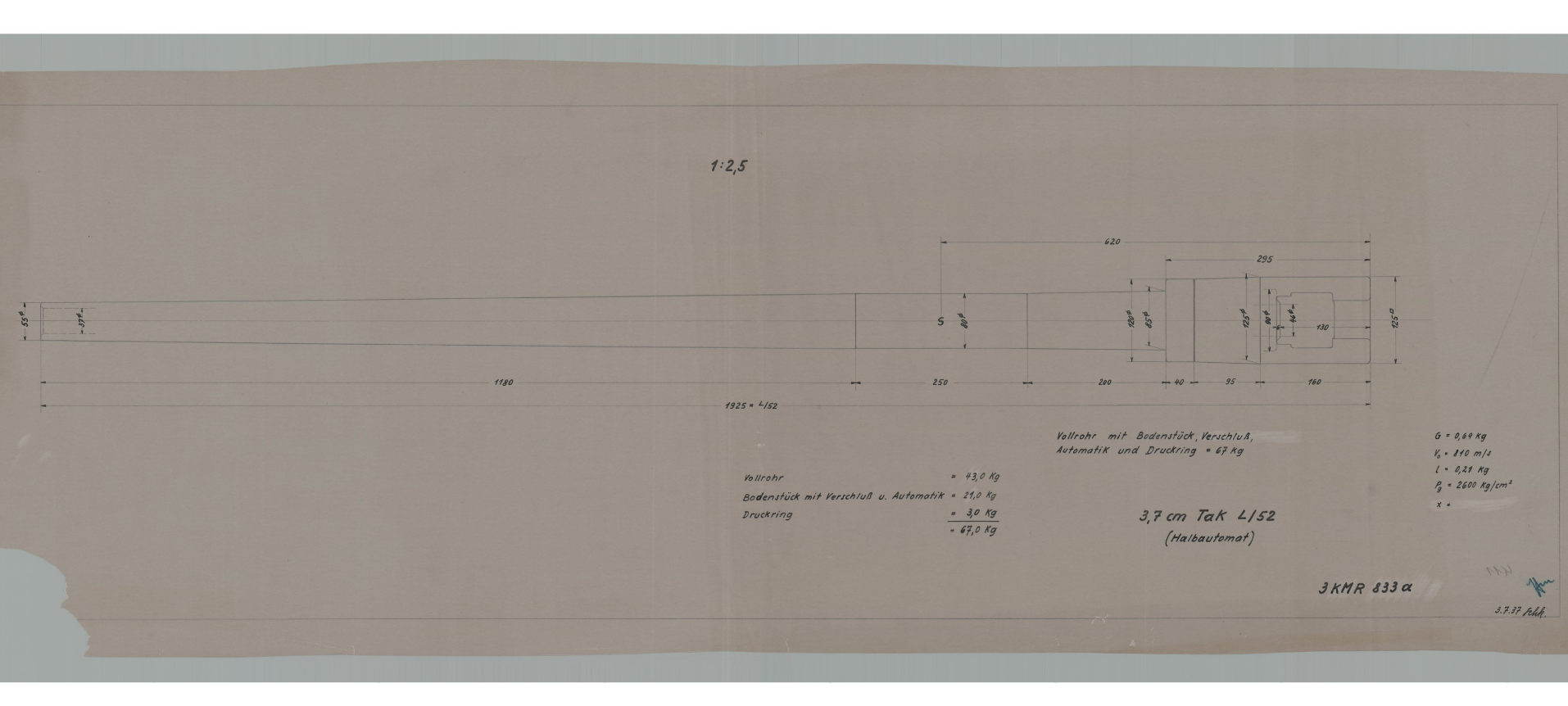
Development for the 3.7cm PaK L/45 started in 1925. The addition of 35 or 36 or even 35/36 at the end of its name is a post-war addition; in pre-war and wartime documents the gun was simply called 3.7cm TAK/PaK or 3.7 cm TaK/PaK L/45.
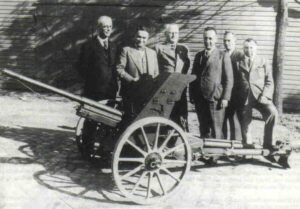
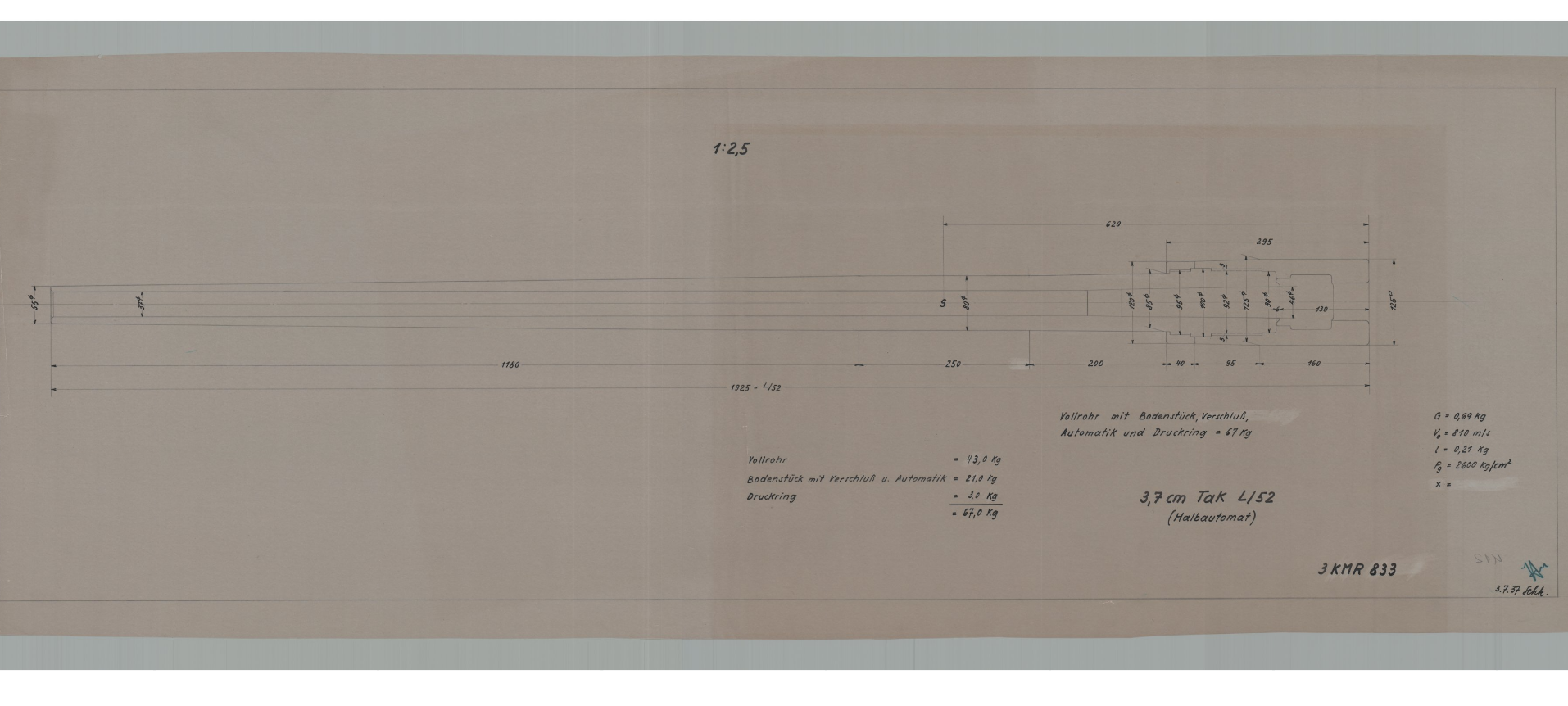
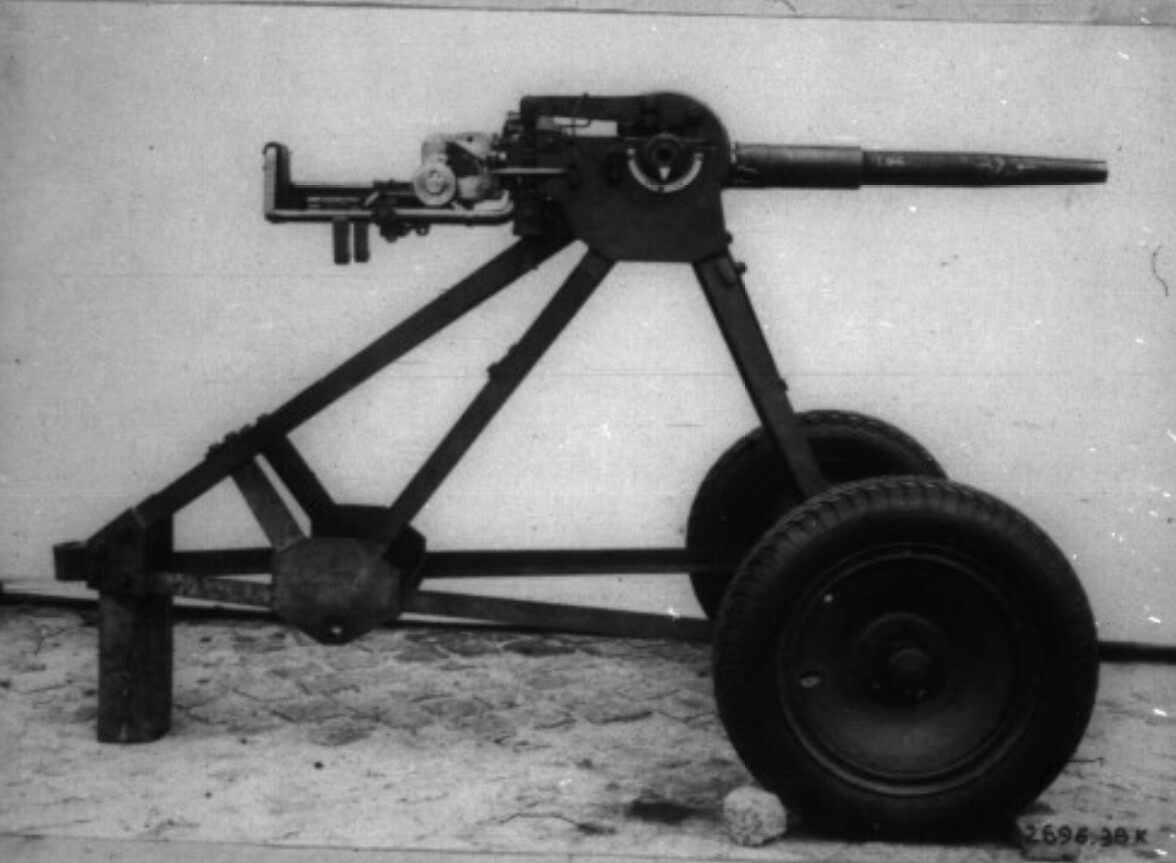
The early requirements of the Reichswehr called for a light gun in the 3.7cm calibre, mainly for AT work with high mobility, but also effective HE rounds. As early as 1928, the first prototypes were ready, at that time still with wooden spoked wheels and a L/52 (and L/50) barrel with a 40 m/s higher velocity. However, for unknown reasons, the barrel was shortened to L/45 for all guns.
Further evolution of the gun
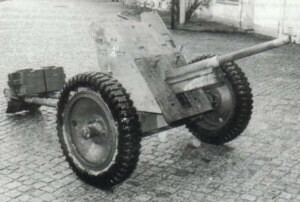
In 1934, the carriage for the TaK 36 saw a switch from wooden wheels to pneumatic wheels, which enabled it to be towed by vehicles. Later, in 1936, it was renamed from TaK to PaK, which is most likely the reason for the post-war designation given to the gun as “PaK 36”.
The overall requirements of the time when improving the PaK 36 were to lower its weight for ease of transport, as well as having sufficient penetration to penetrate all enemy tanks of the time at 1,000 m and at a 30° angle.
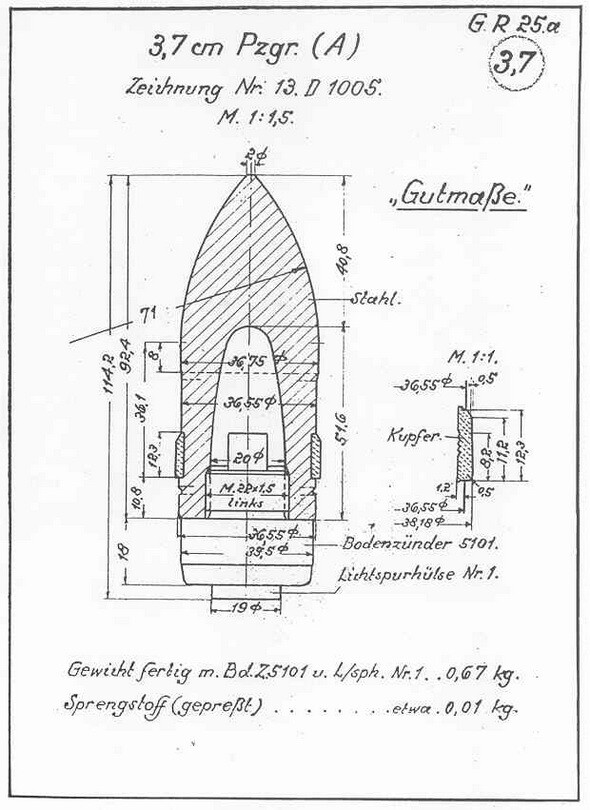
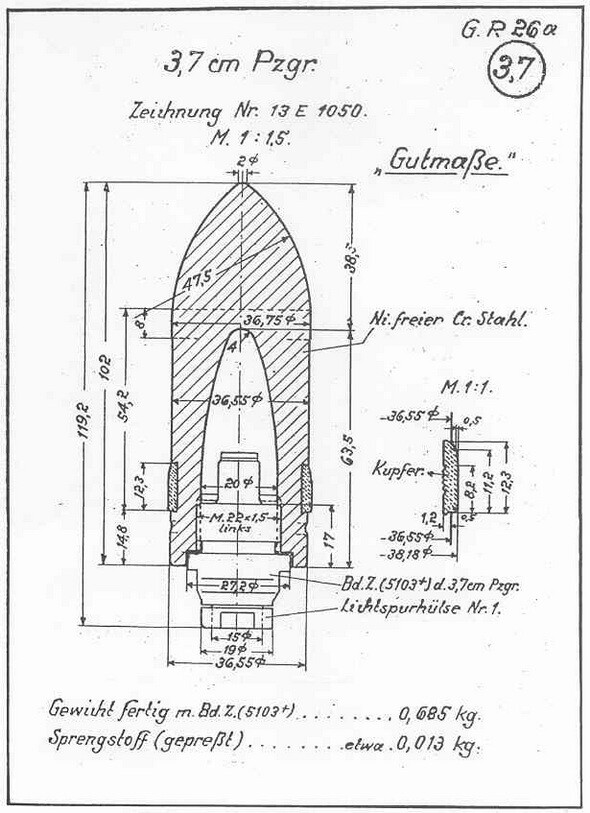
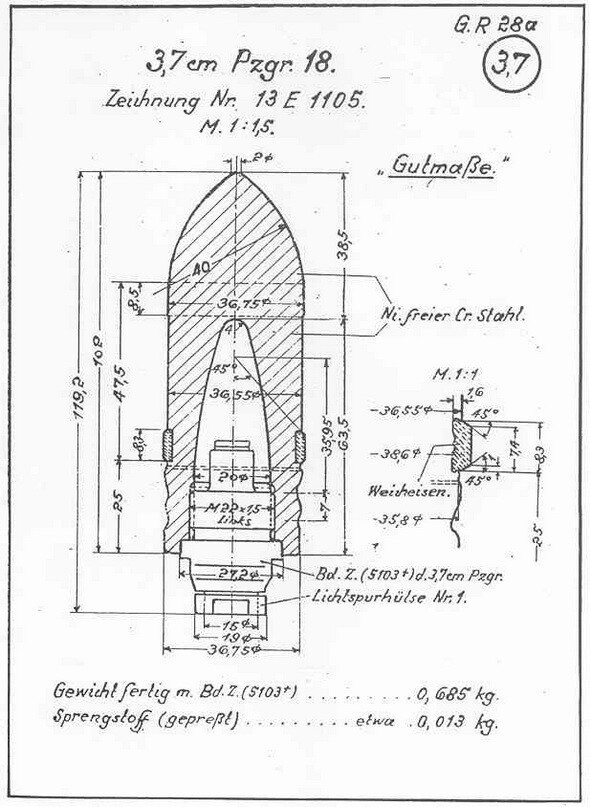
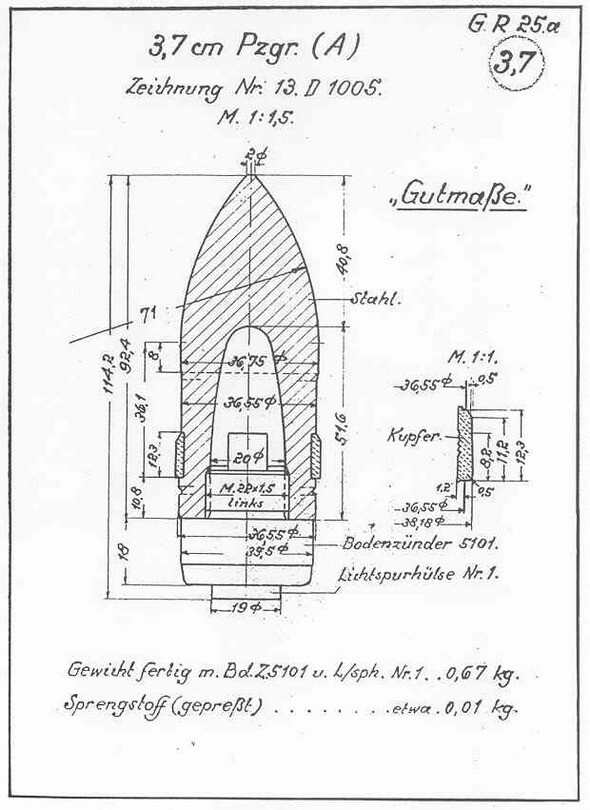
This was first achieved with the Pzgr. (A) shell, which was also used by the USSR for their 3.7 cm M1930 (1-K) — a license produced copy of an early model PaK 35/36, produced as a result of one of the secret agreements Germany signed with the USSR at the time. This was later replaced with the Pzgr., which was slightly heavier (685-695g variants), had slightly more filler, a less pointed head to improve the shell’s angled performance, as well as changes to the rigidity of the nose itself. The same round, under the designation Pzgr.18, was used in the FlaK with only minor adjustments, such as using nickel-free chrome steel, having a shorter driving band, and grooves for the casing to grip better.
The gun was one of the most powerful of its time. It was only truly surpassed by the British 2-pdr in 1936, as well as the US 3.7cm M3, which was partially influenced in its development by the German gun, but with a larger propellant charge, amongst many other changes. Alongside the M3, multiple similar designs appeared in different countries, including Sweden, Poland, Belgium and Czechoslovakia.
Late war life
While the PaK is said to have received the name “Heeresanklopfgerät” (Army door knocker) by troops, it was a very effective gun up to the first half of World War 2, and even after it was rendered obsolete against newer generations of tanks, it still remained more than effective against lighter targets, such as armoured cars and light tanks. While the name “Heeresanklopfgerät” was indeed used ironically by some during the war, it was exaggerated by propaganda and post-war narratives — although not without reason, as the gun did struggle against heavy tanks and later medium tanks.
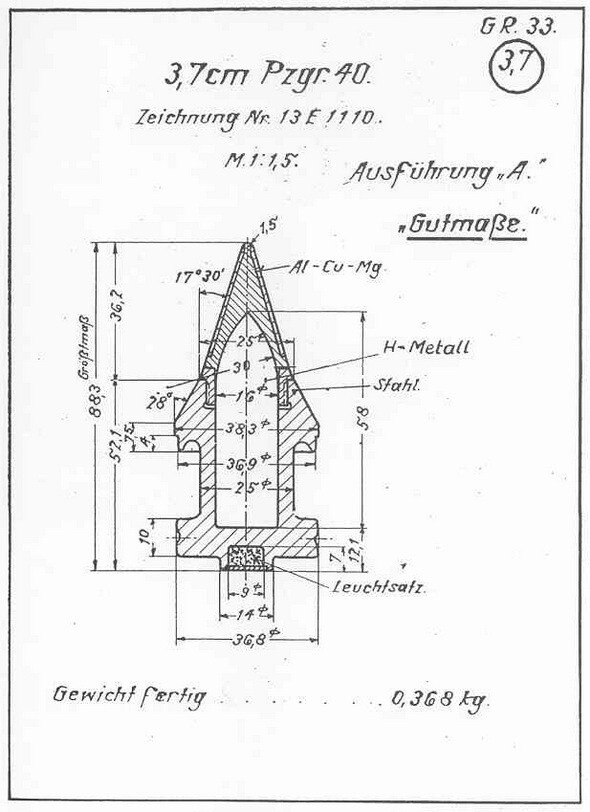
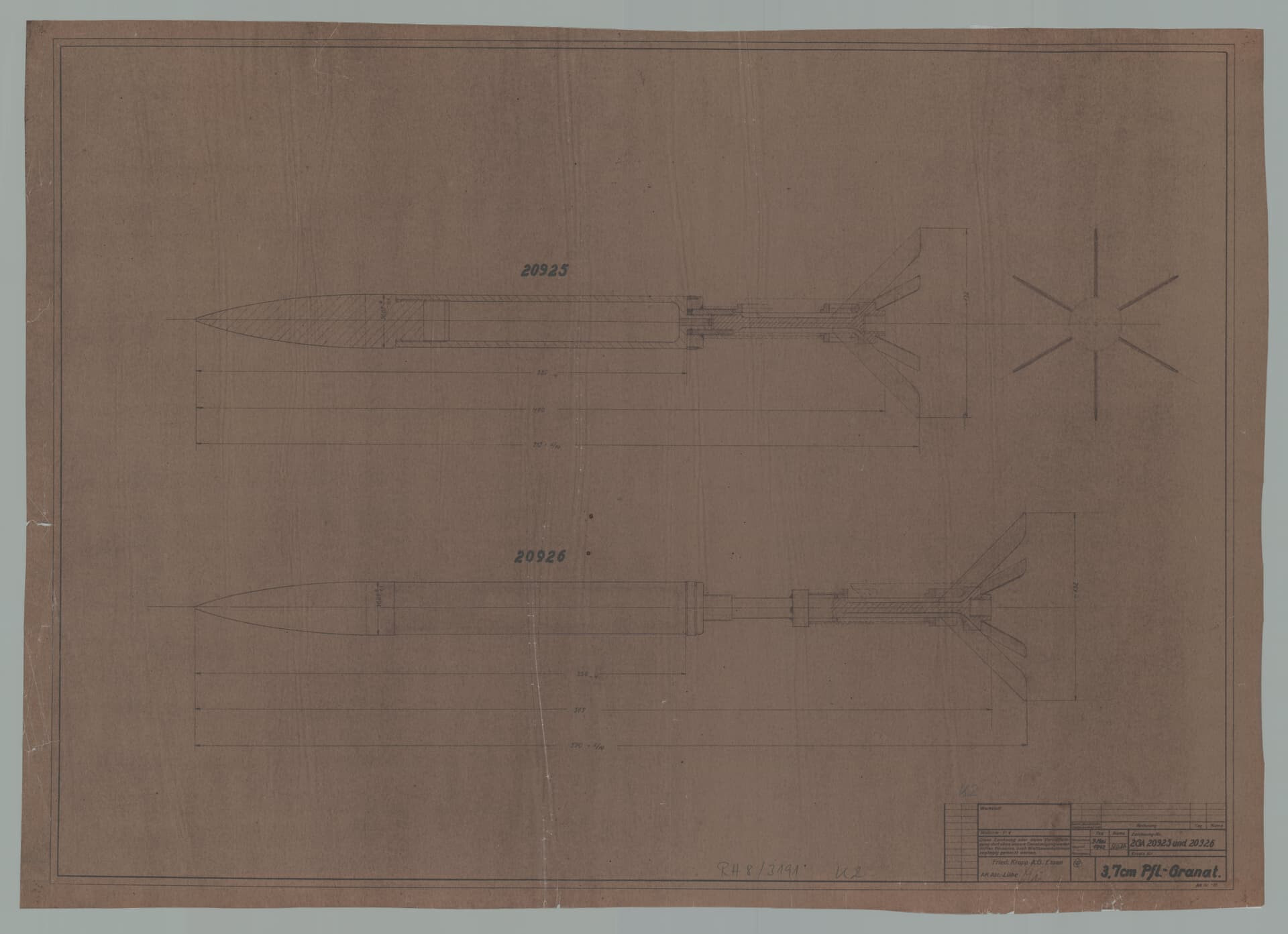
The Army never gave up on the caliber, with various efforts made throughout the war to produce better, next-generation shells — some were successful, others not so much. This began with the Pzgr.40 APCR/HVAP and the 15 cm Stielgranate 41, but also included the Pfeilgranate/Pfeilgeschoss, which were elongated APHE rounds with folding fins. The Pzgr.40 and Stielgranate 41, even with their own limitations, allowed the gun to be used to fight even the heaviest of enemy tanks. This was especially noticeable in urban combat scenarios, where engagement ranges were typically quite short and the streets too narrow for the installation and repositioning of larger, more capable anti-tank guns.
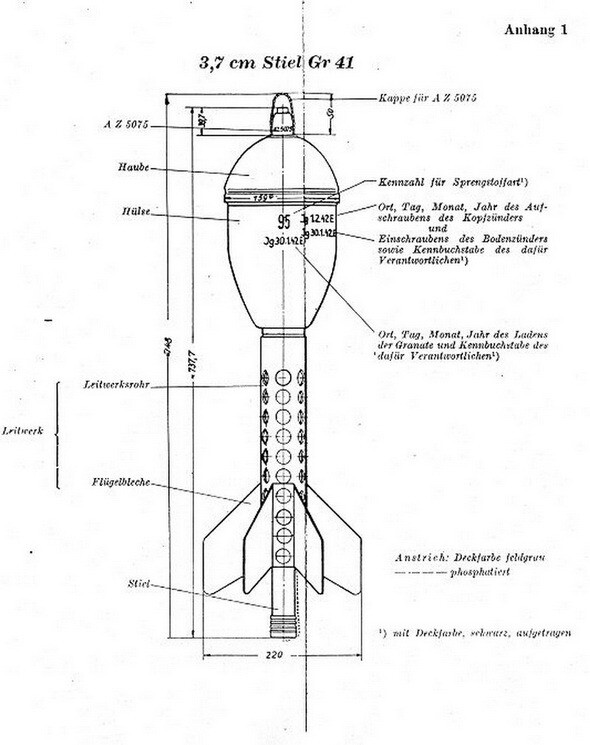
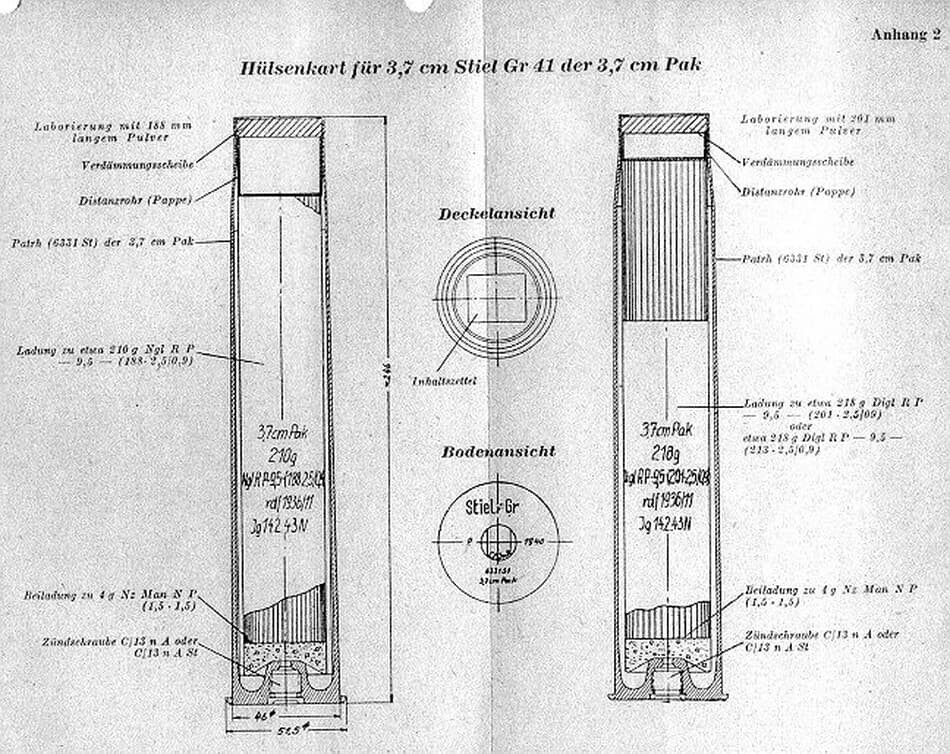
While Pzgr.40 offered good ballistics and penetration, it had noticeably worse post-penetration spalling and was far more expensive than its contemporaries, due to its tungsten core. Compared to the Stielgranate 41, it offered a far greater effective range. The Stielgranate 41, on the other hand, was an overcaliber 15 cm HEAT-FS round that needed to be manually plugged into the front of the gun, requiring the loader to leave the protection of the vehicle or gun shield. A propellant casing was then inserted, allowing it to be fired up to an effective range of 300m, while the theoretical (albeit extremely optimistic) max range was said to be up to 700m. It could, however, penetrate all heavy tanks of its time, and due to its great filler was also effective in the demolition of buildings and against groups of infantry.
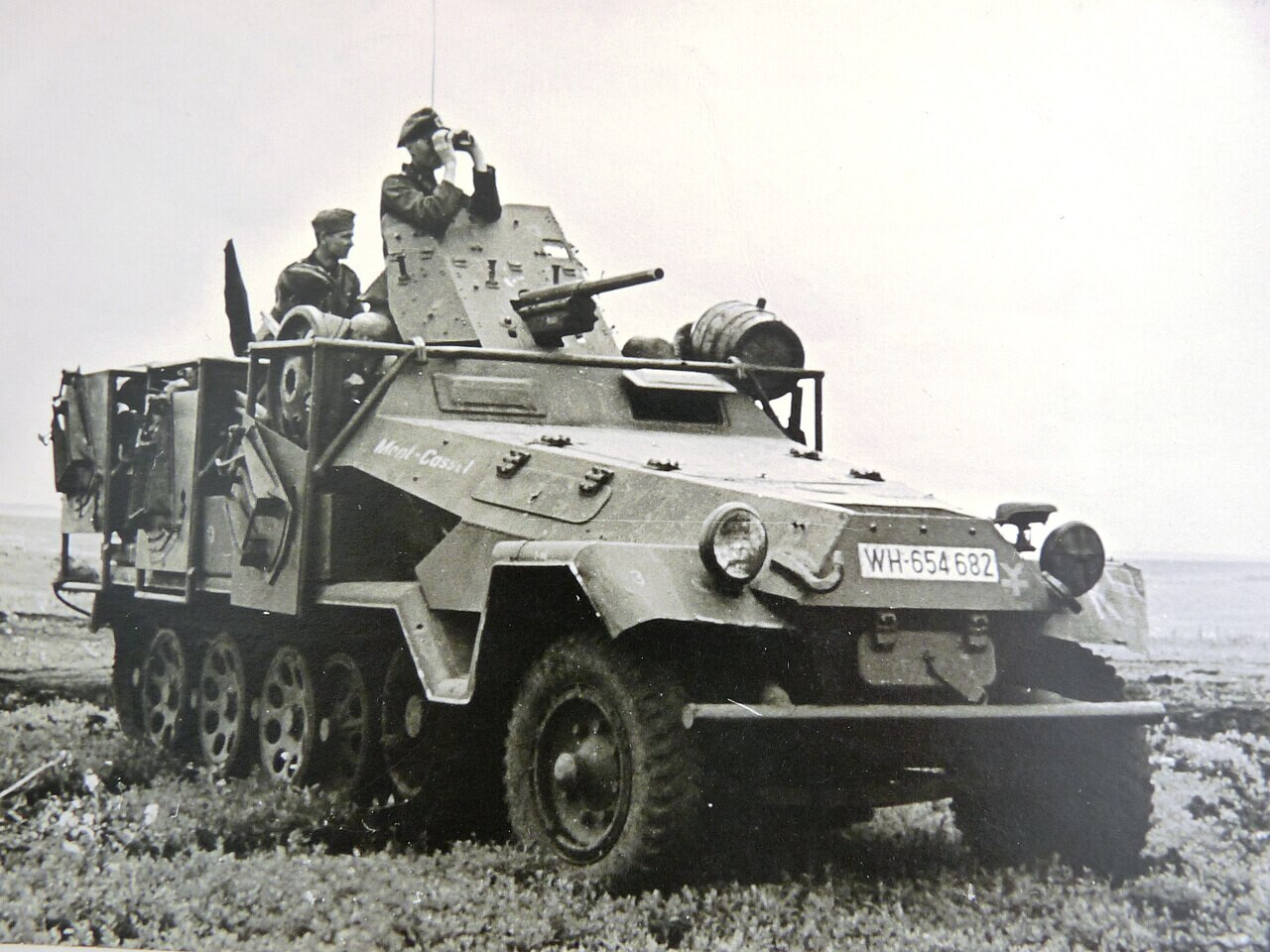
Up until 1942, the PaK 36 was still a mainstay field gun for Germany; While it was clearly starting to show its age as an anti-tank gun, it was still used to great effect as a light infantry gun with Sprgr.18 (Umg.), Sprgr.40 and the Stielgranate 41. Due to its good ballistics, it was capable of shooting into the small openings in bunkers with HE rounds, making it quite lethal. It was also often mounted on half tracks such as the Sd.Kfz.251/10 and 250/10, which gave units greater flexibility to use light artillery support whenever and wherever necessary.
With AT gun development being so important at the time, so too was the development of a new tank cannon. To simplify logistics the same gun was to be reused, repurposed as the primary armament of the new generation of German armor. This was first for the Leichttraktor, then a test Großtraktor with a coaxial 3.7cm KwK L/45, and then the Nb.Fz. For the Nb.Fz, a 5cm gun was requested, which would ultimately become the 5cm KwK 38 L/42 — however, the gun wasn’t ready in time, and as such the 3.7cm KwK L/45 was retained on the vehicle. While the Leichttraktor and Großtraktor were developmental dead ends and the Nb.Fz. was ultimately relegated to a life of being paraded around as propaganda material, the Pz III also received this armament. While a tank with an intended armament of a 50mm high-velocity gun was asked for, such a vehicle was not expected to be ready for some time.
Other mentions
When the main production variant of the Pz III — the Pz III Ausf.E — reached production, it was already becoming clear that its armament would be insufficient in the near future. While 50mm armaments were in development, there were also plans for improved 3.7cm guns to be mounted instead, such as the 3.7cm K. L/65 and L/70, which found their way onto the Pz.Sfl. half-track as well as into bunkers. A switch to this new gun design, which used much bigger 37×355mmR casings compared to the 37×250mmR shells used on the PaK 36, was seen as redundant. It would have meant abandoning the already large stockpiles of 37×250mmR shells already in inventory, as well as re-tooling all factories for production of this interrim gun, when larger caliber guns were already in development! As such, these stronger 3.7cm cannons ultimately never entered mass production.
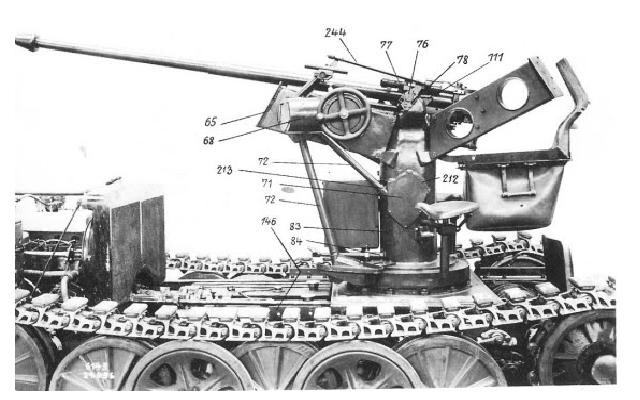
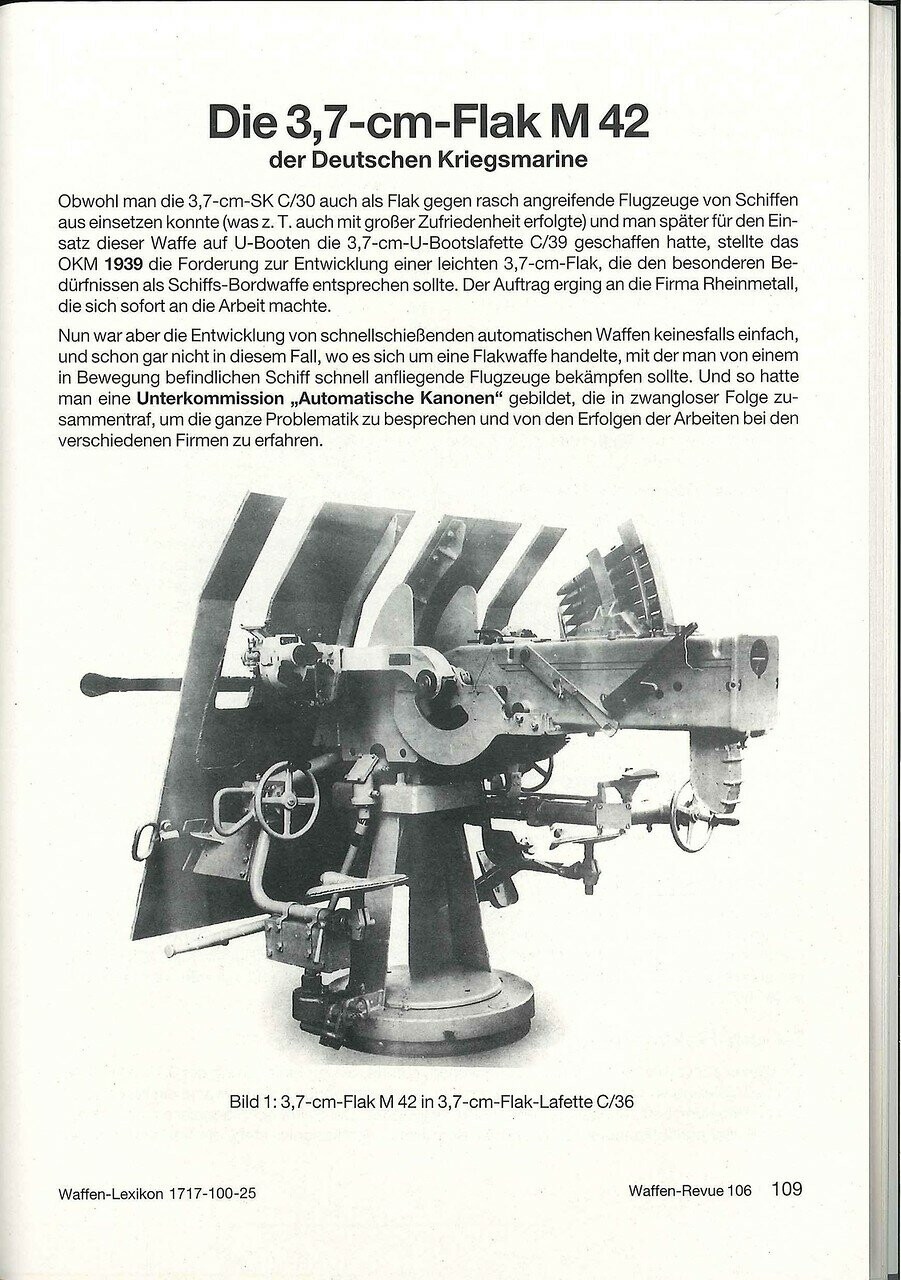
On a side note, the same 250mmR casing, with a reinforced bottom, was also used for Rheinmetall’s 3.7cm Flak M42 L/69 top loading automatic AA/GP guns for the Kriegsmarine, although initially (maybe even throughout the war) old Pak ammo was also used. Overall in design it was similar to the 40mm Bofors, differing in that it fired weaker ammunition but had a higher fire rate and was generally lighter. Aside from the normal Pzgr. (Psgr.) and Sprgr. shells, it also used the other Flak rounds, such as Br.Sprgr. L’Spur, Br.Sprgr. Vk. L’Spur, Br.Sprgr. o.L’Spur and M.Gr. L’Spur (though with a weight of 565g and a warhead of 86g HTA, not to be confused with the M.Gr.18 weighing 550g and 90g HTA). The reinforced ammunition was fired at higher velocities of 815-925m/s, compared to regular rounds that were fired at 760-780m/s. It was loaded from the top with simple clips, and fired at 250 rpm.
Vehicle
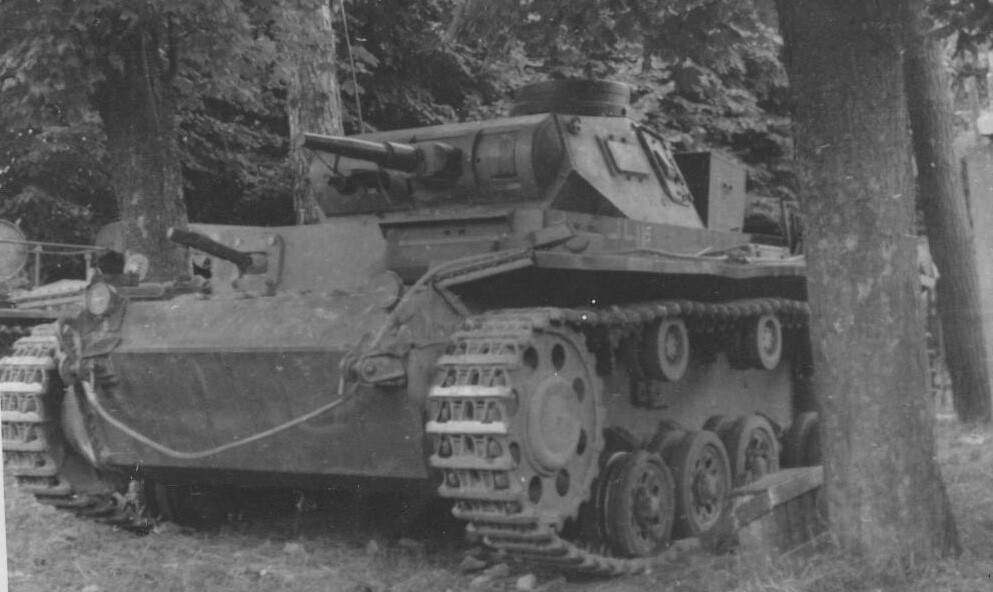
The 3.7cm PaK L/45 and its variants were used on a multitude of vehicles, such as the Leichttraktor, an experimental Großtraktor, the Neubaufahrzeug (Nb.Fz), the Pz.III Ausf. A-G and on halftracks and trucks, both as intended armament and field modifications. This armament was primarily envisioned for use against enemy armor, but also equipped with effective HE rounds to engage infantry or hardened enemy positions as well.
Before the war, tactics revolving around the idea of a small, lighter tank for fighting other tanks and a bigger tank for supporting infantry were envisioned. The vehicles that came of this concept were the Leichttraktor and the Großtraktor. The Leichttraktor was armed with a 7.92mm MG 08 and an 3.7cm KwK L/45, while the Großtraktor was armed with 7.92mm MG 08 and a 7.5cm KwK L/20 and later L/24. Experimentally for the Nb.Fz, one GT was also armed coaxial to the 7.5cm gun with an 3.7cm L/45 gun.
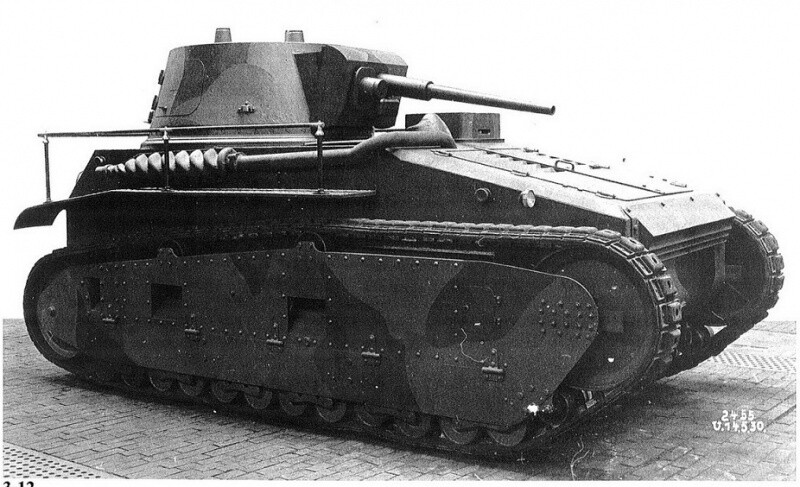
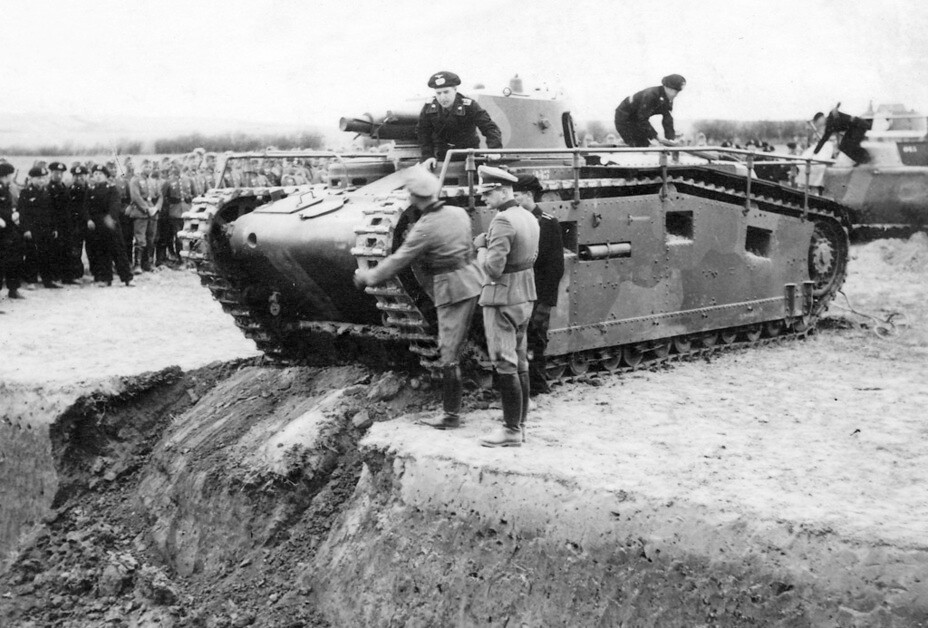
Despite much time and effort being put into both designs, both turned out to be developmental dead ends, although they laid the groundwork for other tanks, such as the Leichttraktor’s turret continuing to be used in Sweden’s own tank development efforts, and the suspension of the Großtraktor being used in the T-28.
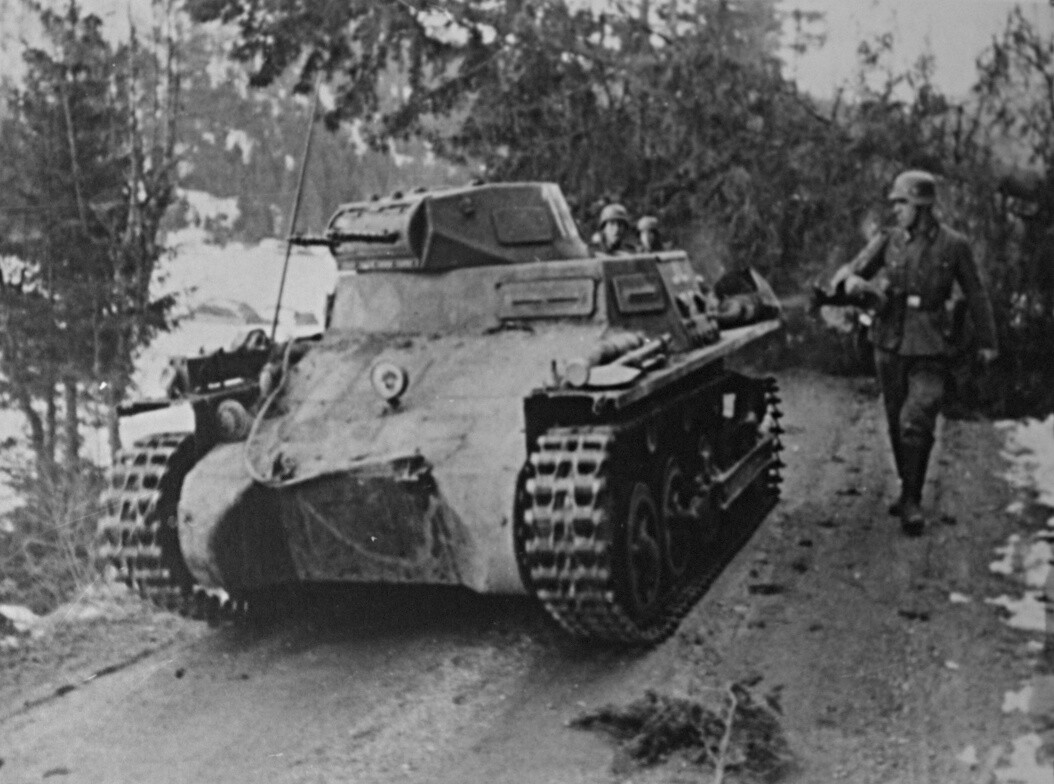
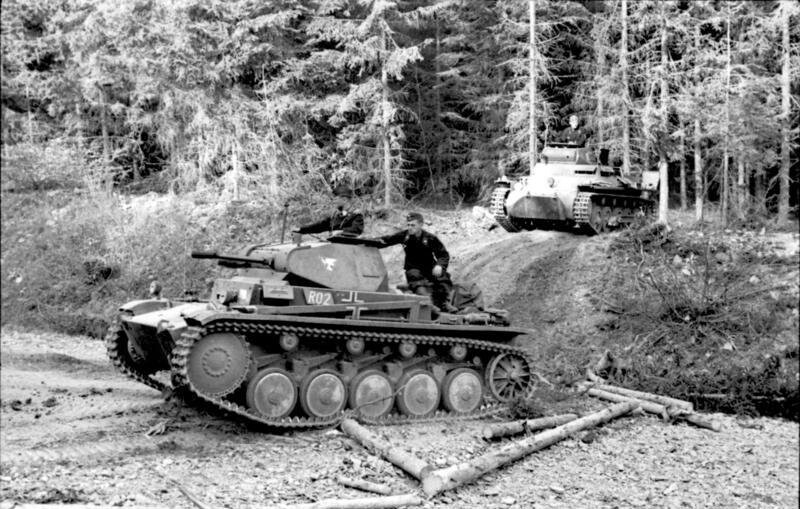
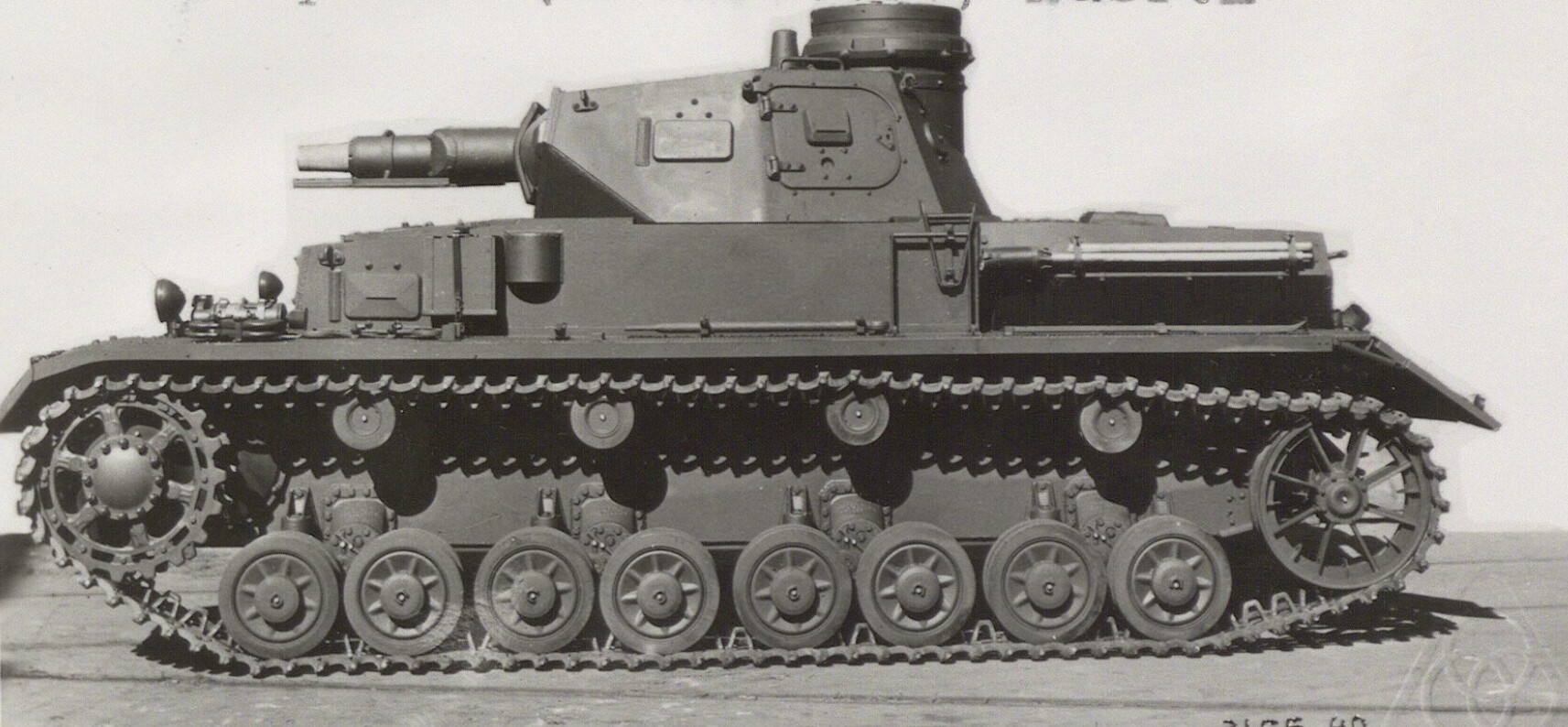
Instead, a multitude of vehicles were planned, the Panzers I to IV, with the Panzer I and II being made to support infantry and be easy to mass produce, while the Panzer III (Z.W. Zugführer Wagen) and the IV (B.W. Begleit Wagen) would have been better-armed and armored to tackle more dangerous threats.
The Pz III shared the same armament as the Leichttraktor, the KwK L/45, which while seen as inadequate in the long term was the only available option that was both mass-produceable and capable enough for the time. To handle super-heavy tanks with thick armor (for the time) such as the French Char 2C, stronger main guns such as the 5cm KwK 38 L/42 were being developed, but were ultimately not ready in time to be fitted to early Pz IIIs.
After the 3.7cm PaK L/45 became obsolete as the primary anti-tank towed gun of the war, being superceded by the later Mittlere PaK (5cm) and Schwere PaK (7.5cm and up) guns, they were repurposed as either light infantry guns, firing primarily HE shells at enemy infantry, or mounted on halftracks such as the Sd.Kfz.250 and 251, where they could offer mobile fire support and were able to knock out enemy light vehicles if they ever encountered them.
Ammo
There were multiple different AP, HE and dual-purpose rounds that saw field usage as well as some that were still only in the testing phase at the end of the war.
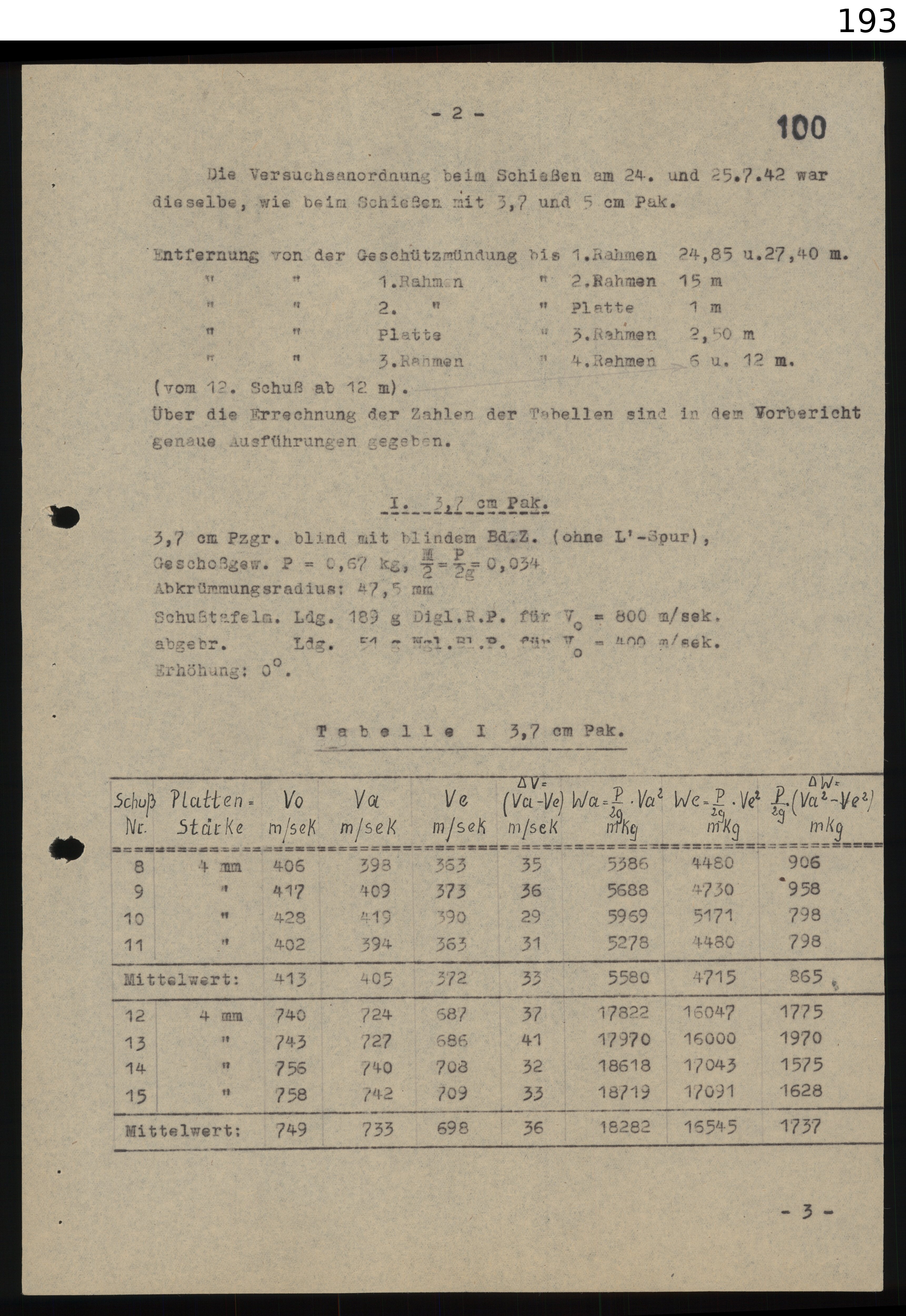
Both the worn barrel (table velocity) and new barrel velocities for the respective shells are given, split with a “/”. Such a system was only used by the Heer, with the table velocities being 20-30m/s lower than the actual velocity (depending on ammo type), to account for barrel wear.
The ammo included, but was not limited to:
AP
This round was an early APHE round, originally designed for the 3.7 cm TaK 1918. It was soon replaced by the standard Pzgr. shell with a more refined design.
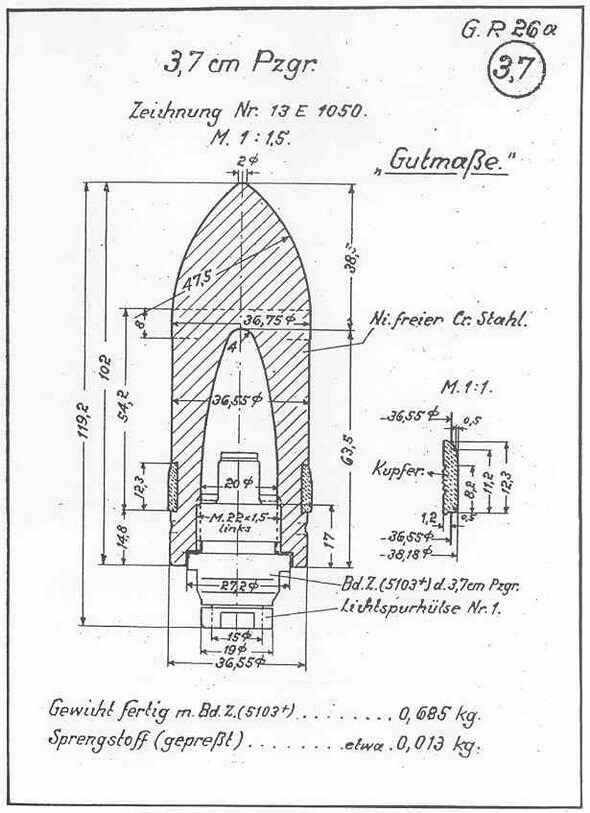
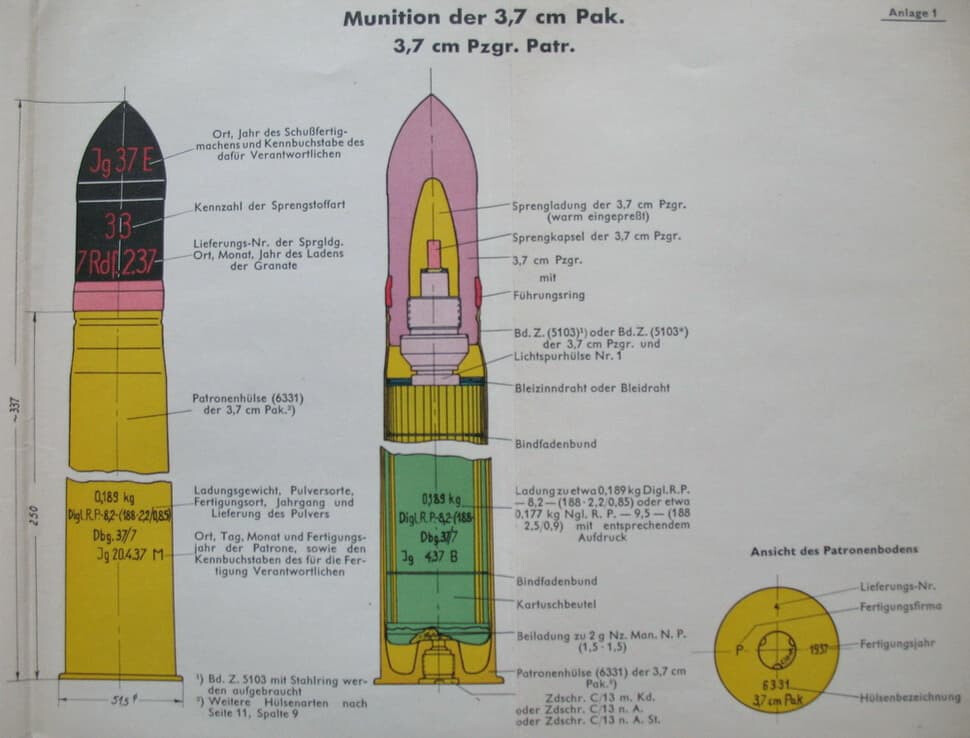
This grenade, while often written as weighing 685g, was also in production in 695-700g variants as well. However, I was unable to figure out why it existed (at the same time) with 2 different weights, it might be allowed production differences.
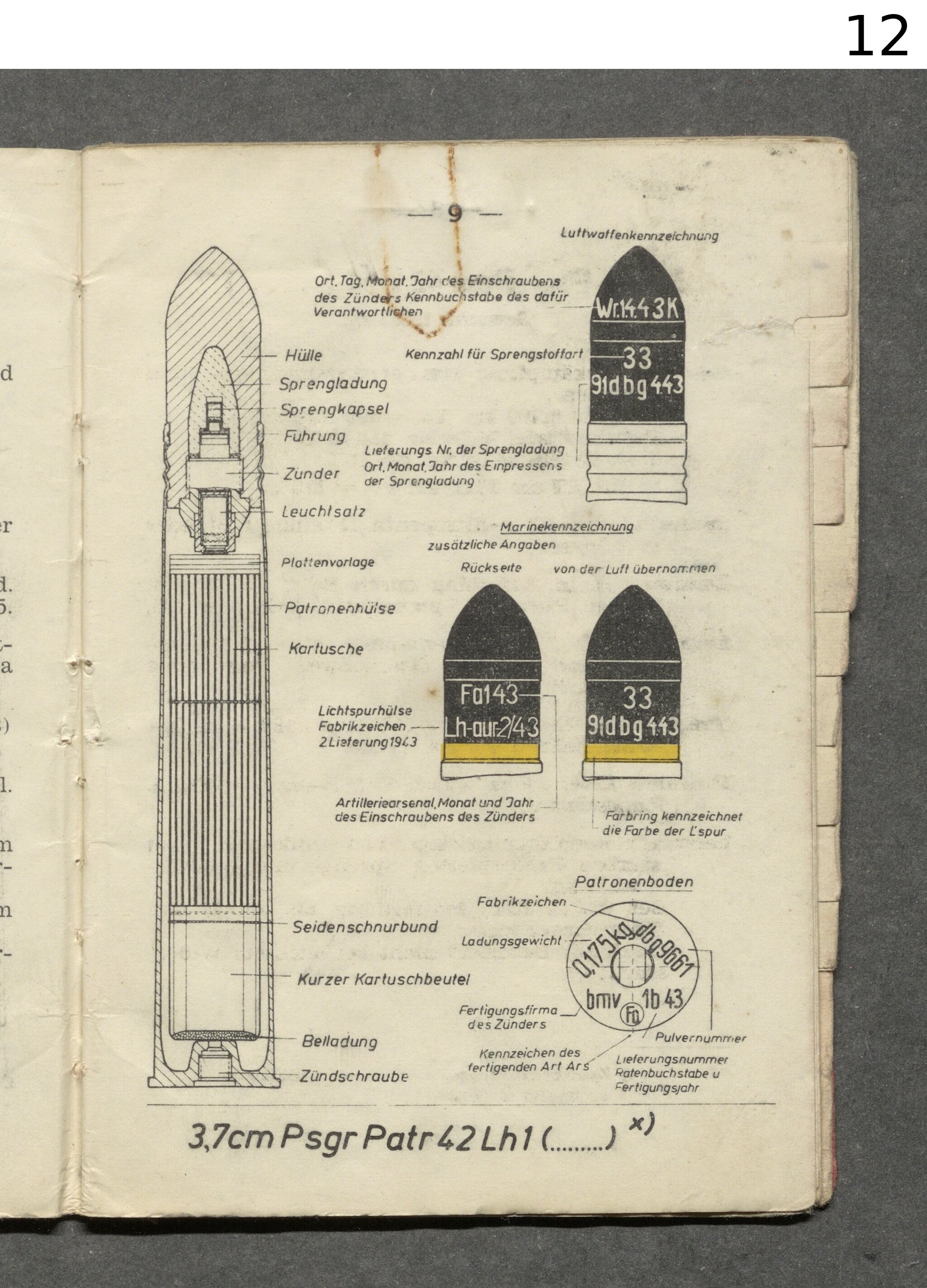
HE
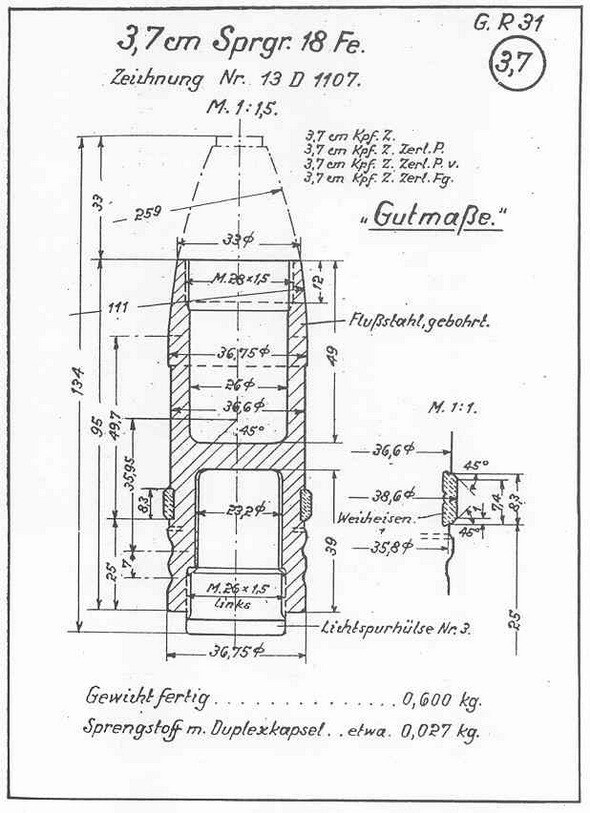
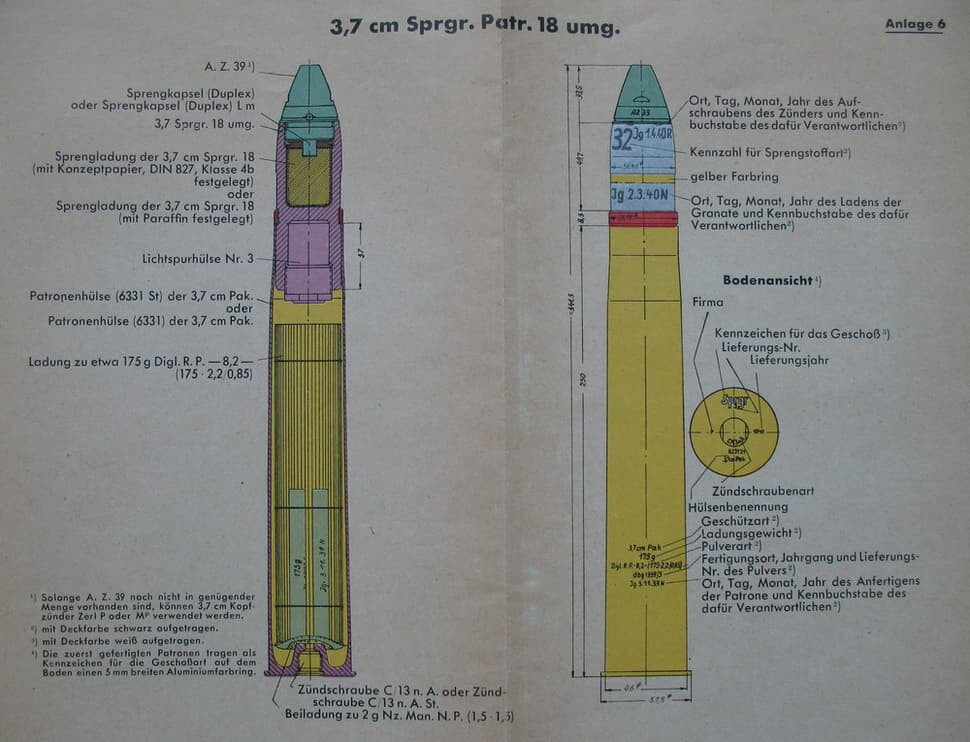
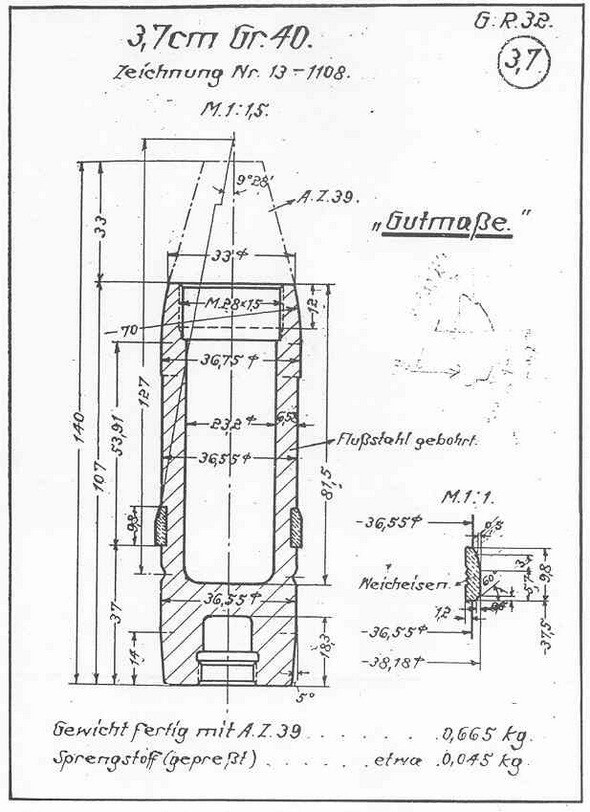
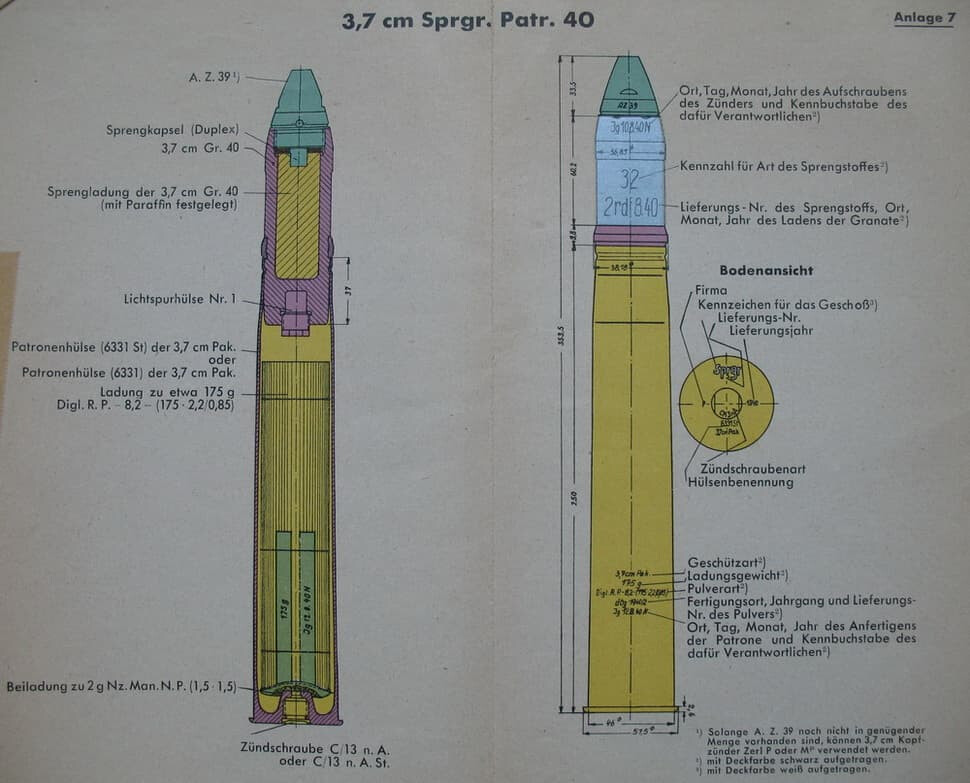
(umg. (umgebaut/modified) changed from 2 to 1 driving bands on the shell to save on material. There is alternatively also the Sprgr.18 Fe, which used an iron driving band instead of copper)
Experimental Rounds
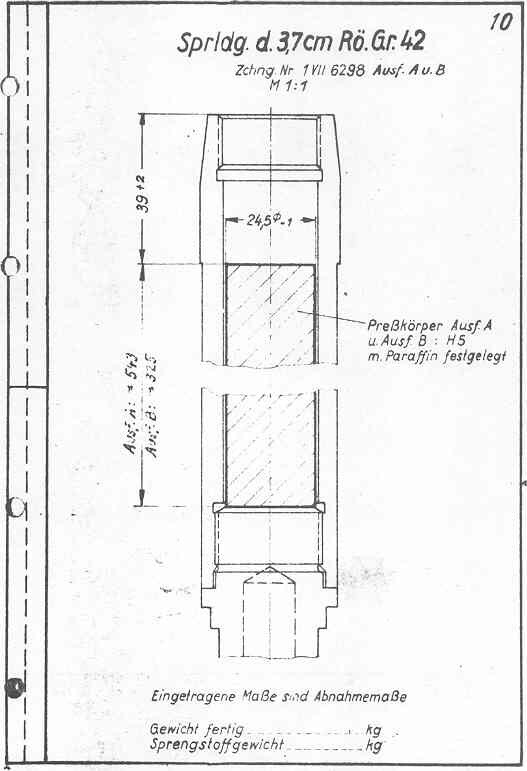
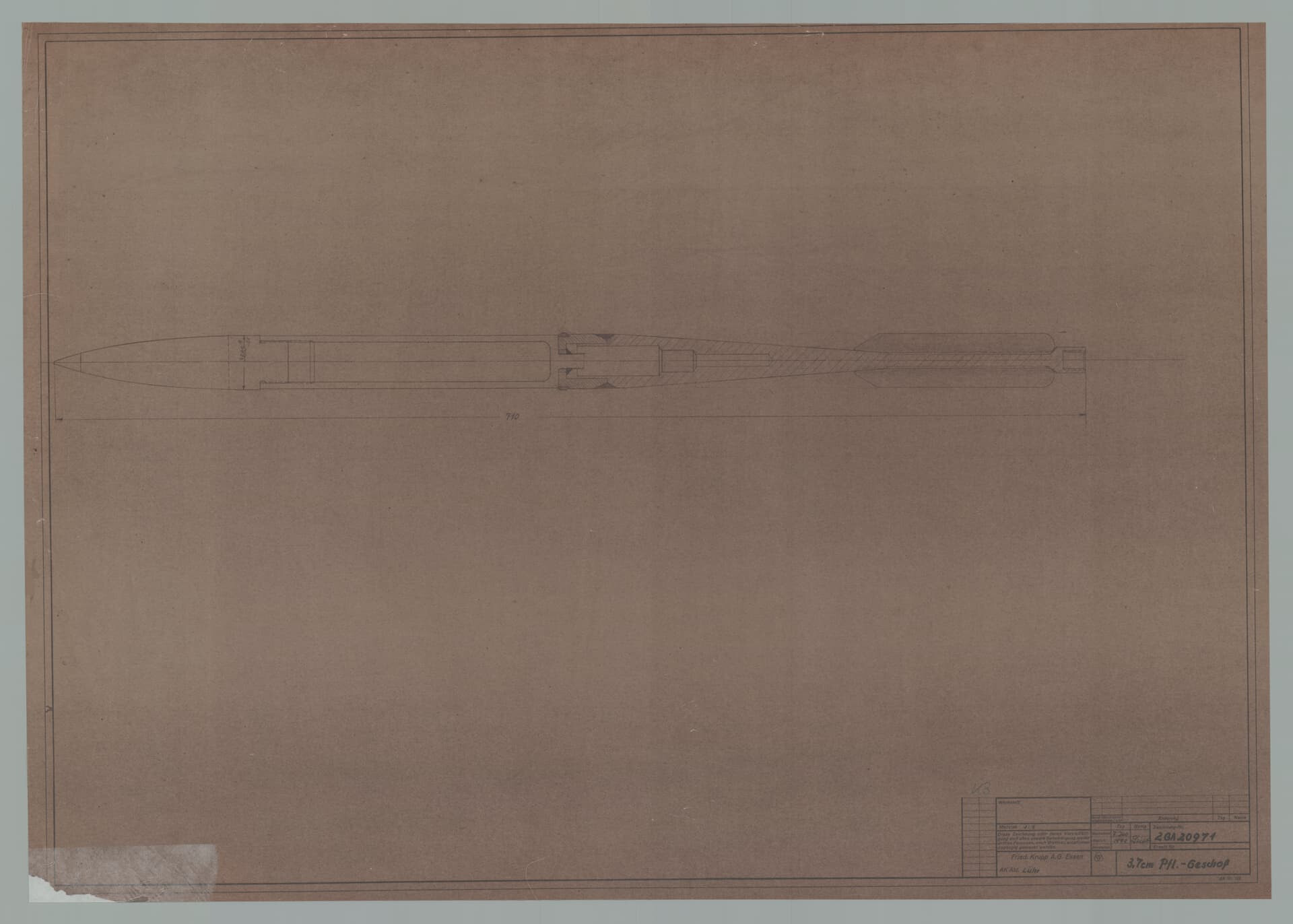
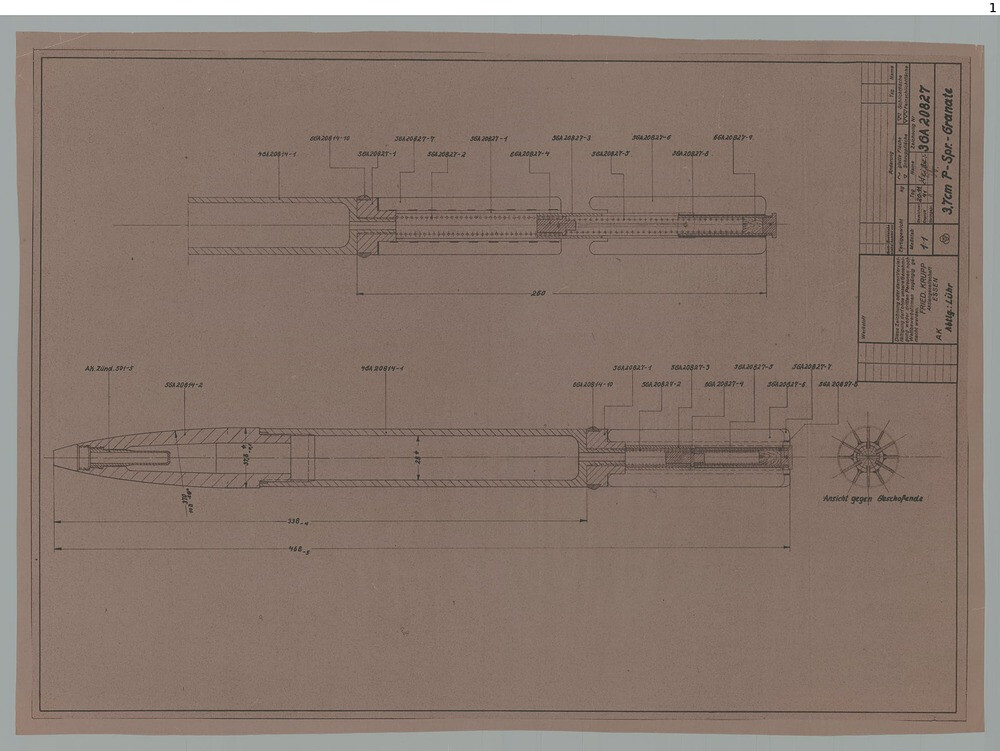
Guide regarding the ammo
In-game, as of time of writing, only the Pzgr. and Pzgr.40 rounds are available on various 3.7cm PaK L/45 derivatives. The Pzgr. round will be your main ammunition of choice, being the default APHE round for the gun with reasonable penetration. It is currently implemented with the table velocity of 745m/s, which uses the worn barrel velocity, which is the lowest velocity reached by the gun when it is worn out and needs to be replaced after 8000 shots fired (can be less, if many Pzgr.40 shells are used) and not the 765m/s of a new barrel. However, given the difference is only 20m/s, the effect of this on gameplay is quite minimal.
As the KwK 36 has a good reload speed it is recommended to take somewhere around 25-35 rounds of Pzgr. and 5-10 Pzgr.40 rounds, to avoid running out of ammunition quickly. While the Pzgr. is relatively reliable, due to its 13g PETN filler, it can be somewhat middling to use past midrange (~500m), as it only has 46mm of penetration going 745m/s, compared to the Pzgr.40's 1020m/s shell speed and 86mm penetration. The Pzgr.40 is your backup round, with a high shell velocity and high penetration, but as it’s an APCR round with no explosive filler, it’s only recommended to use this round either at longer ranges to deal with far away opponents easily, or to go through thick (but flat) enemy armor when facing off against a well-armored opponent.
Tactics
The PaK and KwK 36 have been mounted to various vehicles, many of which are available in War Thunder. These vehicles are the Sd.Kfz.251/10, Pz III Ausf.B/E, and the Nb.Fz.
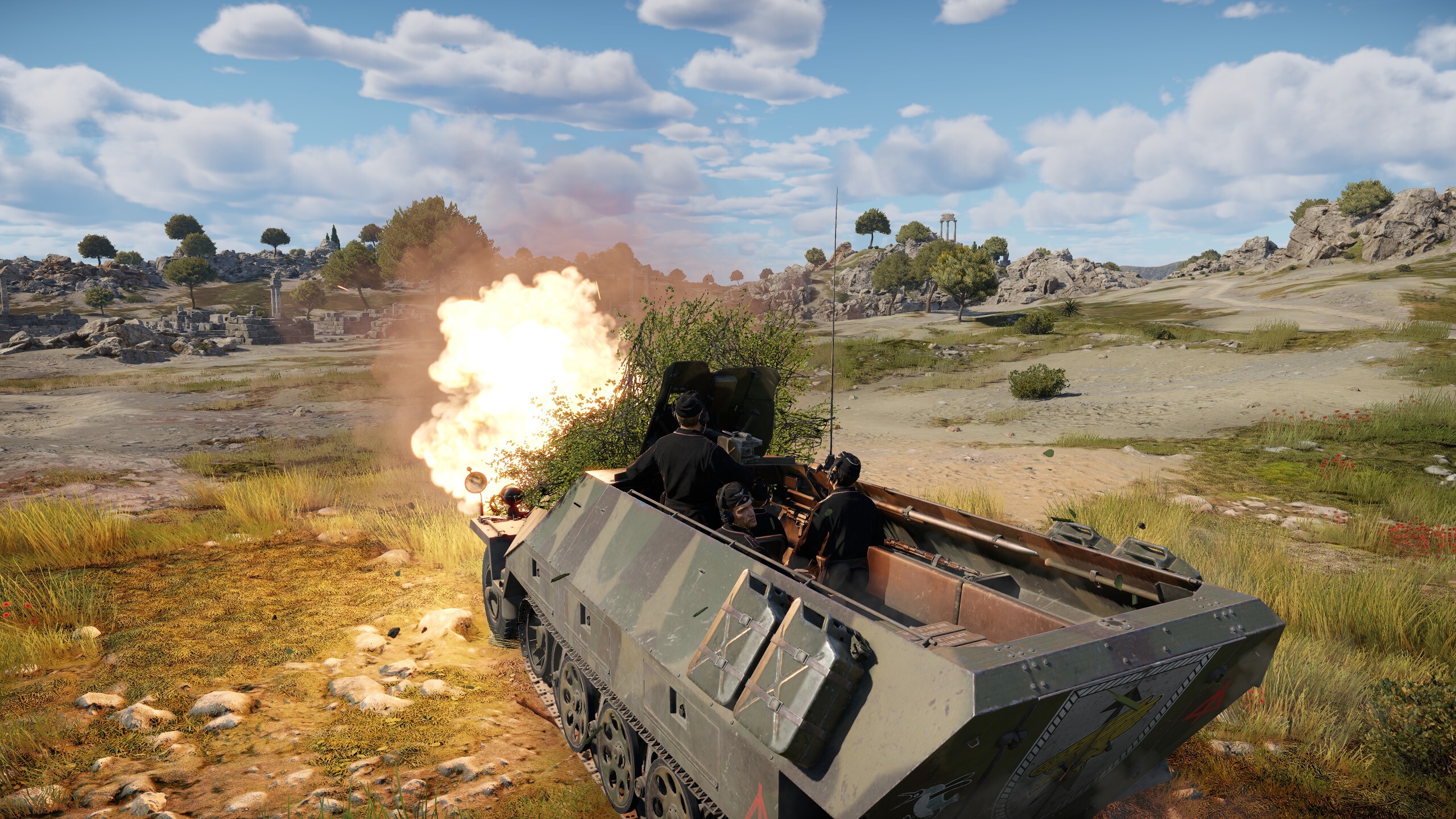
The Sd.Kfz.251/10 can be used to great effect as a tank destroyer — while lacking in penetration, shell caliber and shell velocity compared to the Panzerjäger I, it reloads quickly, its gun can slew horizontally much quicker and wider, and if your shells do penetrate their filler content is ~50% higher. The vehicle is equipped with the early gun shield, which did not adequately cover the gunner’s left side, which is also a noticable problem in game as more knowlegable players will simply shoot out the gunner. At closer ranges, the gun shield is even vulnerable to 7mm MG fire, meaning that it’s advised to gain some distance between you and your enemies if you want to avoid your gunner being knocked out easily.
Being reasonably mobile, the Sd.Kfz 251/10 can often get into good positions easily, although faster enemy light tanks may end up out-flanking you if you go too far. With adequate (-8) gun depression and a quick reload, the 251/10 has many chances to get the right shot on an enemy, although its somewhat poor penetration can mean that your aim may matter more with the 37mm PaK L/45. Due to its lack of a proper turret and open-top nature, the Sd.Kfz 251/10 is exceptionally vulnerable to being flanked or overpressured, although in the case of the former it can make quite tight turns even at lower speeds, so don’t give up hope just because you saw an enemy too late.
The Panzer III Ausf.B and E are also both equipped with the KwK 36 37mm cannon, although they diverge when it comes to their armor and mobility. The Pz.III B has half the top speed of the Pz.III E and half the armor, but in exchange it has a ~50% faster horizontal turret slew speed and a slightly higher HP/t ratio, making it less flexible at positioning but better at reacting quicker, so long as your enemy doesn’t have HMGs. With their fast reloads and reasonable filler, the 37mm can put in work at close range against multiple enemies at once, although it’s recommended to ultimately move on to the Panzer III Ausf.F eventually, which has a higher-caliber gun with more penetration in the form of the 5cm KwK 38 L/42. It is recommended to bring some Pzgr 40 APCR rounds (around 10 or so) on the Panzer IIIs, as the APHE will often be ineffective against enemy heavy armor in uptiers.
On the Nb.Fz. the 37mm gun is coaxial to the 75mm KwK L/24 main gun. Both guns are roughly evenly matched in performance, with the 75mm winning out when using HEAT ammunition in terms of penetration, although at the cost of shot velocity. At close range you can effectively double your firepower by shooting the guns separately, and timing your shots so that your other gun is reloaded by around half before firing. This can be harder to pull off at range, due to the differing shell ballistics, but ample practice and weapon switching can enable accurate hits up to long range, with adequate user skill.
Source:
- Geschossringbuch I
- Ringbuch der Sprengladungen I
- Bundesarchiv
- History of Autocannons Crowood
- Angaben über Heeres-Geschütze Konstruktion Rheinmetall und eingeführte Geräte
- Schusstafel und Verbesserungstafeln
- Munitionshefte
- Hauptkonstruktions-Datenblatt
- Panzer Tracks
- Enzyklopädie deutscher Waffen 1939-1945
- Waffen Revue Nr.106
- RH 8/2990K