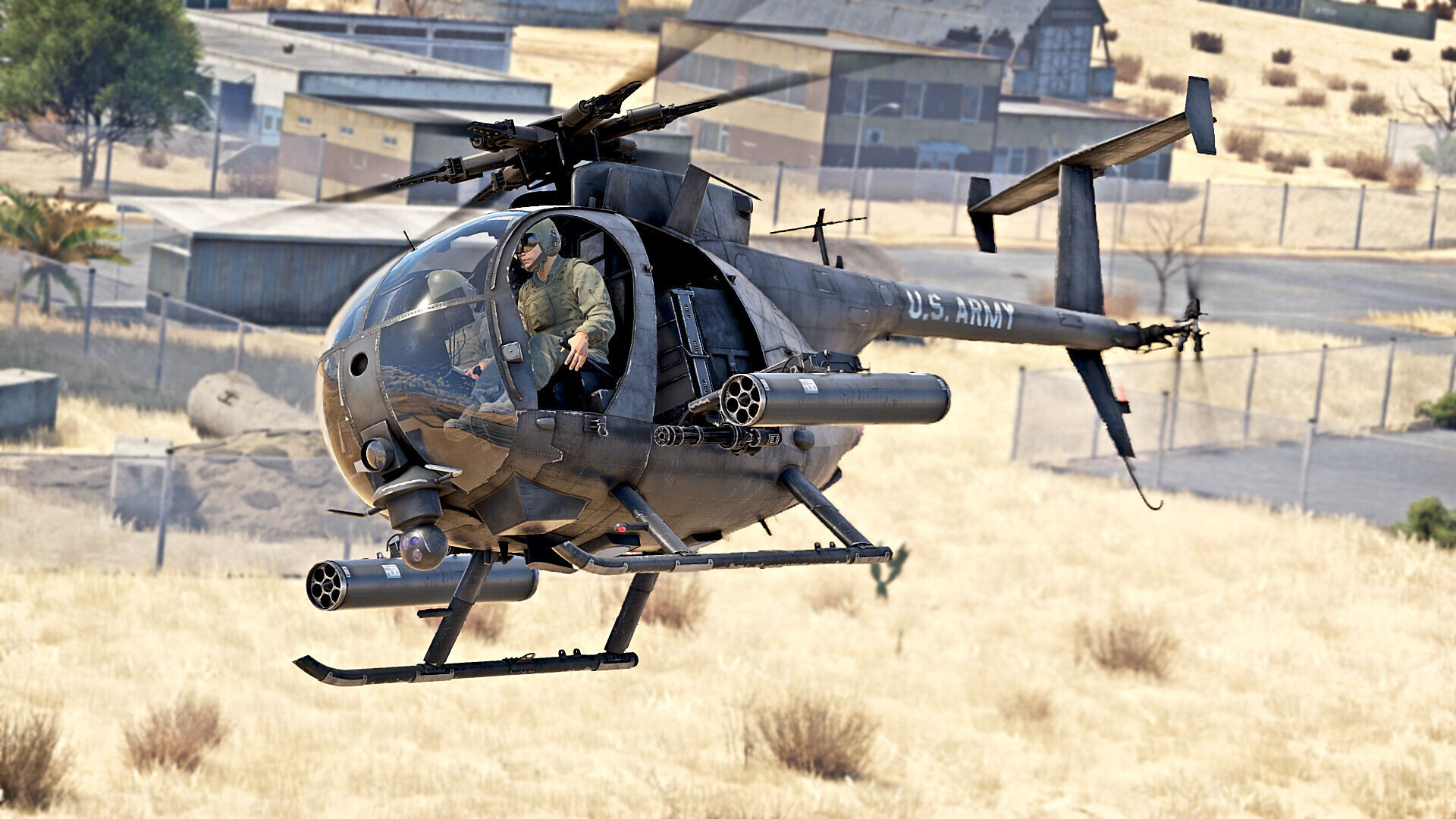
The AH-6M Little Bird, later nicknamed the “Killer Egg”, is a tiny, cute, but still formidable and dangerous helicopter to fight. Great maneuverability and advanced weaponry against ground units, consisting of long-range ATGMs and an array of unguided rockets, work wonders against your enemies. What can you do with all this weaponry, and how do you use your small size to your advantage? All these questions will be answered and explained in this article.
| Pros | Cons |
| Small size | Only two hardpoints for secondary weapons |
| Amazing flight performance | Lack of any countermeasures |
| Ability to carry AGM-114K ATGMs | Small max speed |
| Ability to capture points in Ground Battles |
Flight Performance
The AH-6M is an excellent helicopter in terms of speed. Equipped with the Allison 250-C30 engine, the Little Bird easily reaches an average speed of 230 km/h. Of course, in comparison with the Mi-35M or the G-LYNX the speed is lacking, but that’s not unexpected, as they are several times larger and equipped with bulkier and more powerful engines than the AH-6.
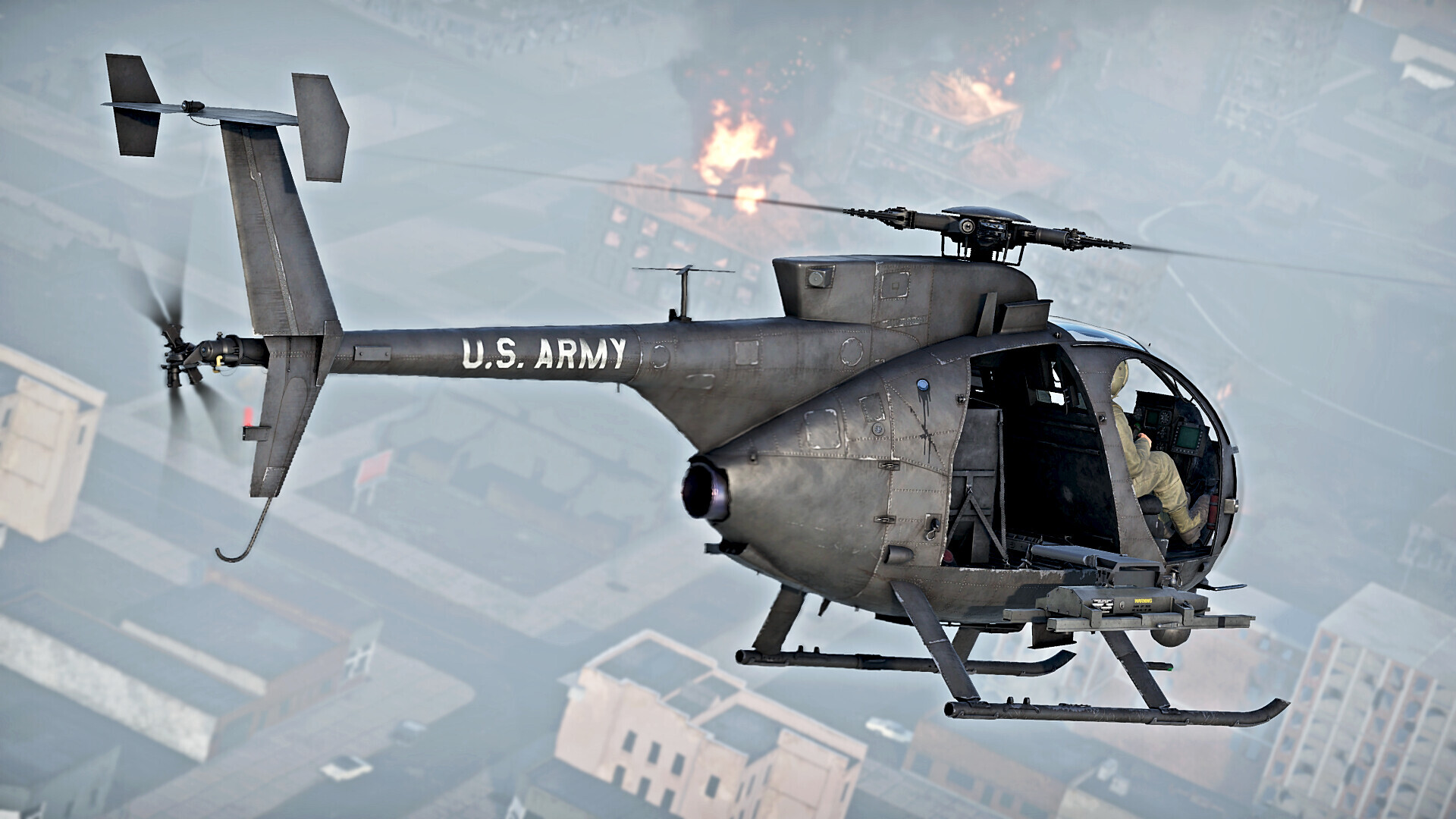
But the helicopter’s manoeuvrability compensates for that. The Little Bird not only holds the record for the lightest empty mass of 990 kg, but is also able to easily fly between trees and city streets because of its rotor diameter of only 8.1 m. You can easily play as a saboteur, sneaking up behind enemy pushes. But you have to remember that, because of its small size, it gets really clunky while carrying its maximum combat load. It’s better not to overburden it, limiting yourself to a single rocket pod.
Survivability and armor
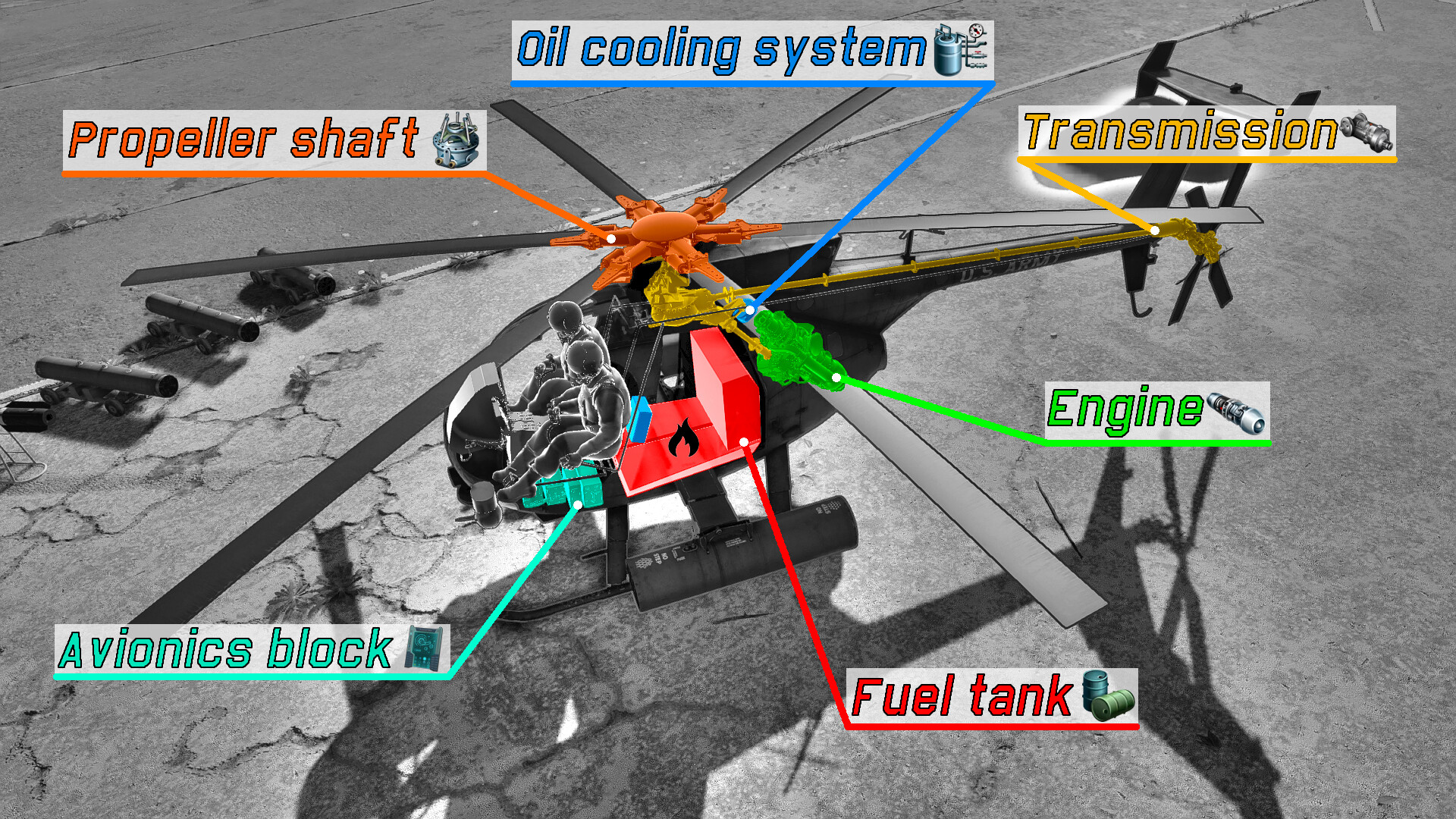
The AH-6M does not have any armor, not even armored glass. Because of its tiny size, its internal modules are almost hugging the two pilots, leading to sub-optimal survivability. Hits from .50 caliber machine guns, and sometimes even from 7.62 mm machine guns, can be fatal. The best protection the Little Bird has is its small size, allowing it to easily terrain-mask behind dense tree groves or in folds of the terrain.
The helicopter is also equipped with the AN/APR-39A (V)1 RWR system, the same system that is found on the AH-64A Apache. It shows the pilot the approximate location of enemy SPAA systems and warns the pilot about radar locks and missile launches. It can detect up to 10 simultaneous threats on its scope, 7 threat types from D-band to M-band, and 5 tracked launches. All that at up to 65 km of range, with range approximation by signal strength and friend-or-foe identification.
Armament
Secondary guns
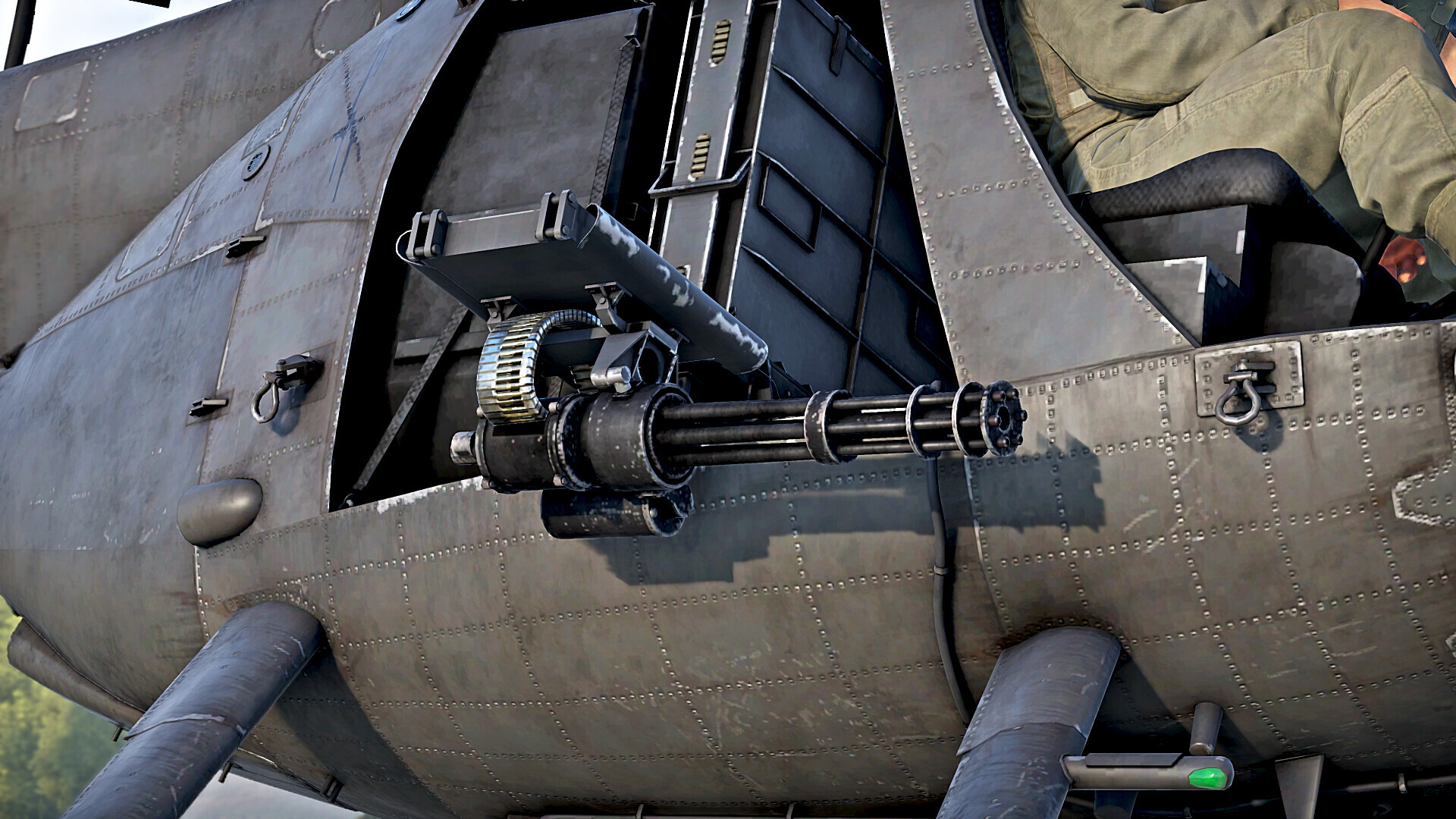
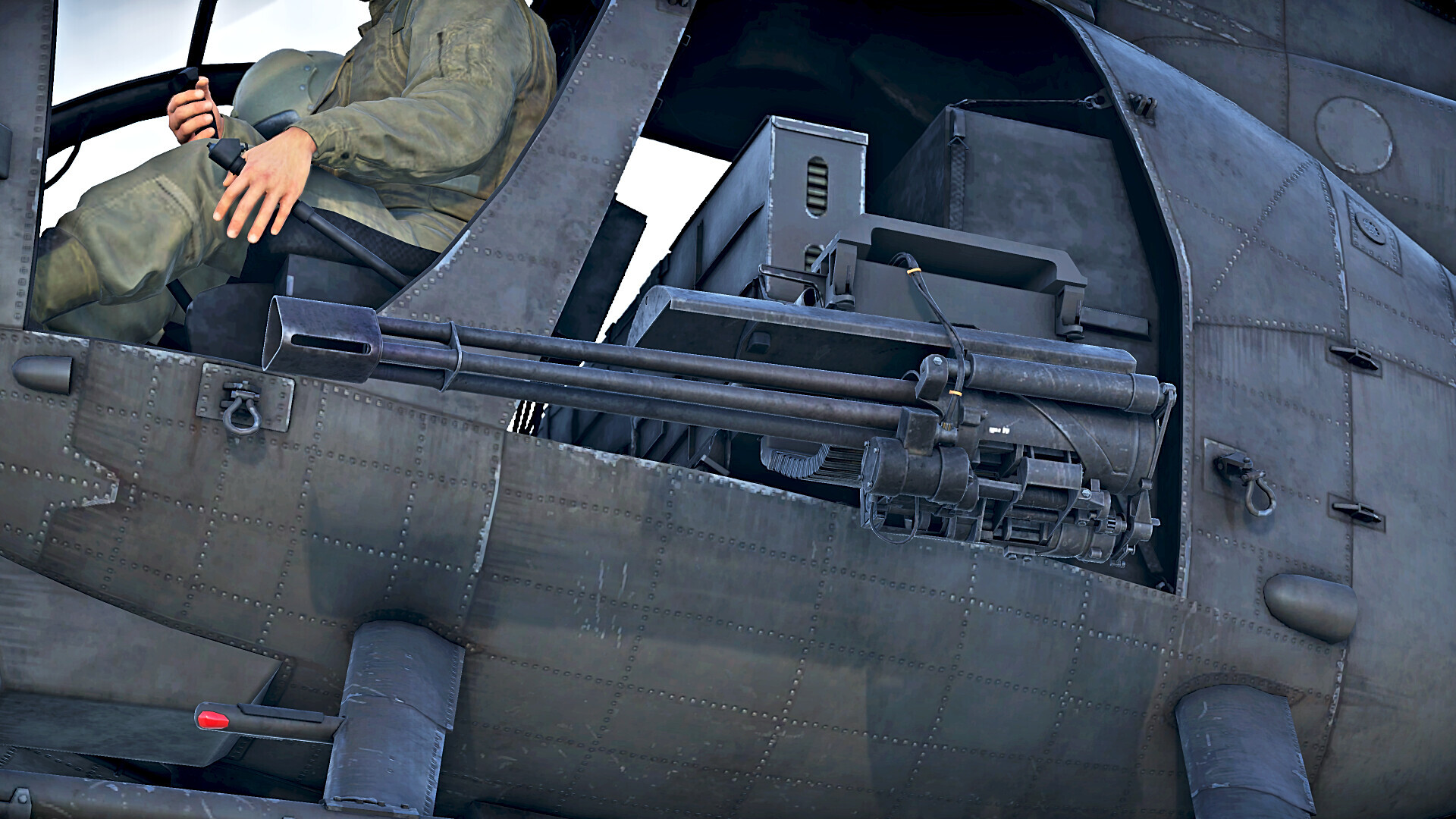
2. 12.7mm machine guns GAU-19/B.
The Little Bird lacks primary cannon armament. Instead, the helicopter can be equipped with up to two six-barrel M134 Miniguns in 7.62 mm caliber with an ammunition load of 12,000 rounds, or alternatively, two 12.7 mm General Electric GAU-19/Bs. Both machine guns have rigid mounts, meaning they can only fire in the direction the helicopter is moving.
The M134s are an excellent choice when fighting other helicopters or aircraft head-on because of their high rate of fire and large ammo count, whereas the GAU-19/B can be used against lightly armored targets, such as IFVs or SPAA systems. Although the GAU-19/B’s penetration is an impressive 41 mm of RHA, this is sometimes not enough to effectively destroy even light enemy vehicles.
Unguided rocket pods
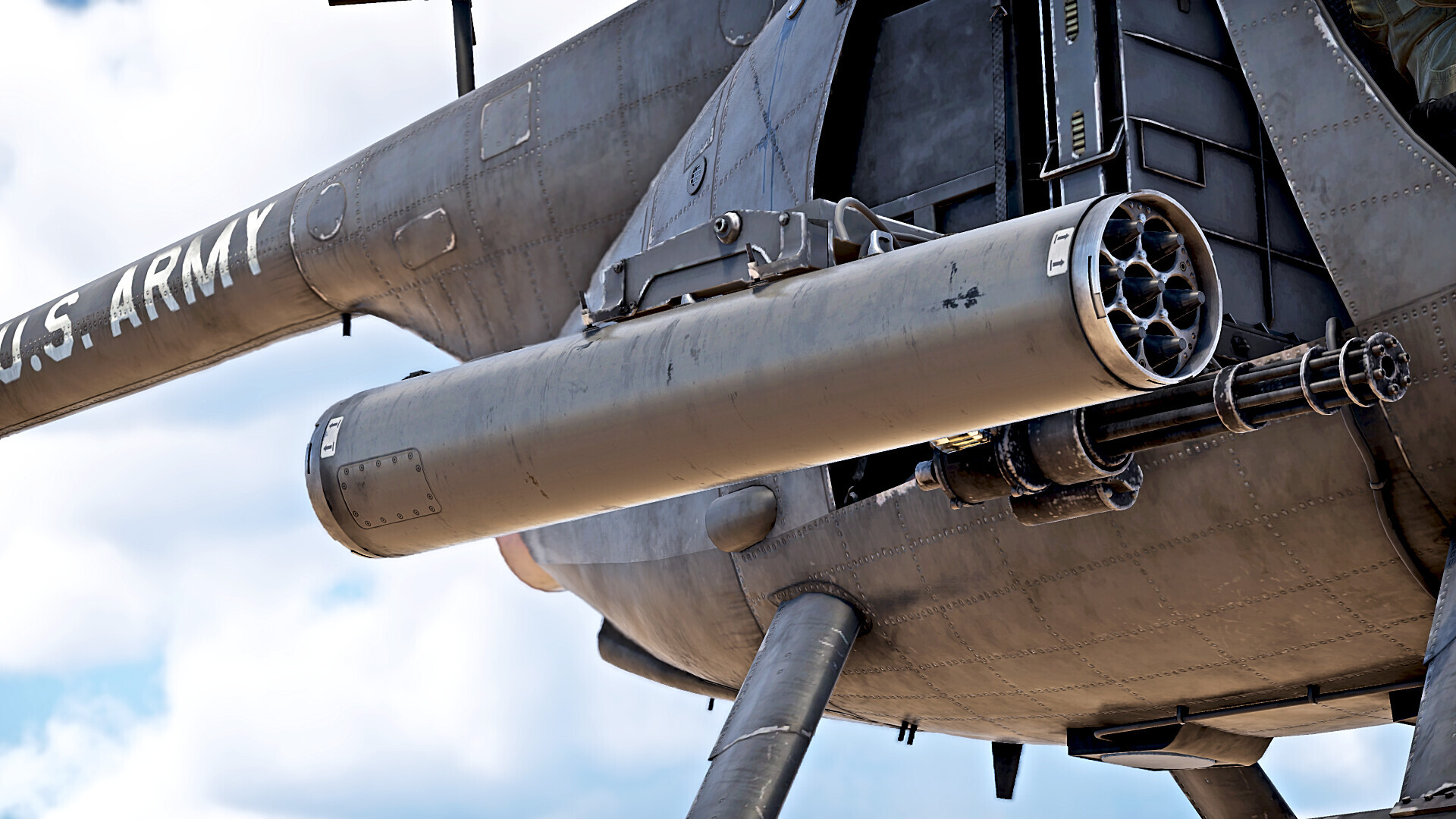
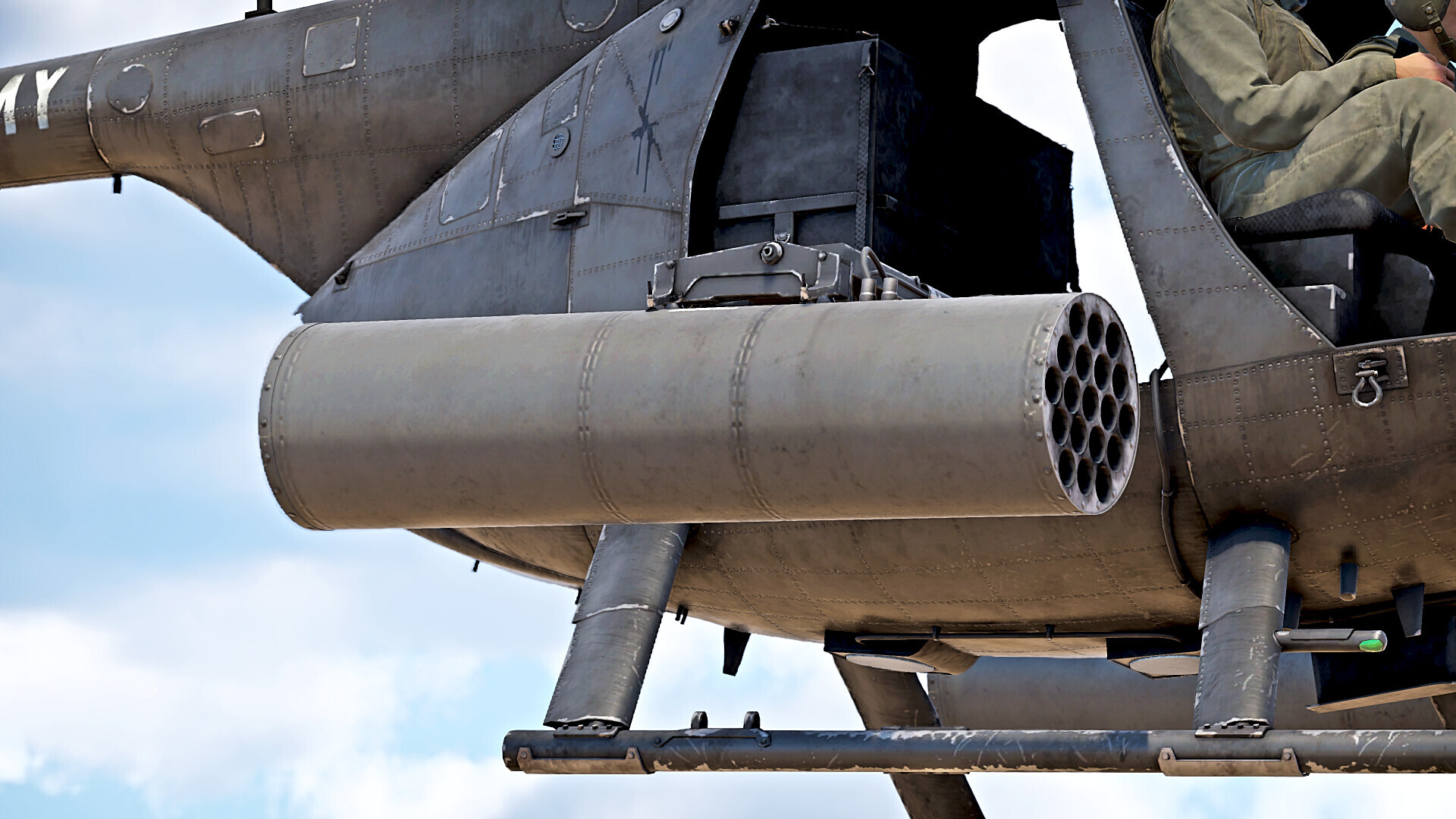
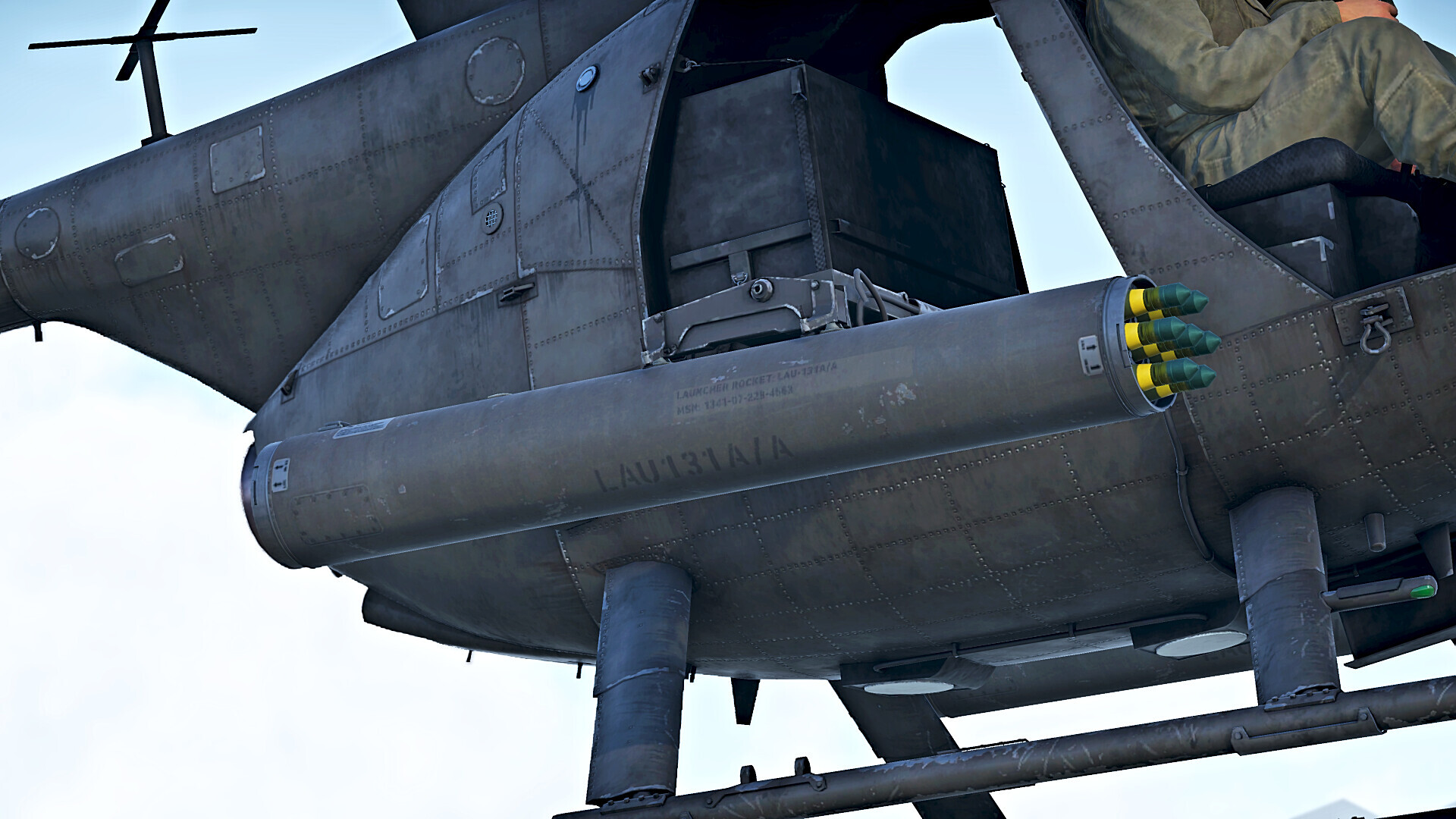
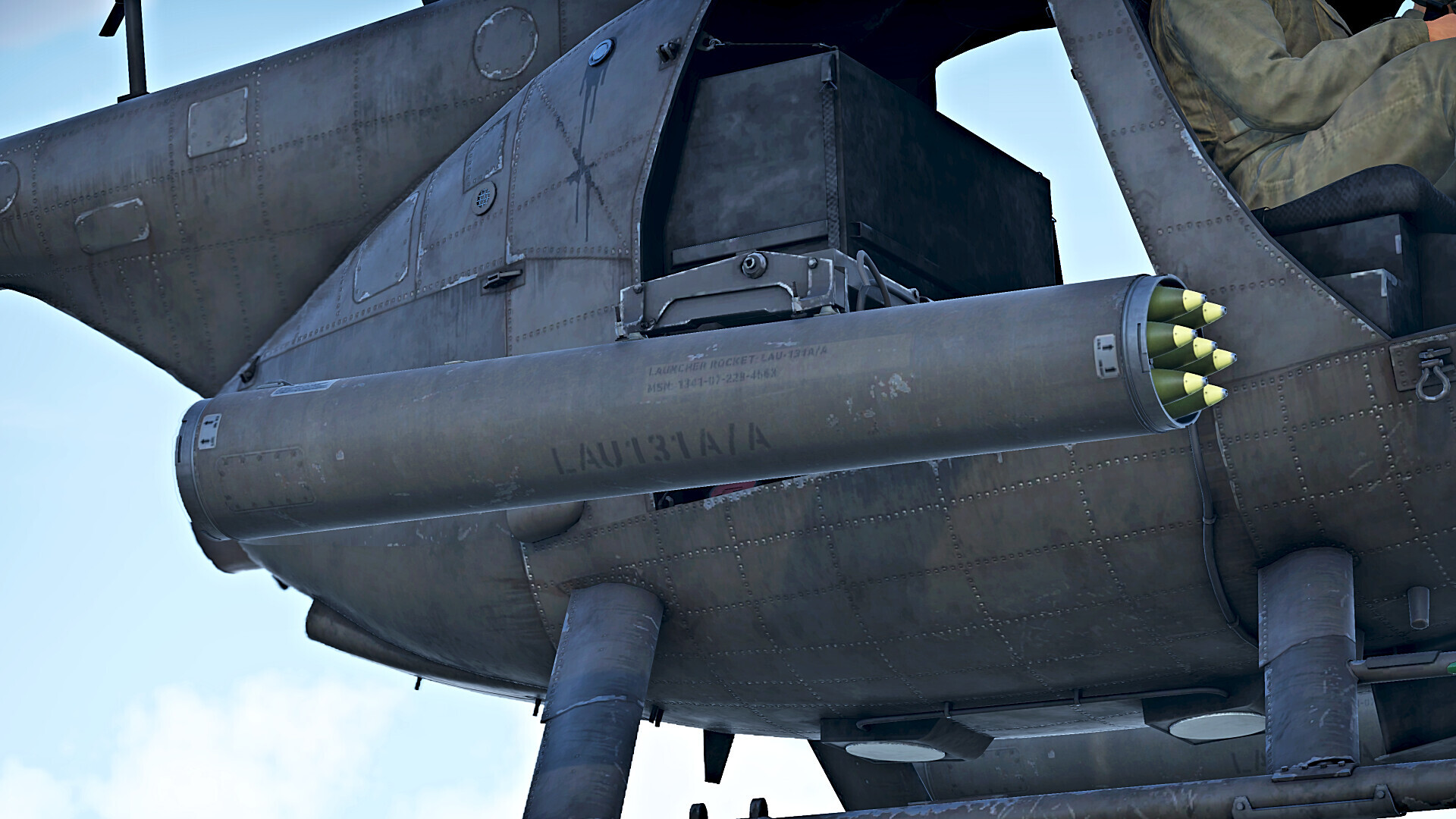
Hydra 70 WAFAR M247 — the true classic and, for the most part, the main secondary armament of the AH-6M. Up to two rocket pods, each containing either 7 or 19 rockets, can be mounted. These work wonders against tanks, especially at close quarters. However, the penetration of only 290 mm and the high-explosive anti-tank warhead may fail to penetrate MBTs armored with ERA or NERA.
Air-to-Ground guided weaponry (AGM)
2. AGR-20B APKWS-II;
3. AGM-114K Hellfire-II.
- AGR-20 APKWS-II (A/B) — air-to-ground rockets based on the Hydra 70. The AGR-20A variant has amazing speeds of up to 455 m/s and an average range of 5 km. It is well suited for engaging SPAA systems and aircraft, all because of its 1.4 kg of high-explosive filler. The AGR-20B variant, however, has an average speed of 395 m/s and is suitable for neutralising light tanks due to its increased armor penetration, but decreased explosive mass of 568 g. These rockets aren’t the best choice against MBTs because of their limited explosive mass, penetration, and the availability of better weaponry against these targets;
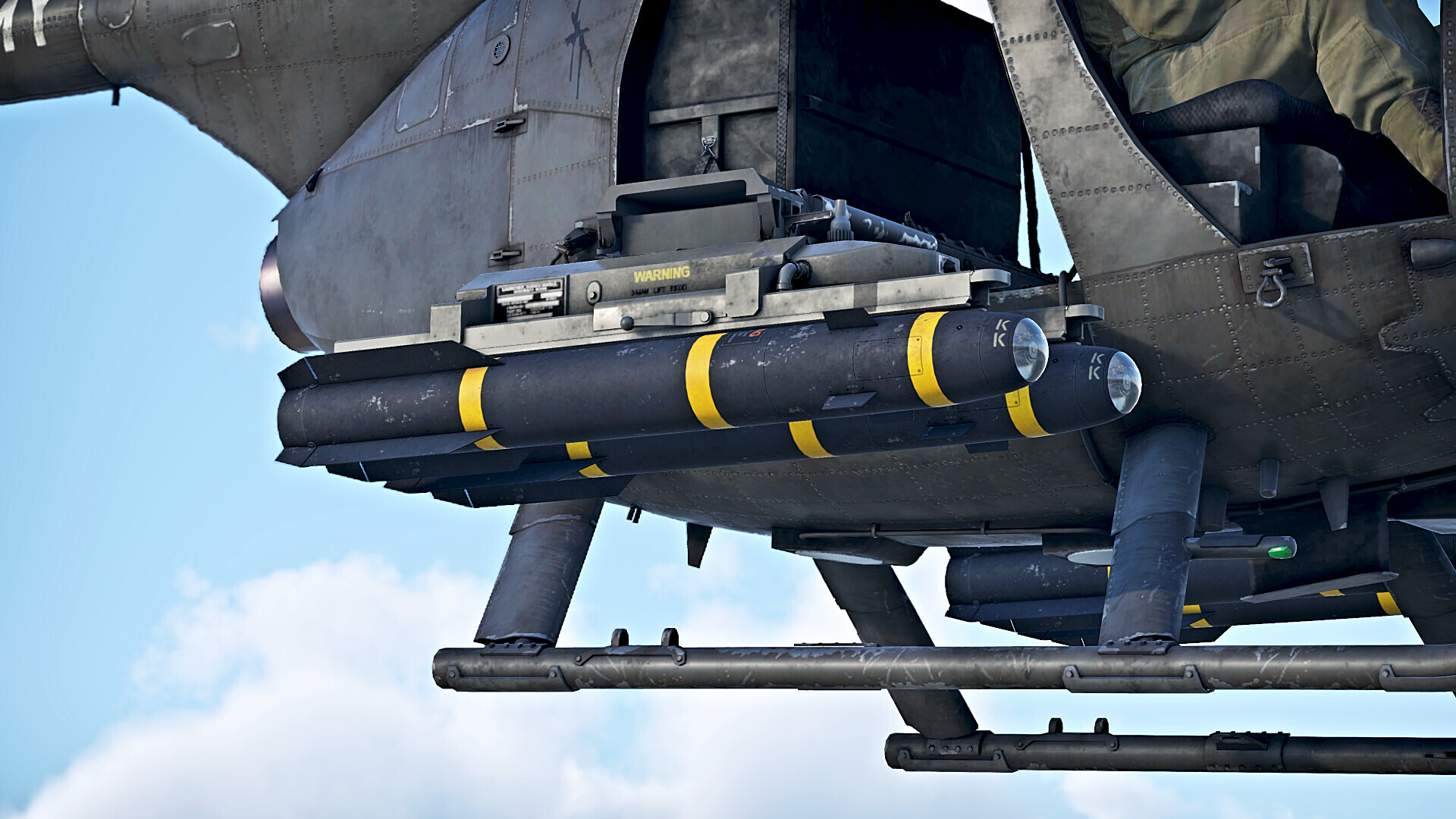
- AGM-114K Hellfire-II — excellent AGMs with 1,200 mm of armor penetration. These have a tandem warhead, allowing them to penetrate tanks with ERA, and they can be used at ranges of up to 8 km. The main feature of these missiles is their flight path. Hellfires start lofting after launch, and, using laser guidance, aim for the roof of the vehicle, which in most cases is less protected than the hull or the rest of the turret. However, if the target hides behind an obstacle, the missile will lose guidance and miss. If the enemy is moving through trees or buildings, it is recommended to track the target and adjust its guidance manually. Up to 4 missiles can be carried on both hardpoints, together with the M134 Miniguns on their respective hardpoints.
Battle usage
In-game, the AH-6M is a versatile platform, able to be used efficiently at the beginning of a match, as well as in the mid- and late-game. The main issues stem from its lack of countermeasures as well as any meaningful AAMs. Because of this, the main protection you will have will be terrain masking and nap-of-the-earth flying, and the best strategy against other aircraft will be head-on fights using M134s or GAU-19/Bs. Because of its small size, the AH-6 can also be used with no secondary weapons, capturing points on ground maps. To do this, you can simply make a custom loadout with no weapons.
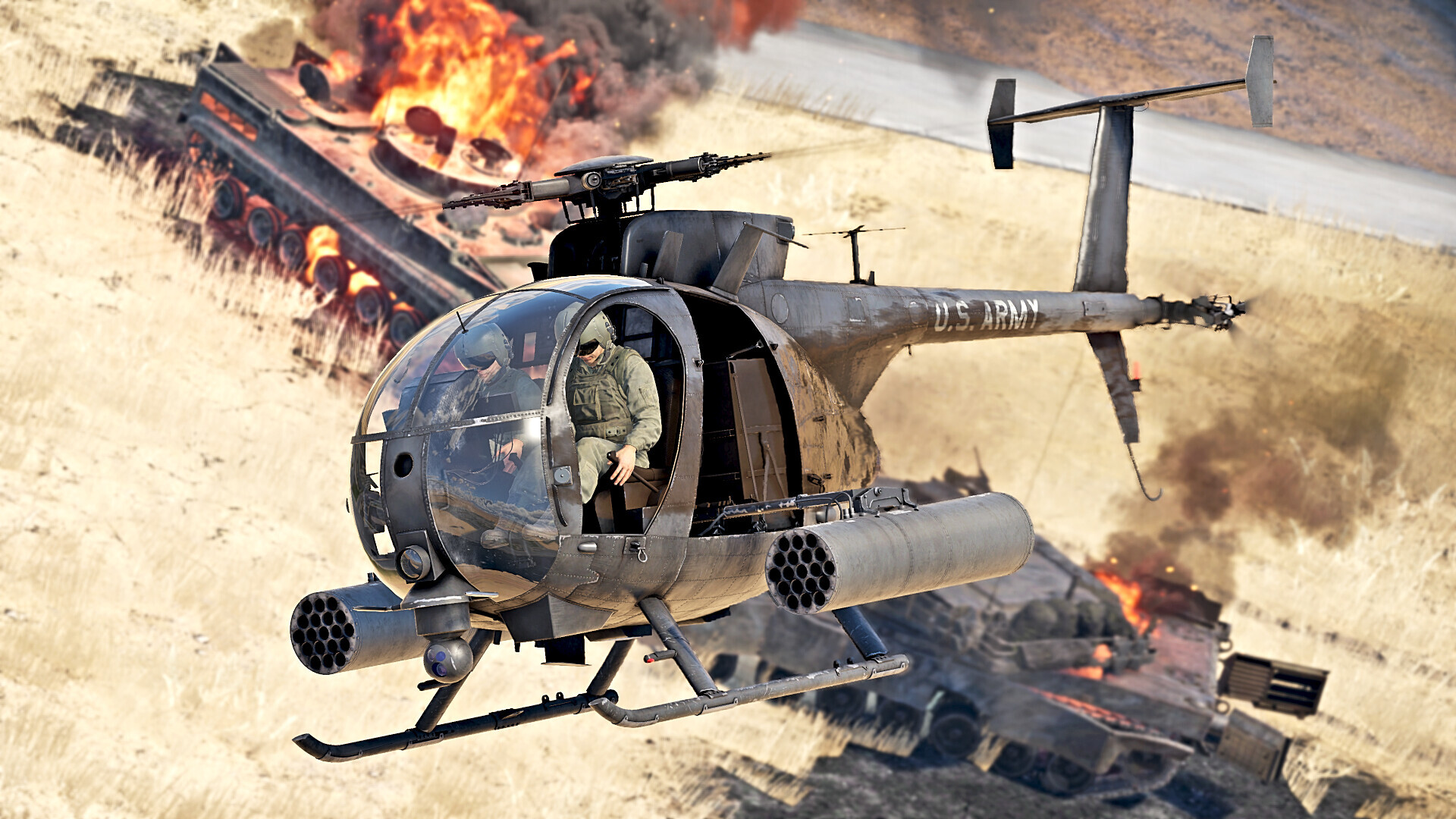
For sorties with unguided rockets, it is recommended to first make a custom loadout. One of the options is the heaviest configuration, consisting of 38 x Hydra 70s and 2 x M134 machine guns. Using this loadout, the AH-6 can not only engage ground targets, but also defend itself against other aircraft thanks to two Miniguns with a total of 12,000 rounds of ammunition. However, the main downside of such a loadout is its weight — with 2 rocket pods and additional machine guns, the engine struggles even more to keep the helicopter airborne.
The most efficient loadout at the beginning of a match can be considered one rocket pod of 19 x Hydra 70s and one GAU-19/B. This way, the helicopter does not feel as sluggish, although the firepower is slightly worse. Fewer rockets mean fewer destroyed tanks — so flying with 38 x Hydra 70s is still a viable option.
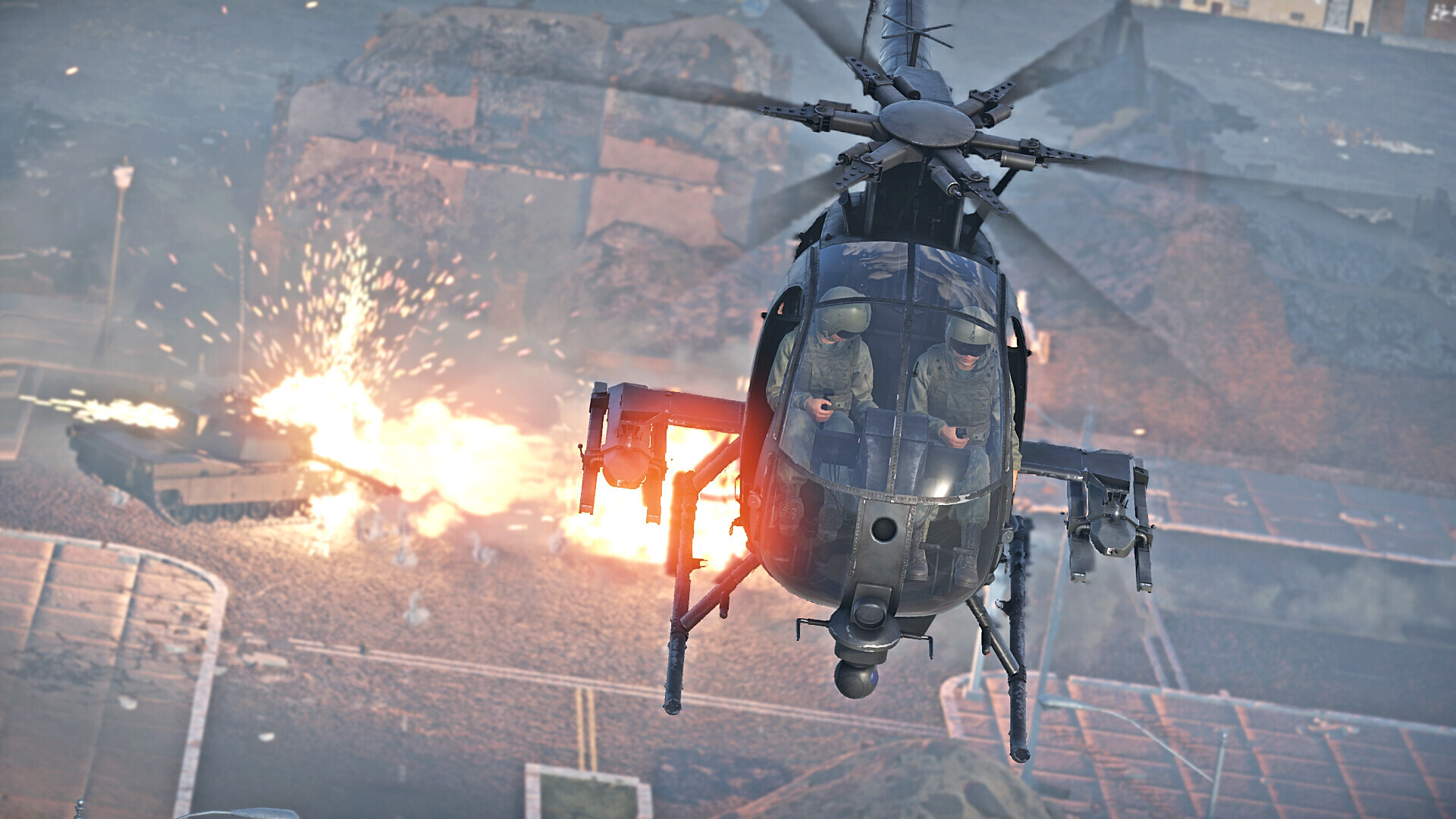
The most efficient loadout for the Little Bird is 4 x AGM-114K and 2 x M134. This way, the helicopter can both hunt enemy MBTs using its amazing targeting system with FLIR and defend itself from aircraft. The only drawback of the targeting system is its 19x zoom limit, making it difficult to employ Hellfires from ranges beyond 6 km. The best approach is to take close, hidden positions not too far from the enemy spawn, allowing you to engage SPAAs efficiently. It is also important to remember that AGM-114s loft at first and only then dive onto the roof of the target.
If Hellfires become boring and you want to play differently, you can make a loadout consisting of 14 x AGR-20B and 2 x M134. This way, the Little Bird becomes a chopper hunter, while also being able to attack both light tanks and SPAAs. Because of their relatively small size, APKWS rockets are difficult to intercept, especially using a gun-based SPAA. AGRs can be effective at ranges up to 5 km, but it is important to remember that, when using these rockets, the scope must be aligned with the ballistic computer so that the missile reaches its target.
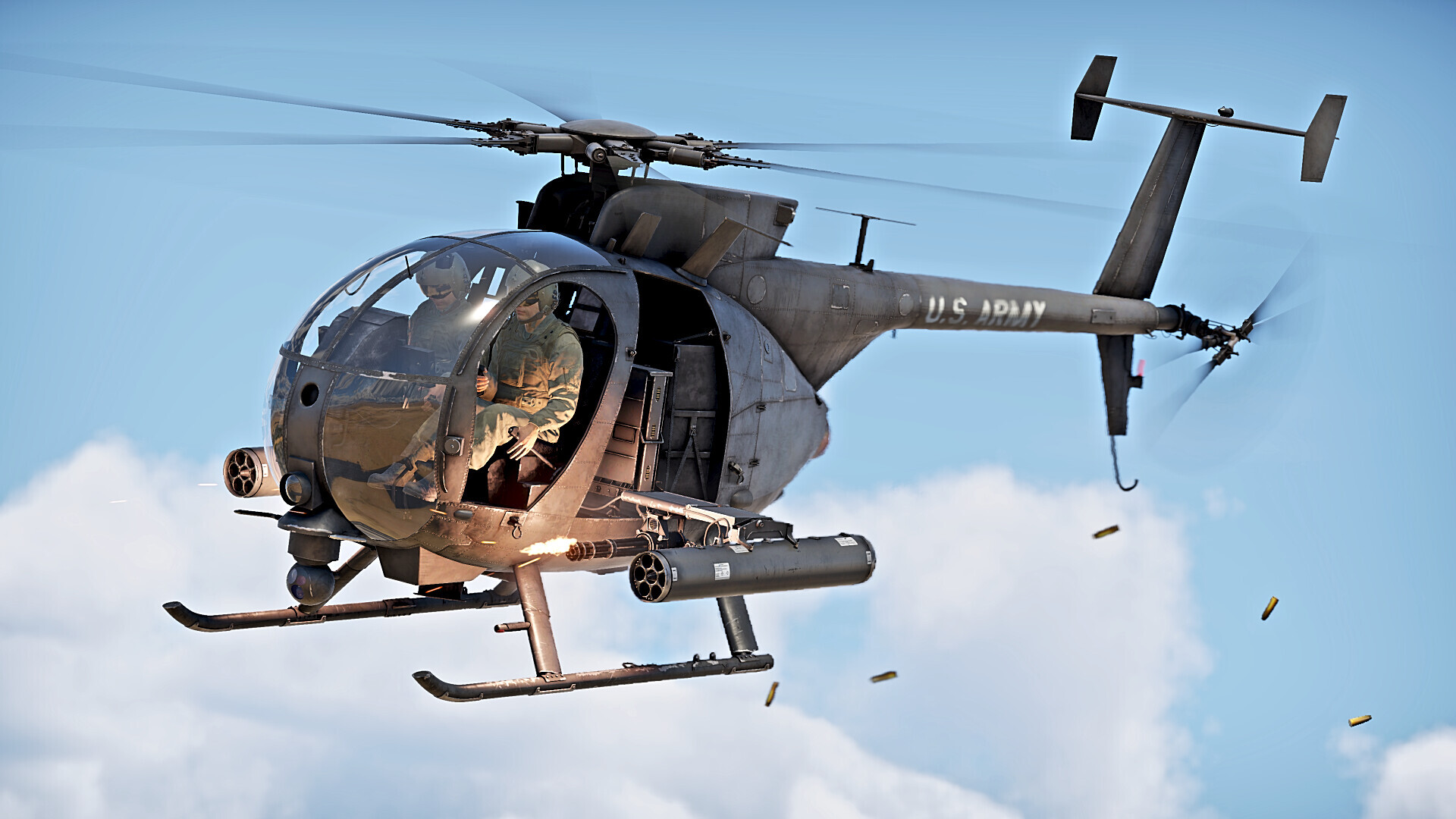
The most universal loadout for the AH-6M is a mix of 7 x AGR-20B rockets, 2 x AGM-114K Hellfires, and 2 x M134 Miniguns. This allows the helicopter to both strike tanks using Hellfires and light tanks or SPAAs using APKWS. The key is to use the weapon selector properly.
Historical notes
On 14 October 1953, the U.S. Navy Bureau of Aeronautics launched the LOH programme to develop a four-seat light helicopter intended to replace the aging OH-13 and OH-23. According to the requirements, the aircraft had to be capable of performing a wide array of objectives, from transporting personnel and conducting rescue missions to conducting strike missions and reconnaissance. Twenty-five manufacturers were invited to the competition. By 1961, 12 companies, including Cessna, Bell, Hiller, and Hughes, had submitted 19 designs for the program, and by 1963, three of them had been selected for flight testing — YOH-4, YOH-5, and YOH-6.
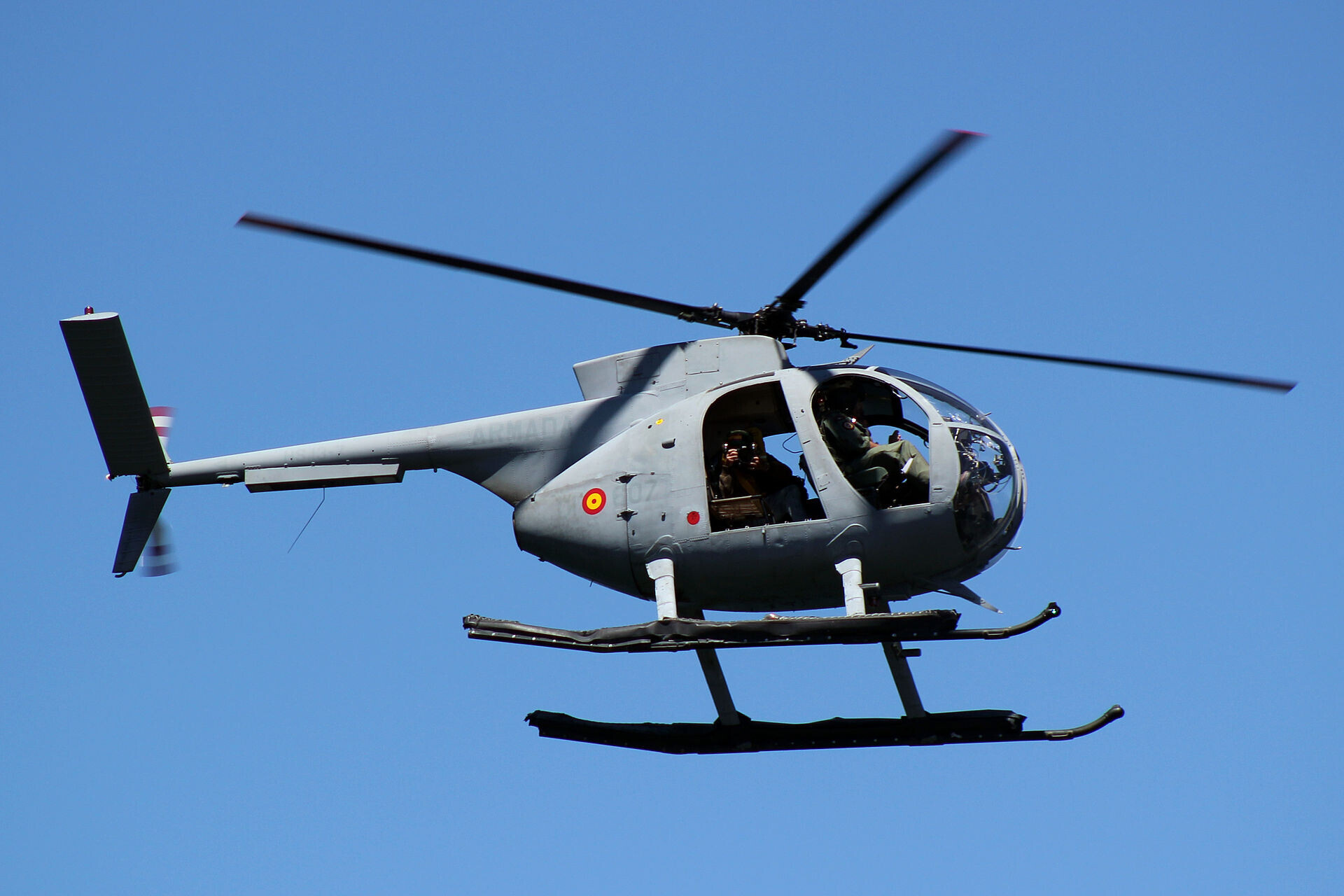
As a result of the trials, Hughes won the competition, and their YOH-6 prototype was accepted into production and entered service in 1966 as the OH-6 Cayuse. It immediately took part in the Vietnam War, where its performance impressed pilots with its excellent cockpit visibility and high maneuverability. The helicopter could carry up to five passengers or 1,000 pounds of cargo, and it was armed with a 7.62 mm M134 Minigun, while the co-pilot often operated the well-known M60 machine gun. As later reported, 964 OH-6As were shot down during the conflict.
However, the Cayuse was not only produced for the U.S. Army, as it was also widely used in civil aviation, where it became known as the Hughes 500. This was not merely a civilian version of the OH-6, but a true dual-purpose aircraft that was actively used by various law enforcement and security agencies.
After Hughes was acquired by McDonnell Douglas, the Model 500 designation was changed to MD 500, and based on it, the MD 530 was developed, equipped with a new Allison 250-C30 engine. Later, after McDonnell merged with Boeing, the MH-6M light helicopters were developed based on the 530 series for the U.S. Army special operations unit “Night Stalkers”.
The helicopter was equipped not only with a more powerful engine and a six-blade rotor, but also had its side doors removed and troop seats installed in the troop compartment. The aircraft mainly served as a transport helicopter for rapid insertion of troops deep into operational areas due to its small size. A variant called the AH-6M was also produced for the unit, intended to provide fire support thanks to the ability to mount external weapons.
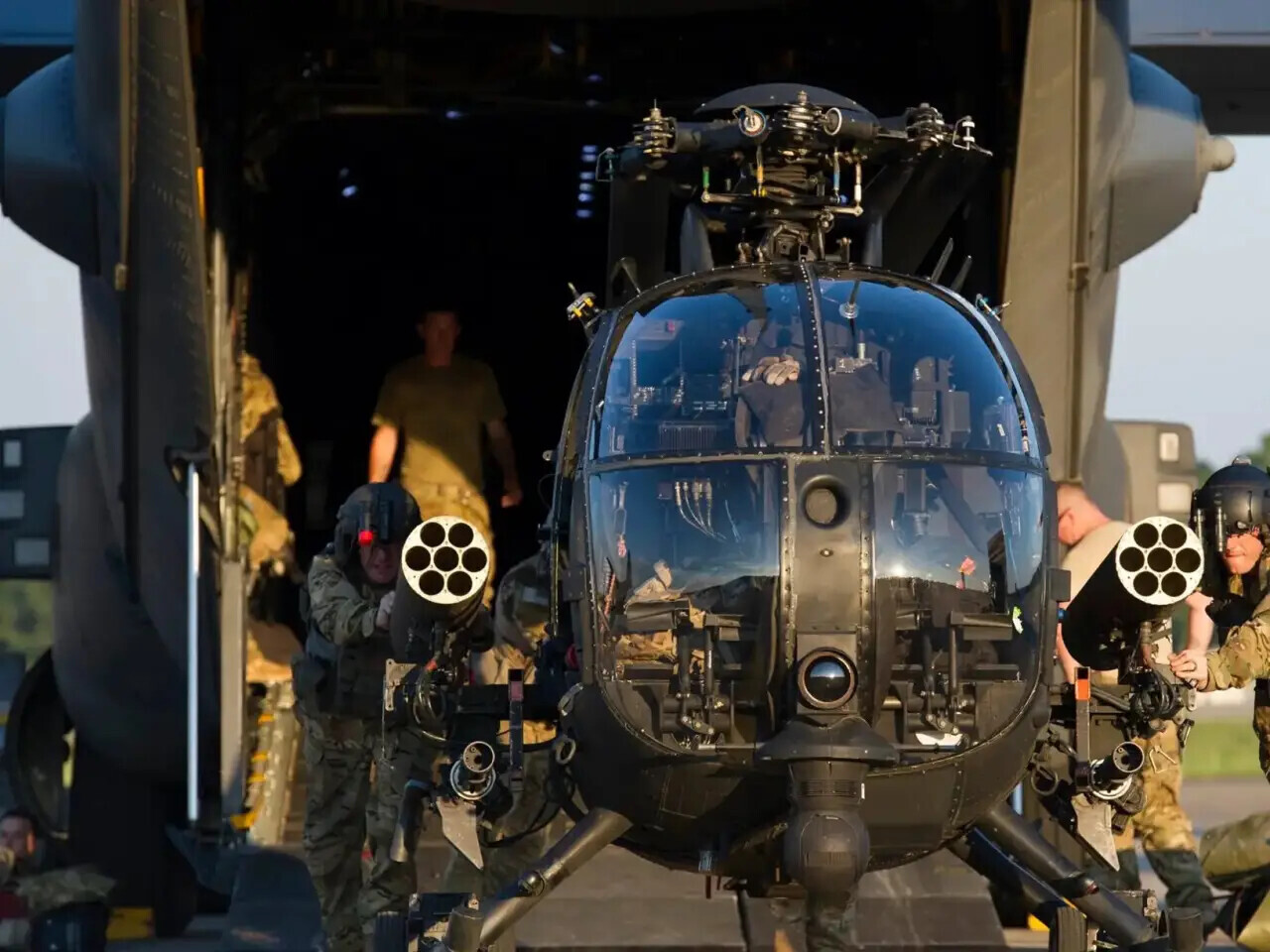
The helicopter has participated in many conflicts worldwide, including Grenada, the Iran–Iraq War, Operation “Just Cause” in Panama, and the Somali Civil War. It also proved its value in air transportability — up to two AH-6 helicopters can fit inside a C-130 cargo aircraft, and up to five helicopters can be loaded into a C-17 Globemaster III.
Sources
Translation produced with the author’s permission, original article (RU).