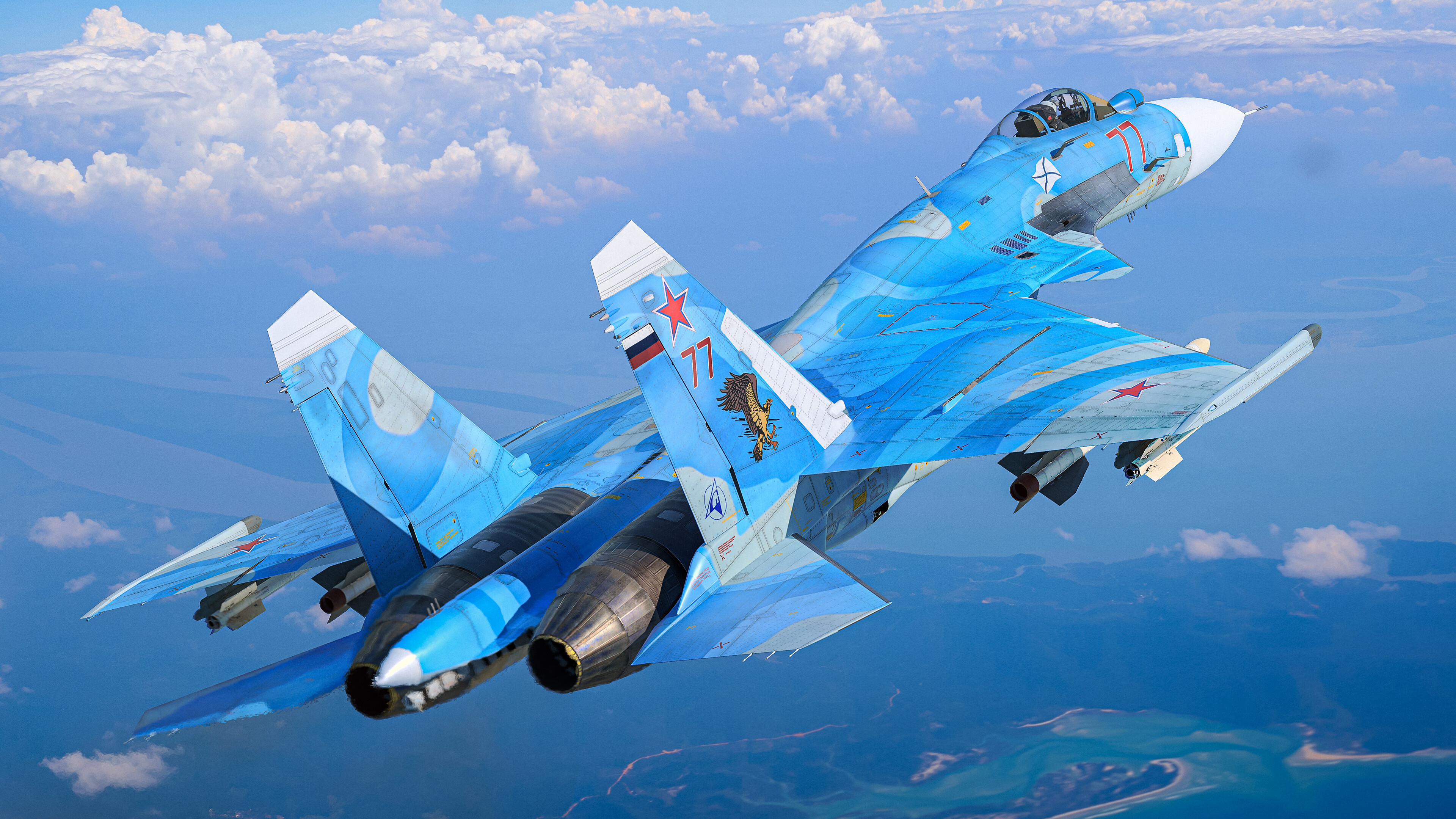
The Su-33 is a carrier-based air superiority fighter developed from the Su-27 to meet the needs of the Soviet Navy. It features reinforced landing gear, folding wings, an arrestor hook, and canards to improve low-speed handling during carrier operations. Designed for operations aboard the Admiral Kuznetsov, the Su-33 is optimized for long-range interception and high-maneuverability combat. Despite its increased weight, the Su-33 maintains decent maneuverability and is capable of employing a wide range of air-to-air missiles, making it one of the most capable carrier-based fighters of its era.
| Pros: | Cons: |
|---|---|
| Digital RWR | Heavier than the Su-27 |
| IRST | Poor sustained turn rate |
| HMS | Slow radar scan speed |
| R-27ER, R-27ET and R-73 missiles | No guided air-to-ground weapons |
| Up to 12 air-to-air missiles | Low amount of countermeasures |
Air-to-Air Capabilities:
The Su-33 has access to a variety of IR and SARH missiles, including:
- R-73: A close-range IR missile equipped with a thrust-vectoring engine and IRCCM. When paired with the HMS, it excels in dogfights and allows highly effective off-boresight launches. Effective range: up to 3 km. Note that the further away the target is, the less effective the gatewidth IRCCM becomes.
- R-27ET: A medium/long-range IR missile equipped with IRCCM. Because it is infrared-guided, it does not trigger the enemy’s RWR, making it ideal for silent long-range attacks or flanking. Effective range: 5 to 10 km, depending on altitude and target aspect.
- R-27ER: A long-range SARH missile equipped with IOG and datalink, making it the most capable SARH missile in War Thunder. It maintains excellent energy and speed over distance, making it reliable for engaging targets at medium to long ranges. Effective range: up to 50 km at high altitude (above ~5,000 m) and around 10-15 km at lower altitudes.
- GSh-30-1 (30 mm cannon): The Su-33 is equipped with a single 30 mm GSh-30-1 cannon with 150 rounds. While its rate of fire is slower than that of many contemporary Western cannons, the large 30 mm caliber delivers extremely high damage on impact, often requiring only a few hits to disable or destroy an enemy aircraft. Ammunition is limited, so trigger discipline is important to avoid wasting rounds.
Note that these values represent the ranges where kills are most likely, not the missile’s absolute maximum reach.
Air-to-Ground Capabilities:
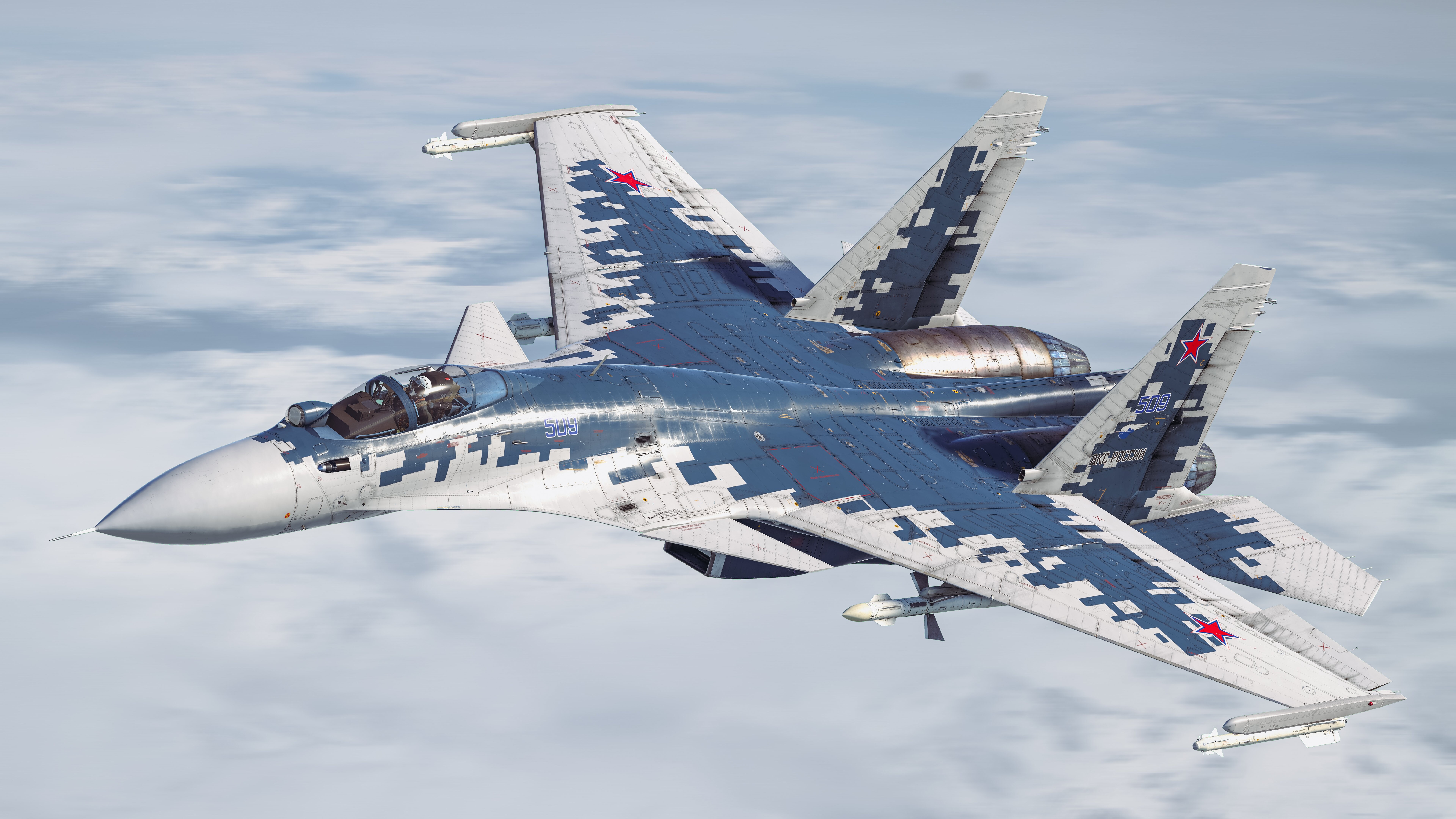
The Su-33 has limited ground attack capabilities, as it can only carry unguided bombs and rockets:
Bombs:
- 100–500 kg OFAB bombs (including parachute-retarded variants)
- 250–500 kg FAB bombs
- ZB-500 incendiary bombs
Rockets:
- S-8KO, S-130F, S-250, S-250F, and S-250FM rockets
- Up to 40 rockets per loadout
Flight Performance:
Despite having improved engines compared to the Su-27, the Su-33 is significantly heavier, and the additional thrust does not fully compensate for the extra weight. As a result, the aircraft is not particularly well-suited for prolonged dogfights. The canards allow for a higher AoA and good instantaneous turn rates, but the Su-33 bleeds speed very quickly in sustained maneuvers. In practice, it’s generally best to avoid dogfights altogether, but with proper speed management, the Su-33 can still out-turn opponents who enter a fight too fast, allowing you to get the gun on target or fire an R-73 first in a single turn.
Survivability and Avionics:
Radar (N001K):
The Su-33 uses the N001K pulse doppler radar. While functional, it is considered below average in comparison to other aircraft: it has a slow scan speed, can take some time to detect incoming targets, and often struggles to lock onto aircraft at longer ranges. Despite these limitations, the radar includes TWS and HMS support, as well as IFF, making it perfectly usable once you understand its quirks. At the start of a match, TWS HDN is usually the most effective mode for long-range detection. It detects approaching targets more reliably than standard TWS, allowing you to pick up bandits climbing toward you even when normal TWS fails. However, TWS HDN has a short-range blind spot, making it unable to detect nearby targets. It also performs poorly against aircraft flying away from you, which is why it’s best used primarily during the opening phase of the match. Overall, the radar isn’t exceptional, but it gets the job done when used correctly.
IRST:
The Su-33's IRST offers passive infrared detection but is extremely slow to scan (slower than the radar). It also has difficulty locking targets at longer ranges, with a practical limit of around 20 km, and it can be easily disrupted by enemy flares. Additionally, unlike the radar, the IRST does not provide IFF, so extra caution is needed when tracking targets at a distance.
Despite its limitations, the IRST is excellent for silent attacks, since it does not trigger enemy RWRs. When paired with the R-27ET, it becomes a powerful tool for ambushing unaware opponents, especially while flanking or engaging distracted targets.
RWR (SPO L-150):
The SPO L-150 digital RWR is a major improvement over the older analog SPO-15LM found on the Su-27, providing much better situational awareness. It features IFF capability and can detect radars operating across the C to J bands, allowing the Su-33 to identify and track most radar threats in the game.
Countermeasure:
The main weakness of the aircraft is its very limited countermeasure capacity, carrying only 48 large-caliber countermeasures, which are dispensed in single-pop mode (one flare or chaff per key press). Despite the low quantity, they are effective and eject upward, making them useful for defeating missiles fired from below. However, their limited number requires careful management throughout the match.
Conclusion:
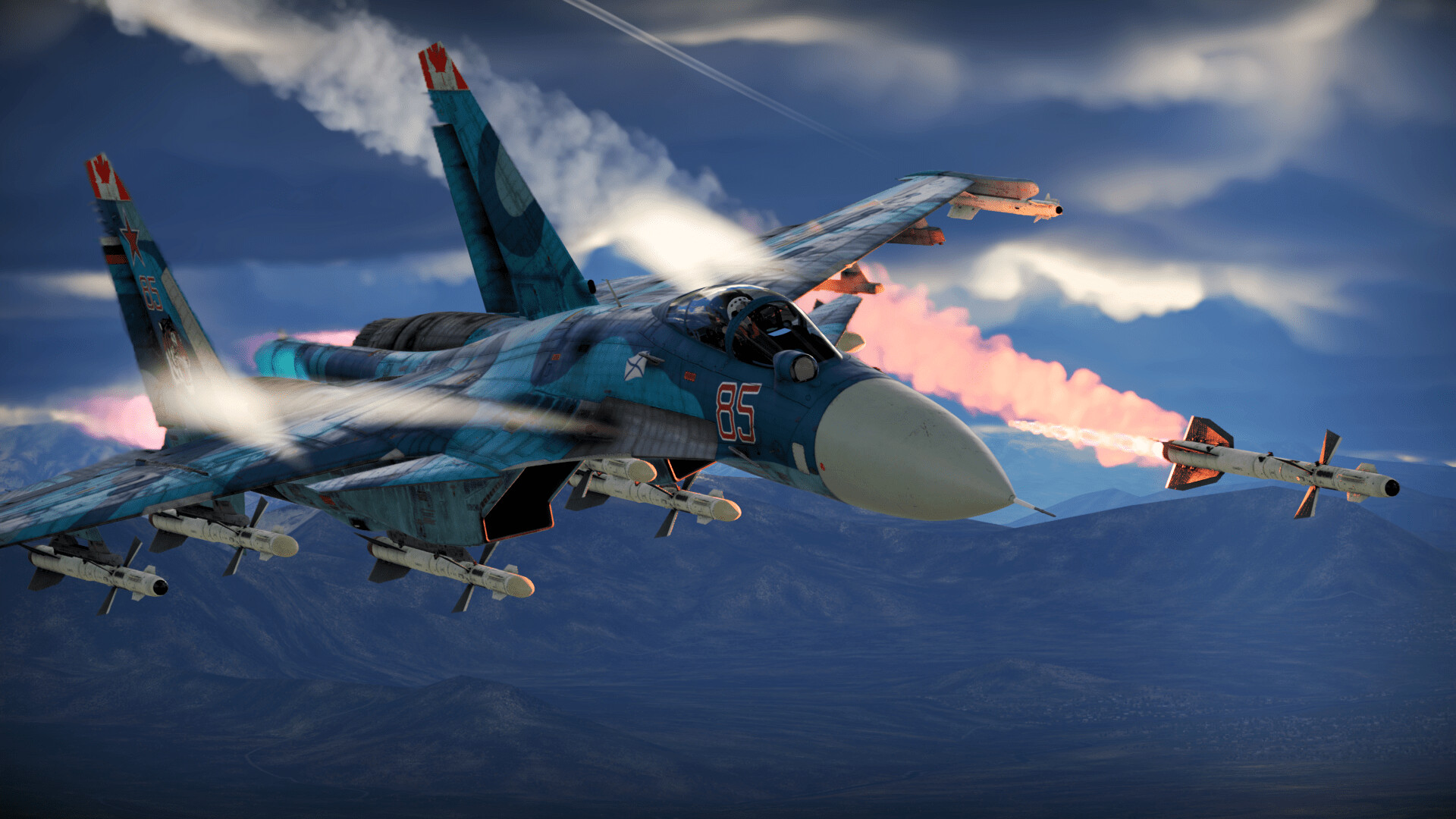
The Su-33 is a powerful and versatile fighter that remains highly competitive even without access to ARH missiles. Its powerful missile loadout and good instantaneous maneuverability make it a serious threat in the hands of a disciplined player.
The most effective way to fly the Su-33 is to gain altitude early in the match and maintain air superiority before engaging. From above, you can safely pick off low-flying opponents using the R-27ER’s long-range performance or catch unaware targets with the silent R-27ET. Staying high also helps mitigate the aircraft’s weaknesses in sustained turning and its limited countermeasure capacity.
While the Su-33 can equip unguided bombs and rockets, it is not well-suited for close air support. Its lack of guided air-to-ground weapons and its fragile defensive capability make CAS risky and generally inefficient compared to dedicated strike aircraft.
Overall, the Su-33 excels as an altitude-based interceptor that rewards smart positioning, smart missile usage, and situational awareness. When flown to its strengths, it can dominate the battlefield and outperform many of its contemporaries.
Credits (in order):
- WT Live — image by KohleR
- WT Live — image by Sahar_3ok
- WT Live — image by MapleWolf34