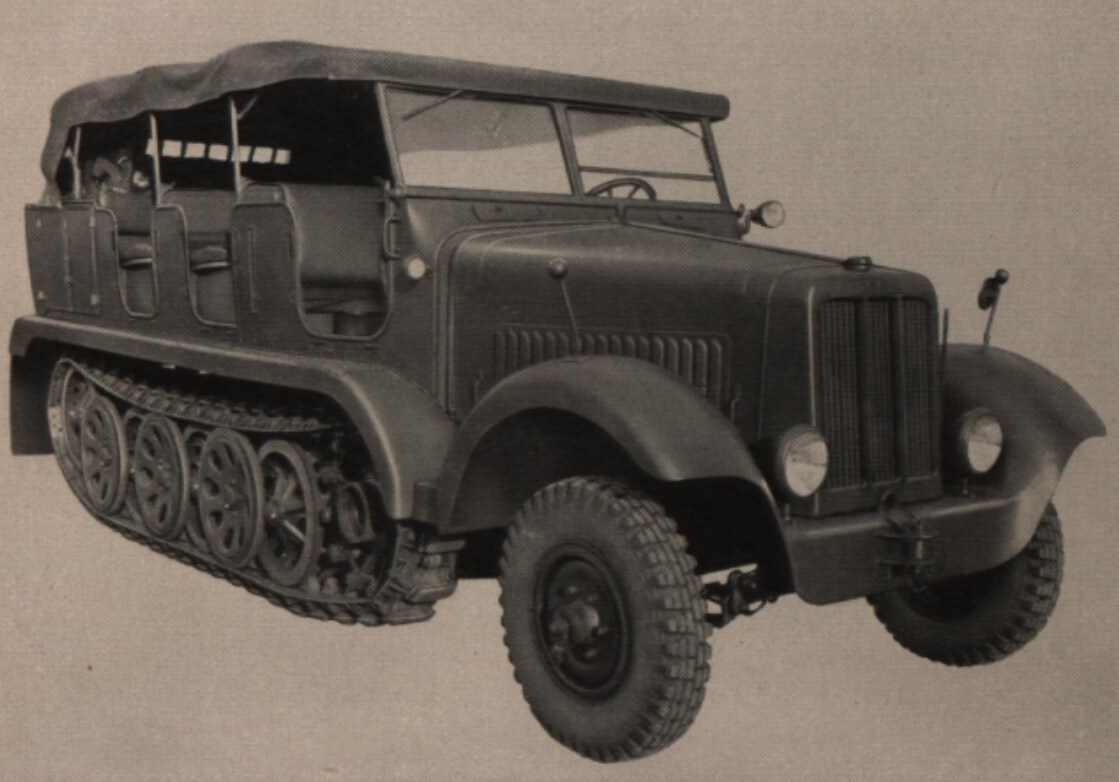
The Sd.Kfz. 6, or “Mittlerer Zugkraftwagen 5 t / medium tractor 5 t,” was a half-track vehicle of the German Wehrmacht. It was intended for the transport of materiel such as howitzers and anti-tank guns, as well as personnel. More than 3,500 examples were produced between 1939 and 1944.

Technical Data
Note: This Datas is for the Sd.Kfz. 6, 6/1 and 6/2
| Height | 2.50 meters |
| Width | 2.26 Meters |
| Length | 6.325 meters |
| Mass | 9.0 t (max.) |
| Payload | 1.5 t |
| Climbing Ability | 24° |
| Engine | Maybach HL 54 TUKRM |
| Performance | 115 HP (85 kW) |
| Speed | 50 km/h (Street) |
| Power-to-Weight Ratio | 12.8 HP/t |
| Fuel Supply | 190 l |
| Range | 300 km (street) |
| Crew | 10 — 15 |
Development
As part of the rearmament effort after the First World War, the Wa Prüf 6 department, under the direction of engineer Kniepkamp, commissioned Krauss-Maffei with the development of a “light all-terrain tractor”.
This led to the production of a prototype, the KM l 4, in 1934. Shortly thereafter, responsibility for the development of this vehicle class was transferred to Büssing-NAG, and a small series of eight vehicles, designated BN l 4, was produced by Büssing-NAG. In the following years, Daimler-Benz also became involved in licensed production.
Note: The abbreviations BN (Büssing-NAG), KM (Krauss Maffei), and DB (Daimler Benz) stand for the production versions. These abbreviations were used in the construction of the small series, which featured minor, but mostly experimental, differences, such as different braking technology or a different chassis, to develop the final Sd.Kfz. 6.
Over the next few years, the following types were also manufactured: BN l 5 (184 units), BN l 7 (281 units), BN l 8 (464 units), BN 9 (617 units), BN 9 V (2 units), BN 9b (1,167 units) at Büssing-NAG, BN 9b (300 units) at BMM, BN 11 V (1 unit), DB l 5 (313 units), DB l 7 (228 units), and DB l 8 (272 units). Production ended in November 1943.

Note: In the years before the Second World War, the production figures for the individual types were inadequately documented. Only the respective inventory reports from the Army provide information on the rate at which these vehicles were delivered to the Wehrmacht. It is certainly important that on September 1st, In 1939, 1,506 vehicles were registered with the Army and 68 vehicles with the Air Force.
Variants
Sd.Kfz. 6
The Sd.Kfz. 6 was the standard model of the Sd.Kfz. 6 and was intended for the transport of pioneers and their equipment. It could carry 15 people.
Sd.Kfz. 6/1
A standard half-tracked vehicle designed to tow artillery pieces and transport 10 men plus 500 kg of equipment and ammunition. Together with the Sd.Kfz.6, more than 3,640 were produced.
Sd.Kfz. 6/2
An Sd.Kfz. 6, equipped with a 3.7 cm Flak 36 gun. The side rails could be folded down to increase the working space. The crew consisted of seven men: three loaders and two gunners in the rear, the rest in the front.
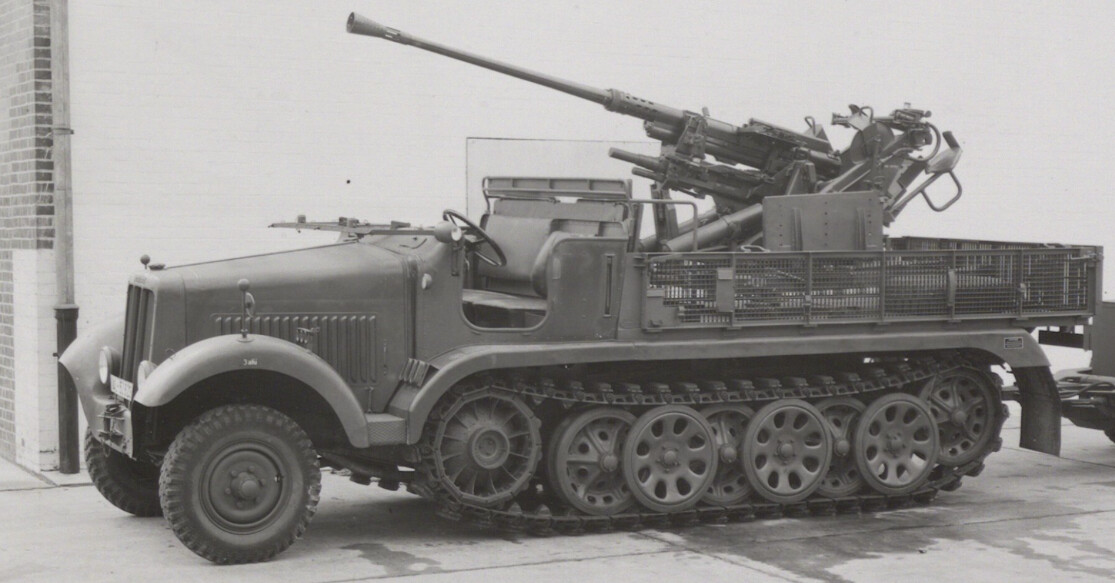
Between 1939 and 1941, 198 and 203 vehicles were produced for the Luftwaffe. The gun had an elevation angle of -8 to +85 degrees.
In terms of weight and crew, the smallest half-track suitable as the basis for the 3.7 cm Flak was the 5 t Zugkraftwagen. The model introduced at the time of the order was the BN 9 version produced by Büssing-NAG, which formed the chassis for the Sd.Kfz. 6/2. As early as July 1939, the first 25 vehicles with a body from Gottfried Lindner AG in Ammendorf were delivered. By this time, the Luftwaffe had already ordered 198 of these vehicles. At that time, the vehicle was designated as the 3.7 cm Flak Truppenluftschutz auf Selbstfahrlafette auf 5 t Zugkraftwagen. During the course of the war, the 1st Battery “Grossdeutschland” (Great Germany) was the only Wehrmacht unit equipped with these vehicles. All other units belonged to the Luftwaffe.
Sd.Kfz. 6/3
A tank destroyer built from an Sd.Kfz. 6 carrying a captured Soviet 76 mm F-22 gun mount in an armored superstructure. It was designated Sd.Kfz. 6/3, 7.62 cm F.K. (r) auf 5t Zugkraftwagen or 7.62 cm F.K. (r) auf armeerer Selbstfahrlafette Sd.Kfz. 6/3
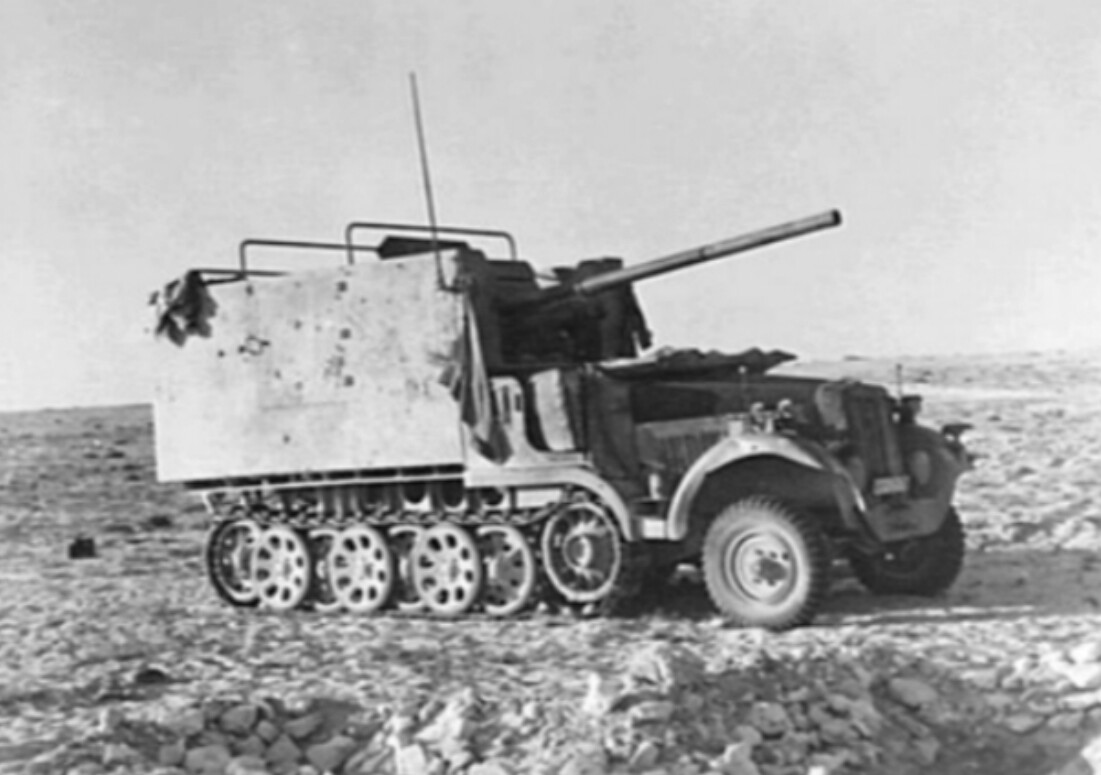
The gun was mounted at the rear of the mount, and 5 mm thick armor plates were added to the sides and rear to reinforce the gun shield. Nine examples were produced in 1941/42.
The Sd.Kfz. 6/3 was based on the modified chassis of the Sd.Kfz. 6 half-track vehicle. During production, several changes were made to this half-track vehicle to improve its overall performance. The 7.62 cm F.K. (r) auf gp. Selbstfahrlafette Sd.Kfz. 6/3 used the subversion of the BN 9b, which included changes from previous versions: a redesign of the suspension with torsion bar springs, the addition of two additional road wheels, and the installation of a more powerful Maybach NL 54 TUKRM engine producing 115 hp at 2,600 rpm. With this new engine and its associated new weight of approximately 10 to 10.5 tons, the 7.62 cm F.K. (r) auf gp. Selbstfahrlafette Sd.Kfz. 6/3 could reach a top speed of around 50 km/h. The tank volume of around 190 liters enabled a range of 222 km on the road and 112 km off-road.
The 5 to 6 man (commander, gunner, loader, driver and two additional ammunition carriers could support the loader) crew was protected by 4.5 mm thick armor plates. While it was hoped that this would at least provide protection against small-caliber projectiles, this was not the case in reality. The front was largely protected by a 3 mm thick gun mantlet. The Sd.Kfz. 6/3 had a length of 6.33 m, a width of 2.26 m, and a height of 3.05 m. The gun had a pivotability of 30° in both directions and an elevation of -7° to +20°. The armor penetration at 1 km was 67 to 77 mm. In total, around 100 shells could be transported, and with the help of a trailer, even more.
Pz.Sfl.II
The Panzer-Selbstfahrlafette II, or 7.5 cm Kanone L/41 auf Zugkraftwagen 5t (HKp 902), was a German half-tracked tank used and developed during World War II. Development began in 1936, when Büssing-NAG was commissioned to develop an advanced half-track chassis with a rear-mounted engine, specifically designed for use as a tank destroyer. Four prototypes of the HKp 902 chassis were built, two of which were equipped with Rheinmetall-Borsig’s 7.5 cm L/40.8 cannon in an open-topped, flat-topped turret.

The gun had an elevation range of between −8 and +20 degrees. It fired a 6.8 kg red Pz. Kr.Gr. shell with a muzzle velocity of 685 m/s and a 5.85 kg HE shell at 485 m/s. It had a capacity of 35 rounds. The armor, designed to withstand 7.92 mm armor-piercing rounds, was 20 mm thick at the front, 14.5 mm and 10 mm on the sides, 10 mm at the rear, 10.5 mm on the roof of the superstructure, and 5.5 mm on the belly.
The two prototypes were completed in 1941 and combined into a platoon for field trials with Panzerjägerabteilung 605 of the Afrika Korps. The first vehicle was received by Panzerjägerabteilung 605 on January 17, 1942, but the second did not arrive in Tripoli until February 23, 1942. The platoon was transferred to the Kampfstaffel of the Oberkampfaber Panzerarmee Afrika (Rommel’s personal combat group) on March 8, 1942. On May 25, at the start of Operation Venezia during the Battle of Gazala, only one vehicle was reported operational; the other had been captured by the British, as can be seen in undated photographs. Shortly thereafter, on June 5, the combat squadron reported that the other vehicle had been lost after destroying three tanks.
Schneeschleuder auf m. Zgkw. 5t (Sd. Kfz. 6)
This is an Sd.Kfz. 6 which was converted into a snow plough by the Schmidt company from St. Blasien (Baden-Württemberg) and was intended for civilian use.
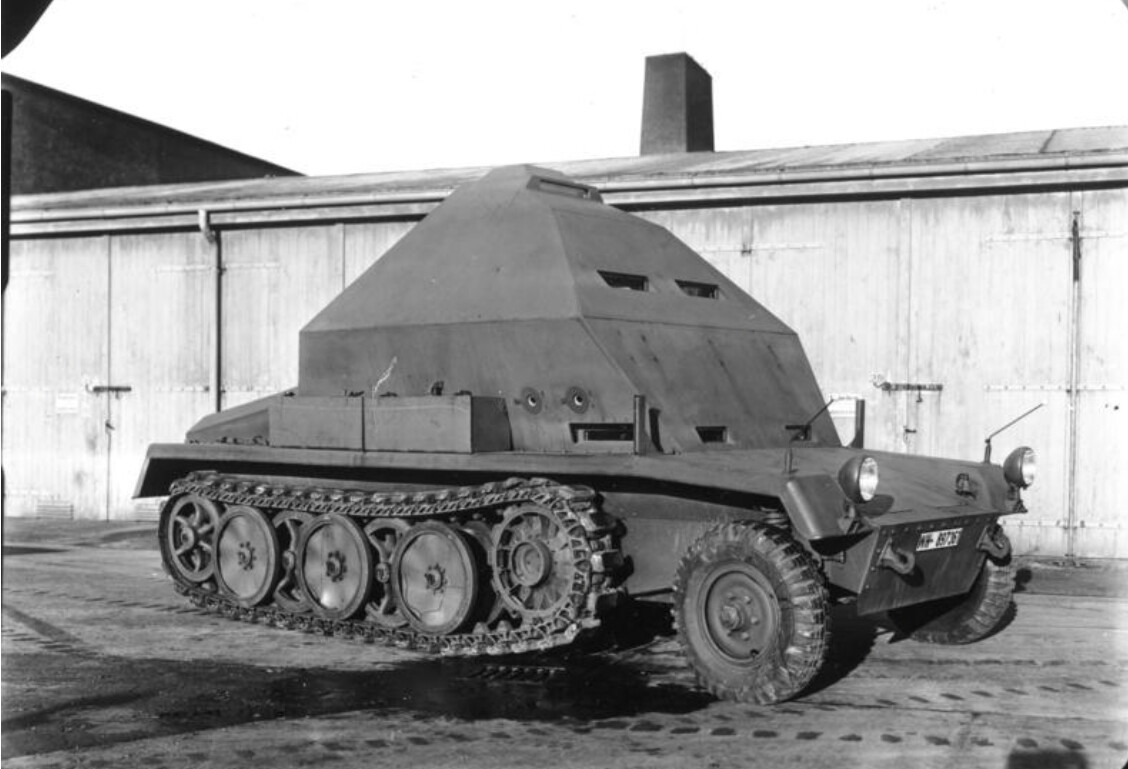
Versuchs-Feuerleitpanzer auf Fahrgestell BN 10 H
Based on the BN 10 H, a test chassis for the Sd.Kfz. 6 for armored self-propelled guns, a vehicle was converted into an armored fire control vehicle in 1944. The engine of this design was located in the rear. There was probably only one vehicle, which was probably used only in Peenemünde.
Deployment
During development, the Sd.Kfz. 6 was planned for use by the Army’s engineer and artillery units, as already mentioned. Typically, the vehicle was intended for use in bridge columns and with the divisional artillery.

Typical towing capacities for these vehicles were also typical for the engineers, with the pontoons on the Pf. 10 or Pf. 11 and the light pontoons on Pf. 14 and 15, as well as the 10.5cm le.FH 18 for the artillery.
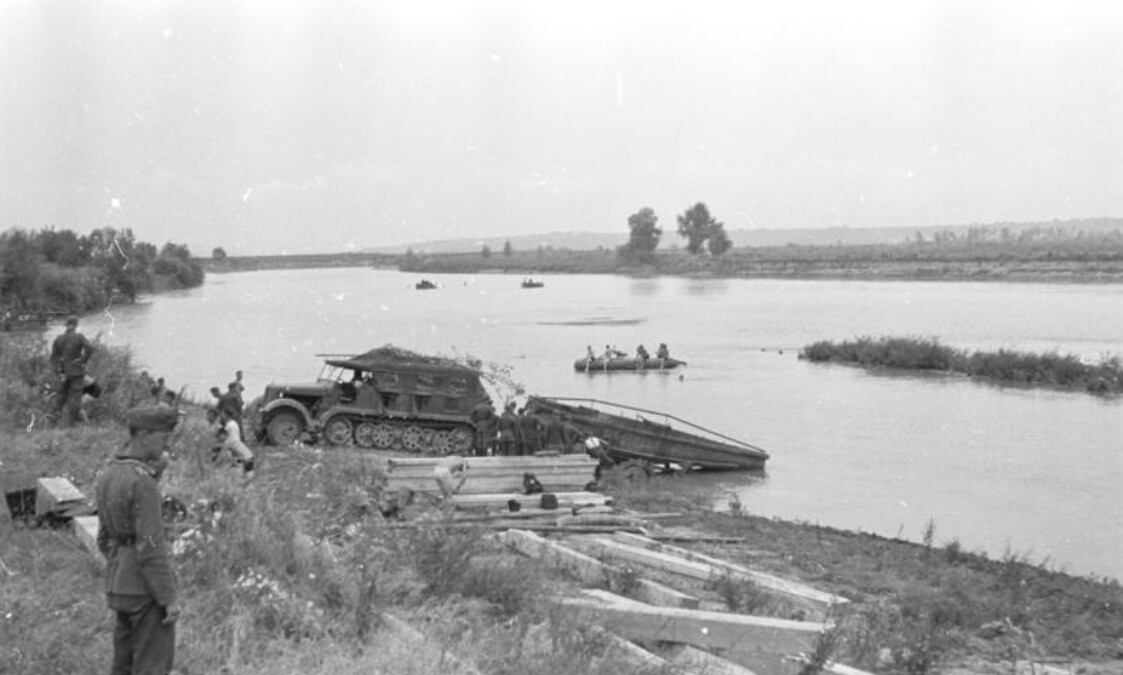
The superstructures for these different tasks were different, as the engineers had larger crews and the artillery usually carried standby ammunition. The rough production ratio for the superstructures was said to be 1/3 engineer and 2/3 artillery.
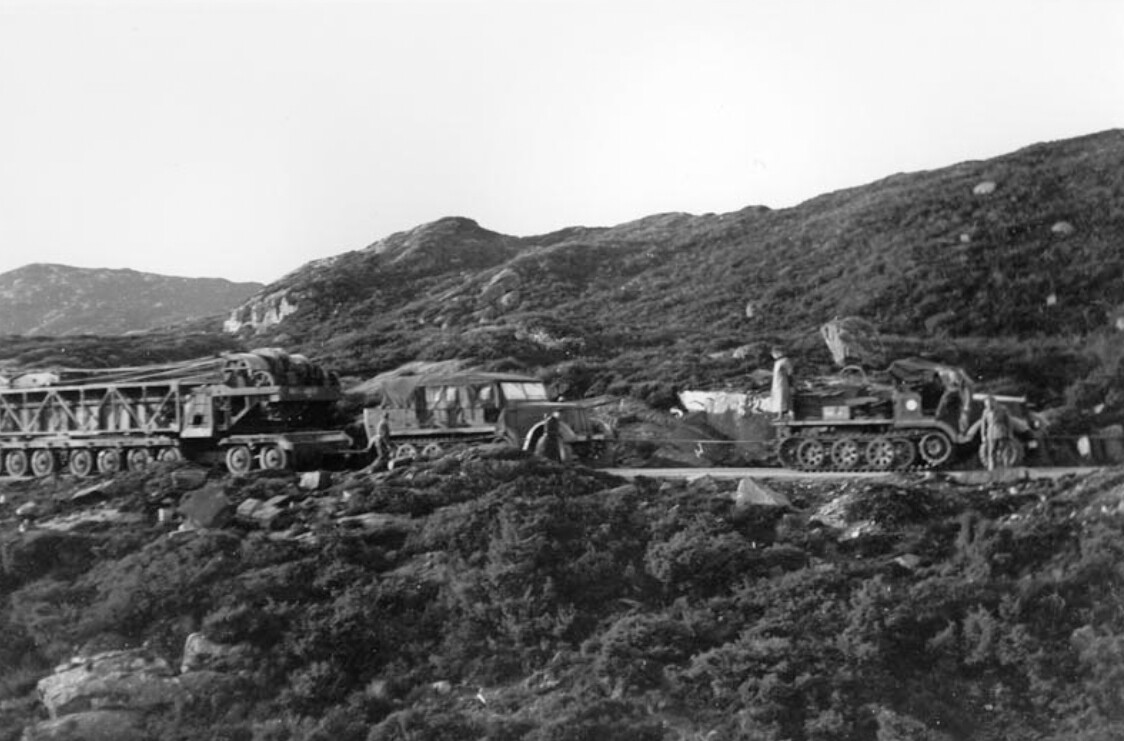
The Sd.Kfz. 6 was also planned as a towing vehicle for the 8.8cm PaK 43, for example, with the K.St.N. 1146 heavy tank destroyer companies, each with 12 medium-sized tractors. After Büssing-NAG was tasked with developing a new, standardized type, the Sd.Kfz. 6 was replaced by the new heavy Wehrmacht tractor starting in 1943.
Sources
- [Wiki DE] Sd.Kfz. 6
- [Wiki DE] Liste der Sonderkraftfahrzeuge der Wehrmacht
- [Wiki DE] 3,7-cm-Flak 37 (Sd.Kfz. 6/2)
- [Wiki EN] Pz.Sfl. II
- [Wiki EN] Sd.Kfz. 6
- [Kfz der Wehrmacht DE] mittlerer Zugkraftwagen 5t (Sd. Kfz. 6)
- [Kfz der Wehrmacht DE] Schneeschleuder auf m. Zgkw. 5t (Sd. Kfz. 6)
- Kfz der Wehrmacht DE] Versuchs-Feuerleitpanzer auf Fahrgestell BN 10 H
- [Kfz der Wehrmacht DE] Panzer-Selbstfahrlafette II
- [The Online Tank Museum EN] 7.62 cm F.K. 36(r) auf gepanzerte Selbstfahrlafette Sd.Kfz.6/3