During the Second World War, Britain found itself in a pickle. Domestic factories were unable to produce enough suitable tanks fast enough for the British Army to be able to fight in North Africa and beyond. Similarly, the lessons of the Fall of France, as well as the enormous loss of heavy equipment — albeit somewhat obsolete anyway; meant that the Ministry of Defence was forced to look across the pond to the United States for support.
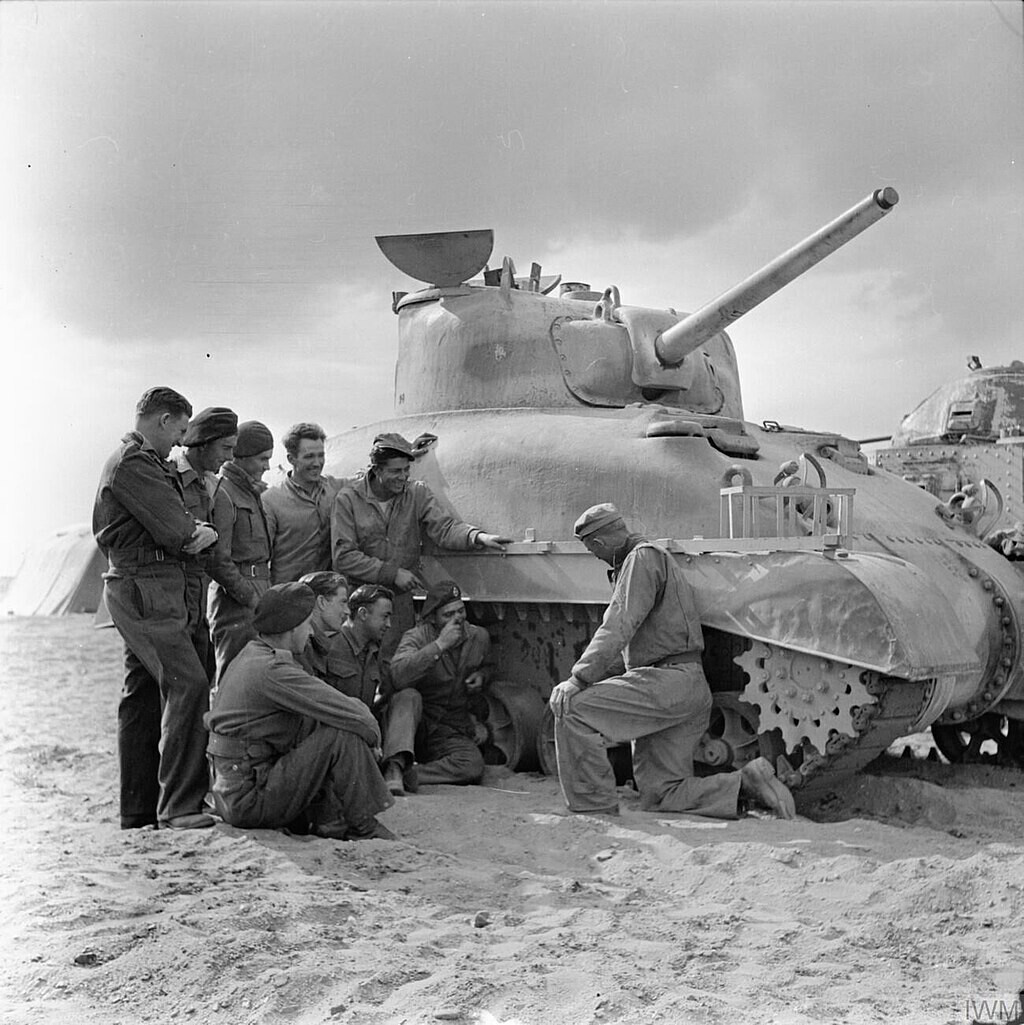
The Lend-Lease Scheme
Prior to 1941, the British government used almost every economic lever it had to fund the colossal war effort. Much of this went to procuring military vehicles, and a sizeable portion of that went to buying American planes and ships. But the Treasury was running out of money, and, reluctant to sell British overseas assets, they send the Tizard Mission to Washington during the height of the Battle of Britain. This mission shared with the Americans many technologies developed just prior to the war but that Britain was unable to use due to its dire position. Some of these technologies were vital for the production of radar, effective warplanes, jet engines and, perhaps most importantly, the nuclear bomb.
Shortly after this Mission, Churchill sent a letter to President Roosevelt asking for help in fighting the war. American non-interventionists such as famed pilot Charles Lindbergh were strongly against any form of aid for the UK. However, many Americans, having seen the devastation caused by the Blitz and the Occupation of France, were in favour of aiding the UK. In March 1941, after a lengthy process, Roosevelt signed the Lend-Lease Act into law. It allowed him to “sell, transfer title to, exchange, lease, lend, or otherwise dispose of, to any such government [whose defense the President deems vital to the defense of the United States] any defense article.”
This Act initially benefited the UK primarily, but after the invasion of the USSR by Germany in April 1941, Roosevelt extended the aid to them, supplying military equipment and rolling stock which Stalin needed to begin to fight back against the invaders. China also received materiel, as did Free French forces and several other countries.
All branches of the British Armed Forces and of British society benefited from Lend-Lease, but this article is dedicated simply to the tanks and armoured vehicles supplied to the British Army.
The Lend-Lease Tanks
M3 Stuart — or “Honey”
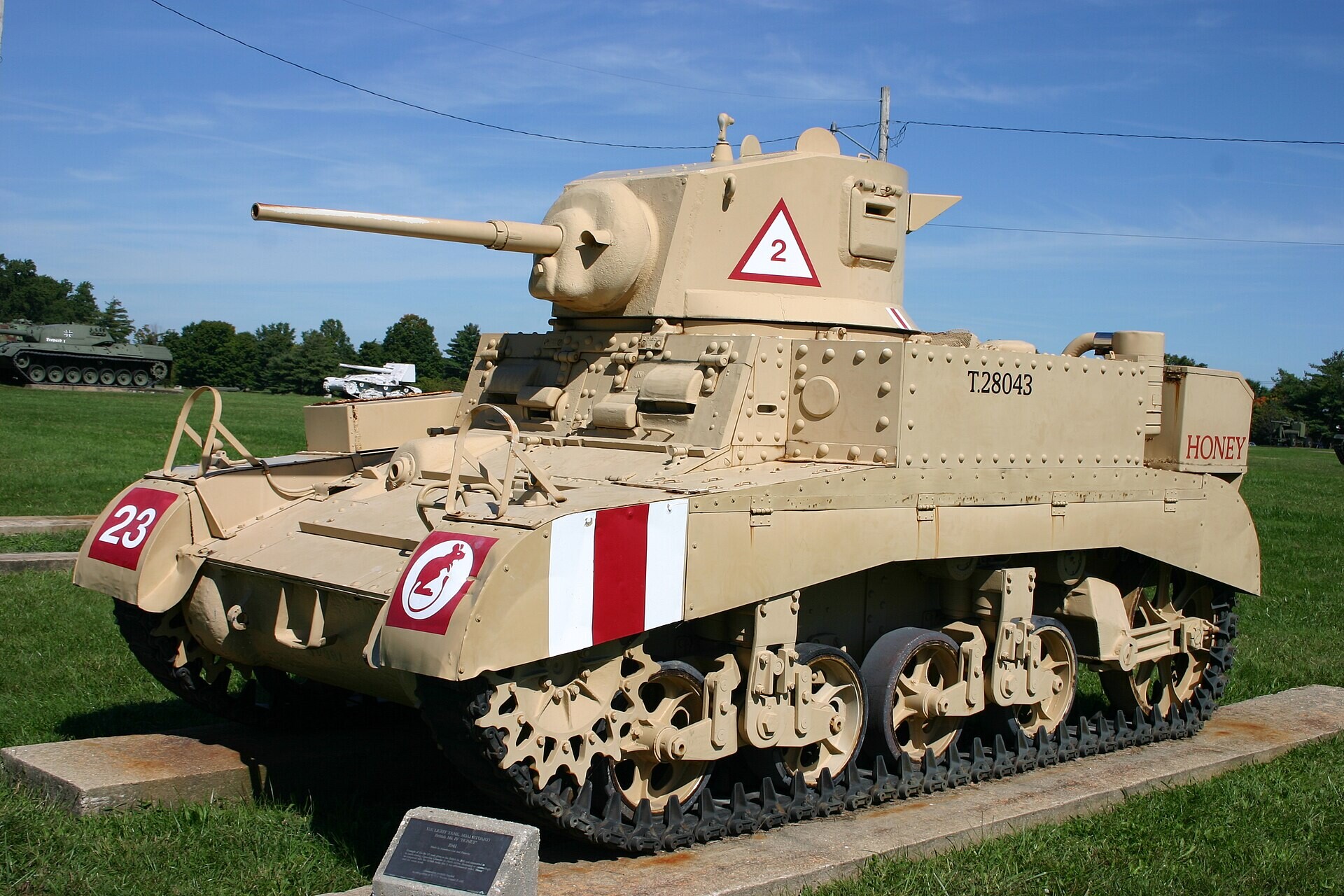
The ubiquitous M3 Stuart — or Honey as it was often referred to in British service — was one of the first and most numerous types to be supplied to British Forces from July 1941. Legend has it that the name Honey was bestowed upon the type by REME engineers who appreciated its reliability compared to some British types. It first saw action in North Africa, where crews used to the fast, manoeuvrable A13 Cruiser tanks found the Honey quite easy to adjust to. The 37mm cannon was very similar to the British 40mm 2-pounder found on many tanks at the time — so was just as quickly outclassed by new enemy Panzer designs.
By mid-1942, most units preferred to use the Honey as a reconnaissance tank, as opposed to using it in combat with other tanks. The Honey’s small size and relatively high speed made it very effective in this role, though its limited range — half that of the faster Crusader — was a source of irritation.
M3 Grant

The “Iron Cathedral”, as American forces dubbed it, was initially only meant to be a stopgap measure before the M4 Sherman could be brought into production. The flaws were apparent: riveted and light armour, the sponson-mounted cannon, tall silhouette and a radio in the hull all grated with veterans of combat in France. However, American companies had refused to build British-designed tanks and the M3 could be brought into full-scale production immediately, so the British — in dire need of a more heavily armed tank — somewhat reluctantly placed several orders.

As it was, the Grant arrived in North Africa just at the right time to halt the surging German advance at a little railway junction known as El Alamein in 1941. It arrived just as the British war machine really began to roar. That year also saw the introduction of aircraft such as the Avro Lancaster and De Havilland Mosquito and the formation of the infamous Special Air Service — all of which would play key roles in the years to come. The Grant served all through the North African campaign, eventually being replaced by M4 Shermans. The remaining Grants were sent to the Far East where they enjoyed a level of technological superiority over the Japanese armoured forces.
The spacious hull of the Grant went on to be used as a base for several other vehicles used by British and Commonwealth forces. The M7 Priest SPG took the hull of the Grant and replaced the 75mm main gun with an 105mm howitzer. Many M7s were subsequently converted into Kangaroo Armoured Personnel Carriers as British forces found that the numerous but tiny Universal Carriers and the handful of M3 Half-Tracks they received to be insufficient. Grant Armoured Recovery Vehicles were also created, mounting a large crane in place of any heavy armament. General Montgomery, commander of British forces in North Africa, could often be found observing battles from the cupola of a Grant Command fitted with map tables and more radios. There was even a top-secret version, one of Hobart's Funnies, fitted with a powerful searchlight in the turret, that proved exceptionally useful during the many nighttime operations in Europe in 1944-45.
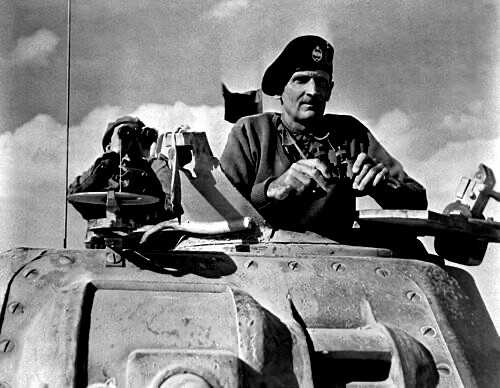
M4 Sherman
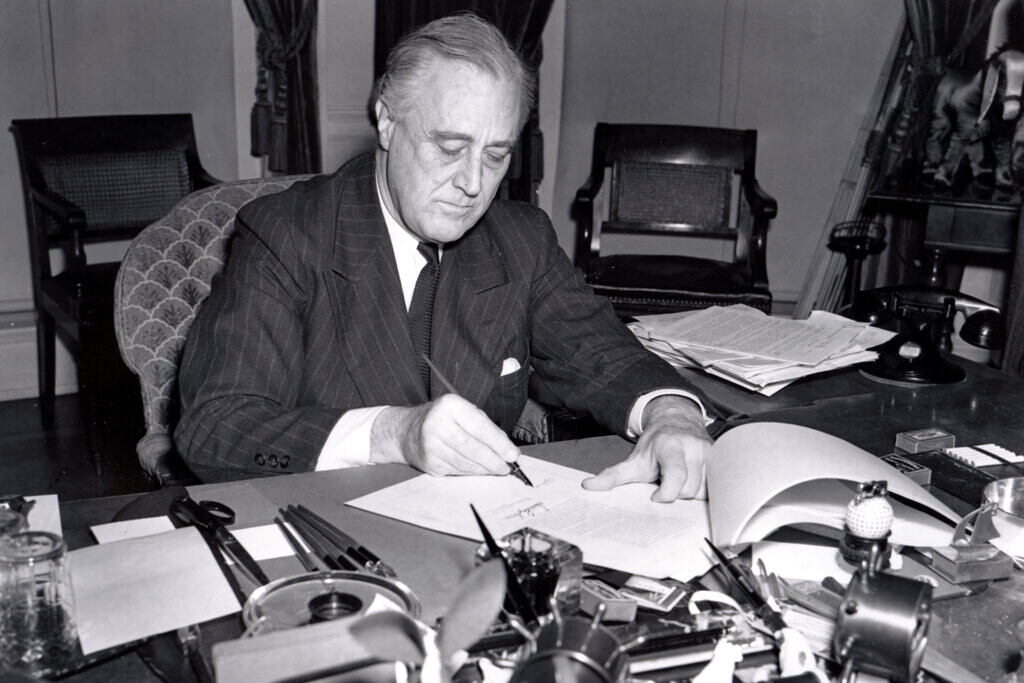
The ubiquitous Sherman was supplied in vast quantities to all of America’s allies during the war. Its simple yet robust nature made it ideal for mass production, and near endless American industrial capacity ensured there was no shortage of them. British units received Shermans from 1942 onwards, often whole regiments were equipped with them. They filled a niche which had been left open by contemporary British designs — that of the general-purpose medium tank, capable of both supporting infantry with HE shells and machine guns and of tank-to-tank combat.
The British also used the Sherman as the basis for many specialised or up-gunned tanks:
Sherman VC Firefly
Perhaps the most famous of the Sherman sub-variants, it was equipped with a devastating QF 17-pounder cannon, a radical improvement in anti-tank capability over the base M4s. This change necessitated extensive modifications to the turret and engine, and the replacement of the bow machine gunner with an ammo rack. The Firefly was in high demand as Allied forces came up against well-armoured tanks such as Tigers and Panthers, so they were often scattered through armoured divisions equipped with regular Shermans. Usually in each section of four Shermans there was one Firefly.
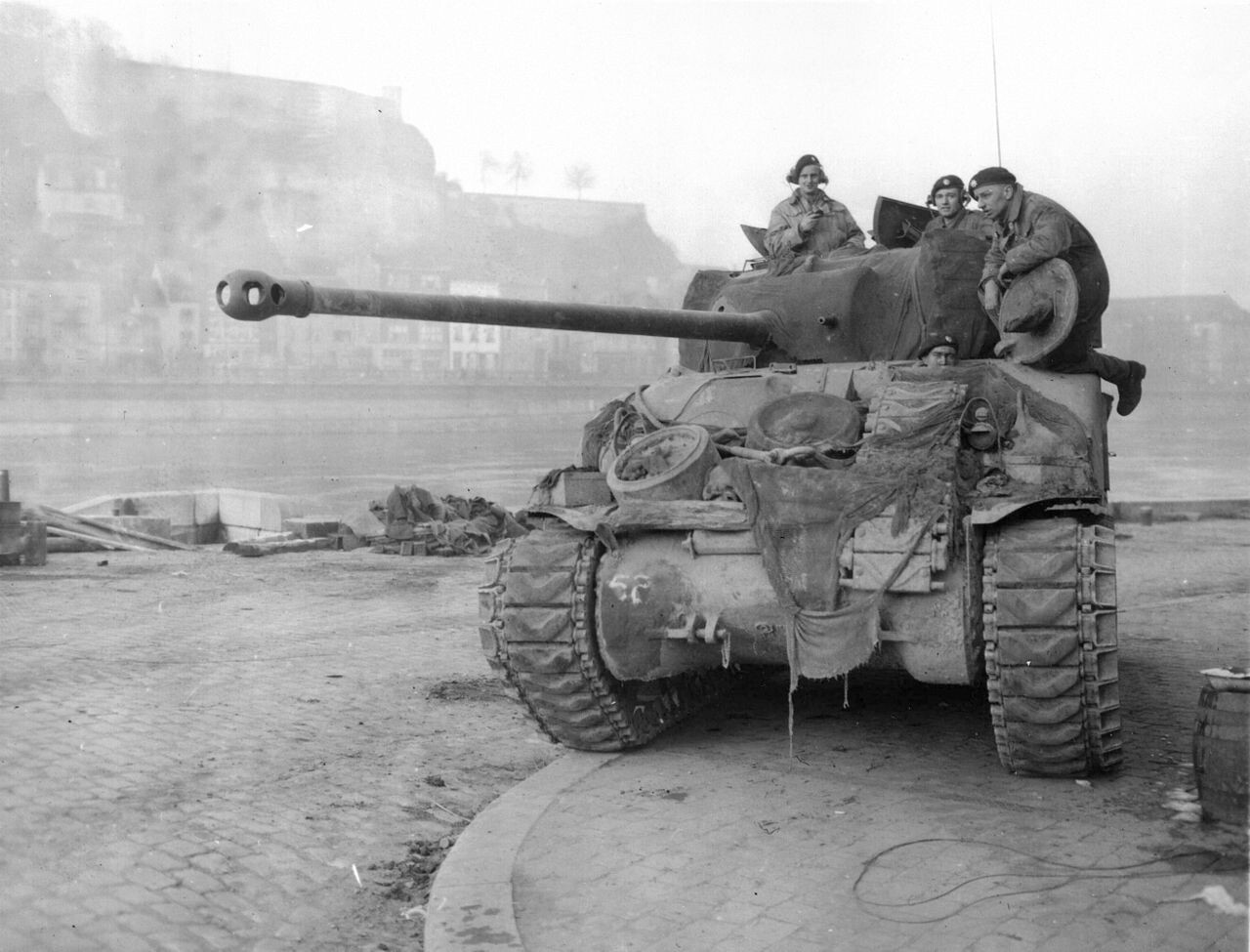

Sherman Crab
One of Hobart’s Funnies, it was designed specifically to clear mines. It was equipped with a massive chain flail on the front which would be spun as the tank drove forward to detonate mines (relatively) safely. It kept its turret and main gun, and saw extensive use with the 79th Armoured Division on D-Day and during the subsequent campaigns.
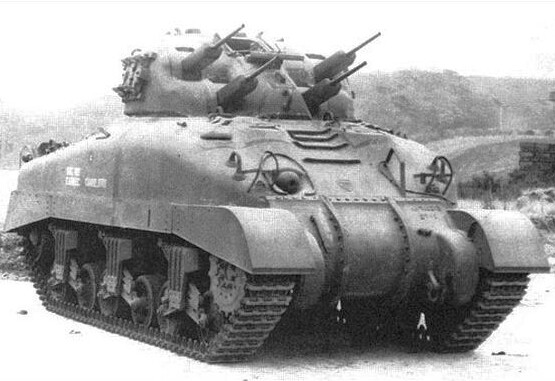
Skink AA
Although technically a Canadian modification of the Canadian Grizzly, a licence-built M4, it used in essence a Sherman hull but with a new, fully cast turret equipped with four British Polsten cannon. It was designed to provide Allied forces with air cover during the invasion of Europe, though in the end overwhelming Allied air power meant that it wasn’t needed. The prototype saw action in France in 1944, but only shot at infantry — forcing many enemy troops to surrender — as no aircraft presented themselves due to overwhelming Allied air superiority.

17pdr SP Achilles
This was a variant of the American M10 SPG which itself was based, of course, on the M4 Sherman’s hull. The Achilles was born of the British habit of bolting an Ordnance QF 17-pounder onto absolutely anything that moved. In the Achilles, the 17-pounder replaced the M10's 76mm cannon, drastically improving its combat effectiveness. 1,100 Achilles were produced, the second most numerous 17-pounder armed tank in service during the war after the Firefly. In service it performed very well, its gun capable of knocking out almost every enemy tank in service. Due to the weak armour and slow manual turret traverse, Achilles were almost always used defensively, only being used offensively in concert with Churchill tanks which had no 17-pounder toting equivalent such as the Shermans and Cromwells did.
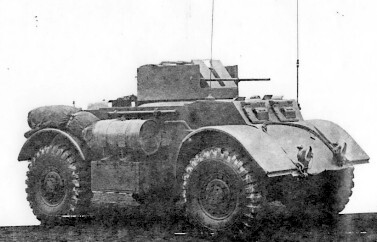
T17E1 Staghound
This was conceived as a medium armoured car in July 1941. It never saw service with American forces, only with British and Commonwealth units under the name Staghound — the Americans only referred to it as the T17E1. It was armed with the same 37mm gun as the Stuart, though some variants touted 75mm howitzers and QF six-pounders. It arrived too late for the North African campaign, so was first used in Italy, where its large size was sometimes found to be problematic on the tight town roads.
The T17E1 used by British forces is not to be confused with the very similar T17, which was built by Ford, but rejected by the Army due to being much less capable and reliable than the Chrysler-built T17E1.
The tank cannon-equipped Staghound Marks I, II and III are not modelled in-game, however the British tech tree does have the T17E2 Staghound AA, which mounted a power-operated Frazer-Nash turret with two .50 calibre machine guns. 1,000 units were built between 1943 and 1944.
Other Vehicles
Alongside these vehicles which we have in War Thunder, the Lend-Lease scheme also supplied a wide range of other vehicles and equipment to the British Army, to say nothing of the support the RAF and Royal Navy received. Some of the other vehicles provided included:
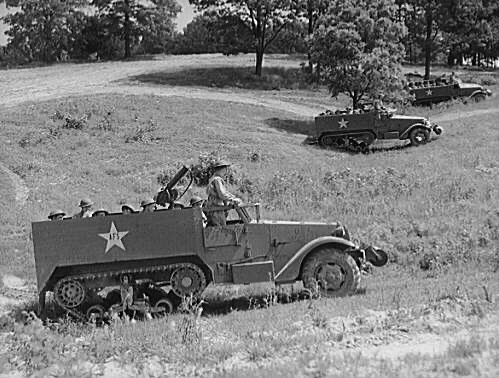
M3 Half-track
The famous M3 Half-track is most commonly associated with US forces in WW2 and the Korean War but a sizeable contingent served with Commonwealth forces as well. Little information seems to exist on their Commonwealth usage but they appear to have been used in much the same way as their US counterparts.
Willys Jeep
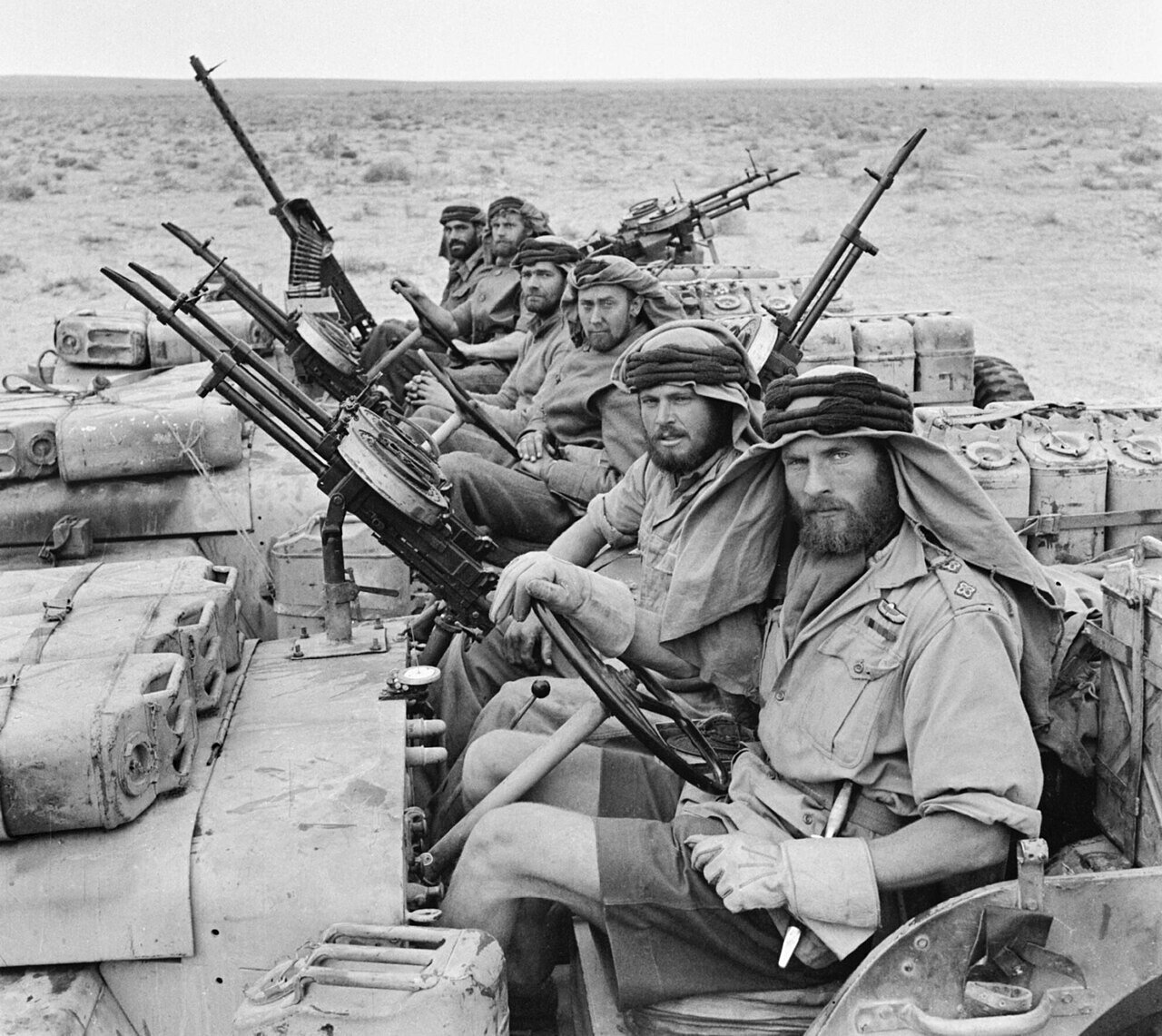
This ubiquitous little car found its way to every corner of the Allies inventory, and saw extensive usage with Commonwealth forces. It was used to tow light guns, transport casualties, troops, officers, and equipment, and everything else besides.
Perhaps its most famous user was the fledgling Special Air Service, formed in 1941. The SAS Jeeps were modified to withstand the harsh desert conditions, and to carry all of the supplies need to keep L Detachment SAS going on long-range patrols and hit-and-run raids. These machines could carry up to four machine guns and were used to great effect in daring raids from North Africa to France. This model of light, fast, and hard-hitting vehicles has persisted with the SAS and other special forces units ever since, with vehicles such as the Land Rover Pink Panthers continuing the Jeep’s legacy.
The Crew’s View
Tank crews who fought in both British and American tanks often had mixed feelings about both. For example, when former veterans of the Honey in North Africa were issued Cromwells for the fighting in France, they were severely disappointed, seeing in them many of the flaws that had been present in the old A13 series of tanks at the start of the war. They found visibility to be worse compared to the Honey and found the cramped fighting compartment with its tiny escape hatches comparable to an armoured coffin. However, other crews much preferred the Cromwells over the Shermans, due to the Cromwell’s speed and lower profile, as well as the good armour-penetrating power of the 6-pounder gun.
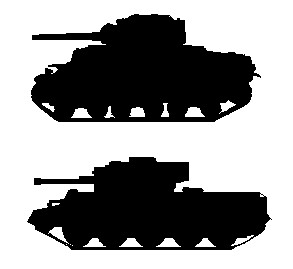
While fighting in North Africa, many crews despised the Grant for its height and the limited arc of fire of its 75mm cannon. This made it both a “splendid target” and made it difficult for the crew to reliably return fire. This fear was proven justified by many actions in which Grants were knocked out from well beyond the range of their own guns. At the same time, crews found it much more comfortable — if also more crowded — than the cramped Valentine infantry tanks which they had used previously.
Sherman Fireflies were fairly well regarded by their crews. They appreciated the power of the cannon, as it was capable of disabling virtually any opponent at a respectable range, though they disliked the poor ergonomics of the fighting compartment, especially for the loader. Crews often took to camouflaging them, to attempt to blend in with regular, shorter-barrelled Shermans for fear of being targeted by enemy gunners first.
The common saying that Fireflies were deliberately and routinely targeted first by German forces may or may not hold water, as many conflicting accounts exist both for and against this theory. In the fog and panic of battle, it would likely have been very difficult for a gunner to specifically target a tank based on a relatively minor detail such as the length of its barrel — a more pressing concern would likely be the tank pointing its gun at him, no matter its length. During an ambush, however, a smart tank commander might well choose to knock out the more powerful tanks amongst the column first to give the ambush the best chance of success.
Final Thoughts
The Lend-Lease tanks supplied to British forces during the Second World War were undoubtedly vital in the successful prosecution of campaigns in North Africa, Europe and the Far East. They filled vital roles as tanks that were jacks-of-all-trades yet masters of none, enabling more specialised British-built tanks to play to their strengths. When upgraded for the fighting in France, the Sherman Fireflies became some of the most lethal tanks on the battlefield and were invaluable when faced with the Tigers that lurked in the French hedgerows. In short, the tanks that Roosevelt sent to Britain were a vital lifeline to the overstretched British armoured units across the world, and will be fondly remembered as a great gesture of support and solidarity against a common adversary.
Sources
- Anon (?). Tanks-AFV Sherman Firefly [Accessed 30/11/2025]
- Anon (?). Tanks-AFV 17pdr SP Achilles [Accessed 30/11/2025]
- B, David (2014). Tank Encyclopaedia M3 Grant [Accessed 30/11/2025]
- Anon (?). Tank Museum M3 Stuart [Accessed 30/11/2025]
- The BBC’s Tankies: Tank Heroes of WWII. Unfortunately not available on BBC iPlayer as of 30/11/2025.
- Norris, J (2024). Military Trader Vehicles A look at the 'Staghound' [Accessed 30/11/2025]
- Various (?). Wikipedia M3 Stuart [Accessed 30/11/2025]
- Various (?). Wikipedia M3 Lee [Accessed 30/11/2025]
- Various (?). Wikipedia M4 Sherman [Accessed 30/11/2025]
- Various (?). Wikipedia Sherman Firefly [Accessed 30/11/2025]
- Various (?). Wikipedia Mine Flail [Accessed 30/11/2025]
- Various (?). Wikipedia Skink anti-aircraft tank [Accessed 30/11/2025]
- Various (?). Wikipedia T17E1 Staghound [Accessed 30/11/2025]