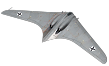
The Horten Ho 229, also known as the Gotha Go 229, was yet another German wonder weapon developed during World War II in an attempt to save Germany in the final months of the war. It is well known for its sleek, tailless design, minimizing drag and improving aerodynamics. It was one of the earliest jet-powered flying wing aircraft, designed to meet Hermann Göring’s “3 × 1000” requirement.
Why the flying wing design?
In 1943, Hermann Göring made a request for an aircraft capable of meeting his “3 × 1000” requirement. This meant the aircraft had to be able to fly 1000 km, at 1000 km/h with 1000 kg of ordnance. German bombers were already capable of such long ranges, but due to their slow speed, they were vulnerable to Allied fighters.
To make these requirements possible, it was deemed necessary to use jet propulsion. However, German jet engines had excessive fuel consumption, limiting range. To compensate, they had to minimize drag as much as possible, which led to the Horten Brothers concluding that the flying wing design would be ideal. Without a vertical stabilizer, drag was reduced, allowing for lower cruise power and extended range. However, the design wasn’t without its flaws. Without a vertical stabilizer, the aircraft was prone to sideslip, which could lead to a flat spin. This was resolved by using split ailerons, which increased drag on one side of the aircraft, effectively acting as a rudder.
Further Development
The Government Air Ministry (Reichsluftfahrtministerium) quickly approved Horten’s proposal, but ordered the addition of two 30 mm cannons, as they felt the aircraft could be used as a fighter due to it being much faster than existing Allied aircraft. On 12 March 1945, the Ho 229 was included in the Jäger-Notprogramm (the emergency fighter program) for the accelerated production of these wonder weapons. The Air Ministry ordered 100 units, later reduced to 20, and manufacturing would be done by an established company, Gothaer Waggonfabrik, due to the Horten Brothers lacking production facilities.
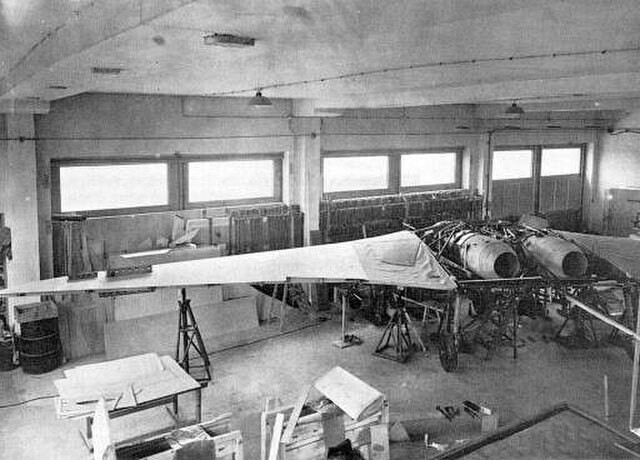
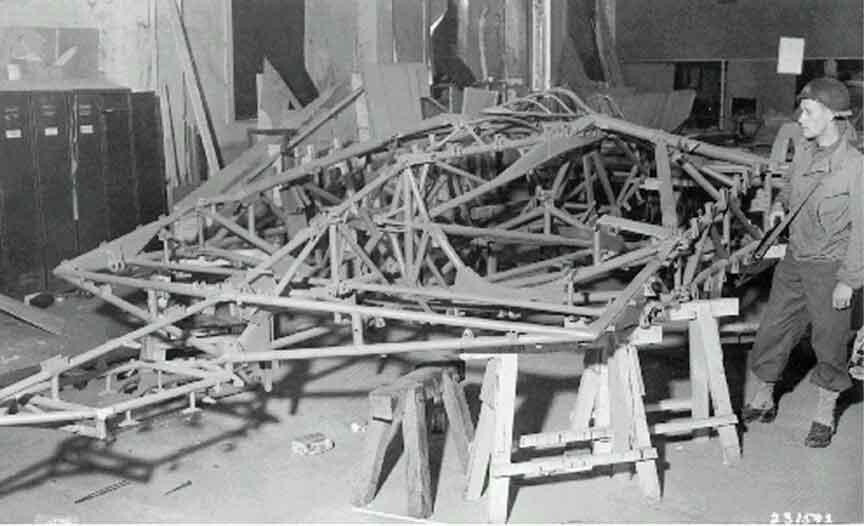
The Horten was of mixed construction, with the center pod made from welded steel tubing and wing spars built from wood. The wings were made from two thin, carbon-impregnated plywood panels glued together with a urea resin mixture. The wing had a single main spar, penetrated by two jet engine inlets, and a secondary spar used for attaching the elevons. It was designed with a 7G load factor and a 1.8x safety rating; therefore, the aircraft had a 12.6G ultimate load rating. The wing’s chord/thickness ratio ranged from 15% at the root to 8% at the wingtips. It also featured a drag chute, an airbrake, a primitive ejection seat, and a pressure suit designed by Dräger.
“Stealth” technology
In 1983, Reimar Horten claimed that he had planned to use charcoal dust mixed into the urea resin mixture of the Ho 229 to absorb radar waves and reduce visibility to British Chain Home radar. However, there is no documentation supporting this idea, and the V3 prototype never used such materials. Later analysis by Northrop Grumman in 2008 found no evidence of charcoal or carbon black in the aircraft’s materials. Testing of the V3's wooden nose cone showed only slight differences from ordinary plywood, likely due to natural aging, and concluded that the material would have been a poor radar absorber.
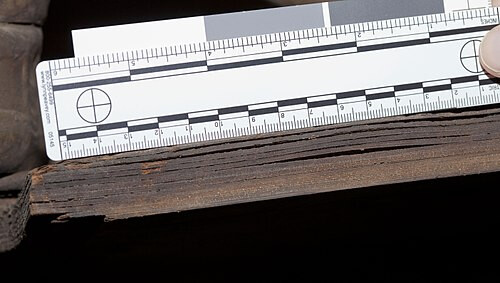
Despite the lack of radar-absorbing materials, the Ho 229's smooth shape with no protrusions, could have offered some reduction in radar cross-section compared to typical aircraft of the time. In 2008, Northrop Grumman built a full-size wooden replica and tested it with radar in the 20–50 MHz range. Results showed that even under ideal conditions, a hypothetical Ho 229 would still have been detected by outdated Chain Home radar at about 80% of the range needed to spot a Messerschmitt Bf 109. The tests suggested that while the aircraft had some radar-reducing features due to its shape, it did not offer a significant stealth advantage.
Combat Usage
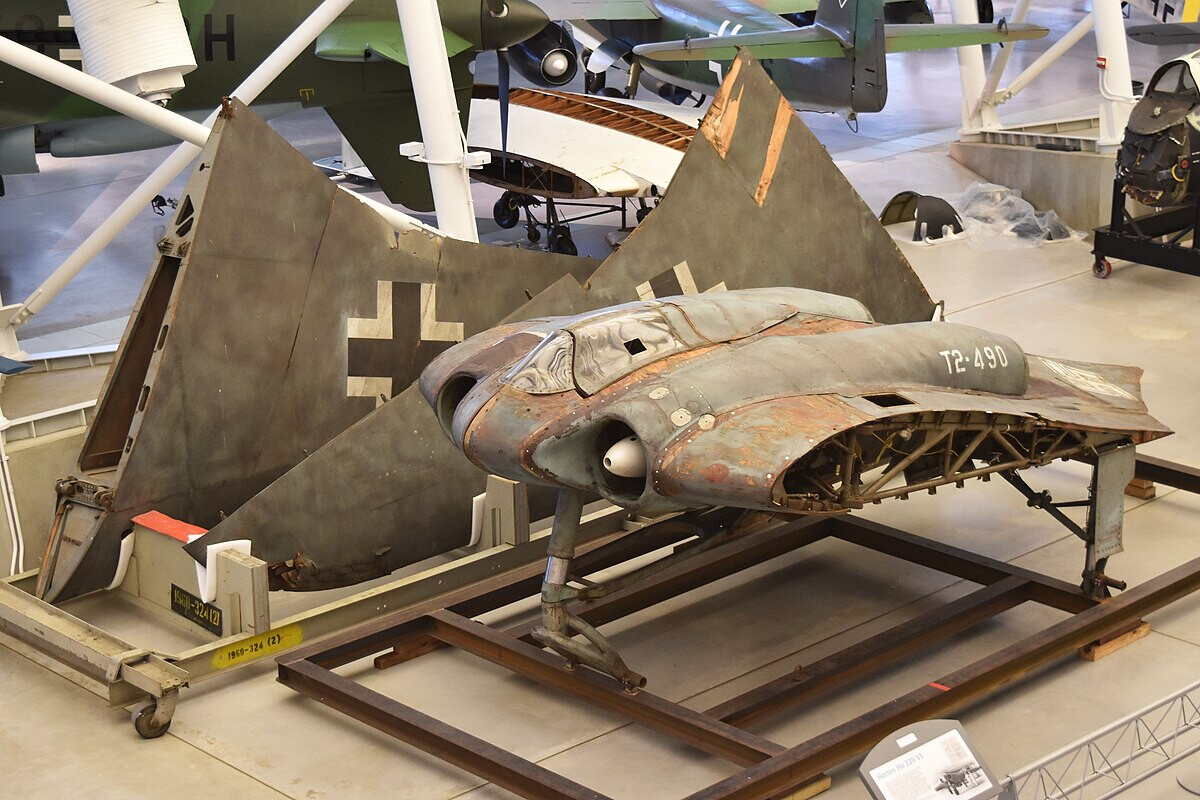
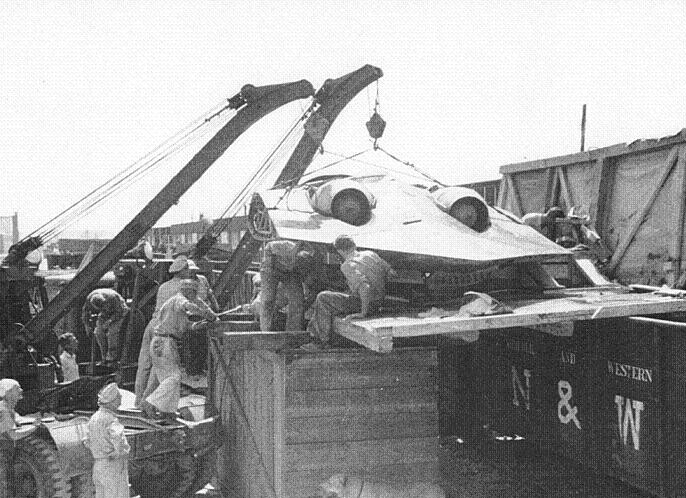
No variants of the Ho 229 saw any combat during the war, only earlier prototypes had some flight testing. In April 1945, the variant closest to completion, the V3, was captured by George Patton’s Third Army. Before being shipped to America for testing, it stayed in the UK where it was considered for installation of British jet engines but the larger engine diameter of British jets made it not worthwhile. It would then reach America, where an evaluation team gave it the Foreign Evaluation identity FE-490, which was later changed to T2-490. It arrived at Silver Hill, Maryland, for storage in 1952 and was officially transferred to the Smithsonian Institute in 1960.
Variants
H.IX V1
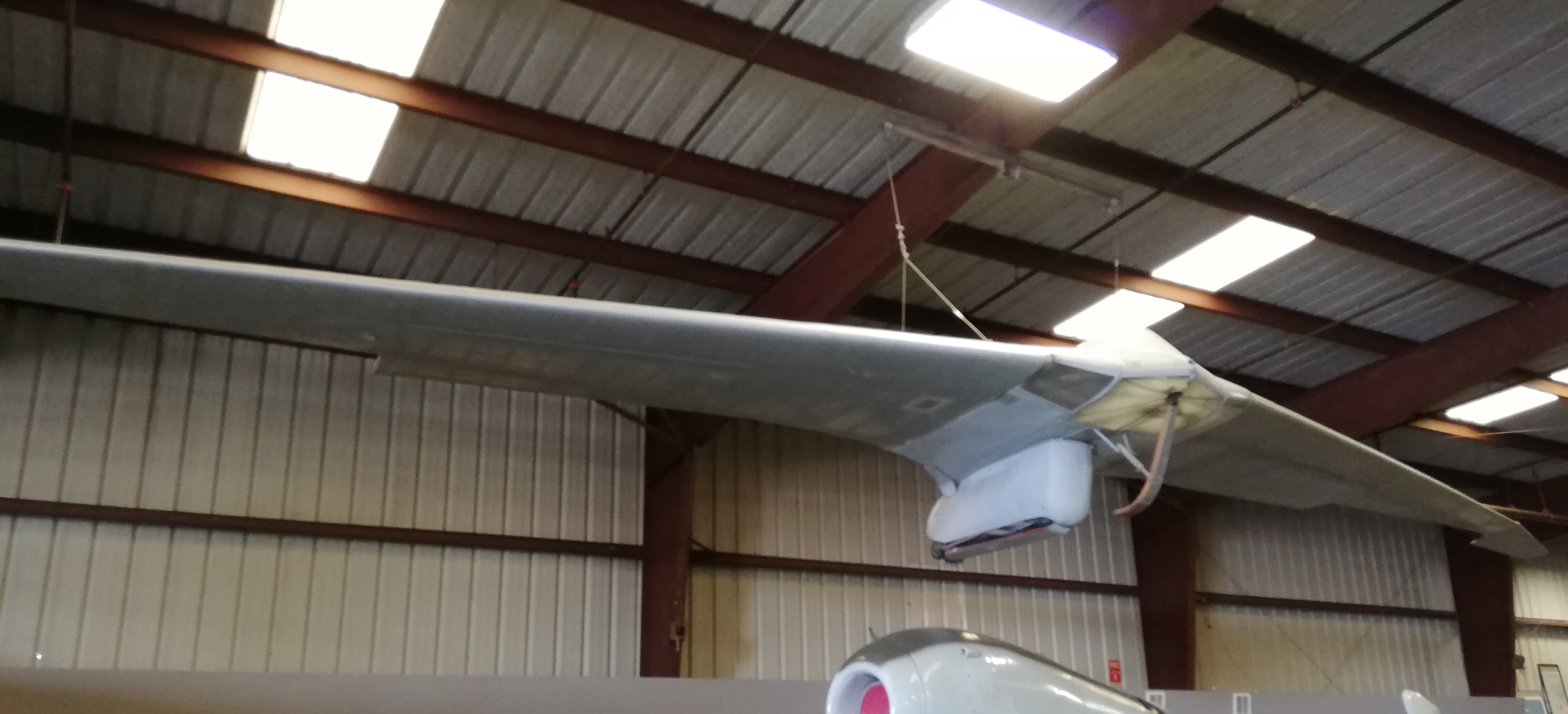
This was the first prototype, an unpowered glider with fixed tricycle landing gear. Only one was built and flown. It flew on the 1st of March, 1944 with favorable results. The nose wheel was one of the tail landing gear of a wrecked He 177 “Greif” bomber.
- Crew: 1
- Length: 7.47 m (24 ft 6 in)
- Wingspan: ~16.8 m (55 ft 4 in)
- Cockpit height: ~1.10 m (3 ft 7 in)
- Wing area: 50.20 m² (540.35 ft²)
- Empty weight: N/A
- Loaded weight: N/A
- Max. takeoff weight: N/A
Due to being a prototype glider it had no armament or engines installed.
H.IX V2
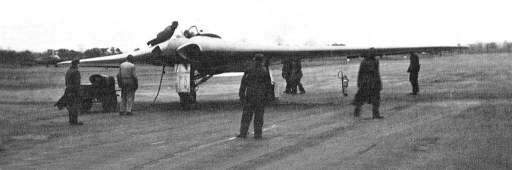
The first powered prototype, was built and flown with two Junkers Jumo 004B engines, although the BMW 003s were preferred. The first flight of the H.IX V2 was made in Oranienburg on 2 February 1945. The H.IX V2 reportedly displayed very good handling qualities, with only moderate lateral instability. While the second flight was equally successful, the undercarriage was damaged by a rough landing, caused by Lieutenant Erwin Ziller deploying the brake parachute too early during his landing approach. In a simulated dogfight it was projected that the H.IX V2 would have outperformed the Me 262 “Schwalbe”.
- Crew: 1
- Length: 7.47 m (24 ft 6 in)
- Wingspan: 16.76 m (55 ft 0 in)
- Cockpit height: ~1.10 m (3 ft 7 in)
- Wing area: 50.20 m² (540.35 ft²)
- Empty weight: ~4,844 kg (10,679 lb)
- Loaded weight ~6,544 kg (14427 lb)
- Max. takeoff weight: ~6,876 kg (15,159 lb)
Due to being a powered prototype, it was yet to receive any armament.
Ho 229 V3
This was the most complete variant, it had revised engine intakes and engine positions and was larger than the previous H.IX V2. It was the one captured by American forces in April 1945 and was held in storage at NASM’s Silver Hill facility.
- Crew: 1
- Length: 7.47 m (24 ft 6 in)
- Wingspan: 16.76 m (55 ft 0 in)
- Overall height: 2.81 m (9 ft 2 in)
- Wing area: 50.20 m² (540.35 ft²)
- Empty weight: 5,067 kg (11,198 lb)
- Loaded weight: 6,912 kg (15,238 lb)
- Max. takeoff weight: 8,999 kg (19,887 lb)
And the following armament:
- Guns: 2 × 30 mm MK 108 cannons (these were not installed, but there was space for them at the wing roots)
- Rockets: R4M rockets
- Bombs: 2 × 500 kilograms (1,100 lb) bombs
Ho 229 V4/V5
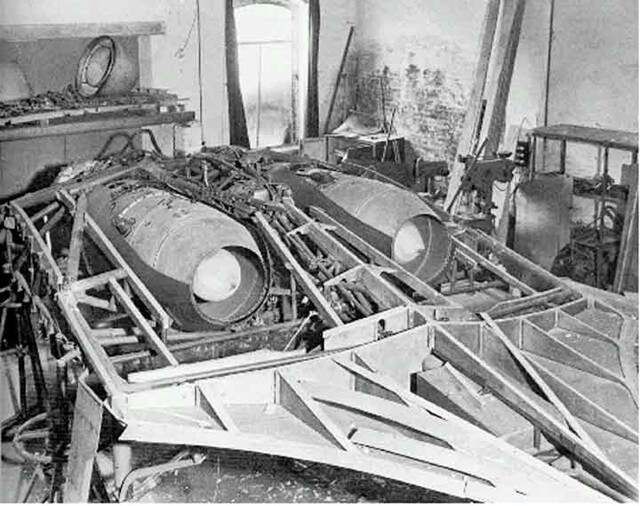
Proposed two-seat all-weather night fighter, in construction at Friedrichroda. It was planned to have a stretched fuselage and nose to accommodate a second crew member and a radar. The V5 was nothing more than the tubular framework of the center section and the V4 was similar but had received engines and work began on the wooden structure.
- Crew: 2
- Length: 7.47 m (24 ft 6 in)
- Wingspan: 16.76 m (55 ft 0 in)
- Cockpit height: ~1.10 m (3 ft 7 in)
- Wing area: 50.20 m² (540.35 ft²)
- Empty weight: N/A
- Loaded weight: N/A
- Max. takeoff weight: N/A
Armament and weight is unknown due to the prototypes not being completed. However, the V4 and V5 would likely have had two 30 mm Mk 108 cannons.
Ho 229 V6/Ho 229 A-0
This would have been the expedited production variant produced by Gothaer, based on the V6 which was similar to the V3 but served as an armament test prototype. A mock-up was captured during production at Ilmenau and it would have some improvements due to being the finalized version.
- Crew: 1
- Length: 7.47 m (24 ft 6 in)
- Wingspan: 16.76 m (55 ft 0 in)
- Overall height: 2.81 m (9 ft 2 in)
- Wing area: 50.20 m² (540.35 ft²)
- Empty weight: ~4,600 kg (10,141 lb)
- Loaded weight: 6,912 kg (15,238 lb)
- Max. takeoff weight: ~8,100 kg (17,857 lb)
And the following armament:
- Guns: 2 × 30 mm MK 108 cannons (There were proposals for 4 of these guns)
- Rockets: R4M rockets
- Bombs: 2 × 500 kilograms (1,100 lb) bombs
Surviving Aircraft
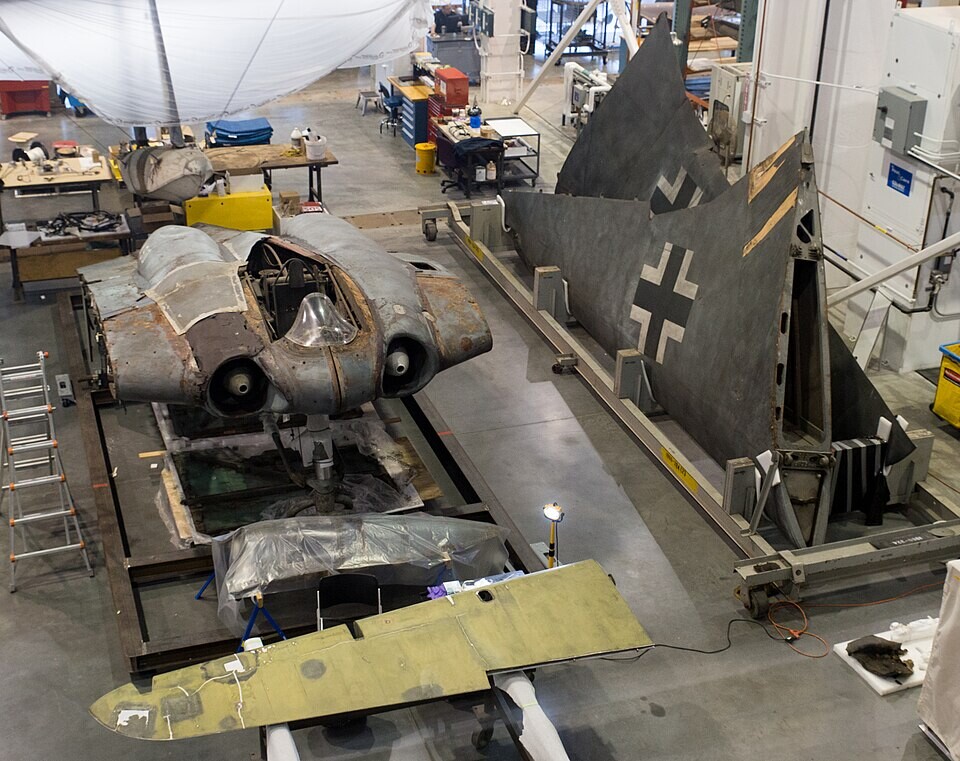
Only one Ho 229 prototype exists, the V3, which is on display at the Smithsonian National Air and Space Museum in Virginia, USA. It’s in a partially restored state, with its wings and landing wheels detached, and the middle section mounted on a support frame.
Bibliography:
- https://en.namu.wiki/w/Ho%20229
- https://aircraftnut.blogspot.com/2013/06/horten-ho-229-flying-wing.html
- https://www.warbirdsresourcegroup.org/LRG/ho229_development.html
- https://military-history.fandom.com/wiki/Horten_Ho_229#Specifications_(Horten_Ho_229A_(V3))
- https://www.indianamilitary.org/FreemanAAF/Aircraft%20-%20German/FE%200490-HO229V3/0490.htm