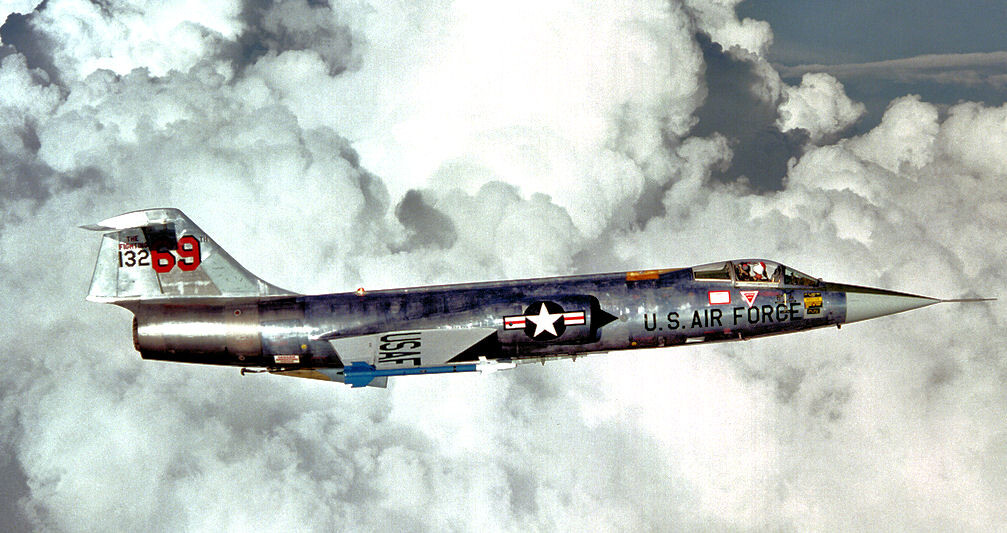
The Starfighter, the Lawn Dart, the Widowmaker, the Missile with a Man it it; regardless of what you may know it as, it’s impossible to deny its influence on military aviation. The first mass-production airframe to ever reach Mach 2, the F-104 was, and still is, used across the globe by both numerous national air forces and private owners alike. Its design echoed the role it was made for, trading complexity and a wide selection of ordnance for a simple design, made for raw speed. While its many nicknames earned it the dubious honor of being an accident-prone aircraft in popular media, it was still an incredibly unique and capable fighter for its time, only being roughly matched in speed by the MiG-21 a few years later.
Background Information
Since the dawn of military aviation itself, heavy emphasis was placed on striking a good balance between protection, armament, and agility. It is rare for planes to strike a perfect balance of all three, and even rarer for a plane to have an outsized impact in combat as well — the A6M Zero, for example, managed to come close to achieving such a feat early on in WW2 with its mix of average protection for its time, an adequate armament for the time as well as incredible agility, but even this edge ultimately did not last until the end of the war due to rapid advances in technology making the A6M somewhat obsolete. However, even the attempts that do focus on one trait of an aircraft rarely aim for 'only' a high speed, nor do most programs push forwards with that as their sole goal. The Starfighter was one such fighter, built to go faster than all before it as its primary advantage.
Development History
The story of the F-104 starts in 1951, with Clarence “Kelly” Johnson interviewing American pilots during the Korean War. Many U.S. pilots opined that they wanted a fighter to have an unmatched climbrate and top speed, to which Johnson took note and began to plan a lightweight, small fighter capable of those traits. This went against the trend of the time, as fighters tended to become larger and more complex over the years and not the other way 'round. In 1952, design work on the F-104 began, with a singular General Electric J79 turbojet being chosen to power the airframe. Only minimal changes to the design were made during the design process, and the eventual XF-104 prototype did not differ particularly much from the later production F-104As.
Johnson presented his design to the USAF in late 1962, and despite the fact that the F-100 Super Sabre hadn’t even flown yet, there was enough interest in the design to warrant a design competition tailored to the F-104, to supplement and even potentially replace the F-100 in the future. With their design already prepared, Lockheed quickly took the lead, and was given a contract for two prototypes in 1953. Less than one year later, the XF-104 had its first flight, an impressive contract-to-flight time for the era. The J79 turbine engine was unavailable for the XF-104's test flights, which led to considerably worse performance during testing — its max speed was only around 1300 mph (2100 km/h), despite it being a ton lighter than production F-104As. However, it had the same 20mm Vulcan as would be present in the F-104, and was also slightly shorter in length.
Both of the two prototypes would eventually crash, not an uncommon fate for prototypes of their time, but nevertheless, the USAF accepted the design in late 1955. In 1958, the first production F-104 was delivered to the USAF, and it became one of the main interceptors of the USAF.
The USAF had many reasons to adopt the F-104, ranging from the fear of Soviet fast bombers getting through to needing to keep up in the Cold War aerial arms race. It could intercept nearly all Soviet bombers at the time with its excellent climb rate, and with the introduction of the AIM-9 Sidewinder, it proved to be effective as a fighter as well. It could climb at 240 m/s, and despite its heavy fuel usage, it was decently efficient when at speed.
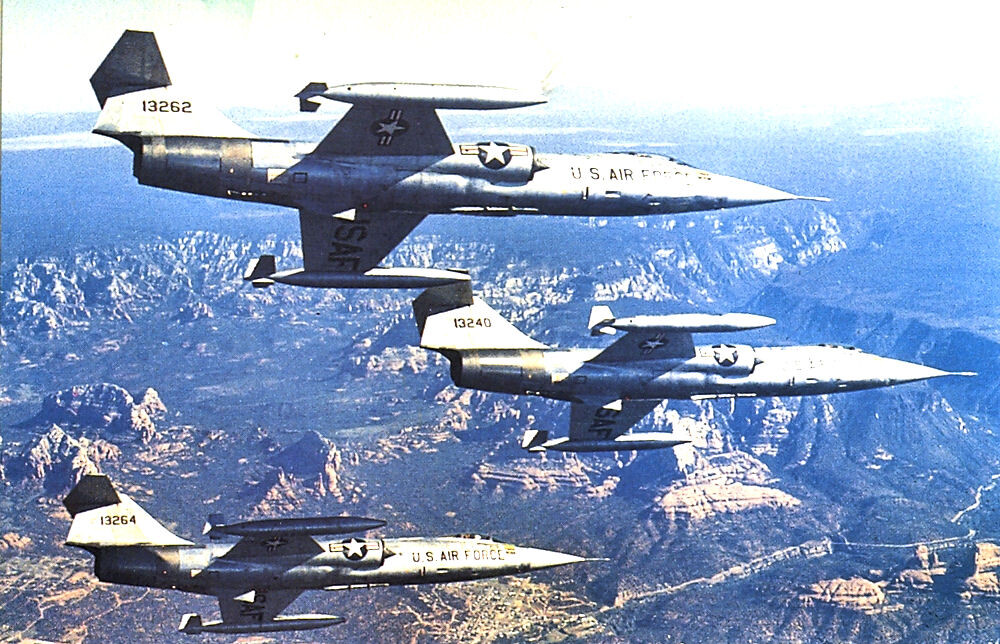
The F-104 had outstanding performance when it came to speed, although it sacrificed nearly everything else for that advantage. Its radical thin, trapezoidal wings were so thin on the leading edge that, for the safety of ground crews, while the aircraft was on the ground protective equipment was added to the wing. Said thin wing also meant that the Starfighter couldn’t carry fuel in its wings, leading many air forces to use it with tip tanks for extra range. The F-104 also had a very high landing speed and would stall fairly easily, again due to its thin, narrow wings, which made it a very delicate bird to fly and often contributed to accidents.
The F-104 was used not only as an interceptor, and its best-selling variant, the F-104G, was a fighter-bomber. It had slightly worse performance in this configuration due to the added equipment and hardpoints, and it suffered considerably higher losses operating in this role compared to when it was used strictly for air interception.
Safety Issues, and the “Lawn Dart”
The F-104 had quite the bad reputation for being a flying coffin, and for good reason. It had to land at much faster speeds compared to other aircraft, and its unique flight characteristics were often fatal in the hands of inexperienced pilots. However, it can also be argued that it was not entirely unsafe either, with 25 airframes being destroyed for every 10,000 sorties in USAF service. This was less than double that of the F-100 (17 per 10,000 sorties), and yet news of the era often made it out to be strictly an aircraft problem, rather than perhaps the use of an interceptor as a fighter-bomber as a contributing factor.
As an interceptor, the F-104 performed quite well. While its public safety record may have suggested otherwise, it could reach incredible speeds and altitude with ease due to its light weight and powerful engine. Its turn radius was rather poor, but given its intended role was interception, this was not a problem with the airframe, but with the role it was used for.
Common issues with the F-104 commonly included pitching up when past 15 degrees AOA, which could disorient the pilot and cause a loss of control, as well as the high wing loading causing it to drop like a stone out of the sky if there was an engine failure. In general, a problem in the F-104 was more dangerous than in other fighters of the era, but still not a death sentence like rumors would have you believe. Due to losses in training accidents with the RCAF, it was unceremoniously nicknamed the “Lawn Dart” by personnel, only serving to further tarnish its image.
The F-104 was commonly operated as a fighter-bomber in international service, and it had poor performance at low altitude. Coupled with its downward ejection system in earlier variants, this meant that training flights with the F-104 were particularly dangerous, further harming its reputation.
It is, however, also important to note that while the Starfighter crashed quite often, jets of the era were just as unreliable as it, if not often more unsafe sometimes; the F-100 Super Sabre, for example, may have had a lower airframe loss rate than the F-104 shown above, but out of the total 2,294 airframes produced the “Hun” had 889 airframes lost in accidents in USAF service alone (a 38% accident loss rate, with 324 pilots killed!), more airframes lost than the total number of all F-104 airframe losses across the globe! Other aircraft of the time such as the Supermarine Scimitar (51% loss rate) or de Havilland Sea Vixen (37% loss rate) were just as unreliable and accident-prone, so simply looking at loss percentages or lost airframes can show an inconsistent picture of these aircraft’s service records.
Another point could be that the operators of most of these F-104s were simply 'using the plane wrong' — as described earlier, the F-104 was designed first and foremost as an interceptor. It sacrificed much in the way of flexibility and comfort for that high ascent rate and top speed, so logically trying to use it for close air support, something that demands good low-speed maneuverability and a long loiter time, was perhaps not the best choice. Italy and Germany, the nations with possibly the most troubled history with the Starfighter, all operated the F-104 as a fighter-bomber, while countries like Japan, Norway and Spain used the F-104 in its designated interceptor role and had virtually no issues with the aircraft in operational service. (The JASDF operated around 230 odd F-104Js for over two decades, with only three airframe losses including a mid-air crash, and Spain lost no F-104s in service!) As a result, it does beg the question of if it was the F-104 that was accident prone, or if it was perhaps the result of forces trying to use an interceptor in the fighter-bomber role it was never designed for because the marketing brochure said it could.
The Starfighter on the World Stage
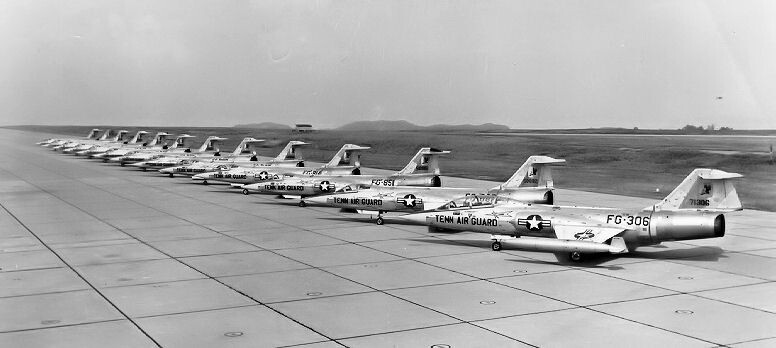
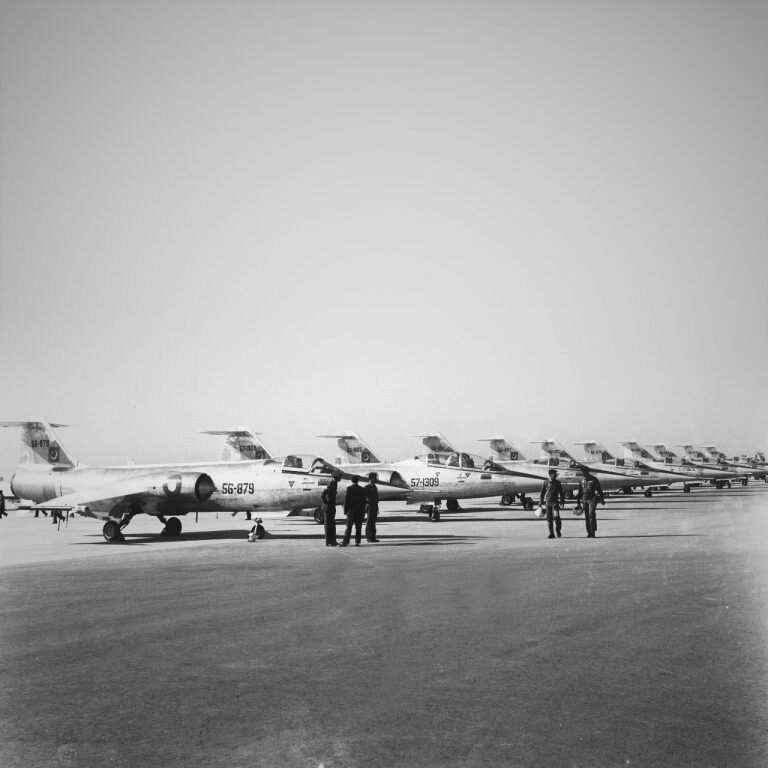
The F-104 was quite popular on the world stage, being used by countries ranging all the way from Canada to Pakistan and everywhere in between. While the USAF required pilots to have 1500 hours of flight experience, the German Air Force often had no such luxuries, and pilots with only 400 flight hours in the seats of F-104s was not an uncommon occurrence. This served to further exacerbate the F-104's problems, especially with its tricky handling characterstics. Eric Brown's book, Wings on My Sleeve, includes a exceptional quote on the F-104:
“The Starfighter is a ‘hot ship’ and has to be flown every inch of the way. In bad weather, or with an on-board emergency situation, it is a real handful to cope with. The USAF had recognised this and required pilots assigned to the Starfighter to have at least 1,500 flight hours’ experience. The new breed of German military pilots had been trained in the blue skies environment of Texas, then returned to Europe and its fickle weather with about 400 hours total flying time. To put such raw pilots into a Starfighter was asking for trouble, especially as the German F-104G version had become a multi-mission aeroplane, weighing 2,000lb more than the standard F-104. Trouble they got in plenty.”
This worldwide usage was not purely due to its performance, despite it being an extremely good interceptor. It was heavily marketed to NATO allies, and Lockheed was eventually caught having bribed several countries for various contracts, including the adoption of the F-104. The Lockheed bribery scandals, as they later became known, were a stain on Lockheed’s reputation but also raised many eyebrows for Starfighters in West German service, as allegations of bribes being taken in exchange for 900 F-104Gs was brought up as well during this time.
The F-104 was not the only Lockheed airframe to receive such a boost, with allegations that Italy’s C-130 purchases were also due to Lockheed bribes. Lockheed was also shown to have directly paid Saudi Arabian arms dealers to promote Lockheed products. While it is somewhat uncommon for companies to be found bribing foreign officials this brazenly and on such a wide scale, Lockheed is most definitely not the only company guilty of such dealings, and the criticisms on the F-104's reputation solely based on these allegations can be a bit misleading as Lockheed was not really selling a 'flawed failure' abroad. It was also found that Henry Kissinger was aware of the bribes, and did not release any details about these dealings to the public.
The Operational History of the Starfighter
The Starfighter set many records, including time-to-climb, altitude, and top speed records worldwide, being the first aircraft to hold the world speed and altitude records at the same time. In 1959, a F-104C piloted by USAF Captain “Joe” B. Jordan (F-104C No. 56-0885) set a world altitude record of 31,513 meters altitude, while also only taking 904 seconds (15 minutes) after takeoff to reach the 30,000 meter mark after takeoff. A year prior in 1958, a YF-104 piloted by USAF Captain Walter W. Irwin (YF-104A No. 55-2969) had also set a world speed record of 2,259 km/h over Edwards AFB.
NASA operated F-104s before the USAF, using them as launch platforms and chaseplanes for sounding rockets and experimental aircraft. They operated them from 1956 to 1994, and they proved successful in their roles. Starfighters Inc. still operates the F-104 in this role, having recently stopped doing air shows and focusing on private contracts.
The Starfighter was first used operationally during the Taiwan Strait Crisis, but that was not its first foray into actual combat. Its first combat use would be during the Vietnam War, starting in 1965. According to many F-104 pilots, the Vietnamese People’s Air Force (VPAF) was well aware of the fighter’s capabilities, and seemed to actively avoid engaging them during the conflict overall, leading to only fourteen airframes being lost during the war. It was mostly used as an escort fighter or close air support aircraft, and did not get any aerials kills during the war.
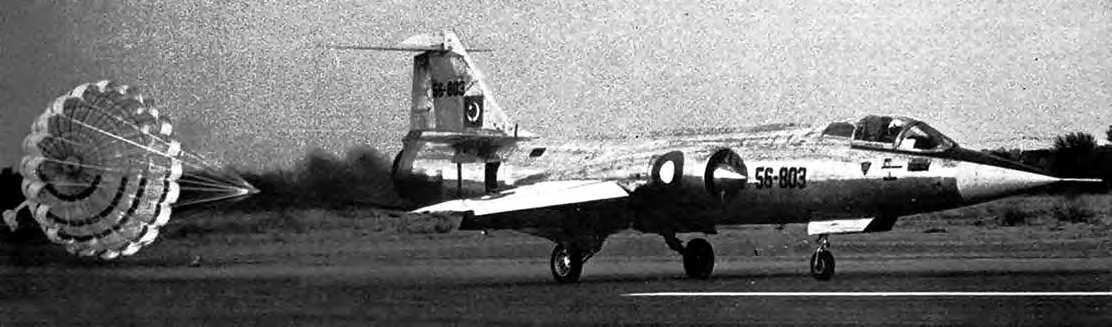
In the Indo-Pakistani war of 1965, the Starfighter was used in small numbers by the Pakistani Air Force, and it scored its first kill during the war. It was used repeatedly for deterrence, as there were no notable Indian airframes at the time which could counter it. Its reported first kill was of a Dassault Mystere IV, claimed destroyed by a AIM-9B Sidewinder, and in the same mission damaged another with the 20mm Vulcan. There were a handful of other kills, but very few were verified across both sides, so unfortunately it is somewhat hard to judge the Starfighter’s success in the conflict as a whole. In all, the F-104 was mostly a deterrent rather than a threat during the conflict. In the later Indo-Pakistani war of 1971, it had far more confirmed kills, and finally faced off against an equivalent fighter, in the form of the MiG-21.
The F-104 had a fairly decent track record overall, boasting high win rates against fighters and bombers of its era, and a decent overall safety record, though still not the best amongst its peers. After the mid '60s, the F-104 was only minimally used in combat, and it rarely won when it got into fights post-1968. It was simply outclassed by the rapidly advancing aviation tech of the era, and was phased out of service from the USAF in the 1970s.
The last military operator of the F-104 was Italy, using the F-104S-ASA/M until late 2004. In comparison to many of its Century-series peers, the Starfighter had a remarkably long service life; the F-106, for example, retired from US ANG service in 1988, and NASA service in 1998, while the F-100 retired from ANG service in 1979! It’s even still used by a civilian operator, “Starfighters Inc.” which uses the once-interceptor as a launch platform for small satellites and other various private military ventures. The Starfighter lineage is still going strong, seven decades after it was first introduced, with seemingly no end in sight for at least a decade more to come. Perhaps, as its family namesake implies, it will be around for its centennial anniversary.
Variants of the Starfighter
There were minimal structual changes between any two given variants of the Starfighter, with most changes merely adding and/or replacing components to modernize the aircraft. If anything, tip tanks being added to an individual airframe would be more of a difference airframewise than comparing separate variants. Several unarmed variants were also made, such as NASA’s N variant (a lightened F-104G, three were made) for use as a chaseplane, helping document the X-15. One such example, F-104N No. 4058 (NASA 813, formerly NASA 013, third 104N) piloted by Joe Walker, was involved in the aerial crash between the F-104N and the XB-70A No.2 on June 8th, 1966, and was lost.
| Designation | Number Produced | Notes | Operator Nations | Produced in | Is it in War Thunder? |
| XF-104 | 2 | Prototype of the F-104 | America | America | No |
| YF-104 | 17 | Pre-production of the F-104, after the prototypes | America | America | No |
| F-104A | 153 | First mass-production variant | America, Jordan, Pakistan, Taiwan | America | Yes |
| F-104B | 26 | Trainer variant | America, Jordan, Pakistan, Taiwan | America | No |
| F-104C | 77 | Fighter-bomber variant, could carry a Mk28 nuclear weapon | America | America | Yes |
| F-104D | 21 | Trainer variant based on the C variant | America | America | No |
| F-104F | 30 | Trainer variant exported to West Germany’s Luftwaffe | Germany | America | No |
| CF-104 | 200 | Canadian variant of F-104 | Canada | Canada | No |
| F-104G | 1,122 | Fighter-bomber variant, exported worldwide and produced by dozens of companies; most produced variant. | America, Belgium, Canada, Italy, Germany | America, Canada, Germany, etc. | Yes |
| F-104H | 0 | Never built | N/A | N/A | No |
| F-104J | 210, some made by Lockheed, some by Mitsubishi | Interceptor variant produced for the Japanese Air Force | Japan | America, Japan | Yes |
| F-104S | 286 | Modernized variant for interception duties | Italy, Turkiye | Italy | Yes |
| F-104ASA | 147 modified F-104Ss | Upgraded S variant | Italy | Italy | Yes |
| F-104ASA/M | 64 modified F-104ASAs | Last military variant, upgraded ASA variant | Italy | Italy | No |
| F-104N | 3, modified from F-104As | Chaseplane for NASA | America | America | No |
Specifications of the F-104G
- Crew number: 1 (Pilot)
- Length: 16.66 meters
- Span: 6.63 meters
- Wing thickness: .41 Millimeters at leading edge
- Height: 4 meters
- Wing area: 18.22 meters squared
- Empty weight: 7 tons
- Max takeoff weight: 14.5 tons
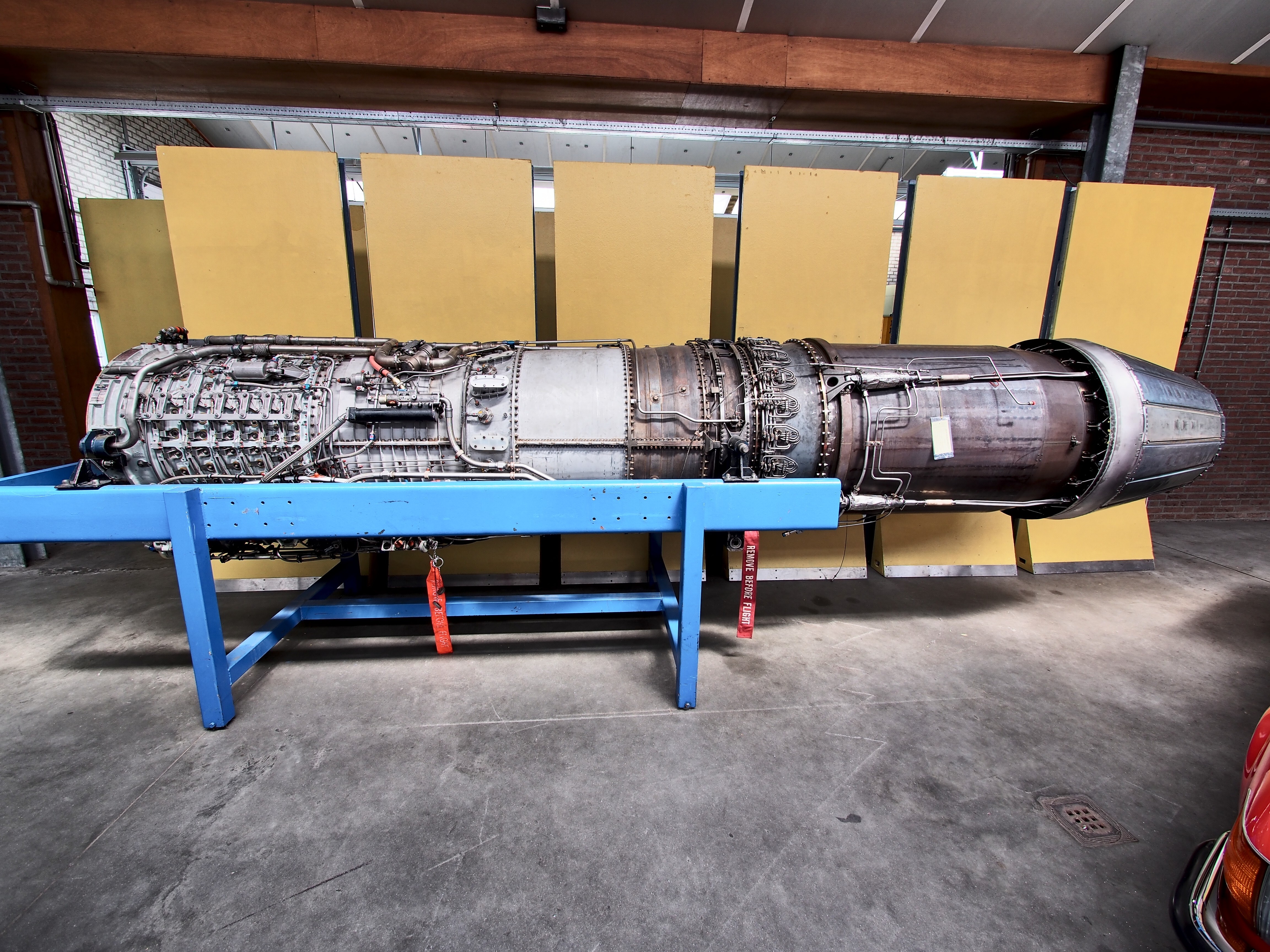
- Engine: 1 General Electric J79 turbojet, producing 69 kN of thrust at full afterburner
- Max speed: 2,450 km/h, or around M2.0
- Range: 680 km
- Flight ceiling: 22,000 m
- Rate of climb: 240 m/s
- Guns: 1 20mm Vulcan rotary cannon with 725 rounds
- Hardpoints: 7, could carry up to 2 tons of ordnance, including missiles and bombs
References
- Jane’s All the World’s Aircraft 1998
- NASA.gov
- Wikipedia.org, both for the J79 and the Starfighter itself