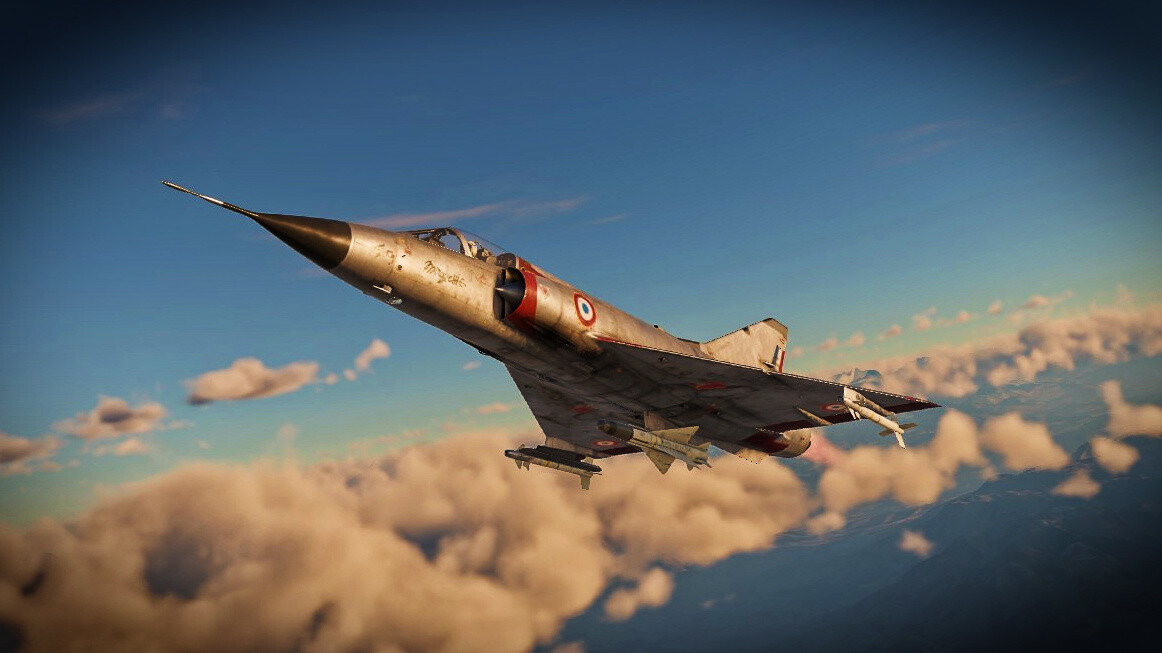
The Mirage IIIC is an iconic French single-seat delta-wing jet fighter from the late 1950s. The aircraft is highly maneuverable with excellent flight performance, capable of flying at supersonic speeds at any altitude. Its primary armament consists of two 30mm DEFA cannons and air-to-air missiles, initially carrying only one Matra R530 radar-guided missile while later versions could also carry two AIM-9B or Magic 1 IR-guided missiles. For its time, the Mirage IIIC was equipped with a very modern radar, the Cyrano Ibis. This was the first radar in the world capable of automatically slewing its antenna onto a target, which meant that the pilot simply had to press a button, and the radar would acquire and lock onto the target. This reduced the workload of the pilot drastically, which is always of crucial importance in actual combat engagements.
| PROS: | CONS: |
| Good flight performance at high speeds | No countermeasures, lacks a RWR |
| Great missiles | Mediocre acceleration |
| Great climb rate, high top speed | Bad flight performance at low speeds |
| Cannons are lethal on hit | DEFAs can be hard to aim at range |
Table of content:
Flight performance
Maneuverability
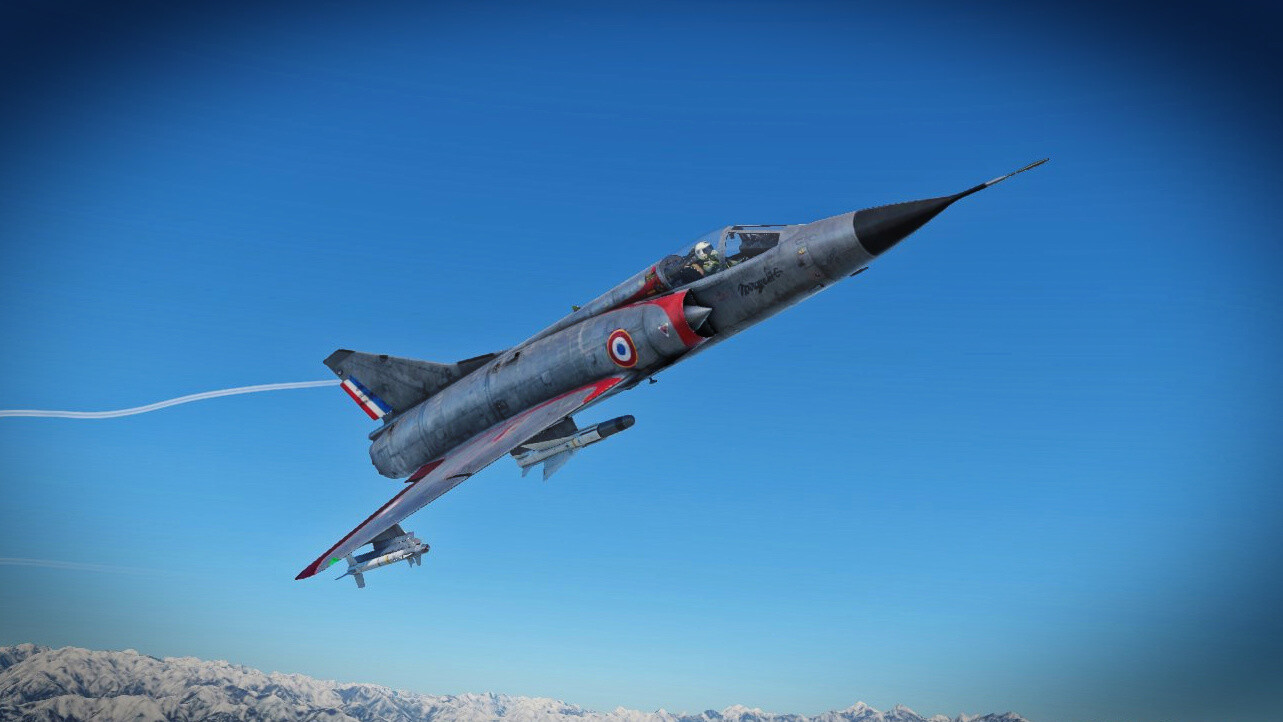
The Mirage IIIC is a very maneuverable aircraft. Its delta-wing design and lightweight frame allow it to perform high-speed turns unlike many other jets. It performs best at speeds around 800 km/h, but even at supersonic speeds, maneuvers are not a problem. You can easily outturn aircraft such as the MiG-21, Mitsubishi T-2, F-1, and F8U-2 Crusader. However, you can perform only two or three of these extremely sharp turns, because it costs you a lot of speed. For example, if you make 180° turn at 800 km/h, your speed afterwards will drop to around 550 km/h. Any maneuvers below 500 km/h will be a problem, because the plane starts bleeding excessive speed and handles very poorly as a result. Any other drastic maneuvers in this situation will just make this situation even worse, so aim to make any dogfight you take be as short as possible. Luckily, in many cases this is not a problem, because if you choose to take the dogfight you will generally have a speed advantage and will be able to shoot down the enemy aircraft before your plane loses all its energy. The only supersonic aircraft more maneuverable than the Mirage IIIC is the Saab J35 Draken, thanks to its special maneuvering mode, but due to the J35's low TWR the Draken will often flounder and stall mid-air if this is used excessively on their part.
Structural limits
The maximum speed of the Mirage IIIC at sea level is Mach 1.17 (1,460 km/h). Do not attempt to fly any faster - you'll rip your wings right off! However, during high-speed turns, the wings are practically indestructible, and you can safely maneuver at Mach 1.5 without much of a fear of structural failure. The only real limitation is the pilot’s G tolerance. The absolute maximum speed of the airframe is Mach 2.04 (2,160 km/h), though this speed cannot be achieved in flight. The Mirage does not have flaps, so its landing speed is relatively high.
| Wings limit | 1,460 km/h (at sea level) |
| Gear limit | 450 km/h |
| Flaps | No flaps |
Engine
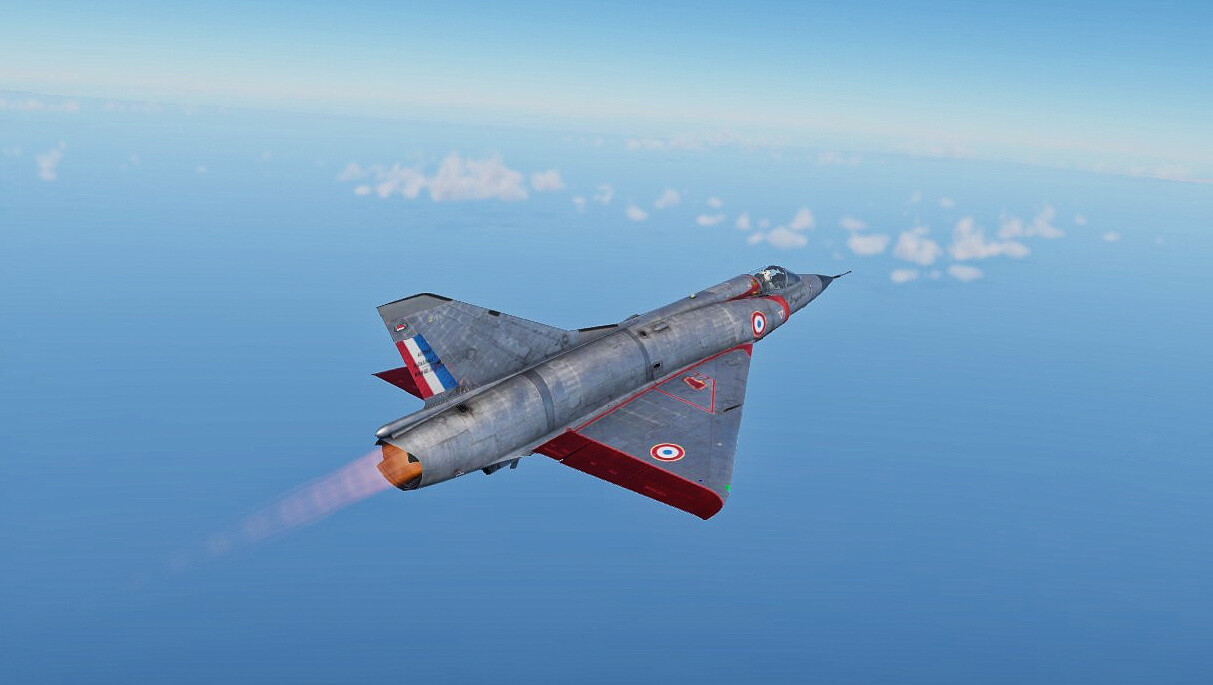
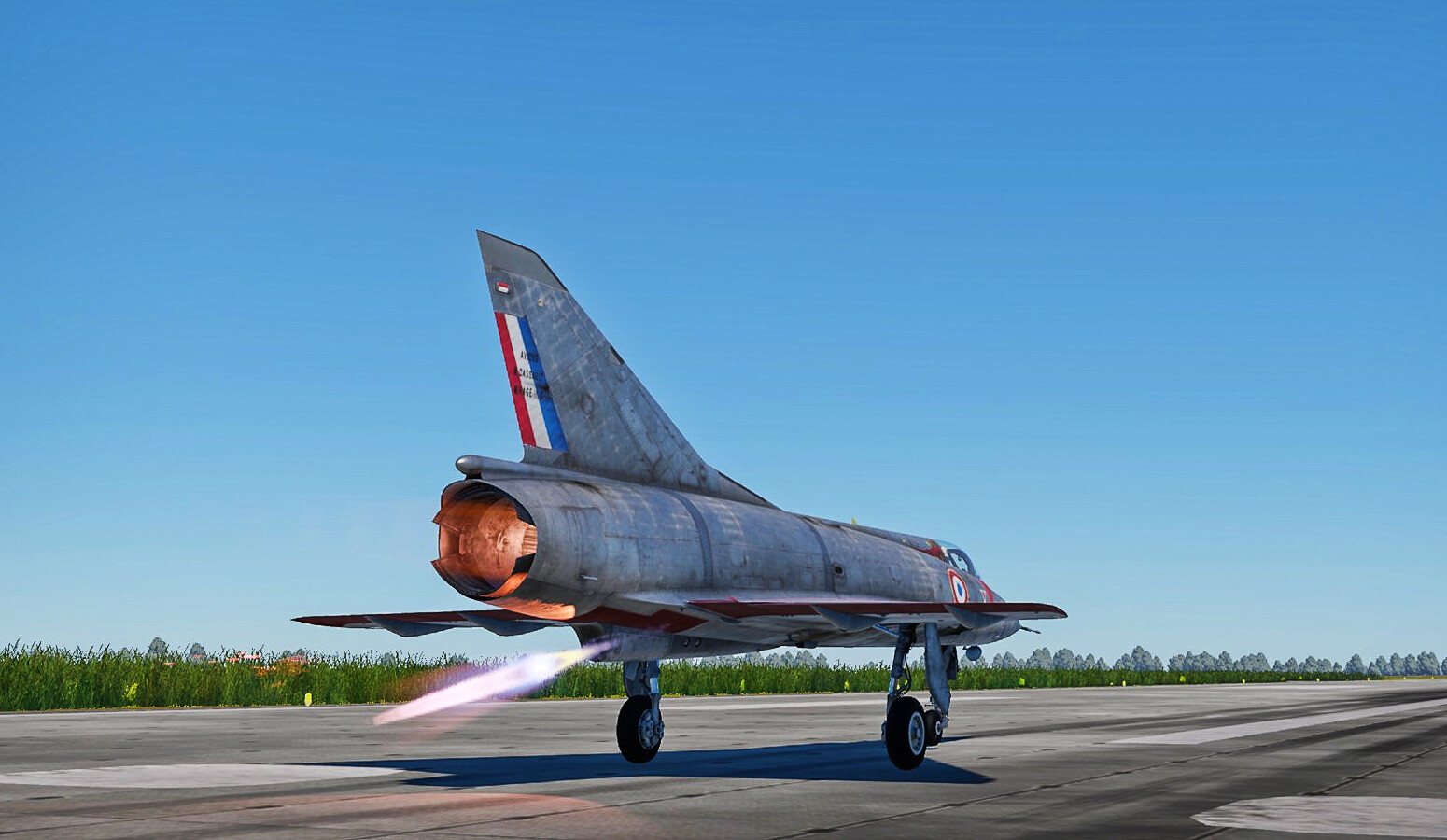
The SNECMA ATAR 9B is another engine from the ATAR family. It produces 4,230 kgf of thrust without afterburner and 6,090 kgf with afterburner. The relatively economical engine allows you to carry less fuel, but its lacking acceleration means accelerating the plane up to supersonic speeds can take a while. This, in combat, translates to the Mirage needing time to accelerate after any large adjustments to its course are made. This is potentially dangerous, because faster enemies can easily catch up if you bleed too much speed in the process, allowing them to get within missile range of you. To improve the Mirage's acceleration, you can use the SEPR 841 liquid rocket booster, which lasts for roughly two minutes providing ~1,600 kgf of thrust and can be switched on and off whenever necessary - however, the oxidizer tank for the booster takes up the space normally occupied by the 30mm DEFAs, meaning in exchange for the extra acceleration you now have to completely rely on your air-to-air missile armament. This is usually not recommended for inexperienced players, as this makes your engagement options extremely limited, but the added acceleration can turn the plane into a more F-104-esque opportunistic hawk, if that's what you prefer.
Avionics
Cyrano Ibis radar
The radar has a nominal maximum lock range of around 27 kilometers. While this is a bit short, it is more than enough for the Mirage III C because the optimal launch range for the Matra R530 radar-guided missile is roughly between 5–8 km. Due to the lack of look-down capability on the Cyrano Ibis, the radar can often struggle to lock targets that are below the aircraft near the ground due to terrain clutter. As such, it is recommended to use the radar for targets that are at the same altitude as you or higher, for when you're just about to launch your R530 at an enemy.
Survivability
The aircraft has no countermeasures and no RWR (radar warning receiver), which makes evading missiles very difficult or even impossible in certain cases. The first line of defense against missiles is awareness - if you consciously avoid going within certain aircraft from the front, for example, you can greatly reduce the chances of being hit by an all-aspect missile. However, sometimes you may be forced to engage enemy players, sometimes against your will as the situation calls for it - here are some tips on how to protect yourself better.
Against basic IR and SARH air-to-air missiles such as the AIM-9B/R-3S or R-3R, simply outrunning the missile in the case of the former two and avoiding the latter by pulling in one direction hard is a quite trivial endeavor. However, against more advanced, higher-G missiles such as the AIM-9D/G/H/J, R-60 and AIM-9C, simply pulling hard in one direction can often not be enough as these missiles may keep up with your maneuvers, especially when launched from close up. Against these missiles, you will want to have some distance (preferably more than 2~2.5km) between you and your opponent, and actively be moving away from them - this way, you'll generally have the energy to escape most of these missiles, and if they still have some energy left you can maneuver hard afterwards which they won't usually be able to keep up with. It's generally preferable to dive away rather than try to climb when pulling drastic maneuvers, as you need every extra G you can pull and climbing drains your energy by the nature of trading kinetic energy to potential energy.
The trouble comes with all-aspect missiles, most notably the AIM-9L and R-60M, as with these missiles they can lock you even from the front, meaning your positioning is less impactful against them. While the carriers of these missiles are relatively slow attackers such as the A-10 or Su-25, if launched from within 2~2.5km they can often be a one-way trip back to the hangar. If launched from further away than 2.5km and you were losing them, simply flying away from the missile will lead to the missiles running out of energy long before they reach you; however, when launched frontally at these ranges, most of the time you'll be unable to kinetically evade the missile. In this case, one trick you can try is firing off a missile (usually the AIM-9B or Magic 1) at the incoming missile, while cutting your afterburner and pulling away from the missile. As your missile's motor will be burning hot, and your non-afterburning plane colder, this can often cause the enemy's missile to re-acquire your missile, not your plane, as its target, causing it to veer off course and miss you entirely. While sacrificing one of your two most potent kill-securing options is costly, this will let you survive such an encounter to now punish the enemy strike aircraft that will most likely struggle to win against you in a dogfight.
The aircraft has seven fuel tanks, but only two of them around the upper fuselage are self-sealing. There is no protection of note for the pilot on the aircraft, so any hits near the front will most likely result in a dead pilot, but if a grazing hit is taken to one of the wings you may still be able to maintain control and return to base safely.
Armament
Guns
The Mirage IIIC is equipped with two DEFA 552A 30mm cannons, with 125 rounds per gun making a total of 250 available rounds. The guns are unavailable if you take the SEPR 841 liquid rocket booster, as the space normally reserved for the guns is instead taken up by the booster and its fuel.
Belts:
Against aircraft it's recommended to take either the Air Targets belt or the Stealth belt, as they are the belts with the highest HE shell content. The Stealth belt is recommended for more experienced players, as the lack of tracers makes aiming the shells much harder, but it also makes it hard for the enemy to dodge them as they too can't easily see where, if not 'if' you're even firing without the tracers. For ground strike and/or Ground Battles, taking the Ground Targets belt is recommended as this is the belt with the most penetration, although the API shells may be slightly less effective against enemy aircraft at times compared to HE. The Default belt is also a decent option, as it has both API and HE shells in the belt with a 1:2 rather than 1:3 shell ratio for the Ground Targets belt, which could make it better if you're planning on going after both air and ground targets simultaneously.
Missiles are the Mirage IIIC’s best weapons. It can carry one radar-guided missile and two IR missiles, or three IR missiles. The stock AIM-9Bs are somewhat limited in their uses due to a caged seeker, limited range and limited G-loading, but the Magic 1s are exceptional missiles for their tier due to their quick acceleration and high G-loading.
Matra R550 Magic 1 (Backronym: Missile Automatic Guide Interception and Combat).
The Matra Magic 1 is an exceptionally quick and agile missile, in part due to its double canard design. While its flare resistance is poor, much like other missiles of the era, due to its fast acceleration it can often catch people off guard, closing the distance before they even have a chance to flare. Decently long ranged, the Magic 1 is best fired from ranges of 1.5 ~ 2.0 km or closer in order to minimize the time the enemy has to flare the missile, although it can still be fired up to ranges of ~2.5km if you're gaining quickly on the enemy. Due to the missile's high G-loading and acceleration, when launched against other flareless aircraft the missiles will often lead to an easy 2 kills. The Magic 1 is best used against flareless aircraft, or enemies that are distracted in a dogfight, using its superior acceleration to close the gap and secure a kill swiftly and decisively.
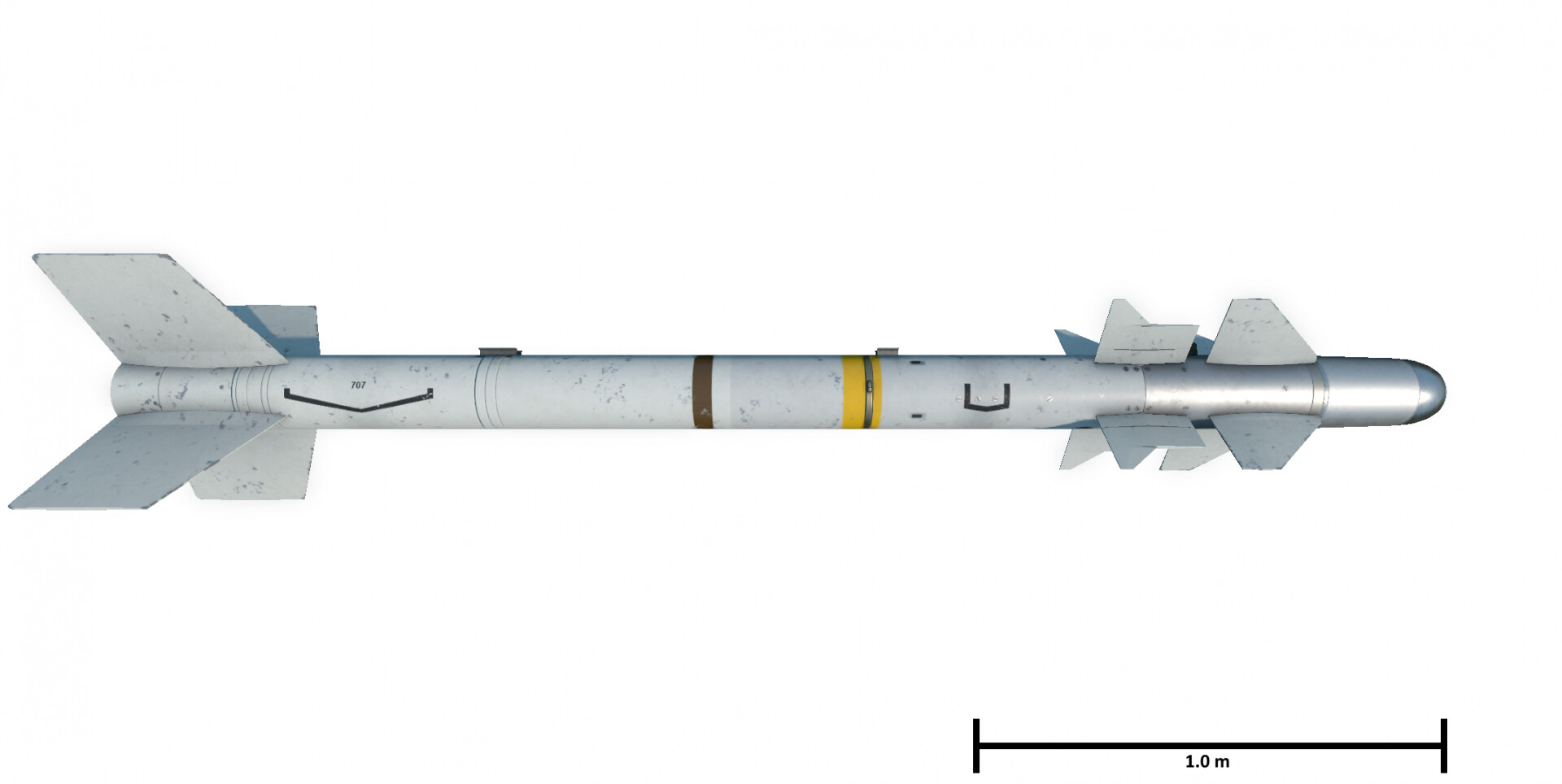
Matra R530/530E
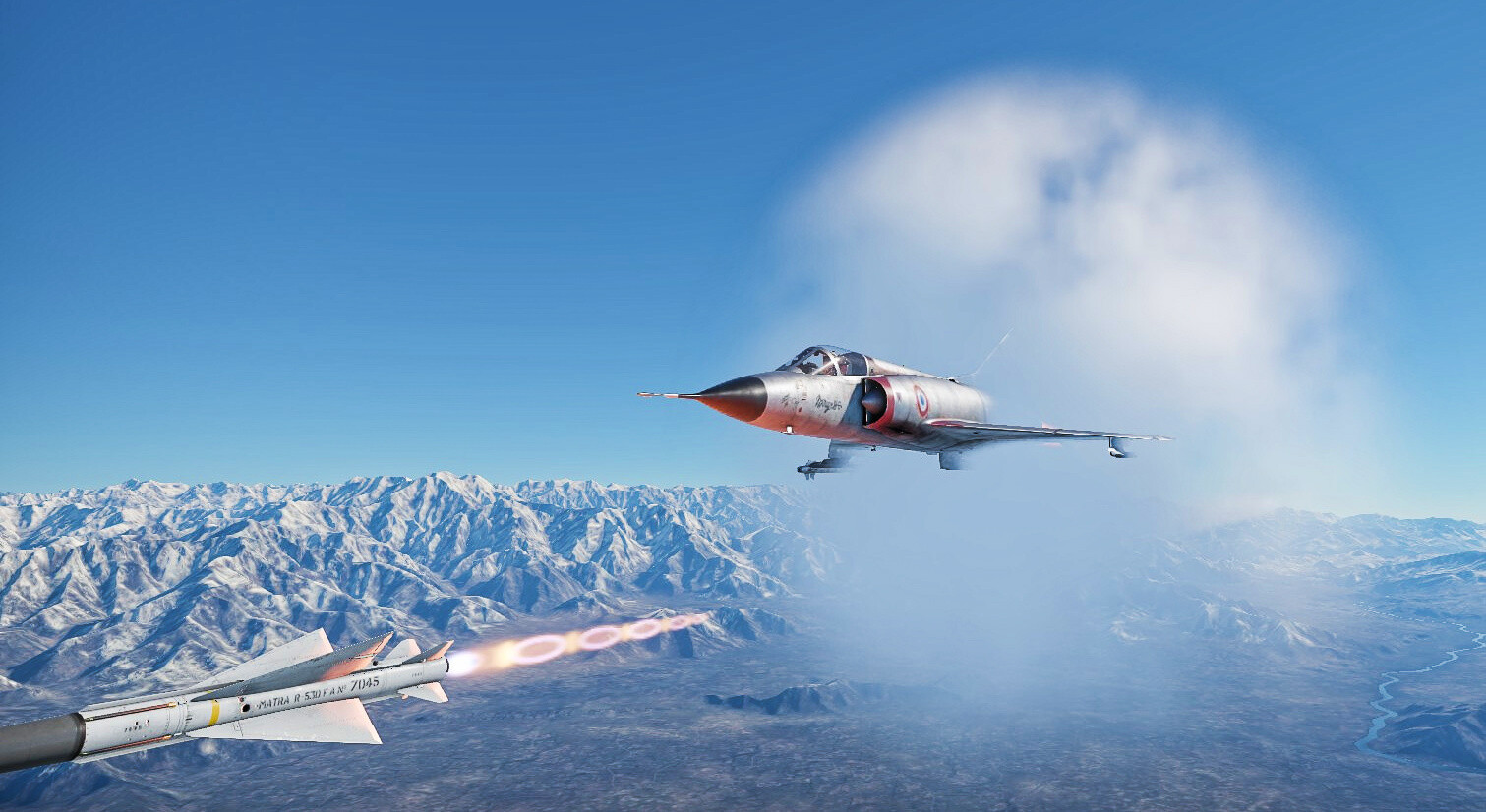
This large medium-range missile is not very maneuverable, but it has a long flight time (thanks to its sustainer motor) and a reasonable top speed. The R530 is radar-guided and is best used at high altitude in a head-on (front) engagement. Launch the missile against a high-flying, preferably flareless target from around 5-8km for best results, although it can help to lock the enemy for a prolonged period of time to check if they're actively dropping countermeasures or not - if they don't seem to react to your radar lock at all, you can go ahead with the launch, while if they chaff it may be best to find a more unaware target. It is recommended to avoid launching the R530 at aircraft that are armed with chaff — as the missile has a Pulse seeker rather than a CW one, it is prone to losing its target when chaffed. It is also recommended to avoid firing at targets flying extremely low, because the radar will often lose its lock against the ground clutter.
The R530E is the IR seeker variant of the R530; while not an all-aspect missile, this seeker change means that you can actually go after people that are on the deck without much issue. However, as an IR missile, you will generally not be launching your missiles in a head-on encounter, meaning that the missile's effective range may feel much shorter as a result. The R530's anemic acceleration doesn't help much, although given enough time the missile will start getting up to speed - this can be of use in certain cases, where an enemy sees the missile but thinks it won't hit them because of how slow it's going, only for it to slam into them a few seconds later! Overall, due to the 530E not requiring a radar lock, this can allow you to try and launch at people without any forewarning, preferably from a slightly longer range than normal, although its slow initial speed and poor flare resistance mean that if your enemy flares for whatever reason it most likely won't hit.
Air-to-surface weapons
The Mirage IIIC can also carry a small selection of bombs, rockets and guided munitions - however, due to the lack of a targeting pod, shallow magazine depth and the lack of CCIP, most strike duties are better performed by more dedicated aircraft in the French aviation tech tree. 2 400kg bombs is nowhere near enough to total a base, and trying to precisely aim rockets without CCIP, while doable, is certainly far less consistent than if you had access to CCIP. The single AS-30 that you can mount in the center pylon can be useful in Ground Battles as a standoff weapon against both tanks and enemy anti-aircraft vehicles, or as a decoy missile/flare in Air Battles if you feel that the R530s are too sluggish to be used in the "all-aspect missile parrying" role. Overall, the Mirage IIIC carries too few munitions and lacks many of the features you would expect to perform accurate precision strikes at its rank, and it isn't its strong suit by a long shot.
Gameplay
Air RB
Before you spawn your aircraft, always make it a habit to check what planes are on your teams on the Statistics menu. As both teams will have to conform to the same matchmaker, if your team has vehicles of a certain era, it is most likely your enemies will mostly follow a similar team composition.
Tactic 1: We will focus on matches in which you will encounter many subsonic aircraft (such as the F-100, J32B, or Ariete) and supersonic aircraft without countermeasures (such as the J35D, MiG-21S, or F-106A). For armament, take the DEFA 552 cannons, the Matra R530 missile, and the Magic missiles. These matches tend to be shorter, so around 20 minutes of fuel may be enough, so long as you mostly stay on 'economic' (~101-103%) afterburner - if not, taking 25 ~ 30 minutes of fuel is also acceptable, if you feel that you may need to use full afterburner more often. It is recommended to, in these games against slower and less capable aircraft, try and exploit your advantages, namely your high performance, to your advantage. This can come in many forms, but one way to do it would be to accelerate at the start of the match, zoom climb to an altitude of approximately 5,000 ~ 6,000m, and then searching for a high-flying enemy target. Once you see a potential target, try locking them to see if they try to evade or deploy countermeasures - if they don't, you can try lining up a shot with the Matra R530. It's recommended to launch your missile at a distance between 5 ~ 8km, as any further and the missile may lack the energy to hit your target, while any closer and the missile may be unable to pull into your enemy in time. In the case of the missile either failing to hit or the enemy evading your missile in time, don't try to aggressively turn in, as this may result in you bleeding speed you can't afford to lose - gain some distance between you and your enemies first!
After this, you can turn around to engage the slower strike aircraft on the enemy team, such as the A-10, although it is recommended to keep a missile caged in case they notice you. Good positioning is key to avoid frontal encounters with these aircraft as much as possible! You can also go after other, flareless aircraft first, or choose to deal with the more capable supersonics with flares first to try and eliminate potential threats to you first - just make sure you don't get a missile launched at you from too close, or commit to a dogfight with multiple people nearby that may all come to their teammate's aid.
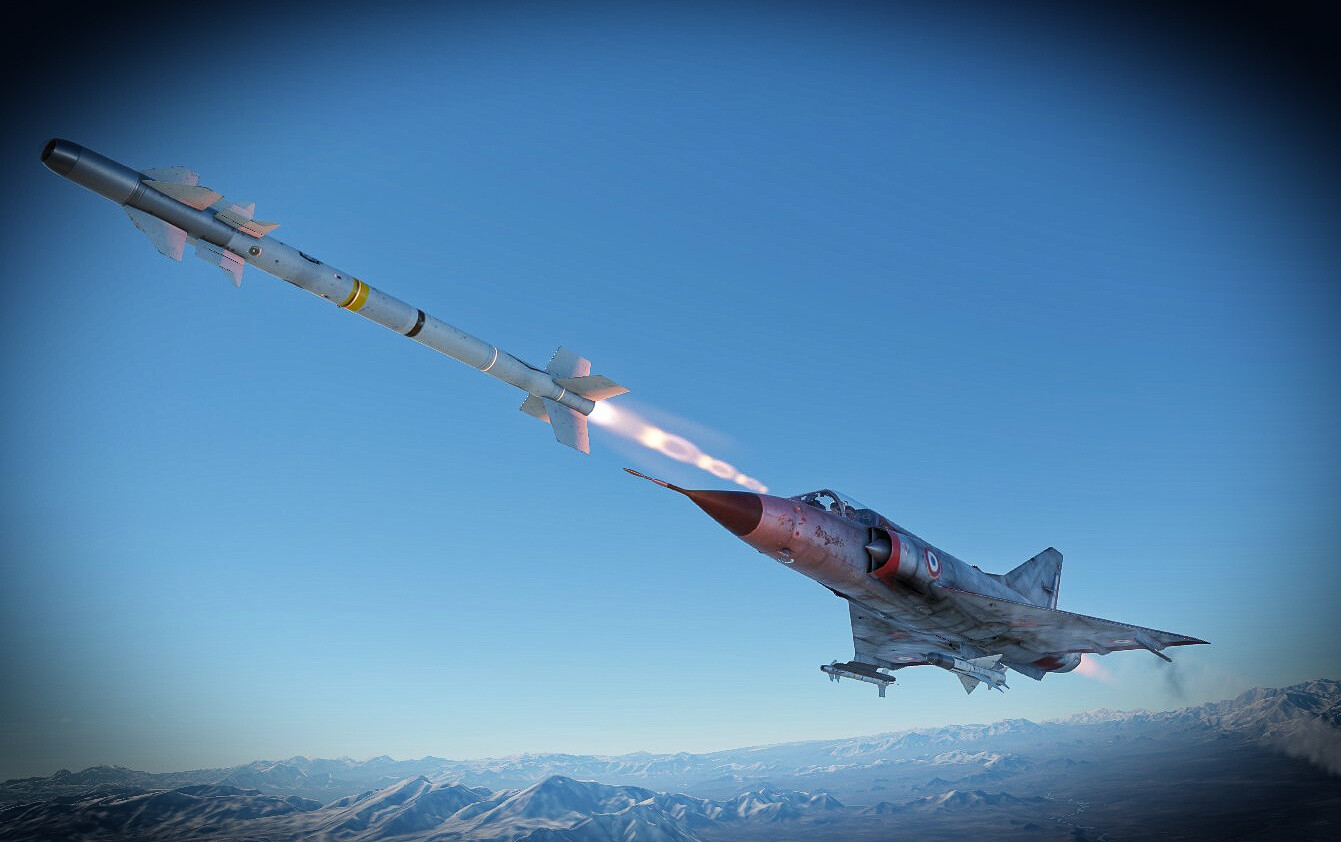
Tactic 2: We will deal with matches in which you will face much more powerful and more advanced planes, such as the MiG-21bis, F-4EJ, or F-5E. It is recommended to take slightly more fuel in these matches, and if you want an even greater advantage you can take a much lower internal fuel load in exchange for taking the two external fuel tanks for the early part of the game. In these games, you'll generally want to take the R530E, the DEFAs as well as your Magic 1s, as your radar can't compete with most of the more advanced aircraft you'll be facing to really be betting on getting any use out of it. Try and stay at the edge of any furballs that happen, and swoop in only when you see an opening to either gun down a distracted enemy or fire an IR missile at them discreetly. Due to your lack of a RWR, flying higher than 2,000m can result in you potentially being missiled without you being none the wiser, so unless you explicitly know where your enemies are and what planes they're in it's recommended to stay near the ground.
Ground RB:
Due to the lack of varied ordnance and CCIP, the Mirage IIIC is not a particularly great choice for Ground Battles; its Mirage IIIE cousin has the same ordnance, but is equipped with flares and has a RWR, and compared to other aircraft such as the Jaguar A that have much more ordnance, never mind guided ordnance, it pales in comparison. However, if you wish to fly the Mirage IIIC in ground battles, a good way to use it is using the SNEB rocket pods as well as the AS-30 Nord, as the Nord lets you take care of enemy anti-aircraft vehicles from range so that you can swoop in and unload your rockets on some unfortunate enemy's rooftop. The Magic 1s can come in handy if you're trying to hunt enemy aircraft, and against enemy drones the R530 can engage them quite easily due to their slow speed and lack of any defensive capabilities.