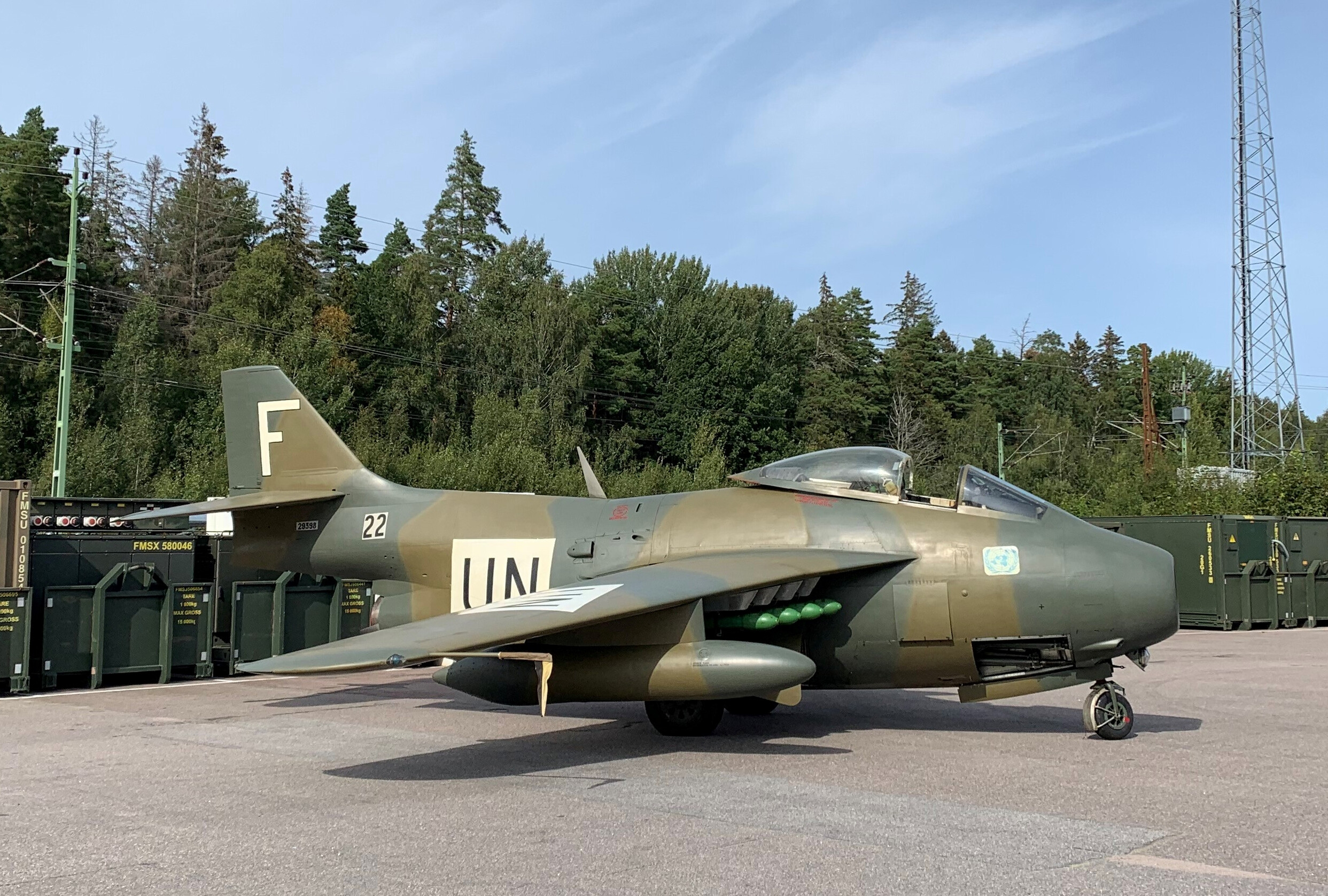
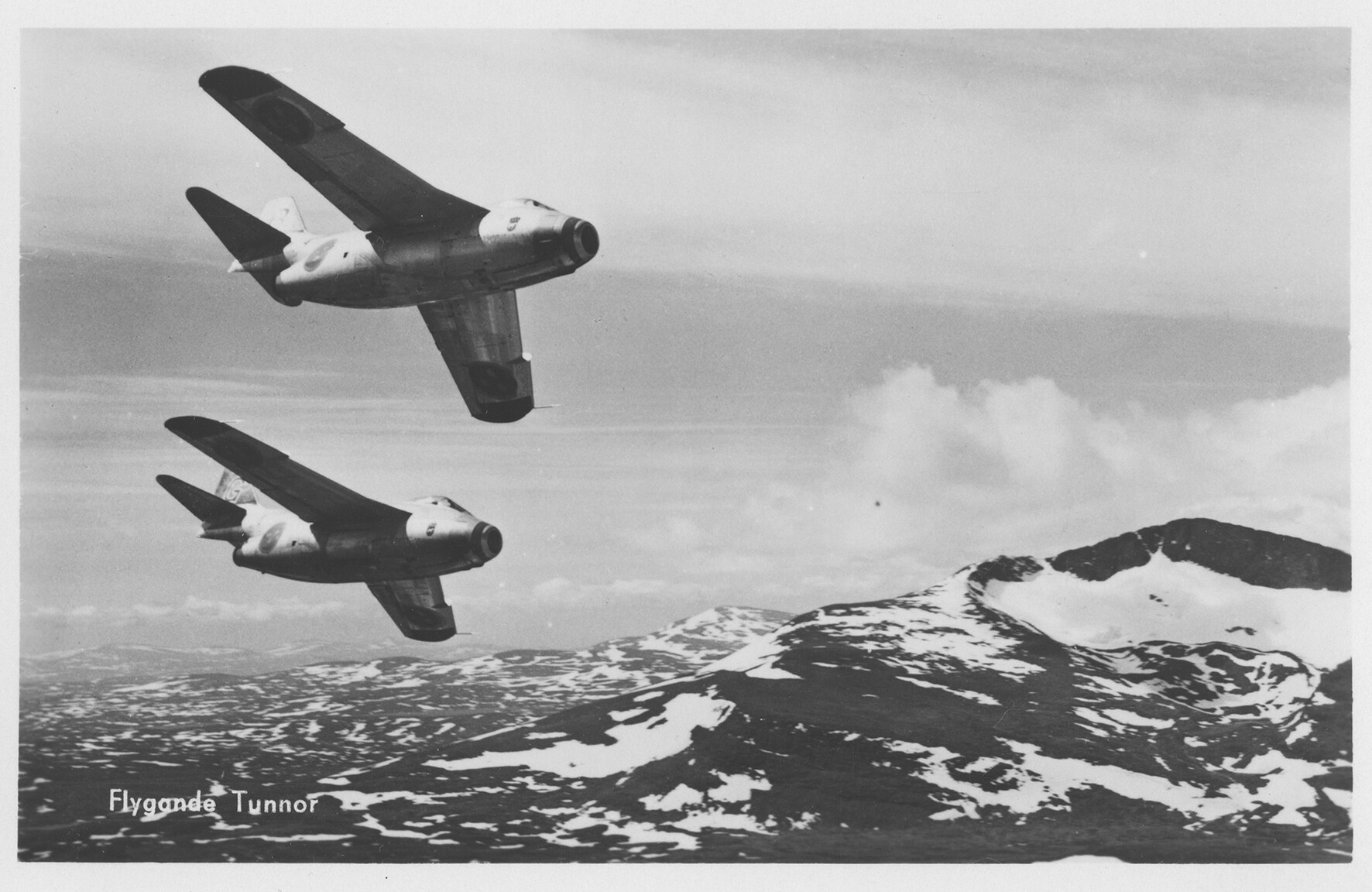
The SAAB 29, commonly known as the "Flygande Tunnan" or "Flying Barrel", was Sweden's first mass-produced jet fighter. Developed in the aftermath of World War II as Europe's first swept-wing jet fighter, its remarkable performance, adaptability, and family of variants extended its operational life from the early 1950s into the late 1970s, and propelled Sweden to the forefront of jet fighter development in the years to come.
Initial development
During WWII, Sweden had effectively fallen behind in the development of military aircraft. This was largely due to a severely underdeveloped aircraft engine industry in Sweden, which meant that there were no high-end engines available for aircraft production. Thus, Sweden was still designing propeller-driven fighter aircraft in 1945 equivalent to fighters designed by other nations 1–3 years prior. Since it was obvious by 1945 that jet aircraft were the future, the Swedish Air Force decided to immediately scrap all propeller-driven fighter projects and instead make the jump to a jet fighter.
Sweden's leading aeronautical firm, SAAB, which was already actively working with the Swedish Air Force on the previously mentioned propeller fighters, was tasked with designing this new jet fighter. Several designs were considered, but by mid-1945 it was decided that a mid-high wing aircraft with a central air intake would be the best option. Due to the mid-high wing, it was not possible to house the landing gear in the wings. Instead, it was decided to house the landing gear in the fuselage of the aircraft. This concept received the project name R1001, R standing for "reaktionsmotor" (reaction engine), the Swedish military term for jet engines.
The original specifications for the R1001 called for a radar rangefinder, four Bofors 20 mm akan m/45 cannons mounted in the nose with 180 rounds per gun, external fuel tanks, and a top speed of 1,000 km/h. The engine was originally supposed to be an indigenous design by the company STAL, but by late 1945 Sweden had gotten the green light to acquire the new state-of-the-art de Havilland Ghost engine. There are several reasons why Sweden was allowed to buy this engine even before it was finished, but the two main factors were the economic state of Britain after the war and Sweden's good relations with the company de Havilland.
The engine, however, was not the only thing that changed at an early stage. Originally, the R1001 featured straight wings, as was common at the time. However, by pure luck, Sweden was able to acquire some German WWII research papers from a Swiss source regarding swept wings on aircraft and their increased performance at high speeds. Thus, it was decided to change the R1001 design to feature swept wings. The first blueprints of the R1001 featuring swept wings were finished by late 1945, and within three years a prototype had been constructed and was ready for flight testing. During these three years, the design would change even further from the original concept. The radar rangefinder was dropped for unknown reasons, and the Bofors cannons were switched for Hispano designs due to delays at Bofors. By 1947, the aircraft had also received the designation J29.
Testing and production
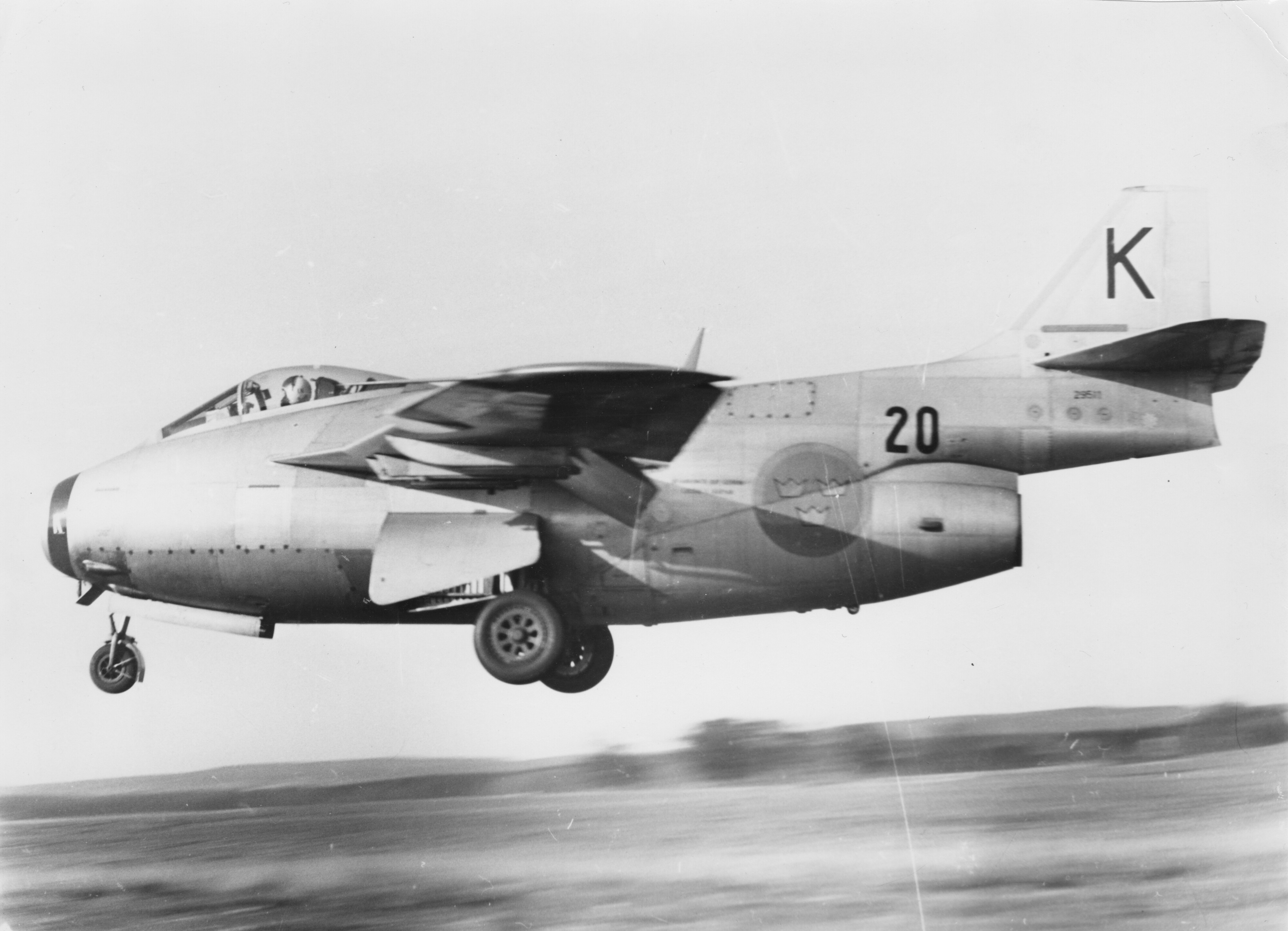
The J29 prototype flew for the first time on the 1st of September 1948 and immediately showed incredible performance. The pilot chosen for this flight was SAAB's test pilot at the time, an Englishman by the name Robert A. "Bob" Moore. He was a British squadron leader with previous experience flying jets and was thus suitable for the tests. The test flight lasted for half an hour, and after a successful landing, Moore stated that "on the ground, it's an ugly duckling, but in the air it's a swift." Like many aircraft which pick up a nickname due to a specific feature or shape, the J29 would fairly quickly receive the nickname "Flygande Tunnan" (Flying Barrel) or just "Tunnan" (Barrel) for short. Initially thought of as degrading, the nickname Tunnan would not only become the official name for the aircraft but would also start the SAAB tradition of naming their combat aircraft, a tradition which persists to this day.
After correcting a few production errors, the prototype would not only achieve the specified top speed of 1,000 km/h but would even surpass it, achieving a sustainable speed of 1,060 km/h at one point. The design of the J29 showed a lot of promise for the future, and talk of future variants would begin even before production had started. In fact, just a month after the prototype had taken to the air, there was talk of implementing attack rockets and deflatable internal fuel tanks.
Production of the first J29 variant, the J29A, would commence in 1950 and deliveries to the air force would start in early 1951. It was quickly realized that the internal fuel capacity of the J29A was too limited, and work began on implementing the previously discussed internal deflatable fuel tanks. This would be realized in a new version of the J29, designated J29B, which entered production and service in 1953. The J29B's new internal fuel tanks gave it a 50% increase in fuel capacity compared to the J29A. The J29B would be followed by an unarmed reconnaissance version called the S29C, which had been planned at an early stage. The S29C was to be followed by the J29D, featuring increased armament and an afterburner, but due to a variety of reasons, the J29D never entered production. Instead, a modified version of the J29B, called the J29E, would enter service. The E-variant featured a new dog-toothed wing which increased manoeuvrability at high speeds. The J29E was soon followed by the J29F, which was an upgrade program for 210 J29B and E aircraft, increasing their performance and allowing them to serve throughout the 1960s.
All in all, 661 J29s would be produced for the Swedish Air Force, the largest production run by SAAB ever. The last of these would serve until the late 1970s.
J29A
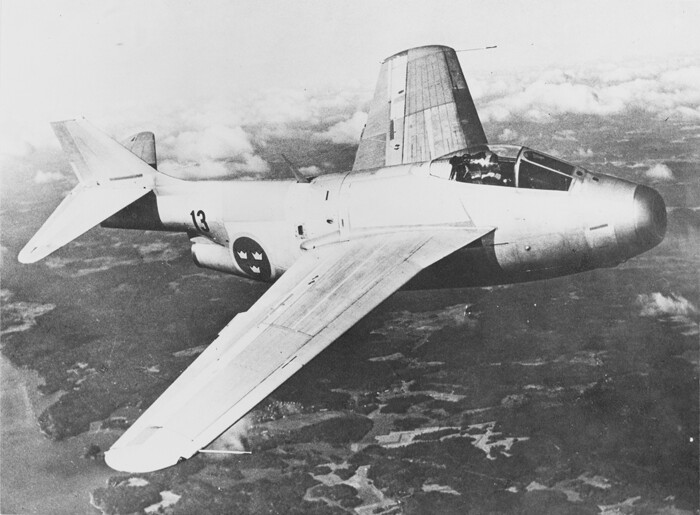
Between 1950 and 1953, SAAB would produce 224 J29As. These were delivered to the Swedish Air Force between the 10th of May 1951 and the 22nd of April 1953 and would come to serve in the Swedish Air Force until the early 1960s.
As mentioned previously, it lacked the internal deflatable fuel tanks that were fitted to the later models and thus had a fairly limited range. It could, however, equip two underwing drop tanks weighing up to 600 kg each. This increased the range to acceptable levels. Interestingly, the drop tanks could also be armed as incendiary bombs via a switch box in the cockpit. Beyond drop tanks, the aircraft was also capable of carrying a wide variety of rockets for different missions.
The J29A came to serve in the Swedish Air Force until late 1962 when they were taken out of service. Decommissioned J29As were either scrapped or used as shooting targets. One J29A survives to this day and is owned by the Swedish Air Force museum.
J29B
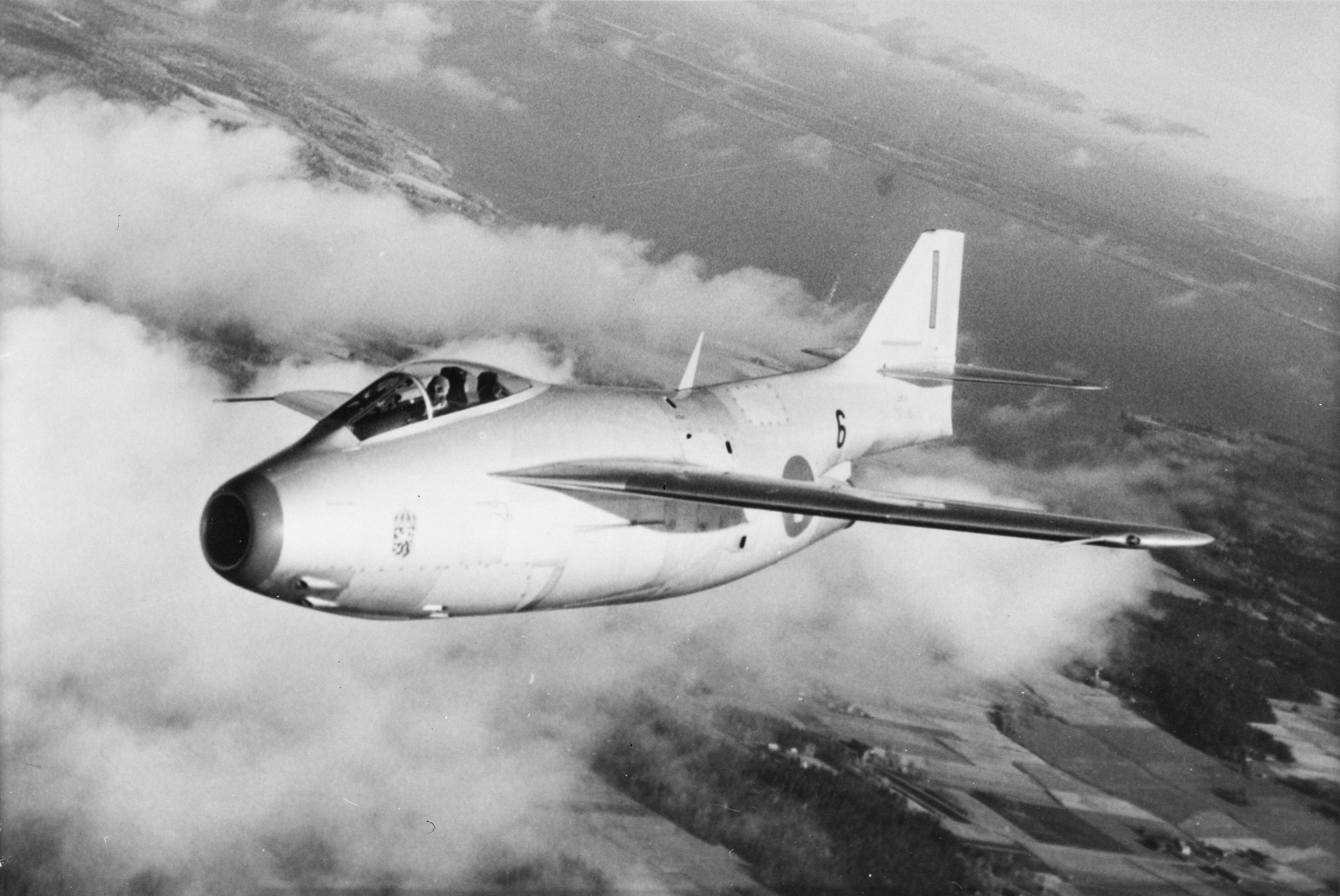
Between 1953 and 1955, SAAB would produce and deliver 361 J29Bs to the Swedish Air Force. These would come to serve in the Swedish Air Force up until the early 1960s.
As mentioned previously, the J29B was fitted with new internal deflatable fuel tanks located in the inner wings. This gave the J29Bs ~50% more fuel than its older brother, the J29A. The J29B could also equip two underwing drop tanks weighing up to 600 kg each, which increased the range even further. Interestingly, the drop tanks could also be armed as incendiary bombs via a switch box in the cockpit. Beyond drop tanks, the aircraft was also capable of carrying a wide variety of rockets for different missions.
Due to delays with development of the A32A, the J29B would initially serve as an attack aircraft, being designated as the A29B. While rockets were available for the J29A, it was decided to use the J29B as an attack aircraft due to it being a new aircraft type which could be sent directly to the attack wings. There they would stay until 1957 when the A32A finally entered service. Afterwards, they served as regular fighters under the designation J29B.
In Sweden, the J29B would be used until 1963 when the type was ultimately decommissioned due to being obsolete. However, a large number of J29Bs had by this time been upgraded to J29F standards, and these would serve until 1978.
J29D
Even before production of the J29A had started in the late 1940s, the Swedish Air Force started to discuss the use of an afterburner in the J29. While the J29 was very advanced for its time, it became clear fairly early on that it did not have the climb rate needed to effectively intercept high-altitude strategic bombers. To solve this, it was decided to start designing an indigenous afterburner for the J29. SFA (Svenska Flygmotor AB, today Volvo Aero), which was license-producing the de Havilland Ghost engine, was tasked to develop an afterburning version of it. After initial calculations, it was concluded that the new afterburner would increase power by ~25% and double the climb rate.
Besides introducing an afterburner, there was also a lot of talk about increasing the armament of the J29. Several ideas were brought up, everything from anti-air missiles to anti-air rockets to more powerful guns. In the end, it was decided that all three ideas would be tested. Since there were a few 30 mm aircraft guns on the international market by the start of the 1950s, it was decided to trial the new J29 with new guns first. Thus, in April 1952, a J29A from air wing F 13 was sent to the Swedish Air Force experimental bureau Försökscentralen (FC) to be fitted with mockups of 30 mm guns for flight testing. Flight testing with mockups was performed as the barrels of the new 30 mm guns were protruding out from the front of the J29, which could interfere with flight characteristics. After four months of successful flight trials were completed, the aircraft was restored and sent back to air wing F 13.
About two years later, the afterburning Ghost engine was finished and it was decided to install it in the J29B prototype, then becoming the J29D prototype. The J29D prototype flew for the first time on the 20th of March, 1954. Initial flight trials were apparently successful; however, during trestle-mount ground trials in 1954, it was found that the 30 mm guns selected for the J29D were flawed and the idea to use these was scrapped. Instead, it was decided that anti-air rockets and missiles were the way to go.
SAAB at this time had also designed a new wing for the J29, a so-called dog-tooth wing which improved airflow and handling. It was decided that all future J29s would feature this dog-tooth wing and thus the J29D project was scrapped. Instead, it was decided to make an afterburning J29 with the new dog-tooth wings. Unfortunately, as production of the afterburning Ghost engine was not ready yet, it was decided to introduce the new dog-tooth wing first in an intermediate version called the J29E, which consisted of J29Bs being modified in the factory or in the field with the new wings. The plan was to later retrofit 210 of the J29B and J29E models with dog-tooth wings and afterburning Ghost engines, turning them into J29Fs.
Luckily, this was not the end for the J29D prototype. In order to test the J29F concept, it was decided to modify the J29D prototype into the J29F prototype. Modifications were done by early February 1955 and the J29F prototype was approved for service in April the same year. That same year, Bofors would finalize the anti-air rockets which entered service on the J29B, E, and F as the 75 mm srak m/55. In 1956, the legacy of the J29D would end, as the J29F entered service.
J29F
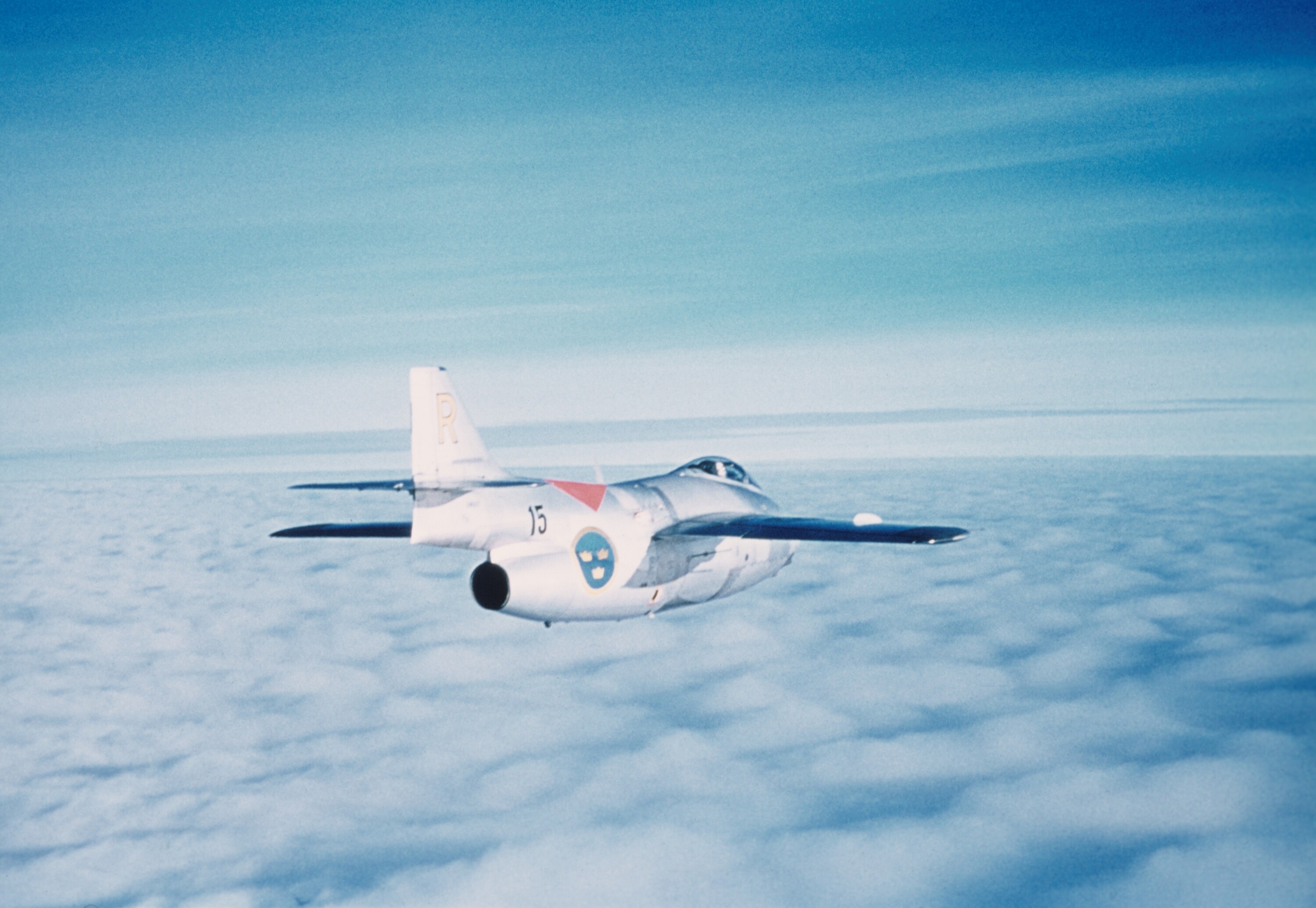
The J29F was an upgrade program spanning from 1956 to 1958, in which 210 of the J29B and J29E models were upgraded to F-standard. F-standard meant that the aircraft would be equipped with new dog-tooth wings originally introduced on the J29E, but also the afterburning engine of the scrapped J29D project.
The J29F was an important step in prolonging the service life of the J29. Being an aircraft with its roots from 1945, the basic J29 was about to become obsolete by the early 1960s. By upgrading them to F-standard, they would still be usable throughout the 1960s. This was further improved in 1961 when the J29F was modified to carry RB24B (AIM-9B) Sidewinder air-to-air missiles, allowing them to attack high-altitude bombers from behind. Previously, the idea was to attack bombers head-on using 75 mm srak m/55 rockets. The J29F came to see service with Sidewinders all the way to 1978. It was finally decommissioned in 1978, 27 years after the initial type entered service.
Legacy
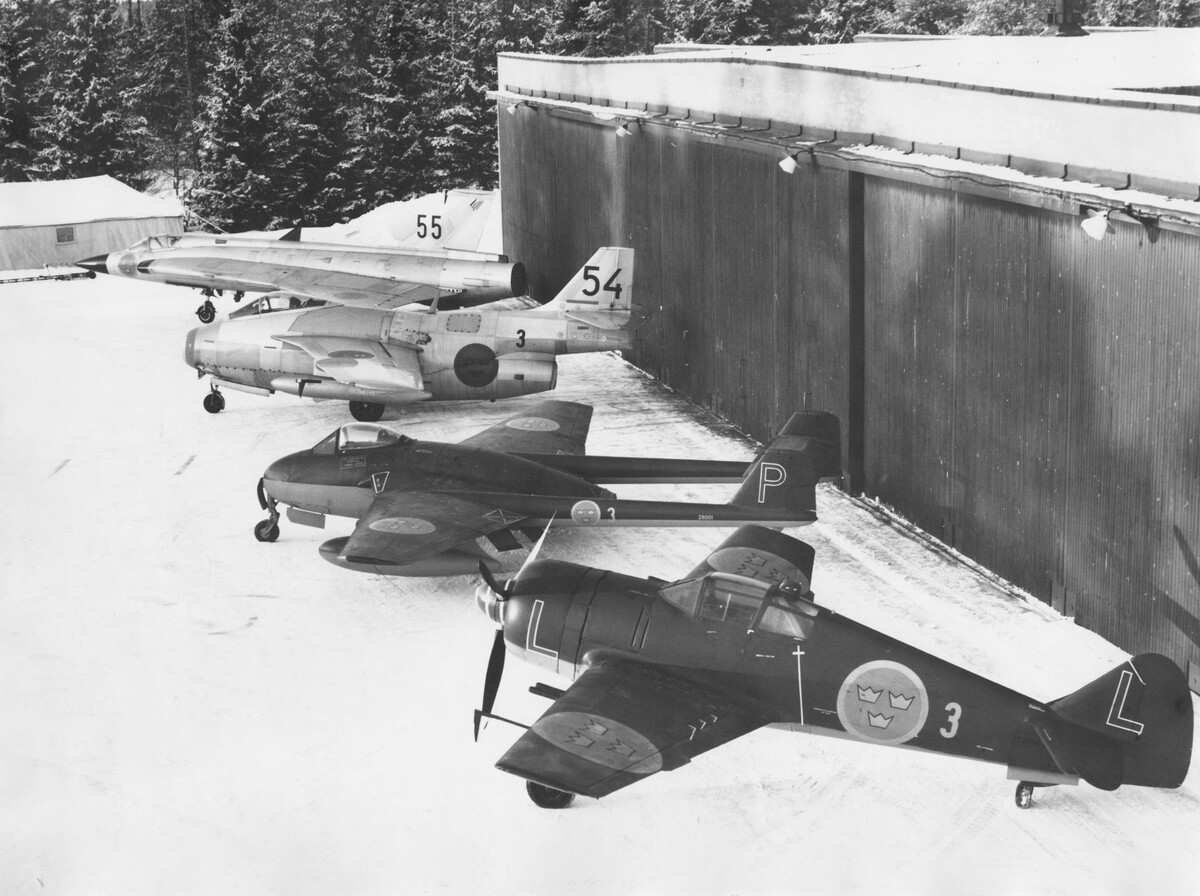
The J29 was a truly historical wonder for its time. After being stranded for the duration of the war, Sweden managed not only to catch up with modern aircraft development in a short amount of time, but it was also able to lead jet fighter development in Europe for the time and arguably even into modern times. The J29 was the first swept-wing jet fighter to be mass-produced in Europe and, together with the Soviet MiG-15 and American F-86, it set the bar for how the next generation of fighter aircraft should be. It was extremely fast for its time and actually managed to take home two closed-circuit world speed records during the mid-1950s.
Besides its international legacy, the J29 was the first Swedish-designed aircraft to see combat. In September 1961, as part of the Congo crisis, five J29Bs were stationed in the Republic of Congo to contribute to a UN peacekeeping mission (ONUC) in the region. This led to the formation of the air wing F 22, which exclusively served in Congo. F 22 was later reinforced by four more J29Bs and two S29C reconnaissance planes in 1962. F 22 would quickly take air superiority in the area, which in turn led to them primarily performing attack missions during the conflict. No aircraft were lost during the ONUC despite large amounts of ground fire. When the ONUC was terminated in 1964, the aircraft type had been decommissioned in Sweden and thus it was decided to only send home a select few J29s to Sweden. The majority of the F 22 J29s were blown up on the spot in Congo when the Swedish left the area.