
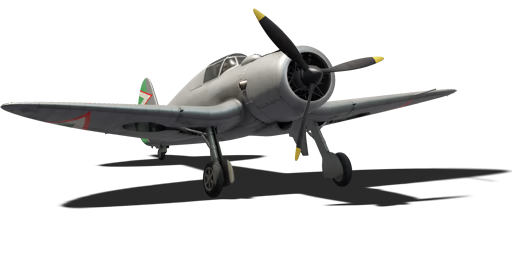




When the Royal Hungarian Air Force was established in 1938, its fleet consisted primarily of obsolete CR.32s and CR.42s, which could not compete with modern monoplanes. Since acquiring Bf 109s was not feasible, the Hungarians decided to purchase He 112s and placed an order for 36 aircraft in September. However, due to various political reasons, they only received three. This did not satisfy the military, so while searching for a new fighter abroad, they decided to develop their own aircraft.
Development began in the summer of 1939, and by the end of 1940, the prototype of the aircraft, the WM-23 Ezüst Nyíl, was ready. It was equipped with a Weiss-Manfred WM K-14B engine (the same as on the WM-21), a plywood wing with Fowler flaps, and a German VDM propeller. The aircraft made its first flight in the winter-spring of 1941. Subsequent tests impressed the military far more than the He 112, and there were plans to mass-produce it. However, on April 21, 1942, the sole prototype crashed, and the plans were abandoned. The Hungarians were already using Héja aircraft, which had similar characteristics and fulfilled the same role. Furthermore, production of the Bf 109 was set to begin in Hungary soon, so the new aircraft was no longer needed.
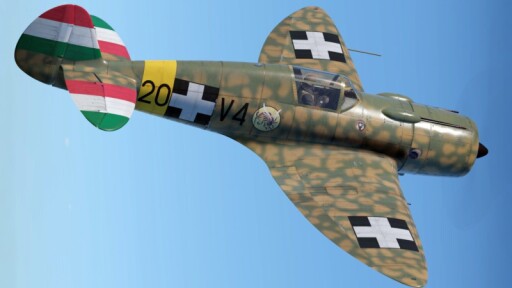
The Hungarian WM-23 was introduced in Update 2.55 "Ninth Wave", as a part of the Italian aviation research tree. It is a highly maneuverable aircraft with excellent handling at low speeds. It also boasts decent armament. However, it has a poor roll rate, low top speed, and significant loss of maneuverability at high speeds.

flaps
flaps
flaps
brake
| Belt | Belt filling | Armor penetration (mm) at a distance: | |||||
|---|---|---|---|---|---|---|---|
| 10 m | 100 m | 500 m | 1000 m | 1500 m | 2000 m | ||
| T/Ball/Ball/I/AP | 21 | 19 | 12 | 7 | 4 | 2 | |
| AP/AP-I/HEF/API-T/I | 21 | 19 | 12 | 7 | 4 | 3 | |
| API-T/AP-I/HEF | 21 | 19 | 12 | 7 | 4 | 3 | |
| API-T | 21 | 19 | 12 | 7 | 4 | 3 | |
| AP-I/AP-I/HEF/HEF | 20 | 18 | 11 | 6 | 4 | 2 | |
| Belt | Belt filling | Armor penetration (mm) at a distance: | |||||
|---|---|---|---|---|---|---|---|
| 10 m | 100 m | 500 m | 1000 m | 1500 m | 2000 m | ||
| AP-T/AP | 9 | 8 | 6 | 3 | 0 | 0 | |
| AP-T/AP/AP-T | 9 | 8 | 6 | 3 | 0 | 0 | |
| AP/AP | 5 | 4 | 2 | 1 | 0 | 0 | |

 ◔WM-23

Flight performance | |
|---|---|
Survivability |
|---|
Weaponry | |
|---|---|