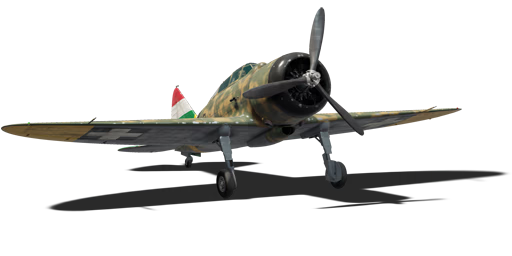




The Héja II (Héja is Hungarian for "Hawk") was a Hungarian fighter aircraft developed from the Héja I, which was a modification of the Italian Re.2000. While retaining its predecessor's platform, the aircraft underwent numerous fundamental changes. The most notable change was the replacement of the armament; the Italian Breda-SAFAT machine guns were replaced with more advanced Gebauer 1940 M GKM 12.7 mm machine guns. This resolved the synchronization issues with the Italian machine guns. Additionally, the powerplant was replaced with a more reliable WM K-14B engine, smaller wing fuel tanks were installed, and a new propeller was fitted. Hungary used the Héja II as an interceptor or a training aircraft during World War II. Production continued until August 1944. A total of 204 Héja IIs were built.
The Héja II was introduced in Update 2.55 "Ninth Wave", as a part of the Italian aviation research tree. It is an early fighter with a high top speed, good maneuverability for a monoplane, and fairly powerful armament, though its climb rate is mediocre. Unlike the Héja I, the Héja II also received a more powerful engine.

flaps
flaps
flaps
brake
| Belt | Belt filling | Armor penetration (mm) at a distance: | |||||
|---|---|---|---|---|---|---|---|
| 10 m | 100 m | 500 m | 1000 m | 1500 m | 2000 m | ||
| T/Ball/Ball/I/AP | 21 | 19 | 12 | 7 | 4 | 2 | |
| AP/AP-I/HEF/API-T/I | 21 | 19 | 12 | 7 | 4 | 3 | |
| API-T/AP-I/HEF | 21 | 19 | 12 | 7 | 4 | 3 | |
| API-T | 21 | 19 | 12 | 7 | 4 | 3 | |
| AP-I/AP-I/HEF/HEF | 20 | 18 | 11 | 6 | 4 | 2 | |


 ◔Héja II
Flight performance | |
|---|---|
Survivability |
|---|
Weaponry |
|---|