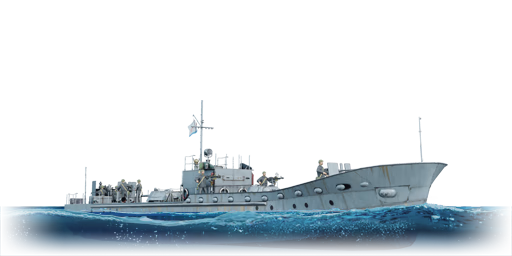
The Project 161 armored boats were designed and built in besieged Leningrad. When the Baltic Fleet's large surface ships were unable to leave their bases, the burden of combat operations in the Gulf of Finland and the Baltic Sea fell on the few submarines and the "mosquito fleet", necessitating ships of this class. Design work was carried out in record time, practically in parallel with construction of the first hull. The final design was approved on September 15, 1943, a week before commissioning of the lead boat. Testing was kept to a minimum; the most important test for the new armored boats was combat operations. The boats actively provided artillery support for landings during the Vyborg, Moonsund, and East Prussian offensives and participated in the sinking of the German destroyer T-31 in the Battle of Nerva Island.
Nevertheless, the tight development schedule took its toll, and many shortcomings in the boats had to be corrected during production. For instance, later boats built in 1944 had more streamlined bow lines, improving their seaworthiness. Additionally, the engine room ventilation was improved with three electric fans, and the compass platform was lowered by 750 mm and equipped with a machine telegraph and a speaking tube. A total of 20 ships of this project were built from 1943 to 1944. Three were lost, and the rest remained in service until the late 1950s.
The MBK-161 late was introduced in Update 1.79 "Project X". This "shallow-water battleship" is well-armored and armed but has very low speed. Therefore, when entering battle, it is necessary to determine the direction in advance because it will not be possible to quickly change flanks.