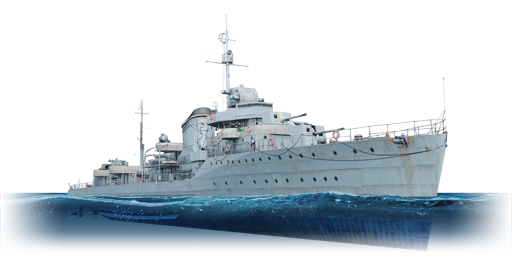
The Besposhchadny was a Gnevny-class destroyer built for the Soviet Navy in the 1930s. The Gnevny class was a licence-built version of the Italian Folgore class, inheriting stability issues due to the Soviet design being heavier than the original. Besposhchadny was laid down on 15th May 1936 and commissioned on 2nd October 1939. In June 1941, after the German invasion of the Soviet Union, Besposhchadny laid minefields off Sevastopol. Between August and October, she was hauling supplies and providing naval gunfire support to besieged troops in Odessa, during which, on 22nd September, she was damaged by Ju 87 dive bombers from StG 77. Her bow was nearly blown off by the bombs, and she had to be towed back to Sevastopol by her sister Soobrazitelny. She was repaired using the salvaged bow from the sunk destroyer Bystry. While undergoing repairs, she was again attacked by Ju 87s, which started a large fire and destroyed her machinery. She had to be towed to Poti by the Fidonisy-class destroyer Shaumyan. Her repairs completed in September, she left Poti after the necessary trials in November to shell German troops at Kuban. In February 1943, her task was to transport troops between Tuapse and Gelendzhik, during which she ferried 8,037 troops.
On 6th October 1943, while returning from the shore bombardment of Feodosiya, Besposhchadny, her sister Sposobny, and the Leningrad-class destroyer leader Kharkov came under attack from Ju 87 dive bombers after being spotted by a German reconnaissance plane. Kharkov was damaged by the bombers, and Sposobny had to tow her. After a second attack, both Kharkov and Besposhchadny were damaged by bombs, and Sposoby had to alternate between towing both. The third attack sank both Kharkov and Besposhchadny. Only 41 crewmen of Besposhchadny survived. This incident led Stalin to forbid the use of destroyer-sized and larger vessels without his direct order.
The Besposhchadny was introduced in Update "Fire and Ice". As the main armament of all Project 7 destroyers is manually driven, the turrets suffer from poor traverse speed, rendering them difficult when switching targets. The guns themselves are also protected only by 8 mm thick anti-fragmentation armour covering the sides, front, and top. As with most destroyers from other navies, the Gnevny class features unarmoured magazines above the waterline, which can lead to a fatal explosion when hit. Her boilers and transmission also take up nearly the entire length of the ship past the bridge. Being hit in these spaces will damage or disable the machinery, leaving the ship dead in the water.