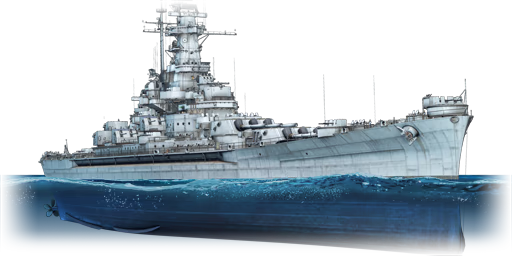
The USS South Dakota (BB-57) was a battleship in the United States Navy and the lead ship of its class. Laid down on July 5, 1939, at a New York shipyard, it was launched on June 7, 1941, and commissioned on March 20, 1942.
Immediately after joining the fleet, the battleship was sent to reinforce American forces in the Guadalcanal campaign. She later participated in the Battle of the Santa Cruz Islands and the Second Naval Battle of Guadalcanal. After undergoing repairs in the winter of 1942–1943, the battleship was sent to reinforce the British Home Fleet, which was engaged in escorting convoys to the USSR. In mid-1943, the ship was transferred again, this time to the Pacific Ocean, where it participated in the Gilbert and Marshall Islands campaign. In 1944, the battleship took part in Operation Forager to capture the Mariana Islands and the Philippine campaign. In 1945, the South Dakota took part in the operation to capture Iwo Jima and Okinawa and shelled the Japanese coast several times. After the war ended, the South Dakota took part in the initial stage of occupying the country. In early 1946, the battleship was transferred to the Philadelphia Shipyard, where it was laid up and placed in reserve. Over the following years, various proposals were made to modernize ships of this class, including converting them into anti-aircraft battleships, but none of these plans were adopted. Ultimately, on June 1, 1962, the battleship was decommissioned, and it was sold for scrap in October of that year.
The USS South Dakota was introduced in Update 2.53 "Line of Contact" in its 1945 configuration. The battleship has a very powerful main caliber and a high rate of fire compared to previous American battleships. Additionally, it has an excellent secondary armament of rapid-fire, versatile 127mm guns, as well as a powerful battery of small-caliber anti-aircraft artillery. However, the battleship's speed and maneuverability are mediocre, and its armor is below average.