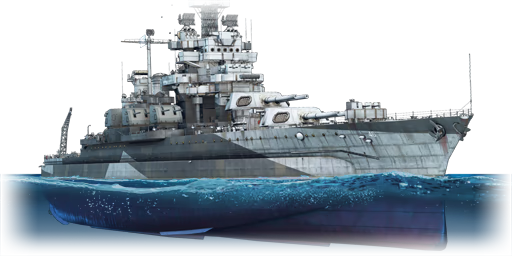

The USS Maryland (BB-46) was a superdreadnought in the US Navy and the second ship in the Colorado class, which were the last superdreadnoughts, or “standard battleships”, in the American fleet. She was laid down on April 24, 1917; launched on March 20, 1920; and commissioned on July 21, 1921. Ships of this class were essentially identical to the preceding Tennessee class in design, except for their main armament; the new battleships were equipped with 16-inch (406.4 mm) guns.
Maryland was the third ship to be named after the seventh state. She was also nicknamed "Old Mary" and "Fighting Mary". During the interwar period, like many other battleships, Maryland mainly went on cruises, participated in exercises, and patrolled the seas. On December 7, 1941, she was part of the famous "Battleship Row" at Ford Island in Pearl Harbor. During the Japanese air attack, she was next to the battleship Oklahoma, which sank. Maryland was hit by two armor-piercing bombs; one caused flooding, increasing the ship's draft by 1.5 meters. After the attack, however, the ship made her own way to Puget Sound for repairs, which were completed in February 1942. The battleship subsequently played an active role in Pacific battles, first as a patrol and escort ship and then, beginning with the Battle of Tarawa, providing artillery support for ground operations. On June 22, 1944, during the Battle of Saipan, the battleship was hit by a torpedo. The damage was not serious, and the ship made her own way to Pearl Harbor, albeit in reverse, as the hole was in the bow. Thirty-four days later, Maryland returned to sea. Maryland actively participated in the Battle of Leyte Gulf and the Battle of Okinawa. After the war ended, the ship took part in Operation Magic Carpet, returning American servicemen to their homeland. In December 1945, the battleship completed her participation in the operation. In July 1946, she was placed in reserve.
She was transferred to the reserve fleet in the Pacific Ocean on April 3, 1947. On July 8, 1959, she was sold for scrap. On June 2, 1961, a monument to the battleship and her crew was unveiled in Annapolis, Maryland's capital.
The USS Maryland was introduced in Update 2.49 "Tusk Force" in her 1945 configuration. She has decent main-caliber guns, a powerful anti-aircraft battery, and good armor. However, her main-caliber guns have an extremely low rate of fire, and her speed and maneuverability are mediocre.

| Ammunition | Type | Armor penetration (mm) at a distance: | |||||
|---|---|---|---|---|---|---|---|
| 1000 m | 2500 m | 5000 m | 7500 m | 10000 m | 15000 m | ||
| HE | 103 | 97 | 87 | 79 | 74 | 74 | |
| APCBC | 694 | 654 | 591 | 534 | 482 | 388 | |
| APCBC | 756 | 718 | 659 | 605 | 555 | 464 | |
| Ammunition | Type | Armor penetration (mm) at a distance: | |||||
|---|---|---|---|---|---|---|---|
| 1000 m | 2500 m | 5000 m | 7500 m | 10000 m | 15000 m | ||
| HE | 36 | 36 | 36 | 36 | 36 | 36 | |
| Common | 119 | 94 | 63 | 44 | 31 | 28 | |
| SP Common | 146 | 116 | 79 | 55 | 40 | 34 | |
| HE-VT | 36 | 36 | 36 | 36 | 36 | 36 | |
| Belt | Belt filling | Armor penetration (mm) at a distance: | |||||
|---|---|---|---|---|---|---|---|
| 10 m | 100 m | 500 m | 1000 m | 1500 m | 2000 m | ||
| HEFI-T | 6 | 6 | 5 | 5 | 4 | 4 | |
| Belt | Belt filling | Armor penetration (mm) at a distance: | |||||
|---|---|---|---|---|---|---|---|
| 10 m | 100 m | 500 m | 1000 m | 1500 m | 2000 m | ||
| HEF-T/AP-T | 34 | 32 | 26 | 21 | 18 | 16 | |


 2 x (425 / 600) %
2 x 214 %
2 x (425 / 600) %
2 x 214 %
Seakeeping |
|---|
Unsinkability | |
|---|---|
Firepower | ||
|---|---|---|