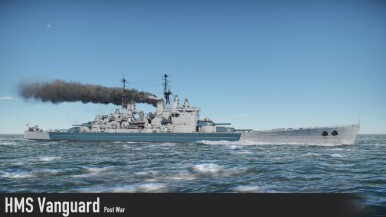
HMS Vanguard (23) was a battleship of the Royal Navy, the only ship of her class. She was laid down on 2 October 1941, launched on 30 November 1944, and commissioned on 12 May 1946.
By the early 1940s, it had become clear that the British Navy was inferior in the number and power of its battleships to the combined fleets of Germany and Japan. Consequently, design work on the Lion-class battleships began. These ships were powerful, but protracted work on the design of their main battery (triple mounts with 406 mm guns) delayed their construction.
For this reason, an interim design was developed that proposed using older 381 mm Mark I guns. Despite being hastily laid down in 1941, the confusion surrounding the Lion-class battleships, and the fact that the war was drawing to a close, led to significant construction delays, and Vanguard never saw combat. During her brief service, the battleship served primarily as a royal yacht or training ship, spending much time on cruises. In 1954, the battleship underwent a very expensive refit, which was completed in March 1956, after which she was placed in reserve. Vanguard remained inactive until the end of 1959, during which time she was gradually stripped of her armament and equipment. She was subsequently stricken from the Navy list and sold for scrap to the British Iron & Steel Corporation in June 1960.
Introduced in Update "Leviathans" in her 1946 configuration, HMS Vanguard boasts fairly good protection, possesses a versatile and powerful, albeit few in number, secondary battery, and fields a strong anti-aircraft battery. However, the battleship's main battery has insufficient penetration against other late battleships. Her manoeuvrability is also quite average, which can be especially inconvenient when fighting faster opponents.








 HMS Vanguard