
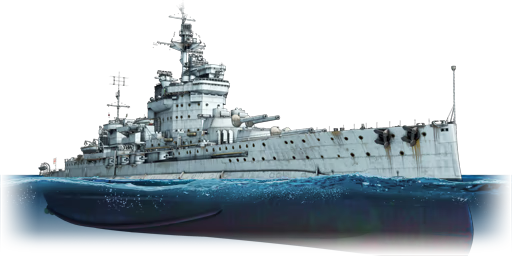



HMS Warspite (03) was a British Queen Elizabeth-class dreadnought battleship and the second ship of its class. Its name has a fascinating origin — it comes from the old word "speight," meaning woodpecker. This emphasizes that the ship would "peck" holes in the wooden hulls of its opponents. This is the sixth ship to bear the name. She was laid down at the Davenport shipyard on October 31, 1912; launched on November 26, 1913; and commissioned on March 8, 1915. Due to the outbreak of World War I, the ship entered service without undergoing full trials.
On May 31, 1916, the ship took part in the Battle of Jutland, during which she was hit more than ten times by 280 mm shells from German dreadnoughts. With the exception of Jutland and a few other incidents, she was mainly engaged in patrolling and training exercises during World War I.
During the interwar period, the ship was first assigned to the Atlantic Fleet and then to the Mediterranean Fleet. She participated in parades and exercises, actively showing the flag abroad. In the second half of the 1930s, the ship underwent a major modernization. During this time, the superstructure was reconstructed, the power plant was replaced, the armor was reinforced, and the air defense was improved.
Following the outbreak of World War II, she rejoined the Metropolitan Fleet and took part in the Norwegian Campaign. By the end of 1940, she had been transferred to the Mediterranean Sea, where she participated in operations against the Italian fleet. In mid-1941, she was severely damaged during the Siege of Crete and was sent to the United States for three months of repairs. She then joined the Eastern Fleet in the Indian Ocean. In 1943, she was transferred to the "H Force" in the Mediterranean Sea and took part in battles with the Italian fleet again during the Italian Campaign. During the Salerno landing, she was damaged by a radio-controlled Fritz X bomb. Afterwards, she was repaired for a year. Despite not being fully repaired, she took part in the bombing of coastal fortifications during the Normandy landings. On February 1, 1945, she was decommissioned and sold for scrap. While being towed, however, she ran into a storm and ran aground in Prussian Bay near Cornwall. She was eventually cut up for scrap by April 1947.
HMS Warspite was introduced in Update 2.45 "Hornet's Sting" in her 1942 modification. The ship has decent anti-aircraft batteries, substantial armor, and fairly powerful main guns, although with high vertical dispersion. It is also worth noting that the ship's speed is mediocre.

| Ammunition | Type | Armor penetration (mm) at a distance: | |||||
|---|---|---|---|---|---|---|---|
| 1000 m | 2500 m | 5000 m | 7500 m | 10000 m | 15000 m | ||
| SAPCBC | 225 | 211 | 189 | 169 | 151 | 120 | |
| APCBC | 649 | 607 | 542 | 483 | 429 | 337 | |
| APCBC | 655 | 619 | 565 | 517 | 474 | 403 | |
| Ammunition | Type | Armor penetration (mm) at a distance: | |||||
|---|---|---|---|---|---|---|---|
| 1000 m | 2500 m | 5000 m | 7500 m | 10000 m | 15000 m | ||
| HE | 53 | 53 | 53 | 53 | 53 | 53 | |
| SAPBC | 176 | 140 | 95 | 66 | 46 | 38 | |
| Ammunition | Type | Armor penetration (mm) at a distance: | |||||
|---|---|---|---|---|---|---|---|
| 1000 m | 2500 m | 5000 m | 7500 m | 10000 m | 15000 m | ||
| HE-TF | 20 | 20 | 20 | 20 | 20 | 20 | |
| Belt | Belt filling | Armor penetration (mm) at a distance: | |||||
|---|---|---|---|---|---|---|---|
| 10 m | 100 m | 500 m | 1000 m | 1500 m | 2000 m | ||
| HEF | 4 | 4 | 3 | 3 | 3 | 3 | |
| Belt | Belt filling | Armor penetration (mm) at a distance: | |||||
|---|---|---|---|---|---|---|---|
| 10 m | 100 m | 500 m | 1000 m | 1500 m | 2000 m | ||
| HEF-T/AP-T | 34 | 32 | 26 | 21 | 18 | 16 | |


Seakeeping |
|---|
Unsinkability | |
|---|---|
Firepower | ||
|---|---|---|