
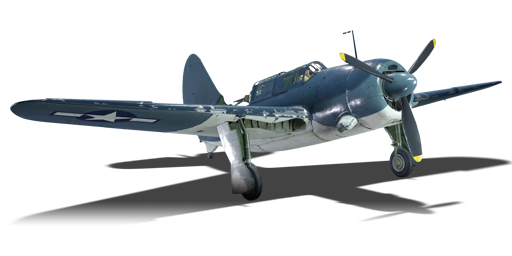
SB2C-1C



Although the SBD Dauntless had yet to enter production by the late 1930s, the US Navy had already planned for its replacement. To this end, the USN contracted Curtiss-Wright to design a new dive bomber, resulting in the Curtiss SB2C Helldiver. However, problems began to mount after the prototype made its first flight on 18 December 1940. The aircraft was noted to have very poor handling, structural integrity, flight stability, and stall characteristics. This forced Curtiss to delay production to remedy these issues, and it would not be until 1943 that the SB2C would enter production. As a result, Curtiss-Wright was investigated by the Truman Committee, which produced a scathing report that permanently damaged Curtiss' reputation. The SB2C ended up as a disappointment, with crews expressing their frustration through various derogatory nicknames. Nevertheless, the SB2C would serve as the main American dive bomber in late World War II, and was later sold to various allied countries after the war. In total, 7,140 SB2Cs of all variants were built.
The SB2C-1C Helldiver was the first production variant of the SB2C to see combat. Compared to the initial production variant, the SB2C-1, it replaced four Browning MGs with two 20 mm AN/M2 autocannons as well as hydraulic-powered flaps. In total, 778 of the SB2C-1C were built, and it served primarily from late 1943 to early 1944.
The SB2C-1C was introduced in Update 1.51 "Cold Steel". While suffering from a bad reputation in real life, the Helldiver can still perform quite well in its intended role. The plane offers a decent variety of payloads, including a powerful torpedo and naval mine. While the Helldiver's flight performance is mediocre at best, it can be used as an ad hoc "interceptor" due to its powerful 20 mm autocannons and access to an air spawn. However, the Helldiver is only defended with a pair of weak machine guns, thus leaving it easy prey to any pilot who can outmanoeuvre it.

flaps
flaps
flaps
brake
| Belt | Belt filling | Armor penetration (mm) at a distance: | |||||
|---|---|---|---|---|---|---|---|
| 10 m | 100 m | 500 m | 1000 m | 1500 m | 2000 m | ||
| HEI/AP-T | 39 | 36 | 25 | 16 | 10 | 6 | |
| AP-T/AP-T/HEI/HEI | 39 | 36 | 25 | 16 | 10 | 6 | |
| HEI/HEI/HEI/AP-T | 39 | 36 | 25 | 16 | 10 | 6 | |
| AP-T/AP-T/AP-T/HEI | 39 | 36 | 25 | 16 | 10 | 6 | |
| HEI | 5 | 4 | 4 | 4 | 4 | 4 | |
| Belt | Belt filling | Armor penetration (mm) at a distance: | |||||
|---|---|---|---|---|---|---|---|
| 10 m | 100 m | 500 m | 1000 m | 1500 m | 2000 m | ||
| T/Ball/Ball/AP/I | 13 | 12 | 7 | 3 | 2 | 0 | |
| T/AP/AP/AP/I | 13 | 12 | 7 | 3 | 2 | 0 | |


Flight performance | |
|---|---|
Survivability |
|---|
Weaponry | ||
|---|---|---|