
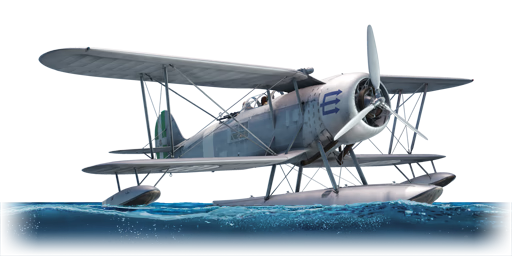
Ro.43


The IMAM Ro.43 was an Italian reconnaissance seaplane from the interwar period. Developed between 1935 and 1936, it was essentially a conversion of the Ro.37 "Lince" (Italian for "lynx") training and reconnaissance aircraft for maritime service. It had the fuselage of the Ro.37bis reconnaissance aircraft, marine radio equipment, and a central float housing an unprotected fuel tank instead of retractable landing gear. Two auxiliary floats were suspended directly under the wingtips. To reduce space, a folding wing locking mechanism was used, allowing the aircraft to be placed on catapults in the limited space between superstructures or on the ship's deck where main-caliber turrets were usually located. The goal was not to invent a new aircraft, as the Soviet Union had done with the KOR-1, but rather to modify an existing, proven design. They did not lose out; the aircraft turned out to be exceptionally good compared to its counterparts of that time.
Because the production of the Ro.37 was well-established, mass production of this vehicle began in Naples in 1936. This was followed by the production of the modified Ro.44. About 130 aircraft were built, but their combat use is not well documented. There is no evidence that these aircraft were used for anything other than reconnaissance. They participated in the operation to capture the island of Crete in the Mediterranean Sea, and they were also used to detect British convoys. The most fateful moment occurred when an aircraft crew spotted a British carrier strike group and the landing fleet that was escorting it to invade Greece. The Italians then suffered a crushing defeat at Cape Matapan.
The Ro.43 was introduced in Update 2.13 "Winged Lions", and is only available as a seaplane that can be launched from a catapult on several Italian Bluewater ships. It is a fairly good aircraft in terms of flight characteristics and is one of the fastest and most agile seaplanes. However, it has limited combat capabilities; its only armaments are two 7.7 mm Breda machine guns and a turret behind the cockpit. Therefore, it is more effective for capturing distant control points, detecting enemy vessels, and laying temporary smoke screens.

flaps
flaps
flaps
brake
control
| Belt | Belt filling | Armor penetration (mm) at a distance: | |||||
|---|---|---|---|---|---|---|---|
| 10 m | 100 m | 500 m | 1000 m | 1500 m | 2000 m | ||
| T/Ball/Ball/AP-I/AP | 13 | 12 | 7 | 3 | 2 | 0 | |
| T/AP/AP-I/AP-I | 13 | 12 | 7 | 3 | 2 | 0 | |
| T | 5 | 4 | 2 | 1 | 0 | 0 | |
| AP/AP/AP/AP-I/AP-I | 13 | 12 | 7 | 3 | 2 | 0 | |
| Belt | Belt filling | Armor penetration (mm) at a distance: | |||||
|---|---|---|---|---|---|---|---|
| 10 m | 100 m | 500 m | 1000 m | 1500 m | 2000 m | ||
| T/Ball/Ball/AP-I/AP | 13 | 12 | 7 | 3 | 2 | 0 | |
| T/AP/AP/AP | 13 | 12 | 7 | 3 | 2 | 0 | |
| T/AP-I/AP-I/AP-I | 13 | 12 | 7 | 3 | 2 | 0 | |