
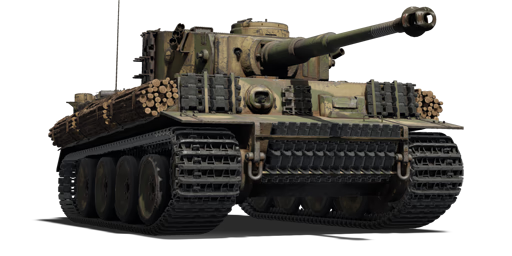
Tiger Ost


The Tiger I, also known as the Pz.Kpfw.VI or Sd.Kfz. 181, was a German heavy tank of the Second World War. It is one of the most famous and, above all, one of the most feared tanks ever built. More than 1,350 tanks were built by Henschel between 1942 and 1944. These were used on the Eastern Front, the Western Front, in Italy, and in Africa.
The Tiger I was first deployed to the Eastern Front on 29 August 1942 at Mga, near Leningrad. Four Tigers were intended for use in the difficult terrain; however, three of the four quickly broke down due to technical defects and had to be recovered in a costly operation. The Tiger I saw its first significant deployment, with 152 units, in the Kursk Pocket. Even there, the Tiger I was notorious and feared by the Russian forces, as they possessed few comparable tanks capable of penetrating the Tiger I with their guns. Instead, anti-tank guns like the ZIS-3 and air attacks posed a potential threat to the Tiger. The Red Army leadership even instructed its tank crews to approach a Tiger I at maximum speed upon encountering it and then disable it from the sides, rear, or at critical points such as the engine block or tracks. Meanwhile, the heavy tank battalions achieved high kill numbers, but the Tiger I’s weaknesses soon resurfaced. Technical defects and problems occurred repeatedly, sometimes leading to Tiger I crews destroying their own tanks as they were abandoning them. Soon, newer Russian tank models like the T-34-85 and the IS-2 appeared, which offered a real chance against the Tiger I and could now penetrate it head-on.
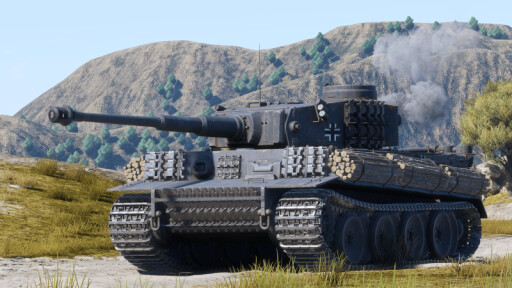
The Tiger Ost was introduced in Update 2.43 “Storm Warning”. It possesses all the capabilities of the Tiger H1: its powerful 88 mm KwK36 L/56 gun, and speed typical for a heavy tank. One disadvantage of the Tiger I is its frontal armour, which is easily penetrated when unangled. The Tiger Ost features bundles of wood on its sides that can absorb some of the impact of shells, thus reducing internal damage to the tank. It also has track gliders on the turret and front hull, similar to those found on the Tiger I and Panzer IV, for additional protection. Further differences from other Tiger models are purely cosmetic: only the decoration on the turret and the cannon are clearly visible.

| Ammunition | Type | Armor penetration (mm) at a distance: | |||||
|---|---|---|---|---|---|---|---|
| 10 m | 100 m | 500 m | 1000 m | 1500 m | 2000 m | ||
| APCBC | 165 | 162 | 151 | 139 | 127 | 117 | |
| HE | 18 | 18 | 17 | 15 | 14 | 13 | |
| APCBC | 153 | 151 | 140 | 128 | 116 | 106 | |
| HEAT | 110 | 110 | 110 | 110 | 110 | 110 | |
| Belt | Belt filling | Armor penetration (mm) at a distance: | |||||
|---|---|---|---|---|---|---|---|
| 10 m | 100 m | 500 m | 1000 m | 1500 m | 2000 m | ||
| AP/AP/AP-T | 13 | 12 | 7 | 3 | 2 | 0 | |


 2 x (85 / 130 / 145) %
2 x 148 %
2 x (85 / 130 / 145) %
2 x 148 %
Mobility | |
|---|---|
Protection |
|---|
Firepower | |
|---|---|