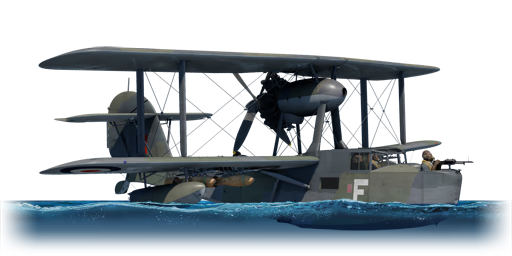
Walrus Mk.I

In the 1930s, the Royal Australian Air Force requested a new spotter aircraft that could be launched from cruisers using a catapult. Supermarine took on the project as a private venture and submitted its Supermarine Seagull V in 1933. The Seagull V resembled the Seagull III, which was developed in the 1920s. In July, the aircraft underwent catapult launch tests on British Navy battleships. Following these tests, the Royal Australian Air Force placed an order for 24 aircraft.
The Australians received the aircraft in 1935, and the Royal Navy Air Service then took an interest in them, placing an order for 12 slightly modified aircraft designated the Walrus Mk.I. Production continued until 1944, with a total of 740 aircraft built. The British used them for reconnaissance, rescue, and anti-submarine missions. They remained in service on ships until 1943, when radars took their role. The British continued to use them until 1947, while other countries, including Argentina, Australia, New Zealand, Canada, Egypt, France, Ireland, and Turkey, continued to use them until 1958.
The Walrus Mk.I was introduced in Update 2.13 "Winged Lions". Unlike many other shipborne hydroplanes the Walrus is relatively heavily armed and equipped with landing gear capable of operating from land airfields and aircraft carrier decks. The aircraft features two turrets with 7.7-mm machine guns that cover the front and rear hemispheres. It is also equipped with four 250-pound bombs, allowing it to be used as a light bomber. However, the aircraft has mediocre flight characteristics and poor maneuverability, which must be considered in combat.

flaps
flaps
flaps
brake
| Belt | Belt filling | Armor penetration (mm) at a distance: | |||||
|---|---|---|---|---|---|---|---|
| 10 m | 100 m | 500 m | 1000 m | 1500 m | 2000 m | ||
| T/Ball/Ball/Ball/AP | 13 | 12 | 7 | 3 | 2 | 0 | |
| T/AP/AP/AP | 13 | 12 | 7 | 3 | 2 | 0 | |
| T/AP-I/AP-I/AP-I | 13 | 12 | 7 | 3 | 2 | 0 | |