
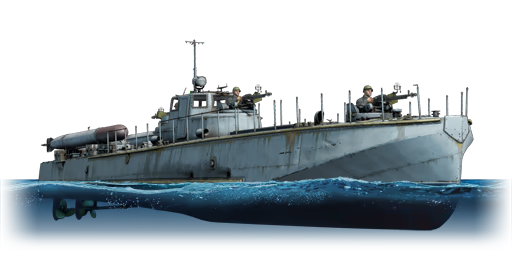
SM-4



In November 1935, the Soviet Navy signed a contract with Plant No. 194 to build G-8-type boats. However, Chief Designer N. S. Nekrasov and his design bureau decided to refine the design by creating a boat with a steel hull instead of a duralumin one. They also replaced the drop-collar torpedo launchers with a better designed system and changed the design of the wheelhouse and hull contours. Essentially, they created a new boat. At the factory, it was designated “Стальной-Морской-4”, or simply the SM-4. Development was delayed until 1939 due to various redesigns and the arrest of nearly all the design bureau members.
Workers managed to finish one boat, which underwent testing in 1940 and reached a speed of 39.5 knots instead of the planned 45. Despite its much more complex design, the SM-4 did not stand out from the existing D-3, which is why further work on the project was discontinued and the built boat was sent back for additional improvements. In August 1941, the boat was transferred to the fleet as TK-124 and soon became TK-164. It was used as a torpedo boat until June 1942, after which it was converted into a subchaser and minelayer. On August 11, 1943, the SM-4 was converted back into a torpedo boat. On November 8, 1944, TK-164 struck a magnetic mine and sank in Petrovskaya Harbor in Tallinn.
The SM-4 was introduced in Update 2.45 "Hornet's Sting". Unlike the D-3, the SM-4 has a steel hull and an additional DShK machine gun; however, it is slower. Its playstyle remains unchanged; the SM-4 is ideal for breaking through to distant capture points and engaging similar boats. However, its machine gun armament is insufficient for fighting larger ships.

| Belt | Belt filling | Armor penetration (mm) at a distance: | |||||
|---|---|---|---|---|---|---|---|
| 10 m | 100 m | 500 m | 1000 m | 1500 m | 2000 m | ||
| AP-I/API-T/IAI | 30 | 29 | 26 | 23 | 20 | 19 | |
| IAI/IAI/IAI/API-T | 29 | 28 | 25 | 22 | 19 | 17 | |
| API-T/AP-I/IAI/AP-I | 30 | 29 | 26 | 23 | 20 | 19 | |
10 × BM-1 small depth charge