
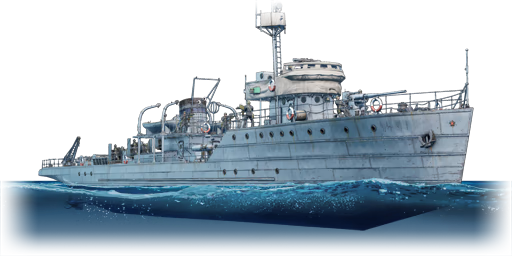
Strela



The Strela was a Soviet Fugas-class minesweeper and a Project 53 subtype. She was laid down at Shipyard No. 190 in Leningrad (finished on factory No. 196) on May 10, 1935. She was launched on May 17, 1936, and commissioned on August 13, 1938. The development of this class of minesweepers began in 1930, and the preliminary sketches were ready by October of that year. The preliminary design was approved on April 25, 1931. By the end of the year, the design had been finalized and approved as "Project 3". However, the technical design was not approved until 1932. The minesweepers were intended to conduct patrols, minesweeping operations and escort ships through hazardous areas. They could also lay mines themselves. The actual design for Project 3 was finished in April 1934. Eight ships were built under Project 3. The first, T-204 "Fugas", entered service on December 10, 1936.
Project 53 followed this design. Development began after the 1933–1938 naval construction program was approved, calling for the construction of 27 Fast Basic Minesweepers. On October 3, 1933, the designers were thus instructed to modify the stern and rudder designs to lighten them, improve access to the inter-hull compartments, and modify the systems, mechanisms, and structure. The first ship in the series was the T-1 Strela, followed by ten more minesweepers of the same class. Unlike many of her sister ships, the Strela had a very uneventful service with the Pacific Fleet, limited to escorting landing forces to Japanese ports in modern North Korea territory in August 1945. Beginning on August 17, the minesweeper served in the Soviet North Korean Maritime Defense Sector. On December 31, 1947, she became part of the 5th Naval Fleet. In December 1953, the Strela was transferred to the DPRK Navy. By February 1954, she had been decommissioned.
The Strela was introduced in Update 2.59 "Sky Odyssey". This Soviet ship boasts a decent 100-mm gun and fairly powerful 37-mm cannons. However, it has only one main gun that can easily be taken out of action. Additionally, despite its large size, the ship has a small crew.

| Ammunition | Type | Armor penetration (mm) at a distance: | |||||
|---|---|---|---|---|---|---|---|
| 100 m | 1000 m | 2000 m | 3000 m | 4000 m | 5000 m | ||
| HE | 27 | 24 | 24 | 24 | 24 | 24 | |
| HE-TF | 27 | 24 | 24 | 24 | 24 | 24 | |
| HE-VT | 27 | 24 | 22 | 19 | 17 | 16 | |
| Belt | Belt filling | Armor penetration (mm) at a distance: | |||||
|---|---|---|---|---|---|---|---|
| 10 m | 100 m | 500 m | 1000 m | 1500 m | 2000 m | ||
| HEF-T/AP-T/HEF-T/HEF-T/AP-T | 79 | 76 | 65 | 56 | 49 | 44 | |
| HEF-T/HEF-T/HEF-T/HEF-T/AP-T | 79 | 76 | 65 | 56 | 49 | 44 | |
| AP-T/AP-T/AP-T/AP-T/HEF-T | 79 | 76 | 65 | 56 | 49 | 44 | |
| Belt | Belt filling | Armor penetration (mm) at a distance: | |||||
|---|---|---|---|---|---|---|---|
| 10 m | 100 m | 500 m | 1000 m | 1500 m | 2000 m | ||
| AP-I/API-T/AP-I/IAI | 30 | 29 | 26 | 23 | 20 | 19 | |


Seakeeping |
|---|
Unsinkability | |
|---|---|
Firepower | ||
|---|---|---|