9K317M "BUK-M3" (TADS)
Basic unit

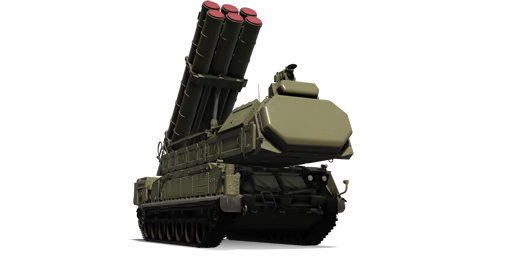


The Buk-M3 is a Russian SAM system, developed as a replacement for the earlier 2K12 Kub SAM family. After experience with the Kub in combat, it was decided that each TEL should have its own fire-control radar instead of relying on a single central radar for the entire system. The Buk was interoperable with the Kub, allowing for easier integration. The Buk-M1 was adopted in 1983 as a modernised version of the initial Buk-1, featuring upgraded ECM resistance, a modernised radar, and an increased probability of kill. In 1998, the Buk-M2 entered service, utilising the new 9M317 missile, which increased range and improved kinematic performance.
In 2016, the Buk-M3 emerged. Unlike previous versions of the Buk such as the Buk-M1 and Buk-M2, the Buk-M3 features a six-missile launcher instead of the previous four, as well as new electronics and missile upgrades, allowing it to be ready to fire faster. The Buk-M3 is the latest version currently in service. The TELARs of the Buk-M3 system also have their own tracking radar and are capable of firing and guiding missiles independently without the radar vehicle, albeit with decreased radar performance. The launchers are capable of carrying six missiles, with additional missiles transported by reload vehicles based on the same chassis. As of today, Russia is the sole operator of the Buk-M3, while other countries such as Algeria, Egypt, Ukraine, and Venezuela operate older versions of the Buk.
Introduced in Update 2.49 "Tusk Force", the Buk-M3 is the newest of the Russian anti-aircraft systems, armed with six 9M317MA missiles and another six ready to be loaded using the ammo crate mechanic. The missiles are very fast, reaching up to 1,550 m/s, with a maximum range of 70 km and strong overload capability, as well as a large warhead. They are equipped with an ARH seeker as well as IOG and datalink, aiding their guidance. Unlike other SAM systems, the Buk is unique in that its launchers are equipped with their own tracking radar, allowing it to function even if the radar vehicle is destroyed. Each TELAR's radar is capable of guiding up to six missiles and has a range of up to 70 km, while offering vertical coverage of up to 60 degrees. However, it does not possess IFF.


| Ammunition | Type | Armor penetration (mm) at a distance: | |||||
|---|---|---|---|---|---|---|---|
| 10 m | 100 m | 500 m | 1000 m | 1500 m | 2000 m | ||
| AAM | — | — | — | — | — | — | |