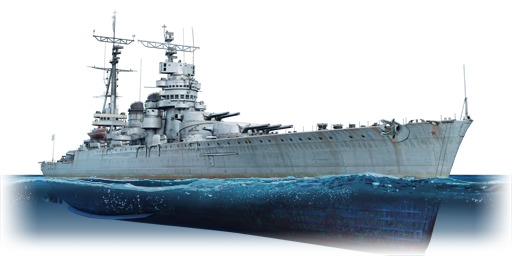
Novorossiysk (Giulio Cesare in the Italian navy) was an Italian battleship of the Conte di Cavour class that was transferred to the Soviet Union after the end of World War II as reparations. It was laid down on June 25, 1910; launched on October 15, 1911; and completed in November 1913. She joined the Royal Italian Navy on June 7, 1914. During World War I, the battleship repeatedly went to sea but did not participate in combat operations. It was only permitted to risk the dreadnoughts in the event of an encounter with enemy battleships. In all other cases, Italy protected its capital ships. From 1933 to 1937, the battleship underwent comprehensive modernization, including the installation of 320mm main-caliber guns, an advanced fire-control system, a new power plant, reinforced armor, and a lengthened hull.
At the beginning of World War II, after Italy entered the war in July 1940, the battleship encountered British ships near Punta Stilo while escorting a convoy. During the battle, the Cesare was hit by a 381-mm shell, causing serious damage. However, the battleship was able to return to Taranto, undergo repairs, and return to service. However, in January 1941, the battleship was damaged in an air raid and was sent in for repairs again. The Cesare went to sea several more times in the summer of 1941 but did not see any action. By August, due to fuel shortages, the battleship was no longer used in combat operations. It made its last combat voyage from January 3 to 5, 1942, after which it was withdrawn from the fleet. In January 1943, the Cesare was transferred to Pola, where it was converted into a floating barracks. After Italy's surrender, it was used for training purposes.
In February 1949, the battleship was transferred to the soviets and relocated to Sevastopol. On March 5, it was renamed Novorossiysk. The ship was in extremely poor condition when transferred to the USSR—it had been laid up from 1943 to 1948 without undergoing the necessary major repairs. However, for political reasons, the ship was forcibly taken to sea for maneuvers in the summer of 1949. Over the next six years, the battleship underwent periodic factory repairs. In May 1955, the Novorossiysk was finally accepted into the fleet and participated in exercises several times that year. On the night of October 28–29, 1955, two explosions of unknown origin rocked the ship, causing it to capsize and sink in Sevastopol Bay. The disaster claimed 617 lives. Preparatory work to raise the ship began in the summer of 1956, and it was not until May 1957 that the battleship was raised and towed to Kazachya Bay, where it was scrapped.
Novorossiysk was introduced Update 2.33 "Air Superiority" in its 1953 state. It boasts a fairly large crew and a very good anti-aircraft battery but suffers from mediocre protection and weak main-caliber damage.