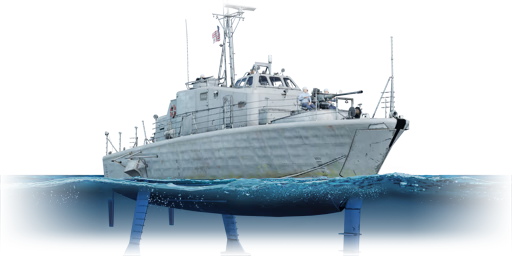
USS Tucumcari (PGH-2) was the second hydrofoil gunboat built for the US Navy. Designed by aircraft manufacturer Boeing, she was laid down on 1 September 1966 in Seattle, launched on 15 July 1967, and commissioned on 7 March 1968. She was unique at the time by using water-jet propulsion instead of propellers. After being stationed at Naval Base Coronado, California, Tucumcari was sent to South Vietnam to conduct anti-convoy raids against North Vietnam. After the Vietnam War, she was sent back home in March 1970 and went on a tour around NATO countries as a technology demonstrator, serving as the basis for the Sparviero-class and PG 02 hydrofoil patrol boats. On 16 November 1972, Tucumcari suffered catastrophic damage after her hydrofoil collided with a coral reef and ran aground off Vieques Island, Puerto Rico. Due to the extent of the damage, the US Navy considered repairing the ship uneconomical, and she was scrapped there in 1973.
USS Tucumcari was introduced in Update 1.79 "Project X". As a hydrofoil gunboat, Tucumcari features high top speed and stability that allows her to comfortably take aim with better accuracy than conventional designs. Her armament is typical of small gunboats, being a single Bofors autocannon and a pair of Browning machine guns, capable of dealing with lighter boats, though the lack of torpedoes means she is incapable of engaging early destroyers that became increasingly common. The main downside of the ship mainly derives from the hydrofoil design; the ship’s control becomes stiffened at high speeds, and the underwater hydrofoil may cause the ship to run aground in certain waterways. In addition, Tucumcari's hull is quite fragile, meaning that she is incapable of taking hits, especially from destroyer-calibre cannons.